AI-ready infrastructure
 Refer and earn


 Ethereum
 Hyperliquid
 Solana
 Arbitrum
 BNB Smart Chain
 Base
Base Polygon
 TRON
TRON Sui
Sui Robinhood


Top 7 Ethereum RPC providers for RWA in 2026

Ethereum is the dominant settlement layer for tokenized real-world assets, securing over $14.9 billion in on-chain RWA value as of early 2026 — more than 60% of the global on-chain RWA market. The sector crossed $26.4 billion total in March 2026, driven by institutional entries from BlackRock (BUIDL at $1.9B AUM), Ondo Finance ($2.7B across tokenized Treasuries and equity products), and Securitize ($3.3B in tokenized assets under administration) — all settled primarily on Ethereum.
What makes RPC infrastructure uniquely critical for RWA protocols is the compliance dimension: a missed event or a dropped NAV update does not just affect user experience — it can affect the legal integrity of the tokenized asset itself. ERC-3643 and ERC-1400 token standards require synchronous identity registry checks via eth_call on every transfer simulation, and eth_getLogs must be polled continuously without missing a single ComplianceCheck or Transfer event across the token contract and identity registry simultaneously.
This guide covers the seven RPC methods central to Ethereum RWA infrastructure, the infrastructure requirements that separate production-grade from development-grade endpoints, and a seven-provider comparison evaluated specifically through the lens of regulated asset workloads.
Already using Chainstack? Jump to the Ethereum tooling docs or deploy your endpoint in minutes.
RWA on Ethereum: RPC requirements
Real-world asset protocols are not typical DeFi workloads. They combine the data throughput of DeFi indexers with the uptime requirements of payment infrastructure and the compliance obligations of regulated financial services. Understanding what this means for your RPC selection starts with the specific methods these protocols call — and how they call them.
Latency requirements
RWA infrastructure is not latency-critical in the way HFT or MEV is, but it is consistency-critical. A tokenized treasury fund polling for oracle updates every 60 seconds can tolerate 200ms response times — but cannot tolerate a 30-second gap where the endpoint is unavailable or rate-limited. Transfer compliance checks via eth_call must complete before a transaction is broadcast, so p99 latency matters as much as median for interactive flows.
The practical threshold: p95 below 500ms for eth_call, under 2 seconds for paginated eth_getLogs across a 5,000-block range. Archive-dependent lookups for audit trail reconstruction are latency-tolerant but must be reliable — a failed debug_traceTransaction during a regulatory review window is not recoverable with a retry.
Throughput requirements
A typical RWA protocol in production generates:
- Continuous
eth_callload — 1 to 5 eligibility checks per user action, plus background polling against the ONCHAINID registry - Periodic
eth_getLogsbursts during settlement and distribution windows - Steady WebSocket subscription traffic for real-time Transfer and ComplianceCheck event monitoring
- Occasional
debug_traceTransactioncalls triggered by compliance workflow or audit reconstruction
This translates to 50–200 RPS on active protocols with burst patterns during settlement cycles. Public shared endpoints with 10–25 RPS caps are inadequate for anything beyond prototyping.
Key RPC methods for Ethereum RWA
These seven methods form the core RPC surface for ERC-3643 and ERC-1400 protocols. Every provider in this comparison is evaluated against their ability to handle this method mix reliably at production scale.
| Method | What it does for RWA | Infrastructure concerns |
|---|---|---|
eth_call |
Checks investor eligibility against ONCHAINID / identity registry before every transfer | Runs pre-broadcast on every transfer attempt; absorbs continuous load — method weighting is expensive on CU platforms |
eth_getLogs |
Indexes Transfer, ComplianceCheck, and OracleUpdate events across token + registry contracts | Public endpoints throttle this aggressively; 5,000-block range limit requires careful pagination and retry logic |
eth_getStorageAt |
Retrieves historical contract state for proof-of-reserve and audit reconstruction | Requires archive node access — not available on full node endpoints |
debug_traceTransaction |
Provides transaction-level execution trace for regulatory audit trails | Debug namespace not available on all provider tiers; requires dedicated or archive-enabled plans |
eth_sendRawTransaction |
Broadcasts compliant token transfers after eligibility verification | Standard on all providers; failover and broadcast reliability matter more than raw speed |
eth_getTransactionReceipt |
Confirms settlement finality and extracts event logs from executed transfers | Latency and reliability critical for downstream settlement logic triggered on confirmation |
eth_subscribe("logs") |
Real-time streaming of contract events via WebSocket | Requires WebSocket endpoint with reconnect support; shared endpoints often cap concurrent subscriptions |
For the full reference of Ethereum RPC methods available through Chainstack, see the Ethereum API reference: JSON-RPC and Beacon quickstart.
Infrastructure requirements
Archive node access is mandatory, not optional. Any RWA protocol performing historical state reconstruction for audits, historical NAV lookups, or regulatory reporting needs archive data. Several providers gate archive access behind premium tiers or charge separately — this must be confirmed at contract time, not at incident time.
Dedicated endpoints for data residency. Many RWA protocols serving regulated investors face data residency requirements. Public shared endpoints route through infrastructure with no data residency guarantees. Dedicated Nodes provide isolated infrastructure with known data flow paths — a prerequisite for jurisdictional compliance in several EU and APAC markets.
WebSocket stability for event subscriptions. eth_subscribe("logs") subscriptions must survive network hiccups without dropping events. Production implementations require WebSocket endpoints with automatic reconnection and a fallback eth_getLogs polling strategy. Providers with instability at the WebSocket layer create compliance gaps — a dropped subscription during a settlement window means missed events with no automatic recovery.
Rate limit predictability over cost minimization. The cost structure for RWA is dominated by eth_call and eth_getLogs. Providers that weight these methods heavily in their CU or credit calculations impose a significant cost premium and, more importantly, unpredictable rate consumption that makes burst capacity planning difficult. Method-agnostic pricing removes this variable from compliance infrastructure planning.
SOC 2 Type II and ISO 27001 certification for vendor due diligence. Regulated asset issuers performing vendor due diligence on infrastructure providers — a standard requirement for funds and licensed platforms — need documented, audit-backed security certifications covering both operational controls and information security management. Self-reported compliance postures are not acceptable for institutional review.
Chainstack for RWA on Ethereum
Chainstack addresses the critical requirements for production RWA infrastructure simultaneously: archive access on every plan, dual SOC 2 Type II (December 2025) and ISO 27001 (July 2026) certification, and method-agnostic pricing where 1 RPC call = 1 request unit for standard reads.
The pricing model is particularly relevant for RWA workloads. Standard eth_call and eth_getBlockByNumber calls cost 1 RU; archive reads and debug_traceTransaction/trace_* calls cost 2 RU regardless of how far back they reach (see current multipliers on request units). eth_getLogs follows the same block-age rule — 1 RU within roughly 127 blocks of the tip, 2 RU for historical ranges. That flat structure removes the cost uncertainty that makes RWA infrastructure budgeting unpredictable on CU-weighted platforms: a protocol running 500,000 compliance checks per month against recent state spends the same RU budget as 500,000 standard block queries.
For regulated RWA deployments, Chainstack provides:
- Dedicated Nodes on paid plans — isolated infrastructure with known data paths for data residency compliance
- Unlimited Node add-on — flat-fee RPS tiers starting at $149/month for 25 RPS up to $3,199/month for 500 RPS, with zero per-request billing, suited to continuous background indexing workloads
- 99.99%+ uptime with contractual SLA
- MEV Protection shipped by default on Ethereum Global Nodes, routing signed transactions to a private block-builder network instead of the public mempool — relevant when an RWA token’s secondary-market liquidity touches AMM pools exposed to front-running
- Dual SOC 2 Type II and ISO 27001 certification, covering security, availability, confidentiality, and a full information security management system
Current plan pricing: Developer free (3M RU/month, 25 RPS); Growth $49/month (20M RU, 250 RPS); Pro $199/month (80M RU, 400 RPS); Business $499/month (200M RU, 600 RPS, includes role-based access control); Enterprise from $990/month (400M+ RU, custom throughput). Annual billing saves up to 16%; see current figures on pricing since tiers are revised over time.
For regulated asset platforms specifically, see blockchain infrastructure for RWA, blockchain infrastructure built for fintech, and stablecoin infrastructure. For institutional deployments requiring contractual SLA and dedicated account management, see enterprise.
Prior Chainstack research on RWA-specific RPC requirements, including ERC-3643 infrastructure patterns and oracle monitoring workflows, is covered in depth at RPC infrastructure for RWA: EVM node requirements.
Code example: indexing ERC-3643 compliance events
The most common RWA infrastructure task is continuously indexing Transfer and ComplianceCheck events across the token contract and ONCHAINID identity registry. Both contracts must be watched together — an indexer watching only the token contract can miss registry updates that affect transfer eligibility:
import { ethers } from "ethers";

const provider = new ethers.JsonRpcProvider("YOUR_CHAINSTACK_ENDPOINT");

// ERC-3643 Transfer and ComplianceCheck event signatures
const TRANSFER_TOPIC = ethers.id("Transfer(address,address,uint256)");
const COMPLIANCE_TOPIC = ethers.id("ComplianceAdded(address,address)");

const RWA_TOKEN_ADDRESS = "YOUR_TOKEN_CONTRACT";
const IDENTITY_REGISTRY = "YOUR_IDENTITY_REGISTRY";

async function indexComplianceEvents(fromBlock, toBlock) {
  const logs = await provider.getLogs({
    address: [RWA_TOKEN_ADDRESS, IDENTITY_REGISTRY],
    topics: [[TRANSFER_TOPIC, COMPLIANCE_TOPIC]],
    fromBlock,
    toBlock,
  });

  for (const log of logs) {
    console.log(`Block ${log.blockNumber}: ${log.topics[0].slice(0, 10)} from ${log.address}`);
  }
}

indexComplianceEvents("earliest", "latest");
The Ethereum tooling documentation includes full SDK examples for Hardhat, Foundry, ethers.js, viem, and web3.py.
Provider comparison
Comparison table
The table below summarizes public positioning as of August 2026. Ankr and dRPC, both meaningful Ethereum providers in general, are left out of this specific comparison — neither publishes a compliance certification suited to RWA vendor due diligence, which is the deciding criterion for this use case rather than raw chain coverage.
| Provider | Pricing model | Free tier | Dedicated nodes | Archive & trace | Why it matters for RWA |
|---|---|---|---|---|---|
| Chainstack | Method-agnostic (1 RU standard, 2 RU archive/trace) | 3M RU/month, 25 RPS, no card required | Yes (paid plans) | Yes, all plans | Dual SOC 2 Type II + ISO 27001, flat pricing, and MEV Protection by default eliminate cost uncertainty and vendor risk for regulated workloads |
| RouteMesh | Per-request, tiered by routing class ($3–6/1M requests) | Free public community endpoint | No (routing layer) | Depends on the upstream node it routes to | Automatic failover across 21 underlying Ethereum providers reduces the single-endpoint downtime risk RWA compliance polling can’t tolerate |
| Uniblock | Usage-based across pooled providers (confirm current rates) | Free developer tier available | No (Direct Provider APIs pass through to dedicated backends) | Depends on the upstream provider routed to | Webhooks for contract-level event delivery cut reliance on constant eth_getLogs polling for Transfer and ComplianceCheck events |
| Blockdaemon | Custom enterprise pricing | Not published | Yes, node clusters with automated failover | Not publicly detailed for Ethereum — confirm per contract | SOC 2 + ISO 27001 institutional stack serving 400+ regulated institutions — the closest match to Chainstack’s own certification story among non-direct providers |
| Infura | Credit-based, method-weighted | Limited credits/day | Enterprise only | Yes (add-on) | Ethereum-native with ConsenSys institutional credentials; archive gated behind add-on |
| Alchemy | CU-weighted (26 CU/eth_call) |
30M CUs/month | No (private endpoints) | Yes, paid tiers | Strong developer tooling; CU weighting inflates cost for compliance-heavy eth_call workloads |
| Quicknode | Credit-weighted by method | 1-month trial only | Dedicated clusters | Yes, all tiers | SOC 2 Type II + ISO 27001 — the strongest published compliance stack among direct competitors; full archive and trace on all tiers |
Chainstack
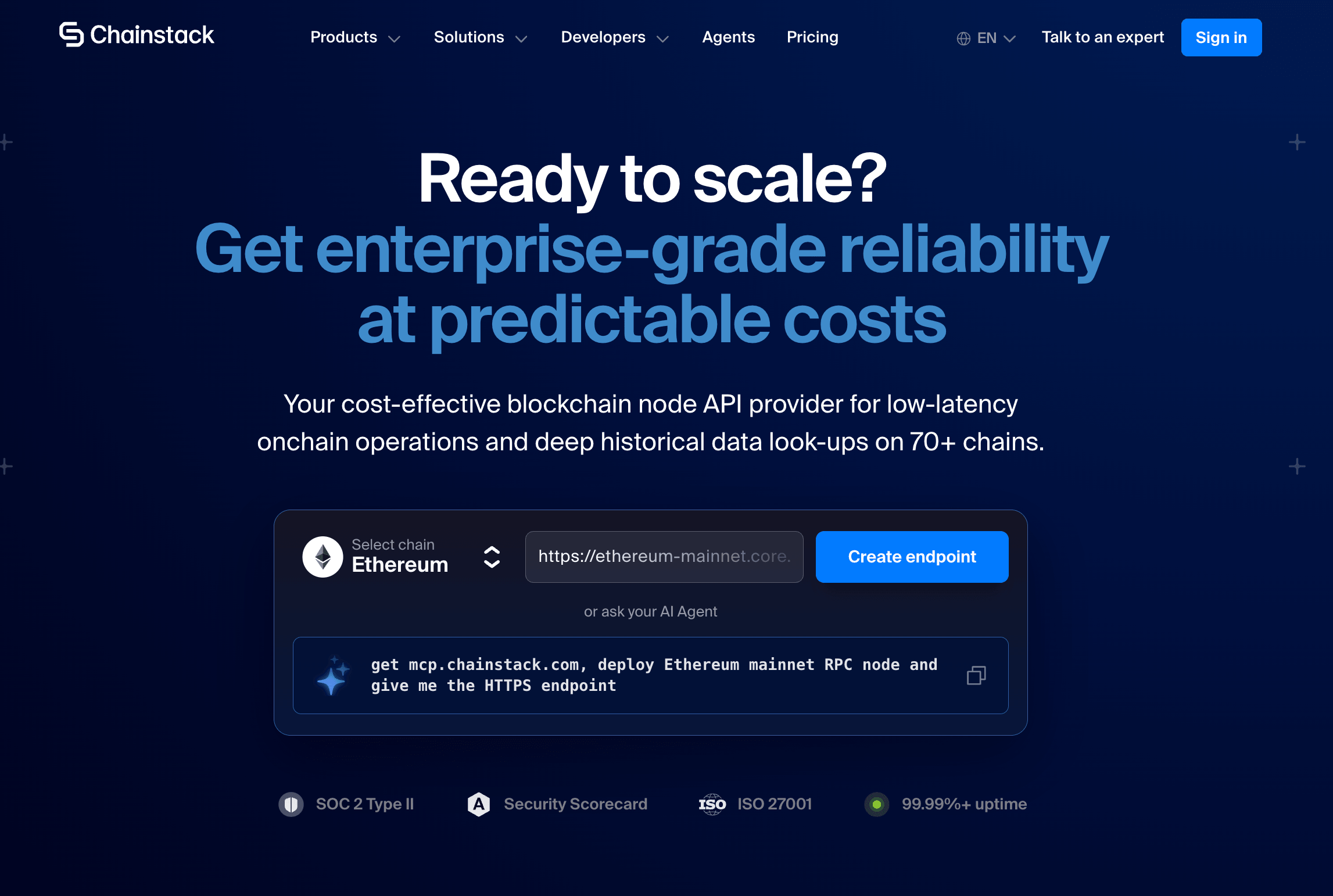
Chainstack’s position for RWA infrastructure combines dual SOC 2 Type II and ISO 27001 certification, method-agnostic pricing, and Dedicated Nodes with contractual SLA — the requirements that appear most consistently on institutional vendor due diligence checklists. For teams building ERC-3643 or ERC-1400 protocols, the absence of method weighting means 10,000 eth_call compliance checks against recent state cost exactly the same as 10,000 eth_getBlockByNumber calls, removing cost modeling complexity from compliance infrastructure planning.
Global Nodes provide geo-balanced shared infrastructure across multiple regions with 99.99%+ uptime, appropriate for teams at early to mid-scale. Paid plans unlock Dedicated Nodes for infrastructure isolation and predictable throughput. The Unlimited Node add-on converts billing entirely to a flat monthly fee across 25–500 RPS tiers — the right model for RWA protocols running continuous background compliance polling and event indexing that generate high but predictable request volume. Archive and debug/trace access are included on all tiers, billed at the standard 2 RU rate rather than gated behind a separate add-on.
Limitations: The free tier caps at 25 RPS, insufficient for production-scale continuous compliance polling. Enterprise SLA and dedicated account management require the $990/month Enterprise plan.
Fit by workload:
- RWA compliance (ERC-3643/ERC-1400): Excellent — method-agnostic pricing, archive on all tiers, dual certification, and Dedicated Nodes make this the top choice for compliance-critical workloads
- Archive and audit trail access: Excellent —
debug_traceTransactionand full archive available on all plans at the standard 2 RU rate - Enterprise / regulated deployments: Excellent — contractual SLA, isolated Dedicated Nodes, and dual audit reports meet institutional due diligence requirements that a single certification often doesn’t satisfy on its own
RouteMesh
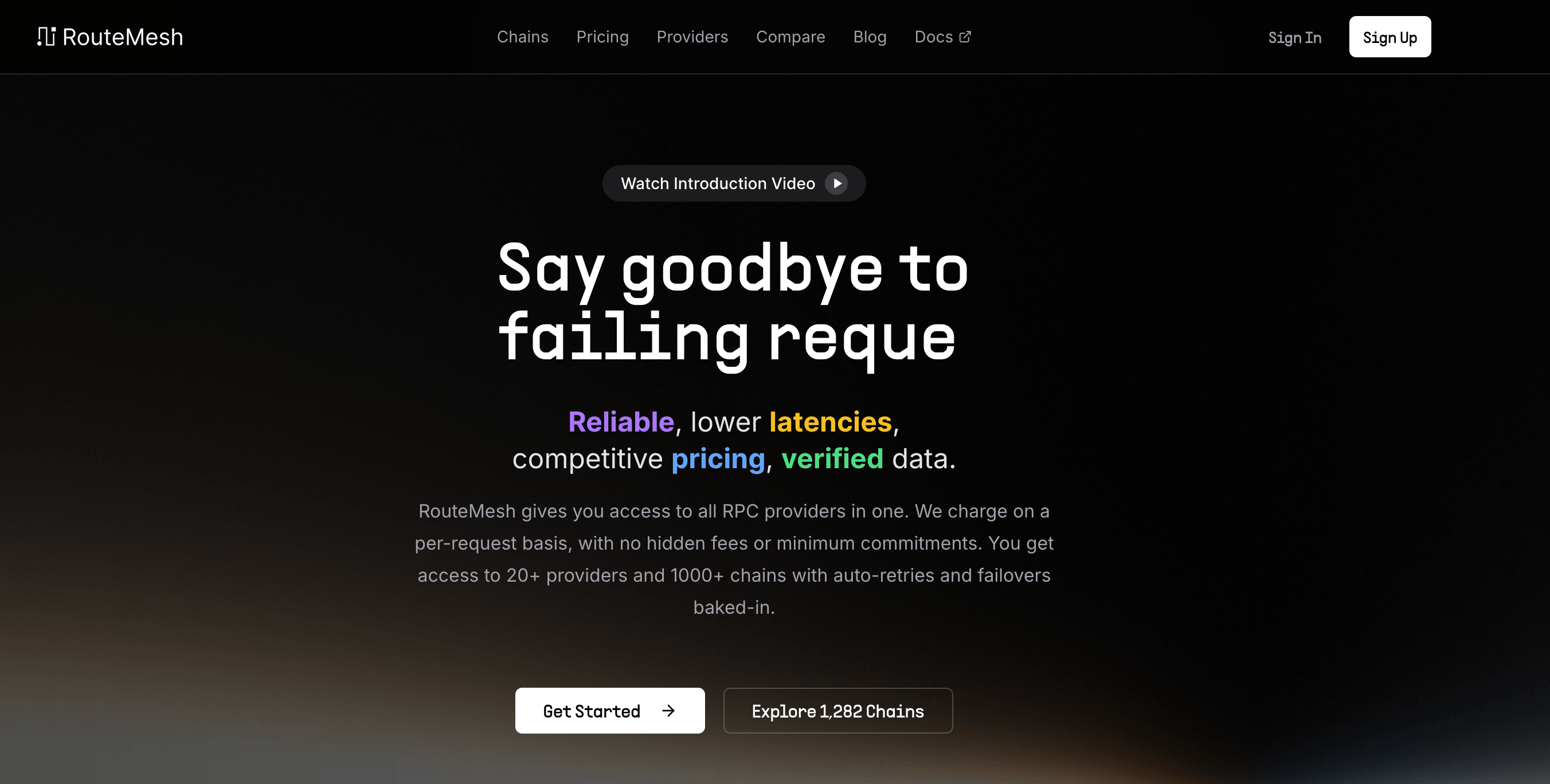
RouteMesh is an intelligent RPC routing layer covering 1,000+ EVM networks, aggregating 21 underlying Ethereum providers behind a single endpoint with real-time health scoring and automatic failover between them. Published latency data shows eth_call at 18ms median on its community tier and 21ms on premium routing, with pricing at $3 per million requests standard and $6 per million for premium routing. Customers include LI.FI (routing 97% of its EVM RPC calls through RouteMesh across 60+ chains), Vaults.fyi, and DAMM Capital.
For RWA infrastructure specifically, the value is availability rather than raw speed: the introduction section above notes that a tokenized treasury protocol can tolerate 200ms response times but not a 30-second endpoint outage. RouteMesh’s routing across multiple upstream providers means a single provider incident doesn’t take the endpoint down — traffic reroutes automatically to a healthy backend. It is a routing and monitoring layer rather than a node operator, so archive depth, trace availability, and compliance certifications depend on which underlying provider a given request lands on, not on RouteMesh itself.
Limitations: RouteMesh doesn’t operate its own dedicated Ethereum infrastructure or publish its own compliance certification — teams needing a single attestable vendor for audit purposes will still need to evaluate the underlying providers it routes to. Archive and trace support varies by which backend serves a given request.
Fit by workload:
- RWA compliance (ERC-3643/ERC-1400): Good — the failover model directly reduces gap risk during compliance polling, though it adds a routing hop between the app and the node that actually holds compliance certification
- Archive and audit trail access: Moderate — depends entirely on the underlying provider a request routes to at that moment
- Enterprise / regulated deployments: Limited — no published SOC 2 or ISO 27001 of its own; institutional buyers will need to pair it with a certified upstream provider for the compliance story
Uniblock
Uniblock is a managed multi-chain infrastructure layer spanning 300+ blockchains through 55+ underlying RPC providers, with three product tiers: Unified JSON-RPC for raw chain access, Unified APIs for higher-level token/NFT/market data, and Direct Provider APIs for pass-through access to specific backends. Ethereum sits among its core supported networks. Notably, one of its customers — Plume Network — is itself an RWA-focused chain, alongside Stellar, Hypernative, and Oku Trade, across a base of 4,000+ developers.
The webhooks product is the most directly relevant piece for RWA compliance monitoring: event-driven delivery for contract activity means a compliance system doesn’t have to run its own continuous eth_getLogs polling loop to catch Transfer and ComplianceCheck events — Uniblock pushes the notification instead. Pooling requests across 55+ providers also gives some rate-limit headroom for teams running high-volume eligibility checks that would otherwise bump against a single provider’s cap.
Limitations: Uniblock doesn’t publish per-method pricing or a specific compliance certification for its own infrastructure layer — teams should confirm current rates and, for regulated deployments, the certification status of whichever underlying provider ends up serving Ethereum traffic.
Fit by workload:
- RWA compliance (ERC-3643/ERC-1400): Good — webhook delivery for compliance events is a genuine fit; pricing and archive depth depend on the underlying provider mix
- Archive and audit trail access: Moderate — routed through Direct Provider APIs to whichever backend supports it
- Enterprise / regulated deployments: Limited — no independently published SOC 2 or ISO 27001; suitable as a complement to a certified provider rather than a standalone compliance vendor
Blockdaemon
Blockdaemon is institutional blockchain infrastructure built for custody, staking, tokenization, and node operation in one bundle, serving 400+ institutions including banks, asset managers, and exchanges across $110B+ in secured assets. Ethereum RPC access runs through production node clusters with automated scaling and failover, positioned explicitly for regulated buyers rather than individual developers.
For RWA specifically, Blockdaemon’s certification stack — SOC 2 and ISO 27001, alongside OFAC/sanctions-list compliance — gives institutional issuers the audit-backed posture their procurement teams expect. The tradeoff is procurement friction: pricing is custom and enterprise-only, with no published free tier or self-serve sign-up, which fits Blockdaemon’s institutional buyer but rules it out for teams that want to prototype before a sales conversation.
Limitations: No self-serve tier and no published pricing means evaluating Blockdaemon requires a sales cycle before any code gets written. Archive depth and trace method availability for Ethereum specifically aren’t detailed publicly — confirm directly for compliance-heavy audit workloads.
Fit by workload:
- RWA compliance (ERC-3643/ERC-1400): Strong — the compliance and custody bundle matches what a regulated issuer’s procurement team is already looking for, once the sales process clears
- Archive and audit trail access: Moderate — dedicated node clusters support it, but per-chain archive depth for Ethereum isn’t published
- Enterprise / regulated deployments: Excellent — this is Blockdaemon’s core buyer; 400+ institutional customers and a dual-certification stack built specifically for this audience
Infura
Infura is the most established Ethereum-native provider, operating as ConsenSys‘ infrastructure layer and the default RPC for MetaMask. For teams with existing ConsenSys ecosystem relationships, or building wallets and dApps targeting MetaMask’s user base, Infura offers depth of Ethereum protocol integration and institutional familiarity that carries weight in vendor selection discussions with regulated platforms.
Archive access is available but treated as an add-on rather than included in standard plans. eth_getLogs with deep historical range and debug_traceTransaction both require archive-enabled endpoints. Credit-based pricing is method-weighted, with eth_getLogs costing substantially more credits than simpler reads. Infura’s compliance posture is anchored in ConsenSys’ SOC 2 Type II report; teams should confirm current ISO 27001 scope directly with Infura before citing it in a procurement document, since it isn’t published with the same clarity as its SOC 2 status. The Enterprise plan provides dedicated infrastructure, a contractual SLA, and 24/7 engineering support.
Limitations: Archive access is a paid add-on, not a default — this adds procurement friction for RWA protocols that need archive data from launch. Standard plans do not include a contractual SLA.
Fit by workload:
- RWA compliance (ERC-3643/ERC-1400): Strong — reliable WebSocket support and deep Ethereum protocol expertise; archive as an add-on requires explicit provisioning ahead of launch
- Archive and audit trail access: Good — available via add-on; debug/trace on archive-enabled endpoints
- Enterprise / regulated deployments: Strong — Enterprise plan offers dedicated infrastructure, SLA, and ConsenSys institutional credentials recognized in traditional finance contexts
Alchemy
Alchemy is the strongest option for Ethereum developer tooling, with a mature SDK ecosystem, Notify webhooks for event delivery, and a free tier at 30M CUs per month with no time limit. The Transact API adds reliability guarantees for transaction broadcast, and the webhook infrastructure reduces reliance on polling eth_getLogs for event-driven workflows.
The CU structure needs careful evaluation for production RWA workloads: eth_call currently costs 26 CU per request. An RWA protocol running 100,000 compliance checks daily consumes 2.6M CUs per day — roughly 87% of the entire monthly free tier in a single day at that rate. Alchemy publishes SOC 2 Type II certification but does not publish ISO 27001 — a distinction worth checking directly if a compliance team specifically requires both. Alchemy does not offer dedicated nodes in the traditional sense; infrastructure isolation runs through private endpoints, which don’t provide guaranteed throughput under load the way a dedicated cluster does.
Limitations: CU weighting makes Alchemy expensive at scale for eth_call-heavy compliance workloads. No dedicated nodes means no guaranteed throughput isolation for production RWA protocols during busy settlement windows.
Fit by workload:
- RWA compliance (ERC-3643/ERC-1400): Good — solid reliability and archive access on paid tiers; CU weighting creates cost unpredictability at scale
- Archive and audit trail access: Good — archive and trace available on paid tiers, not by default
- Enterprise / regulated deployments: Moderate — SOC 2 Type II only; no dedicated nodes and no standard contractual SLA below Enterprise tier
Quicknode

Quicknode carries the most extensive published compliance posture of any direct competitor in this comparison: SOC 2 Type II and ISO 27001. For RWA protocols subject to regulatory audit, where vendor attestation must be presented to compliance officers, that certification stack is straightforward to cite. All plans include full archive access and trace/debug methods with no gating, and dedicated clusters are available for teams needing isolated throughput.
Current plans run from Build ($49/month) through Accelerate ($249/month), Scale ($499/month), and Business ($999/month) up to custom Business+ and Enterprise tiers — pricier at every step than Chainstack’s equivalent tier. There’s no permanent free plan; new accounts get a one-month free trial (10M credits, 15 RPS) before it converts to a paid subscription. Credit-weighted pricing for eth_call and eth_getLogs increases effective cost for compliance-heavy workloads relative to method-agnostic pricing — teams evaluating Quicknode for continuous compliance polling should model their specific method mix against a cost comparison before committing to a tier.
Limitations: No permanent free tier — only a one-month trial. Credit-weighted pricing for eth_call-heavy RWA compliance workloads means the effective cost per check climbs faster than the sticker price suggests.
Fit by workload:
- RWA compliance (ERC-3643/ERC-1400): Excellent — strongest compliance certification stack among direct competitors; full archive and trace on all plans
- Archive and audit trail access: Excellent — all plans include debug, trace, and full archive without restriction
- Enterprise / regulated deployments: Excellent — SOC 2 Type II + ISO 27001 provides broad vendor attestation for institutional due diligence, at a higher list price than Chainstack’s equivalent tier
Real-world performance benchmark
Ethereum is tracked on the Chainstack performance dashboard, which measures method-level latency across providers and regions including EU, US West, and Asia-Pacific. For RWA infrastructure specifically, the most diagnostic metrics are eth_call response time — your compliance check latency floor — and eth_getLogs query time under realistic block ranges of 1,000–5,000 blocks. compare.chainstack.com gives a faster top-level read if you just want a current ranking rather than a per-method breakdown.
Before committing to a provider, benchmark from your actual deployment region rather than relying on aggregated averages. p95 and p99 latency are more relevant than median for compliance-critical workflows where a single slow response blocks a transfer.
⚡ Benchmark before you commit: Run a curl timing loop or a short k6 script against each provider’s endpoint from your target region before finalizing your infrastructure choice — even a 100-request sample surfaces meaningful p95 differences for
eth_callandeth_getLogs.
Getting started with RWA on Chainstack
Deploy a production Ethereum endpoint for RWA infrastructure in a few steps and build better with Ethereum on Chainstack:
- Log in to the Chainstack console (or create an account).
- Create a new project
- Select Ethereum as your blockchain protocol
- Choose network: Ethereum Mainnet or Sepolia / Hoodi testnet
- Deploy the node
- Open Access and credentials and copy your HTTPS and WebSocket endpoints
For continuous background indexing workloads — the standard pattern for RWA event monitoring — evaluate Dedicated Nodes or the Unlimited Node add-on after the initial deploy to eliminate per-request billing entirely; both are available inside the same project.
Here is a minimal compliance eligibility check using eth_call via web3.py, the pattern that runs on every investor transfer attempt in an ERC-3643 protocol:
from web3 import Web3

w3 = Web3(Web3.HTTPProvider("YOUR_CHAINSTACK_ENDPOINT"))

# Minimal ABI for ERC-3643 identity registry isVerified()
IDENTITY_REGISTRY_ABI = [
    {
        "inputs": [{"type": "address", "name": "userAddress"}],
        "name": "isVerified",
        "outputs": [{"type": "bool"}],
        "stateMutability": "view",
        "type": "function",
    }
]

IDENTITY_REGISTRY_ADDRESS = w3.to_checksum_address("YOUR_IDENTITY_REGISTRY")
registry = w3.eth.contract(address=IDENTITY_REGISTRY_ADDRESS, abi=IDENTITY_REGISTRY_ABI)

def check_investor_eligibility(investor_address: str) -> bool:
    return registry.functions.isVerified(
        w3.to_checksum_address(investor_address)
    ).call()

print(check_investor_eligibility("YOUR_WALLET_ADDRESS"))
📖 For the full integration guide, see the Chainstack Ethereum tooling documentation.
Need testnet ETH? Grab some from the Chainstack Sepolia faucet.
🤖 You can also access Chainstack Ethereum RPC directly from Claude, Cursor, Codex, Windsurf, Gemini CLI, GitHub Copilot, Antigravity, Claude.ai, or ChatGPT using Chainstack MCP. For a fuller agent stack — MCP, the Chainstack skill, llms.txt for context ingestion, and WebMCP for agentic browsers — see the Chainstack Agents page.
Conclusion
Provider selection for Ethereum RWA in 2026 is primarily a compliance question, not a performance question. Archive access defaults, published certification depth, pricing predictability for eth_call-heavy compliance workflows, and dedicated infrastructure isolation separate the providers here more than raw latency does.
- For compliance-critical RWA with institutional due diligence requirements: Chainstack — dual SOC 2 Type II + ISO 27001, method-agnostic pricing, archive on all plans, MEV Protection by default
- For teams that want managed failover across many upstream Ethereum providers: RouteMesh — automatic rerouting reduces single-endpoint downtime risk during compliance polling
- For teams wanting webhook-driven compliance event delivery alongside raw RPC: Uniblock — pooled provider access plus contract-event webhooks
- For institutional issuers already evaluating custody or staking vendors: Blockdaemon — bundles compliance-grade nodes with custody and tokenization services
- For established Ethereum-native deployments with ConsenSys ecosystem ties: Infura — deepest Ethereum protocol familiarity, archive available as an add-on
- For developer-centric RWA dApps at early stage: Alchemy — generous free tier and Ethereum tooling depth; CU weighting becomes a constraint at scale
- For teams that specifically need ISO 27001 alongside SOC 2 from a direct competitor: Quicknode — strongest published compliance stack among direct competitors, at a higher list price
Frequently asked questions
Q: What RPC methods do ERC-3643 RWA protocols call most frequently on Ethereum?
The most frequent methods are eth_call for eligibility checks against the ONCHAINID identity registry on every transfer simulation, eth_getLogs for indexing Transfer and ComplianceCheck events across both the token contract and the identity registry, and eth_subscribe("logs") for real-time event streaming. Archive methods — eth_getStorageAt and debug_traceTransaction — run less frequently but are essential for audit trail reconstruction.
Q: Which Ethereum RPC provider is best for prototyping an RWA compliance workflow before committing to a paid plan?
Chainstack and Alchemy both offer permanent free tiers with no time limit — Chainstack at 3M RU/month with no card required, Alchemy at 30M CUs/month. Quicknode’s entry offering is a one-month trial that converts to a paid plan afterward, not a standalone free tier. RouteMesh and Uniblock both expose lower-friction pooled access for early testing, though neither publishes the compliance certification a production RWA deployment will eventually need.
Q: How do I migrate an existing RWA protocol from Infura or Alchemy to a method-agnostic provider without downtime?
Deploy the new endpoint alongside the existing one, point a canary percentage of traffic at it, and compare eth_call and eth_getLogs responses against your current provider before cutting over fully. Because Chainstack, Infura, and Alchemy all expose standard JSON-RPC, the application code doesn’t need to change — only the endpoint URL and any provider-specific rate-limit handling. Keep the old endpoint live until the new one has run a full settlement cycle without a compliance event gap.
Q: What RPC latency does a production Ethereum RWA protocol need?
RWA infrastructure is consistency-critical rather than ultra-low-latency. A p95 below 500ms for eth_call and under 2 seconds for paginated eth_getLogs across a 5,000-block range is sufficient for most protocols. More important than median latency is the absence of rate-limit interruptions during compliance polling and settlement windows. Benchmark from your deployment region using the Chainstack performance dashboard before committing.
Q: Which providers have published certifications relevant to RWA vendor due diligence?
Chainstack holds both SOC 2 Type II (December 2025) and ISO 27001 (July 2026). Quicknode and Blockdaemon also publish both SOC 2 Type II and ISO 27001. Alchemy publishes SOC 2 Type II only — not ISO 27001. Infura’s compliance posture runs through ConsenSys’ SOC 2 Type II; confirm current ISO 27001 scope directly. RouteMesh and Uniblock, as routing/aggregation layers, don’t publish certifications of their own — the certification that matters is whichever underlying provider ultimately serves the request.
Q: How much more does method-weighted pricing cost for RWA compliance workloads?
eth_call costs 26 CU on Alchemy versus 1 RU on Chainstack for the same recent-state read. A protocol running 500,000 compliance checks per month against recent state pays roughly $0.50 in RUs on Chainstack against a meaningfully larger CU draw on Alchemy at list rates, on this method alone. Total cost impact depends on your full method mix — run your own numbers through the cost comparison rather than assuming a flat multiplier applies to every method.
Additional resources
- How to get an Ethereum RPC endpoint in 2026
- Ethereum tooling documentation — Chainstack Docs
- Ethereum methods — Chainstack Docs
- Enable Debug & Trace APIs for your Ethereum node — Chainstack Docs
- Blockchain infrastructure for RWA
- RPC infrastructure for RWA: EVM node requirements
- More Ethereum tutorials and articles on the Chainstack Blog
- Chainstack pricing