AI-ready infrastructure
 Refer and earn


 Ethereum
 Hyperliquid
 Solana
 Arbitrum
 BNB Smart Chain
 Base
Base Polygon
 TRON
TRON Sui
Sui Robinhood


Top 7 Polygon RPC providers for fintech and payments in 2026

Polygon is an Ethereum-compatible proof-of-stake network built for high-throughput, low-cost transactions, and in 2026 it has become one of the default settlement rails for stablecoin payments. Visa’s stablecoin settlement pilot hit a $7 billion annualized run rate in April 2026, and Polygon carried 54% of all USDC transfers that same month — more than every other chain combined.
The constraint that makes RPC provider choice matter this year specifically is Polygon’s own infrastructure change: in May 2026 the network cut its block time to 1.75 seconds, its first block-time reduction since genesis, pushing theoretical throughput past 3,200 TPS. A payment confirmation API polling on a fixed timer built for the old 2-second cadence now either lags behind real settlement speed or over-polls and burns through its request budget faster than expected.
This guide compares the top seven Polygon RPC providers and partners for fintech and payment workloads — stablecoin payout APIs, cross-border settlement, and compliance/audit infrastructure — on latency, archive and trace access, compliance certification, and cost predictability.
💡 Already using Chainstack? Jump straight to the Polygon tooling docs or deploy your endpoint in minutes.
Fintech and payments on Polygon: RPC requirements
Payment infrastructure tolerates less variability than most blockchain workloads. A DeFi swap can absorb a slow eth_call; a payment confirmation API polling on a schedule built around Polygon’s block time cannot — a latency spike there shows up directly as a delayed merchant confirmation or a stalled payout.
Latency requirements
- Transaction submission (
eth_sendRawTransaction): should complete well under 100ms — delays here push straight through to customer-facing checkout or payout confirmation. - Confirmation polling (
eth_getTransactionReceipt): called repeatedly until a transaction is mined. With Polygon’s 1.75-second block time, polling intervals of 500ms–1s are standard, and tail latency (p99) on this method degrades perceived settlement speed more than the average does. - Balance and allowance checks (
eth_call): called before submission and during checkout flows, contributing directly to pre-authorization response time.
Geographic proximity matters more than a headline benchmark number: an endpoint averaging 10ms from a US West Coast datacenter is no advantage to a team running payment infrastructure out of Frankfurt. Test from your actual deployment region.
Throughput requirements
Fintech payment infrastructure, from RPC endpoints to merchant payment APIs such as NOWPayments, generates sustained, not spiky, loads:
- Receipt polling — tens to hundreds of concurrent requests per second during settlement windows, higher during batch payroll or merchant reconciliation runs.
- Balance and contract reads (
eth_call) — parallel calls during checkout spikes. - Event log scanning (
eth_getLogs) — wide block ranges during scheduled reconciliation sweeps; a single reconciliation job can scan tens of thousands of blocks in one burst. - WebSocket subscriptions (
eth_subscribe) — persistent connections monitoringTransferevents across multiple token contracts at once.
If your platform runs scheduled settlement batches, validate that a provider handles the jump from low-traffic baseline to burst without rate-limiting the first wave of requests.
Key RPC methods for Polygon fintech
| Method | Role in fintech | Watch for |
|---|---|---|
eth_sendRawTransaction | Submit signed payment transactions | Latency under load; mempool sync lag |
eth_getTransactionReceipt | Confirm transaction finality | Polled repeatedly per payment — p99 latency matters most |
eth_getTransactionByHash | Retrieve transaction details for audit or display | Usually fast; issues arise on pre-archive-depth lookups |
eth_getLogs | Scan ERC-20 Transfer events for reconciliation | Block-range caps vary by provider; recent blocks need no archive |
eth_call | Balance checks, allowance queries, dry-run before sending | Counts against credit/RU budgets — check per-method cost |
eth_getBalance | Native POL balance checks | Low-cost on flat-RU providers |
debug_traceTransaction | Compliance audit trails, transaction tracing | Requires archive; Polygon’s Bor client doesn’t support Parity’s trace_* namespace, so debug_* is the method to use |
⚠️ Archive node note: Standard confirmation flows —
eth_getTransactionReceipt,eth_getLogsover recent blocks,eth_getTransactionByHashfor recent transactions — run on full nodes and need no archive access. Archive is required specifically fordebug_traceTransactionand anyeth_calloreth_getBalancequery naming a historical block number instead of"latest". Compliance teams building long-horizon audit trails typically need archive and debug together.
⚠️ Benchmark before you commit: No public real-time dashboard currently tracks Polygon RPC providers across regions the way it does for a handful of other chains. Run your own latency test from your target deployment region before committing — a curl loop or k6 script hitting
eth_blockNumberand one heavier method (eth_getLogs, oreth_callat a past block) is enough to surface meaningful p95/p99 differences at your actual call volumes.
Provider comparison for fintech and payments on Polygon
The table below summarizes public positioning as of August 2026.
| Provider | Pricing model | Free tier | Dedicated nodes | Archive & trace | Why it matters for fintech & payments |
|---|---|---|---|---|---|
| Chainstack | RU-based (flat 1 RU/call) | 3M RU/mo, 25 RPS, no card | Yes | Yes (2 RU/req) | Unlimited Node add-on caps polling-heavy bills; SOC 2 Type II and ISO 27001 |
| RouteMesh | Per-request (pooled routing) | Yes (free community endpoint) | No (routing layer) | Via underlying providers | Sub-10ms multi-provider failover across Polygon and 1000+ EVM networks (Chainstack among the routed providers) |
| Uniblock | Per-request (pooled) | Yes | No (aggregation layer) | Via underlying providers | Unified APIs (webhooks, token data) cut build time for payment notification and reconciliation systems |
| Ankr | API credit | 200M credits/mo | No | Yes (premium tier) | Generous free tier; compliance certification not clearly published |
| dRPC | Flat per 1M requests | Public nodes (no SLA) | Not documented | Yes | Cheapest standard-call pricing; compliance documentation thin for regulated use |
| Alchemy | CU-based (~27 CU avg/request) | 30M CU/mo | No standard dedicated | Yes | Strong multi-chain tooling; no isolation for settlement-window traffic |
| Quicknode | Credit-based | 1-month free trial | Yes | Yes | SOC 2 Type II and ISO 27001; credit model complicates cost forecasting |
⚠️ Note: Quicknode is the only provider here without a permanent free tier — its offering is explicitly a time-limited trial. Chainstack, RouteMesh, Uniblock, and Alchemy all provide standing free allowances, though Alchemy’s 30M CU/month cap runs tight relative to typical fintech polling volume.
Chainstack
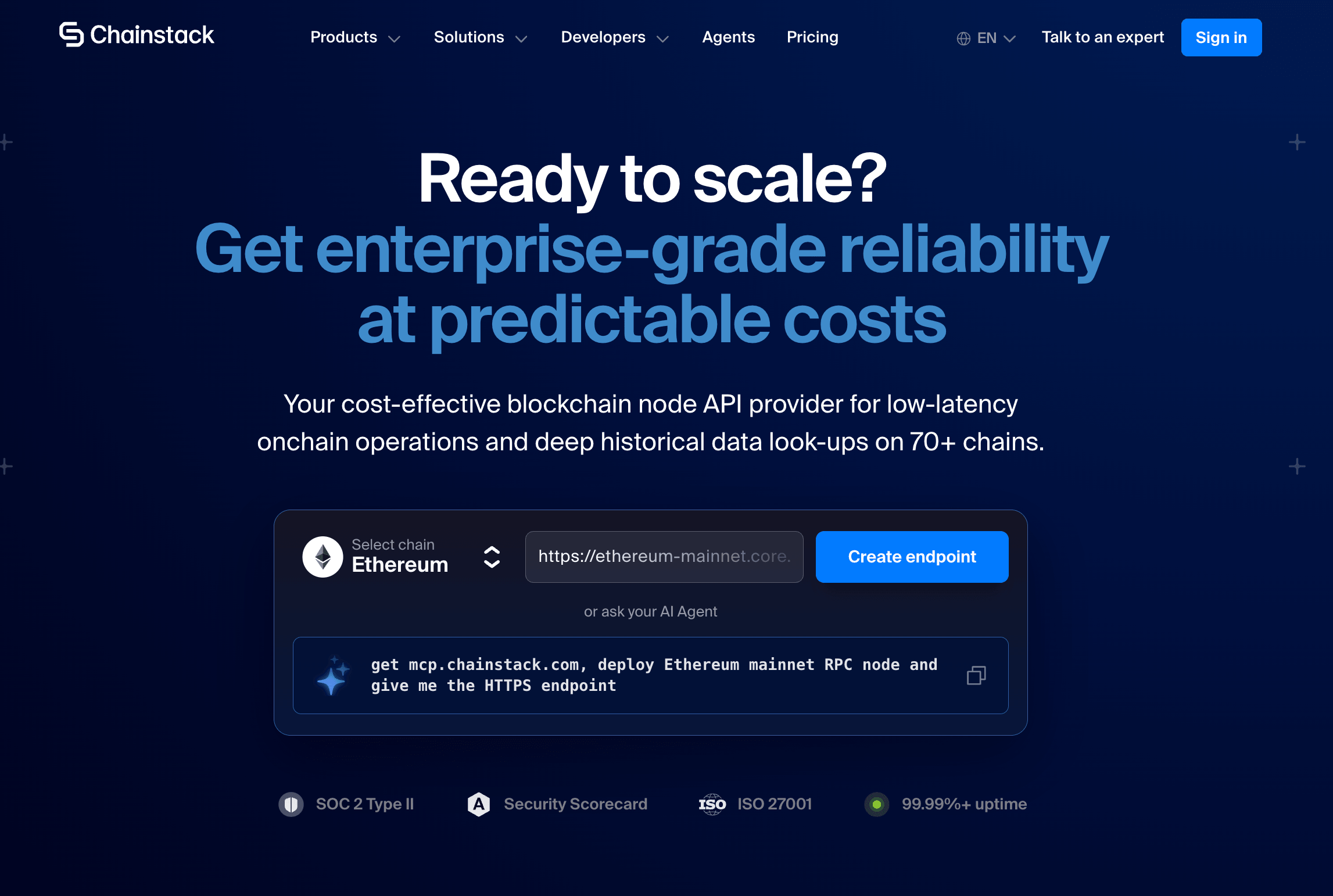
Chainstack runs Polygon RPC infrastructure across Polygon PoS mainnet and Amoy testnet, via Global Nodes and Dedicated Nodes, with flat 1-RU-per-call billing and a permanent free Developer plan (3M RU/month, 25 RPS, no card required). Global Nodes route geographically across US, EU, and APAC regions, which matters directly for payment platforms operating in more than one geography.
For polling-heavy payment workloads specifically, the Unlimited Node add-on converts the thousands of hourly eth_getTransactionReceipt polls a settlement API generates into flat-rate RPS capacity instead of per-request billing — 25 RPS at $149/month up to 500 RPS at $3,199/month. Dedicated Nodes with Bolt fast-sync add isolated throughput for settlement windows that can’t share capacity with other tenants, and archive access (2 RU per request versus 1 RU standard) plus the full debug_* namespace cover compliance audit trails — Polygon’s Bor client doesn’t support Parity’s trace_* namespace, so debug_* is what teams should reach for.
SOC 2 Type II and ISO 27001 certification, a contractual uptime SLA on paid plans, and Self-Hosted support for Polygon mainnet (Bor + Heimdall client stack, for teams that need nodes inside their own environment) round out the compliance and deployment-flexibility picture. One honest gap: MEV protection is on by default for Ethereum and BNB Smart Chain — not yet Polygon — though this matters far less for payment settlement than it does for DEX trading. Chainstack’s fintech infrastructure and stablecoin infrastructure pages name Circle, Ripple, Trust Wallet, and Rabobank among production clients.
Limitations: Archive queries bill at 2 RU instead of 1, doubling effective cost for compliance workloads heavy on historical trace queries. Dedicated Nodes require a paid plan, and MEV protection isn’t yet extended to Polygon.
Fit by workload:
- Stablecoin payment APIs (sustained polling): Excellent — the Unlimited Node add-on removes the polling-overage risk this workload creates by design.
- Compliance and audit infrastructure: Excellent — archive plus the full debug namespace, dedicated isolation, and both certifications in one stack.
- Regulated enterprise fintech: Excellent — contractual SLA and named production clients in exactly this vertical.
RouteMesh
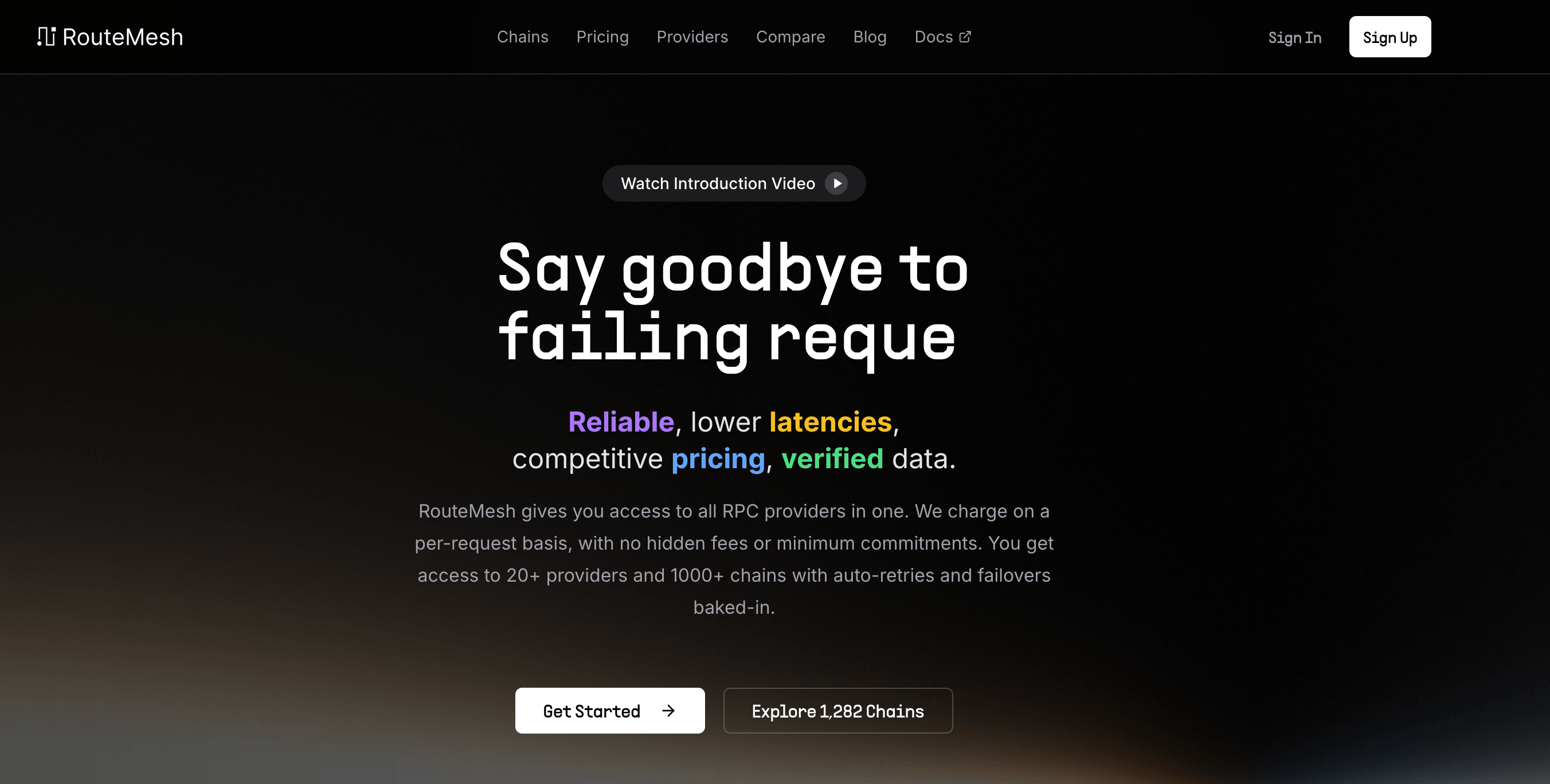
RouteMesh is an intelligent RPC routing layer spanning 1000+ EVM networks, including full support for Polygon, that aggregates and routes each request across multiple underlying providers — Chainstack among them — with sub-10ms routing decisions and automatic failover. Pricing is per-request based on key type, chain, and method, with a free community endpoint available for Polygon.
For payment infrastructure, the pitch is reliability through redundancy: a settlement API routed through RouteMesh doesn’t go down because one underlying provider has a bad afternoon, since the routing layer detects degraded health and shifts traffic automatically. This suits teams running payment rails across many EVM chains at once, or bridge and cross-border settlement backends where a single point of failure is unacceptable.
Limitations: As a routing layer, RouteMesh has no dedicated nodes or archive infrastructure of its own — depth on debug_traceTransaction and historical reads depends entirely on whichever underlying provider handles a given request. Compliance attestation is similarly inherited, not independently published.
Fit by workload:
- Stablecoin payment APIs (sustained polling): Strong — automatic multi-provider failover is exactly the reliability property sustained settlement traffic needs.
- Compliance and audit infrastructure: Moderate — archive depth depends on which underlying provider serves the request.
- Regulated enterprise fintech: Moderate — no independent certification; a compliance team would need to trace attestation to whichever provider is serving traffic at any given moment.
Uniblock
Uniblock is a managed infrastructure layer spanning 300+ chains including Polygon, routing across 55+ underlying providers — Chainstack among them — with automatic failover and request hedging. Its Unified APIs layer sits above plain RPC, adding token-data and webhook endpoints that a payment reconciliation dashboard would otherwise have to build from raw logs.
For fintech teams, the webhook and token-balance APIs are the differentiator: a payment notification system that needs to fire on confirmed transfers can consume Uniblock’s webhook layer directly rather than running its own polling loop against eth_getLogs. Pricing is per-request with a free tier.
Limitations: Like RouteMesh, Uniblock runs no dedicated Polygon nodes of its own — archive and trace depth trace back to whichever underlying provider serves a given request, and compliance certification is not independently published.
Fit by workload:
- Stablecoin payment APIs (sustained polling): Strong — webhooks cut the polling load a notification system would otherwise generate itself.
- Compliance and audit infrastructure: Moderate — archive depth depends on the underlying provider serving the request.
- Regulated enterprise fintech: Moderate — no independent certification to point a vendor-review team toward.
Ankr
Ankr runs Polygon on a distributed network of independently operated nodes, with a free tier of 200M API credits per month — generous on paper, though credit consumption per method means the effective request count is lower than the headline number suggests. Archive access and the debug namespace are available on premium tiers, and WebSocket support ships on paid plans.
The decentralized node model gives Ankr geographic breadth useful for payment platforms with global reach, but it also means compliance attestation is harder to pin down: public documentation doesn’t clearly state a current SOC 2 status, which is worth confirming directly with Ankr before relying on it for vendor procurement rather than assuming a certification level.
Limitations: Compliance certification status isn’t clearly published, a real gap for regulated fintech vendor review. No dedicated node tier. Credit-based billing makes cost modeling less transparent than flat-RU pricing for teams building financial forecasts.
Fit by workload:
- Stablecoin payment APIs (sustained polling): Good — broad node distribution handles global traffic, though credit consumption needs monitoring at scale.
- Compliance and audit infrastructure: Moderate — debug namespace is there, but the certification gap may not clear an enterprise vendor review.
- Regulated enterprise fintech: Moderate — better suited as a secondary provider than a primary one until certification status is confirmed.
dRPC
dRPC distributes Polygon traffic across a global network of independent operators at a flat $6 per million requests, with every call costing the same regardless of method — no credit math, no method-weighted multipliers. WebSocket support, archive access, and trace APIs are all available, and the flat pricing makes dRPC the cheapest standard option in this comparison for high-volume, low-complexity calls.
Public nodes carry no SLA, and the decentralized operator model introduces latency variability that a single-operator provider with fewer, better-controlled nodes typically avoids. For fintech specifically, dRPC’s compliance footprint is thin: no SOC 2 certification is clearly published, and the decentralized model makes third-party audit attestation structurally harder than it is for a single operator.
Limitations: No clearly published compliance certification. No standard dedicated node tier for Polygon. Public nodes have no SLA, and per-request latency varies more than on shared infrastructure with fewer, controlled nodes.
Fit by workload:
- Stablecoin payment APIs (sustained polling): Moderate — the price is hard to beat, but no SLA is a real risk for payment-critical polling.
- Compliance and audit infrastructure: Limited — trace and archive exist, but the documentation a compliance review needs isn’t there.
- Regulated enterprise fintech: Limited — better suited to a secondary or non-regulated workload than a primary payment RPC.
Alchemy
Alchemy is a multi-chain RPC provider covering Polygon alongside Ethereum and the major L2s, billing on a Compute Unit model that averages roughly 27 CUs per standard request, with a permanent free tier of 30M CU/month. Enhanced APIs (token balances, historical transfers) and webhook infrastructure reduce the build effort for reconciliation and reporting features specifically.
Method weighting is the catch: eth_getLogs over wide block ranges and debug_traceTransaction consume meaningfully more CUs than the average implies, so the 30M-CU free tier maps to fewer real payment-workload requests than the headline number suggests. Alchemy holds SOC 2 Type II, though ISO 27001 isn’t confirmed on its public pages the way it is for Chainstack and Quicknode. At meaningful production volume, Alchemy’s per-CU pricing is one of the pricier options in this comparison — Chainstack’s own pricing page puts method-weighted competitors like Alchemy at up to a 26x multiplier on heavy calls versus Chainstack’s flat 1 RU, so it’s worth running an actual settlement-workload method mix through a calculator before committing to volume.
Limitations: No standard dedicated nodes — all traffic runs on shared infrastructure, a real constraint for payment platforms that need contractual throughput guarantees or resource isolation during settlement windows. CU-based pricing adds forecasting uncertainty for mixed-method workloads.
Fit by workload:
- Stablecoin payment APIs (sustained polling): Good — reliable shared infrastructure, though there’s no dedicated tier to isolate settlement-window bursts.
- Compliance and audit infrastructure: Good — archive and trace are there; the CU cost of running them at volume is the thing to model.
- Regulated enterprise fintech: Moderate — SOC 2 Type II is confirmed, but no dedicated nodes or contractual throughput SLA to point at during vendor review.
Quicknode

Quicknode supports Polygon PoS with a credit-based pricing model, dedicated cluster options through enterprise sales, and both SOC 2 Type II and ISO 27001 certification — an edge over several competitors here for institutional procurement. Its entry offering is a 1-month free trial (10M credits, 15 RPS) rather than a permanent tier, so staging environments need a paid plan once the trial ends.
Standard reads consume relatively few credits, but eth_getLogs with wide block ranges and debug_traceTransaction consume credits faster than a flat-RU model would for the same workload. The marketplace adds enhanced APIs, WebSocket management, and notification webhooks that cut integration work for payment notification systems specifically. Quicknode’s tiered credit plans look reasonable on the surface, but method-weighted billing means the effective cost per call climbs fast once archive or debug-heavy compliance queries enter the mix — worth modeling against an actual method mix before committing to a tier, particularly since the free trial doesn’t leave much runway to find that out gradually.
Limitations: Credit math adds real complexity when estimating costs for mixed-method workloads. No permanent free tier complicates running separate dev/staging/production environments without a paid plan on day one.
Fit by workload:
- Stablecoin payment APIs (sustained polling): Strong — dedicated clusters are available through sales, but credit consumption needs active monitoring under sustained polling.
- Compliance and audit infrastructure: Strong — both certifications plus archive and debug access cover most vendor-review checklists.
- Regulated enterprise fintech: Strong — the certification pairing clears most enterprise procurement bars; credit-based cost forecasting is the remaining friction.
Getting started with fintech and payments on Chainstack
Deploy a production Polygon endpoint in a few steps and build better with Polygon on Chainstack:
- Log in to the Chainstack console (or create an account).
- Create a new project.
- Select Polygon as your blockchain protocol.
- Choose network: Polygon Mainnet or Amoy testnet.
- Deploy the node.
- Open Access and credentials and copy your HTTPS and WebSocket endpoints.
For settlement workloads that can’t tolerate shared-endpoint contention, evaluate Dedicated Nodes or the Unlimited Node add-on after the initial deploy — both are available inside the same project.
from web3 import Web3
w3 = Web3(Web3.HTTPProvider("YOUR_CHAINSTACK_ENDPOINT"))
# Check a token balance before initiating a payout
token = w3.eth.contract(
    address=Web3.to_checksum_address("YOUR_TOKEN_ADDRESS"),
    abi=[{"inputs": [{"name": "account", "type": "address"}],
          "name": "balanceOf", "outputs": [{"name": "", "type": "uint256"}],
          "stateMutability": "view", "type": "function"}],
)
balance = token.functions.balanceOf("YOUR_WALLET_ADDRESS").call()
print(f"Token balance: {balance / 1e6:.6f}")
📖 For the full integration guide, see the Chainstack Polygon tooling documentation.
Need testnet POL? Grab some from the Chainstack Amoy faucet.
🤖 You can also access Chainstack Polygon RPC directly from Claude, Cursor, Codex, Windsurf, Gemini CLI, GitHub Copilot, Antigravity, Claude.ai, or ChatGPT using Chainstack MCP. For a fuller agent stack — MCP, the Chainstack skill, llms.txt for context ingestion, and WebMCP for agentic browsers — see the Chainstack Agents page.
Conclusion
The single most important decision for Polygon fintech infrastructure in 2026 is whether your provider’s pricing model and compliance documentation can survive a vendor risk review, not just a load test.
- Stablecoin payment APIs and settlement batches: Chainstack with the Unlimited Node add-on caps billing on polling-heavy workloads, or RouteMesh for multi-provider failover across a broader EVM footprint.
- Compliance teams and audit infrastructure: Chainstack Dedicated Nodes with archive and full debug namespace access, backed by SOC 2 Type II and ISO 27001.
- Multi-chain development teams: Alchemy covers Polygon alongside Ethereum and the major L2s in one account, at the cost of method-weighted CU pricing that climbs under receipt-polling workloads.
- Teams needing dual SOC 2 Type II and ISO 27001 with dedicated clusters: Quicknode, with credit-based billing that needs active cost modeling.
- Cost-sensitive batch workloads on non-regulated platforms: dRPC’s flat per-request pricing removes credit math entirely, though compliance documentation isn’t sufficient for regulated payment products.
Frequently asked questions
Q: Does Polygon’s 2026 block-time reduction change how often I should poll for payment confirmations?
Yes — Polygon cut its block time to 1.75 seconds in May 2026, so a polling interval built around the old 2-second cadence now either lags real settlement speed or polls unnecessarily often. Match your eth_getTransactionReceipt polling interval to the new block time and watch p99 latency, not just the average, since that’s what determines perceived settlement speed under load.
Q: Which Polygon RPC provider has the best free tier for a payments team prototyping before committing?
Chainstack’s Developer plan is a permanent free tier (3M RU/month, 25 RPS, no credit card), as are RouteMesh’s and Uniblock’s free community/aggregation tiers. Alchemy’s 30M CU/month is also permanent but maps to fewer real requests once heavy methods enter the mix; Quicknode’s is explicitly a 1-month trial, not a standing option for ongoing staging.
Q: How do I migrate a Polygon payment backend from Quicknode or Alchemy to Chainstack?
Both are drop-in JSON-RPC and WebSocket replacements — swap the endpoint URL and re-point your client. The main adjustment is billing: Chainstack’s flat 1 RU per call replaces method-weighted credits or CUs, so re-estimate cost from raw call volume rather than method mix, and run both endpoints in parallel behind failover during cutover.
Q: What RPC latency should a payment confirmation API target on Polygon?
Target sub-100ms for eth_sendRawTransaction submission, and treat p99 latency on eth_getTransactionReceipt polling as the number that matters most — a provider with a fast average that spikes under load will show up as delayed merchant confirmations at exactly the moments (batch settlement, peak checkout) when it’s most visible.
Q: Which providers in this comparison actually clear enterprise compliance vendor review for regulated fintech?
Chainstack and Quicknode both hold SOC 2 Type II and ISO 27001. Alchemy holds SOC 2 Type II with ISO 27001 unconfirmed on its public pages. Ankr’s certification status isn’t clearly published, and dRPC has no clearly published SOC 2 — both are gaps worth confirming directly before regulated procurement.
Q: Why does the pricing model matter more than the sticker price for Polygon fintech workloads?
Payment workloads lean on eth_getTransactionReceipt and eth_call at high, sustained volume, and method-weighted models (Quicknode credits, Alchemy CUs) charge multiples of a standard call for heavier methods like debug_traceTransaction — Chainstack’s own pricing page puts that multiplier at up to 26x for method-weighted competitors on comparable heavy calls. Flat per-call billing keeps the bill predictable regardless of which methods a settlement job actually calls.
Additional resources