AI-ready infrastructure
 Refer and earn


 Ethereum
 Hyperliquid
 Solana
 Arbitrum
 BNB Smart Chain
 Base
Base Polygon
 TRON
TRON Sui
Sui Robinhood


BNB Smart Chain for DeFi: best providers and infrastructure guide 2026

BNB Smart Chain is one of the most active EVM-compatible networks in production, averaging about 10.8 million daily transactions in 2025, with 0.45-second blocks since the Fermi hard fork in January 2026, and a DeFi ecosystem whose total value locked grew 40.5% through 2025. For DeFi developers and protocol teams, the same high throughput and cheap gas that make BNB Chain attractive for AMM trading, liquidation bots, and on-chain data pipelines also mean that BNB RPC infrastructure bears the full brunt of every spike in market activity.
The 2026 BNB Chain roadmap targets 20,000+ TPS and sub-150ms finality — upgrades that will compress competitive windows for latency-sensitive DeFi workloads. At the same time, BNB’s growing real-world asset (RWA) and stablecoin ecosystem has drawn institutional DeFi protocols that treat audit trails, uptime SLAs, and compliance certifications as hard requirements alongside raw performance. The provider you choose today will determine whether your smart contracts, bots, and data pipelines keep up with the chain — or fall behind it.
This guide covers the RPC requirements specific to DeFi on BNB Chain, breaks down the top providers for each sub-workload, and shows you how to get started with production-grade infrastructure.
💡 Already using Chainstack? Jump straight to the BNB Smart Chain tooling docs or deploy your endpoint in minutes at chainstack.com/build-better-with-bnb-smart-chain.
DeFi on BNB Chain: RPC requirements
DeFi workloads on BNB Chain are structurally more demanding than typical dApp or explorer traffic because they are latency-sensitive, stateful, and continuous. An AMM arbitrage bot that fires eth_call every 200 milliseconds to check PancakeSwap V3 pool prices, then races to submit eth_sendRawTransaction ahead of competing bots, has completely different infrastructure needs from a block explorer polling every 10 seconds. A liquidation engine monitoring Venus Protocol positions must sustain high-frequency eth_getLogs scans without rate-limit interruptions, then react within milliseconds when a borrower’s health factor crosses the liquidation threshold. And a protocol analytics pipeline backtesting historical pool behavior needs unrestricted archive access across months of chain history.
All three workloads share one underlying constraint: the RPC endpoint is the rate-limiting factor. Every millisecond of added latency, every dropped WebSocket connection, and every rate-limit rejection translates directly into missed trades, failed liquidations, or incomplete data.
Latency requirements
AMM trading and liquidation bots operate in the sub-second competitive range. For strategies on PancakeSwap V3 pools or Venus Protocol liquidations, the round-trip time between eth_call (reading pool or position state) and eth_sendRawTransaction (submitting the transaction) is a direct determinant of success rate. The difference between 30 ms and 120 ms endpoint latency can mean the difference between a profitable arbitrage and a failed transaction that still costs gas. For protocol data indexing and analytics, batch tolerance is higher, but sustained throughput without throttling matters more than individual call latency.
Throughput requirements
Production DeFi bots commonly generate 50–500 RPS against a single endpoint. Multi-strategy bots scanning multiple pools across PancakeSwap V2, V3, and third-party AMMs can exceed 1,000 RPS at peak. A shared RPC endpoint on a free tier — typically capped at 25–50 RPS — will fail within seconds of a realistic load test. Dedicated infrastructure with flat-rate RPS tiers is the correct architecture for any DeFi workload beyond early development.
Key RPC methods for DeFi on BNB Chain
BNB Smart Chain is fully EVM-compatible and exposes the standard Ethereum JSON-RPC interface. The following eight methods are the operational core of DeFi on BNB Chain; all are documented in the BNB Smart Chain methods reference.
| Method | DeFi use | What to watch for |
|---|---|---|
eth_call | Reading pool prices, position health, reserve ratios, and balances from smart contracts | High-frequency bots generate significant RU/CU load; providers may rate-limit repeated identical calls on shared tiers |
eth_getLogs | Scanning Swap, Transfer, Liquidation, and Borrow events across block ranges | Works on full nodes for current data — does not require archive access for scanning recent event history |
eth_sendRawTransaction | Submitting swaps, liquidity additions, liquidations, and debt repayments | Propagation speed determines competitive outcome; Chainstack’s Warp transactions route via bloXroute for priority propagation |
eth_subscribe | WebSocket subscription to pending transactions and new blocks | Requires persistent WebSocket connection; test provider reconnection handling under sustained load |
eth_estimateGas | Pre-submission gas estimation for DeFi transactions | Reverting calls still consume compute; high-frequency estimation adds to your RPS budget |
eth_getTransactionReceipt | Confirming swap execution and checking event logs in receipt | Use WebSocket newHeads + batch receipt fetch rather than per-receipt polling |
debug_traceTransaction | Tracing MEV bundle execution, liquidation call paths, failed transaction root cause analysis | Needs a debug/trace-enabled node (Growth plan and above on Chainstack); old blocks also need archive state. Not available on all providers or plan tiers |
eth_call at historical block | Historical protocol state for backtesting, analytics, and risk modeling | Requires archive node. Any eth_call with a specific past blockNumber parameter needs archive access |
Infrastructure requirements
For production DeFi on BNB Chain, the baseline is:
- Dedicated or isolated nodes: Shared multi-tenant endpoints are unsuitable for latency-critical bots. Traffic spikes from other customers create unpredictable latency variance at exactly the moments your strategy needs reliability.
- Geographic proximity: Deploy your bot in the same region as your RPC endpoint. BNB Chain’s block time is 0.45 seconds since the Fermi hard fork in January 2026 — regional latency on a shared endpoint can represent a large fraction of your available execution window.
- WebSocket stability: DeFi bots relying on real-time event streams need providers with robust WebSocket reconnection handling and no silent timeouts under sustained connection load.
- Archive access for trace methods: Liquidation analytics, backtesting, and post-mortem debugging require
debug_traceTransactionand historical state access — which need a debug/trace-enabled node (Growth plan and above on Chainstack), with archive state for old blocks.
For the complete BNB Smart Chain JSON-RPC reference, see the BNB Smart Chain API quickstart on Chainstack.
Chainstack for DeFi on BNB Chain
Chainstack addresses BNB Chain DeFi infrastructure through a layered approach: Global Nodes for moderate traffic with geo-balanced latency, Dedicated Nodes for isolated high-throughput production workloads, and the Unlimited Node add-on for flat-rate RPS pricing that eliminates per-request billing volatility for bots with unpredictable request patterns.
For transaction propagation speed — the critical factor in AMM arbitrage and liquidation racing — Chainstack offers BNB Smart Chain Trader Nodes with Warp transactions. Warp routes eth_sendRawTransaction calls through bloXroute’s private relay network, bypassing standard mempool propagation delays. For competitive DeFi strategies on BNB Chain, this is the single most impactful performance lever available at the infrastructure layer, and it requires no code changes — just use eth_sendRawTransaction as usual. For institutional DeFi protocols, check the Chainstack traders page for dedicated trading infrastructure options.
Chainstack’s SOC 2 Type II and ISO 27001 certification, a 99.9% contractual SLA with service credits, and 99.99%+ measured uptime make it the appropriate choice for institutional DeFi protocols and lending platforms where downtime has direct financial consequences. Archive node access is available on Growth plan and above, enabling debug_traceTransaction and historical eth_call required for liquidation analytics and risk backtesting.
Code example: reading a PancakeSwap V3 pool price and monitoring Swap events
from web3 import Web3
import json

# Replace with your Chainstack BNB Smart Chain endpoint
endpoint = "https://bsc-mainnet.core.chainstack.com/YOUR_KEY"
w3 = Web3(Web3.HTTPProvider(endpoint))

# PancakeSwap V3 WBNB/USDT pool (example address)
POOL_ADDRESS = Web3.to_checksum_address("0x36696169C63e42cd08ce11f5deeBbCeBae652050")

# Minimal ABI for slot0 — contains current sqrtPriceX96 and tick
SLOT0_ABI = [{"inputs": [], "name": "slot0", "outputs": [
    {"name": "sqrtPriceX96", "type": "uint160"},
    {"name": "tick", "type": "int24"},
    {"name": "observationIndex", "type": "uint16"},
    {"name": "observationCardinality", "type": "uint16"},
    {"name": "observationCardinalityNext", "type": "uint16"},
    {"name": "feeProtocol", "type": "uint8"},
    {"name": "unlocked", "type": "bool"}
], "stateMutability": "view", "type": "function"}]

pool = w3.eth.contract(address=POOL_ADDRESS, abi=SLOT0_ABI)

# eth_call: read current pool price (no archive needed — reads latest state)
slot0 = pool.functions.slot0().call()
sqrt_price = slot0[0]
print(f"Current sqrtPriceX96: {sqrt_price}")

# eth_getLogs: scan recent Swap events (full node, no archive needed)
SWAP_TOPIC = w3.keccak(text="Swap(address,address,int256,int256,uint160,uint128,int24)")
latest = w3.eth.block_number
logs = w3.eth.get_logs({
    "fromBlock": latest - 500,
    "toBlock": latest,
    "address": POOL_ADDRESS,
    "topics": [SWAP_TOPIC]
})
print(f"Found {len(logs)} Swap events in last 500 blocks")
See the BNB Smart Chain tooling docs for full integration guides with ethers.js, viem, Web3.py, Hardhat, and Foundry.
🤖 You can also access Chainstack BNB Smart Chain RPC directly from Claude, Cursor, Codex, Gemini, or Windsurf using Chainstack MCP. Learn more about Chainstack MCP.
Provider comparison
The table below summarizes public positioning as of October 2026. BNB Smart Chain is fully EVM-compatible; all providers below support the standard Ethereum JSON-RPC interface on BNB Chain unless noted.
| Provider | Pricing model | Free tier | Dedicated nodes | Archive + trace | Why it matters for DeFi |
|---|---|---|---|---|---|
| Chainstack | RU-based | 3M RU / 25 RPS | Yes (from Pro) | Yes (archive on paid plans) | Warp tx propagation via bloXroute; Unlimited Node add-on for high-RPS bots |
| Dwellir | 1 credit per response (flat) | 20 responses/s, 100,000/day | Yes (cluster $12,600/mo; Unlimited Nodes from $119/mo) | Full nodes by default; archive via dedicated node on request; trace/debug on paid plans | Flat per-response billing; dedicated cluster with 99.99% SLA (custom terms) |
| Ankr | API credits | 200M credits/month | Enterprise only (sales-led) | Archive on all plans; trace/debug on Premium | Distributed node operators; 200M free credits (about 1M requests) |
| dRPC | Flat per million requests | Public endpoints (no SLA) | No | Debug/trace on the paid Growth plan | Simple pricing; cost-efficient for high-volume analytics |
| Quicknode | Credit (method-weighted) | 30-day trial only | Yes (dedicated clusters) | Yes (on paid plans) | Large global edge network; Streams add-on for event-driven workflows |
Chainstack
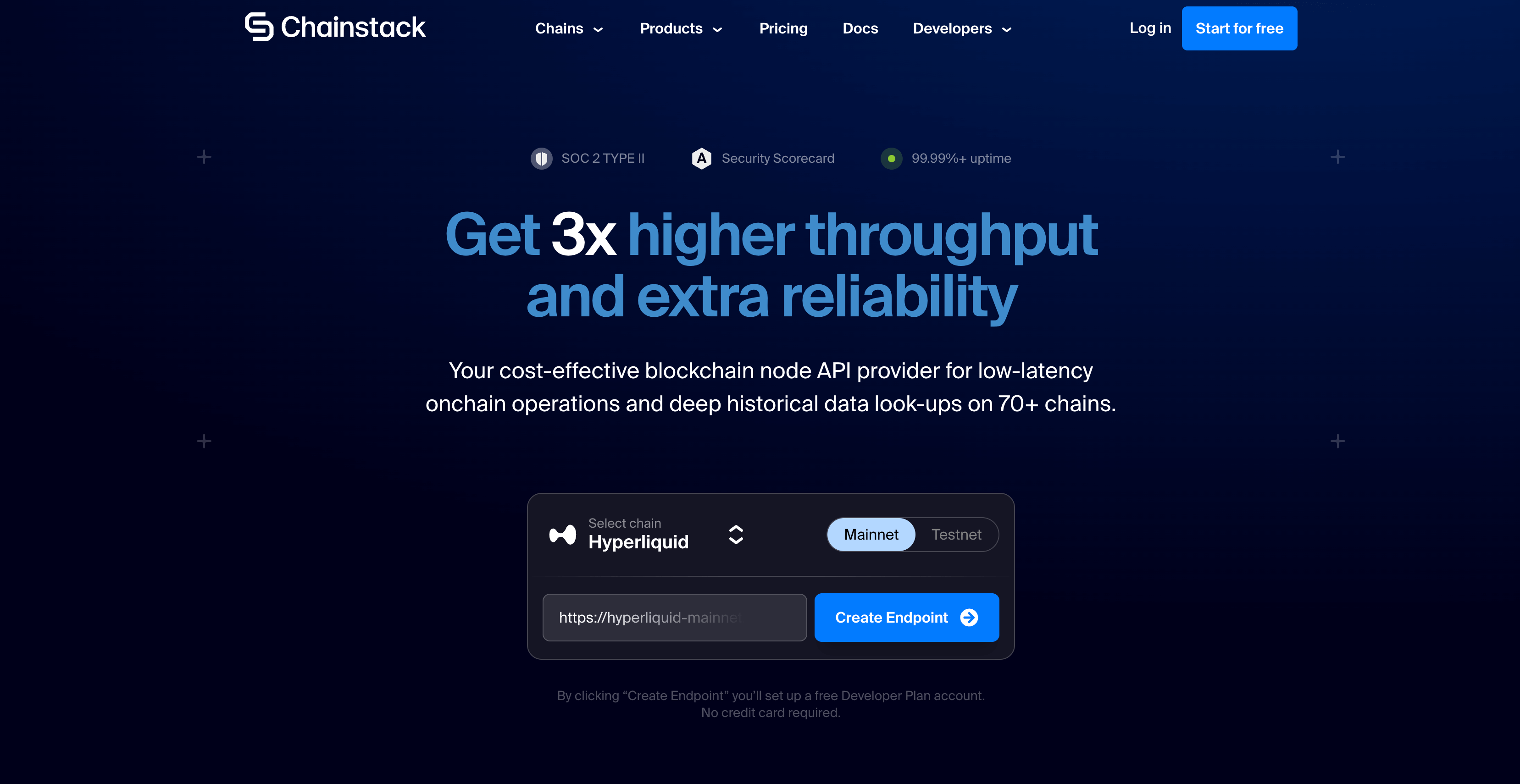
Chainstack offers BNB Smart Chain Global Nodes on all plans, with Dedicated Nodes available from the Pro plan onward. The Developer plan provides 3M RU/month at 25 RPS — sufficient for development but not for production DeFi bots. The Growth plan at $49/month brings 20M RU, 250 RPS, archive access, and the ability to add the Unlimited Node add-on starting at $149/month for 25 flat-rate RPS with no per-request billing. For bots with spiky or high-sustained request volumes, the Unlimited Node add-on removes the cost uncertainty that makes credit-based pricing impractical for production strategies.
The headline DeFi-specific feature is Warp transactions: eth_sendRawTransaction calls route through bloXroute’s relay network, cutting propagation time and improving transaction inclusion in competitive scenarios. Available as a node add-on on paid plans, with Warp transactions billed separately. For archive-dependent workloads — debug_traceTransaction for liquidation path analysis, or historical eth_call for backtesting — Chainstack’s archive nodes on paid plans provide full BSC history.
SOC 2 Type II and ISO 27001 certification, 99.99%+ measured uptime, and a 99.9% contractual SLA with service credits make Chainstack the production choice for DeFi protocols and lending platforms where infrastructure downtime translates directly into financial risk.
Limitations: The Unlimited Node add-on is priced separately from the base plan; teams needing both archive access and high flat-rate RPS need to budget for both. The free Developer plan’s 25 RPS cap is too low for any serious DeFi bot testing at realistic load.
Fit by workload:
- AMM/DEX trading bots: Excellent — Warp propagation, Dedicated Nodes, geo-balanced Global Nodes
- Liquidation and MEV bots: Excellent — archive +
debug_traceTransaction, Warp, Dedicated Nodes for isolated throughput - Protocol data indexing: Excellent — Unlimited Node add-on for high-volume
eth_getLogsscans, archive for historical state queries
Dwellir
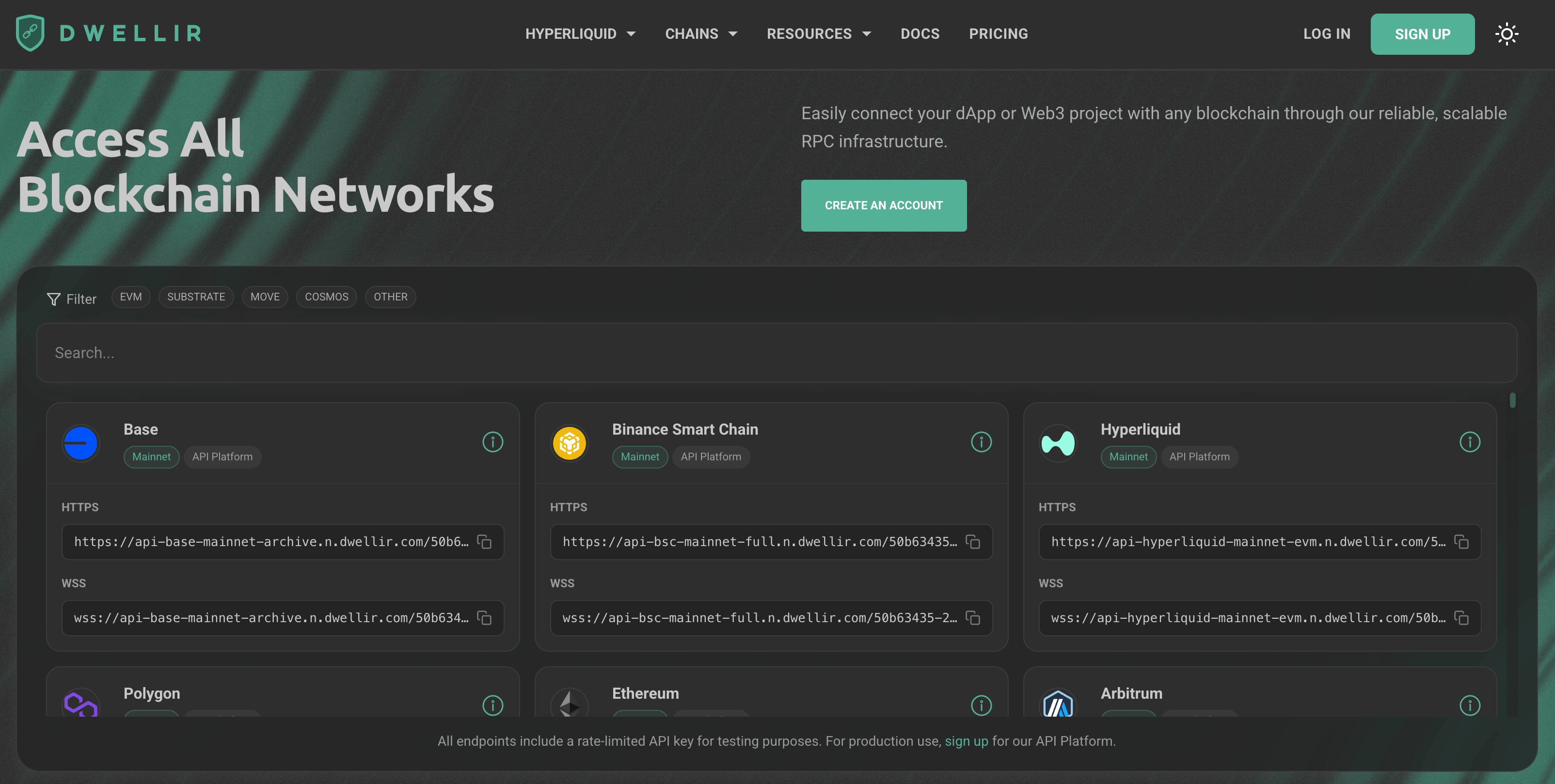
Dwellir is a Swedish RPC provider with a long Polkadot track record that now serves 150+ networks, BNB Smart Chain (chain ID 56) among them. Its standard BNB endpoint over HTTPS and WebSocket runs full nodes, so deep historical queries such as eth_call at arbitrary past blocks need a dedicated archive node arranged with its team. Shared plans bill one credit per response with no compute-unit weighting, which keeps high-volume eth_getLogs scans and eth_call loops easy to forecast.
Pricing runs from a free plan (20 responses per second, 100,000 responses per day) through Developer at $49/month (25M responses, 100 per second), Growth at $299/month (150M, 500 per second) and Scale at $999/month (500M, 5,000 per second). Unlimited Nodes start at $119/month flat for 25 to 1,000 RPS, and the BNB archive cluster is listed at $12,600/month, unmetered, with a 99.99% SLA on custom terms. Trace and debug APIs are available on every paid plan, on Unlimited Nodes and on dedicated clusters (not on the free plan). You can pay in crypto. Pricing checked October 9, 2026.
Limitations: No SOC 2 or ISO 27001 attestation on its public pricing and dedicated-cluster pages; standard endpoints are full nodes only; its BNB page lists no transaction-propagation add-on comparable to Warp; the free plan is capped at 100,000 responses per day.
Fit by workload:
- AMM/DEX trading bots: Moderate — a dedicated cluster or Unlimited Node removes request counting, but there is no propagation add-on for racing transactions
- Liquidation and MEV bots: Moderate — trace and debug come with paid plans, but deep historical state needs an archive node arranged separately
- Protocol data indexing: Good — one credit per response and flat-rate Unlimited Nodes suit high-volume event log scanning
Ankr
Ankr provides BNB Smart Chain RPC through a distributed network of node operators, with 200M free API credits per month, roughly 1M EVM requests at Ankr’s per-call credit cost. For DeFi developers in early stages, this makes Ankr a practical sandbox environment before committing to paid infrastructure. Archive data is available on every plan and trace/debug on Premium, and paid plans use an API credit model, and WebSocket connections are supported for eth_subscribe workloads.
Ankr offers dedicated nodes only through its sales-led Enterprise plan; the self-serve Freemium and Premium plans run on shared infrastructure, which is the critical limitation for production DeFi. Shared multi-tenant infrastructure means your bot’s latency is exposed to traffic spikes from other users. For competitive AMM trading or liquidation bots where milliseconds determine outcomes, this is a structural problem regardless of Ankr’s average performance. Ankr is best suited for non-latency-critical DeFi workloads: analytics pipelines, portfolio trackers, and protocol dashboards that can tolerate occasional latency variance. Ankr’s infrastructure operator holds a SOC 2 Type II attestation (report under NDA) and ISO 27001 is in progress, which covers teams with basic vendor attestation requirements.
Limitations: Dedicated nodes require an Enterprise agreement, so self-serve plans leave shared-tier latency variance unavoidable for production bots. Trace and debug require the Premium plan. Credit pricing model adds per-request cost unpredictability at scale.
Fit by workload:
- AMM/DEX trading bots: Moderate — adequate for development and low-frequency monitoring; not viable for competitive production bots
- Liquidation and MEV bots: Limited — self-serve plans are shared infrastructure and dedicated capacity needs an Enterprise contract, so it is not viable for latency-critical liquidation execution without one
- Protocol data indexing: Good — a large free credit allowance and archive data on every plan suit high-volume event log scanning
dRPC
dRPC offers BNB Smart Chain endpoints with a flat pricing model at roughly $6 per million requests on paid plans, with free public endpoints available without registration. This pricing model is particularly attractive for DeFi teams running high-volume eth_getLogs scans and eth_call loops where cost per request matters more than latency guarantees. Public endpoints carry no SLA, which positions dRPC primarily as a development and cost-optimization option rather than a production-grade DeFi infrastructure choice.
dRPC’s distributed routing aggregates requests across multiple backend providers, which introduces additional latency hops compared to direct-provider endpoints. For latency-sensitive AMM trading bots, this architecture is a structural disadvantage. For data pipelines and analytics workloads that prioritize cost efficiency over response time, dRPC’s pricing is genuinely competitive — every method costs the same, so the bill is easy to forecast. There is no published SOC 2 or equivalent security certification for dRPC, which limits its suitability for institutional DeFi protocols with compliance requirements.
Limitations: No SLA on public endpoints, no dedicated nodes, no published compliance certification. Distributed routing adds latency relative to direct-endpoint providers.
Fit by workload:
- AMM/DEX trading bots: Limited — no SLA, no dedicated nodes, routing overhead not suitable for competitive trading strategies
- Liquidation and MEV bots: Limited — same structural constraints; debug/trace sit on the paid plan
- Protocol data indexing: Good — competitive flat pricing for high-volume bulk requests where latency tolerance is high
BNB Chain RPC provider scoring — DeFi workloads
Scored across: Archive + trace /25 · Low-latency throughput /25 · WebSocket stability /20 · Pricing transparency /20 · Enterprise SLA /10. Click any row to expand criteria.
Chainstack
95 / 100
| Archive + trace | 25 / 25 |
| Low-latency throughput | 23 / 25 |
| WebSocket stability | 18 / 20 |
| Pricing transparency | 19 / 20 |
| Enterprise SLA + compliance | 10 / 10 |
| Total | 95 / 100 |
Quicknode
87 / 100
| Archive + trace | 22 / 25 |
| Low-latency throughput | 22 / 25 |
| WebSocket stability | 18 / 20 |
| Pricing transparency | 16 / 20 |
| Enterprise SLA + compliance | 9 / 10 |
| Total | 87 / 100 |
Ankr
70 / 100
| Archive + trace | 17 / 25 |
| Low-latency throughput | 17 / 25 |
| WebSocket stability | 14 / 20 |
| Pricing transparency | 17 / 20 |
| Enterprise SLA + compliance | 5 / 10 |
| Total | 70 / 100 |
dRPC
65 / 100
| Archive + trace | 15 / 25 |
| Low-latency throughput | 16 / 25 |
| WebSocket stability | 13 / 20 |
| Pricing transparency | 18 / 20 |
| Enterprise SLA + compliance | 3 / 10 |
| Total | 65 / 100 |
Scored by Chainstack · May 2026 · DeFi workload criteria · Dwellir was not part of this scoring
Quicknode

Quicknode is one of the most established providers for BNB Smart Chain and supports the full Ethereum JSON-RPC interface including debug_ and trace_ namespaces on archive-enabled plans. Its global edge network spans 17+ regions, and dedicated cluster options provide isolated throughput for production bots. Quicknode’s add-on marketplace includes Streams (event streaming via WebSocket or webhook) and QuickAlerts for event-driven workflows — both useful for liquidation monitoring systems that need real-time event delivery without polling.
Pricing uses a method-weighted credit system: debug_traceTransaction costs twice the credits of eth_call. For bots making thousands of calls per minute across mixed methods, the credit math can become difficult to predict without careful benchmarking. Quicknode’s 30-day trial provides full feature access without a permanent free tier, making it less attractive for extended development phases compared to providers with ongoing free tiers.
SOC 2 Type II and ISO 27001 certification make Quicknode suitable for institutional DeFi protocols with compliance requirements.
Limitations: Method-weighted credit pricing creates cost unpredictability for mixed DeFi workloads. No permanent free tier means development costs start from day one after the trial.
Fit by workload:
- AMM/DEX trading bots: Strong — global edge network, WebSocket support, dedicated clusters available
- Liquidation and MEV bots: Strong —
debug_traceTransactionon archive plans, Streams add-on for event-driven delivery - Protocol data indexing: Strong — Streams provides event-driven pipeline delivery; archive access available on paid plans
Real-world performance benchmark
BNB Smart Chain is tracked on the Chainstack performance dashboard, which provides real-time latency data for key RPC methods across providers and regions. Before committing to a provider for production DeFi, benchmark the methods your workload actually calls — eth_call for price reads, eth_getLogs for event scans, and eth_subscribe for WebSocket streaming — across EU, US West, and Asia Pacific regions from the location your bots will run.
For DeFi workloads, p95 latency matters more than average: a provider with a 50ms average but a 500ms p95 will stall a latency-sensitive strategy more often than one with an 80ms average and 120ms p95. A single outlier in a competitive window costs the trade. Chainstack’s geo-balanced Global Nodes deliver tight latency distributions on BNB Chain across regions, and Dedicated Nodes further tighten p95/p99 variance by eliminating shared-tenant interference entirely.
⚡ Data sourced from the Chainstack performance dashboard. Filter by chain, method, and region for current latency numbers across providers.
Getting started with DeFi on BNB Chain on Chainstack
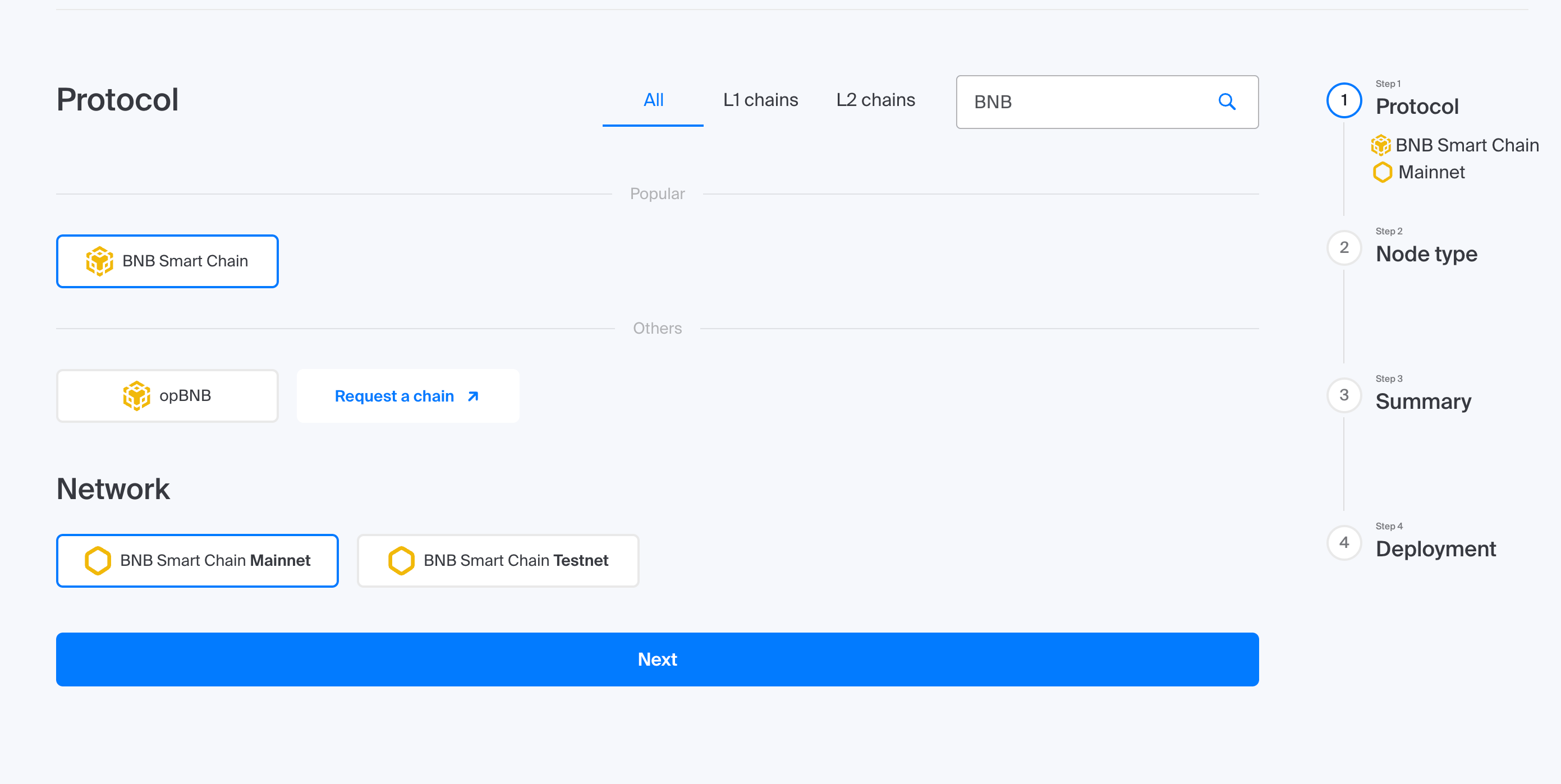
- Create a Chainstack account at console.chainstack.com or log in if you already have one.
- Create a project — select “Multichain” for flexibility across networks.
- Deploy a BNB Smart Chain node — choose Mainnet, then Global Node for geo-balanced access or Dedicated Node for isolated throughput. Enable archive if your workload uses
debug_traceTransactionor historical state queries. - Copy your HTTPS or WebSocket endpoint from the node details page.
- Configure your bot or application using the BNB Smart Chain tooling docs for integration guides with ethers.js, viem, Web3.py, Hardhat, and Foundry.
For trading bots and liquidation engines, enable Warp transactions in your node settings to route eth_sendRawTransaction through bloXroute for faster propagation.
Here is a minimal WebSocket subscription example for monitoring pending DeFi transactions:
import asyncio
import json
from websockets import connect

async def monitor_pending_txs():
    uri = "wss://bsc-mainnet.core.chainstack.com/ws/YOUR_KEY"
    async with connect(uri) as ws:
        # eth_subscribe: real-time pending transactions
        await ws.send(json.dumps({
            "id": 1,
            "method": "eth_subscribe",
            "params": ["newPendingTransactions"]
        }))
        resp = await ws.recv()
        print(f"Subscribed: {resp}")
        while True:
            msg = await ws.recv()
            data = json.loads(msg)
            tx_hash = data.get("params", {}).get("result", "")
            if tx_hash:
                print(f"Pending tx: {tx_hash}")

asyncio.run(monitor_pending_txs())
🤖 You can also access Chainstack BNB Smart Chain RPC directly from Claude, Cursor, Codex, Gemini, or Windsurf using Chainstack MCP. Learn more about Chainstack MCP.
Conclusion
DeFi on BNB Chain in 2026 demands infrastructure that can sustain high-frequency requests, guarantee sub-100ms latency under load, and provide archive access for the trace methods that competitive liquidation and MEV strategies depend on.
- AMM/DEX trading bots: Chainstack (Dedicated Nodes + Warp), Quicknode (dedicated clusters) for latency-sensitive production; dRPC as a development-only fallback
- Liquidation and MEV bots: Chainstack (Dedicated Nodes, archive, Warp) is the clear leader; Quicknode for teams already invested in their stack
- Protocol data indexing and analytics: Chainstack (Unlimited Node add-on for high-throughput event scanning), Dwellir, Ankr or dRPC for cost-optimized non-latency-critical pipelines
- Institutional and regulated DeFi protocols: Chainstack (SOC 2 Type II and ISO 27001, contractual SLA, Dedicated Nodes, see Chainstack for enterprise), Quicknode as alternative
Additional resources