AI-ready infrastructure
 Refer and earn


 Ethereum
 Hyperliquid
 Solana
 Arbitrum
 BNB Smart Chain
 Base
Base Polygon
 TRON
TRON Sui
Sui Robinhood


10 tools for building modern EVM frontends

Building an EVM frontend is no longer just about connecting a wallet and calling a contract. A production app usually needs a typed RPC client, React state management, wallet connection UI, authentication, embedded wallet options, transaction handling, and a reliable RPC endpoint for every chain it supports.
That creates a stack decision. You can build everything with low-level libraries, start with a prebuilt wallet modal, or use a user onboarding platform that handles authentication and wallets together. The best choice depends on how much control you want, how much wallet UX you want to own, and whether your users are crypto-native or mainstream users who expect email, social login, or embedded wallets.
This list covers 10 tools from the Chainstack Marketplace that are useful when building frontend applications for Ethereum and EVM-compatible chains. The ranking favors active relevance, production fit, interoperability, and how naturally each tool fits into a modern frontend stack.
For the RPC layer, you can connect these tools to Chainstack-supported protocols such as Ethereum, BNB Smart Chain, Polygon, Arbitrum, Base, Optimism, and Avalanche.
Quick comparison
| Rank | Tool | Best for | Main role in the stack |
|---|---|---|---|
| 1 | viem | Type-safe blockchain reads, writes, and utilities | Low-level TypeScript RPC and contract interface |
| 2 | wagmi | React apps that need wallet and contract hooks | React state and hooks layer |
| 3 | RainbowKit | Fast wallet connection UI for React apps | Wallet modal and connection UX |
| 4 | WalletConnect | Wallet-to-app connectivity across wallets and chains | Wallet connection protocol and SDK layer |
| 5 | Reown AppKit | Multichain wallet modals and app onboarding | Prebuilt wallet, auth, and network UX |
| 6 | Privy | Embedded wallets and consumer onboarding | Authentication and wallet infrastructure |
| 7 | Dynamic | Configurable wallet onboarding and auth flows | Wallet stack, auth, and user management |
| 8 | Coinbase Wallet SDK | Direct Coinbase Wallet integration | Wallet connector for Coinbase Wallet users |
| 9 | ethers.js | Mature Ethereum scripting and app integrations | General-purpose Ethereum JavaScript library |
| 10 | web3.js | Maintaining older Ethereum JavaScript codebases | Legacy Ethereum JavaScript library |
1. viem
viem is the strongest starting point for teams that want a low-level, type-safe interface for EVM chains. It gives frontend and library developers primitives for creating clients, setting transports, reading blockchain data, working with contracts, encoding and decoding ABI data, and sending transactions.
It is especially useful when you want control over the RPC layer. In a production app, you can configure viem with an authenticated RPC URL instead of relying on public RPC endpoints. That makes it a natural fit with Chainstack RPC endpoints for supported EVM chains.
Use viem when:
- You want a TypeScript-first way to read from and write to EVM chains.
- You need strong typing for contract ABIs and transaction data.
- You are building a library, SDK, or frontend where bundle size and modular imports matter.
- You want a clean RPC client that can sit under wagmi, RainbowKit, or a custom wallet flow.
Watch out for:
viem can feel more explicit than older libraries. That is often a good tradeoff for production code, but teams used to ethers.js may need some time to adjust to the client and action model.
2. wagmi
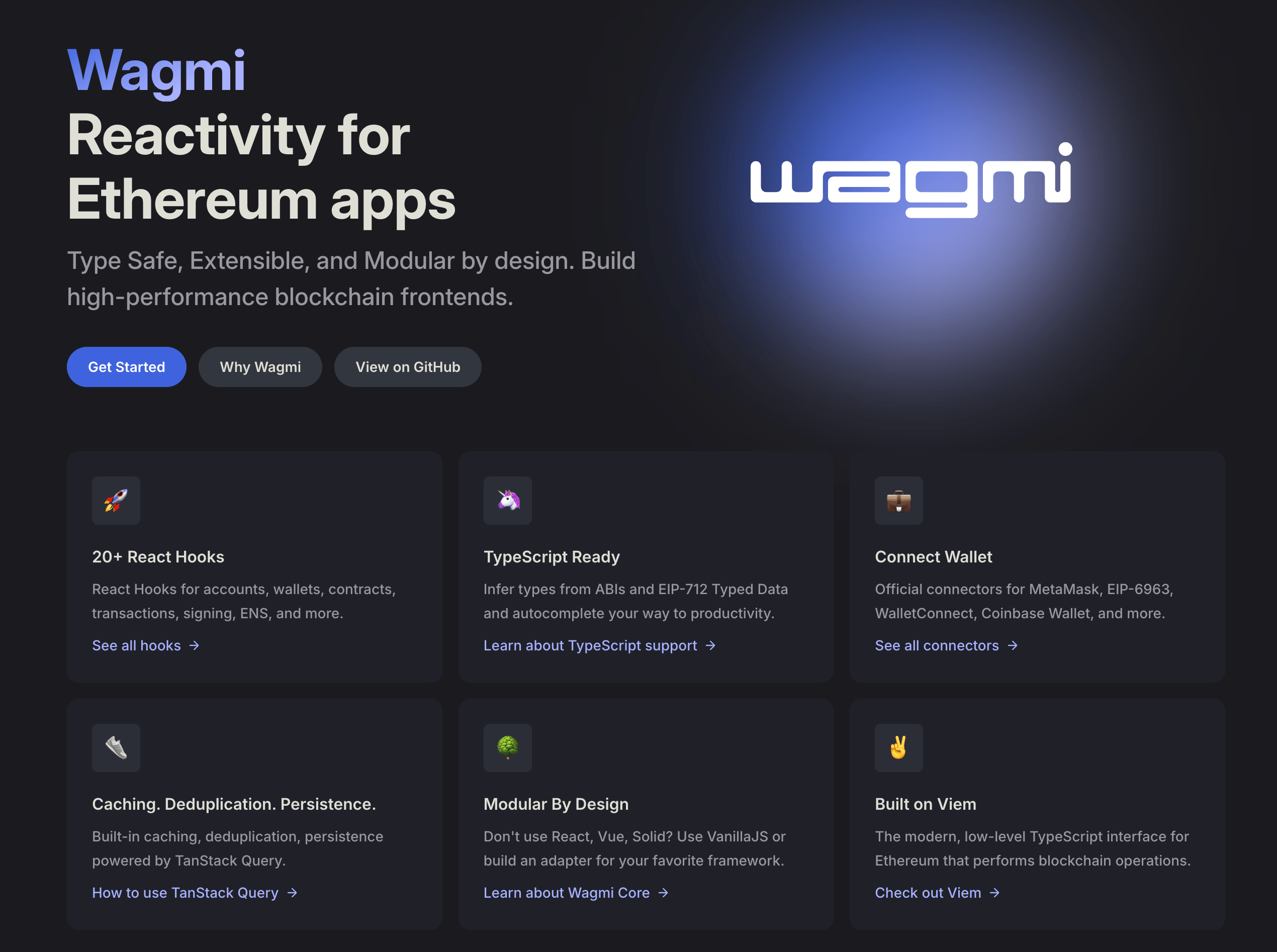
wagmi is a React hooks library for Ethereum applications. It sits above the low-level blockchain client layer and gives frontend teams hooks for wallet connections, balances, contract reads and writes, transaction status, chain switching, and common EVM app state.
For React teams, wagmi is often the practical center of the frontend stack. It works well with viem, uses TanStack Query for async state management, and reduces the amount of custom wallet and contract state code you need to maintain.
Use wagmi when:
- You are building a React or Next.js frontend.
- You need hooks for wallet connection, contract reads, contract writes, and transaction state.
- You want a typed stack that pairs well with viem.
- You want to use wallet UI libraries such as RainbowKit or Reown AppKit without wiring everything from scratch.
Watch out for:
wagmi is best when your frontend framework matches its strengths. If you are not using React, you may want to use viem directly or choose a wallet SDK that supports your target framework.
3. RainbowKit
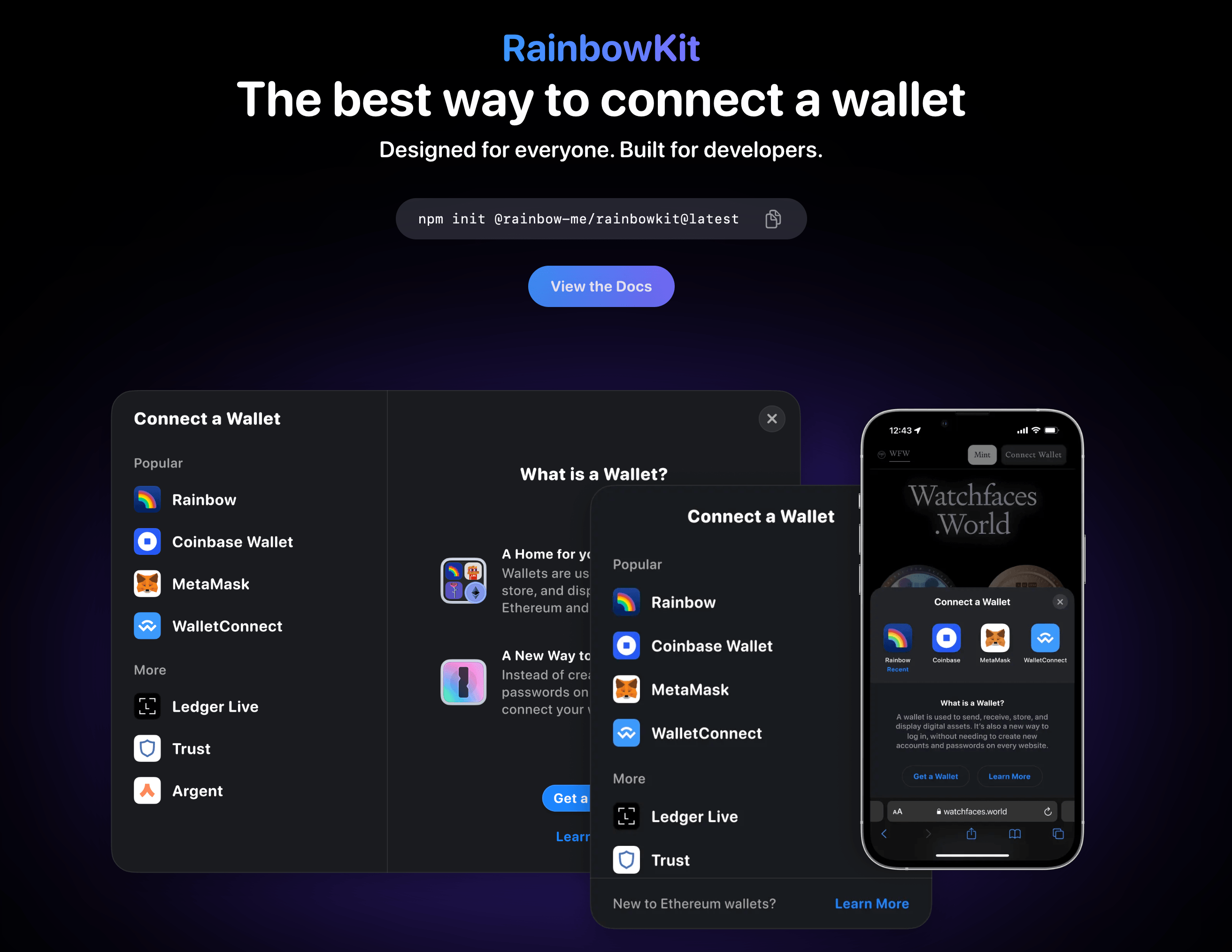
RainbowKit is a React library for adding wallet connection UI to a DApp. It handles wallet selection, connection and disconnection, chain switching, ENS display, balances, theming, and other wallet UI details that teams otherwise spend time building themselves.
RainbowKit is a strong choice when you want a polished wallet modal but still want a developer-controlled stack. It relies on viem and wagmi, so it fits well when those two already form the data and state layer of the app.
Use RainbowKit when:
- You need a wallet connection modal for a React app.
- You want good default UX without building wallet selection screens yourself.
- You already use wagmi and viem.
- Your users are familiar with browser wallets and wallet connection flows.
Watch out for:
RainbowKit is focused on wallet connection UX. If you need embedded wallets, email login, policy controls, or broader onboarding infrastructure, tools such as Privy, Dynamic, or Reown AppKit may cover more of the product surface.
4. WalletConnect
WalletConnect is the connectivity layer that lets wallets and apps communicate across many wallet environments. Its current documentation positions Wallet SDK as a modular SDK for secure, multichain, policy-aligned wallet access, with support for signing, authentication, and chain-agnostic wallet infrastructure.
For frontend teams, WalletConnect matters because users do not all arrive with the same wallet. Some use browser extensions, some use mobile wallets, and some need QR-based or deep-link wallet flows. WalletConnect helps bridge those app-to-wallet environments.
Use WalletConnect when:
- Your app needs to support many wallet types.
- You need mobile wallet and desktop app connection flows.
- You want a protocol-level wallet connection layer.
- You are building wallet infrastructure, not only a DApp frontend.
Watch out for:
Many frontend teams will use WalletConnect indirectly through RainbowKit, Reown AppKit, wagmi connectors, or another wallet UX library. Direct integration makes more sense when you need lower-level control.
5. Reown AppKit
Reown AppKit is a broader wallet and onboarding toolkit built around app connectivity. Its docs describe support across frameworks such as React, Next.js, Vue, Svelte, JavaScript, React Native, Flutter, Android, iOS, and Unity, with network coverage across EVM chains, Solana, Bitcoin, TON, and TRON depending on framework and feature.
For EVM frontend teams, Reown AppKit is useful when wallet connection is only one part of the onboarding problem. It can provide a prebuilt modal, WalletConnect protocol support, authentication options, analytics, swaps, on-ramp features, and smart account capabilities depending on the implementation.
Use Reown AppKit when:
- You want a prebuilt wallet modal with multichain support.
- You need wallet connection plus onboarding features.
- You are building across more than one frontend framework.
- You want a productized SDK instead of assembling every wallet component yourself.
Watch out for:
Reown AppKit covers a lot. Before using it, check which features are supported in your target framework and network combination. For a small React-only EVM app, RainbowKit plus wagmi may be simpler.
6. Privy
Privy is a wallet and authentication platform for applications that want to onboard users without making wallet setup the first hurdle. Its docs focus on integrating Privy wallets into apps, with SDKs across client-side, server-side, and API-based workflows.
Privy is a good fit for consumer apps, games, social products, fintech apps, and marketplaces where users may not arrive with an existing wallet. Instead of asking users to install an extension, you can build flows around embedded wallets, familiar login methods, and app-controlled wallet UX.
Use Privy when:
- You need embedded wallets.
- You want email, social login, or app-native onboarding.
- You are optimizing for mainstream users, not only crypto-native users.
- You need wallet infrastructure across frontend and backend flows.
Watch out for:
Privy moves more of the user and wallet layer into a platform. That can speed up onboarding, but teams should review custody model, security controls, export flows, policy needs, and how the wallet layer fits their compliance requirements.
7. Dynamic
Dynamic is another strong option for wallet onboarding, authentication, and user management. Its docs describe it as a complete wallet stack with low-level APIs, full SDKs, prebuilt flows, embedded wallets, external wallet support, authentication, and dashboard controls.
Dynamic is useful when you need more than a wallet modal but still want flexibility. It can support crypto-native wallet connection flows and more familiar login experiences, which makes it relevant for products that serve mixed audiences.
Use Dynamic when:
- You need a configurable wallet and authentication stack.
- You want embedded wallets and external wallet support in one place.
- You need user management, analytics, dashboard controls, or authentication policies.
- You are building onboarding flows that need to adapt by user type or chain.
Watch out for:
Like Privy, Dynamic is a product layer, not just a library. The main question is whether you want that extra onboarding surface managed through a platform or built with lower-level open-source components.
8. Coinbase Wallet SDK
Coinbase Wallet SDK is useful when Coinbase Wallet is an important wallet option for your users. Coinbase describes Coinbase Wallet as a self-custody wallet available as a browser extension and mobile app, and its developer documentation presents Coinbase Wallet SDK as an open-source SDK for connecting applications to Coinbase Wallet users.
This is not a full frontend stack by itself. It is best treated as a wallet connector that can be part of a broader setup with wagmi, viem, RainbowKit, or another wallet connection layer.
Use Coinbase Wallet SDK when:
- You want direct support for Coinbase Wallet users.
- You are building an EVM app where Coinbase Wallet is a common user wallet.
- You need browser extension and mobile wallet connection options.
- You want a connector that can sit alongside other wallet options.
Watch out for:
If your goal is broad wallet coverage, do not use a single wallet SDK as the only option. Pair it with a wallet selection layer or broader connector stack.
9. ethers.js
ethers.js is a mature JavaScript library for interacting with Ethereum and its ecosystem. It remains widely recognized, especially in older tutorials, scripts, wallet tooling, and applications that predate the current viem and wagmi-centered frontend stack.
ethers.js is still useful when your team already uses it, when a dependency expects it, or when you need a familiar general-purpose Ethereum library. It can read chain data, work with contracts, handle providers and signers, and support scripts as well as frontend applications.
Use ethers.js when:
- Your existing codebase already uses ethers.js.
- You need compatibility with older examples, plugins, or internal tooling.
- You are building scripts or integrations where the ethers.js API is already familiar to the team.
- You do not need the TypeScript-first ergonomics of viem.
Watch out for:
For new React frontends, start by evaluating viem and wagmi first. ethers.js can still be the right choice, but it is no longer the automatic default for every new EVM frontend.
10. web3.js
web3.js is the legacy JavaScript library many early Ethereum applications used to interact with local or remote Ethereum nodes over HTTP, IPC, or WebSocket connections. It supports accounts, contracts, transactions, providers, and Ethereum JSON-RPC workflows.
The important caveat is maintenance status. The official web3.js documentation says the libraries were sunset on Mar 4, 2025. That does not make existing code disappear, but it does change how teams should treat web3.js in new frontend decisions.
Use web3.js when:
- You maintain an older app that already depends on it.
- You need to understand or migrate a legacy Ethereum frontend.
- You are working with examples or dependencies that still expect web3.js.
Watch out for:
Do not choose web3.js as the default for a new EVM frontend unless you have a specific compatibility reason. For new builds, viem, wagmi, and modern wallet SDKs are usually better starting points.
Suggested stacks by use case
React DApp with wallet connection
Use:
- viem for typed RPC and contract operations.
- wagmi for React hooks and EVM app state.
- RainbowKit for wallet connection UI.
- Chainstack RPC endpoints for supported EVM chains.
This is the cleanest default stack for many EVM teams.
Consumer app with embedded wallets
Use:
- Privy or Dynamic for embedded wallets and authentication.
- viem or wagmi for EVM reads, writes, and transaction state.
- Chainstack RPC endpoints for production network access.
This is the better pattern when users may not already have a wallet.
Multichain app with prebuilt onboarding
Use:
- Reown AppKit for a prebuilt wallet and network experience.
- WalletConnect for wallet protocol support.
- viem or wagmi where you need lower-level EVM app logic.
- Chainstack RPC endpoints for EVM chains your app supports.
This works when you want faster onboarding across multiple chains and wallet environments.
Existing Ethereum codebase
Use:
- ethers.js if the existing codebase already depends on it.
- web3.js only for maintenance or migration work.
- viem and wagmi as the likely modernization path for new frontend modules.
How to choose
Start with the user flow, not the library.
If your users are crypto-native and already have wallets, a stack like viem, wagmi, and RainbowKit is usually enough. If your users are mainstream consumers, embedded wallets and social login may matter more than wallet selector customization, so Privy or Dynamic may be a better foundation.
If you need a wallet protocol layer, WalletConnect is still important. If you want a larger prebuilt onboarding surface, Reown AppKit may save time. If your app has older Ethereum code, ethers.js can remain useful, while web3.js should mostly be treated as a legacy dependency because of its sunset status.
Whatever you choose, do not let public RPC endpoints become the weak link in your frontend. A wallet modal and contract hooks still need reliable RPC access for reads, simulations, transaction status, and chain-specific UX. Connect your frontend stack to production-grade RPC endpoints for the chains you support.
How Chainstack fits into your EVM frontend
Frontend tools handle wallet connections and contract interactions. Chainstack provides the EVM access layer behind them. Connect RPC and WebSocket endpoints for contract reads, transaction submission, event subscriptions, and real-time application state, then give your frontend a dependable path from a user action to confirmed onchain activity.