AI-ready infrastructure
 Refer and earn


 Ethereum
 Hyperliquid
 Solana
 Arbitrum
 BNB Smart Chain
 Base
Base Polygon
 TRON
TRON Sui
Sui Robinhood


What we shipped to Chainstack Self-Hosted in July

Nine releases, six new networks, eleven new deployment targets, and full Robinhood Chain support across managed and self-hosted — July was our densest month since Self-Hosted launched. The release cadence averaged one every three days, and the platform nearly doubled its multi-chain footprint.
Robinhood Chain: managed and self-hosted from launch
Robinhood Chain launched in July with an Ethereum L2 aimed at tokenized stocks and real-world assets. Chainstack shipped full support across managed RPC and Self-Hosted — both deployment models available on the same platform.
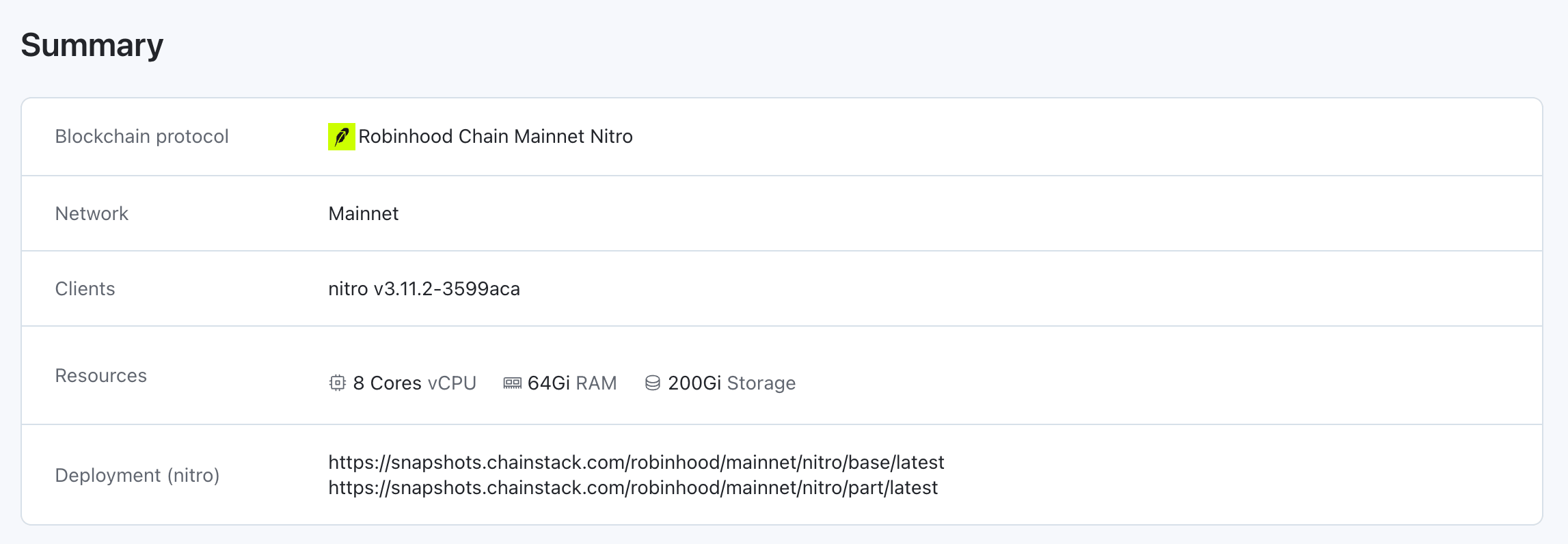
Mainnet and Testnet ship with snapshot bootstrap out of the box — a first for the Nitro family on Self-Hosted, and until this release snapshot bootstrap only covered Ethereum and OP Mainnet. Nitro sizing lands at 4–8 vCPU, 32–64 GiB RAM, 200–300 GB storage. Because the Nitro component is config-driven, the same foundation extends cleanly to other Nitro-based chains as they land.
Five more networks on the deploy menu
Beyond Robinhood Chain, July added Polygon (mainnet) plus Arbitrum, Sui, Tempo, and Plasma — mainnet and testnet each — for a total of nine additional deployment targets alongside the two Robinhood Chian networks.
| Protocol | Highlights | Sizing |
|---|---|---|
| Polygon | Bor + Heimdall as a matched pair | 12 vCPU, 64 GiB, ~5.5 TB |
| Arbitrum | Arbitrum One + Sepolia, Nitro client, snapshot-accelerated sync | 4–8 vCPU, 32–64 GiB, 200 GB – 2.5 TB |
| Sui | Mainnet + Testnet, official Sui full node, snapshot-accelerated sync, gRPC + JSON-RPC on one port | 16 vCPU, 64 GiB, 400 GB – 2.2 TB |
| Tempo | Archive mode with debug and trace, snapshot bootstrap from client software, Mainnet + Testnet | 4 vCPU, 16 GiB, 70 GB – 1.1 TB |
| Plasma | Reth for execution + PlasmaBFT consensus, syncs from genesis | 5 vCPU, 20 GiB, 250–350 GB |
Every new deployment ships with the same Chainstack-managed control plane June operators already know: self-healing, in-console monitoring, tracked configuration revisions, and one-click deploy. Full per-chain sizing and endpoint configuration in the supported deployments catalog.
Operator quality-of-life in the Control Panel
Three UX shifts operators feel every day.
Notification center. A bell icon in the Control Panel header now surfaces an unread badge, opens a slide-in drawer, and links to a dedicated notifications page grouped by date. When a newer version of a supported client or of the Control Panel itself becomes available, you get notified in-console — no more tracking releases elsewhere. cpctl picked up the same behavior, so CLI users get parity with the UI.
Custom node sizing at deploy time. The deployment wizard now includes a custom-configuration option. Instead of accepting a preset as-is and reconfiguring after deploy, you can edit CPU, RAM, storage, and client-specific settings per component before the node comes up. The summary step shows a per-component diff of everything you changed, and edits are preserved if you navigate back to adjust.
Server-side session revocation. Signing out now revokes tokens on the server rather than only clearing them from the browser. Revoked tokens are tracked in a dedicated store and rejected on subsequent requests — closing the window where a previously issued token could still be used after logout.
Reliability and infrastructure work
The infrastructure layer got a substantial workover in July.
- Zero-downtime control-plane upgrades — the deployments API, workflow engine, and tracer now roll out one instance at a time. Upgrading the Control Panel no longer interrupts running operations, which makes routine platform maintenance safe to run during business hours.
- Ethereum reth: archive → full mode — Ethereum Mainnet and Sepolia reth presets now run in full mode rather than archive, matching the pruned snapshots they restore from. Full mode retains roughly the most recent 10,000 blocks of receipts. Hoodi is unaffected and continues to run in archive mode.
- TRON stability — TRON nodes restored from a pruned RocksDB snapshot no longer crash-loop on startup, and TRON logs now stream to standard output so
kubectl logsshows what the node is actually doing. - Polygon Heimdall retention — Heimdall nodes now ship with state pruning and block retention configured out of the box. The blockstore stays bounded instead of growing unbounded after a snapshot restore.
- Snapshot restore reliability — single-file compressed snapshots now extract correctly during download, restored filenames are preserved end to end, orphaned artifacts from interrupted restores get cleaned up automatically, and snapshot data sources can target specific placement per source entry.
- Snapshot or genesis toggle — you can now choose per deployment whether to sync from a snapshot or from genesis. Clients that ship a snapshot default to it, and the deployment summary shows the choice explicitly.
Three new guides from July:
- Learn how to cut RPC costs with a hybrid self-hosted and cloud setup — pair a self-hosted full node with a Chainstack Cloud archive node behind a single eRPC endpoint. Recent traffic hits your hardware; archive-only methods and pruned-state failover go to Cloud.
- When self-hosting a Base node actually pays off — the case for a self-hosted Base node for stablecoin settlement and AI agent workloads, and what the post-Azul base/base client stack looks like in production today.
- What the case against self-hosting gets wrong — the five arguments people still make against running your own nodes (cost, upgrades, DevOps overhead, reliability, firefighting) and where each one holds up when the tooling has moved on.
Try Chainstack Self-Hosted
That’s it for July. Want the same node operations layer on infrastructure you control, across the growing chain lineup? Get started with Chainstack Self-Hosted and deploy your first node with monitoring, updates, and self-healing.
Read more
Full July changelog:
From the blog:
- What we shipped to Chainstack Self-Hosted in June
- Chainstack introduces Robinhood Chain support
- Introducing Chainstack Self-Hosted
Docs: