AI-ready infrastructure
 Refer and earn


 Ethereum
 Hyperliquid
 Solana
 Arbitrum
 BNB Smart Chain
 Base
 Polygon
 TRON
 Sui
 Robinhood


Solana RPC provider scores for indexers (November 2026)

Data sources: the Chainstack Compare scorecard and the 7-day dashboard, both read on Nov 10, 2026. The scorecard page shows no timestamp.
Abstract
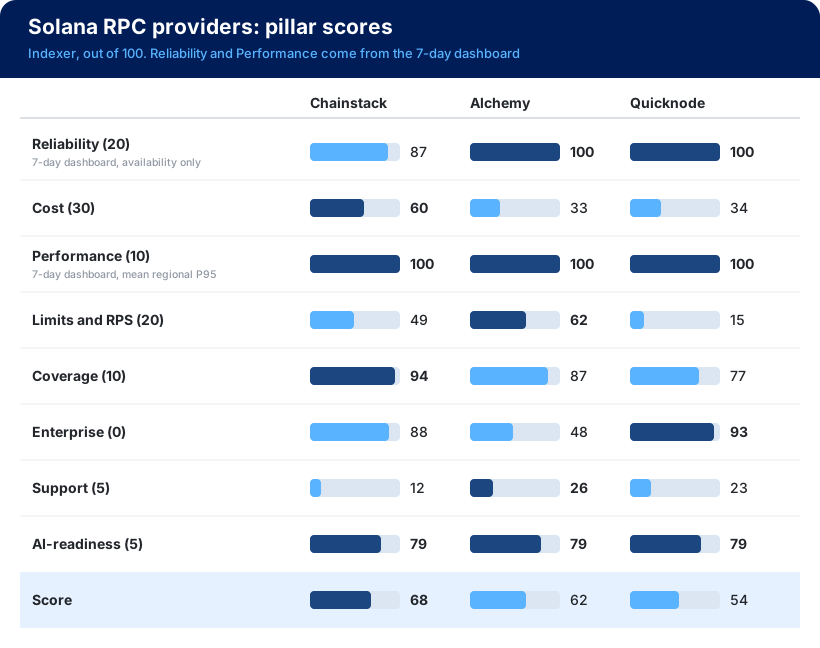
These Solana RPC provider scores for indexers show Chainstack at 68 out of 100, Alchemy at 62 and Quicknode at 54 on the Compare scorecard. The score rests on 80% of the weight, because freshness, correctness and the spike test are not yet scored. Chainstack publishes the scorecard and is one of the three providers compared.
Key findings
- Chainstack scores 68, 6 points ahead of Alchemy (62) and 14 ahead of Quicknode (54), on 80% of the weight.
- Cost carries 30 of 100 weight for indexers. Chainstack's Cost score is 60, against 34 for Quicknode and 33 for Alchemy, at $4.87 per 1M requests against $16.64 and $12.74.
- Alchemy leads Limits and RPS with 62 against Chainstack's 49, at 408 RPS on pay-as-you-go against 50 RPS on both Growth and Build plans at $49.
- Quicknode and Alchemy score 100 on Reliability from availability alone, against 87 for Chainstack, whose Frankfurt probe succeeded 99.945% of the time over the 7 days.
- All three score 100 on Performance: the mean regional P95 is 41.5 ms for Chainstack, 47.8 ms for Quicknode and 69.8 ms for Alchemy, all under the 80 ms ceiling.
Verdict and best for
| Rank | Provider | Score | Best for | Trade-off |
|---|---|---|---|---|
| 1 | Chainstack | 68 | Lowest cost per 1M requests, widest coverage, flat-fee unlimited RPS option | Support score 12, Reliability 87 |
| 2 | Alchemy | 62 | Highest RPS on a roughly $50 plan, 100% availability this week | Cost score 33, Singapore P95 146.7 ms |
| 3 | Quicknode | 54 | Enterprise terms (SLA, SSO, RBAC), 100% availability to the page's rule | Cost score 34, Limits and RPS score 15 |
Higher is better. The highest score is in bold.
Contents
- How the score is built
- Solana RPC provider scores: pillar table
- Solana RPC provider comparison by pillar
- Reliability and Performance from the 7-day dashboard
- Conclusion
- Appendix: weights and rules
- Other RPC providers
How the score is built
Each provider gets one score: the weighted mean of eight pillars, using the weights the Compare page sets for the Indexer use case. Each weight is scaled by the share of that pillar that has data.
What the scorecard scored
- Six pillars from the page. Cost, Limits and RPS, Coverage, Enterprise, Support and AI-readiness come from the Compare scorecard. Chainstack, the publisher, is one of the three providers scored.
- Hand-compiled evidence. Cost, limits, coverage, enterprise, support and AI-readiness are compiled by hand from public pages. The page says to confirm prices and limits with each provider.
- Enterprise has weight 0. The Indexer use case gives the Enterprise pillar no weight, so it does not move the score. The Enterprise pillar is shown for completeness.
What this report adds
- Two pillars from the dashboard. The page showed Reliability and Performance as not scored on Nov 10, 2026. This report computes both from the 7-day dashboard window read on the same day, with the page's published formulas.
- Reliability rests on availability alone. Availability is 40% of the Reliability pillar, so Reliability counts for 40% of its weight (8 of 20 points).
- Performance rests on P95 latency alone. That is 100% of the pillar, so it counts for its full weight (10 points).
- Why the totals differ. On the six static pillars alone, the page's own formula gives 61 for Chainstack, 40 for Quicknode and 50 for Alchemy. That total excludes live Reliability and Performance, which is why it differs from the scores here.
What the dashboard measures
- Scope. Three probe regions (Frankfurt, US West, Singapore), the first paid plan of each provider, no end-user latency and no correctness measurement.
- Window. 7 days, Nov 3, 2026–Nov 10, 2026. Availability is the mean of the three regional success rates, and latency is the mean of the three regional P95 values.
- Providers left out. The dashboard also lists Helius and dRPC. The scorecard does not score Helius or dRPC, so neither appears in this report.
How to read the numbers
- Scored share. The score rests on 80% of the weight. Unscored are freshness, correctness and separate error-rate measurement (12 points of Reliability weight) and the behavior-under-spike test (8 points of Limits weight), which needs a load test the page does not run.
- Rounding. Scores are shown as whole numbers and rounded for display. A gap under 3 unrounded points is a tie by the page's own rule. The 6-point lead here is 6.9 points unrounded.
- Direction. Higher scores are better. In the pillar tables the best value in each row is in bold: the highest score, and the lowest price.
Solana RPC provider scores: pillar table
Chainstack scores 68, Alchemy 62 and Quicknode 54. Pillars marked "dashboard" are computed from the 7-day dashboard; the others are the page's own values.
| Pillar | Weight | Source | Chainstack | Quicknode | Alchemy |
|---|---|---|---|---|---|
| Reliability (availability only) | 20 (40% scored) | dashboard | 87 | 100 | 100 |
| Cost | 30 | page | 60 | 34 | 33 |
| Performance | 10 | dashboard | 100 | 100 | 100 |
| Limits and RPS (60% scored) | 20 | page | 49 | 15 | 62 |
| Coverage | 10 | page | 94 | 77 | 87 |
| Enterprise | 0 | page | 88 | 93 | 48 |
| Support | 5 | page | 12 | 23 | 26 |
| AI-readiness | 5 | page | 79 | 79 | 79 |
| Score | 80% of weight | 68 | 54 | 62 |
Solana RPC provider comparison by pillar
Cost
Cost carries 30 of 100 weight for indexers, the largest of any pillar. Chainstack leads with 60, Quicknode scores 34 and Alchemy 33. Lower prices are in bold.
| Metric | Share | Chainstack | Quicknode | Alchemy |
|---|---|---|---|---|
| $ per 1M requests, Solana mix, compute only | 70% | $4.87 (score 53), Growth | $16.64 (score 17), Accelerate | $12.74 (score 25), Pay As You Go |
| Bill predictability | 20% | 100: overage, no multipliers, archive 2× | 100: overage, flat 20/30 credits per network, no archive surcharge | 70: overage, 10–60 CU depending on method, no archive surcharge |
| Archive and history, $ per 1M | 10% | $10.65 (score 30) | $16.64 (score 17) | $20.80 (score 11) |
The monthly benchmark is 18.69M calls.
Limits and RPS
Limits and RPS carries 20 of 100 weight for indexers and is 60% scored. Alchemy leads with 62, Chainstack scores 49 and Quicknode 15.
| Metric | Share | Chainstack | Quicknode | Alchemy |
|---|---|---|---|---|
| RPS on a roughly $50 plan | 40% | 23: 50 RPS, Growth $49 | 23: 50 RPS, Build $49 | 93: 408 RPS, pay-as-you-go |
| Behavior under spike (2× limit) | 40% | not scored: load test required | not scored: load test required | not scored: load test required |
| Flat-fee or unlimited RPS | 20% | 100: Unlimited Node, 25–500 RPS, from $149/mo | 0: no self-serve option | 0: Enterprise from 1,000 RPS by contract |
Coverage
Coverage carries 10 of 100 weight. Chainstack scores 94, Alchemy 87 and Quicknode 77.
| Metric | Share | Chainstack | Quicknode | Alchemy |
|---|---|---|---|---|
| Listed chain count | 30% | 98: 93 listed protocols | 91: 77 catalogue chains | 90: 75 mainnets |
| Archive on Solana | 10% | 100 (Growth and above) | 100 (all plans) | 100 (all plans) |
| WebSocket | 10% | 100 | 100 | 100 |
| gRPC and streams | 10% | 100: Yellowstone gRPC add-on from $49 | 100: Yellowstone gRPC add-on; Streams on all plans | 100: Yellowstone gRPC at $75/TB |
| Dedicated nodes | 10% | 100: self-serve from Pro, $0.50/h | 50: Enterprise only | 50: sales only |
| Region selection | 10% | 100 | 50: dedicated only | 50: dedicated only |
| MEV protection | 10% | 50: Warp speeds up sendTransaction, not front-running protection | 0: not disclosed | 100: on by default |
| Testnets and faucet | 10% | 100 | 100 | 100 |
Enterprise
Enterprise has weight 0 for indexers, so it does not move the score. Quicknode scores 93, Chainstack 88 and Alchemy 48.
| Metric | Share | Chainstack | Quicknode | Alchemy |
|---|---|---|---|---|
| SOC 2 Type II | 25% | 100 | 100 | 100 |
| ISO 27001 | 10% | 100 | 100 | 0 |
| SLA of 99.9% or more with credits | 25% | 100: 99.9% | 100: 99.99%, Enterprise only | 0: percentage not disclosed |
| SSO, RBAC and audit log | 15% | 67: audit log not documented | 100 | 100 |
| Single-tenant and jurisdiction | 15% | 50 | 50 | 50 |
| Status page with 90 days of history | 10% | 100 | 100 | 0: history under 90 days |
Support
Support carries 5 of 100 weight. Alchemy scores 26, Quicknode 23 and Chainstack 12, the lowest on the scorecard for this pillar.
| Metric | Share | Chainstack | Quicknode | Alchemy |
|---|---|---|---|---|
| Response time, roughly $50 plan | 50% | 0: under 24 h, 24×5 | 18: 24-hour SLA | 18: 24 h |
| Response time, roughly $500 plan | 30% | 0: under 24 h, 24×5 | 46: 8-hour SLA | 18: 24 h |
| Channels and coverage | 20% | 60 | 0 | 60 |
AI-readiness
AI-readiness carries 5 of 100 weight. All three score 79.
| Metric | Share | Chainstack | Quicknode | Alchemy |
|---|---|---|---|---|
| MCP, 5 reference tasks | 35% | 80: 4 of 5 | 40: 2 of 5 | 40: 2 of 5 |
| Docs for LLMs | 25% | 100 | 100 | 100 |
| Machine-readable pricing | 15% | 100 | 100 | 100 |
| Skills and plugins | 10% | 50 | 100 | 100 |
| Agent self-serve and payments | 15% | 40: no x402, pay-as-you-go through sales only | 100 | 100 |
Reliability and Performance from the 7-day dashboard
These two pillars are computed from the 7-day dashboard (Nov 3, 2026–Nov 10, 2026), not taken from the page.
Reliability, availability only
Availability is the mean of three regional success rates. Reliability is 100 at 99.99% or above, 0 at 99% or below, and scaled between. Higher is better.
| Provider | Frankfurt | US West | Singapore | Mean availability | Reliability score |
|---|---|---|---|---|---|
| Chainstack | 99.945% | 100% | 100% | 99.982% | 87 |
| Quicknode | 100% | 99.990% | 99.990% | 99.993% | 100 |
| Alchemy | 100% | 100% | 100% | 100.000% | 100 |
Chainstack scores lower here: one 99.945% region pulls its mean below the 99.99% line. The single-rate snapshot shows 99.987% for Chainstack, 99.994% for Quicknode and 100.000% for Alchemy.
Performance, mean regional P95
Performance is 100 at a mean P95 of 80 ms or below and 0 at 1,500 ms or above. Lower latency is in bold.
| Provider | Frankfurt | US West | Singapore | Mean P95 | Performance score |
|---|---|---|---|---|---|
| Chainstack | 29.4 ms | 54.4 ms | 40.7 ms | 41.5 ms | 100 |
| Quicknode | 26.0 ms | 53.3 ms | 64.1 ms | 47.8 ms | 100 |
| Alchemy | 24.6 ms | 38.3 ms | 146.7 ms | 69.8 ms | 100 |
All three are under the 80 ms ceiling, so the score does not separate them. Alchemy's Singapore P95 is 146.7 ms, the highest regional value.
Conclusion
Chainstack has the highest score on this scorecard for a Solana indexer: 68 against 62 for Alchemy, a 6-point lead, on 80% of the weight. Cost, the heaviest pillar for indexers, drives most of that lead.
- Cost: Chainstack, 60, at $4.87 per 1M requests.
- Limits and RPS: Alchemy, 62, at 408 RPS on pay-as-you-go.
- Coverage: Chainstack, 94.
- Reliability: Quicknode and Alchemy tie at 100; Chainstack is 87.
- Performance: all three tie at 100.
- Support: Alchemy, 26; Chainstack scores lowest at 12.
- AI-readiness: all three tie at 79.
- Enterprise: Quicknode, 93, with weight 0 for indexers.
A reader who weights Limits and RPS or Reliability above Cost may rank Alchemy first. Freshness, correctness and the spike test remain unscored.
Appendix: weights and rules
| Pillar | Indexer weight | Scored share |
|---|---|---|
| Reliability | 20 | 40% (availability only) |
| Cost | 30 | 100% |
| Performance | 10 | 100% |
| Limits and RPS | 20 | 60% |
| Coverage | 10 | 100% |
| Enterprise | 0 | 100% |
| Support | 5 | 100% |
| AI-readiness | 5 | 100% |
Score = Σ(weight × scored share × pillar score) ÷ Σ(weight × scored share). Performance = 100 × ln(1500 ÷ m) ÷ ln(1500 ÷ 80) for mean P95 m in ms, between 80 ms and 1,500 ms. Reliability = 50 × (−log10(1 − a) − 2) for success fraction a, between 0.99 and 0.9999.
Other RPC providers
The scorecard scores only the providers in this report. These Chainstack lists cover others.
- Best RPC providers 2026: 10 options compared
- Top 5 Alchemy alternatives in 2026: compute-unit pricing vs flat billing
- Top 5 Quicknode alternatives in 2026: credits vs request units, free tiers and archive access
- Top 6 Helius alternatives in 2026: getProgramAccounts costs, gRPC streaming and RPS limits