AI-ready infrastructure
 Refer and earn


 Ethereum
 Hyperliquid
 Solana
 Arbitrum
 BNB Smart Chain
 Base
Base Polygon
 TRON
TRON Sui
Sui Robinhood


What is Firedancer on Solana? Architecture guide

Introduction
Solana has always been fast, but fast and resilient are different things. For most of its history, Solana has relied heavily on a dominant validator client, Agave, which meant the network had limited client diversity and shared similar failure modes. Firedancer, the new high-performance client built by Jump Crypto, changes that.
There’s a second benefit that’s easy to overlook. Solana’s historical weakness wasn’t just outages, it was spam. When transaction fees are low and throughput is constrained, flooding the network with junk is a cheap and effective attack. Firedancer’s raw performance raises that cost significantly. Higher throughput makes spam-based denial-of-service attacks more expensive and less effective, which strengthens the network’s security posture.
Frankendancer to Firedancer 1.0
Before Firedancer shipped in full, there was Frankendancer. A hybrid client that grafted Firedancer’s C-based networking layer onto Agave’s Rust execution engine, giving validators an intermediate path before the full client was ready. It was a deliberate stepping stone, letting validators begin adopting parts of Firedancer’s architecture without waiting for the complete rewrite. But the performance ceiling was always going to be limited by whichever half was slower, and that was Agave’s execution layer. Firedancer’s headline throughput claims depend on the fully integrated client, rather than the hybrid Frankendancer setup.
The 33% stake-weight threshold is where client diversity stops being theoretical. Below it, Agave still holds a superminority, meaning a consensus failure there could halt the chain with nothing to counteract it. Once Firedancer clears that mark, no single client can do that alone.
The Architectural shift from monolith to tiles
Agave runs as a single process. Everything, networking, execution, consensus, shares the same memory space and competes for the same resources. Firedancer scraps that design entirely. Instead, Firedancer breaks work into isolated tiles, each responsible for a narrow task and mapped to dedicated CPU resources to reduce contention.
Memory is handled the same way. Rather than relying on standard heap allocation, which introduces non-deterministic latency every time the allocator has to find and return memory, Firedancer pre-allocates everything upfront in hugepages. Memory is pre-allocated up front, which helps avoid the latency spikes that can come from runtime allocation.
Core assignment follows the same logic, with tiles placed based on physical proximity to the NIC to minimise cross-socket memory access and keep the hot path as short as possible. The goal throughout is to eliminate every source of unpredictable latency at the architectural level, not patch it after the fact.
The networking layer: bypassing the kernel
Every packet Agave processes takes a round-trip through the Linux kernel’s networking stack. That overhead is manageable at moderate throughput and punishing at scale. Firedancer minimizes kernel overhead using technologies such as AF_XDP and eBPF to move packet handling closer to userspace and the NIC. The throughput ceiling becomes the hardware itself, not the software sitting in front of it.
Signature verification gets the same treatment. Ed25519 verification is expensive at scale, and Firedancer uses SIMD-accelerated signature verification to process signatures in parallel batches rather than sequentially. For a network where every transaction carries a signature that needs verifying, this is one of the more consequential performance decisions in the entire stack.
What this means for infrastructure operators
Firedancer’s architecture only delivers on its promises if the environment underneath it is configured to match. The tile model assumes uncontested access to hardware, and that assumption breaks the moment the OS starts interfering. In practice, running Firedancer well means disabling hyperthreading, isolating cores from the kernel scheduler, and setting CPU affinity so each tile owns its assigned core without interruption. These aren’t optional performance tweaks.
The more interesting question is what the efficiency gains actually mean economically. Two outcomes are possible and they have different implications. If Firedancer lowers the hardware floor so operators can hit the same performance targets on cheaper infrastructure, it could reduce the cost of running a competitive node and broaden validator participation. If it instead raises the ceiling on what high-end hardware can do without improving the economics at the lower end, the gains accrue primarily to well-capitalised operators. Which of those plays out in practice will matter more for network decentralisation than the TPS headline ever will. The signal to watch is mid-tier validator hardware. If operators running commodity infrastructure start hitting performance targets that previously required high-end nodes, the floor is moving. If the gains stay concentrated at the top end, the ceiling is. Chainstack’s managed nodes sit in a useful position here, abstracting the hardware question for teams who need reliable RPC access without committing to a validator setup while that plays out.
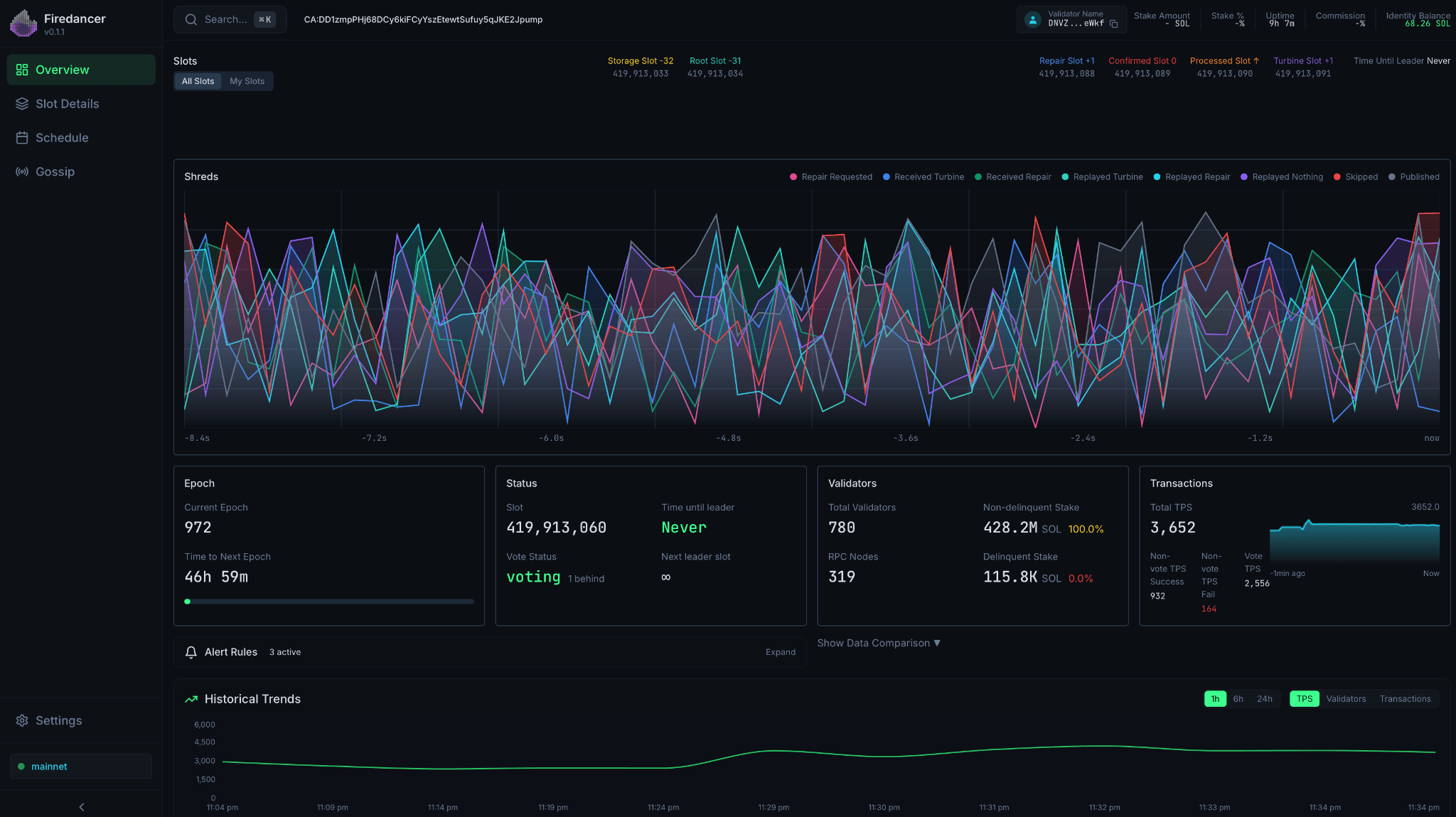
Observability gets a significant upgrade regardless. Firedancer’s monitoring and GUI surfaces tile-level operational data that gives operators a much clearer view of where the node is slowing down. Instead of relying only on broad node-wide signals, you can inspect the specific tile or processing stage that is backing up, which makes performance troubleshooting far more precise. In practice, that means bottlenecks can be identified directly rather than inferred from aggregate CPU load or other coarse metrics.
The RPC layer still matters
Firedancer raises the throughput ceiling at the validator layer. But that ceiling isn’t what application developers run into day to day — they work through RPC endpoints, and the properties that matter there are different: consistent latency under load, predictable response times when the network is busy, stability when block production is fast and irregular.
Here’s the counterintuitive part: as Firedancer pushes throughput higher and Alpenglow compresses block times, the gap between a well-managed RPC endpoint and a noisy one gets wider, not smaller. More blocks per second means more state changes per second, more concurrent requests, more pressure on the infrastructure sitting between your application and the chain. A faster validator layer doesn’t absorb that pressure — it increases it.
That’s where Chainstack’s Solana RPC comes in. Not as an afterthought to the validator client discussion, but as the layer that actually determines what developers experience when the underlying network changes beneath them.
Firedancer and the broader Solana roadmap
Firedancer doesn’t exist in isolation. Alpenglow, Solana’s proposed consensus overhaul, introduces Rotor as its broadcast layer and targets sub-second finality. Those goals are much easier to pursue with a client that can keep up. Firedancer’s throughput and latency profile complements Alpenglow and helps make its targets more realistic. Without a client capable of sustaining that performance under real network conditions, the finality targets stay theoretical.
For application developers, sub-second finality changes what’s buildable. Onchain interactions that currently require optimistic UI updates to feel responsive become genuinely low-latency. Confirmation times stop being a UX constraint you design around.
The implications sharpen when you look at SIMD-0370, an actively debated proposal that would remove the block-level compute cap. The discussion is ongoing and contested, with objections raised around validator economics, self-throttling, and centralization risk, but if passed, it would reduce one of the fixed software ceilings on how much work the network can do per block. What replaces it is Firedancer’s parallel execution capacity, which means the fee market’s actual governor shifts from a hardcoded rule to the physical limits of the hardware validators are running. That’s a meaningful change in how the network’s constraints are defined. A software cap can be raised or lowered by governance vote. A hardware-defined limit is determined by what the infrastructure can actually sustain, which ties network economics directly to the performance characteristics of the validator set in a way they haven’t been before.
Quantum readiness: Falcon comes to Firedancer
Firedancer’s architecture also positions Solana well for a challenge that isn’t immediate but isn’t distant either: quantum computing. In April 2026, Anza and Firedancer both independently concluded that protocol-level quantum readiness should be built in before it’s needed. Both teams landed on Falcon, a post-quantum signature scheme selected by NIST, with Firedancer’s team noting that its compact signature size makes it a natural fit for a high-throughput network. The transition is not expected to meaningfully affect throughput, which says something about how the architecture was built from the start.
Conclusion
The 1M TPS number gets the attention, but it’s the wrong thing to focus on. No application needs a million transactions per second today, and benchmarks run under controlled conditions tell you less than you’d think about how a system behaves under adversarial load or network partitions that actually stress production infrastructure.
Firedancer is a ground-up rewrite built on different assumptions. Isolated processes, pre-allocated memory, kernel bypass networking, SIMD signature verification, hardware-aware tile placement. None of these are optimisations bolted onto an existing design and they reflect a different starting point by taking hardware seriously.
The more consequential changes are structural. If SIMD-0370 passes and removes the compute cap, the fee market will be governed by what validators can physically process, and that makes the performance gap between clients an economic variable, not just an operational one. Alpenglow’s finality targets assume a client underneath them that can sustain the throughput. And the 33% threshold, once crossed, changes what a single-client failure can actually do to the network. Firedancer looks less like the conclusion of Solana’s infrastructure work and more like the foundation that makes the rest of the roadmap more achievable.
Reliable Solana RPC node infrastructure
Getting started with Solana on Chainstack is fast and straightforward. Developers can deploy a reliable Solana node within seconds through an intuitive Console — no complex setup or hardware management required.
Chainstack provides low-latency Solana RPC access and real-time gRPC data streaming via Yellowstone Geyser Plugin, ensuring seamless connectivity for building, testing, and scaling DeFi, analytics, and trading applications. With Solana low-latency endpoints powered by global infrastructure, you can achieve lightning-fast response times and consistent performance across regions.
Start for free, connect your app to a reliable Solana RPC endpoint, and experience how easy it is to build and scale on Solana with Chainstack – one of the best RPC providers.
FAQ
Firedancer is a high-performance Solana validator client built from scratch in C by Jump Trading. Unlike Agave, which is the dominant Rust-based client, Firedancer uses an isolated tile architecture, kernel-bypass networking, and pre-allocated memory to minimize latency and maximize throughput. It runs independently of Agave, which increases client diversity on the network.
Agave runs as a monolithic process — networking, execution, and consensus share the same memory space. Firedancer separates work into isolated tiles, each mapped to dedicated CPU resources. Firedancer also bypasses the Linux kernel for packet processing using AF_XDP and eBPF, and handles Ed25519
Frankendancer is a hybrid validator client that combines Firedancer’s C-based networking layer with Agave’s Rust execution engine. It was released as an intermediate step before the full Firedancer client was ready, giving validators a way to adopt parts of Firedancer’s architecture without waiting for the complete rewrite. Its performance ceiling is limited by Agave’s execution layer, unlike the fully integrated Firedancer client.
Yes. Firedancer reached Solana mainnet in 2025. The full client — not the Frankendancer hybrid — is now available for validators to run. The key threshold to watch is whether Firedancer’s stake weight crosses 33%, at which point no single client can halt the network alone.
Firedancer’s tile architecture assumes uncontested access to CPU cores, which means standard cloud configurations may not deliver the expected gains without tuning. In practice, running Firedancer well requires disabling hyperthreading, isolating cores from the kernel scheduler, and configuring CPU affinity so each tile owns its assigned core. These are requirements, not optional tweaks.
Related reading