AI-ready infrastructure
 Refer and earn


 Ethereum
 Hyperliquid
 Solana
 Arbitrum
 BNB Smart Chain
 Base
Base Polygon
 TRON
TRON Sui
Sui Robinhood


Top 6 World Chain RPC providers for production apps in 2026

World Chain is the OP Stack Layer 2 built by Tools for Humanity to give verified humans priority access to on-chain applications, secured by World ID zero-knowledge proofs of personhood. In 2026 it hosts the Mini Apps platform inside World App, which reaches millions of World ID-verified users.
That consumer scale is exactly what makes World Chain RPC provider choice matter more than usual. A chain optimized for millions of real people running mini apps generates a very different request profile from a DeFi-only L2 — spiky read traffic, wallet-driven eth_call bursts, sybil-resistant airdrops that hammer the log APIs, and identity-gated flows that cannot afford a dropped transaction during onboarding. World Chain also settles to Ethereum through the Optimism Superchain and runs world-chain, World’s OP Stack execution client built on Reth, so the RPC surface is standard Ethereum JSON-RPC — but the throughput and consistency demands are anything but standard.
This guide compares six World Chain RPC providers for production teams in 2026 — evaluating archive and trace access, dedicated infrastructure, pricing transparency, uptime guarantees, and compliance so you can match the right endpoint to your workload.
💡 Already using Chainstack? Jump straight to deploying your endpoint in minutes.
Why RPC provider choice matters for World Chain
World Chain’s defining property — priority for verified humans — pushes application traffic toward patterns that punish weak infrastructure. Sybil-resistant airdrops and identity-gated grants create synchronized demand spikes when a campaign opens: thousands of verified wallets simultaneously scanning eligibility via eth_getLogs, reading contract state via eth_call, and submitting claims via eth_sendRawTransaction. A shared endpoint that throttles at peak hours turns a launch moment into a support incident. Because World Chain applications are consumer-facing rather than trader-facing, the failure mode is visible to real users, not just to bots.
The chain’s OP Stack lineage sets a technical baseline that not every provider meets consistently. World Chain exposes the full eth, net, web3, debug, and trace namespaces, but not txpool — so mempool-dependent tooling needs to be designed around that gap. Archive and trace access is a separate consideration entirely: teams reconciling airdrop distributions, auditing World ID-gated grant flows, or indexing the full history of a mini app need historical state, and that requires an archive node, not a stock full node. The criteria below separate providers built for production consumer load from those tuned for casual development.
Key criteria for evaluating a World Chain RPC provider:
- Cost predictability and pricing model — flat request-unit billing versus method-weighted CU/credit models. This is what decides whether the monthly bill is predictable at scale. Chainstack bills every call as 1 RU (archive at a higher multiple); Alchemy CUs and Quicknode credits weight methods, so an airdrop heavy in eth_getLogs and debug_traceTransaction costs a multiple of the sticker rate — see the cost comparison breakdown
- Archive and historical data access — depth and method coverage (
debug_*,trace_*, eth_call at past blocks) for airdrop reconciliation, grant audits, and mini app indexing; treat archive as a top criterion whenever your use cases touch historical reads - Throughput stability under load — synchronized airdrop and mini app spikes demand sustained RPS without p99 degradation, not just a high average
- Support quality across tiers — whether the free tier gives you engineers in a community channel or docs-only, and whether paid tiers carry a real response SLA; getting an actual engineer on an
eth_getLogstimeout is the difference between shipping and stalling - Free-tier reality — a permanent standalone plan (Chainstack, Alchemy) versus a one-month trial (Quicknode), and whether a card is required upfront — decisive for hackathons and early-stage evaluation
- WebSocket / subscription support — eth_subscribe for
newHeadsand log streams so wallets and indexers react to blocks without polling - SLA, dedicated options, and compliance — a contractual uptime guarantee, Dedicated Nodes or flat-rate throughput for launch load, and SOC 2 Type II plus ISO 27001 for identity-adjacent, payment, or regulated workloads
Comparison table
The table below summarizes public positioning as of October 2026.
| Provider | Pricing model | Free tier | Dedicated nodes | Archive & trace | SOC 2 / compliance |
|---|---|---|---|---|---|
| Chainstack | RU-based (flat per method) | Yes — 3M RU/month | Not yet for World Chain (Global + Unlimited Node) | Yes (debug + trace on Growth plan and up) | SOC 2 Type II + ISO 27001 |
| Dwellir | 1 credit per response (flat) | Yes — 100,000 responses/day | Yes (cluster $5,880/mo; Unlimited Nodes from $119/mo) | Trace/debug listed; archive depth not published | Not documented |
| RouteMesh | Per-request (key, chain, and method-based) | Free community endpoint (no key; reads via community nodes, writes via premium) | No (routing layer, not raw nodes) | Depends on underlying provider it routes to | Not documented |
| dRPC | Flat $6 per 1M requests | Yes — 210M CU/month | No | Debug/trace on the paid Growth plan; free tier is public nodes only | Not documented |
| Alchemy | CU-based (method-weighted) | Yes — 30M CU/month | Enterprise only | Archive yes; no Debug or Trace API listed on World Chain | SOC 2 Type II |
| Quicknode | Credit-based (method-weighted) | No — one-month trial (10M credits) | Yes (add-on) | Yes | SOC 2 Type II + ISO 27001 |
How to choose a World Chain RPC provider
1. Pricing model — flat vs weighted, and what that means at scale
The pricing model, not the sticker price, decides your real World Chain bill. Chainstack bills every call as 1 RU, with archive reads at a defined multiple; Alchemy’s compute units and Quicknode’s credits are method-weighted, so debug_traceTransaction, eth_getLogs over wide ranges, and historical-state reads each cost multiples of a standard call. Roughly, 3M Chainstack RU maps to about 78M Alchemy CU or 60M Quicknode credits for typical workloads. For a sybil-resistant airdrop — which is dominated by exactly those weighted methods — the flat model is the one whose invoice you can forecast. The cost comparison breakdown works the numbers through.
2. Archive, trace, and debug method access
Reconciling an airdrop distribution, auditing a World ID-gated grant, or building a full historical index of a mini app all require reading past state — an archive node, not a full node. Note the distinction: scanning event logs across a wide block range with eth_getLogs works on a full node, but querying eth_call at a historical block, and every debug_* or trace_* call, needs archive. World Chain exposes the full trace namespace on archive nodes, so confirm your provider actually offers World Chain archive access rather than assuming EVM parity — and check the per-request cost, because on method-weighted plans archive is where the bill balloons.
3. Free-tier reality
Not all free tiers are the same shape. Chainstack’s Developer plan, Alchemy’s 30M CU/month, Dwellir’s 100,000 responses a day, and dRPC’s 210M CU/month are permanent standalone plans; Quicknode’s free offering is a one-month trial (10M credits, 15 RPS). Chainstack additionally supports paying in crypto on every plan. For a hackathon team or an early-stage mini app evaluating providers before committing to a subscription, a permanent no-card free tier is worth more than a slightly larger trial allowance that expires.
4. When dedicated or flat-rate infrastructure matters
Move beyond shared endpoints when your mini app is about to be featured in World App and you expect a synchronized spike, you run an airdrop where thousands of verified wallets claim in the same window, or you sustain hundreds of RPS around the clock. On World Chain specifically, Dedicated Nodes are not yet available on Chainstack — the production answer today is the Unlimited Node add-on, flat-fee RPS tiers from 25 to 500 RPS with no per-request billing and no overage during a surge. Dwellir lists a World Chain dedicated cluster at $5,880/month, which Chainstack does not yet offer on this chain. Teams that need the node inside their own environment can run Self-Hosted, which supports World Chain Mainnet and Sepolia.
5. World Chain-specific data access
World Chain runs world-chain, World’s OP Stack execution client built on Reth and exposes the eth, net, web3, debug, and trace namespaces — but not txpool, so mempool-inspection tooling has to be designed around that gap. That is an OP Stack trait, not a provider limitation, and it holds across every World Chain endpoint regardless of who runs it. When a provider claims “full EVM parity,” verify the trace namespace and archive depth specifically. For the OP Stack JSON-RPC surface, the Base API reference is a close proxy — World Chain shares the same method set.
6. Support quality — tiered, not “SLA yes/no”
“SLA available” tells you nothing; the tier does. Chainstack keeps engineers active in its community Discord and Telegram on the free Developer plan, adds email support with a response SLA from the Growth plan, and offers 24/7 Enterprise support with a fast, SLA-backed response. Getting an actual engineer to answer an eth_getLogs timeout on a free tier is unusual and genuinely valuable when a launch is on the line. Weigh each provider’s free-tier support model (docs-only vs engineers-in-channel) alongside its paid escalation path.
7. Latency consistency vs. average latency
Average latency hides the failures that matter. A provider averaging 40ms can still spike to 500ms at p99 under load — long enough for a wallet confirmation to stall or a claim to miss a block during an airdrop rush. Ask for p95 and p99 figures from your target region, not a headline average.
⚡ Benchmark before you commit: Neither the Chainstack performance dashboard nor compare.chainstack.com covers World Chain yet. Run a quick latency test against each provider’s endpoint from your target region before committing — a
curlloop or k6 script hitting eth_blockNumber and one heavier method like eth_getLogs is enough to surface meaningful p95/p99 differences.
Choose by use case
Mini apps and consumer dApps at scale
World Chain’s flagship workload is the mini app — lightweight consumer apps running inside World App and reaching millions of verified users through MiniKit. The RPC demand profile is defined by breadth and burstiness: enormous numbers of wallets making short, read-heavy sessions, punctuated by feature-driven spikes when an app hits the World App discovery feed. The methods that dominate are eth_call for contract reads, eth_getBlockByNumber and eth_subscribe for keeping UIs live, and eth_sendRawTransaction for user actions — all of which must stay fast for a non-technical audience that reads latency as “the app is broken.”
For this profile, geo-balanced Global Nodes handle the baseline, and the Unlimited Node add-on absorbs feature-driven spikes at a flat RPS price without surprise overage. Chainstack, Alchemy, and Quicknode all offer generous free tiers that comfortably cover a mini app’s early life, with clear upgrade paths as it scales. dRPC’s large free allowance is attractive for read-heavy prototypes, though its lack of published compliance certifications matters more as an app grows toward payments.
Sybil-resistant DeFi
World Chain’s proof-of-personhood layer enables a category most chains cannot: DeFi where one human equals one account. That unlocks fairer airdrops, one-person-one-vote governance, and undercollateralized primitives gated on verified identity — but it also concentrates load. A sybil-resistant airdrop is, from the RPC layer’s perspective, a coordinated stampede: verified wallets scanning eligibility through eth_getLogs over wide block ranges, checking allocations via eth_call, and racing to claim through eth_sendRawTransaction, all inside a narrow window. Reconciliation afterward pulls historical state and debug_traceTransaction, which requires archive access.
Providers that sustain wide-range log queries and archive reads without throttling win here. Chainstack’s flat RU pricing keeps the cost of a log-heavy airdrop predictable — every call is billed the same regardless of method — while the Unlimited Node add-on caps cost at a fixed RPS tier during the stampede. Quicknode offers solid archive and trace support for post-airdrop reconciliation, while Alchemy covers archive but lists no Debug or Trace API on World Chain; both use method-weighted billing, which makes a log-heavy event harder to forecast. dRPC’s paid Growth plan includes debug and trace at a flat per-request price, a genuine advantage for teams doing exploratory analytics.
Enterprise identity and payments
As World Chain moves from consumer experiments toward verified-human payments and identity-native services, the infrastructure requirements shift toward what regulated organizations demand. Enterprise teams building payment rails or identity-gated financial products need SOC 2 Type II certification, ISO 27001 for European procurement under frameworks like MiCA, contractual SLAs with defined remedies, and audit trails that require reliable archive access. The identity dimension raises the bar further: a chain designed around real people invites scrutiny from compliance and legal teams that most RPC providers were never built to satisfy.
From an RPC standpoint, these deployments need consistent throughput, archive access for reconciliation and audit, and a vendor that can answer a security questionnaire in days. Chainstack’s SOC 2 Type II plus ISO 27001 certification, a 99.9% contractual SLA (99.99%+ measured uptime), and 24/7 Enterprise support make it the strongest fit for regulated World Chain workloads, and Quicknode — with both SOC 2 Type II and ISO 27001 — is the closest alternative for multi-cloud enterprise teams. For workloads that must keep the node inside the customer’s own perimeter, Chainstack Self-Hosted runs World Chain Mainnet and Sepolia in your environment — see the supported clients and protocols docs. Providers without published, audited certifications create documentation gaps that a compliance team must fill by hand.
Provider breakdown
Chainstack
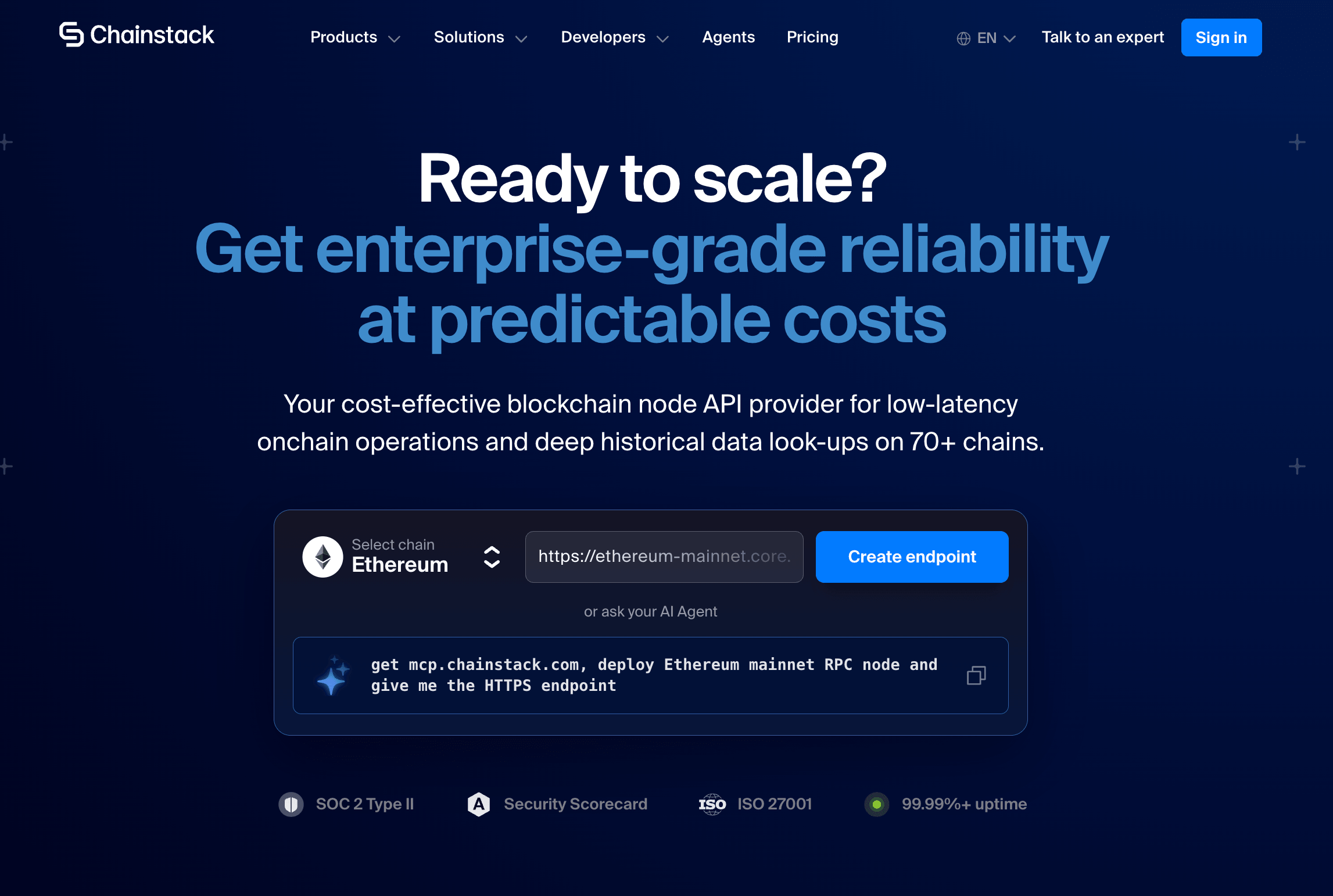
Chainstack delivers World Chain RPC as part of a 70+ chain platform with a compliance posture built for institutional clients. Its SOC 2 Type II certification plus ISO 27001 are the most complete in this comparison, and its 99.99%+ measured uptime sits alongside a 99.9% contractual SLA with service credits. The pricing model is deliberately simple: every World Chain JSON-RPC call costs 1 RU regardless of method, with archive calls at a flat multiple — no method-weighting algorithms and no billing surprises during an airdrop spike. Roughly, 3M Chainstack RU maps to about 78M Alchemy CU or 60M Quicknode credits for typical workloads, and the gap widens on archive- and trace-heavy traffic; the cost comparison breakdown works it through. World Chain went live on Chainstack via Global Nodes in August 2026, with the full eth, net, web3, debug, and trace namespaces and archive access available on paid plans.
Because World Chain is a consumer chain prone to synchronized spikes, the Unlimited Node add-on is Chainstack’s headline answer for production scale: flat-fee RPS tiers from 25 to 500 RPS ($149/month starting), with no per-request billing and no overage — ideal for a mini app hitting the discovery feed or a sybil-resistant airdrop. Teams that need nodes inside their own environment for data-sovereignty reasons can run Self-Hosted, which supports both World Chain Mainnet and Sepolia. The permanent free Developer tier (3M RU/month, 25 RPS) supports paying in crypto on every plan.
Support is tiered in a way that matters on launch day: Chainstack keeps engineers active in its community Discord and Telegram on the free Developer plan, adds email support with a response SLA from Growth, and offers 24/7 Enterprise support.
Limitations: Dedicated Nodes are not yet available for World Chain on Chainstack — teams that require fully isolated single-tenant compute today will need the Unlimited Node flat-rate model instead, or another provider. The txpool namespace is not exposed on World Chain (an OP Stack characteristic, not a Chainstack limitation), so mempool-dependent tooling must be designed around it. Chainstack is also a multi-chain platform rather than a World-native specialist.
Fit by workload:
- Mini apps and consumer dApps: Excellent — Global Nodes plus Unlimited Node absorb feature-driven spikes without a rearchitecture
- Sybil-resistant DeFi: Excellent — flat RU billing keeps a log-heavy airdrop’s invoice predictable, and archive covers reconciliation
- Enterprise identity and payments: Excellent — the SOC 2 Type II and ISO 27001 pairing, contractual SLA, and RBAC are hard to match here
Dwellir
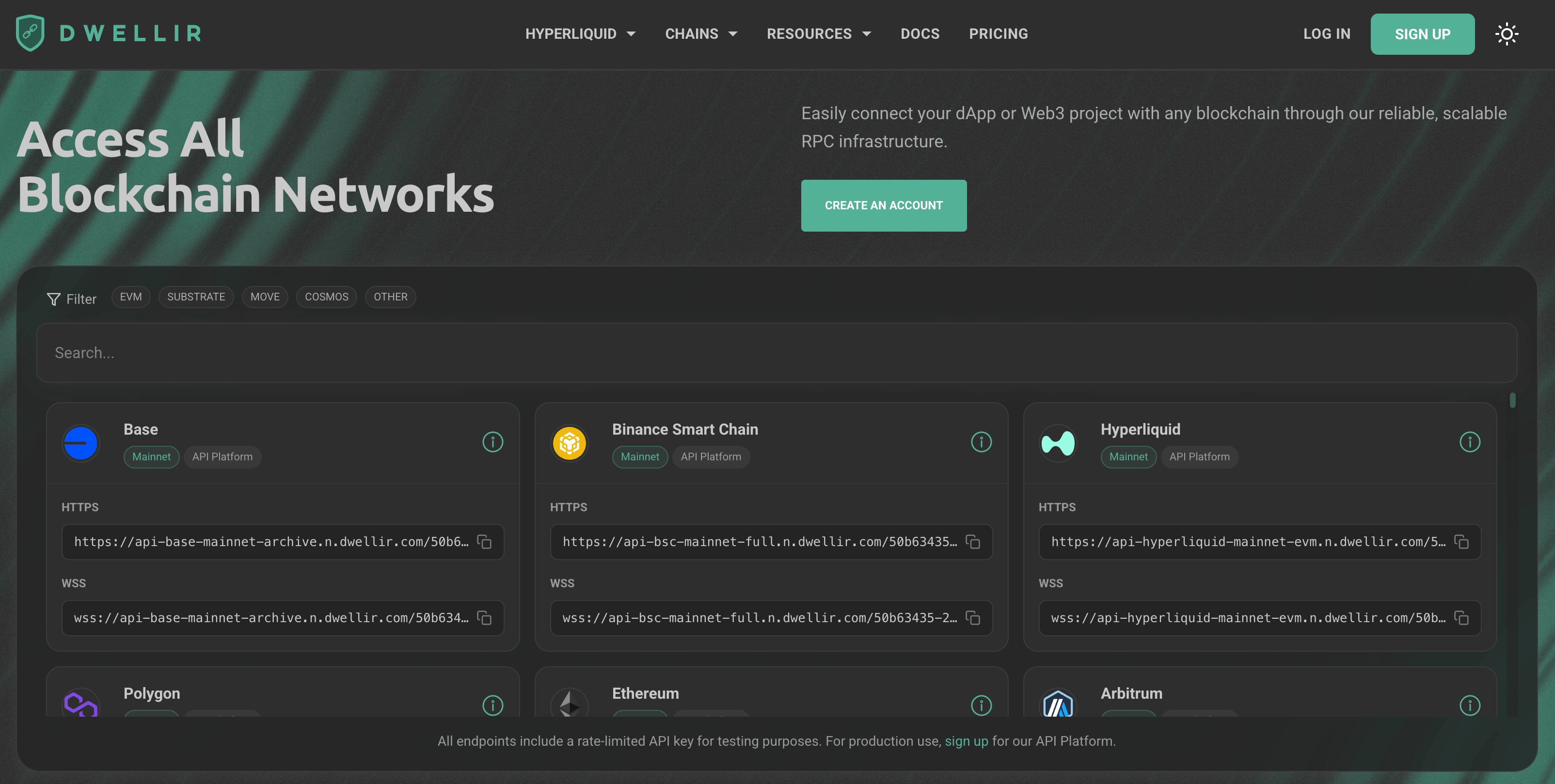
Dwellir is a Swedish RPC provider with a long Polkadot track record that now serves 150+ networks, including World Chain Mainnet (chain ID 480) over HTTPS and WebSocket. Shared plans bill one credit per response with no compute-unit weighting, and its World Chain page lists trace and debug APIs alongside standard JSON-RPC.
Pricing runs from a free plan (20 responses per second, 100,000 responses per day) through Developer at $49/month (25M responses, 100 per second), Growth at $299/month (150M, 500 per second) and Scale at $999/month (500M, 5,000 per second). Unlimited Nodes start at $119/month flat for 25 to 1,000 RPS. Unlike Chainstack, Dwellir also lists a World Chain dedicated cluster at $5,880/month, unmetered, with a 99.99% SLA on custom terms. You can pay in crypto. Pricing checked October 9, 2026.
Limitations: No SOC 2 or ISO 27001 attestation on its public pricing and dedicated-cluster pages; the free plan is capped at 100,000 responses per day; archive depth on World Chain is not published, so verify it before an airdrop reconciliation depends on it.
Fit by workload:
- Mini apps and consumer dApps: Strong — one credit per response and flat-rate Unlimited Nodes from $119/month absorb spiky, read-heavy traffic
- Sybil-resistant DeFi: Good — a dedicated cluster covers launch-day load and trace/debug are listed, though archive depth needs checking
- Enterprise identity and payments: Limited — no published compliance attestation
RouteMesh
RouteMesh is an intelligent RPC routing layer covering 1,000+ EVM networks, including World Chain (chain ID 480), with automatic failover across multiple underlying providers. Rather than operating its own nodes, RouteMesh sits in front of several upstream RPC backends — Chainstack among them — and routes each request to whichever is healthiest at that moment, with real-time health scoring driving the decision.
For a consumer chain like World Chain, that failover model is a genuine hedge against a single provider having a bad minute during a mini app’s discovery-feed spike or an airdrop claim window — RouteMesh’s customers include LI.FI (60+ chains, 97% of EVM RPC calls routed through it) and cross-chain infrastructure like Vaults.fyi. Pricing is per-request, scoped by key, chain, and method rather than a flat published tier, and the platform ships an MCP server and Cursor integration for teams wiring RPC access directly into agentic workflows.
Limitations: RouteMesh is a routing layer, not a node operator — archive depth, trace support, and ultimate data freshness depend on whichever upstream provider a given request lands on, not on RouteMesh itself. It does not publish SOC 2 or ISO 27001 certifications, and there is no dedicated single-tenant node option since the product isn’t built around direct node access.
Fit by workload:
- Mini apps and consumer dApps: Strong — failover across providers absorbs a bad node without the app noticing
- Sybil-resistant DeFi: Good, though archive depth for reconciliation depends entirely on the upstream provider it happens to route to that day
- Enterprise identity and payments: Limited — no published compliance certifications of its own
dRPC
dRPC added World Chain support with an unusually developer-friendly free tier: 210M compute units per month on public nodes (archive and trace/debug sit on the paid Growth plan) — a genuine advantage for teams doing exploratory analytics or reconciliation without committing budget. dRPC runs a distributed provider network with a 99.99% uptime target, and its paid Growth tier is a transparent flat $6 per 1M requests, which is easy to reason about for read-heavy consumer workloads.
For a mini app in prototyping, or a DeFi team that needs to trace and replay airdrop transactions before going to production, dRPC’s flat $6 per 1M requests, with debug/trace on the Growth plan, is hard to beat on cost. The flat request-based pricing avoids the method-weighting overhead of credit and CU models.
Limitations: dRPC does not publish SOC 2 or ISO 27001 certifications, which rules it out as the primary endpoint for regulated identity or payment workloads. It offers no dedicated single-tenant nodes, so teams needing guaranteed isolated throughput during a large launch will need to look elsewhere.
Fit by workload:
- Mini apps and consumer dApps: Strong — large free tier, transparent flat pricing, good for read-heavy prototypes
- Sybil-resistant DeFi: Good for analytics thanks to flat pricing with debug/trace on the paid plan, but there’s no dedicated capacity to absorb launch-day load
- Enterprise identity and payments: Limited — no published compliance certifications for regulated deployments
Alchemy
Alchemy is an official World Chain infrastructure partner — World Chain runs on Alchemy Rollups, and Alchemy operates the canonical public endpoint (worldchain-mainnet.g.alchemy.com). That tight integration makes Alchemy a natural default for teams that want the reference implementation, with confirmed HTTP and WebSocket support, archive access (its World Chain page lists no Debug or Trace API), and the enhanced APIs (Transfers, Token, NFT) that Alchemy layers on top of standard JSON-RPC. The free tier is generous at 30M compute units per month, and pay-as-you-go runs $0.525 per 1M CU (from 300 RPS).
Alchemy’s developer experience is among the most polished in the market — a mature dashboard, webhooks, Subgraphs, and account abstraction tooling that suits consumer mini apps well. SOC 2 Type II certification covers the platform. For teams already standardized on Alchemy across other Superchain networks, adding World Chain is close to zero friction.
Limitations: Alchemy’s compute-unit model weights methods differently, so a log- and trace-heavy workload — exactly what a sybil-resistant airdrop generates — is harder to forecast than flat-rate billing. Dedicated single-tenant nodes are available only on Enterprise contracts, and Alchemy does not publish ISO 27001, which some European regulated buyers require.
Fit by workload:
- Mini apps and consumer dApps: Excellent — canonical endpoint, enhanced APIs, strong DX, large free tier
- Sybil-resistant DeFi: Strong on archive, though no Debug or Trace API is listed on World Chain and CU weighting makes airdrop cost forecasting harder than it should be
- Enterprise identity and payments: Strong — SOC 2 Type II covers most requirements, but no ISO 27001 and dedicated nodes gated to Enterprise
Quicknode

Quicknode added World Chain support with its usual breadth of platform features and holds the most comprehensive compliance portfolio alongside Chainstack — SOC 2 Type II and ISO 27001. For enterprise procurement teams that specifically require ISO 27001, Quicknode and Chainstack are the two options here that carry it. On World Chain, Quicknode provides archive and trace access, dedicated nodes as a paid add-on, and its Streams product for pushing on-chain data to your backend without polling.
Quicknode’s Free trial includes 10M API credits, with self-serve paid tiers from Build ($49/mo) through Scale ($499/mo) and custom Enterprise pricing beyond that, and the platform’s marketplace of add-ons (simulation, NFT APIs, functions) is the deepest in the comparison. Enterprise support tiers include dedicated account management and priority escalation.
Limitations: Quicknode’s credit-based pricing applies method weighting, so complex calls cost more credits than simple ones — predictable for stable traffic, but harder to model for the bursty, log-heavy pattern World Chain airdrops produce. Several capabilities, including dedicated nodes and some data products, are add-on purchases rather than bundled into base plans.
Fit by workload:
- Mini apps and consumer dApps: Strong — reliable multi-chain platform, Streams, deep add-on marketplace
- Sybil-resistant DeFi: Archive, trace, and dedicated add-ons are all there, but method-weighted billing complicates forecasting a log-heavy event
- Enterprise identity and payments: Excellent — SOC 2 Type II plus ISO 27001, dedicated nodes, enterprise support
Getting started with World Chain on Chainstack
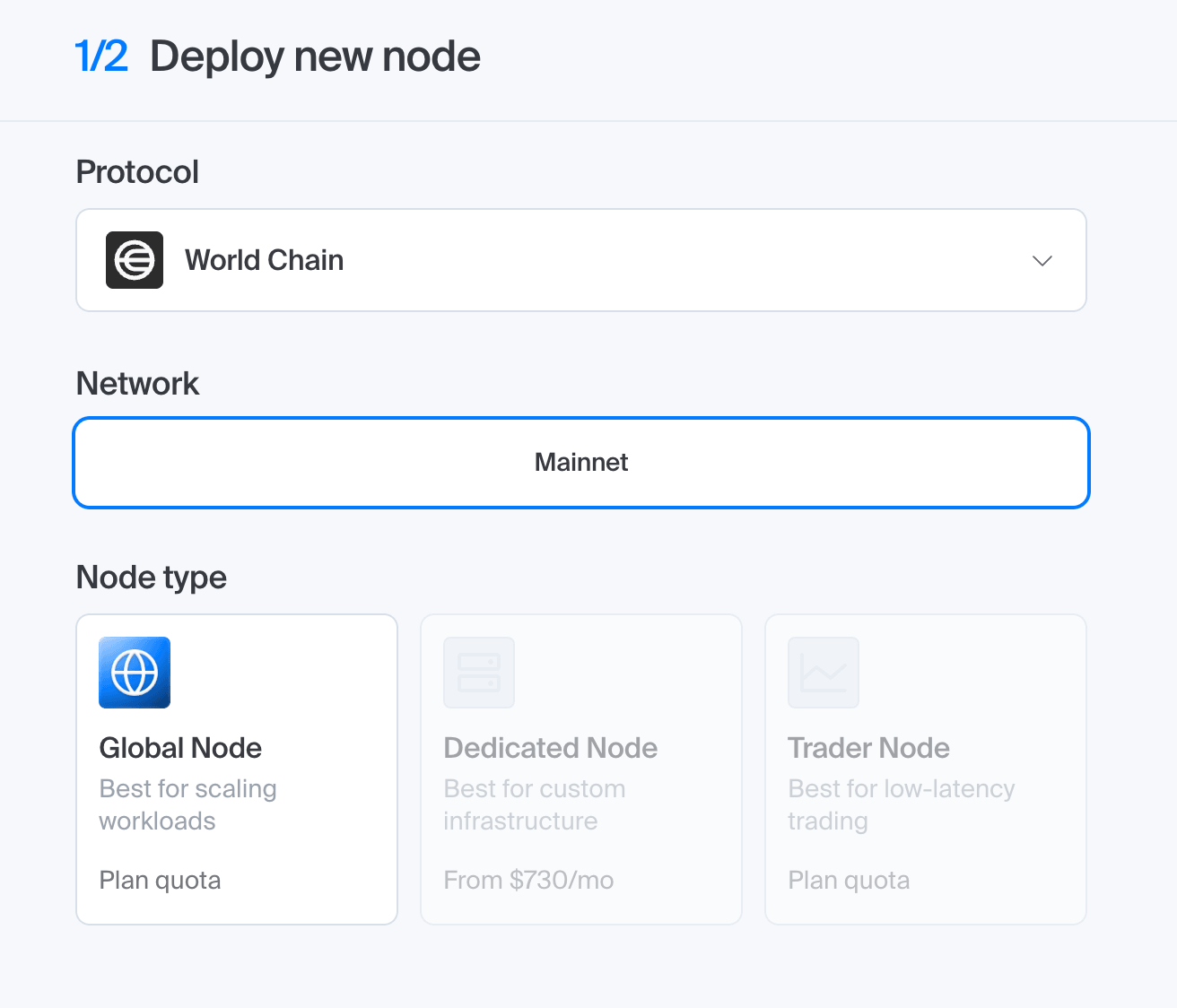
Deploying a World Chain endpoint on Chainstack takes a few minutes:
- Log in to the Chainstack console (or create an account).
- Create a new project
- Select World Chain as your blockchain protocol
- Choose network: World Chain Mainnet (Sepolia testnet is available via Self-Hosted, not the managed console flow)
- Deploy the node
- Open Access and credentials and copy your HTTPS and WebSocket endpoints
Once deployed, a plain JSON-RPC call is the fastest way to confirm the endpoint is live. The World Chain tooling docs cover MetaMask, ethers.js, viem, and web3.py setup:
curl -X POST YOUR_CHAINSTACK_ENDPOINT \
  -H "Content-Type: application/json" \
  -d '{"jsonrpc":"2.0","id":1,"method":"eth_blockNumber","params":[]}'
Because World Chain is fully EVM-compatible, standard tooling works without modification — viem, ethers.js, Foundry, and Hardhat all point at the endpoint directly with no chain-specific configuration. For SDK-based integration, use the Chainstack docs — SDK examples vary by chain and library version. For OP Stack method coverage specifically, the Base API reference is the closest documentation match, since World Chain shares the same Reth-based JSON-RPC surface.
🤖 You can also access Chainstack World Chain RPC directly from Claude, Cursor, Codex, Windsurf, Gemini CLI, GitHub Copilot, Antigravity, Claude.ai, or ChatGPT using Chainstack MCP. For a fuller agent stack — MCP, the Chainstack skill, llms.txt for context ingestion, and WebMCP for agentic browsers — see the Chainstack Agents page.
Conclusion
The single most important decision for World Chain infrastructure in 2026 is whether your provider can hold consistent throughput through the synchronized, consumer-scale spikes this chain produces — mini app features and sybil-resistant airdrops — without turning success into a bill or an outage.
Provider recommendations by use case:
- Mini apps and consumer dApps: Chainstack (Unlimited Node flat-rate spikes, generous free tier) or Alchemy (canonical endpoint, enhanced APIs)
- Sybil-resistant DeFi: Chainstack (flat RU billing for log-heavy airdrops, archive and trace) or dRPC (flat per-request pricing, debug/trace on the paid plan)
- Enterprise identity and payments: Chainstack (SOC 2 Type II, ISO 27001, Self-Hosted for data sovereignty) or Quicknode (SOC 2 Type II + ISO 27001, multi-cloud)
- Fastest integration on the reference stack: Alchemy (official infra partner, canonical endpoint, enhanced APIs)
- Dedicated capacity for a launch: Dwellir’s World Chain dedicated cluster, or Chainstack’s Unlimited Node flat-rate tiers
- Multi-provider failover: RouteMesh, for teams that want automatic routing across several backend RPC providers rather than a single one
Frequently asked questions
Q: What RPC methods does World Chain support?
World Chain is an OP Stack L2 running world-chain (a Reth-based client), so it exposes the standard Ethereum JSON-RPC surface across the eth, net, web3, debug, and trace namespaces, including full debug_* and trace_* methods on archive nodes. The txpool namespace is not available, so mempool-dependent tooling must be designed around that gap. The method set closely matches other OP Stack chains like Base.
Q: Which World Chain RPC providers have a free tier?
Chainstack’s Developer plan is a permanent free tier — 3M request units/month at 25 RPS. Alchemy (30M compute units/month) and dRPC (210M CU/month on public nodes) are also permanent free tiers, and Dwellir’s free plan allows 20 responses per second and 100,000 responses per day. Quicknode is the exception: its free offering is a one-month trial (10M credits, 15 RPS), so it’s not a permanent option for prototyping.
Q: How do I migrate an existing World Chain RPC integration to Chainstack?
Because World Chain exposes the standard Ethereum JSON-RPC surface, migrating is a config change, not a code change — swap the endpoint URL in viem, ethers.js, Foundry, or Hardhat and the rest of your integration keeps working. Before cutting over, confirm your new provider covers the same archive depth and debug_*/trace_* methods your app relies on, and keep the old endpoint live as a fallback until the new one has run under production traffic for a few days.
Q: How do I benchmark World Chain RPC latency?
Neither the Chainstack performance dashboard nor compare.chainstack.com covers World Chain yet, so run your own test. A curl timing loop or k6 script hitting eth_blockNumber and eth_getLogs against each candidate endpoint surfaces the p95/p99 tail latency that headline averages hide — test under airdrop-style bursts, not steady traffic.
Q: Which World Chain RPC providers are SOC 2 certified?
Chainstack (SOC 2 Type II plus ISO 27001), Quicknode (SOC 2 Type II plus ISO 27001), and Alchemy (SOC 2 Type II) publish audited certifications. dRPC, Dwellir, and RouteMesh do not publish SOC 2 documentation. For identity-adjacent or payment workloads on World Chain, that distinction matters to compliance teams.
Q: How does flat RU billing compare to credit or CU billing for World Chain?
Flat billing (Chainstack) charges 1 RU per call regardless of method, so a log-heavy sybil-resistant airdrop stays predictable. Method-weighted models (Quicknode credits, Alchemy CUs) charge multiples for archive, trace, and debug_* calls — cheaper for simple reads but hard to forecast for bursty, trace-heavy events. Roughly, 3M Chainstack RU ≈ 78M Alchemy CU ≈ 60M Quicknode credits for typical workloads; for fixed-cost throughput during a launch, the Unlimited Node add-on removes per-request billing entirely.
Additional resources