AI-ready infrastructure
 Refer and earn


 Ethereum
 Hyperliquid
 Solana
 Arbitrum
 BNB Smart Chain
 Base
Base Polygon
 TRON
TRON Sui
Sui Robinhood


Top 6 Stable RPC providers for stablecoin infrastructure in 2026

Stable is an EVM-compatible Layer 1 built by the team behind USDT0, purpose-designed so that dollars — not a volatile gas token — are the unit of account for every transaction. The most important 2026 fact about it: gas is paid in USDT0, it runs on StableBFT (a CometBFT/Tendermint proof-of-stake consensus) with block times around 0.7 seconds, and mainnet launched in December 2025 alongside its STABLE governance token.
That design is exactly what makes RPC provider choice matter more than usual here. On a general-purpose chain, a dropped RPC call is an annoyance. On a settlement chain where every transaction moves real dollars — payroll runs, cross-border remittances, merchant payouts, treasury sweeps — a missed eth_getLogs page or a stale balance read is a reconciliation break that an accountant has to chase down. Stable also ships several behaviors that will surprise teams porting Ethereum tooling directly: a permanently empty public transaction pool, a native gas token that reports 18 decimals while its ERC-20 twin reports 6, and a handful of standard Ethereum methods that behave differently or don’t work at all.
This guide covers what stablecoin infrastructure workloads actually demand from a Stable RPC endpoint, the methods that carry that load, and how the best Stable RPC providers supporting the chain today compare for this exact use case.
💡 Already building on Stable? Jump straight to the Stable tooling docs or deploy a production endpoint in minutes with Chainstack Global Nodes.
Stablecoin infrastructure on Stable: RPC requirements
Stablecoin infrastructure is not a latency-bragging-rights workload the way MEV or high-frequency trading is — but it is unforgiving about correctness and completeness. A payment processor, treasury system, or issuer backend does not need sub-millisecond block reads; it needs every USDT0 transfer accounted for, every receipt confirmed, and every historical balance reproducible on demand for reconciliation and audit. That shifts the infrastructure priorities toward archive access, log-indexing throughput, WebSocket reliability, and compliance posture rather than raw speed.
Stable’s design pushes those priorities further. Because USDT0 is the native gas token, fee estimation returns dollar-denominated values, and settlement logic has to treat gas and payment as the same asset class. And because Stable runs a private, aggregated mempool — the public transaction pool always responds empty — teams cannot rely on pending-transaction subscriptions to detect inbound payments. Confirmation has to be receipt-driven and block-driven, not mempool-driven.
The decimal trap you must handle first
Before any of the methods below, internalize this: the native USDT0 gas balance carries 18 decimals, but the USDT0 ERC-20 token (contract 0x779Ded0c9e1022225f8E0630b35a9b54bE713736) reports 6 decimals. Both are called USDT0. Confusing them is a factor of 10^12 error — reading a gas balance with formatUnits(value, 6) will overstate a user’s dollars by a trillion. Use formatEther() for native gas balances and formatUnits(value, 6) for the ERC-20 token. Every stablecoin integration on Stable lives or dies on getting this right.
The methods that carry stablecoin infrastructure
These are the RPC calls a Stable stablecoin backend leans on hardest:
eth_sendRawTransaction— submits signed USDT0 transfers and settlement transactions. On Stable this is your only submission path, since there is no public mempool to broadcast into and observe.eth_getTransactionReceipt— the confirmation primitive. With ~0.7s blocks and fast finality, receipts are your source of truth that a payment settled and which Transfer logs it emitted.eth_getLogs— the reconciliation workhorse, scanning USDT0Transferevents to match on-chain movement against your ledger. Watch the range: like other EVM chains on Chainstack, the query window is capped by your plan — 100 blocks on Developer, 10,000 on paid tiers (see the eth_getLogs limitations doc) — so any backfill or historical sweep must paginate. This does not require an archive node — log scans by block range run fine on full nodes.eth_getBalanceandeth_call— balance checks for native USDT0 gas (eth_getBalance) and the ERC-20balanceOf(eth_call). Historical balance-at-block reads for reconciliation require an archive node.eth_subscribe— WebSocketlogsandnewHeadssubscriptions for real-time payment notifications. Because pending-tx subscriptions return nothing on Stable,logson the USDT0 contract is how you detect inbound payments the moment they land in a block.eth_blockNumber— the settlement cursor. A stablecoin indexer tracks its last processed block and reconciles forward.debug_traceTransactionanddebug_traceBlockByNumberwithcallTracer— trace internal transfers for audit trails and dispute resolution. Parity-styletrace_*methods return-32601on Stable; the debug namespace on an archive node is the supported replacement — usecallTracerin place oftrace_blockortrace_transaction.eth_createAccessListandeth_simulateV1also return errors and aren’t usable.eth_getProofdoes work, but with a catch: it requires an explicit block number (latestis rejected) and returns a Cosmos IAVL proof rather than a standard Ethereum Merkle-Patricia proof — not a drop-in for typical Ethereum state-proof verification tooling, a direct consequence of Stable’s CometBFT-derived execution layer.
For the full method surface and Stable-specific behavior, see the Ethereum JSON-RPC reference and the Stable methods documentation — Stable is Ethereum-compatible, so standard EVM method semantics apply except where the tooling docs note otherwise.
Infrastructure requirements
Put together, a serious stablecoin operation on Stable needs: archive access for reconciliation and audit reads at historical blocks; debug/trace on archive for dispute resolution; stable WebSocket connections for real-time payment detection; log-indexing throughput high enough to keep paginated eth_getLogs sweeps flowing without hitting your plan’s rate limits; and a compliance posture — SOC 2 Type II, contractual uptime — that a regulated payments or fintech team can put in front of an auditor. The public Stable RPC at https://rpc.stable.xyz is capped at 1,000 requests per 10 seconds per IP and returns HTTP 429 past that, which is fine for testing and wrong for production.
Provider comparison for stablecoin infrastructure on Stable
Stable launched in late 2025, so the provider landscape is still forming — but it is not empty. The six providers below all support Stable today, including RouteMesh, which confirms Stable Mainnet in its routed chain list. The table summarizes public positioning for the stablecoin infrastructure use case as of October 2026.
| Provider | Stable support | Archive & debug | Why it matters for stablecoin infrastructure | Compliance | Pricing model |
|---|---|---|---|---|---|
| Chainstack | Mainnet, full + archive | Yes (debug on archive) | Archive + debug + WebSocket + audited compliance on one platform | SOC 2 Type II, ISO 27001 | RU-based; Unlimited Node flat-fee option |
| RouteMesh | Mainnet (routed across upstream providers) | Depends on routed upstream | Automatic failover across upstream providers for continuous settlement uptime | Not independently published (routing layer) | Per-request (varies by key, chain, method) |
| Dwellir | Mainnet (HTTPS + WebSocket) | Debug APIs listed; archive depth not published | Flat per-response pricing and a dedicated cluster for steady load | Not published | 1 credit per response ($49–$999/mo; cluster $4,860/mo) |
| Tenderly | Mainnet (officially listed) | Simulation & tracing | Best-in-class debugging for stablecoin contract disputes | SOC 2 Type II | Credit/unit-based |
| dRPC | Mainnet (routed) | Varies by route | Decentralized load-balancing for redundancy | Not published | Pay-per-request |
| Alchemy | Mainnet (RPC, Debug API, WebSocket); testnet listed | Debug API; no Trace API | Strong dev tooling; archive depth and dedicated nodes not published | SOC 2 Type II | CU-based |
Note: We found no Stable (chain ID 988) listing for Quicknode, Uniblock or OnFinality — teams standardized on those stacks will need one of the providers above for Stable. Verify current support before committing, as the landscape is moving fast.
Provider-by-provider breakdown
Chainstack
Chainstack delivers Stable RPC through the Chainstack Partner Network, built around exactly what a stablecoin backend needs: Global Nodes with geo-balanced, auto-scaling routing, full and archive node types, and the debug namespace (debug_traceCall, debug_traceTransaction, debug_traceBlockByNumber) exposed directly on archive — covering the reconciliation-to-dispute-resolution loop this use case demands on one platform.
For stablecoin infrastructure the archive tier is the differentiator: historical balance-at-block reads for reconciliation and debug_traceTransaction for audit trails both need it. Global Nodes cover most teams, with a production endpoint deployable in a couple of minutes; Dedicated Nodes aren’t supported for Stable yet. For data-sovereignty requirements, Self-Hosted deployment is also available for both Stable Mainnet and Stable Testnet.
On pricing, Chainstack’s free Developer plan includes 3M request units and 25 RPS, with paid tiers from Growth ($49/mo, 20M RU, 250 RPS) through Business ($499/mo, 200M RU, 600 RPS) and Enterprise (from $990/mo). For a steady backend the Unlimited Node add-on is the more relevant option: flat monthly RPS tiers (25 RPS at $149/mo up to 500 RPS at $3,199/mo) with no per-request overage — so reconciliation sweeps and continuous log indexing don’t turn into a variable bill.
The compliance story is the closing argument for regulated stablecoin work. Chainstack holds audited SOC 2 Type II and ISO 27001 certifications, and its stablecoin infrastructure offering — introduced for Stable Mainnet in August 2026 — already backs institutional stablecoin issuers and wallets.
Limitations: RU-based metering means teams must model their read/write mix to pick the right tier, and the very cheapest hobbyist endpoints from public-good providers will always undercut a managed platform on raw price — Chainstack competes on reliability, archive depth, and compliance, not on being free.
Fit by workload:
- Stablecoin payments & settlement: Excellent — archive, debug, WebSocket, and flat-fee throughput cover the full reconciliation-to-real-time loop.
- Regulated fintech / issuers: Excellent — audited SOC 2 Type II and ISO 27001 clear vendor reviews without a follow-up call.
- Analytics & reconciliation indexing: Strong — archive depth plus Unlimited Node throughput keep continuous log-indexing sweeps affordable at scale.
RouteMesh

RouteMesh is an intelligent RPC routing layer spanning 1,000+ EVM networks, including Stable Mainnet, that aggregates multiple underlying node providers behind sub-10ms routing decisions, real-time health scoring, and automatic failover. For a stablecoin backend, that failover layer is the pitch: if one upstream provider degrades mid-settlement, RouteMesh’s health scoring routes the next call around it without the application ever seeing an outage.
RouteMesh counts LI.FI (routing 97% of its EVM RPC calls across 60+ chains), Vaults.fyi, and DAMM Capital among its customers, and ships an MCP server and Cursor integration for agent-driven infrastructure work. Pricing is per-request, varying by key type, chain, and method; it routes across multiple upstream providers (Chainstack is among its listed providers) and offers a free community endpoint for Stable.
Limitations: As a routing layer rather than a direct node operator, archive depth and debug/trace availability depend on whichever upstream is serving a given request rather than being a property you configure directly — teams needing guaranteed archive access for reconciliation should pair RouteMesh with a direct provider rather than rely on it as the sole endpoint of record.
Fit by workload:
- Stablecoin payments & settlement: Strong — automatic failover keeps real-time detection running through upstream provider hiccups.
- Redundancy / read failover: Excellent — sub-10ms routing and health scoring exist specifically for this problem.
- Regulated fintech / issuers: Moderate — no independently published compliance attestation of its own, so pair it with a certified upstream for the audit trail.
Dwellir
Dwellir is a Swedish RPC provider with a long Polkadot track record that now serves 150+ networks, including Stable Mainnet (chain ID 988) over HTTPS and WebSocket. Shared plans bill one credit per response with no compute-unit weighting, which makes continuous reconciliation and indexing load easy to budget. Its Stable page lists debug APIs on its flat-rate options; Stable returns errors for Parity-style trace_* methods, so the debug namespace is the one that matters here.
Pricing runs from a free plan (20 responses per second, 100,000 responses per day) through Developer at $49/month (25M responses, 100 per second), Growth at $299/month (150M, 500 per second) and Scale at $999/month (500M, 5,000 per second). Unlimited Nodes start at $119/month flat for 25 to 1,000 RPS, and the Stable dedicated cluster is listed at $4,860/month, unmetered, with a 99.99% SLA on custom terms. You can pay in crypto. Pricing checked October 9, 2026.
The gap for the most regulated deployments is compliance disclosure: Dwellir does not publish a SOC 2 Type II attestation, so a fintech vendor review that mandates audited certification will need to raise that directly. Archive depth on Stable is not published either, which matters for historical balance-at-block reads. For teams whose compliance bar is met by contractual uptime rather than a specific attestation, it is a cost-transparent option.
Limitations: No published SOC 2 Type II report; Stable archive depth not published; smaller platform surface than the tier-one providers (fewer enhanced APIs and analytics extras).
Fit by workload:
- Stablecoin payments & settlement: Strong — flat per-response pricing and a dedicated cluster option, with debug APIs listed.
- Analytics & reconciliation indexing: Strong — response-based pricing suits continuous, high-volume sweeps.
- Regulated fintech / issuers: Moderate — solid infrastructure, but no published audited certification.
Tenderly
Tenderly is one of three providers Stable names in its official documentation (with Alchemy and Chainstack), and it occupies a distinctive niche: a full-stack developer platform built around simulation, debugging, and transaction tracing. For stablecoin infrastructure that specialization is genuinely valuable — when a settlement transaction reverts or a payout lands in the wrong amount, Tenderly’s contract-level simulation and step-by-step tracing turn a reconciliation dispute into a debuggable event, which is exactly the failure mode a dollar-denominated backend fears most.
Tenderly provides RPC access alongside its dev tooling, so it can serve as both a build-time and run-time endpoint on Stable mainnet. Its Web3 Actions and alerting also fit stablecoin monitoring well — trigger on a Transfer above a threshold, watch a treasury contract, alert on a failed settlement. Where it is less of a fit is being the sole high-RPS endpoint behind a processor moving continuous, heavy transaction load; it is optimized for observability and developer workflows first.
Tenderly is SOC 2 Type II certified, which clears the compliance bar for regulated work. Pricing is unit/credit-based across its platform tiers.
Limitations: Not positioned primarily as a bulk high-throughput production RPC; teams often pair Tenderly’s debugging and monitoring with a throughput-oriented provider for the settlement hot path.
Fit by workload:
- Stablecoin payments & settlement: Strong — open mainnet RPC plus monitoring, best paired for the heaviest hot paths.
- Contract dispute resolution / audit: Excellent — simulation and tracing are its core strength.
- Regulated fintech / issuers: Strong — SOC 2 Type II plus deep observability for audit workflows.
dRPC
dRPC takes a load-balancer approach: it routes each request across a network of independent node operators to the fastest available route, which hedges against any single operator’s outage. For a stablecoin operation that values redundancy, dRPC’s Stable endpoint can serve as a resilient secondary or as a cost-efficient path for read-heavy balance and log queries.
The trade-off for infrastructure-grade work is transparency. Because requests are routed across third-party operators, archive depth and debug availability vary by route rather than being a guaranteed property of a dedicated node, and dRPC does not publish a SOC 2 Type II attestation. That is acceptable for redundancy and public read traffic; it is a harder sell as the sole endpoint of record for a regulated backend that needs reproducible historical reads.
Pricing is straightforward pay-per-request, and public endpoints are available for testing.
Limitations: No published SOC 2 attestation; archive/debug guarantees depend on the underlying route rather than a dedicated node you control.
Fit by workload:
- Stablecoin payments & settlement: Moderate — strong as a redundant secondary, weaker as the compliance-critical primary.
- Redundancy / failover: Strong — decentralized routing across independent operators is its whole point.
- Regulated fintech / issuers: Limited — no published audited certification.
Alchemy
Alchemy is another provider Stable lists in its official documentation, and it brings a mature developer platform: enhanced token and transaction APIs, real-time webhooks, transaction simulation, and a strong dashboard. For teams already standardized on Alchemy’s SDK, its Stable page lists Mainnet and Testnet with RPC, Debug API, WebSocket, Bundler and Gas Manager support, which makes it a comfortable place to build and test a stablecoin integration.
The catch for this use case is trace coverage and depth. Alchemy’s Stable page lists the Debug API but not the Trace API or gRPC, which fits Stable’s own behavior, and it does not publish archive depth for Stable, so confirm that before relying on it for reconciliation. Alchemy’s enhanced APIs also abstract some low-level behavior, which is convenient but worth verifying against Stable’s decimal and mempool quirks.
Pricing is CU-based (compute units, method-weighted), with a generous free monthly allowance. Alchemy’s cost curve steepens noticeably beyond the free tier; teams with high archive or trace usage often find the bill grows faster than expected, so it’s worth modeling against a cost calculator before committing to volume. Alchemy is SOC 2 Type II certified, so the compliance posture is solid for regulated work — the gating factor is archive depth and dedicated capacity, not attestation.
Limitations: Archive depth for Stable is not published, and there are no standard dedicated nodes — teams needing guaranteed throughput on Stable mainnet must negotiate an enterprise arrangement.
Fit by workload:
- Stablecoin payments & settlement: Good — mature tooling and mainnet RPC with debug and WebSocket, but no standard dedicated nodes.
- Development & testing: Excellent — a listed testnet plus enhanced APIs is a great build environment.
- Regulated fintech / issuers: Strong — SOC 2 Type II plus enterprise onboarding fits, with dedicated capacity negotiated separately.
How to choose a Stable RPC provider for stablecoin infrastructure
- Public RPC for testing, managed endpoint for production. The public
rpc.stable.xyzendpoint (1,000 req/10s per IP) is fine for a prototype. The moment you are settling real dollars, you need a provider with an SLA, archive access, and headroom above that cap.
- When you need guaranteed throughput. Move to the Unlimited Node add-on when any of these hit: sustained log-indexing that would blow through per-request billing, a compliance requirement for isolated infrastructure, or continuous reconciliation sweeps against archive that need guaranteed throughput rather than shared-endpoint best-effort.
- Archive and debug are non-negotiable for reconciliation. Historical balance-at-block reads and
debug_traceTransactionaudit traces both require an archive node with the debug namespace. If a provider can’t guarantee archive depth for Stable, it can’t be your reconciliation primary — no matter how fast itslatest-block reads are.
- Latency consistency over average latency. For settlement, a p99 spike that stalls a batch payout matters more than a good average. No public real-time dashboard tracks Stable RPC providers yet, so measure it yourself.
- Enterprise support and audited compliance for regulated products. Stablecoin issuance and payments sit squarely inside frameworks like MiCA and the GENIUS Act. A vendor review will ask for an audited SOC 2 Type II report — not a self-reported claim. Among providers supporting Stable, Chainstack, Alchemy, and Tenderly hold audited SOC 2 Type II; Dwellir, dRPC and RouteMesh do not publish one. For a regulated deployment, that list narrows your options fast.
⚡ Benchmark before you commit: No public real-time dashboard covers Stable RPC providers yet. Run a quick latency test against each provider’s endpoint from your target region before committing — a simple curl loop or a k6 script hitting eth_getLogs and eth_getTransactionReceipt is enough to surface meaningful p95/p99 differences.
Choose by use case
For stablecoin payments and settlement
Payment and settlement workloads on Stable are correctness-first: every USDT0 transfer must be detected, confirmed, and reconciled. Concretely that means WebSocket eth_subscribe on the USDT0 contract for real-time inbound detection (pending-tx subscriptions are dead on Stable’s empty mempool), receipt-driven confirmation via eth_getTransactionReceipt, and paginated eth_getLogs sweeps for backfill and reconciliation, respecting whatever block-range cap your plan sets.
Chainstack fits this best because it puts archive, debug, WebSocket, and flat-fee throughput on one SOC 2 Type II platform — the full loop from real-time detection to historical reconciliation without stitching providers together. RouteMesh is a useful failover layer to sit in front of a primary endpoint, Tenderly is the strongest companion for contract-level monitoring and dispute debugging, and Dwellir offers dedicated mainnet nodes with transparent pricing for steady load.
For regulated fintech and issuers
Stablecoin issuers, payment processors, and fintechs operating under MiCA (in force) or the GENIUS Act (signed in July 2025, with rules taking effect by January 2027 at the latest) carry an audit burden that basic RPC access doesn’t address. The demanding requirement here isn’t a specific method — it’s reproducibility and attestation: historical state reads that reconcile exactly, trace-level audit trails for disputes, contractual uptime, and a vendor certification a compliance team can file. That means archive nodes with the debug namespace, an SLA, and an audited SOC 2 Type II report.
On this axis the field narrows to providers with published, audited certifications. Chainstack (SOC 2 Type II and ISO 27001), Tenderly, and Alchemy (both SOC 2 Type II) qualify; Chainstack additionally offers self-serve mainnet archive and — per the supported clients and protocols docs — Self-Hosted deployment for teams that need the node inside their own perimeter for data-sovereignty reasons. Dedicated Nodes aren’t supported for Stable yet. Providers without a published attestation should stay out of the regulated hot path.
For reconciliation and payment analytics
Treasury dashboards, merchant-payout reconciliation, and payment analytics on Stable are read-heavy and archive-dependent. The workload is dominated by eth_getLogs Transfer-event sweeps and historical eth_getBalance / eth_call balance-at-block reads. The per-plan block-range cap on eth_getLogs (standard across EVM chains on most providers, not a Stable-specific rule) means this is a high-volume, paginated grind rather than a handful of queries.
The provider question here is throughput economics and archive depth. Per-request billing punishes continuous indexing, so Chainstack’s Unlimited Node add-on — flat-fee RPS with archive access — and Dwellir’s response-based flat tiers are the natural fits for a pipeline running reconciliation around the clock.
Getting started with Stable on Chainstack
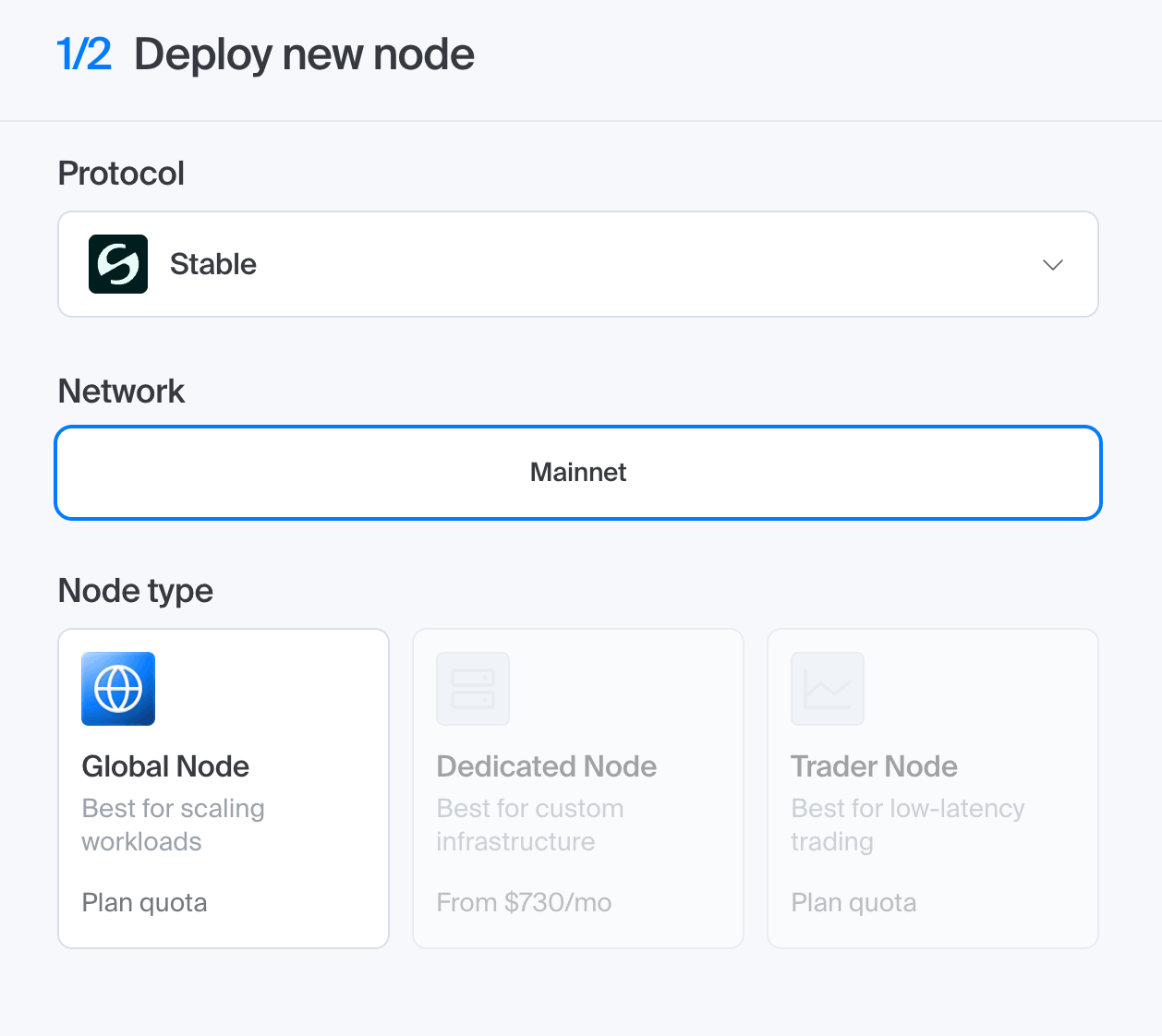
- Log in to the Chainstack console (or create an account).
- Create a new project
- Select Stable as your blockchain protocol
- Choose network: Stable Mainnet (managed Global Nodes currently support Mainnet only; Testnet is available via Self-Hosted; Dedicated Nodes aren’t supported for Stable yet)
- Deploy the node
- Open Access and credentials and copy your HTTPS and WebSocket endpoints
For reconciliation and audit-trail work, deploy an archive node — that’s what unlocks historical balance-at-block reads and the debug namespace. A full node is enough for real-time payment detection and submission.
A quick sanity check — confirm you’re on Stable (chain ID 988), handle both of USDT0’s decimal formats, and read the token supply:
import { createPublicClient, http, formatEther, formatUnits } from 'viem';
import { stable } from 'viem/chains';

const client = createPublicClient({
  chain: stable,
  transport: http('YOUR_CHAINSTACK_ENDPOINT'),
});

console.log('Chain ID:', await client.getChainId());
console.log('Block:', await client.getBlockNumber());

// Native USDT0 gas balance -- 18 decimals
const balance = await client.getBalance({
  address: 'YOUR_WALLET_ADDRESS',
});
console.log('Gas balance:', formatEther(balance), 'USDT0');

// USDT0 ERC-20 token -- 6 decimals, NOT 18
// verified from docs.chainstack.com/docs/stable-tooling on 2026-08-16
const USDT0_ERC20 = '0x779Ded0c9e1022225f8E0630b35a9b54bE713736';

const totalSupply = await client.readContract({
  address: USDT0_ERC20,
  abi: [{
    name: 'totalSupply', type: 'function', inputs: [],
    outputs: [{ type: 'uint256' }], stateMutability: 'view',
  }],
  functionName: 'totalSupply',
});
console.log('USDT0 token supply:', formatUnits(totalSupply, 6));
📖 For the full integration guide, see the Chainstack Stable tooling documentation.
🤖 You can also access Chainstack Stable RPC directly from Claude, Cursor, Codex, Windsurf, Gemini CLI, GitHub Copilot, Antigravity, Claude.ai, or ChatGPT using Chainstack MCP. For a fuller agent stack — MCP, the Chainstack skill, llms.txt for context ingestion, and WebMCP for agentic browsers — see the Chainstack Agents page.
Conclusion
For stablecoin infrastructure on Stable in 2026, the single decision criterion is this: can your provider guarantee archive-backed reconciliation and audited compliance, not just fast reads? Everything else — throughput tier, WebSocket, tooling — follows from that.
- Stablecoin payments & settlement: Chainstack — archive, debug, WebSocket, and flat-fee throughput on one SOC 2 Type II + ISO 27001 platform.
- Automatic failover across providers: RouteMesh — sub-10ms routing and health-scored failover, an easy layer to sit in front of a primary endpoint.
- Contract monitoring & dispute debugging: Tenderly — best-in-class simulation and tracing, officially listed by Stable.
- Predictable-cost dedicated capacity: Dwellir — flat per-response pricing with a dedicated cluster option and debug APIs listed.
- Decentralized redundancy: dRPC — load-balanced routing across independent operators as a resilient secondary.
- Development & testing: Alchemy — Stable Mainnet and Testnet with Debug API, WebSocket and enhanced APIs.
Frequently asked questions
Q: Why does my USDT0 balance look a trillion times too big on Stable?
Because Stable’s native gas token USDT0 carries 18 decimals, while the USDT0 ERC-20 token reports 6 decimals — a 10^12 gap. Use formatEther() for native gas balances and formatUnits(value, 6) for the ERC-20 token. This is the single most common integration bug on Stable.
Q: Which providers support Stable mainnet, and does the free tier work for production?
Chainstack, RouteMesh, Tenderly, Dwellir, and dRPC support Stable mainnet today; Alchemy lists both Stable Mainnet and Testnet. We found no Stable listing for Quicknode, Uniblock, or OnFinality. The public rpc.stable.xyz endpoint is capped at 1,000 requests per 10 seconds with no SLA — fine for testing, not for production.
Q: I’m porting an existing Ethereum backend to Stable — what breaks?
Three things trip up most migrations: pending-transaction subscriptions return nothing because Stable’s mempool is private and always empty, so inbound-payment detection has to move to eth_subscribe log watching; Parity-style trace_* methods, eth_createAccessList, and eth_simulateV1 all return errors, so tracing has to go through the debug_* namespace instead; and the native gas token’s 18 decimals versus the ERC-20 token’s 6 decimals is an easy place to introduce a silent unit-conversion bug.
Q: What RPC latency should I expect for Stable settlement detection?
Stable’s ~0.7-second block time and receipt-driven confirmation model make sub-second settlement detection realistic, but for batch payouts a p99 latency spike matters more than a good average. No public dashboard tracks Stable RPC providers yet, so benchmark your own region with a curl loop or k6 script against eth_blockNumber and eth_getTransactionReceipt before committing to a provider.
Q: Which providers meet compliance requirements for regulated stablecoin issuers?
For MiCA or GENIUS Act workloads, insist on an audited SOC 2 Type II report. Chainstack (SOC 2 Type II plus ISO 27001), Tenderly, and Alchemy hold audited certifications; Dwellir, dRPC, and RouteMesh do not publish one of their own. Chainstack also offers self-serve mainnet archive and Self-Hosted deployment for isolated infrastructure (Dedicated Nodes aren’t supported for Stable yet).
Q: How does pricing work for a high-volume Stable stablecoin backend?
Per-request models (CU, credits, pay-per-request) get expensive under continuous log-indexing and reconciliation load. Chainstack’s Unlimited Node add-on replaces per-request billing with flat monthly RPS tiers ($149/mo for 25 RPS up to $3,199/mo for 500 RPS); Dwellir offers flat per-response tiers from $49/mo and Unlimited Nodes from $119/mo. Both give a backend a fixed infrastructure line instead of a bill that scales with transaction volume.
Additional resources