AI-ready infrastructure
 Refer and earn


 Ethereum
 Hyperliquid
 Solana
 Arbitrum
 BNB Smart Chain
 Base
Base Polygon
 TRON
TRON Sui
Sui Robinhood


Chainstack Extended Nodes explained

“Full” and “Archive” used to be the only two words Chainstack had for how much history a node keeps. That was fine for EVM chains, where the gap between the two is well understood. It broke down for chains like Sui, XRPL, and Stellar, where Chainstack’s nodes serve meaningfully more history than a standard full node — without going all the way to a complete archive from genesis. The honest answer was neither, and now there’s a label for it.
TL;DR: Chainstack Global Nodes now carry an Extended label on Sui, XRPL, and Stellar — a full node that keeps more history than a standard full node of that protocol, but isn’t a complete archive. It’s not a new billing tier: requests are billed exactly like Full, with no request-unit change, on every plan. Below are the real before/after numbers for each of the three chains.
Why “Full” and “Archive” weren’t enough
A standard full node keeps only a short recent window of history — enough to track current state and process new activity, not enough to answer questions about last week. An archive node keeps everything, from genesis, at a storage cost that scales with the chain’s entire lifetime. Most builders don’t need either extreme: they need more than the recent window, but not the full multi-terabyte archive.
Chainstack’s Global Nodes for Sui, XRPL, and Stellar already sat in that middle ground — the increased storage was there, customers were already benefiting from it, but the console only ever showed “Full.” That made the node look standard when it wasn’t, and calling it “Archive” would have overstated what it actually serves. Extended is the label for that middle ground: more than Full, less than Archive.
What Extended actually means
- Global Nodes only. Extended doesn’t apply to Dedicated Nodes.
- No billing change. Requests are billed exactly as on a Full node — no request-unit change, available on every plan.
- Maps to the real deployment. The label only appears where a node genuinely serves extended history — never bolted onto a standard Full node just for show.
- Currently live on three chains: Sui, XRP Ledger, and Stellar — Mainnet and Testnet.
Before vs after: how much history you actually get
The exact window depends on the protocol and moves over time, so treat the numbers below as a snapshot rather than a permanent spec — but the gap they show is the point.
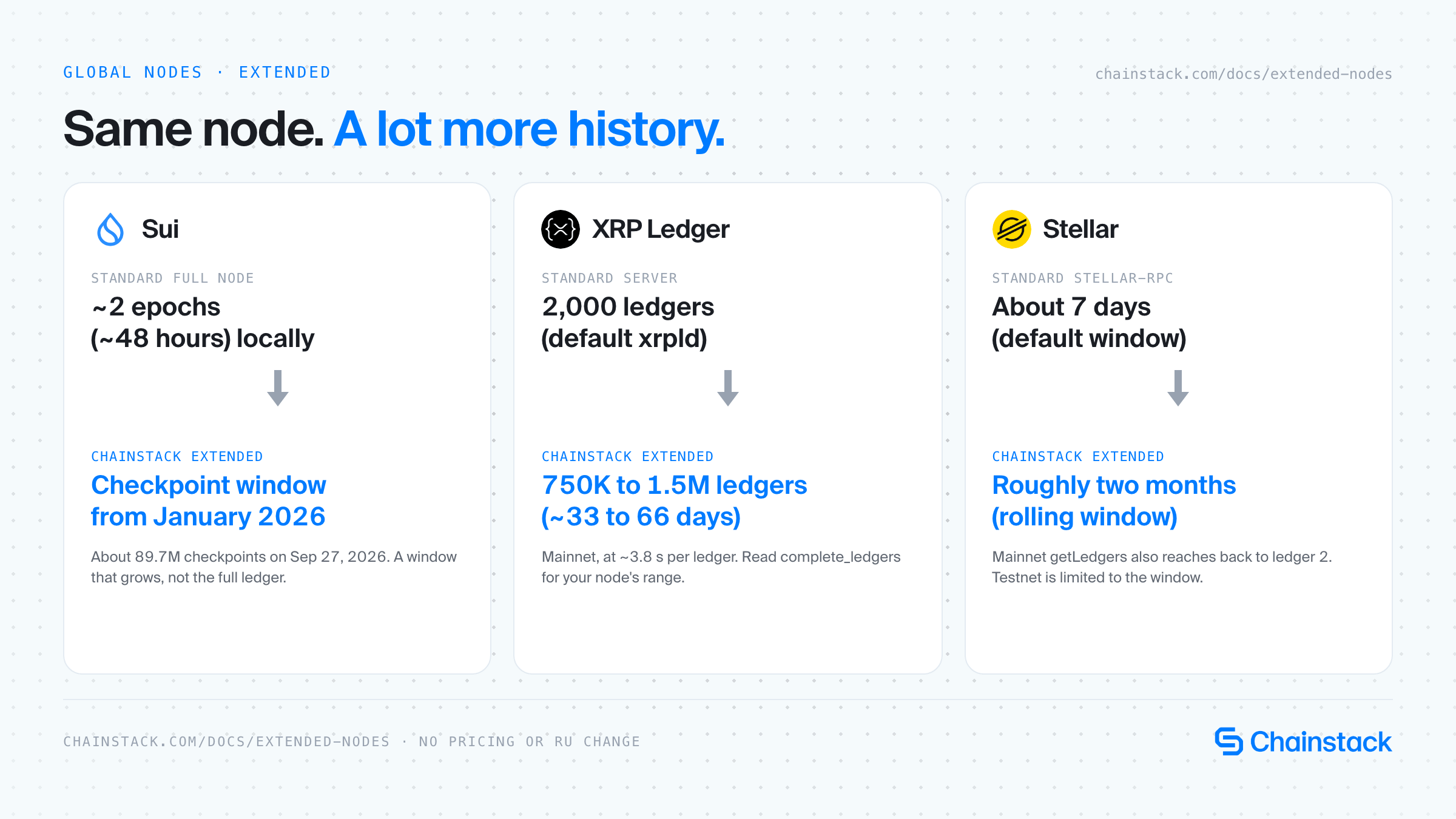
| Chain | Standard full node | Chainstack Extended |
|---|---|---|
| Sui | ~2 epochs (~48 hours) locally | Checkpoint window from January 2026, growing with the chain |
| XRP Ledger | 2,000 ledgers (default xrpld config) | 750,000 to 1,500,000 ledgers, about 33 to 66 days on Mainnet |
| Stellar | About 7 days (stellar-rpc default) | Rolling window of roughly two months; Mainnet getLedgers reaches back to ledger 2 |
 Sui: from ~48 hours to checkpoints since January 2026
A standard Sui full node keeps only the last ~2 epochs locally — roughly 48 hours. Chainstack’s Sui Global Nodes hold a much deeper window of checkpoints: on September 27, 2026 it ran from checkpoint 237,661,232 (January 23, 2026) to the tip, about 89.7 million checkpoints. It is a window, not the full ledger from genesis, and the floor can change, so read lowestAvailableCheckpoint from GetServiceInfo on your own node. See Sui tooling.
 XRP Ledger: from 2,000 ledgers to about 33–66 days
In its default configuration, xrpld (formerly rippled) deletes history older than the most recent 2,000 ledger versions, per XRPL’s own docs. Chainstack’s XRP Ledger Global Nodes rotate out old ledgers and hold between 750,000 and 1,500,000 of the most recent ones. At the Mainnet close rate of about 3.8 seconds per ledger, that is about 33 to 66 days of history.
The lower bound jumps forward each time the node rotates out old ledgers, so read complete_ledgers from server_info at runtime rather than assuming a fixed depth — see XRP Ledger tooling.
 Stellar: from ~7 days to roughly two months
Chainstack’s Stellar Global Nodes keep a rolling window of recent ledgers that is longer than the stellar-rpc default of about 7 days, roughly two months in the docs’ example. Transaction and event queries (getTransactions, getEvents) are limited to that window on both networks. On Mainnet, getLedgers also serves ledgers older than the window, back to ledger 2; on Testnet it is limited to the window. Your node reports its own window in getHealth — oldestLedger, latestLedger, and ledgerRetentionWindow — so work from oldestLedger. See Stellar tooling.
Where you’ll see the Extended label
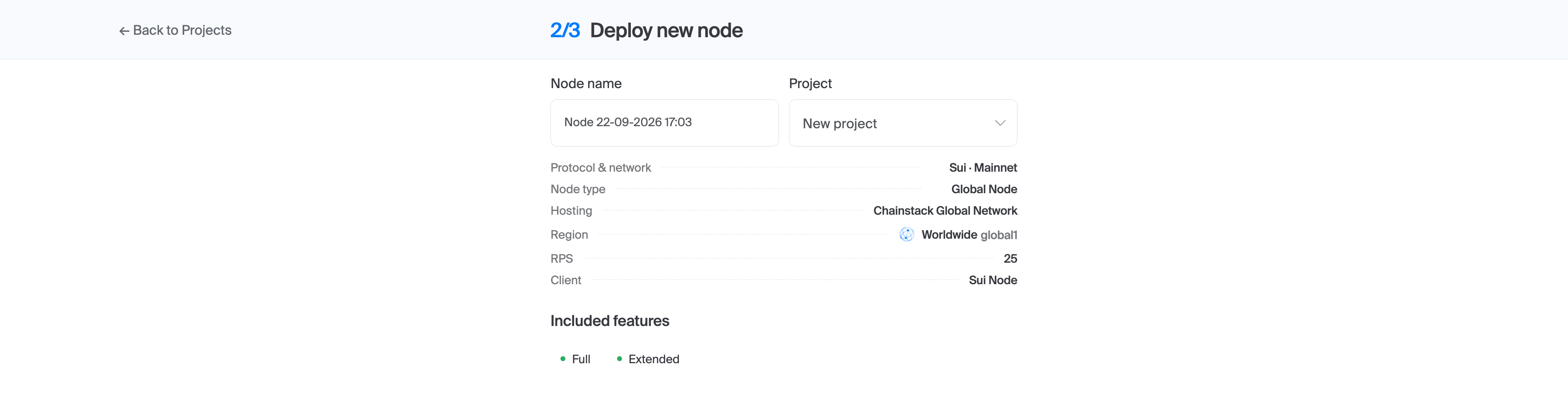
The badge shows up in three places in the Chainstack console, using the same pill style as the existing Full, Archive, Debug, and Trace badges:
- The deploy node wizard, next to “Included features”
- The node detail page, as a pill next to the node name

- The node list, as a pill in the node’s row

It only ever appears where a node genuinely serves extended history — you won’t see it on a vanilla Full node for a chain that doesn’t have this deployment.
Conclusion
Extended doesn’t change what you pay or how you deploy — it just names something Chainstack was already doing. If you’re running Sui, XRP Ledger, or Stellar on a Global Node, you likely already have more history available than “Full” ever let on. Worth checking before you reach for an Archive node or build your own indexing pipeline to work around a retention window that turns out not to be as tight as you assumed.
FAQ
No. Extended is not a new billing tier — requests against an Extended node are billed exactly like a Full node, with no request-unit change, on every plan.
Sui, XRP Ledger, and Stellar, on both Mainnet and Testnet, on Global Nodes. It’s data-driven per chain and network, so more can be added without a console change.
No. Archive means the complete history from genesis. Extended means more retention than a standard Full node, but not the full archive — the exact window varies by chain and is reported by the node itself at runtime.
No, the Extended label is Global Nodes only.
Read it from the node itself rather than assuming a fixed number: XRP Ledger reports complete_ledgers from server_info, Stellar reports oldestLedger/latestLedger/ledgerRetentionWindow from getHealth, and Sui reports the oldest checkpoint it holds as lowestAvailableCheckpoint from gRPC GetServiceInfo.
Additional resources
- Extended history — the full explainer
- Sui tooling
- XRP Ledger tooling
- Stellar tooling
- Chainstack updates: September 16, 2026 — the launch changelog entry