AI-ready infrastructure
 Refer and earn


 Ethereum
 Hyperliquid
 Solana
 Arbitrum
 BNB Smart Chain
 Base
Base Polygon
 TRON
TRON Sui
Sui Robinhood


Best crypto swap exchanges in 2026: on-chain, instant, and centralised

Plenty of guides to crypto swapping still say Uniswap charges a 0.25% interface fee. It has been 0% since 27 December 2025. That one stale number is a fair summary of how this category gets covered. The fee shapes are genuinely hard to compare, so most comparisons copy an old figure and move on.
This guide covers eight venues: Uniswap, ChangeHero, Kraken, StealthEX, Binance, KyberSwap, Jupiter and CoW Swap, plus the infrastructure layer underneath all of them.
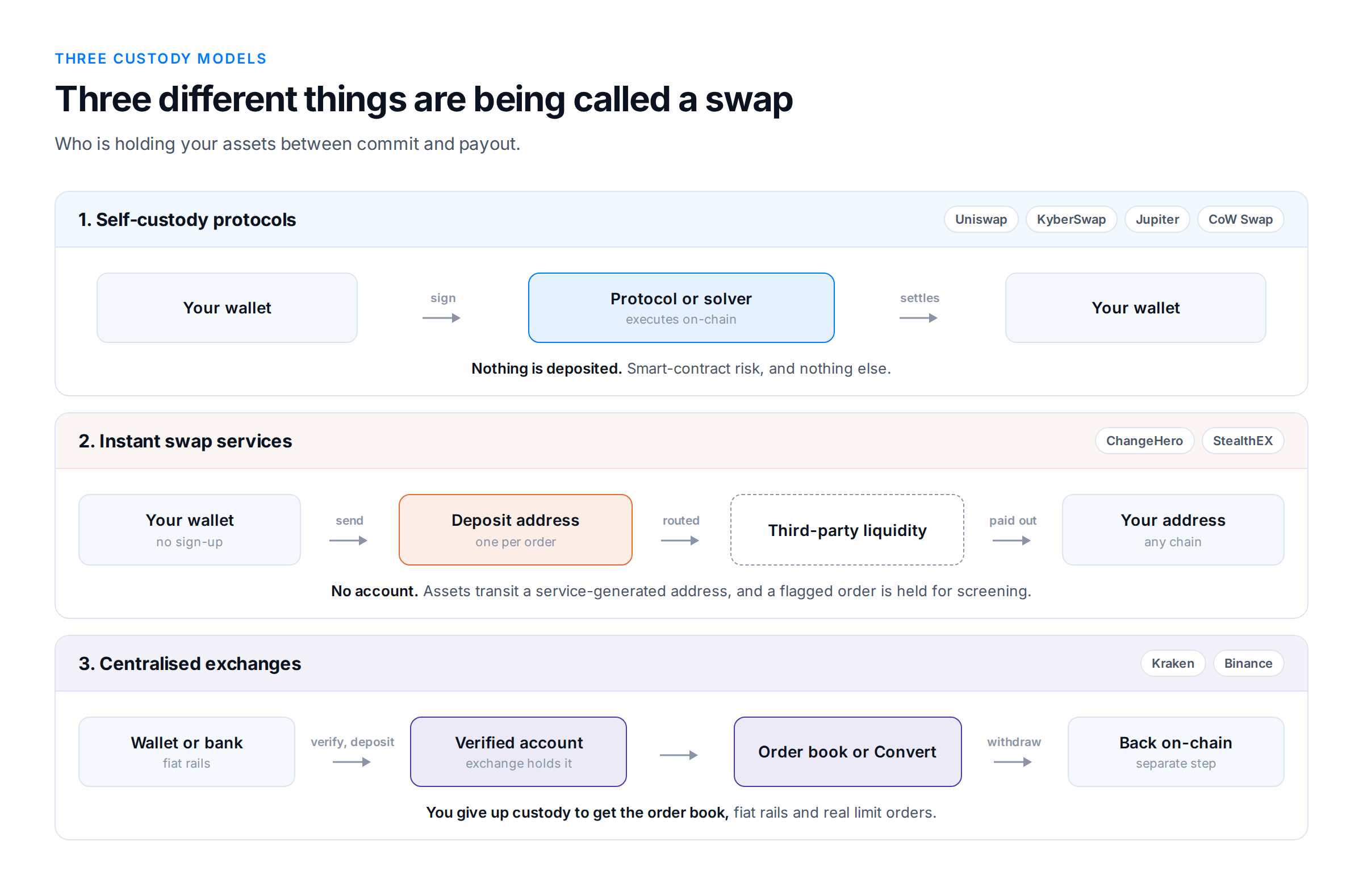
They are not the same kind of product. Four of them never touch your assets, two route them through an address they generate, and two take custody outright and give you an order book in exchange. “Swap” is doing a lot of work in one word.
Every on-chain venue here reads chain state to give you a quote and writes to a chain to settle, and that path runs over RPC. Chainstack provides that layer across 70+ chains for the routing engines, solvers and bots built around these venues, the same way it sits underneath the crypto data APIs one layer up.
What to look for in a crypto swap exchange
Before choosing, it helps to know which custody model you are accepting:
- Self-custody protocols. Uniswap, KyberSwap, Jupiter and CoW Swap never take possession of anything. You sign from your own wallet, the protocol executes, and the output settles back to your address. What you accept instead is smart-contract risk
- Instant swap services. ChangeHero and StealthEX require no registration and no wallet connection, and neither holds user balances. Your assets do transit a deposit address the service generates, and both state in their terms that a flagged transaction is held until verification completes. Registration-free is not the same as unscreened
- Centralised exchanges. Kraken and Binance take deposited funds into custody. Identity verification is mandatory, the exchange holds your assets while you trade, and getting them back on-chain is a separate withdrawal. In return you get fiat rails, real limit orders, and depth no on-chain venue matches on major pairs
Beyond custody, five things separate the venues:
- Chain coverage. One chain, several EVM chains, or a genuine chain boundary crossing
- Liquidity depth. A $500 swap and a $500,000 swap are different products on the same venue
- Fee shape. A protocol fee, an LP fee, an interface fee, gas, a spread and a partner markup are six different costs, and a venue that is free on one is rarely free on all six
- Execution risk. MEV exposure, slippage on thin pairs, and what happens when the quote moves
- Integration path. Whether there is a public API or widget if you are building this into a product
Most people need two of these. Knowing which two eliminates most of the list before price comes up.
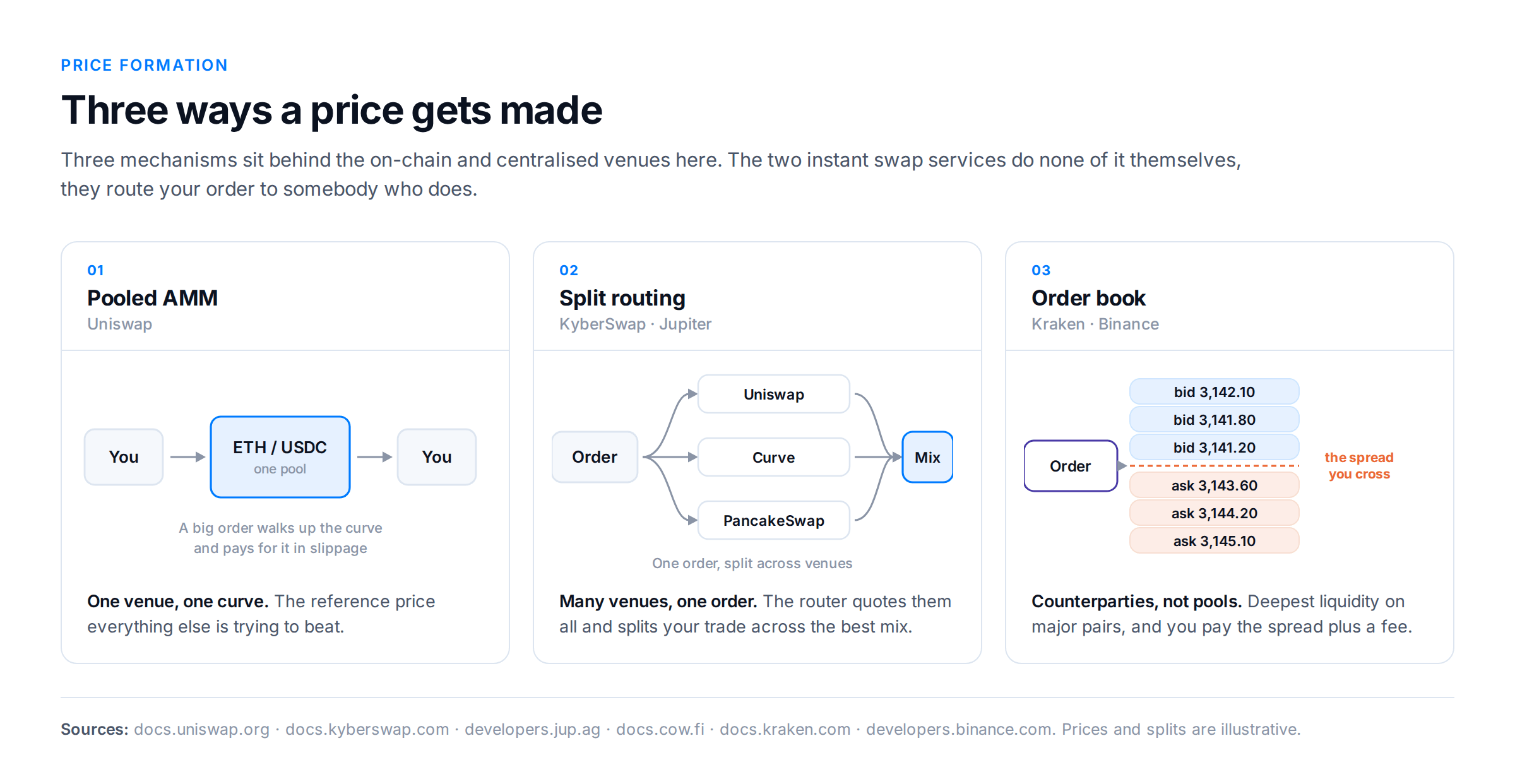
Which leaves the venues. Before pricing and before fees, the first filter is whether one reaches the chain your asset is actually on. For reference, three of the eight cannot see Bitcoin at all.
The 8 best crypto swap exchanges
1. Uniswap
Uniswap is the venue the rest of this list is measured against. It settled $55.75B over a recent 30-day window, roughly 23.6% of all DEX volume, against about $3.5B of TVL, per DefiLlama. Lifetime volume across every Uniswap version DefiLlama tracks is $3.84 trillion.
The story now is v4. Its singleton PoolManager, hooks and flash accounting have pulled it past v3 on both 24-hour and 30-day volume, $28.21B against $26.54B over the same window. Hooks make pool behaviour permissionless and per-pool, which is powerful and also moves diligence onto whoever integrates.
Two things most comparisons get wrong. The official Swapping API supports 20 mainnets, more than Uniswap’s own launch post claims, though UniswapX covers only eight of them and needs a swap worth at least 300 USDC before it is even considered. Below that it is included only if it beats the AMM route by 0.2%. And the Labs interface fee is 0% on both the web app and the wallet, confirmed on its support page as of 27 December 2025, alongside the UNIfication change that switched on protocol fees at the LP layer.
Strengths
- Deepest single-venue liquidity on most EVM pairs
- 20 mainnets on the official API, with a free developer platform since April 2026
- 0% interface fee, and gasless execution through UniswapX where available
- v4 hooks allow custom pool logic without a new deployment
Tradeoffs
- Routes only Uniswap liquidity plus UniswapX solvers, so a true aggregator prices some pairs better
- UniswapX is unavailable on 12 of the 20 supported mainnets, and its 300 USDC floor puts smaller trades back on the path where you pay gas
- Uniswap’s own numbers disagree: 20 chains in the supported-chains table against 18 in its own April 2026 launch post, and a UniswapX column inside that table marking seven chains against the dedicated UniswapX table below it listing eight
Best for Deep liquidity on a major EVM pair when you want one venue, one transaction, and no extra hop.
2. ChangeHero
ChangeHero has been running since 2018 and has settled into the role of the most straightforward instant swap services on the market. There is no wallet connection and no account. You enter a pair and an amount, provide a receiving address, and send. It reports more than three million users, and verification is triggered only when its automated risk engine flags a transaction.
Under the hood it is a liquidity aggregator, scanning ten-plus integrated providers in real time and delivering the swapped asset directly to the address you supplied. Two rate options: Best Rate, which floats with the market, and Fixed Rate, which locks the quote for fifteen minutes. The fee is a flat 0.5% of the swap value on Best Rate, per ChangeHero’s published schedule, which is unusually transparent for this category, and up to 0.7% on Fixed Rate.
Coverage runs past 400 cryptocurrencies, with particular depth in Solana-ecosystem tokens, DeFi assets and BRC-20s. On the B2B side, ChangeHero’s API v3 powers the in-wallet swap inside Exodus, Trezor, Tangem and CoolWallet, and there is a drop-in widget for teams that do not want to build a swap UI.
Strengths
- No wallet connection and no registration required
- A fee you can calculate in advance: a flat 0.5% on Best Rate, up to 0.7% on Fixed Rate
- Rates aggregated from ten-plus providers cover pairs single venues do not list
- Built into Exodus, Trezor, Tangem and CoolWallet, with a partner API and widget for everyone else
Tradeoffs
- Not designed for advanced traders: no charts, order books or limit orders
- Published asset counts run 300+, 350+ and 400+ across its own pages, with no single authoritative figure
- The rates live in a homepage FAQ rather than a proper fee page
Best for Users who want a predictable swap with a fee they can calculate in advance, and anyone who will not connect a wallet to a website.
3. Kraken
Kraken is the clearest regulated choice in this list for anyone in the EEA. It secured a MiCA licence from the Central Bank of Ireland on 25 June 2025, which Kraken says makes it the first major global crypto platform authorised by the CBI, and which lets it serve clients across all 30 EEA states. For anyone in Europe, that single fact settles a lot. CoinStats’ exchange ranking places it fifth by volume, at $35B over 30 days across 1,421 markets.
Its swap products split two ways, and the pricing gap between them is the sharpest number in this guide. Kraken Pro is the maker/taker order book: 0.40% maker and 0.80% taker at Tier 1, falling to 0.00% and 0.05% at the top tier. Convert is the one-click product, at 1% plus a spread Kraken discloses but never quantifies, rising to 1.5% on custom orders. A Tier 1 user pays 80 bps on the book against 100 bps plus spread on Convert; at the top tier the gap is 5 bps against 100 plus spread. Kraken+ at $4.99 a month waives the trading fee on the first $10,000 of monthly volume, though the spread still applies. Stablecoin conversions are free at 1:1 within published daily limits.
Its proof-of-reserves disclosure is the most explicit about its own limits of any exchange here, because it publishes what the method cannot prove: not exclusive possession of keys that may have been duplicated, not hidden encumbrances, not whether funds were borrowed to pass the review, and not whether keys have been lost or funds stolen since. It publishes that list itself, alongside a Merkle-tree reserve ratio against client balances. It remains a point-in-time attestation rather than a full audit.
Strengths
- MiCA licensed across 30 EEA states, with the SEC’s case against it dismissed in March 2025
- Deep order book with taker fees to 0.05%, plus REST, WebSocket v2 and FIX 4.4
- Proof of reserves attested regularly, with explicit stated limitations
- Free 1:1 stablecoin conversions within published daily limits
Tradeoffs
- Convert costs 1% plus an unquantified spread, and 1.5% on custom orders, against 5 to 80 bps on the book
- The 0.40%/0.80% entry tier is four to eight times Binance’s, and it takes $2,500 of monthly volume to move off it
- No public Convert API, so programmatic users have to build it on the order book themselves
- Does not serve Japan, Russia, Iran and several other jurisdictions, nor Maine or New York in the US
Best for Fiat in and out, real limit orders, and anyone who wants a regulated venue in Europe.
4. StealthEX
StealthEX launched in 2018 and has built its position on asset breadth rather than volume. Execution is guest-side: you send to a generated address and the output is routed to the address you supply, across multiple liquidity sources including Binance, KuCoin and Mexc. No account, no wallet connection.
Asset coverage runs past 2,000 cryptocurrencies, noticeably deeper into the long tail than most instant swap competitors, which is why people end up there. Both fixed and floating rates are available, there is no upper limit on crypto-to-crypto swaps, and a swap typically completes in five to thirty minutes depending on confirmation requirements on either chain.
The fee is embedded in the quoted rate rather than charged separately, landing around 0.4% for popular pairs before spread. Transactions flagged by automated risk screening are held for verification, and card-based fiat purchases are routed through Mercuryo and Guardarian. For partners there is a public API and a drop-in widget, with an adjustable revenue share.
Strengths
- Past 2,000 assets, deep into the long tail
- No registration, no upper limit on crypto-to-crypto swaps
- Liquidity routed across Binance, KuCoin, HTX and others
- Free partner program with an adjustable revenue share and several integration formats
Tradeoffs
- The fee is embedded in the quote rather than itemised, so the exact cost is visible only when you request a rate
- Automated risk screening can hold a flagged transaction for verification
- Built for breadth, not depth: no order book, charts or limit orders
Best for Users looking for pairs and long-tail assets the larger platforms have not listed.
5. Binance
Binance is the largest venue in this guide by a wide margin, and the one carrying the biggest caveat: since 1 July 2026 it has stopped onboarding new users across much of the EU. Where it is available, it has the deepest spot book in this guide and the cheapest order-book fees: 0.10% maker and taker at VIP 0, falling to 0.011% and 0.023% at VIP 9, with a further 25% off when paying in BNB. CoinStats’ exchange ranking puts it first, at $286B of spot volume over 30 days and around $11B in a typical day across 1,358 markets, a centralised figure that is not comparable to the on-chain volumes above.
Binance Convert is the swap product, and it is better tooled than Kraken’s: Instant, Limit and Recurring modes, per-pair minimums Binance publishes only in the trade interface, and a genuine public API with getQuote, acceptQuote, limit order placement and cancellation, and configurable quote validity of 10, 30 or 60 seconds. Binance states there are no fees for Convert. It explains that Convert prices are live and size-aware rather than last-traded, but publishes no figure you can hold against a book fill in advance. Its Convert API docs say the service is “not suitable for” price arbitrage, high-frequency trading or price exploitation.
The availability problem is the one that matters. Binance withdrew its MiCA licence application in Greece in late June 2026 and told users in France and other member states it would stop providing crypto-asset services from 1 July 2026, per notices reported by Euronews. Binance’s own statement says only that “some users may be impacted depending on their country and account status”; what it has confirmed is that it stopped onboarding new EU users and that withdrawals remain open. It is also unavailable to US residents except through Binance.US, a separately governed entity currently rebuilding at 0% maker and 2 bps taker. Restrictions are enforced at the API edge, not just at signup. Calls to api.binance.com from a restricted location return HTTP 451 citing the eligibility clause of the terms.
Strengths
- Cheapest order-book fees here, and the deepest spot liquidity on major pairs
- The only convert product in this guide with a real public API, including limit converts
- Proof of reserves using Merkle trees plus zk-SNARKs, with per-user verification
- Roughly 500 listed assets and 1,350+ pairs
Tradeoffs
- No new EU onboarding since 1 July 2026, service restrictions in the member states that received notices, and no US access outside the separate Binance.US entity
- Convert quotes a single all-in price with no published figure you can compare to a book fill in advance
- Binance’s own docs call Convert “not suitable for” arbitrage or high-frequency trading, which is guidance rather than a contractual bar but a clear signal about what the endpoint is for
- Settled a $4.3B DOJ resolution in November 2023 with a three-year compliance monitor whose status remained unresolved well into 2026
Best for Deep liquidity on major pairs at the lowest order-book fees, if you are in a jurisdiction it still serves.
6. KyberSwap
KyberSwap is the entry most of these lists leave out, and on the numbers that is hard to justify. It is the #1 aggregator on Ethereum by 30-day volume at $3.94B, ahead of CoW Swap at $2.76B and 1inch at $2.62B, per DefiLlama’s Ethereum aggregator ranking. Across all chains it did $6.69B over a recent 30-day window, $107.8B over the trailing year, and $175.4B lifetime, routing across 420+ DEXs on 18 to 19 EVM chains, depending which page of its own docs you read.
It also charges nothing. Its fee schedule lists aggregator swaps as “no fee,” with a documented asterisk worth knowing: positive slippage and a dust collector still apply on some trades, and third-party integrators can add their own fees through URL parameters, which display on the interface. Cross-chain is where it does charge, tiered from 0.05% on stable routes to 0.25% for anything touching Bitcoin.
The developer story is the cleanest here. The Aggregator API requires no authentication and no account. You pass an x-client-id header containing your own app name, and that is the entire onboarding. The one caveat is that KyberSwap now recommends a separate API gateway for production traffic, and that one does need a key from its business development team. The keyless endpoint stays available at 3 requests per second.
Strengths
- #1 aggregator on Ethereum by 30-day volume, and the second-largest aggregator in this guide behind Jupiter
- 0% protocol fee on aggregator swaps
- The public API needs no key, no account and no KYC at 3 requests per second; only the production gateway requires one
- Aggregator, Limit Order and Zap APIs plus a customisable widget
Tradeoffs
- Its Elastic AMM was exploited in November 2023 for roughly $55.2M across 2,367 liquidity providers; the aggregator was unaffected, and Elastic and Classic are now deprecated
- Non-EVM coverage is resold third-party routing rather than its own settlement
- Non-aggregator products do charge: limit orders 0.01–1%, Earn zaps 0.01–0.25%
Best for Best-execution routing on EVM chains, and any integration where you want a production API without an account.
7. Jupiter
Jupiter is the largest aggregator in DeFi by any window: $14.48B over a recent 30-day window, $297.1B over the trailing year, $1.279 trillion lifetime. It takes 54.7% of Solana aggregator volume and 21.4% of global aggregator volume, all on one chain.
The mechanism is a competition rather than a router. On /order, four independent routers quote the same request and the best price wins: Metis searches on-chain Solana AMMs, JupiterZ collects signed quotes from RFQ market makers, and Dflow and OKX bid as external aggregators. Execution runs through Jupiter’s own landing pipeline: a high-staked validator with SWQoS, the Beam forwarder, and DoubleZero fiber.
One correction, because it is everywhere: Swap API V2 launched in March 2026 as the recommended path, and Ultra’s /order and /execute moved to it with a base-URL change. Guides still pointing at ultra-api.jup.ag are out of date, though Ultra survives as the default order mode and still powers the Plugin widget.
Strengths
- Reads the chain state
- Managed transaction landing through the Beam forwarder, which bypasses standard RPC nodes
- Keyless at 0.5 RPS, a free key at 1, then $25/month for 10, plus a drop-in Plugin widget
- Hosted MCP server at mcp.jup.ag exposing 75 tools for agent workflows
Tradeoffs
- Solana only, so a multichain product needs a second integration
- Fees are mode- and pair-dependent: in Ultra mode 0 bps on stable-to-stable, 2 on SOL-stable, 5 on LST-stable, 10 by default and 50 on a token under 24 hours old; 0% commission in Manual mode; separate schedules for Limit and DCA. Gasless swaps add a fixed surcharge capped at 10% of the trade, and a trade too small to stay under that cap is refused rather than charged more
- Three base URLs in about 18 months across Swap V1, Ultra and Lite, so integration guides age fast
Best for Anything on Solana, and any product where best execution on that chain is the whole requirement.
8. CoW Swap
CoW Swap is the execution-quality pick. On Ethereum it settled $2.756B over a recent 30-day window, second among aggregators and ahead of 1inch, per DefiLlama. Globally it did $3.06B over the same period and $180.6B lifetime.
You never sign a transaction, only an intent. Intents go into a batch, and solvers bid either on individual orders or on groups where batching creates a coincidence of wants. The protocol filters out unfair batched bids, meaning any that deliver less to an order than an available non-batched bid, then picks the combination maximising total surplus. Two opposite orders can clear against each other with no pool touched and no MEV to extract.
Fees follow the same logic: 2 bps on standard assets, 0.3 bps on correlated ones, plus 50% of any price improvement over the quote on market orders and 50% of surplus on out-of-market limit orders, both capped at 0.98% of volume. If execution does not beat the quote, that part is zero. You pay no gas directly and nothing on a failed or cancelled order, with one exception. Selling native ETH through Eth-flow needs an on-chain transaction and does cost gas.
Strengths
- #2 aggregator on Ethereum by 30-day volume, ahead of 1inch
- Structural MEV protection through batch auctions rather than a private mempool
- Nothing owed on failed or cancelled orders, and no direct gas on standard flows
- Order Book API needs no key, plus an SDK and a widget supporting partner fees to 1%
Tradeoffs
- Auction-paced rather than instant, so it suits size rather than latency-sensitive trades
- The solver set is permissioned through a DAO bonding pool, so execution depends on a curated group of third parties
- Contracts are deployed on 11 mainnets and the hosted Order Book API is live on 10, with Optimism the gap
- CoW AMM is effectively dormant at under $100K of TVL, whatever older articles say about it
Best for Large orders on Ethereum where slippage and front-running cost more than a few seconds of latency.
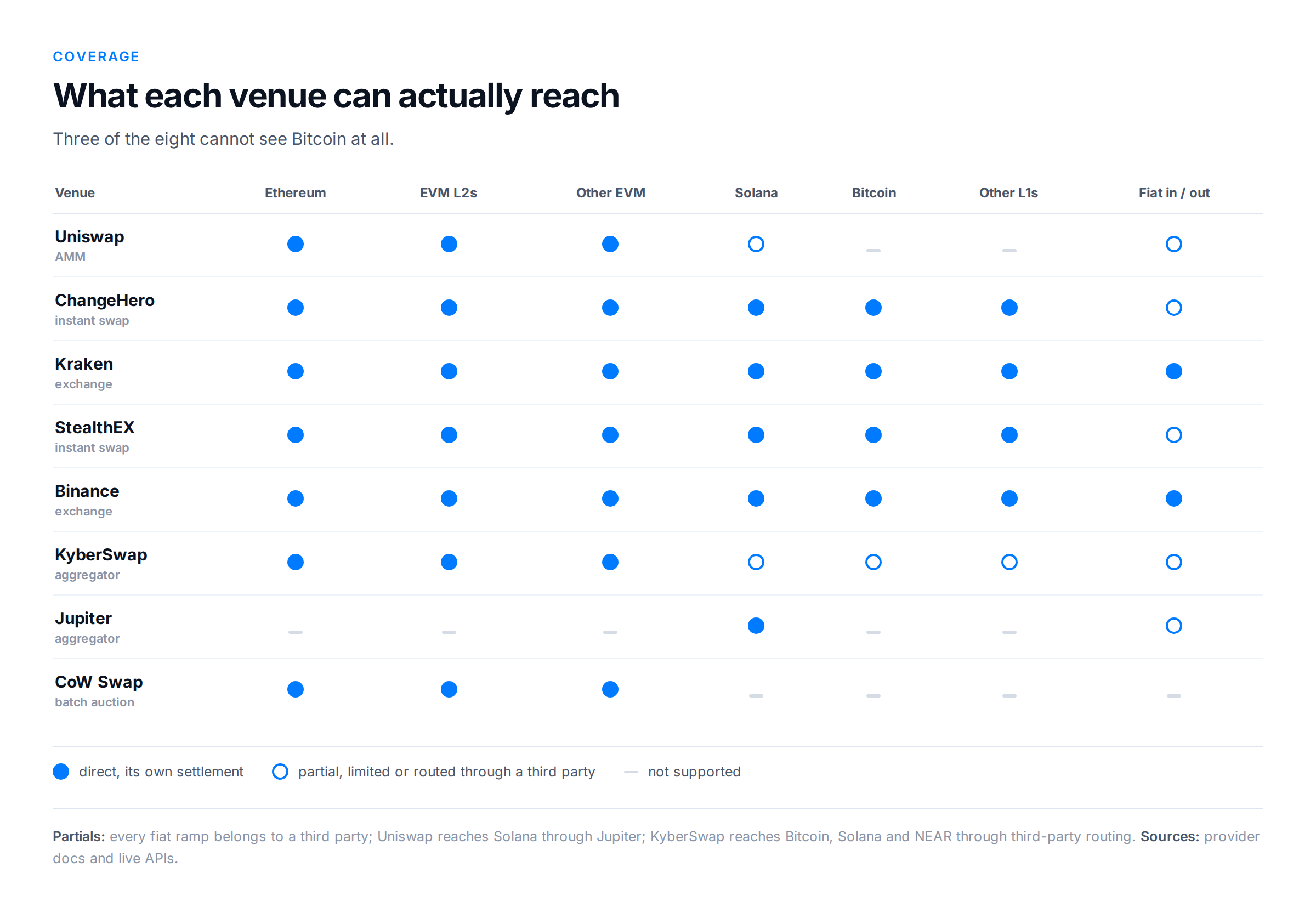
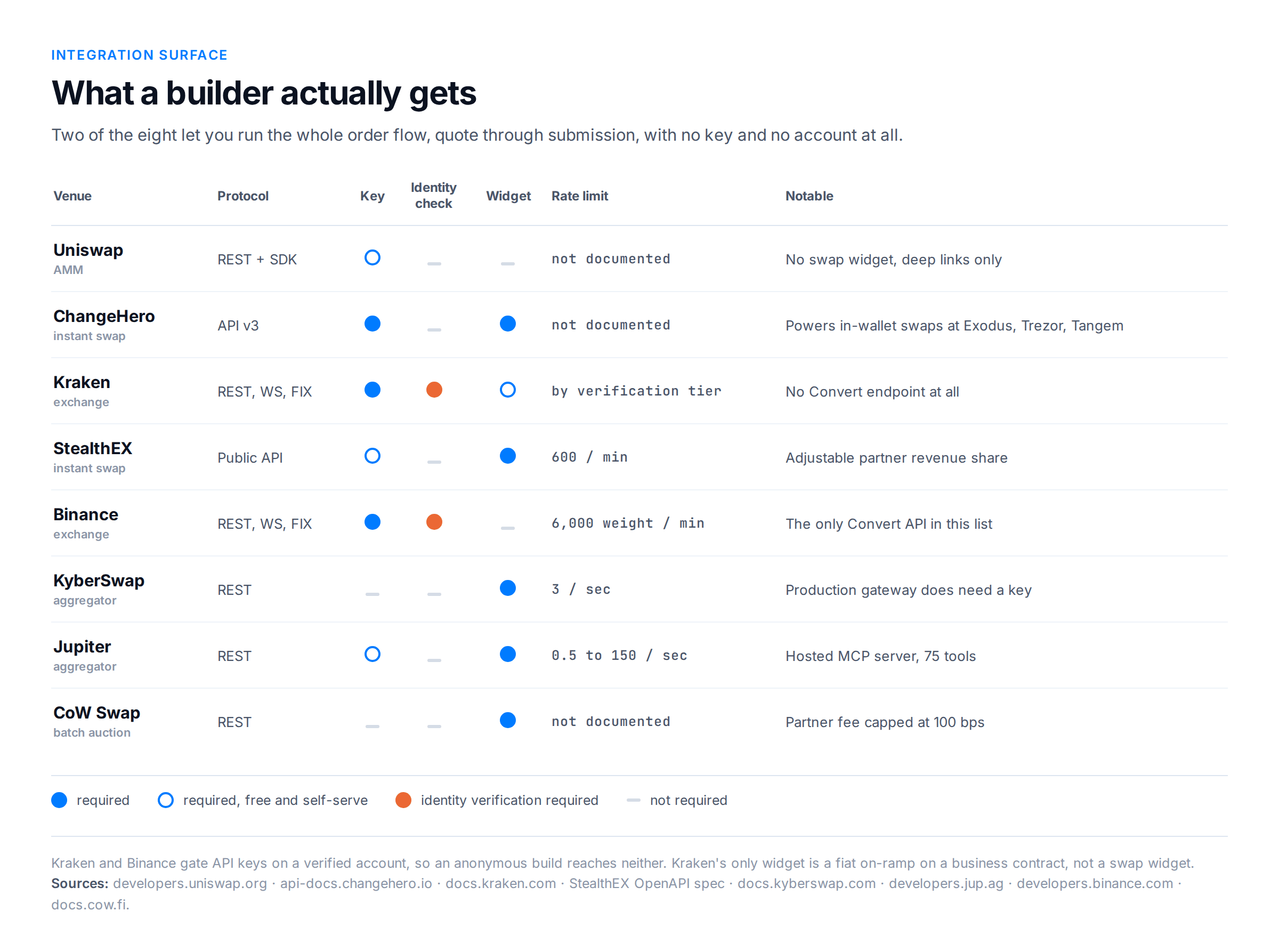
If you are shipping a swap feature rather than making one trade, the shortlist narrows fast on a different axis: what each venue hands a developer.
Comparison
| Provider | Type | Chains | Account needed | Published fee | Volume | Integration |
|---|---|---|---|---|---|---|
| Uniswap | AMM + intents | 20 (API) | No | 1–100 bps pool, 0 interface | $55.75B / 30d | Swapping API, SDKs |
| ChangeHero | Instant swap | 400+ assets | No | 50 bps flat, 70 bps fixed | Not published | API v3, widget |
| Kraken | Centralised exchange | 600+ assets | Yes, KYC | 0–80 bps Pro, 100 bps Convert | $35B / 30d | REST, WS, FIX |
| StealthEX | Instant swap | 2,000+ assets | No | ~40 bps, inside the quote | Not published | Partner API, widget |
| Binance | Centralised exchange | ~500 assets | Yes, KYC | 1.1–10 bps spot, Convert 0 per Binance | $286B / 30d | REST, WS, FIX, Convert API |
| KyberSwap | Aggregator | 18–19 EVM | No | 0 swap, 5–25 bps cross-chain | $6.69B / 30d | REST keyless, widget |
| Jupiter | Meta-aggregator | 1 (Solana) | No | 0–50 bps by pair | $14.48B / 30d | REST, Plugin, MCP |
| CoW Swap | Batch auction | 11 deployed, 10 API | No | 0.3–2 bps + surplus | $3.06B / 30d | Order Book API, widget |
On-chain figures are DefiLlama trailing 30-day volume. Exchange figures are 30-day spot volume from CoinStats’ exchange rankings. The three are different measurements and do not belong in one ranking. Availability, fees and supported assets vary by jurisdiction, account type, route and date; the linked sources are live and will have moved since this was written.
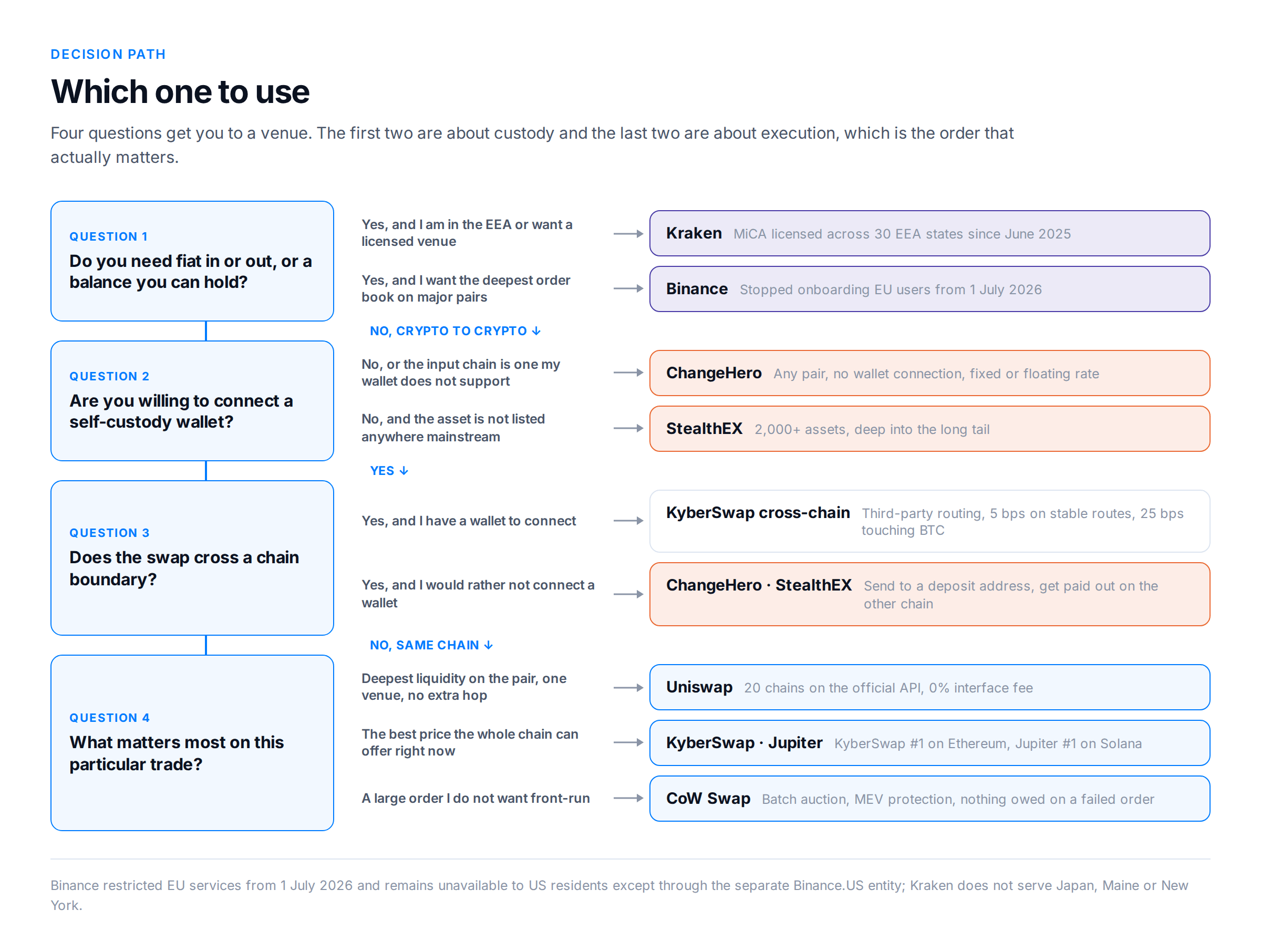
Which crypto swap exchange should you choose?
You need fiat in or out. Kraken if you are in the EEA or want a licensed venue. Binance for the deepest book and cheapest fees, if it still serves your jurisdiction and account. If neither fits, CoinStats ranks 100 exchanges by volume, with 24-hour, 7-day and 30-day figures per venue.
You will not connect a wallet. ChangeHero for common pairs, StealthEX when the asset is obscure enough that nothing else lists it.
You are crossing a chain boundary. KyberSwap’s cross-chain tab if you have a wallet, ChangeHero or StealthEX if you would rather not connect one.
You are trading on Solana. Jupiter, and it is not close.
You are moving size on Ethereum. CoW Swap. The batch auction is worth more than the seconds it costs.
You want the best price the chain can currently offer. KyberSwap on EVM, Jupiter on Solana.
You want the deepest liquidity on one venue with no extra hop. Uniswap.
Final thoughts
The useful question is not which venue is the biggest. It is which custody model you are willing to accept, and after that, whether your trade crosses a chain boundary. Those two answers eliminate most of this list before pricing comes up.
Be sceptical of published numbers, including the ones above. Two of these eight publish no volume figure at all. Kraken’s conversion carries a spread it discloses but never quantifies; Binance’s quotes one all-in number it says carries no fee, with nothing published you could check it against. Two publish chain counts in several places and get several different answers. And the volume figures in the table are three incompatible measurements: on-chain DEX volume, aggregator volume that settles into it, and centralised spot volume, which counts matched order-book trades at a custodial venue. Every figure in this guide names where it came from, which is the standard the category should be held to and mostly is not.
If you are building rather than trading, the venue is only half the stack. Quoting, simulating and submitting all run over RPC, and that layer decides whether your integration feels instant or flaky.
FAQ
What is the difference between a DEX, an instant swap service and a centralised exchange?
A DEX like Uniswap executes against on-chain liquidity while your assets stay in your wallet until settlement, and needs a connected wallet. An instant swap service like ChangeHero or StealthEX generates a deposit address, routes your order to third-party liquidity, and pays out to an address you supply, with no account and no wallet connection. A centralised exchange like Kraken or Binance takes custody: you verify your identity, deposit, trade an internal ledger balance, and withdraw as a separate action. Custody is the real dividing line, not price.
Do any of these require KYC?
The four self-custody protocols and the two instant swap services require no registration to swap. KyberSwap goes furthest, with a public API that needs no account or key at all, though the gateway it recommends for production traffic does. That said, ChangeHero and StealthEX both run automated risk screening and both state in their terms that a flagged transaction is held until verification completes. Kraken and Binance require identity verification before you can trade or withdraw, with no exceptions.
Which one has the lowest fees?
KyberSwap charges no protocol fee on aggregator swaps, and Binance has the cheapest order book at 1.1 bps maker and 2.3 bps taker at its top tier, against 10 bps flat at entry. But the cheapest venue depends on the pair: a low fee on a shallow pool loses to a higher fee on a deep one every time, and Kraken’s convert costs 1% plus a spread it discloses but never quantifies, while Binance states its Convert carries no fees at all. Compare the quoted output, not the advertised rate.
Do I need my own RPC node to build a swap feature?
Not if you are only calling a hosted quote API. You do as soon as you are computing routes yourself, simulating transactions before submitting, watching the mempool, or running a solver. Those workloads are RPC-bound, and shared public endpoints will rate-limit you before your product finds traction. That is the point at which managed node infrastructure stops being optional.