AI-ready infrastructure
 Refer and earn


 Ethereum
 Hyperliquid
 Solana
 Arbitrum
 BNB Smart Chain
 Base
 Polygon
 TRON
 Sui
 Robinhood


How Elysium contracts read and write HyperCore

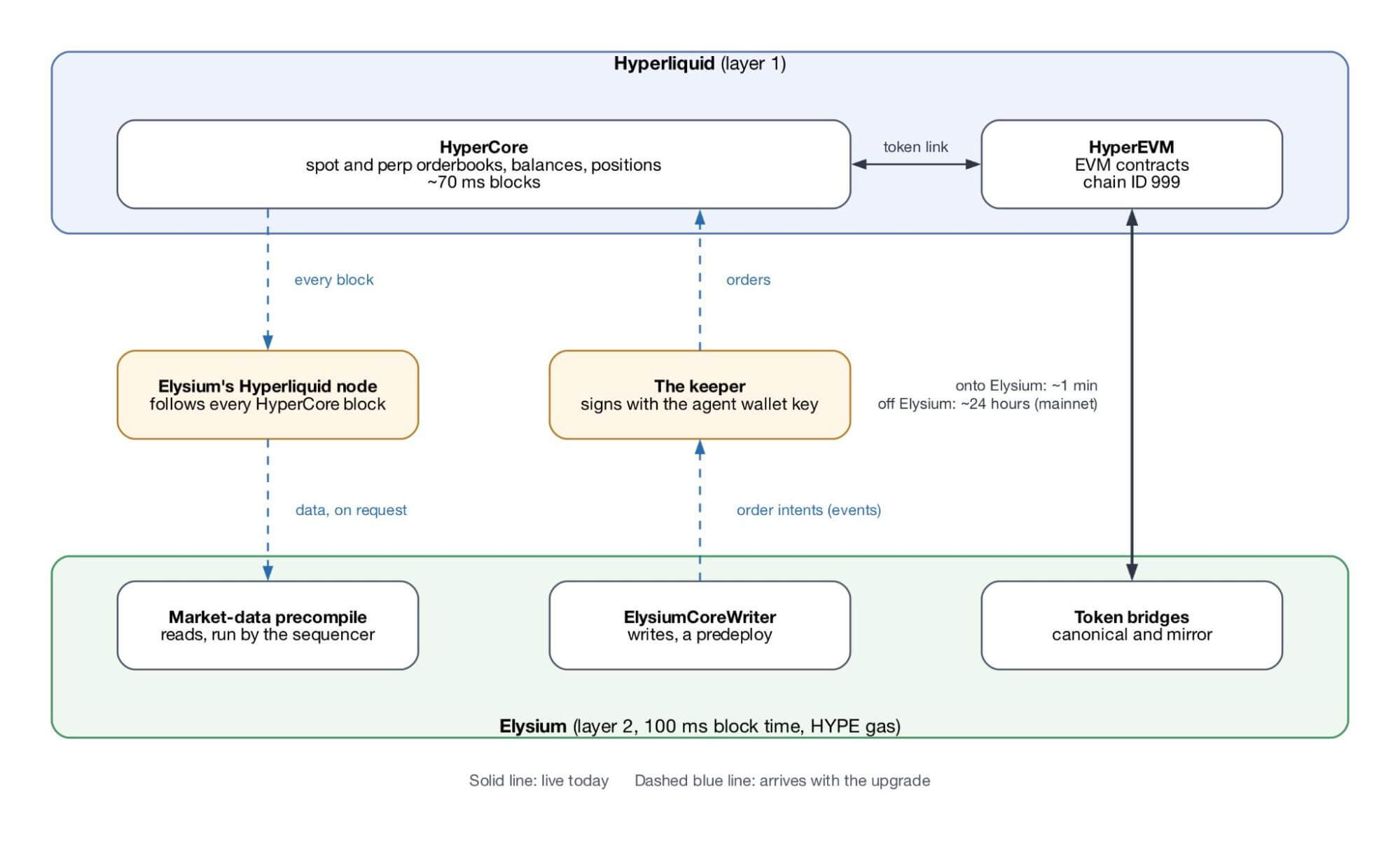
- Elysium is an L2 for Hyperliquid. It runs on top of HyperEVM, uses HYPE for gas and has a 100 ms block time.
- Reading HyperCore from Elysium: the market-data precompile lets any Elysium contract read HyperCore orderbooks, prices, balances and positions for normal call gas.
- Writing on HyperCore from Elysium: a smart contract from Elysium sends an order request to ElysiumCoreWriter, another smart contract built into Elysium. A keeper, a service that runs outside the chain, picks it up and places the order on HyperCore in about 100 ms. The order runs on the user’s own HyperCore account, through a key the user approved for trading only.
- Trust: You have to trust Elysium for the HyperCore data, and nothing proves it on-chain yet. The keeper can’t move funds, but it holds a key that can trade on the user’s account.
ℹ️ Status (November 27, 2026): Elysium mainnet has been live since November 9, 2026. The HyperCore read and write features in this article aren’t live yet. Kinetiq says they ship together in a network upgrade about 4 weeks after mainnet, and it hasn’t published their addresses or interfaces yet.
A smart contract on HyperEVM sees only the highest buy price and the lowest sell price in HyperCore’s orderbook, updated once per second. When it places an order on HyperCore, Hyperliquid delays that order on-chain for a few seconds. That works for a vault that rebalances now and then. It’s too slow for a contract that quotes prices several times per second.
Elysium’s 2 new features, the market-data precompile for reads and the keeper for writes, target those 2 limits.
Hyperliquid, HyperEVM and Elysium
Hyperliquid is a layer 1 blockchain with 2 parts that run on the same chain, under the same consensus:
- HyperCore is the built-in exchange. It runs the spot and perpetual futures orderbooks and stores every account’s balances and positions. It produces a block about every 70 ms. You trade on it by sending signed actions, such as orders and cancels, to Hyperliquid’s API. You can’t deploy your own smart contract on it.
- HyperEVM is Hyperliquid’s EVM side (chain ID 999), with HYPE as gas. You can deploy your own smart contracts on it.
HyperEVM is deliberately small. Its small blocks come every second with a 3M gas limit, and its big blocks come once a minute with a 30M gas limit. That leaves little room for HyperEVM contracts that need to act many times per second.
Elysium is a layer 2 that Kinetiq built on Arbitrum Orbit, Arbitrum’s technology for launching your own chain. It runs on top of HyperEVM: Elysium posts its transaction batches to HyperEVM, and its posted state counts as valid unless someone proves it wrong within a challenge period. Kinetiq calls this an optimistic rollup. Elysium uses HYPE for gas, has a 100 ms block time and targets 300M gas per second, which Kinetiq puts at roughly 100 times HyperEVM’s capacity. At launch, one server, called the sequencer, builds all of Elysium’s blocks: it decides the order of transactions and runs them.
Kinetiq’s docs target high-frequency trading and professional market-making AMMs, and its announcement post calls out prop AMMs alongside spot trading and token launches. A prop AMM is an AMM run by a professional market maker. It updates its prices on-chain several times per second, so it needs fast, cheap blocks. Kinetiq set Elysium’s fees so that updating prices 5 to 10 times per second stays cheap.
Keep the comparison point in mind for the rest of this article: Elysium’s alternative is a contract on HyperEVM. If you just want to place spot orders, sending them straight to HyperCore is faster, because any route through a smart contract adds steps. Elysium matters when your trading logic lives in a smart contract. For a broader comparison of the two networks, see Elysium vs HyperEVM.
Tokens already move, through HyperEVM
Tokens can travel between Elysium and HyperCore today, with HyperEVM in the middle:
- Elysium and HyperEVM are connected by Arbitrum’s standard bridge. ERC-20s from HyperEVM, such as USDC and KNTQ, use the canonical bridge: the original is locked on HyperEVM and a copy is minted on Elysium. Tokens created on Elysium use the mirror bridge, Kinetiq’s setup on top of Arbitrum’s bridge contracts, which locks the original on Elysium and mints a “mirror” token on HyperEVM. Moving onto Elysium normally takes about a minute. Moving off it takes about 24 hours on mainnet, the challenge period during which Elysium’s posted state can still be disputed.
- HyperEVM and HyperCore have their own token link, built into Hyperliquid. An Elysium token reaches HyperCore as its mirror: once the issuer links it to a token on HyperCore, the mirror uses that link through a deposit wallet on HyperEVM. The deposit wallet locks the mirror, and HyperCore credits the same amount to the recipient’s HyperCore spot balance.
What’s missing today is contract access. An Elysium contract can’t see HyperCore’s orderbooks or place an order there. The upgrade adds both, and neither goes through HyperEVM.
Precompiles and predeploys
The read feature is a precompile and the write feature is a predeploy. The names look alike and mean different things. One term first: ArbOS is Arbitrum’s layer around the EVM, present on every Arbitrum chain, Elysium included. It handles what an L2 needs on top of the EVM, such as gas pricing, messages to and from the parent chain, and chain upgrades.
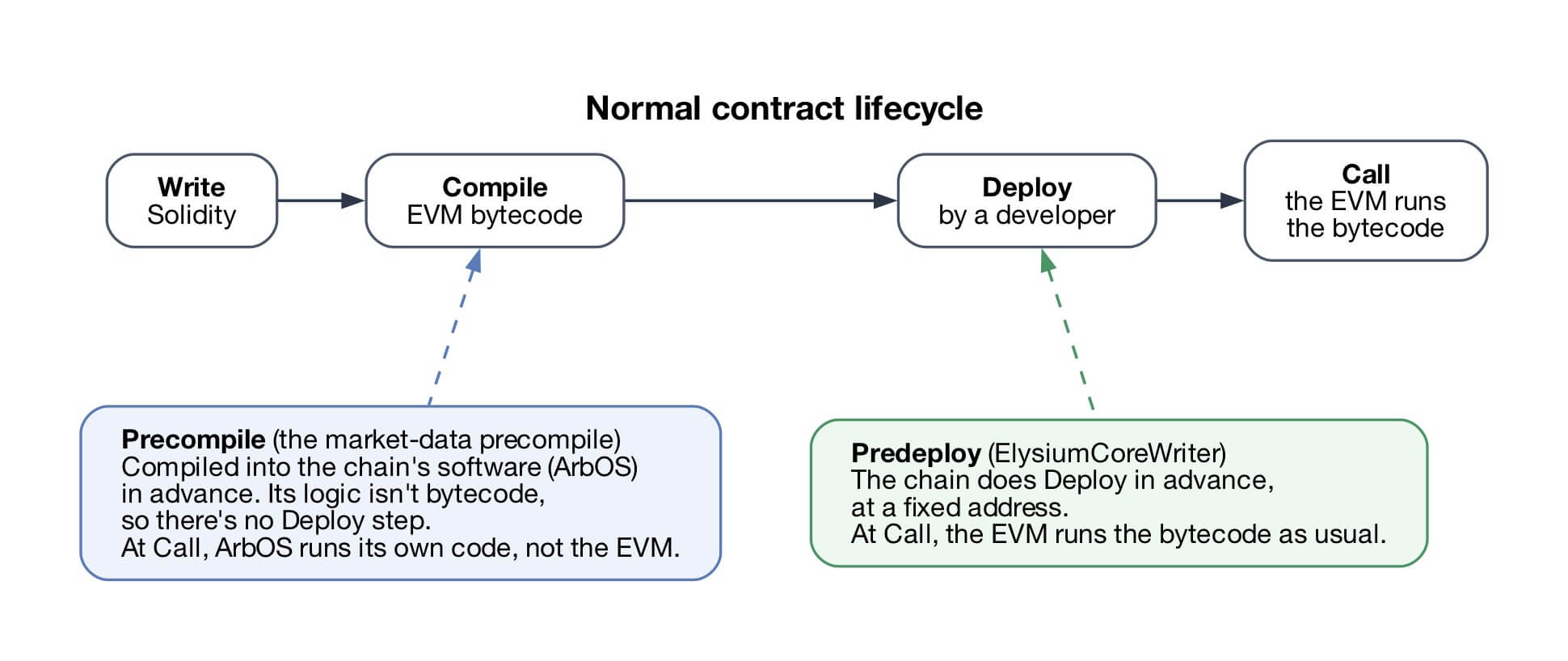
A normal smart contract goes through 4 steps. You write it in Solidity, compile it into EVM bytecode and deploy the bytecode to an address. When a transaction or another contract calls that address, the EVM runs the bytecode. Each of the 2 terms names a step that the chain does ahead of time:
- A predeploy is deployed ahead of time. It’s a normal contract with normal bytecode, but the chain itself places it at a fixed address, at launch or in an upgrade. When it’s called, the EVM runs it like any other contract. ElysiumCoreWriter is a predeploy.
- A precompile is compiled ahead of time, into the chain’s own software. Its logic isn’t EVM bytecode. When it’s called, ArbOS runs its own built-in code in place of the EVM, so a precompile can do things bytecode can’t, like returning data from outside the EVM. The market-data precompile is one. Its code has to be added to ArbOS, which is why it ships in an ArbOS upgrade.
| Aspect | Precompile | Predeploy |
|---|---|---|
| Where its logic lives | Inside ArbOS | EVM bytecode at its address |
| What runs when it’s called | ArbOS | The EVM |
| Can return data from outside the EVM | Yes | No |
| Who adds it | The chain | The chain |
| How other contracts call it | Like any contract | Like any contract |
| On Elysium | The market-data precompile (reads) | ElysiumCoreWriter (writes) |
That explains the split. A read returns HyperCore data from outside the EVM, which normal bytecode can’t do, so it’s a precompile. A write only has to record an order as an event, which normal bytecode can do, and the keeper handles everything outside the chain.
How a read works
The market-data precompile serves 4 kinds of HyperCore data:
- Orderbooks, at any level of detail: from just the highest buy price and the lowest sell price up to every order in the book
- Prices: the oracle price (a reference price built from several exchanges), the mark price (used for margin and liquidations) and the spot price
- Account balances and positions
- Computed figures: how much liquidity sits close to the middle price, whether more buy or sell orders are coming in, and how far the price would move for an order of a given size
The read path uses 2 components:
- The sequencer, which builds Elysium’s blocks.
- Elysium’s Hyperliquid node runs Hyperliquid’s node software, which downloads Hyperliquid’s blocks and rebuilds HyperCore’s state locally. Kinetiq describes it as co-located with the chain, meaning it runs in the same place as the sequencer, so the sequencer can query it with very little delay.
A read takes 6 steps:
- Elysium’s Hyperliquid node follows HyperCore. It processes every HyperCore block and keeps HyperCore’s current orderbooks, prices, balances and positions. Nothing is written to Elysium in advance.
- A smart contract on Elysium calls the market-data precompile. It asks for something specific, such as the highest buy and lowest sell price for one market, or one account’s balance.
- The sequencer answers from Elysium’s Hyperliquid node. While executing the transaction, the sequencer runs the precompile’s built-in code, which gets the data from Elysium’s Hyperliquid node and returns it to the smart contract. Gas grows with the amount of data, so a full orderbook costs more than just the top 2 prices. Neither pays for a storage write.
- The smart contract should check the data’s age. Every answer carries the number and timestamp of the HyperCore block it came from. Kinetiq tells developers to make their contracts enforce their own age limit against those values, for example by reverting if the data is too old.
- The answer is pinned. Kinetiq says each read commits to, meaning permanently fixes, the exact data it returned. So anyone who re-runs Elysium’s transactions later, for example to verify them, gets the same answers, and each answer can be checked against Elysium’s archive of HyperCore data.
- If Elysium’s copy of HyperCore data gets out of date, the read clearly fails as stale, instead of returning old data as if it were current.
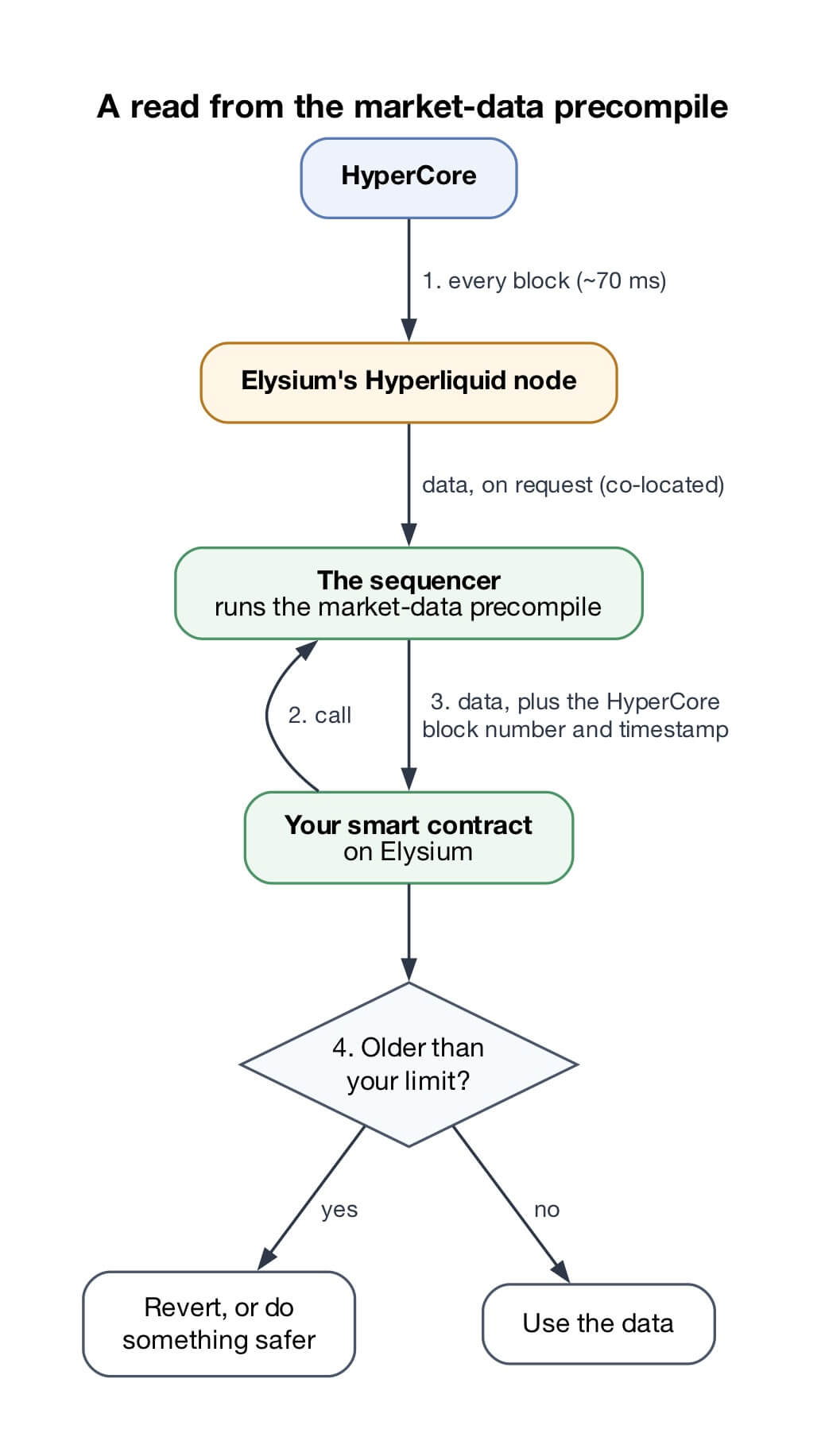
How old is the data?
Kinetiq puts the data’s age at 150–350 ms by the time a smart contract on Elysium reads it, without a breakdown. The table below is our rough estimate of where that time goes. There’s no official source for it yet. It’s based on public Hyperliquid latency measurements, and Elysium may work differently.
| Step | Low | Typical | High |
|---|---|---|---|
| HyperCore block is finalized and reaches Elysium’s Hyperliquid node | ~140 ms | ~160 ms | ~250 ms |
| Waiting for the next HyperCore block | 0 ms | ~35 ms | ~70 ms |
| Elysium block timing (only if data is fixed once per Elysium block) | 0 ms | ~50 ms | ~100 ms |
| Total | ~140 ms | ~195–245 ms | ~320–420 ms |
Row 1 comes from Hyperliquid’s docs, which say a transaction usually takes 2 blocks to become final (about 140 ms at 70 ms per block), and from Dwellir’s Tokyo benchmark, where HyperCore data from gRPC streams reached a test client a median of about 155–180 ms after its block’s timestamp, and the slowest 5% of updates on its fastest WebSocket orderbook feed took over 250 ms. It assumes Elysium’s Hyperliquid node runs in or near Tokyo, as Hyperliquid’s node README recommends. Row 2 follows from HyperCore making a block about every 70 ms. Row 3 applies only if Elysium fixes the data once per block, as HyperEVM does.
How old is too old depends on what the smart contract does. A prop AMM that quotes from an old price can lose money to traders who buy or sell against that outdated price, so it needs a tight limit. A lending market checking collateral can usually work with a looser one. Either way, when the data is too old, the smart contract should revert or do something safer, such as pausing its quotes.
Compared with HyperEVM and push oracles
HyperEVM has its own HyperCore read precompiles, called L1Read (Chainstack’s guide to HyperEVM precompiles and CoreWriter covers how they work). Push oracles are a common alternative on other chains: an operator writes prices on-chain in regular transactions. Kinetiq compares the three this way:
| Feature | Elysium market-data precompile | HyperEVM L1Read | Push oracles |
|---|---|---|---|
| Updates | Every HyperCore block (~70 ms) | Every HyperEVM block (1 s) | Every oracle update |
| Orderbook data | Up to the full book | Highest buy and lowest sell price only | Usually a single price |
| Cost to keep fresh | None | None | Gas for every update |
How a write works
Writes involve 3 components:
- ElysiumCoreWriter is the predeploy that smart contracts on Elysium call to send orders toward HyperCore.
- The keeper is a service outside the chain that watches ElysiumCoreWriter and submits orders to HyperCore. Kinetiq runs one, which its docs call a “managed signing service,” and you can run your own keeper instead.
- The agent wallet is a HyperCore feature: a HyperCore account can approve a separate key to trade on its behalf. Kinetiq’s docs note that HyperCore itself enforces the limits: an agent wallet can place and cancel orders and can never withdraw or transfer funds. (Kinetiq’s docs call it a “trade-only agent,” and Hyperliquid’s docs call it an “API wallet.”)
One-time setup
- The user funds a HyperCore account. The account must exist before its first action.
- The app’s smart contract on Elysium links that account. It registers the user’s HyperCore account on ElysiumCoreWriter and picks the keeper that will handle its orders: Kinetiq’s or one you run. (Kinetiq’s docs call the chosen keeper the “registrar.”)
- The user approves an agent wallet. On HyperCore, the user’s account approves the agent wallet whose key the keeper holds. From then on, the keeper can trade for that account and can’t move its funds.
Every order
- The app’s smart contract emits an order intent. It calls ElysiumCoreWriter, which emits the order as an event in an Elysium block. Kinetiq calls this an order intent. Nothing has reached HyperCore yet.
- The keeper signs and submits it. The keeper reads the order intent, signs it with the agent wallet’s key and sends it to HyperCore, usually within one HyperCore block. Kinetiq puts the whole trip, from order intent to an order sitting in HyperCore’s orderbook, at about 100 ms.
- HyperCore executes it on the user’s account. Any resulting trades belong to the user, who pays their own HyperCore trading fees.
Getting results back
The Elysium transaction is finished before HyperCore even sees the order, so the app’s smart contract can’t learn the result in the same transaction. To get it, the app deposits a small amount of HYPE on ElysiumCoreWriter in advance. Each order’s HyperCore result is then sent back to the smart contract that placed it, in a call known as a callback, and the gas for that call is refunded from the deposit.
Nothing makes the Elysium transaction and the HyperCore order succeed or fail together. Kinetiq advises writing callbacks so a repeated delivery does no harm: the smart contract checks each order intent’s nonce, a unique number per order intent, and skips results it has already processed.
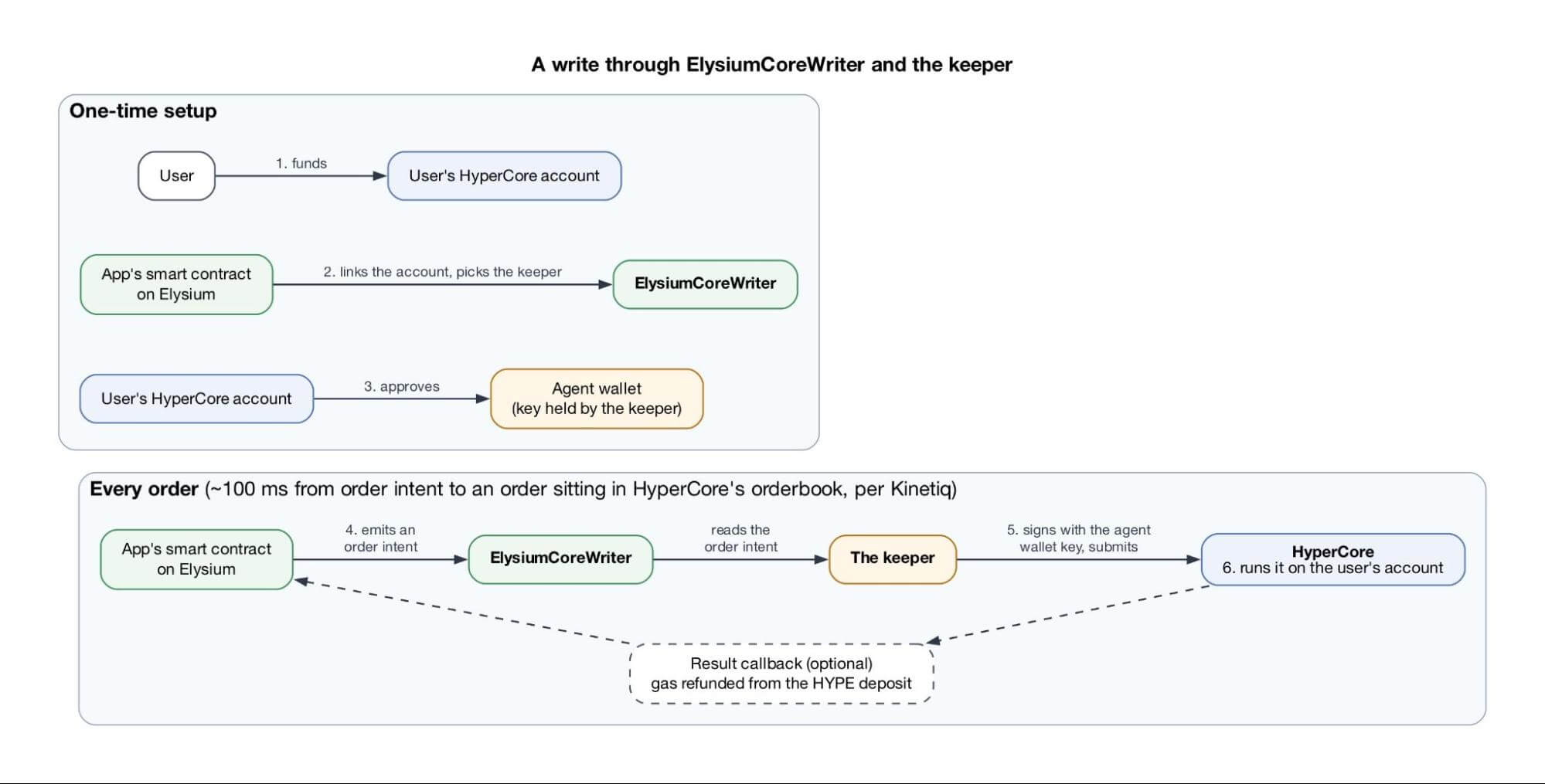
Leaving
The user can cancel the agent wallet’s access at any time with one HyperCore action, or trade directly with the account’s own key. Neither involves Elysium. To switch keepers, the app’s smart contract registers again with a different one. Order intents are public events on Elysium, the same stream Kinetiq’s keeper reads, so you can run your own keeper in its place.
On Chainstack nodes. A keeper follows ElysiumCoreWriter events, and Chainstack Elysium nodes serve contract logs over WebSocket (
eth_subscribe("logs")) anddebug_*traces. See Elysium methods and Elysium tooling.
Compared with HyperEVM’s CoreWriter
On HyperEVM, contracts send orders through CoreWriter, which acts from the calling contract’s own HyperCore account and, per Hyperliquid’s docs, delays orders “for a few seconds” on top of HyperEVM’s 1-second blocks. Elysium’s keeper doesn’t use CoreWriter: it submits orders to HyperCore directly with the agent wallet’s key, on the user’s account, so our reading is that this delay doesn’t apply, which fits Kinetiq’s ~100 ms figure.
What you’re trusting
Reads. HyperCore doesn’t publish any cryptographic proof of its state, so nothing proves Elysium’s market data on-chain yet, unlike HyperEVM’s L1Read data, which Hyperliquid itself guarantees.
Writes. The keeper can’t move the user’s funds, but a compromised or buggy keeper can lose money through bad trades, and if it goes offline, order intents stop reaching HyperCore.
| What | What you trust | What limits the damage |
|---|---|---|
| HyperCore data | The sequencer returns real HyperCore data | The block number and timestamp on each answer, the archive, and your contract’s age check |
| Order delivery | The keeper submits every order intent, on time | Callbacks report results; you can run your own keeper |
| Order content | The keeper’s key places only the orders your contract asked for | Agent wallets can’t withdraw; the user can cancel their access at any time |
| Funds on HyperCore | HyperCore itself, which holds them in the user’s own account | Elysium and the keeper can’t move them; HyperCore blocks agent wallet withdrawals |
The chain underneath. Elysium launched with the standard setup for a new Arbitrum chain. It has one sequencer. Only approved validators can dispute Elysium’s state for now, and Arbitrum BoLD, planned for later, would let anyone do it. Elysium’s full transaction data is stored by one server run by Conduit, Elysium’s infrastructure operator. If the sequencer ignores your transaction, you can force it in through a contract on HyperEVM, Elysium’s delayed inbox. Withdrawals are protected by the challenge period of about 24 hours.
Conclusion
Elysium gives smart contracts fresher HyperCore data and faster HyperCore orders than HyperEVM, in exchange for trusting Elysium instead of Hyperliquid itself. If your contract needs to react many times per second, Elysium is built for it. You can start building on it today with Chainstack’s Elysium endpoints.
Frequently asked questions
Elysium is a layer 2 for Hyperliquid, built by Kinetiq on Arbitrum Orbit. It runs on top of HyperEVM, uses HYPE for gas and has a 100 ms block time. Its mainnet launched on November 9, 2026.
Yes, once Kinetiq’s network upgrade ships. The market-data precompile lets any smart contract on Elysium read HyperCore orderbooks, prices, balances and positions for normal call gas. Kinetiq puts the data’s age at about 150–350 ms.
A smart contract on Elysium sends an order request, which Kinetiq calls an order intent, to ElysiumCoreWriter. A keeper, a service outside the chain, signs it with an agent wallet key and submits it to HyperCore on the user’s own account. Kinetiq puts the whole trip at about 100 ms.
A predeploy is a normal smart contract that the chain places at a fixed address in advance, and the EVM runs it like any other contract. A precompile’s logic isn’t EVM bytecode: it’s built into the chain’s software (ArbOS on Arbitrum chains), so it can return data from outside the EVM.
For smart contracts, yes. A smart contract on HyperEVM sees only the highest buy price and the lowest sell price once per second, and Hyperliquid delays its HyperCore orders for a few seconds. A smart contract on Elysium can read the full orderbook, and Kinetiq says its orders reach HyperCore in about 100 ms. Sending orders straight to HyperCore, without a smart contract, is faster than both.
No. The keeper trades through an agent wallet, and Kinetiq’s docs note that HyperCore lets an agent wallet place and cancel orders but never withdraw or transfer funds. A compromised or buggy keeper can still lose money through bad trades, and the user can cancel the agent wallet’s access at any time.
Not yet. HyperCore doesn’t publish any cryptographic proof of its state, so you trust Elysium’s sequencer to return real HyperCore data. Each answer carries the HyperCore block number and timestamp it came from, and Kinetiq plans to make reads provable later.
Kinetiq says the market-data precompile and ElysiumCoreWriter ship together in a network upgrade about 4 weeks after the November 9, 2026 mainnet launch. As of November 27, 2026, they aren’t live yet.
About 24 hours on mainnet, because withdrawals wait out Elysium’s challenge period. Moving tokens from HyperEVM onto Elysium normally takes about a minute.
Related reading