AI-ready infrastructure
 Refer and earn


 Ethereum
 Hyperliquid
 Solana
 Arbitrum
 BNB Smart Chain
 Base
Base Polygon
 TRON
TRON Sui
Sui Robinhood


Before mainnet: 10 smart contract security tools worth using

Mainnet is not the place to discover that a contract invariant was never tested, an upgrade path was too permissive, or an admin action had no monitoring. Security work needs layers. Static analysis catches common mistakes early. Fuzzing and symbolic testing exercise paths humans miss. Formal verification checks high-value properties. Competitive audits and bug bounties add independent pressure. Operational tooling helps teams keep control after deployment.
This list covers 10 tools and services from the Chainstack Marketplace that fit into a serious smart contract security workflow. It is written for EVM teams preparing contracts for production, especially DeFi protocols, marketplaces, wallets, games, bridges, and infrastructure products.
The right stack depends on your contracts, risk surface, and launch timeline. A small NFT project does not need the same process as a lending protocol. But every team should have a clear answer to the same question: what did we check, who checked it, and what happens after deployment?
The launch-readiness map
| Stage | Goal | Tools to consider |
|---|---|---|
| Early development | Catch obvious issues before review | Slither, Mythril |
| Test design | Turn assumptions into repeatable checks | Echidna, Scribble |
| Deep verification | Check properties across many states and paths | Certora Prover, Halmos |
| External review | Get independent human review before launch | Cyfrin, Code4rena |
| Post-launch coverage | Catch reports and operate contracts safely | Immunefi, OpenZeppelin Defender |
1. Slither
Slither is the first tool most EVM teams should wire into their review flow. Trail of Bits describes it as a static analysis framework for Solidity and Vyper that runs vulnerability detectors, prints contract information, and exposes an API for custom analyses.
The reason to run Slither early is simple: it is fast enough to use often and practical enough to catch issues before they reach auditors. It can fit into local development, pull request checks, and continuous integration.
Where it fits: first-pass review, pull request checks, continuous integration, and developer self-review.
Why it matters: static analysis helps surface patterns that should not need manual review time, such as dangerous calls, shadowing, unchecked assumptions, risky upgrade patterns, or authorization mistakes.
Limit: Slither does not prove your protocol is safe. It finds patterns and code-level risks. Complex economic bugs, missing invariants, and protocol-specific failures still need deeper testing and review.
2. Echidna
Echidna is a property-based fuzzer for Ethereum smart contracts. Its repository describes the core workflow as generating random sequences of calls and checking whether invariants remain true.
Echidna becomes useful when your team can state what should always be true. For example: total supply should match accounting, a vault should not lose assets, a position should not be liquidated outside the rules, or a user should not withdraw more than their balance.
Where it fits: invariant testing, regression testing, and pre-audit preparation.
Why it matters: many smart contract bugs are not single-line mistakes. They appear after specific call sequences. Fuzzing helps search those sequences instead of relying only on hand-written happy-path tests.
Limit: Echidna is only as good as the properties you write. Weak invariants can produce a false sense of coverage.
3. Scribble
Scribble is a runtime verification tool for Solidity. Its docs explain that Scribble transforms specification annotations into concrete assertions, which can then be checked through testing, fuzzing, or symbolic execution.
Scribble is useful when important assumptions live in the team’s head or documentation but not in executable tests. By writing specifications directly around contract behavior, teams can make expected properties visible and testable.
Where it fits: specification-driven testing, invariant design, and audit preparation.
Why it matters: security work improves when assumptions become executable. Scribble helps turn “this should never happen” into assertions that tools can evaluate.
Limit: Scribble adds another specification layer. Teams need to maintain those annotations as the contracts change.
4. Certora Prover
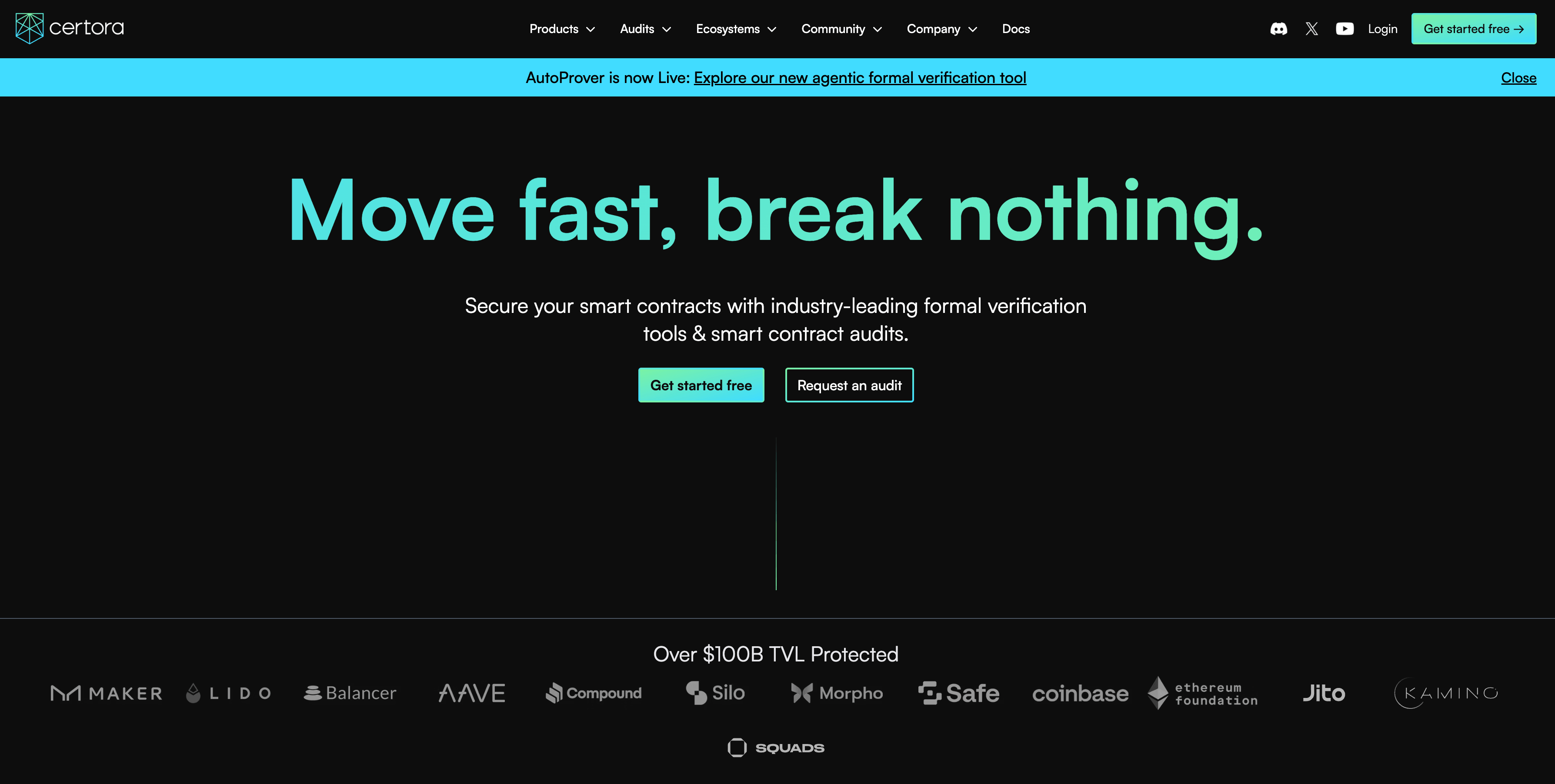
Certora Prover is for formal verification of smart contracts. Certora’s docs center on the Prover, the Certora Verification Language, and rule-based verification. Certora’s product page describes the workflow as comparing smart contract bytecode against rules that define expected behavior.
This is most useful for high-value properties where fuzzing is not enough. Examples include solvency, access control guarantees, accounting correctness, token conservation, pause behavior, liquidation rules, or upgrade restrictions.
Where it fits: high-value protocol properties and mature pre-launch security review.
Why it matters: formal verification helps teams reason about behavior across large state spaces, especially where a single invariant failure could become a critical vulnerability.
Limit: The hard part is writing the right rules. Formal verification is powerful, but it does not replace threat modeling or protocol design review.
5. Halmos
Halmos is a symbolic testing tool for EVM smart contracts. Its repository describes a Solidity and Foundry frontend, which makes it especially relevant for teams already using Foundry tests.
Halmos is a good bridge between normal developer testing and deeper formal methods. Teams can start from tests they already have and use symbolic execution to explore behavior more broadly than a single concrete test input.
Where it fits: Foundry-heavy workflows, property exploration, and deeper test coverage.
Why it matters: symbolic testing can help reveal edge cases that unit tests miss while staying closer to a developer-friendly test workflow.
Limit: Symbolic tools can run into complexity limits. Use Halmos on focused properties and critical code paths rather than expecting it to solve the entire protocol in one run.
6. Mythril
Mythril is a symbolic execution-based security analysis tool for EVM bytecode. Its repository says it detects vulnerabilities in smart contracts built for Ethereum and other EVM-compatible blockchains.
Mythril is useful as an additional automated analysis pass, especially when you want bytecode-level symbolic execution and vulnerability detection. It can complement Slither because the two tools approach analysis differently.
Where it fits: automated vulnerability analysis, bytecode-oriented checks, and additional pre-audit scanning.
Why it matters: using more than one automated analyzer can reveal different classes of issues and reduce dependence on a single detection model.
Limit: Like other automated tools, Mythril can produce findings that require careful triage. Do not treat every alert as equal. Review exploitability, impact, and whether the finding applies to your architecture.
7. Cyfrin
Cyfrin is broader than a single tool. Its docs describe Cyfrin as a platform for Web3 security researchers, developers, and learners, with products such as CodeHawks competitive audits, Updraft education, Solodit vulnerability research, and Aderyn static analysis.
For protocol teams, Cyfrin is most relevant when the work needs human review, competitive audit coverage, security research, or structured support around smart contract security.
Where it fits: external audit workflows, competitive audits, vulnerability research, and team education.
Why it matters: internal tooling is not enough for serious launches. An outside review can challenge assumptions, find protocol-level issues, and produce findings that automated tools do not see.
Limit: An audit is a point-in-time review. If the code changes after review, the security posture changes too.
8. Code4rena
Code4rena is a competitive audit platform. Its docs describe a model with wardens, sponsors, judges, findings, judging, awards, and published audit reports.
Code4rena is a strong fit when a team wants many independent researchers to review a codebase during a defined competition window. That can be valuable for protocols with broad attack surfaces, complex DeFi mechanics, or meaningful assets at risk.
Where it fits: competitive audits and independent researcher review before launch.
Why it matters: competitive review can expose a codebase to many perspectives. It can also produce public audit artifacts that users, integrators, and partners may inspect.
Limit: A competitive audit needs preparation. Teams should freeze scope, provide documentation, define known issues, answer researcher questions, and plan enough time to fix and re-test findings.
9. Immunefi
Immunefi is a bug bounty platform for Web3 projects and whitehat researchers. Immunefi’s rules and support docs emphasize program scope, report quality, proof of concept expectations, platform-mediated communication, and project-specific program rules.
Immunefi is most useful after a project has something live or close to live and wants a structured channel for vulnerability reports. It is not a replacement for testing or audits, but it can create a clear process for external researchers to report real issues.
Where it fits: post-launch bug bounties, responsible reporting, and security response workflows.
Why it matters: once contracts are live, researchers need a safe and official path to report vulnerabilities. A well-scoped bounty program can reduce chaos and encourage higher-quality reports.
Limit: A bug bounty works only if the scope, reward table, severity rules, and response process are clear. Launching a bounty without internal response ownership creates operational risk.
10. OpenZeppelin Defender
OpenZeppelin Defender helps teams deploy, upgrade, monitor, and operate smart contracts. OpenZeppelin’s Defender docs cover secure deployments and upgrades, relayers, actions, monitors, workflows, and operational controls.
Defender belongs in this security list because launch risk does not end when code is deployed. Admin actions, upgrades, relayers, monitors, private keys, multisig approvals, and incident response all affect the real security posture of a protocol.
Where it fits: deployment, upgrade management, relayers, monitoring, automated actions, and operational security.
Why it matters: many production failures are operational, not purely code-level. Defender helps teams put safer processes around the contracts they ship.
Limit: Defender will not fix weak governance or unclear ownership by itself. Teams still need multisig policies, runbooks, monitoring ownership, and tested emergency flows.
A practical sequence before launch
Use this sequence if you need a simple default:
- Run Slither on every pull request.
- Add Echidna tests for protocol invariants.
- Use Scribble when important assumptions need explicit specifications.
- Add Halmos or Certora Prover for critical paths and high-value properties.
- Run Mythril as an additional automated analysis pass.
- Bring in Cyfrin, Code4rena, or another external review process before launch.
- Deploy and operate contracts with clear multisig, relayer, monitor, and upgrade workflows.
- Launch a scoped Immunefi program only when the team can triage reports quickly.
How to choose the right mix
If your contracts are simple, start with Slither, strong unit tests, Echidna invariants, and clear deployment controls. If your contracts hold meaningful value, add external review before launch. If your protocol has complex accounting, liquidations, cross-chain logic, or upgrade paths, evaluate formal verification with Certora Prover, Halmos, or both.
Do not choose tools just to make a security checklist look long. Choose tools that match the risks in the contracts. A lending market needs accounting and solvency properties. A bridge needs message, replay, and access-control review. A marketplace needs asset custody and payment-flow tests. A token contract needs authorization, minting, burning, and upgrade assumptions checked.
The goal is not to say “we used 10 tools.” The goal is to reduce unknowns before mainnet and keep a responsible response path after launch.
How Chainstack fits into your security workflow
Security tools help find issues in your contracts. Chainstack helps you test and operate the infrastructure around them. Connect RPC and WebSocket endpoints to test suites, deployment workflows, monitors, and incident-response tooling, so your team can validate behavior against live network data before mainnet and keep watching it after launch.