AI-ready infrastructure
 Refer and earn


 Ethereum
 Hyperliquid
 Solana
 Arbitrum
 BNB Smart Chain
 Base
 Polygon
 TRON
 Sui
 Robinhood


Polygon RPC for enterprise: best providers 2026

Polygon PoS is the enterprise RPC infrastructure of choice for institutional Web3 — an EVM-compatible chain now processing roughly 8 million transactions per day (743 million in Q2 2026) with a TVL of about $0.7 billion and stablecoin circulation near $2.9 billion. In 2026, its institutional profile is impossible to ignore: Franklin Templeton runs its on-chain money market fund on Polygon, JP Morgan executed its first public DeFi trade on the network via MAS Project Guardian in November 2022, and Apex Group — managing $3.5 trillion AUM — is building a compliance-first institutional chain using Polygon CDK.
The 2026 technical picture adds urgency to provider selection. The Giugliano hard fork (April 8, 2026) introduced new RPC fee-data capabilities and earlier block signaling. Block time dropped to 1.75 seconds in May 2026, tightening settlement windows and raising the baseline reliability bar for every RPC endpoint in your stack. The May 2026 launch of Polygon Confidential Chains — configurable on-chain privacy via AggLayer for financial institutions — means enterprise teams now have chain-level privacy primitives to work with, and need providers that can handle the associated trace and state query workloads reliably.
This guide covers the six providers best positioned to serve enterprise Polygon workloads in 2026: compliance requirements, audit trail RPC access, SLA accountability, and pricing that won’t generate surprises at month-end.
💡 Already using Chainstack? Jump straight to the Polygon tooling docs or deploy your endpoint in minutes at console.chainstack.com.
Enterprise on Polygon: RPC requirements
Enterprise workloads on Polygon are not defined by raw transaction throughput — they are defined by reliability, auditability, and compliance. A payment settlement system that reconstructs transaction history for a regulatory audit, a tokenized fund that monitors on-chain positions for NAV calculation, a stablecoin issuer that tracks large transfer events across millions of blocks: all of these demand provider capabilities that commodity public endpoints simply cannot provide.
Latency requirements
Enterprise Polygon workloads are generally burst-tolerant rather than sub-millisecond-critical. Settlement confirmation checks, compliance event polling, and batch reconciliation jobs can absorb p99 latencies in the 200–500ms range without breaking business logic. What they cannot absorb is inconsistency: a provider that delivers 80ms median but spikes to 8 seconds at the p99 during a block burst will fail settlement workflows. The requirement is consistent low latency, not minimum latency.
For real-time compliance monitoring (watching mempool for high-value transfers, triggering AML workflows), WebSocket subscription reliability matters more than raw HTTP round-trip time. A dropped subscription that silently misses events is a compliance failure, not a performance metric.
Throughput requirements
Enterprise teams typically run two distinct traffic patterns:
- Steady-state monitoring: 10–200 RPS of event polling, balance checks, and receipt fetches — easily handled by shared endpoints on standard plans
- Batch audit windows: Bursts of 500–2,000+ RPS during reconciliation, historical backfills, or regulatory reporting runs — these require either dedicated nodes or a flat-rate add-on with no overage exposure
A provider that meters both patterns at per-request rates will generate unpredictable bills. Enterprise procurement teams require cost certainty; this is one reason dedicated or unlimited-RPS pricing structures are a meaningful differentiator for this audience.
Key RPC methods for enterprise workloads
| Method | Enterprise use case | Archive required? |
|---|---|---|
eth_getLogs | Audit trail reconstruction, compliance event indexing, monitoring token transfers | No — full node sufficient |
eth_getTransactionReceipt | Settlement confirmation, finality proof, per-transaction compliance evidence | No |
eth_call | Read-only state queries — balances, allowances, contract state at latest block | No |
eth_getBalance | On-chain balance verification for reconciliation and AML checks | Archive for historical |
eth_blockNumber | Sync health monitoring, confirmation depth for finality thresholds | No |
debug_traceTransaction | Transaction forensics, internal call inspection, AML fund-flow analysis | Yes — archive required |
trace_transaction | Parity-style call trace (not served by Bor; use debug_traceTransaction with flatCallTracer on Chainstack); institutional analytics, MEV analysis | Yes — archive required |
eth_getCode | Smart contract verification before interaction; audit readiness checks | No |
⚠️ Archive vs. full node:
eth_getLogsscanning a wide block range does not require an archive node — it works on full nodes. Archive access is required fordebug_traceTransaction(andtrace_transactionwhere a provider serves it), and anyeth_call/eth_getBalancequery targeting a historical block number rather than"latest". Enterprise providers that conflate these requirements (upselling archive for event log access) are either misinformed or pricing opportunistically.
⚡ Benchmark before you commit: No public real-time dashboard covers all Polygon RPC providers yet. Run a quick latency test against each provider’s endpoint from your deployment region before committing — a simple
curlloop or k6 script is enough to surface meaningful p95/p99 differences across providers.
Infrastructure requirements for enterprise
Beyond raw API access, enterprise teams need:
- Dedicated endpoints — shared public nodes have no usage guarantees; a single noisy neighbour can degrade your settlement confirmation latency
- Private networking — enterprise deployments benefit from VPC peering or private endpoint options, reducing attack surface
- Role-based access control — multi-team environments (dev, staging, compliance, ops) need separate API key scopes with audit logging
- Contractual SLA — a provider’s 99.99% uptime blog post is not a contract; enterprise procurement requires a signed SLA with defined remediation
- Vendor compliance certifications — SOC 2 Type II and ISO 27001 are the baseline audit requirements for financial services vendor onboarding
For the full Polygon JSON-RPC reference, see the Polygon RPC getting started guide on Chainstack Docs.
How to choose a Polygon enterprise RPC provider
Not all providers that claim enterprise support deliver the same thing. Before comparing plans, pressure-test each candidate on these five criteria:
- Verify SOC 2 Type II and ISO 27001, not just Type I — Type I is a one-time snapshot of controls at a single point in time. Type II covers a continuous audit period (typically 6–12 months) and is the standard that financial services procurement requires. Ask for the attestation letter, not just a badge on a marketing page.
- Distinguish contractual SLA from a marketing uptime claim — “99.99% uptime” in a blog post is not an SLA. A real SLA defines the measurement period, the exclusions (planned maintenance, force majeure), the credits or remediation if the threshold is missed, and the escalation path. If a provider cannot produce a signed SLA document, assume none exists.
- When dedicated nodes are non-negotiable — If your compliance architecture requires environment isolation (prod/pre-prod/audit sandbox on separate endpoints), your RPC provider must offer dedicated infrastructure. Shared multi-tenant nodes cannot provide this — no amount of API key scoping replaces physical separation.
- Estimate your actual trace call cost before committing — Run a representative batch of
debug_traceTransactioncalls against each provider’s pricing model. CU-weighted providers can cost several times more per trace call than per standard call (Quicknode about 2×, Alchemy roughly 1.5–4× depending on the baseline method). Calculate your monthly trace volume, multiply by the per-call rate, and compare against flat-rate alternatives before signing a plan. - Test p99 latency from your deployment region — Ask each provider for a trial endpoint and run a
curlloop againsteth_getTransactionReceiptfor 10–15 minutes during peak Polygon block times. The p99 number is what your settlement timeout logic will hit; the median is irrelevant.
Chainstack for enterprise on Polygon
Chainstack is the most enterprise-ready Polygon RPC provider in 2026, and that claim is anchored in three concrete facts rather than marketing copy.
First, SOC 2 Type II certification was awarded in December 2025, covering security, availability, and confidentiality, and ISO 27001 certification followed in July 2026. This is the audited certification that compliance and procurement teams require — not self-reported, not Type I, but Type II with continuous controls verification. Most competitors either lack this certification or have only attained the less-rigorous Type I standard.
Second, Chainstack’s pricing model is structurally transparent for enterprise workloads: 1 RU = 1 API request, with no method-based multipliers. A compliance team running 50 million eth_getLogs calls in a reporting batch pays the same per-call rate as a developer running eth_blockNumber checks. There are no surprise compute-unit surcharges when an AML scan triggers a sudden spike in debug_traceTransaction calls — a real scenario documented in the Nexo case study, where Chainstack delivered a 5× cost reduction on debug and trace access compared to the previous provider.
Third, Dedicated Nodes with Bolt technology speed up node sync on Polygon — a meaningful operational advantage for enterprises that need to spin up isolated nodes for different compliance environments (production, pre-prod, regulatory audit sandbox) without multi-day provisioning delays.
Enterprise plan highlights:
| Feature | Chainstack enterprise |
|---|---|
| RU/month | 400M+ (custom) |
| RPS | Unlimited |
| Dedicated Nodes | Available with Bolt fast sync |
| Archive access | Yes (from $49/month on Growth+) |
| debug/trace namespaces | Yes (Growth plan and above) |
| SOC 2 Type II and ISO 27001 | SOC 2 Type II December 2025, ISO 27001 July 2026 |
| Uptime SLA | 99.9% quarterly contractual SLA with service credits; 99.99%+ measured uptime |
| Support | 24/7 priority support; custom SLAs; Premium support tier adds <1 hour response |
| Pricing model | 1 RU = 1 request, no method multipliers |
The Unlimited Node add-on (from $149/month) is the right choice for batch audit workloads: flat-fee RPS tiers (25–500 RPS), no per-request billing, no overage exposure. Reconciliation runs that scan millions of blocks per day will not generate unexpected invoices.
Code example — eth_getLogs for compliance event indexing:
const { ethers } = require("ethers");

// Replace with your Chainstack Polygon endpoint
const provider = new ethers.JsonRpcProvider(
  "https://polygon-mainnet.core.chainstack.com/YOUR_KEY"
);

// Native USDC on Polygon (circle.com/usdc) — not USDC.e (bridged from Ethereum, 0x2791...)
const USDC_ADDRESS = "0x3c499c542cEF5E3811e1192ce70d8cC03d5c3359";
const TRANSFER_TOPIC = ethers.id("Transfer(address,address,uint256)");

async function fetchLargeTransfers(fromBlock, toBlock) {
  const logs = await provider.getLogs({
    address: USDC_ADDRESS,
    topics: [TRANSFER_TOPIC],
    fromBlock,
    toBlock,
  });

  // Filter transfers > $100,000 (USDC has 6 decimals)
  const threshold = BigInt("100000000000"); // 100,000 USDC
  return logs.filter((log) => {
    const amount = BigInt(log.data);
    return amount >= threshold;
  });
}

// Scan last 1,000 blocks for large USDC transfers
const latest = await provider.getBlockNumber();
const transfers = await fetchLargeTransfers(latest - 1000, latest);
console.log(`Found ${transfers.length} large USDC transfers`);
The Polygon tooling documentation includes full SDK examples for ethers.js, Web3.py, Hardhat, and Foundry.
🤖 You can also access Chainstack Polygon RPC directly from Claude, Cursor, Codex, Gemini, or Windsurf using Chainstack MCP. Learn more about Chainstack MCP.
Provider comparison
The table below summarizes public positioning as of October 2026.
| Provider | Pricing model | Free tier | Dedicated nodes | Archive & trace | SOC 2 |
|---|---|---|---|---|---|
| Chainstack | 1 RU = 1 request | 3M RU/month | Yes (Pro plan and up; Bolt; billed per node, compute plus storage) | Yes (Growth+) | Type II (Dec 2025) |
| Dwellir | 1 credit per response, method-agnostic | 100,000 responses/day | Yes (dedicated archive cluster listed at $12,600/mo for Polygon) | Trace/debug on paid plans; archive only on dedicated clusters | Not published |
| Alchemy | CU-based (method-weighted) | 30M CU/month | No | Archive + Debug API (no Trace API) | Type II |
| Infura | Credit-based | 3M credits/day | No | Archive on all plans; debug/trace Developer+ | Not published |
| dRPC | Flat $6/1M requests | Yes (public nodes) | No | Yes | Not published |
| Quicknode | Credit-based (method-weighted) | 30-day trial only | Yes (dedicated clusters) | Yes | Type II + ISO 27001 |
Note: Quicknode’s Flat Rate RPS pricing (launched March 2026) starts at $799/month for 75 RPS on EVM chains including Polygon — a strong option for teams that need predictable throughput without per-request billing.
Chainstack
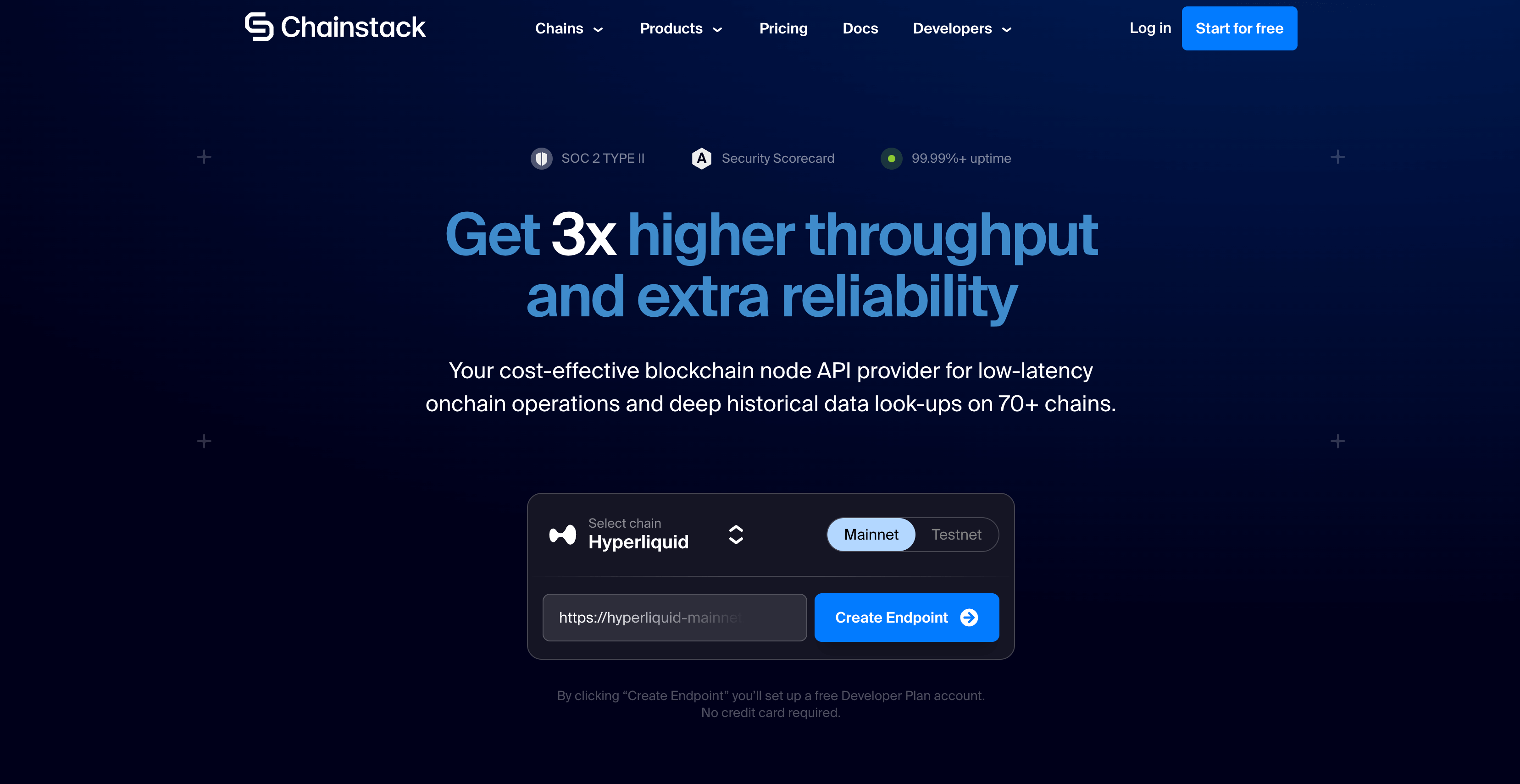
Chainstack is the strongest end-to-end fit for enterprise Polygon deployments in 2026. The combination of SOC 2 Type II and ISO 27001 certification, transparent 1 RU = 1 request pricing, Dedicated Nodes with Bolt fast sync, and a contractual SLA (99.9% quarterly uptime with service credits, alongside 99.99%+ measured uptime) covers every dimension of enterprise vendor requirements simultaneously.
Global Nodes deliver geo-balanced RPC access across multiple regions and clouds — with 25,000+ RPS platform throughput and sub-1-second fault recovery.
Archive access is available from the Growth plan ($49/month), and the debug_ namespace (including debug_trace* with flatCallTracer for Parity-style flat traces) is supported without additional per-method surcharges. The Nexo case study documents a 5× cost reduction on debug/trace workloads after migrating to Chainstack — a representative data point for compliance teams running regular transaction forensics. The Unlimited Node add-on (from $149/month flat) is the right choice for batch audit workloads: fixed RPS, no overage, no billing surprises.
Limitations: Enterprise plan pricing starts at $990/month, which is above the entry point of some competitors. Teams with purely moderate, steady-state workloads may find the Growth ($49) or Pro ($199) plans sufficient; the enterprise tier is most justifiable when you need contractual SLA, dedicated gateway, and 24/7 priority support under a single agreement.
Fit by workload:
- Enterprise compliance & audit: Excellent — SOC 2 Type II and ISO 27001, contractual SLA, debug/trace, transparent pricing, dedicated nodes
- Institutional settlement & payments: Excellent — 99.99%+ measured uptime, Unlimited Node for batch reconciliation bursts
- Regulated DeFi & tokenized assets: Excellent — RBAC, private networking on enterprise plans, archive access, full debug_trace* tracing
Dwellir
Dwellir is a Swedish RPC provider with a long Polkadot track record that now serves 150+ networks, Polygon among them. It serves Polygon over HTTPS and WebSocket with debug and trace methods on paid plans, and sells a dedicated archive cluster (listed at $12,600/month for Polygon) with full archive state, no rate limits or request counting, and a 99.99% uptime SLA on custom terms. Every response costs one credit regardless of method, and payment in crypto is accepted.
Shared plans scale from a Free tier (20 responses/second, 100,000 responses per day) through Developer at $49/month (25M responses, 100/second), Growth at $299/month (150M, 500/second, eth_getLogs over up to 10,000 blocks), and Scale at $999/month (500M, 5,000/second). Unlimited Nodes start at $119/month flat. Growth and above include a dedicated account manager. Pricing checked October 9, 2026.
Limitations: We found no SOC 2 or ISO 27001 attestation on Dwellir’s public pricing and dedicated-cluster pages, and its SLA terms are quoted per contract rather than published, so regulated buyers should request both documents before shortlisting it. A dedicated Polygon cluster is a substantial step up in price from shared plans.
Fit by workload:
- Enterprise compliance & audit: Limited — contractual SLA on dedicated clusters and trace/debug on paid plans, but no public SOC 2 or ISO 27001
- Institutional settlement & payments: Good — flat per-response billing and an unmetered dedicated-cluster path suit predictable settlement traffic
- Regulated DeFi & tokenized assets: Moderate — full archive state on dedicated clusters helps forensics, but the compliance gap matters for regulated issuers
Alchemy
Alchemy supports Polygon PoS with full archive access, WebSocket subscriptions, and the debug_ namespace on paid plans (the Trace API is not supported on Polygon). Its developer experience is a genuine strength: the Alchemy SDK, Webhooks, and Gas Manager tooling reduce the amount of custom infrastructure a team needs to operate. The Alchemy dashboard provides transaction simulation, gas manager, and account abstraction tooling that is relevant for institutional DeFi teams building on top of raw RPC access.
SOC 2 Type II certification covers the core platform; no ISO 27001 is published. The free tier (30M compute units per month, roughly 1.1M standard calls) is enough for initial development and testing. Alchemy’s global distribution across multiple cloud regions provides reasonable latency consistency for most enterprise deployment patterns.
Limitations: The compute unit pricing model — where different methods consume different CU counts — makes cost forecasting materially harder than a flat 1-RU-per-request model. A compliance team running batch debug_traceTransaction calls may find their CU burn rate several times higher than a comparable eth_blockNumber workload, with no simple formula to predict monthly spend in advance. Alchemy does not offer dedicated nodes, which matters for enterprises that need isolated infrastructure for compliance segregation or procurement requirements.
Fit by workload:
- Enterprise compliance & audit: Good — SOC 2 Type II (no published ISO 27001), archive/debug, but CU pricing opaque for batch forensics; no dedicated nodes
- Institutional settlement & payments: Good — reliable, strong SDK, but no flat-rate batch option comparable to Unlimited Node
- Regulated DeFi & tokenized assets: Strong — Alchemy SDK, webhooks, and gas tooling well-suited for DeFi protocol operations
Infura
Infura’s enterprise credibility comes primarily from its parent company, ConsenSys, which has raised over $725M from institutional backers including Microsoft, SoftBank, and Temasek. For enterprises where vendor pedigree and institutional backing matter in the procurement process, Infura carries a weight that pure-play infrastructure providers cannot match.
Polygon’s pivot toward payment infrastructure makes high-availability settlement a central concern for enterprise RPC selection. Full Polygon PoS support covers mainnet and Amoy testnet. The Decentralized Infrastructure Network (DIN) — a failover consortium including Chainstack, Microsoft, and 15+ other operators — provides redundancy at the infrastructure level that is materially different from a single-provider SLA. For regulated entities that cannot tolerate single-provider dependency, DIN participation is a meaningful structural argument. Archive access and trace methods are available on Infura’s paid tiers.
Limitations: Infura does not publish SOC 2 certification details prominently, which creates friction in enterprise vendor questionnaire processes — compliance teams will need to engage Infura’s enterprise sales to obtain security documentation. No standard dedicated node product. Pricing transparency is lower than Chainstack or dRPC. Uptime SLA percentages are not published in standard plan documentation.
Fit by workload:
- Enterprise compliance & audit: Good — strong institutional backing, DIN redundancy, but limited published compliance certifications
- Institutional settlement & payments: Good — DIN failover well-suited for high-availability settlement requirements
- Regulated DeFi & tokenized assets: Moderate — archive and trace available, but dedicated node absence limits compliance segregation
dRPC
dRPC’s core differentiator is pricing clarity: $6 per million requests, flat, regardless of method. For enterprises running sustained, high-volume Polygon workloads — particularly event indexing pipelines that call eth_getLogs millions of times per day — this flat-rate model provides cost certainty that compute-unit providers cannot match. Up to 5,000 RPS is available, which covers most enterprise throughput requirements without a custom sales conversation.
Archive access, debug/trace, and the full Polygon JSON-RPC namespace are supported. Unlimited API keys with team access controls are available at no additional cost. The 8 geo-distributed clusters cover major deployment regions.
Limitations: dRPC has not published SOC 2 or ISO 27001 certifications, which is a hard blocker for enterprises in financial services, healthcare, or any regulated industry where vendor compliance documentation is a procurement requirement. No dedicated node product. No published uptime SLA. For teams where pricing transparency is the primary requirement and compliance documentation is not on the checklist, dRPC is competitive; for regulated enterprises, the compliance gap is likely disqualifying.
Fit by workload:
- Enterprise compliance & audit: Limited — excellent pricing clarity, but no SOC 2 certification and no SLA disqualify it for regulated compliance workloads
- Institutional settlement & payments: Moderate — flat-rate pricing is attractive, but no uptime guarantee creates settlement risk
- Regulated DeFi & tokenized assets: Moderate — good for non-regulated teams building DeFi tooling; unsuitable for regulated institutions
Enterprise RPC provider scoring — Polygon 2026
Scored across five enterprise criteria (100 pts total). Click any bar to expand breakdown.
Chainstack
95 / 100
| SOC 2 Type II and ISO 27001 compliance | 24 / 25 |
| SLA & uptime (99.9% contractual, 99.99%+ measured) | 24 / 25 |
| Archive & trace access | 19 / 20 |
| Pricing transparency (1 RU = 1 req) | 14 / 15 |
| Dedicated infrastructure (Bolt nodes) | 14 / 15 |
Quicknode
90 / 100
| SOC 2 Type II + ISO 27001 | 25 / 25 |
| SLA & uptime (99.99%) | 23 / 25 |
| Archive & trace access | 18 / 20 |
| Pricing transparency (credit/method-weighted) | 11 / 15 |
| Dedicated infrastructure (clusters) | 13 / 15 |
Alchemy
76 / 100
| SOC 2 Type II (no published ISO 27001) | 22 / 25 |
| SLA & uptime (99.9%) | 20 / 25 |
| Archive & trace access (paid) | 17 / 20 |
| Pricing transparency (CU method-weighted) | 9 / 15 |
| Dedicated infrastructure (not available) | 8 / 15 |
Infura
75 / 100
| SOC 2 compliance (unpublished) | 20 / 25 |
| SLA & uptime (no published SLA %) | 18 / 25 |
| Archive & trace access (paid) | 16 / 20 |
| Pricing transparency (credit-based) | 12 / 15 |
| Dedicated infrastructure (not available) | 9 / 15 |
dRPC
57 / 100
| SOC 2 compliance (not published) | 8 / 25 |
| SLA & uptime (no published SLA) | 12 / 25 |
| Archive & trace access | 15 / 20 |
| Pricing transparency ($6/1M flat) | 14 / 15 |
| Dedicated infrastructure (not available) | 8 / 15 |
Scored by Chainstack · May 2026 · Enterprise workload criteria · Dwellir was not part of this scoring
Quicknode

Quicknode is the only other provider in this comparison with comparable enterprise credentials: SOC 1 Type 2, SOC 2 Type 2, and ISO 27001 certifications combined. For organizations in financial services where ISO 27001 is a specific procurement requirement, Quicknode’s certification stack is the broadest in the market.
Full Polygon PoS support includes mainnet and Amoy testnet, archive access, and the debug/trace namespaces. The Flat Rate RPS plan ($799/month for 75 RPS on EVM chains, launched March 2026) addresses one of Quicknode’s historical weaknesses — unpredictable credit-based billing — by offering a fixed throughput tier with no per-request charges. Dedicated clusters are available for teams that need fully isolated infrastructure.
The platform’s add-on marketplace (Streams, Functions, Key-Value Store) is a genuine differentiator for enterprises that want to build event processing pipelines on top of raw RPC access. Quicknode’s Streams product can filter and deliver Polygon events to a webhook or message queue without the team having to operate their own event indexer.
Limitations: Base credit-based pricing is method-weighted, making cost forecasting harder than Chainstack’s flat RU model. The Flat Rate RPS plan caps at defined tiers; custom enterprise pricing requires a sales conversation with less pricing transparency than Chainstack’s published page. Support SLA commitments on sub-enterprise plans are less explicit.
Fit by workload:
- Enterprise compliance & audit: Excellent — strongest certification stack (SOC 2 + ISO 27001), dedicated clusters, full trace access
- Institutional settlement & payments: Strong — Flat Rate RPS predictable for settlement windows, Streams for event pipelines
- Regulated DeFi & tokenized assets: Strong — solid archive and trace, good SDK ecosystem, webhook integrations
Getting started with enterprise Polygon on Chainstack
- Log in to console.chainstack.com or create an account
- Create a new project (or select an existing one)
- Deploy a node: select Polygon PoS → Mainnet (or Amoy Testnet for staging)
- Choose Dedicated Nodes for isolated enterprise infrastructure, or Global Nodes for geo-balanced shared access
- Copy your HTTP or WebSocket endpoint from the node detail page
For compliance environments requiring trace access, select an archive node at deploy time. The Polygon tooling documentation covers endpoint configuration for ethers.js, Web3.py, Hardhat, and Foundry.
Enterprise-specific setup — debug trace via curl:
curl -X POST
  -H "Content-Type: application/json"
  --data '{
    "jsonrpc": "2.0",
    "method": "debug_traceTransaction",
    "params": [
      "0xYOUR_TX_HASH",
      {"tracer": "callTracer"}
    ],
    "id": 1
  }'
  https://polygon-mainnet.core.chainstack.com/YOUR_KEY
This returns a full call tree for any transaction — internal calls, gas usage at each frame, and contract interactions. It is the primary method for AML fund-flow reconstruction and compliance transaction forensics. Requires an archive node.
Need testnet POL for Amoy? Grab some from the Chainstack Amoy faucet.
🤖 You can also access Chainstack Polygon RPC directly from Claude, Cursor, Codex, Gemini, or Windsurf using Chainstack MCP. Learn more about Chainstack MCP.
For Dedicated Nodes with the Unlimited Node add-on, contact Chainstack enterprise directly — the enterprise team can provision private networking, configure RBAC for multi-team environments, and establish contractual SLA terms.
Conclusion
- For SOC 2 Type II and ISO 27001 + transparent pricing + contractual SLA (all three): Chainstack is the strongest single-provider fit
- For SOC 2 Type II + ISO 27001 (ISO required by procurement): Quicknode is the right choice
- For teams with generous developer budgets needing SDK depth: Alchemy covers archive and trace with strong tooling
- For ConsenSys/institutional pedigree and DIN redundancy: Infura is the enterprise-credentialed alternative
- For teams that want flat per-response billing and a dedicated archive cluster: Dwellir (no published SOC 2 or ISO 27001, so request documents first)
- For non-regulated teams prioritizing flat-rate pricing above all: dRPC delivers the most predictable cost at scale
Additional resources