Hạ tầng sẵn sàng cho AI
 Giới thiệu và nhận thưởng


 Ethereum
 Hyperliquid
 Solana
 Arbitrum
 BNB Smart Chain
 Base
 Polygon
 TRON
 Sui
 Robinhood


TRON gRPC API
Use HTTP/2 and Protocol Buffers for high-throughput account, block, and transaction queries. Wallet, WalletSolidity, and Database services share one authenticated endpoint.
Có sẵn trong mọi gói cước
 Tìm hiểu thêm
Đã bao gồm
 SOC 2 Loại II (mở trong một tab mới)
 ISO 27001 (mở trong một tab mới)
 Thời gian hoạt động trên 99,99% (mở trong một tab mới)
Build stablecoin payment apps and wallets. Read TRC-20 balances, verify USDT transfers, and send transactions with reliable, high-performance TRON RPC infrastructure.





Connect to TRON through one geo-balanced endpoint. Query balances, verify confirmed transactions, and broadcast transfers through the nearest available region. Use native HTTP APIs, JSON-RPC reads, or gRPC for your payment and wallet backend.

Connect payment apps to native TRON APIs, query confirmed data, backfill transaction history, and scale request volume with predictable billing.
Use HTTP/2 and Protocol Buffers for high-throughput account, block, and transaction queries. Wallet, WalletSolidity, and Database services share one authenticated endpoint.
Run continuous block polling, wallet balance checks, and payment verification with unlimited request volume within your selected RPS tier.

Retrieve blocks and transactions back to genesis. Backfill payment records and reconcile transfers without a separate TRON archive-data surcharge.

Use walletsolidity over HTTP or the WalletSolidity gRPC service to query solidified transactions and verify payment outcomes.

Read token balances, construct and broadcast signed transfers, and verify successful execution against solidified data. Build checkout, payout, and remittance flows.
Build TRON payment integrations (opens in a new tab)
Process blocks sequentially, inspect transaction receipts and token-transfer logs, and persist your last processed block. Reconcile deposits before crediting customer balances.
Explore TRC-20 monitoring (opens in a new tab)
Read TRX and TRC-20 balances, check transaction status, and connect TronWeb to mainnet or Nile. Keep transaction signing under your application’s control.
Get a TRON RPC endpoint
Query account resources, estimate smart contract execution, and monitor resource delegation. Build treasury and payout services around TRON’s energy and bandwidth model.
Explore TRON methods (opens in a new tab)
Deploy a TRON endpoint through Chainstack MCP. Give agents access to account data, contract reads, and transaction workflows through native TRON tooling.
Khám phá các công cụ AI củ Chainstack (mở trong tab mới)Run stablecoin payment processors, exchange backends, and transaction indexers on isolated TRON infrastructure. Reserve compute and storage for your workload, with Chainstack managing deployment, java-tron upgrades, and node maintenance.
Select TRON mainnet or Nile and an available node configuration to see current monthly infrastructure pricing.

Customer stories from teams using Chainstack for wallets, blockchain analytics, security, and multichain applications.
 Chúng tôi đã giảm từ tình trạng xảy ra sự cố hàng tuần xuống còn không có sự cố nào.Chainstack đã đóng vai trò then chốt trong việc nâng cao tính năng đa chuỗi và trải nghiệm người dùng (UX) của Brave Wallet.ChainstackHệ thống hạ tầng vững chắc của [tên công ty] đã góp phần nâng cao đáng kể khả năng của chúng tôi trong việc bảo mật hiệu quả các môi trường Web3.Nhờ tin tưởng giao phó dịch vụ quản lý nội dung ( nodes) cho Chainstack , chúng tôi có thể tập trung vào việc phát triển và bổ sung thêm các tính năng cho nền tảng.Mô hình phí cố định “Unlimited Node ” giúp chúng tôi dự đoán được chi phí, đồng thời hiệu suất hoạt động cũng vô cùng ổn định

Keep USDT balance checks, deposit verification, and transaction submission responsive with geo-balanced TRON RPC. Choose HTTP or gRPC, start with a free endpoint, and scale to isolated Dedicated Nodes.
Get a TRON endpointRun TRON mainnet or Nile nodes on infrastructure you control. Deploy java-tron through Chainstack Self-Hosted, with monitoring, automated updates, and self-healing operations. Keep your node operations and infrastructure in your own environment.
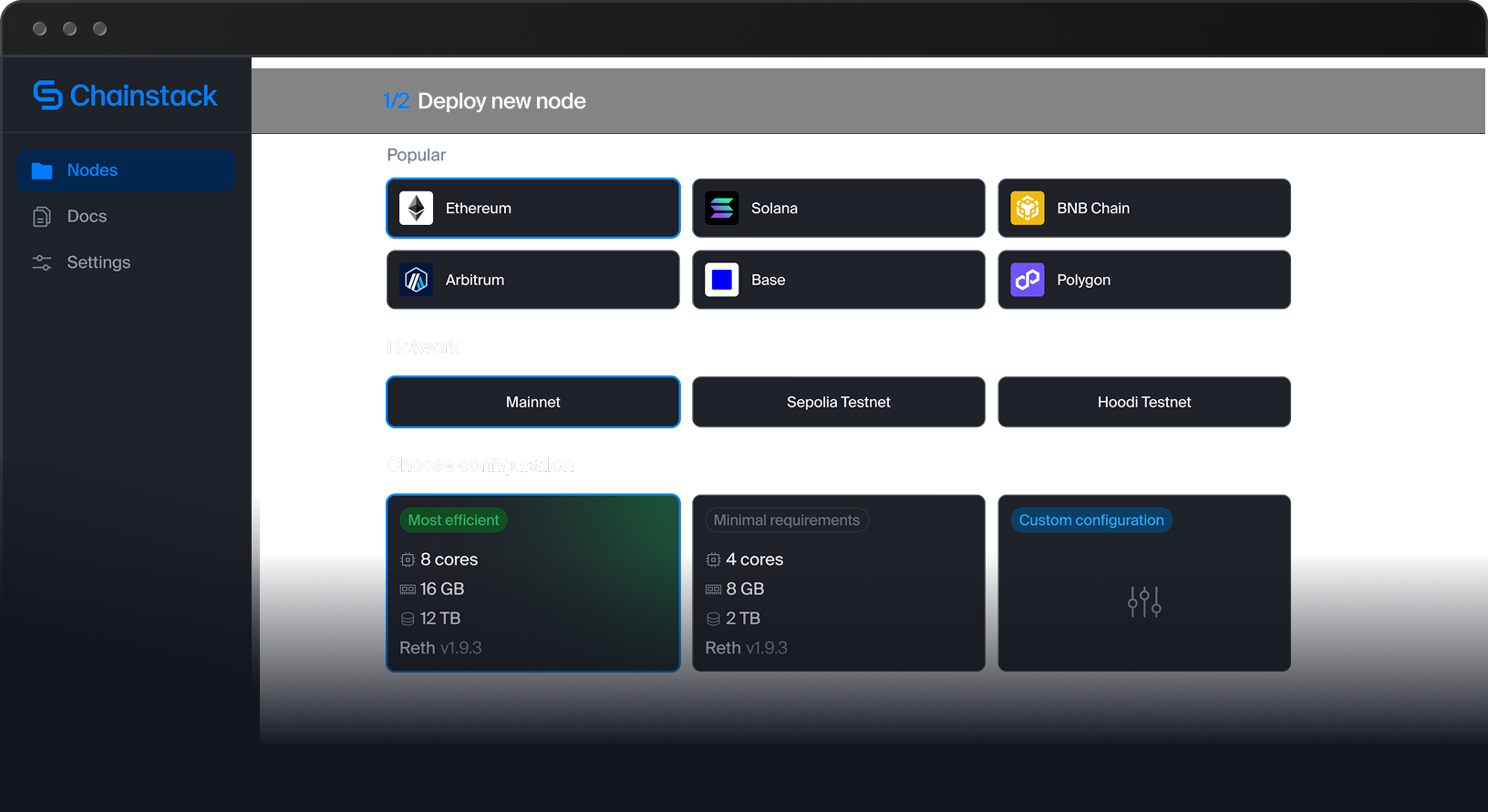


Read a TRON account and its TRX balance through the native HTTP API with /wallet/getaccount.
https://tron-mainnet.core.chainstack.com/YOUR_ENDPOINT_IDtron-mainnet.core.chainstack.com:443x-token: YOUR_X_TOKENCreate a TRON node on mainnet or Nile and copy its HTTPS URL from Access and credentials. Replace the example endpoint and use an activated account on the selected network. The mainnet request uses the address from our API reference.
Get a TRON RPC endpointcurl --request POST \
--url https://tron-mainnet.core.chainstack.com/YOUR_ENDPOINT_ID/wallet/getaccount \
--header 'Content-Type: application/json' \
--data '
{
"address": "TZ4UXDV5ZhNW7fb2AMSbgfAEZ7hWsnYS2g",
"visible": true
}
'The response reports the account’s TRX balance in sun (1 TRX = 1,000,000 sun). TRC-20 token balances use contract calls.
Xem tài liệu tham khảo về phương thức (mở trong một tab mới)
Start with free TRON RPC for mainnet and Nile. Scale payment apps with native gRPC, predictable request billing, and dedicated infrastructure.
Bao gồm:
Tất cả các tính năng dành cho nhà phát triển, cùng với:
Các tiện ích mở rộng và hạ tầng Node chuyên dụng sẽ được tính phí riêng.
 Dịch vụ hỗ trợ xuất sắc trên mọi gói dịch vụ trả phí
Tiết kiệm hơn 50% với gói cước trả theo lượt sử dụng cao cấp của chúng tôi
 Trò chuyện trên Telegram (mở trong một tab mới)
Explore TRON RPC providers, USDT infrastructure, node operations, and endpoint setup.
Compare TRON RPC providers for payment and production workloads.
Đọc bài viết
Understand java-tron operations and the infrastructure behind USDT transfers.
Đọc bài viết
Plan TRON API access for stablecoin balances, transfers, and confirmation checks.
Đọc bài viết
Compare public and private TRON endpoints and connect your application.
Đọc bài viết
A TRON RPC endpoint connects your application to the TRON blockchain to read accounts, query blocks and transactions, call smart contracts, and submit signed transactions. Chainstack provides mainnet and Nile testnet access through native HTTP APIs, gRPC, and a limited Ethereum-compatible JSON-RPC interface.
Create a free Chainstack account, create a project, and deploy a TRON node on mainnet or Nile. Open Access and credentials and copy your endpoint. Use the base HTTPS URL with TronWeb, or copy the gRPC host and x-token for a protobuf client. See the TRON API reference for connection examples.
Yes. The Developer plan includes 3 million request units per month, one node, and an overall limit of 25 requests per second, with no credit card required. Native HTTP, gRPC, and full block and transaction history are included. Every TRON request costs 1 RU. Check method and platform limits for additional restrictions. Onchain transactions still consume TRON resources.
The native /wallet API supports account queries, smart contract calls, transaction construction, and broadcast. /walletsolidity serves confirmed, solidified data. The /jsonrpc interface supports a subset of Ethereum-compatible read methods. It does not expose eth_sendRawTransaction. Use TronWeb and the native API for transaction submission. See TRON for supported integration patterns.
Use TronWeb with your Chainstack HTTPS endpoint to read the TRC-20 contract and construct a transfer. Sign the transaction locally, broadcast it through the native API, and verify the execution result against solidified data. USDT on TRON is a TRC-20 token; TRX is used for network resources. The TRON tooling guide covers contract interaction and transaction submission.
A successful broadcast response means the node accepted a transaction for propagation. It does not prove successful contract execution or finality. Query the transaction and receipt through /walletsolidity or the protocol.WalletSolidity gRPC service, check the execution result, and verify the expected transfer details before crediting a deposit. See the TRON methods reference for confirmed-data methods.
Chainstack TRON nodes do not provide WebSocket event subscriptions or the TronGrid event API. Use sequential block polling and inspect transaction receipts and token-transfer logs for payment monitoring. Persist progress so processing can resume after a restart. Follow the TRC-20 polling guide for an implementation starting point.
Sử dụng tron-mainnet.core.chainstack.com:443 for mainnet or tron-nile.core.chainstack.com:443 for Nile, with TLS and your x-token in gRPC metadata. Chainstack serves protocol.Wallet, protocol.WalletSolidity, và protocol.Database. These are request-response services, not Yellowstone-style event subscriptions. Follow the gRPC setup guide for protobuf definitions and client examples.
Chainstack TRON nodes keep complete block and transaction history from genesis, with no separate archive billing tier for requests. TRON also supports historical TRX balance lookups through specific native methods. This does not provide Ethereum-style historical contract state: eth_call, eth_getCode, and related methods support current state only. Read historical data availability before choosing a query method.
Yes. The Unlimited Node add-on provides unlimited request volume within your selected requests-per-second tier for a fixed monthly add-on fee. It is available starting from the Growth plan. Unlimited volume does not mean unlimited throughput. Your subscription and any Dedicated Node infrastructure are billed separately.
TRON uses bandwidth for transaction data and energy for smart contract execution. Accounts can obtain resources through staking or delegation; when available resources are insufficient, TRX may be burned under the network’s rules. A free RPC plan covers API access, not transaction resources. Use account-resource queries and contract simulation when building payout workflows. The TRON methods reference lists the available calls.
Chainstack supports TRON mainnet and the Nile testnet. TRON also has a separate Shasta testnet, but a Chainstack Nile endpoint does not connect to Shasta. Configure your application, test wallet, token contracts, and faucet for the same network. See the TRON network details.
Open the official TRON faucet guide, choose Nile, and use a Nile testnet address. Follow the faucet’s current claim requirements and verify the funds in your test wallet. Connect the wallet and application to Nile before testing transfers or contracts. Testnet TRX has no monetary value and cannot pay for mainnet transactions. The guide lists faucet websites and community bot options.
Yes. Chainstack Self-Hosted supports java-tron deployments for mainnet and Nile on infrastructure you control. The current package exposes the HTTP API; its internal gRPC port is not exposed externally. The software is free, while you provide and pay for the infrastructure. Follow the installation guide to get started.
Global Nodes provide managed, geo-balanced RPC access for development and production applications. Choose Dedicated Nodes when your payment processor, exchange backend, or indexer needs isolated compute and storage or a deployment-specific configuration. TRON Dedicated Nodes are available from the Pro plan, with infrastructure billed separately.
TRON’s limited JSON-RPC interface lets tools such as web3.py read supported data, but native transactions and contract deployment require TRON-compatible tooling such as TronWeb. You cannot configure TRON as a standard Ethereum network in MetaMask using an RPC URL. Use a TRON-compatible wallet for native TRX and TRC-20 assets. See tooling compatibility for supported workflows.
Connect your application to a Chainstack TRON HTTPS endpoint using TronWeb or a native HTTP client. Use /wallet for account queries, contract calls, transaction construction, and broadcast, and /walletsolidity for confirmed, solidified data. Common methods include getaccount, getnowblock, gettransactioninfobyid, triggerconstantcontract, và broadcasttransaction. Sign transactions locally and verify execution results before crediting payments. See the TRON API reference.
Managed gRPC endpoints use TLS on port 443 with an x-token metadata header. Mainnet uses tron-mainnet.core.chainstack.com:443; Nile uses tron-nile.core.chainstack.com:443. Available services are protocol.Wallet, protocol.WalletSolidity, và protocol.Database. The /jsonrpc interface provides limited Ethereum-compatible reads, while transaction submission uses the native API. Follow the TRON tooling guide for authentication and integration examples.
TRON nodes retain complete block and transaction history from genesis at 1 RU per request. Historical TRX balance methods are available, but general historical contract-state queries are not. WebSocket event subscriptions and the TronGrid event API are not exposed by Chainstack TRON nodes. Use block polling and receipt inspection for transfer monitoring, with persistent progress and retry handling. See historical data availability and the TRC-20 polling guide.





 Xem hướng dẫn cài đặt