Ethereum
 Solana
 Hyperliquid
 Arbitrum
 Base
Base BNB Smart Chain
 MegaETH
 Tempo
Tempo Avalanche
 Aptos
Aptos TRON
TRON Ronin
Ronin zkSync Era
 Optimism
 Sonic
Sonic Polygon
 Unichain
 Fantom
 Gnosis Chain
 Sui
Sui Avalanche Subnets
 Polygon CDK
 Starknet Appchains
 zkSync Hyperchains




 Refer and earn
 Discord
 Telegram
 X (Twitter)
Best Polygon RPC providers for high-throughput apps in 2026

Polygon remains one of the most practical chains for production apps in 2026 not just because it is cheap and EVM-compatible, but because transaction demand is clearly still there. Daily transaction volume on Polygon PoS has climbed sharply, recently moving past the 10M transactions-per-day range, which reinforces its role as a live execution layer for stablecoin transfers, payment rails, gaming backends, consumer apps, and bots. Even as newer L2s compete for attention, Polygon continues to combine real usage, low costs, and mature tooling in a way that makes it operationally relevant for production workloads.
That is exactly why your choice among Polygon RPC providers matters more than most developers initially realize. On Polygon, the bottleneck is almost never “can I get an RPC URL.” The real question is whether that endpoint stays fast and reliable when traffic spikes, when event subscriptions pile up, or when a bot starts backfilling logs at scale.
High-throughput apps do not just need a provider that works in a benchmark demo. They need one that keeps latency stable, exposes the right method surface, and does not become unpredictable under sustained load. This guide breaks down the leading Polygon RPC providers for production workloads in 2026—with a specific focus on stablecoin and payment flows, enterprise deployments, and analytics-heavy or dedicated-node environments.
🤔 Already using Chainstack? Jump straight to the Polygon tooling docs or the Polygon getting started reference to deploy your endpoint in minutes. Testing on Amoy? Grab free test tokens from the Chainstack Amoy faucet.
Why Polygon RPC provider choice matters for production
In a development environment, almost any Polygon RPC provider will do. But in production—where a stablecoin payment app sees sharp spikes around balance checks and transaction confirmations, or where a trading bot needs consistent low-latency state access—the difference between providers becomes operationally significant.
The key factors that separate production-grade Polygon RPC providers from basic public endpoints are:
- Throughput stability under load, not just average latency in quiet conditions
- WebSocket support for subscriptions and real-time event tracking
- Archive, debug, and trace access for indexers, analytics pipelines, and historical queries
- Dedicated node options when shared infrastructure introduces too much noise
- Clear SLA commitments for payment systems, regulated products, and enterprise workloads
- Pricing transparency so cost does not become unpredictable as traffic scales
The comparison below focuses on exactly these criteria across five leading Polygon RPC providers—evaluated for real production conditions, not sandbox demos.
Polygon RPC providers comparison table (2026)
The table below summarizes the public positioning of five Polygon RPC providers as of March 2026. Where providers reserve details for enterprise sales, the table reflects only what is publicly documented.
| Provider | Pricing model | Free tier | Dedicated nodes | Archive / debug / trace | SLA & security |
|---|---|---|---|---|---|
| Chainstack | Request-based plans with optional flat-rate RPS add-on | 3M RU/month, 25 RPS | Yes, on paid plans | Archive on paid tiers; debug/trace on advanced setups | 99.99%+ uptime; formal SLA on paid plans; SOC 2 Type II |
| Alchemy | Compute-unit pricing with free, PAYG, and enterprise scaling | 30M CUs/month | Enterprise/custom infrastructure, but no clearly marketed dedicated Polygon node tier in public docs | Full archive; Debug and Trace API on PAYG and Enterprise | 99.99% uptime; enterprise custom SLAs; SOC 2 Type II |
| QuickNode | Credit-based plans with optional Flat Rate RPS and dedicated enterprise options | Trial only — 10M API credits for 30 days | Yes, Dedicated Clusters available | Archive, Debug API, Trace API, Polygon-specific APIs | 99.99% uptime; formal SLA on paid tiers; SOC 1/2 Type 2, ISO 27001 |
| Ankr | API-credit pricing across Freemium, Premium, and Enterprise tiers | 200M API credits/month after sign-in | Premium private endpoints and enterprise infrastructure, but no clearly positioned dedicated Polygon node product | Full archive; trace/debug on Premium | 99.99% uptime; SOC 2 Type 2 (2025) |
| dRPC | Flat-rate request pricing on paid tier | Free public access (public nodes, no SLA) | No clearly documented dedicated Polygon node tier in public materials | Standard methods; paid-tier trace/filter | High-availability positioning; no clear public SLA or SOC 2 found |
How to choose a Polygon RPC provider
1. Shared RPC is often enough for moderate traffic
If your app has steady but moderate traffic, shared RPC is often sufficient. This applies to dashboards, wallet backends, light bot infrastructure, and consumer apps that read chain state frequently but do not depend on heavy archive queries or strict latency guarantees. In this range, what matters most is a clean pricing model, stable WebSocket support, and reasonable default throughput.
2. Dedicated infrastructure starts to matter when your app becomes operationally sensitive
That threshold is usually crossed in three scenarios:
- Payment or stablecoin traffic with bursty reads and writes
- Bots that depend on consistent low-latency state access, where jitter from shared infrastructure creates operational risk
- Indexers running long backfills or traces, where a noisy shared endpoint can corrupt the consistency of your data pipeline
Once traffic becomes burst-heavy or sustained, shared RPC can become noisy even if average latency still looks fine on a dashboard.
3. Archive, debug, and trace access matters for analytical workloads
If your workload is not just transactional but analytical—replaying historical state, indexing large event ranges, tracing smart contract execution, or supporting internal observability—you need more than a standard full-node endpoint. Archive data access, debug_traceTransaction, trace_block, and long-range eth_getLogs behavior become more important than free-tier size.
4. Latency consistency matters more than average latency for real-time workloads
Average latency is a misleading metric for latency-sensitive applications. What breaks DeFi execution layers, real-time event listeners, keeper networks, and live price feeds is not average response time — it is tail latency and jitter. A provider that averages 40ms but occasionally spikes to 800ms under load will fail production workloads that depend on reacting to chain state within a narrow window.
For these workloads, the relevant criteria are: WebSocket connection stability under sustained subscription load, consistent p95 and p99 latency rather than just p50, and a provider architecture that does not introduce shared-infrastructure noise during peak network activity. Dedicated nodes remove the noise floor entirely, which is why latency-sensitive applications are often the first to outgrow shared RPC — even when average metrics still look acceptable.
5. Enterprise support matters when Polygon is part of a regulated product
Stablecoin apps, payment rails, treasury systems, and institutional middleware usually need more than a performant endpoint. They need a clear SLA, a defined security posture, access controls, and support quality that does not depend on a Discord thread. At this level, your Polygon RPC provider becomes part of your risk model.
Choose the right Polygon RPC provider by use case
For stablecoin and payment apps
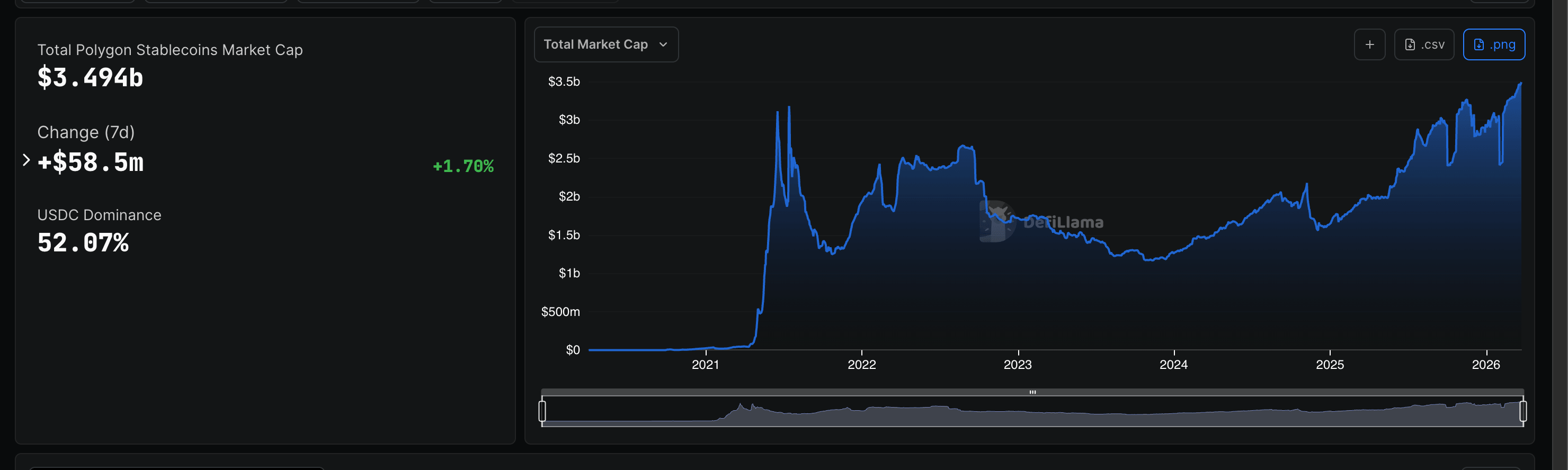
Payment applications on Polygon need a different kind of reliability than general-purpose dApps. The core requirement is not exotic RPC methods. It is consistent low-latency reads, clean transaction submission, and stable performance during bursty traffic.
Payment systems create sharp spikes around balance checks, transaction confirmations, webhooks, and reconciliation. A provider that looks inexpensive for casual usage can still become a liability in production—because payments fail operationally long before they fail cryptographically.
The strongest criteria here are: predictable throughput, clear uptime, and pricing that does not become opaque when traffic becomes repetitive but heavy.
Chainstack stands out because its request-based pricing is easier to reason about than CU-heavy alternatives, and because it offers a clear upgrade path from shared Polygon RPC to dedicated infrastructure. Ankr is also credible for cost-sensitive payment applications, especially where Premium endpoints and WebSockets are sufficient. Alchemy is strong if the payment stack already depends on its broader platform products, but its compute-based billing model is less intuitive for teams that want straightforward cost forecasting.
For enterprise workloads
Enterprise Polygon workloads are less about raw throughput and more about operational assurance. The questions shift from “does it respond fast?” to “is there a contractual uptime model, do we have clear support paths, and does the provider pass our internal security review?”
For enterprise teams, the critical criteria are:
- Publicly available or negotiable SLA terms
- Clear security posture (SOC 2, ISO certifications)
- Dedicated or isolated infrastructure options
- Multi-region resilience
- Support quality that does not degrade when you escalate a P1 incident
QuickNode is strong here because it combines formal security credentials (SOC 1 Type 2, SOC 2 Type 2, ISO 27001) with dedicated cluster options and a mature platform surface. Alchemy is also compelling for enterprise teams already embedded in its ecosystem. Chainstack is a serious contender for teams that want a direct path to dedicated nodes, transparent pricing logic, and SOC 2 Type II-backed infrastructure—without navigating a complex enterprise procurement process just to get meaningful throughput.
For DeFi, analytics, and indexers
DeFi and analytics workloads stress a Polygon RPC provider differently from payment or bot traffic. They care less about single-request latency and more about whether the provider can survive long-running historical reads, event backfills, trace calls, and archive-heavy access patterns without collapsing into throttling or returning inconsistent results.
A cheap endpoint can look fine until it has to serve eth_getLogs across large block windows, replay transactions, or support indexing jobs that run continuously for hours.
Chainstack and QuickNode are the strongest fits here based on publicly documented feature sets. Chainstack has the clearest path to dedicated Polygon infrastructure and production-oriented node control. QuickNode is strong on archive, trace, and marketplace-style platform depth. Alchemy remains viable for analytics-heavy teams, especially those already familiar with its Debug and Trace APIs, but method-weighted cost behavior needs closer modeling at scale.
Polygon RPC providers: breakdown by provider
Chainstack
Best for: High-throughput apps, bots, payment systems, and teams that expect to graduate into dedicated Polygon infrastructure.
Chainstack has the cleanest production path in this comparison. It offers a free shared tier for entry, request-based billing that is easier to forecast than CU-heavy alternatives, and dedicated Polygon nodes for teams that outgrow shared endpoints. It also publicly emphasizes archive access, WebSockets, enterprise support, and SOC 2 Type II compliance.
Pricing & throughput: Developer plan is free (3M RU/month, 25 RPS). Growth starts at $49/mo (20M RU, 250 RPS). Pro at $199/mo (80M RU, 400 RPS). Business at $349/mo (140M RU, 600 RPS). Enterprise at $990/mo (400M RU, unlimited RPS). Overage rates drop from $20/1M RU on Developer to $5/1M RU on Enterprise. The Unlimited Node add-on converts any node to flat-fee, unlimited requests within a chosen RPS tier (25–500 RPS) — no per-request billing, no overage exposure.
For teams that care about predictable cost and a direct move into isolated infrastructure, that is a practical advantage over providers where dedicated nodes are available only through opaque enterprise sales processes.
Limitations: Compared with Alchemy and QuickNode, Chainstack has fewer add-on platform abstractions around notifications, indexed APIs, or broader middleware products. If your team wants a provider that also acts as an application-data platform, that may matter.
Fit by workload:
- Stablecoin and Payment Apps: Excellent — request-based pricing and dedicated-node upgrade paths are straightforward to operationalize
- Enterprise Polygon Workloads: Strong — SOC 2 Type II, reliable public uptime positioning, dedicated infrastructure
- Dedicated Nodes, Analytics, and Indexers: Strongest in this comparison — clearest path to dedicated Polygon access without building your own node operations stack
Alchemy
Best for: Teams already using Alchemy across EVM networks and wanting Polygon support inside the same platform.
Pricing & throughput: Free tier includes 30M CUs/month. Paid tiers start with PAYG at around $1.50/1M CUs. The important caveat: each eth_call consumes ~26 CUs, heavier methods more. This means effective cost per actual request is higher than the headline CU rate suggests. Shared plans scale to 300 RPS; higher throughput requires Enterprise.
Alchemy supports Polygon with RPC, WebSockets, full archive access, and Debug/Trace APIs on paid plans. Its platform also includes analytics, webhooks, and a familiar SDK environment. For product teams already standardized on Alchemy, the operational convenience can outweigh raw request-cost simplicity.
Limitations: The compute-unit pricing model is workable but less intuitive than request-based billing, especially for workloads that use heavier methods or high-volume subscriptions. Dedicated Polygon infrastructure is also less explicitly positioned in public materials compared to Chainstack or QuickNode.
Fit by workload:
- Stablecoin and Payment Apps: Good when the broader Alchemy platform is already part of the stack
- Enterprise Polygon Workloads: Strong through custom throughput, enterprise support, and SOC 2 Type II
- Dedicated Nodes, Analytics, and Indexers: Viable, but cost predictability needs closer review
QuickNode
Best for: Bots, DeFi backends, analytics pipelines, and enterprise teams that want a deep Polygon method surface with dedicated options.
Pricing & throughput: No free plan — trial only (10M credits, 30 days). Build at $49/mo gives 80M credits and 50 RPS. Accelerate at $249/mo (450M credits, 125 RPS). Scale at $499/mo (950M credits, 250 RPS). Business at $999/mo (2B credits, 500 RPS). Each standard EVM call costs 20 API credits; heavier methods like trace calls consume more. Overage rates range from $0.50–$0.62/1M credits depending on plan.
QuickNode’s Polygon documentation is among the most explicit in this set. It covers archive access, Debug API, Trace API, Polygon-specific methods, HTTP and WebSocket endpoints, and dedicated infrastructure paths. Flat Rate RPS is useful for teams that want more predictable billing without jumping immediately to dedicated clusters. Security posture is strong, with SOC 1 Type 2, SOC 2 Type 2, and ISO 27001 publicly stated.
Limitations: The pricing model can still be harder to forecast than simpler request-based providers, especially for workloads that mix standard methods, traces, subscriptions, and higher-cost calls. Flat Rate RPS runs on shared infrastructure and does not include dedicated isolation or SLA guarantees.
Fit by workload:
- Stablecoin and Payment Apps: Good, especially if predictable RPS billing or enterprise controls matter
- Enterprise Polygon Workloads: One of the strongest — compliance posture and dedicated cluster availability
- Dedicated Nodes, Analytics, and Indexers: Very strong — documented archive, debug, and trace support
Ankr
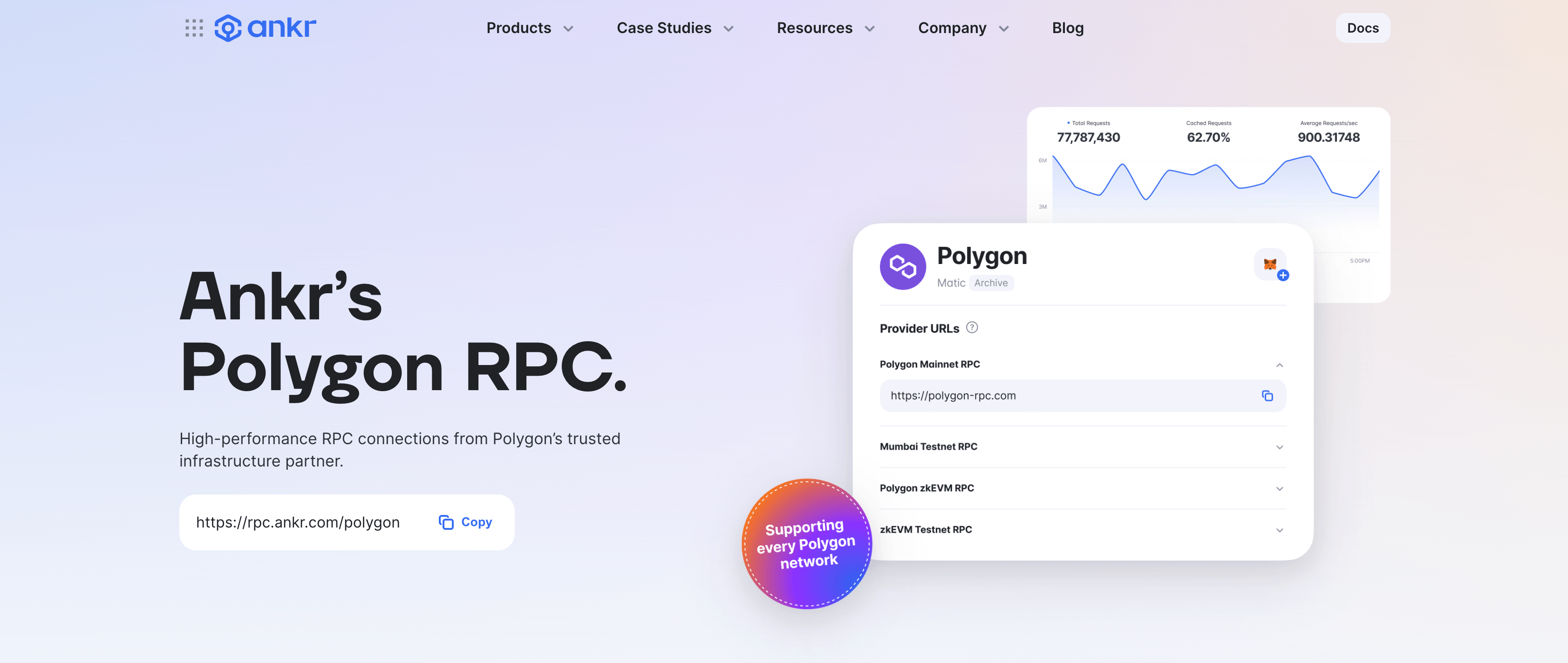
Best for: Cost-sensitive production applications, payments, and teams that want a broad Polygon feature set without immediately committing to enterprise infrastructure.
Pricing & throughput: Freemium includes 200M API credits/month but caps at 30 RPS. Premium PAYG is advertised at $0.10/1M API credits — but each eth_call costs ~200 Ankr credits, making the effective rate closer to $20/1M actual requests. Premium scales to 1,500 RPS. The generous free credit allowance makes Ankr attractive for moderate-volume apps, but cost modeling on heavier method mixes requires careful attention to the credit multiplier.
Ankr clearly separates Public, Freemium, Premium, and Enterprise service levels. It supports HTTPS and WebSocket access, archive data, and Premium-only trace/debug methods. It also publishes concrete rate-limit and block-range guidance, which is practical for teams planning around operational limits. Ankr announced SOC 2 Type 2 compliance in 2025.
Limitations: The Polygon offering is more “platform with Premium private endpoints” than a clearly marketed dedicated Polygon node product. That is fine for many teams but less ideal if you explicitly need isolated infrastructure with dedicated-node semantics.
Fit by workload:
- Stablecoin and Payment Apps: Strong, especially for cost-aware teams that need Premium-level throughput and WebSockets
- Enterprise Polygon Workloads: Viable, but not as cleanly packaged as Chainstack or QuickNode for enterprise Polygon isolation
- Dedicated Nodes, Analytics, and Indexers: Usable on Premium, but less cleanly positioned than providers with explicit dedicated-node products
dRPC
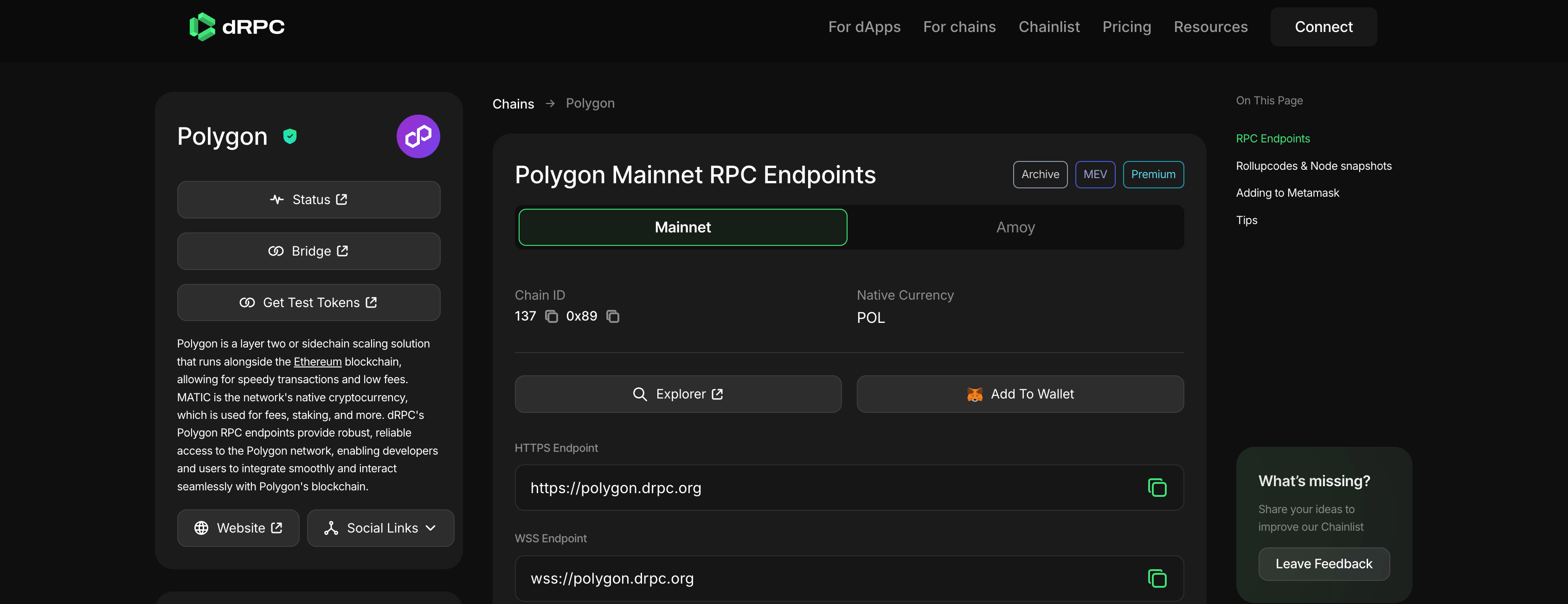
Best for: Cost-sensitive multi-chain apps, dashboards, and teams that want a simple Polygon endpoint inside a broader routing layer.
Pricing & throughput: The clearest pricing model in this comparison — $6/1M requests flat, with 20 CUs per call regardless of method. No multiplier math, no per-method surprises. Paid tier scales to 5,000 RPS, which is the highest shared RPS ceiling in this set. The free public tier routes through public nodes with no SLA guarantees, making it unsuitable for production.
dRPC’s value proposition is clear: multi-chain access, WebSocket support, flat-rate request pricing, and distributed routing. Its Polygon documentation exposes standard chain info, subscriptions, and paid-tier trace methods.
Limitations: dRPC is the weakest of the five for dedicated Polygon workloads. Public materials do not clearly describe a Polygon-specific dedicated-node tier. Security and compliance language is also less explicit in public documentation than with the other four providers.
Fit by workload:
- Stablecoin and Payment Apps: Acceptable for cost-sensitive setups, but weaker when strict support, compliance, or dedicated capacity are required
- Enterprise Polygon Workloads: Weakest fit — limited public enterprise and compliance detail
- Dedicated Nodes, Analytics, and Indexers: Fine for standard workloads, but not the best choice for heavy archive, debug, or indexing requirements.
Final recommendations
- For stablecoin and payment apps: The best Polygon RPC provider is Chainstack. It combines predictable request-based pricing, solid WebSocket support, and a clean upgrade path to dedicated infrastructure when payment traffic stops behaving like normal app traffic and starts behaving like production finance.
- For enterprise Polygon infrastructure: The strongest options are QuickNode and Chainstack, with Alchemy close behind for teams already committed to its broader platform. QuickNode leads on public compliance posture and enterprise packaging. Chainstack leads if you want dedicated Polygon nodes with simpler cost logic and a direct path to isolated infrastructure.
- For DeFi, analytics, and indexers: The best Polygon RPC provider is Chainstack, with QuickNode as the closest alternative. Both are well-suited to archive, trace, and higher-intensity Polygon operations. Alchemy is still viable here, but teams should model cost behavior carefully before committing at scale.
Top 5 Polygon RPC providers 2026 — overall ranking
Chainstack leads with 95/100, 10 points ahead of runner-up
No single provider is universally optimal for every Polygon workload. The right choice depends on your method mix, latency sensitivity, compliance requirements, and cost predictability needs. The ranking below reflects production-readiness for stablecoin, high-throughput bot, and enterprise environments specifically, not general developer experimentation or trial usage.
1. Chainstack — 95/100 For teams prioritizing predictable request-based billing, dedicated Polygon infrastructure, full archive and debug/trace access, and SOC 2 Type II-backed uptime. The most complete infrastructure for payment platforms, trading bots, and analytics pipelines that cannot afford surprise billing or unplanned downtime.
2. QuickNode — 85/100 Best for high-throughput and enterprise-grade Polygon workloads. The most comprehensive Polygon method documentation in this set, Flat Rate RPS for predictable throughput, and the strongest public compliance posture (SOC 1/2 Type 2, ISO 27001). Strong choice for DeFi backends, keeper networks, and analytics pipelines.
3. Alchemy — 82/100 Best for teams already standardized on the Alchemy platform. Debug and Trace APIs, full archive access, webhooks, and a familiar SDK environment make it a strong fit for product teams where Alchemy is already the stack. SOC 2 Type II covers enterprise compliance needs.
4. Ankr — 76/100 Best multi-chain entry point with solid Polygon coverage. Publicly stated 99.99% uptime, 200M free credits, Premium private endpoints, and a clear service-tier separation. Right for cost-sensitive payment apps and teams adding Polygon to an existing multi-chain stack.
5. dRPC — 72/100 Best for cost-optimized standard Polygon workloads. Flat-rate request pricing removes cost uncertainty from high-volume standard calls. Most generous free public access. Multi-provider routing improves upstream resilience. Weaker for dedicated infrastructure, heavy archive/trace, or regulated environments.
Conclusion
For Polygon in 2026, choosing between Polygon RPC providers means selecting the infrastructure layer that will quietly determine your system’s reliability, cost predictability, and operational resilience.
Polygon’s continued relevance as a low-cost EVM execution layer for stablecoin payments, gaming, and consumer apps means the stakes for infrastructure decisions are higher than they appear. Payment platforms need throughput stability and clean billing under bursty traffic. Bot operators need consistent low-latency state access and reliable WebSocket subscriptions. DeFi, analytics, and indexing pipelines need archive depth and trace access that holds up under sustained load.
Chainstack covers all three — predictable request-unit pricing, SOC 2 Type II, full archive and debug access, dedicated node infrastructure, and a managed environment that does not surprise you at scale. For teams where Polygon RPC is foundational rather than incidental, it is the most complete option in 2026.
FAQ
A Polygon RPC provider is a service that gives your application an API endpoint to interact with the Polygon blockchain. Rather than running your own full node—which requires significant infrastructure overhead—you connect your app, bot, or smart contract tooling to the provider’s node infrastructure via JSON-RPC over HTTP or WebSocket. The provider handles node uptime, syncing, and scaling.
A shared Polygon RPC endpoint means your requests are processed on infrastructure shared with other customers. This is cost-effective for most apps. A dedicated node means you get isolated infrastructure—no other customers share your compute or bandwidth. Dedicated nodes matter when traffic is burst-heavy, latency needs to be consistent under load, or you need to run archive or trace calls without competing for resources.
Archive access means the node stores the complete historical state of the blockchain, not just the most recent block. Without it, you cannot query historical account balances, replay transactions, or run eth_getLogs across large ranges. Most production analytics, indexing, and compliance workloads require archive access. Not all Polygon RPC providers include it on their base tier—check before committing.
Yes. Chainstack offers 3M requests/month on its Developer plan. Alchemy offers 30M CUs/month free. Ankr has a Freemium tier with 200M API credits/month. QuickNode offers a 30-day trial. For testnet development on Amoy, you can also use the Chainstack Amoy faucet to get test MATIC without spending mainnet funds.
Yes. Polygon PoS is EVM-compatible, so standard Ethereum libraries like ethers.js, web3.py, viem, and Foundry work with Polygon RPC endpoints with minimal configuration changes—typically just swapping the RPC URL and chain ID. Chainstack’s Polygon tooling docs cover integrations with the most common libraries and frameworks.
HTTP (or HTTPS) is the standard request-response model: your app sends a call and waits for a reply. It works well for most read and write operations. WebSocket provides a persistent, bidirectional connection that is better suited for real-time use cases like subscribing to new blocks, pending transactions, or event logs. For bots, payment listeners, and live dashboards, WebSocket support from your Polygon RPC provider is essential.
Related reading