AI-ready infrastructure
 Refer and earn


 Ethereum
 Hyperliquid
 Solana
 Arbitrum
 BNB Smart Chain
 Base
Base Polygon
 TRON
TRON Sui
Sui Robinhood


Are perp DEXs safe? Pros & cons explained

Perpetual DEXs (decentralised exchanges) now process around 10% of all crypto perpetual futures volume, up from roughly 3% at the start of 2025, according to data from Coinperps. Close to $500 billion changes hands each month on venues where users retain control of their collateral.
Whether this is safer than using a centralised exchange depends on the type of risk. Perp DEXs eliminate the failure modes that brought down FTX. There is no custodian, funds cannot be commingled, and withdrawals cannot be frozen by an exchange operator.
Other risks take their place, including contract exploits, oracle manipulation, vault losses and chain downtime. Governance can also rewrite outcomes within minutes. Here are the advantages and drawbacks, the incidents that exposed them, and the checks to make before depositing.
What is a perp DEX and how does it differ from a CEX?
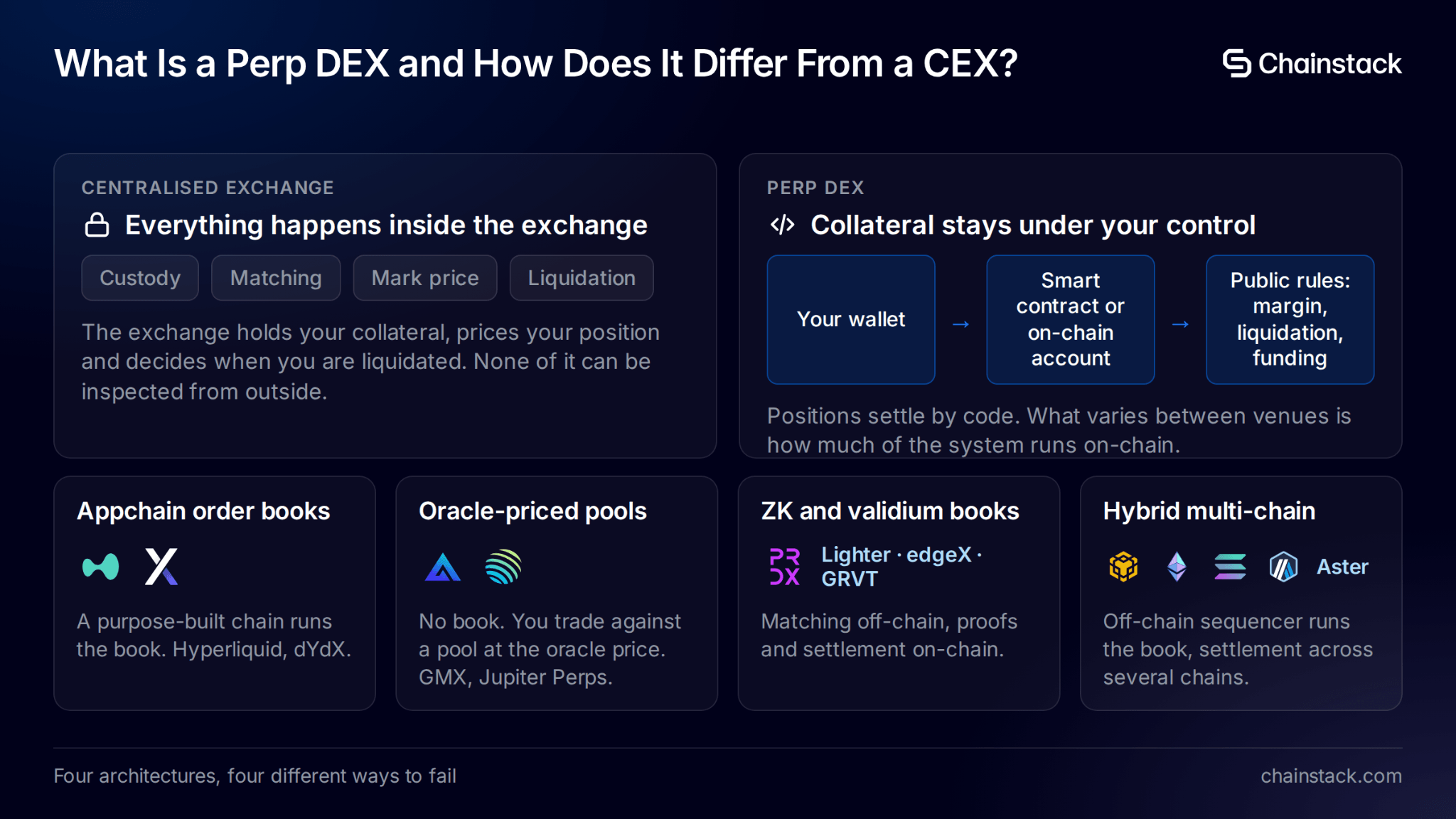
A CEX holds your collateral, operates the matching engine and sets the mark price. It also controls liquidations. All of this happens inside a system traders cannot inspect.
With a perp DEX, collateral remains in a smart contract or an on-chain account under your control until the position settles. Code enforces margin, funding and liquidations under publicly available rules. The amount of infrastructure running on-chain varies by design:
- Appchain order books (Hyperliquid, dYdX): a purpose-built chain operates the book. Hyperliquid uses its HyperCore layer for matching and margin, while HyperEVM runs alongside it for smart contracts.
- Oracle-priced pools (GMX, Jupiter Perps): these venues have no order book. Traders open positions against a liquidity pool using the oracle price.
- ZK and validium order books (Lighter, Paradex, edgeX, GRVT): orders are matched off-chain, with proofs and settlement handled on-chain.
- Hybrid multi-chain venues (Aster): an off-chain sequencer operates the book, while custody and settlement are distributed across several chains.
These architectures have different failure modes, which shape the risks discussed below.
Are perp DEXs safer than centralized exchanges? (Pros)
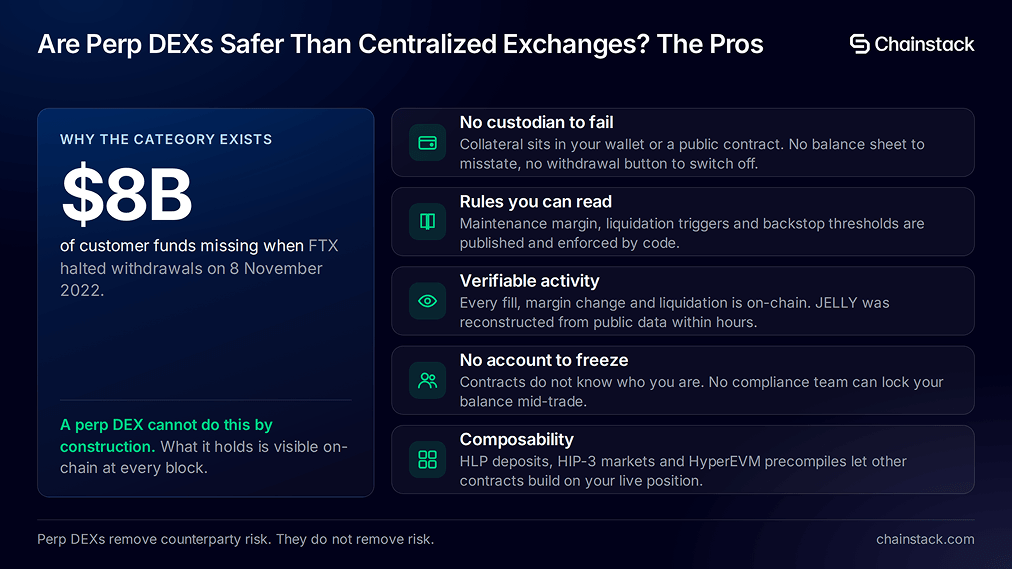
- No custodian to fail: collateral stays in your wallet or a contract with public code. There is no exchange balance sheet to misstate or withdrawal function that an operator can disable. FTX halted withdrawals on 8 November 2022 with roughly $8 billion of customer funds missing. Bankruptcy filings later showed depositors that Alameda had traded against them using their own money. A perp DEX cannot do this by construction because its holdings are visible on-chain at every block.
- Rules you can read: margin requirements, liquidation thresholds and backstop mechanics are published and enforced through code. Hyperliquid documents the maintenance margin for each asset and the point at which positions pass to the HLP backstop. GMX publishes its liquidation fee and pool utilisation caps. CEX insurance fund balances and auto-deleveraging queues remain internal, leaving traders to discover how the engine works when they are liquidated.
- Verifiable activity: fills, margin changes and liquidations are recorded on-chain. After the JELLY incident, Arkham, Halborn and OAK Research reconstructed the attacker’s three accounts and precise sequence of margin withdrawals from public data within hours. Court-appointed examiners took months to unravel FTX’s internal ledger. This transparency also allows aggregators to compare reported volume with on-chain open interest, as covered below.
- No account to freeze: the contracts do not know who you are. Front ends may geoblock users, and Hyperliquid’s interface blocks US traffic, but a compliance team cannot lock an account balance during a trade. There is also no “withdrawals temporarily suspended” banner. Governance can still treat addresses differently during remediation. Following JELLY, the Hyper Foundation reimbursed users except for flagged addresses, showing that permissionless access does not guarantee permissionless outcomes.
- Composability: positions, collateral and vault shares exist as on-chain state that other protocols can use. Anyone can deposit into HLP. Since October 2025, HIP-3 has allowed anyone staking 500,000 HYPE to deploy perp markets. HyperEVM contracts can also read HyperCore positions and prices through precompiles, allowing hedging or structured product contracts to react to live positions without an intermediary oracle. The CEX equivalent is an API key with trading permissions, which introduces a security liability rather than offering the same feature.
Perp DEX risks explained (cons)
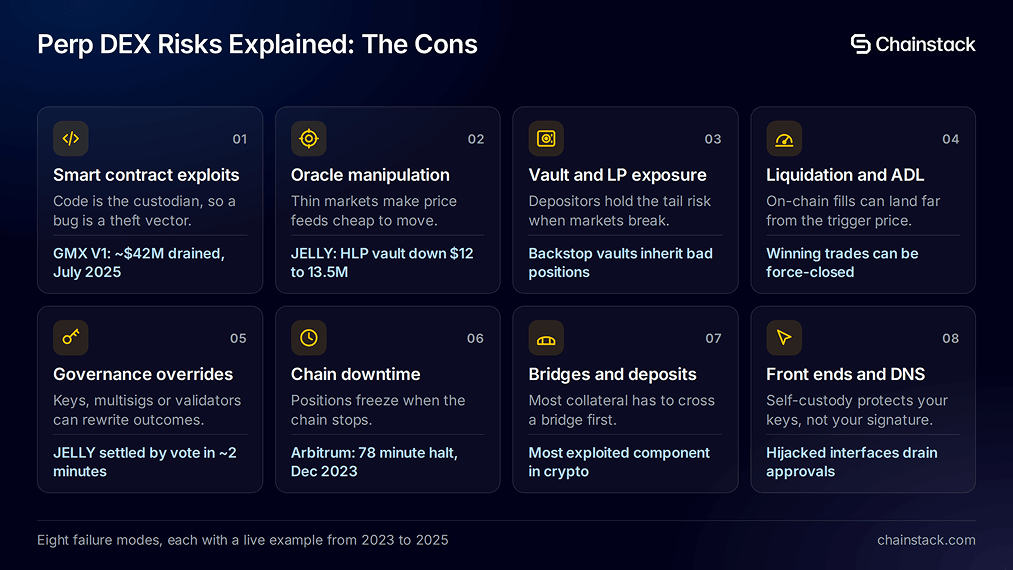
- Smart contract exploits: code acts as the custodian, making any bug a potential theft vector. GMX V1 lost roughly $42 million to a reentrancy exploit in July 2025. The funds were returned under a bounty agreement, but that outcome is unusual. Most losses fall on liquidity providers or the treasury without an insurance scheme behind them.
- Oracle manipulation: a venue is only as reliable as its price feed, and thin markets are cheaper to manipulate. On 26 March 2025, a trader used roughly $8 million in offsetting JELLY positions to trigger a liquidation that Hyperliquid’s book could not absorb. This pushed the HLP vault to a $12 to 13.5 million unrealised loss. HyperEVM contracts can now read HyperCore prices through precompiles rather than relying on an external oracle. That removes one attack surface for builders, but it does not change the behaviour of thin markets.
- Vault and liquidity provider exposure: the LP is the trader’s counterparty on pool-based venues. With order book venues, the backstop vault inherits positions that the market cannot close. Depositors earn yield under normal conditions but carry the tail risk when markets break. Supplying liquidity is effectively selling insurance and should be priced accordingly.
- Liquidation and auto-deleveraging: because liquidations occur on-chain, congestion or a thin book can cause execution far from the trigger price. If the vault cannot absorb a bankrupt position, auto-deleveraging closes profitable positions on the opposite side at a price those traders did not choose.
- Governance and admin keys: Hyperliquid validators resolved JELLY in about two minutes by delisting the contract and settling all positions at $0.0095, the attacker’s entry price. This converted a vault loss into a $700,000 profit. It can be viewed as competent emergency intervention or a small group overriding the market. Every perp DEX has some form of this authority through admin keys, multisigs or validator votes. Hyperliquid has since moved delisting to fully on-chain votes.
- Chain and sequencer downtime: traders can only close positions or add margin while the chain is producing blocks. On 15 December 2023, Arbitrum’s sequencer stalled for about 78 minutes. Positions on Arbitrum venues were frozen while oracle prices became stale. For appchains such as Hyperliquid, the exchange and chain are the same system, so a halt leaves no fallback. Public RPC limitations create a less severe version of this problem. Hyperliquid’s public HyperEVM RPC has been capped at 100 requests per minute per IP since August 2025, which is sufficient for a browser but inadequate for bots or liquidation monitors.
- Bridges and deposits: most venues require collateral to cross a bridge before it can be used, and bridges are the industry’s most frequently exploited component. A venue operating across four chains depends on four bridges, along with a messaging layer connecting them.
- Front ends and DNS: self-custody secures your keys, not the transaction you sign. Compromised interfaces have drained users through malicious approvals presented on legitimate-looking domains. Bookmark the correct URL and confirm contract addresses against official sources.
How to tell if DEX volume is real
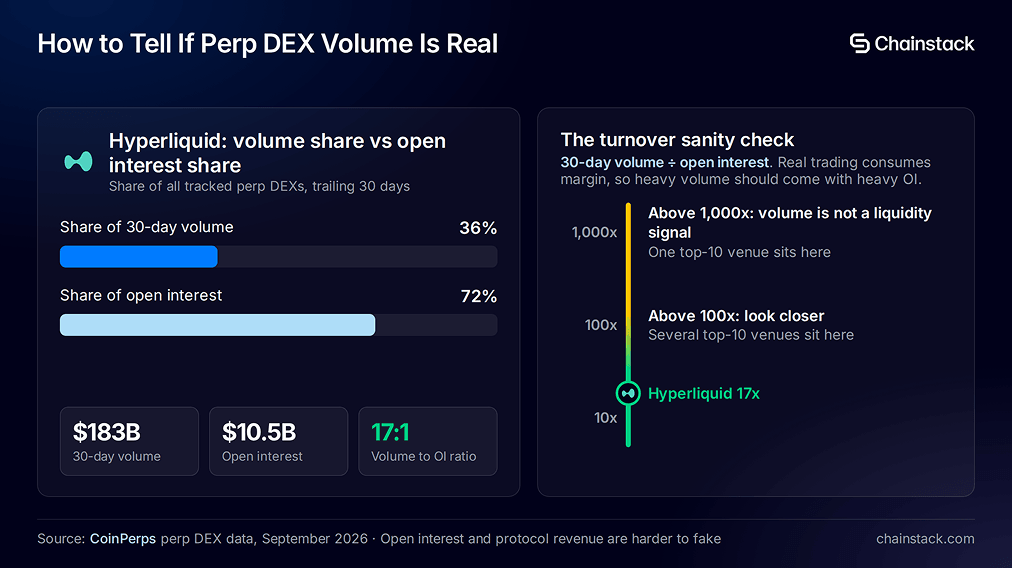
Perp DEX activity is theoretically verifiable because it occurs on-chain. In practice, points programmes often reward volume and create incentives for wash trading. Some venues also publish figures that aggregators cannot reconcile.
A useful check is to compare volume with open interest because genuine trading requires margin. As of early September 2026, Hyperliquid processed around $180 billion over the trailing 30 days against roughly $10.5 billion in open interest. That represents a ratio of about 17 to 1. It handles more volume than any other perp DEX and holds over 70% of the sector’s open interest.
Several venues in the top ten turn over their full open interest more than 100 times per month. One exceeds 1,000 times. This does not prove wash trading, but it shows why volume should not be the sole basis for assessing liquidity. Open interest and protocol revenue are more difficult to fabricate.
Perp DEX vs CEX safety compared
| Category | Perp DEX | Centralized exchange |
|---|---|---|
| Custody | Your wallet or a public contract | Exchange balance sheet |
| Insolvency risk | None from the venue; contract risk instead | Full counterparty exposure |
| Liquidation rules | Public, enforced on-chain | Internal, opaque |
| Oracle risk | High, especially in thin markets | Low, internal index price |
| Downtime | Chain or sequencer halt freezes positions | Exchange outage freezes positions |
| Recovery after loss | Rare, no insurance scheme | Occasional, discretionary |
| Who can override outcomes | Admin keys, validators, multisigs | The exchange |
| Access | Permissionless | KYC and jurisdictional limits |
| Activity data | Verifiable on-chain | Reported by the exchange |
Does the chain a perp DEX runs on affect safety?
The venue inherits the failure modes of its underlying chain, and each type of network fails differently.
- Appchains (Hyperliquid, dYdX): because the exchange is the chain, its validator count, client diversity and halt history form part of the venue’s safety record. HyperCore and HyperEVM use the same consensus, so a stall affects both. This design has fewer moving parts than an L2, but no fallback.
- Ethereum L2s (Arbitrum for GMX, ZKsync for GRVT, Starknet for Paradex): users inherit the centralised sequencer and its outage record. A forced exit through L1 can take from several hours to a day. Proof systems provide verifiability while introducing another component that may stall.
- Solana (Jupiter Perps, Drift): Solana is fast and inexpensive, although its network halt history should inform position sizing. As with any chain, positions remain frozen during an outage.
- Multi-chain venues (Aster): the main risk lies in communication between chains rather than one specific network. Each additional deployment introduces another bridge and another collection of endpoints that must remain operational.
Regardless of the architecture, the trader’s connection is the final link. Public RPC infrastructure tends to deteriorate during the same volatility that causes liquidations. A private or dedicated endpoint is the only part of this stack directly controlled by the trader.
How to check if a perp DEX is safe
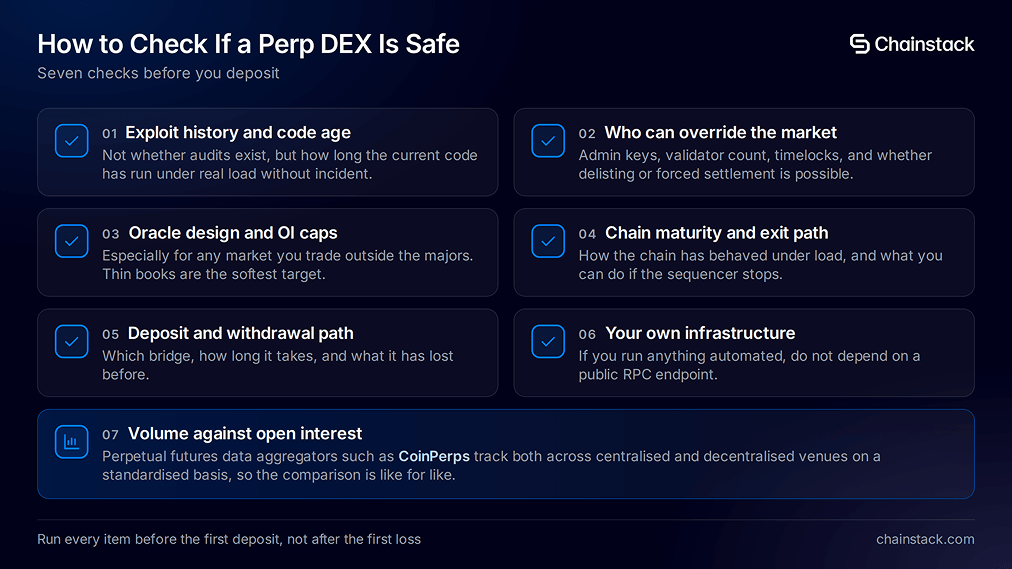
- Exploit history and code age: focus on how long the current code has operated under genuine load without an incident, not simply whether audits exist.
- Who can override the market: review admin keys, validator count and timelocks. Check whether the venue can delist markets or force settlements.
- Oracle design and open interest caps: examine both carefully, particularly for markets outside the major assets.
- Chain maturity and exit path: assess the chain’s performance under load and determine what options remain if its sequencer stops.
- Volume against open interest: perpetual futures data aggregators such as Coinperps track both metrics across centralised and decentralised venues using a standardised methodology, allowing like-for-like comparisons.
- Deposit and withdrawal path: identify the bridge involved, its transaction times and any previous losses.
- Your own infrastructure: automated systems should not rely on a public RPC endpoint.
Why RPC infrastructure matters for perp DEX safety
Every safety check above assumes you can see your position and act on it. On a perp DEX that depends on an RPC connection, and the moment it matters most is the moment public endpoints are least reliable.
- Stale data means wrong decisions: if your endpoint lags the chain by a few blocks during a fast move, the liquidation price you are watching is already out of date.
- Rate limits hit under load: public endpoints throttle when everyone queries at once, which is exactly when liquidations cascade. A capped endpoint turns a close order into a failed request.
- Bots and monitors need redundancy: anything automated should run against a dedicated endpoint with a fallback, not a shared public one.
None of this fixes a halted chain. It does remove the failure that sits between you and a chain that is still running. Providers like Chainstack offer dedicated RPC nodes across the chains perp DEXs run on, including Hyperliquid, Arbitrum, and Solana, which is one way to remove the shared-endpoint bottleneck from your own setup.
Conclusion
Perp DEXs protect users from the failure that led to their creation. No operator can lend out your collateral or refuse a withdrawal. In exchange, traders accept exposure to code, oracles and chains, as well as whoever controls the admin keys.
The sector has produced a real example of each risk: GMX for code, JELLY for oracle and governance failures, and Arbitrum’s sequencer for chain outages.
The trade is counterparty risk for protocol risk. For most traders, that is worthwhile on a mature venue with deep books and an uneventful exploit history. It is not worthwhile when reported volume looks implausibly high relative to open interest.
Related reading