AI-ready infrastructure
 Refer and earn


 Ethereum
 Hyperliquid
 Solana
 Arbitrum
 BNB Smart Chain
 Base
Base Polygon
 TRON
TRON Sui
Sui Robinhood


Migrate your Robinhood Chain RPC to Chainstack

Robinhood Chain shipped in July 2026 and the RPC market around it started forming the same week. Alchemy and BitGo were named at launch. Chainstack shipped Robinhood Chain support three weeks later — Global Nodes, Dedicated Nodes, Full and Archive, on mainnet and testnet, with debug_* methods enabled from day one.
Since then teams have been quietly moving their Robinhood Chain RPC to Chainstack. This guide is the reason to do the same, and the two ways to actually do it: paste one line into any AI coding agent, or migrate manually. First 3 months at 50% off Growth with code ROBINHOOD50.
Robinhood Chain in two minutes
Robinhood Chain is an Arbitrum Orbit L2 for finance and tokenized real-world assets by Robinhood — tokenized U.S. equities (Stock Tokens), onchain lending, agentic trading. Testnet went live February 10, 2026, mainnet on July 1, 2026.
As of mid-August 2026:
- Surpassing $940M TVL
- Over 420M total transactions since testnet
- Average block time: ~100 ms (roughly 10 blocks per second)
- Average transaction cost: ~0.00002 ETH
- Native DeFi at launch: Uniswap, Morpho, Pleiades
- Over 120K ERC-4337 smart accounts and 1.6M+ user operations
The economically interesting part is the distribution. Robinhood’s retail brokerage user base is now onboardable into onchain finance through a chain that was built for exactly that. RWA workloads don’t behave like generic DeFi — compliance events, audit reconstructions, corporate-action multipliers, and 24/7 settlement all sit in the RPC layer. The cost of getting that layer wrong is direct.
Why RPC budgets are getting rebalanced right now
A 100 ms block chain rewrites your RPC cost model whether you notice or not. An indexer that polled every block on Ethereum burned ~7,200 requests per day. The same indexer on Robinhood Chain burns ~864,000 — 120× more. If your provider prices per compute unit or per method with a multiplier, this is where the bill quietly ships.
Here’s how the three big providers price the same workload:
| Provider | Model | Trace on Arbitrum-family | Growth-equivalent tier |
|---|---|---|---|
| Chainstack | 1 RU per request (2 RU for archive), flat multiplier | ✅ debug_* on Global Node, paid plan | Growth: $49/mo, 20M requests, 250 RPS |
| Quicknode | API Credits, 2× multiplier on Trace & Debug, 4× on Arbitrum replay-type methods | ✅ Available, with multipliers | Scale: ~$499+/mo base + usage |
| Alchemy | Compute Units, variable per method | Not clearly documented for Orbit L2s | Pay-as-you-go, ~$230/mo for 20M requests |
Two structural advantages compound for Robinhood Chain workloads specifically:
1. Trace and debug work. Robinhood Chain runs Arbitrum Nitro, so any RWA app doing NAV reconstruction, compliance replay, or forensic audit needs debug_traceTransaction, debug_traceBlockByNumber, and debug_traceCall. Chainstack serves the debug_* namespace on a Global Node paid plan. Quicknode offers trace access at a 2–4× multiplier depending on the method. Alchemy’s trace support for Arbitrum Orbit L2s specifically isn’t clearly documented — worth confirming with them directly before committing to a heavy trace workload.
2. Archive is 2× a full call. Chainstack bills archive requests at 2 RU vs 1 RU standard, a flat multiplier. Quicknode’s stacked multipliers (chain × method × archive) can compound cost on archive-heavy workloads — NAV recalculation, proof-of-reserve, historical compliance queries. For a chain built for RWAs, this matters.
For high-cadence indexers where per-request billing burns quota against 100 ms blocks, the Unlimited Node add-on removes per-request billing entirely at a fixed RPS ceiling (25–500 RPS). Dedicated Nodes start from $0.50/hour + storage for teams needing isolated infrastructure.
Chainstack also holds a 99.99% SLA on both Global and Dedicated tiers, multi-region coverage across the US, EU, and Asia-Pacific, and SOC 2 Type II compliance for teams that need it. Live latency and uptime numbers across providers are published at compare.chainstack.com if you want to check current figures yourself.
How to migrate: two paths
Path 1: One paste into any AI coding agent
Chainstack’s migration runbook is executable. Paste this into Claude Code, Cursor, Codex CLI, Windsurf, Gemini CLI, or any MCP-compatible agent:
get docs.chainstack.com/docs/migrate-to-chainstack-with-ai.md
The agent fetches the Migrate to Chainstack with AI runbook and walks through Assess → Plan → Implement:
- Assess. Scans the codebase for RPC endpoints, identifies protocol and method usage, and checks Chainstack coverage via the Chainstack MCP server. For teams already on Quicknode, the agent pulls billing-period usage directly through the Quicknode Admin API. For Alchemy users, it asks for your usage numbers from the Alchemy dashboard. Then it converts source usage to Chainstack Request Units and produces a live cost comparison.
- Plan. Lays out endpoint-by-endpoint replacement — which existing Chainstack node covers what, or what new nodes need to be created. Flags dedicated-node needs, add-ons like Warp or Yellowstone Geyser, and anything requiring manual console setup.
- Implement. After you approve the plan, the agent creates nodes via
create_nodeand swaps endpoint URLs across your codebase. Summarizes what changed.
For most teams this is minutes, not weeks. The agent stops at the Plan step and waits for explicit approval before touching anything.
Path 2: Manual migration
If you prefer to run the migration yourself, the steps are direct. Timing depends on your codebase — a simple app takes an afternoon; a production workload with multiple services and monitored parallel operation takes a couple of days.
- Inventory. Search the codebase, environment files, config, and secrets manager for RPC URLs pointing at your current provider. Note protocol, network (mainnet or testnet), and any methods that need special handling —
debug_*,eth_subscribefor WebSocket, archive queries. For teams using provider SDKs (Alchemy SDK abstracts the URL), inventory happens at the SDK client instantiation level. - Estimate. Pull your current RPC usage: the Alchemy dashboard, Quicknode Admin API, or the billing page for other providers. Match your monthly request volume against Chainstack pricing — 1 RU per standard request, 2 RU per archive request — and pick the cheapest plan that covers your volume.
- Sign up. Create an account at console.chainstack.com. Apply
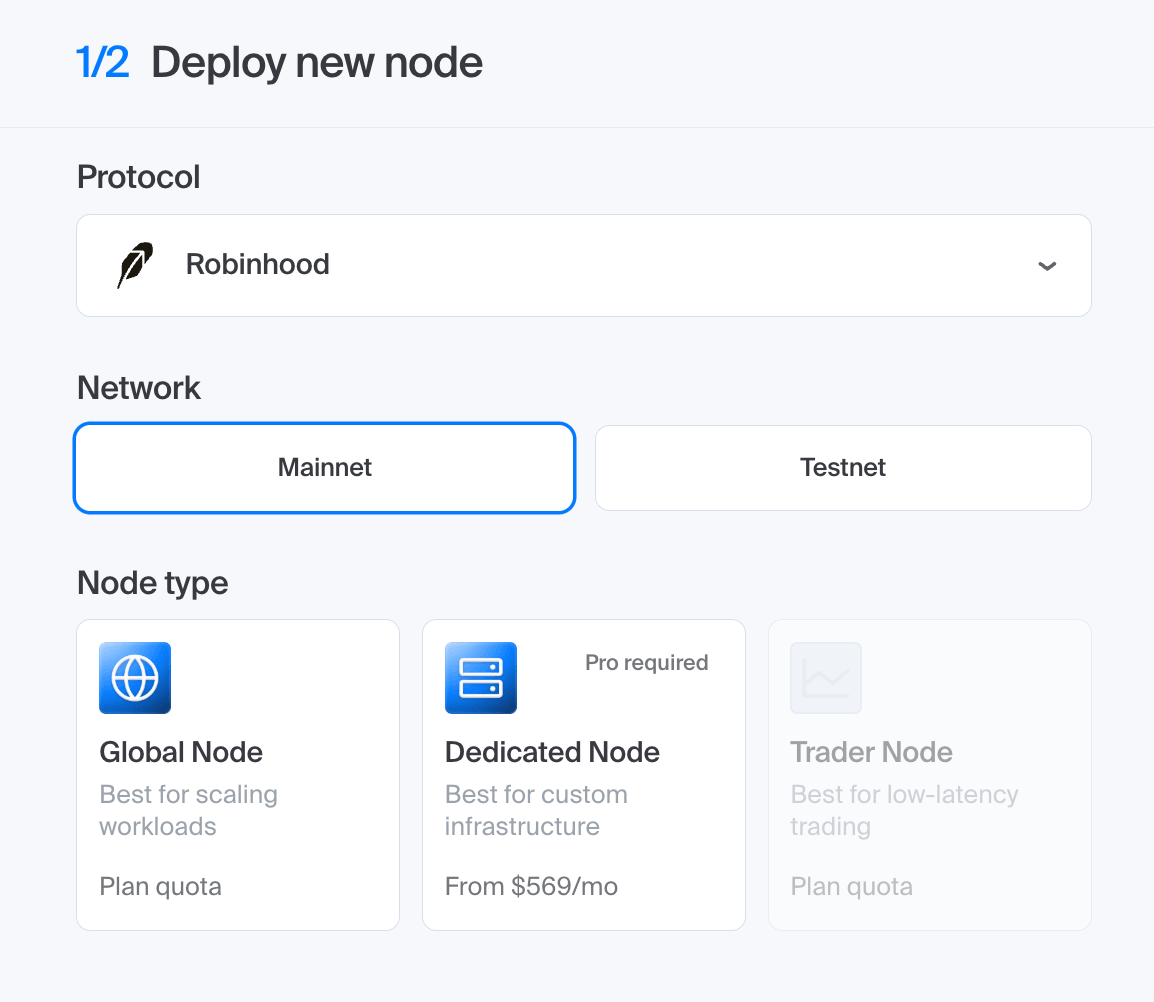
ROBINHOOD50at checkout for 50% off Growth, first 3 months. - Deploy. In the console: Add node → Robinhood Chain → pick Mainnet or Testnet → pick Global Node (shared, geo-balanced, deploys instantly). For Dedicated Nodes (isolated compute, from $0.50/hour), contact the Chainstack team — Dedicated deployment isn’t self-serve through the console.
- Swap. Copy the HTTPS and WebSocket endpoints from Access and credentials and replace your existing RPC URLs. Keep the old provider live during transition as fallback.
- Smoke test. Verify the migration covers your actual workload:
eth_blockNumber,eth_callagainst your key contracts,eth_subscribefor pending transactions if you use it, and adebug_traceTransactionon a known transaction if you rely on trace. Chain ID is4663for mainnet,46630for testnet. - Monitor. Compare P50/P95 latency and error rates against your previous provider for the first 24–48 hours. Use Chainstack Compare for a live benchmark cross-reference.
- Cut over. Once verified, remove the old provider from the config and revoke the API keys.
Both paths land you in the same place. Pick AI-agent if the codebase is complex or the team is small. Pick manual if you want end-to-end control over the sequence.
Deploy and claim your 50% off
- Promo code:
ROBINHOOD50 - What it covers: 50% off the Growth plan — $49/month standard, $24.50/month for 3 months with the code
- Included: 20M requests/month, 250 RPS, Full and Archive nodes on Mainnet and Testnet, WebSocket,
debug_*methods - Larger workloads: Business, Enterprise, or Dedicated deployments get a sales-led custom deal — contact the Chainstack team directly
Two-click redemption:
- Claim 50% off → — sign up or log in, code applies at checkout
- Migration guide → — full AI-agent runbook and manual reference
Who’s already building on Chainstack for Robinhood Chain
The migration pattern is already visible. Teams shipping onchain financial products on Robinhood Chain have moved their RPC to Chainstack for the pricing predictability, trace availability, and 99.99% SLA — 1inch, Trust Wallet, and Zerion among them. If the teams building a leading DEX aggregator, one of the largest mobile wallets, and a top portfolio product are already on the same infrastructure, the pattern is worth checking.
FAQs
No. Chainstack endpoints are drop-in replacements for standard Ethereum JSON-RPC over HTTPS and WebSocket. Deploy the new node, verify it responds to your workload, swap the URL, and remove the old one after monitoring for 24–48 hours. Both providers can run in parallel during the transition.
Yes — the promo applies to teams expanding to Robinhood Chain as well as teams migrating their RPC to Chainstack. Apply ROBINHOOD50 when adding Robinhood Chain nodes to your existing account.
Your plan reverts to standard Growth pricing ($49/month) when the promo period expires. No auto-upgrade to a higher tier.
Yes. Chainstack Self-Hosted supports Robinhood Chain Mainnet and Testnet on your own infrastructure — same one-click deployment flow, snapshot bootstrap, self-healing, and observability stack. See the Self-Hosted v2.8.2 release notes for details.
All standard Ethereum tooling: ethers.js, viem, web3.py, Hardhat, Foundry, Remix, MetaMask. Set the chain ID to 4663 (mainnet) or 46630 (testnet) and point at your Chainstack endpoint. See Robinhood Chain tooling for the full setup.
Those aren’t available on Robinhood Chain specifically (Warp is for high-throughput transaction submission on chains like BNB Smart Chain). For Robinhood Chain, the equivalent throughput features are the Unlimited Node add-on (fixed RPS ceiling, no per-request billing) and Dedicated Nodes (isolated compute for consistent latency).
compare.chainstack.com publishes live P50/P95/P99 latency, uptime, and regional coverage across all major Robinhood Chain RPC providers. Updated live.
Additional resources
- What is Robinhood Chain? A full builder’s guide — architecture, infrastructure, performance, use cases
- Robinhood Chain vs Solana: two paths to tokenized RWAs — comparison editorial
- Chainstack introduces Robinhood Chain support — launch announcement with full coverage details
- Migrate to Chainstack with AI — AI-agent migration runbook
- Chainstack MCP server — full tool reference
- Chainstack Compare — Robinhood Chain — live RPC provider benchmarks
- Chainstack pricing — plans, RU model, calculator
- Robinhood Chain testnet faucet — free testnet funds for development