AI-ready infrastructure
 Refer and earn


 Ethereum
 Hyperliquid
 Solana
 Arbitrum
 BNB Smart Chain
 Base
Base Polygon
 TRON
TRON Sui
Sui Robinhood


Robinhood Chain vs Solana: two paths to tokenized RWAs?

Two chains just landed the same bet from opposite directions. Robinhood Chain went live on mainnet July 1, 2026, an L2 for finance and tokenized real world assets built on Arbitrum’s Orbit stack. Solana has spent years as the default high-throughput L1 for anything that needs speed and cheap execution, HFT-style trading and payments included.
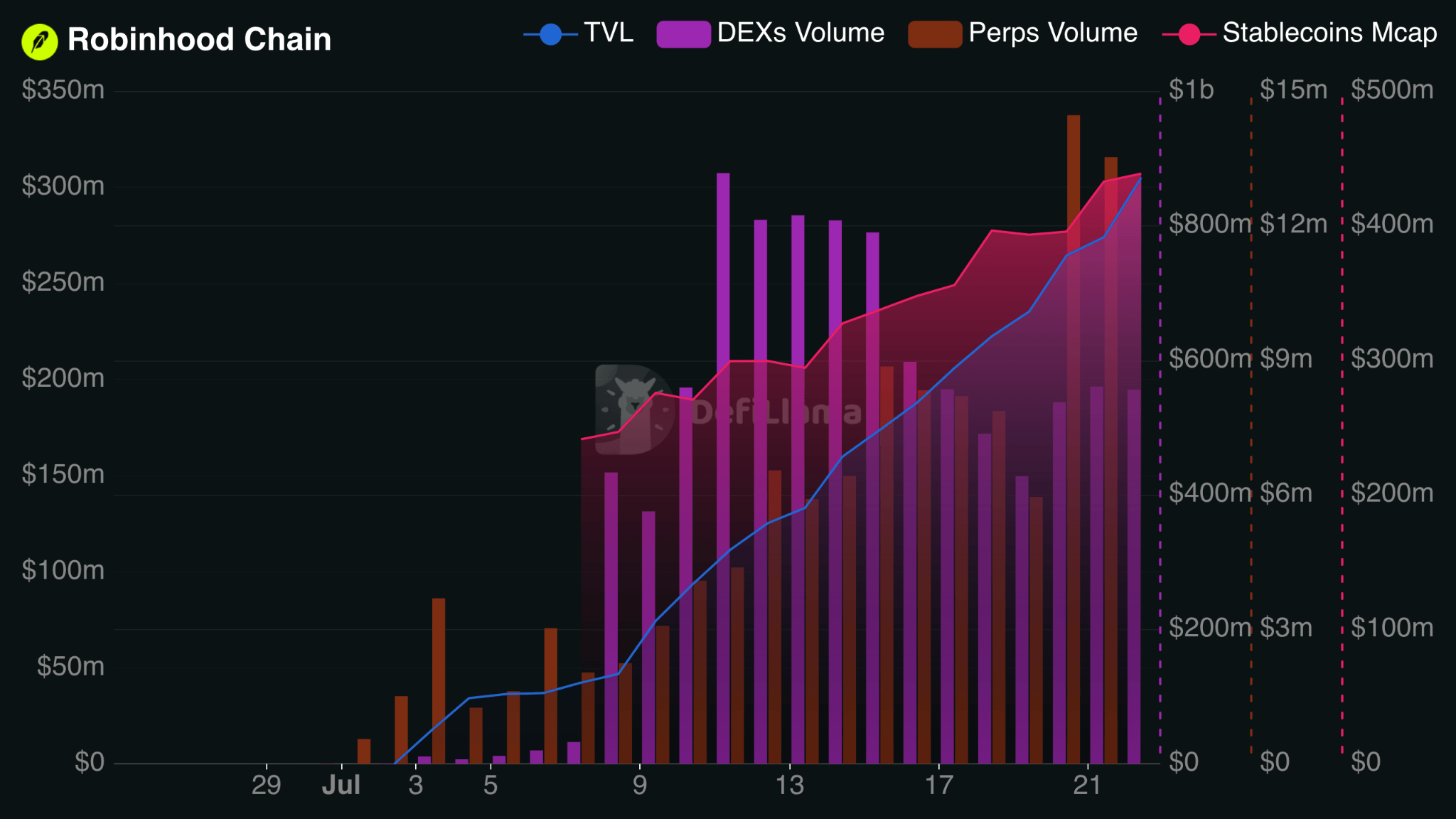
What makes the comparison worth writing is that neither chain’s early traction matched its pitch. Robinhood shipped Stock Tokens and called the chain “purpose-built for tokenized RWAs.” Within three weeks, memecoins like CASHCAT and a flood of tokens launched through the NOXA launchpad were driving most of the activity, RWA value on the chain sat at roughly $12.66 million while the chain’s total value locked crossed $430 million and cumulative DEX volume hit $9 billion, over 80% of it memecoin trading. Solana’s own history rhymes with this — its reputation as serious payments infrastructure was built on the back of BONK, WIF, and pump.fun cycles long before institutional RWA issuers showed up.
So the real question isn’t just architecture. It’s whether tokenized RWAs actually need a dedicated, compliance-minded chain to succeed, or whether they just need whatever chain already has the users, the liquidity, and yes, the memes to get there first.
What is Robinhood Chain
Robinhood Chain is an L2 for finance and tokenized real world assets, built on Arbitrum’s Orbit stack and running the same Nitro client that powers Arbitrum One. It settles to Ethereum for security while executing transactions on its own network for higher throughput and lower fees — standard rollup architecture, full EVM compatibility, and no changes needed for existing Solidity contracts or tooling. The chain moved from public testnet in February 2026 to mainnet on July 1, 2026.
📖 Learn more: What is Robinhood Chain? A full builder’s guide (2026)
Stock Tokens as the flagship RWA
Robinhood markets the chain as “AI-native” and purpose-built for real-world assets, anchored by Stock Tokens like NVDA, AAPL, and GOOG. Technically, each Stock Token is a standard ERC-20 contract with 18 decimals, issued as a tokenized debt security by Robinhood Assets (Jersey) Limited rather than a wrapped or synthetic equity, so holders get economic exposure to the underlying stock without legal or beneficial rights against the issuer. Because they’re plain ERC-20s, they work out of the box with existing wallets, libraries, and DeFi contracts — no custom SDK required.
Corporate actions are handled onchain through a multiplier rather than by rebasing balances. Dividends and stock splits adjust the shares-per-token ratio via a uiMultiplier() function defined by ERC-8056 (the Scaled UI Amount Extension), while a holder’s raw balance stays static until redemption. Swaps aren’t affected by this, and the oracle folds the multiplier into the reported price automatically.
Oracle and pricing infrastructure
Chainlink is the default oracle and cross-chain layer, with CCIP, Data Streams, and Data Feeds live from day one. Every Stock Token has its own onchain Chainlink price feed, so contracts can read live prices directly rather than relying on an off-chain data source or a bridge from another network.
What is Solana
Solana is a monolithic Layer 1, not an L2 settling to anything else. It runs its own consensus (Proof of History combined with Proof of Stake) and its own execution environment, the Solana Virtual Machine (SVM), which parallelizes transaction processing across independent state instead of executing sequentially like the EVM. That architecture is what gives Solana its throughput and sub-second block times, but it also means SVM programs are written in Rust or C, not Solidity — so nothing about Robinhood Chain’s EVM tooling transfers over.
Built for throughput, not a specific asset class
Solana wasn’t designed around any single financial product. It was built as general-purpose infrastructure for high-volume, low-fee execution, and its early narrative leaned heavily on payments and HFT-style trading rather than tokenized securities. That generality is the tradeoff against Robinhood Chain’s purpose-built approach. Solana can host anything from DeFi to gaming to RWAs, but nothing about the protocol layer is opinionated about how any of it should work.
There’s no equivalent to Stock Tokens or a native RWA standard baked into the protocol. Real-world assets on Solana exist as SPL tokens, the network’s general-purpose token standard, issued and managed by third parties like Ondo, Franklin Templeton (BENJI), or Backed. Each issuer handles its own compliance, custody, and price feed setup independently, using the same SPL tooling any fungible token would use — rather than working within a chain-defined framework the way Stock Tokens do on Robinhood Chain.
Architecture head to head
Robinhood Chain has no validator set of its own securing consensus. It inherits Ethereum’s security model by posting transaction data and state roots back to L1 as an Arbitrum Orbit rollup, so finality depends on the underlying rollup’s dispute or validity mechanism settling on Ethereum. Its security ceiling is Ethereum’s, not its own. Solana runs an independent validator set with its own Proof of History and Proof of Stake consensus, so its security is self-contained but also self-limited — it doesn’t borrow trust from any other chain, and its guarantees rise or fall with its own validator economics and client diversity.
- Robinhood Chain inherits Ethereum’s security through rollup settlement, which means weaker sovereignty but a stronger base layer backing it.
- Solana’s security is native and independent, which means stronger sovereignty but full exposure to its own validator set’s failure modes.
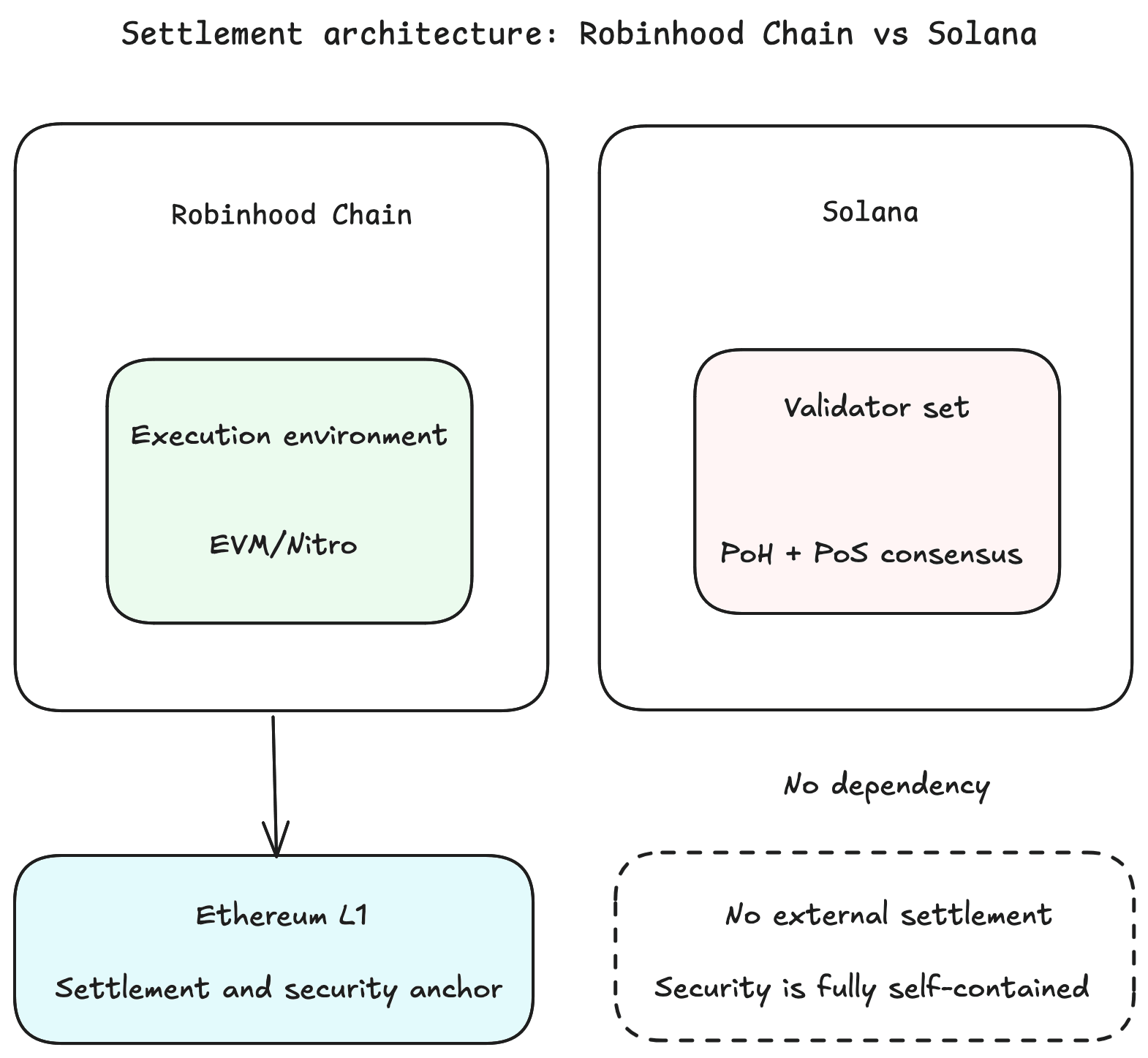
Execution environment
Robinhood Chain runs the Nitro client, which gives it full EVM compatibility. Solidity contracts, ethers.js, Foundry, and Hardhat all work without modification, and debug_* methods behave the same way they do on any Nitro-based chain. Solana’s SVM works differently at the architecture level. It parallelizes execution across accounts with non-overlapping state instead of processing transactions sequentially, which is where its throughput advantage comes from — but it also requires an entirely separate dev stack (Rust, Anchor, a different account and rent model), with zero code portability from Ethereum.
- Robinhood Chain uses EVM tooling and sequential execution, which lowers the switching cost for existing Ethereum teams.
- Solana uses SVM tooling with parallel execution by design, which raises the learning curve but also the throughput ceiling.
Trust assumptions
Robinhood Chain launched with a curated infrastructure set — Chainlink for oracles and interop, Alchemy and BitGo among the named partners — which concentrates a lot of the chain’s critical dependencies around a known group of vendors. Solana’s ecosystem is more permissionless by comparison. Oracle providers, RPC infrastructure, and custody solutions are fragmented across many competing providers rather than a small named set, trading vendor concentration risk for less standardization.
RWA-specific design choices
Robinhood Chain treats DeFi composability as a launch feature rather than something added later. Stock Tokens are usable as collateral from day one, with liquidity and lending partners like Uniswap, Pleiades, Morpho, and Lighter integrated at mainnet launch. RWA issuance and DeFi integration were built to ship together, rather than an asset getting tokenized first and composability arriving whenever a third party gets around to it.
Solana takes the opposite path, mostly by necessity. Since there’s no protocol-level RWA standard, tokenized funds and treasuries get issued through existing infrastructure — SPL tokens, third-party compliance layers, existing DEX and lending integrations — that already work for any other asset on the chain. It’s a mature approach precisely because it isn’t new. Issuers are reusing infrastructure that’s already survived multiple market cycles, but none of it was purpose-built for RWAs specifically.
Infrastructure and node access
Robinhood Chain node coverage
Robinhood Chain on Chainstack is available as Global Nodes in both Full and Archive mode, on Mainnet and Testnet, with Debug & Trace APIs enabled across all four combinations. That’s a fairly complete access surface for a chain three weeks old — full nodes for current state and transaction submission, archive nodes for historical queries, and debug tracing on both networks rather than mainnet-only. See the Chainstack Robinhood Chain announcement for the full support scope, or jump directly to the Robinhood Chain product page.
Solana node coverage
Solana’s setup on Chainstack looks different because the workload it’s built for looks different. Mainnet is served through Global Nodes in Archive mode plus regional Cloud nodes in London and New York, Devnet through Global and Ashburn-based Full nodes. Beyond standard RPC, Solana access includes Warp transactions for accelerated submission and the Yellowstone gRPC Geyser plugin, which streams account and transaction updates directly rather than requiring clients to poll. See the Solana product page for the full stack.
What the tooling is actually built for
The practical difference comes down to what each chain’s tooling optimizes for. Robinhood Chain gives builders standard EVM debug methods — debug_traceTransaction and debug_traceBlockByNumber among them — available from day one because the Nitro client supports them natively. That’s useful for anything that needs to replay a Stock Token transfer or step through a failed contract call. Solana’s tooling optimizes for a different problem: keeping up with a chain that produces state changes far faster than typical block-based polling can track, which is what Geyser’s gRPC streaming is actually for.
Developer experience
Robinhood Chain’s developer experience is largely inherited rather than built from scratch. Because it runs on Arbitrum Orbit and Nitro, existing Ethereum tooling — Solidity, ethers.js, viem, Foundry, Hardhat — works without modification, so deploying to it feels closer to targeting a new network than learning a new stack. Solana asks for more upfront: programs are written in Rust, typically with Anchor, and its account model, rent mechanics, and parallel execution rules don’t map onto anything from the EVM world. That cost isn’t wasted though — it buys into tooling shaped by years of high-frequency trading and payments workloads, where infrastructure like Geyser streaming and Warp transactions is more battle-tested than anything a three-week-old chain can offer.
So the real tradeoff isn’t which stack is objectively better — it’s what an RWA issuer needs most. Familiar tooling and a fast path to shipping favor Robinhood Chain, especially for teams already building on Ethereum or its L2s. Tooling built and stress-tested for raw throughput favors Solana, particularly where performance at scale matters more than onboarding speed.
Which path wins for RWAs
There’s no clean verdict here, and that’s arguably the more honest takeaway than picking a winner. Robinhood Chain isn’t competing on raw technical merit — it’s competing on distribution and trust. A brokerage with tens of millions of retail users already holding real capital, already KYC’d, already comfortable with the idea of owning equities, is a different kind of unlock than another performant L2 hoping developers show up. Solana’s advantage runs in the opposite direction: it already has the liquidity, the DeFi composability, and years of infrastructure maturity that Robinhood Chain is still building out in real time.
- Robinhood Chain optimizes for trust and product market fit, using brokerage distribution as its wedge into RWAs.
- Solana optimizes for scale and existing liquidity, treating RWAs as one more asset class on top of infrastructure that already works.
The more interesting question isn’t which chain is “better,” it’s which force ends up mattering more for where RWA capital actually settles. One read is that regulatory comfort becomes the deciding factor: institutions and issuers gravitate toward a chain with a named, accountable operator and a curated partner set, since that looks more like the compliance posture regulators already understand. The other read is that capital is largely indifferent to who’s operating the rails, and simply flows toward whichever chain offers the deepest liquidity and the most composable DeFi ecosystem — in which case Solana’s head start matters more than Robinhood’s brand.
- If regulatory comfort drives adoption, Robinhood Chain’s curated, accountable structure becomes the advantage.
- If capital efficiency drives adoption, Solana’s existing liquidity and composability becomes the advantage.
It’s also worth resisting the urge to treat this as binary. Nothing structurally prevents both models from working simultaneously for different segments — Robinhood Chain absorbing retail-adjacent, brokerage-native RWA demand, Solana continuing to host the more DeFi-native, permissionless side of tokenization.
Comparison table
| Dimension | Robinhood Chain | Solana |
|---|---|---|
| Architecture | Ethereum L2, Arbitrum Orbit/Nitro | Monolithic L1, own consensus (PoH + PoS) |
| Settlement and security | Inherits Ethereum’s security via rollup settlement | Native, independent validator set |
| Execution environment | EVM, Solidity, sequential execution | SVM, Rust/Anchor, parallelized execution |
| RWA design | Native, Stock Tokens purpose-built with DeFi collateral support day one | Bolted on, SPL tokens issued by third parties (Ondo, BENJI, etc.) |
| Oracle/interop | Chainlink native (CCIP, Data Streams, Data Feeds) | Fragmented, multiple competing providers |
| Trust model | Curated partner set (Chainlink, BitGo) | Permissionless, more fragmented |
| Developer tooling | Standard Ethereum tooling, low switching cost | Rust/SVM, steeper learning curve |
| Chainstack node access | Global Nodes, Full and Archive, Mainnet and Testnet, Debug & Trace on all four | Global and Cloud Nodes, Warp transactions, Yellowstone gRPC Geyser |
| Distribution advantage | Tens of millions of Robinhood brokerage users | Existing DeFi liquidity and ecosystem maturity |
| Current traction reality | Memecoin volume outweighs RWA activity early on | RWA activity mature but still a minority of total volume |
The chains aren’t necessarily fighting for the same capital — they might just be building for different definitions of who an RWA holder actually is.
Conclusion
The question worth sitting with isn’t really which chain wins. It’s whether RWA tokenization needs its own category of infrastructure at all, or whether it just becomes another workload that general-purpose chains absorb once they already have the users and liquidity. Robinhood Chain is betting on the former. Solana’s traction so far suggests the latter might be closer to the truth — and the memecoin numbers on both chains right now aren’t exactly proving either side wrong.
Chainstack’s position is that builders shouldn’t have to bet on that question in advance. Both networks are production-ready on Chainstack today: Robinhood Chain with Global Nodes, Full and Archive modes, and debug and trace on Mainnet and Testnet from day one; Solana with Global and Cloud Nodes, Warp transactions, and Yellowstone gRPC Geyser streaming. Whichever thesis plays out — dedicated RWA rails or absorption into existing chains — the RPC infrastructure to prototype, ship, and scale is available now, without waiting for the market to pick a winner.
The first real evidence either way arrives soon. Robinhood’s Q2 earnings on July 29 should offer the first genuine look at Stock Token adoption, separate from chain-level vanity metrics like TVL or DEX volume — and it’s worth watching that number specifically over whatever headline figure gets reported alongside it. In the meantime, deploy a Robinhood Chain endpoint or a Solana endpoint on Chainstack and start building against the reality of both chains, not the pitch.
🚀 Start building on Robinhood Chain with 50% off the Growth plan for 3 months — use
ROBINHOOD50at signup.
FAQ
Neither has proven the RWA thesis yet. Robinhood Chain is purpose-built for tokenized real-world assets with native Stock Tokens, Chainlink oracles, and DeFi partners integrated at launch — but early activity is dominated by memecoins, with RWA value around $12.66 million against $430 million total value locked. Solana has years of mature DeFi infrastructure and hosts institutional RWA issuers like Ondo and Franklin Templeton, but treats RWAs as one asset class among many rather than a first-class design goal. The winner will be the chain that converts speculative liquidity into persistent RWA adoption faster — a question July 29’s Robinhood Q2 earnings will start to answer.
Yes. Robinhood Chain runs the Nitro client under the Arbitrum Orbit framework, which gives it full EVM compatibility. Solidity contracts, ethers.js, viem, Foundry, Hardhat, and MetaMask all work without modification — teams can point existing tooling at a Robinhood Chain RPC endpoint and deploy the same way they would on Arbitrum One. Standard debug_* methods for transaction replay and call tracing are also available natively.
This isn’t unique to Robinhood Chain. Solana was built as high-throughput infrastructure for payments and HFT-style trading, and became memecoin capital of crypto via BONK, WIF, and pump.fun long before institutional RWA issuers arrived. Ethereum went through ICOs, NFTs, and DeFi-summer cycles before institutional capital came in. Speculative liquidity often bootstraps chains before serious workloads arrive — meme-dominance early doesn’t disprove the chain’s long-term positioning, but it does mean the “purpose-built for RWAs” pitch is still unproven in production.
Yes, but not through a native standard. Real-world assets on Solana exist as SPL tokens — the network’s general-purpose token standard — issued by third-party providers like Ondo (USDY), Franklin Templeton (BENJI), Backed, and VanEck. Each issuer handles its own compliance, custody, and oracle setup independently, using the same SPL tooling any fungible token would use. On Robinhood Chain, Stock Tokens are a first-class product with Chainlink price feeds built in per token — a more opinionated framework, but a narrower one.
For Robinhood Chain: Global Nodes on Mainnet and Testnet, in Full and Archive modes, with debug and trace APIs enabled across all four combinations. For Solana: Global and regional Cloud Nodes on Mainnet and Devnet, Warp transactions for accelerated submission, and the Yellowstone gRPC Geyser plugin for real-time account and transaction streaming. Both chains are production-ready today — RWA builders can prototype on either without waiting for feature parity.
Robinhood’s Q2 2026 earnings release is scheduled for after market close on July 29, 2026, with a call at 2:00 PM PT / 5:00 PM ET. That report should be the first genuine signal of Stock Token adoption — separate from chain-level metrics like TVL or DEX volume, which have been dominated by memecoin activity so far. Watch specifically for Stock Token holder counts, dollar value of Stock Tokens issued, and any commentary on cross-border retail uptake in the 120+ jurisdictions where Stock Tokens are available.
Additional resources