AI-ready infrastructure
 Refer and earn


 Ethereum
 Hyperliquid
 Solana
 Arbitrum
 BNB Smart Chain
 Base
Base Polygon
 TRON
TRON Sui
Sui Robinhood


Top 7 Solana RPC providers for DeFi in 2026

Solana is a high-throughput L1 blockchain in production, with real-world throughput averaging over 1,400 transactions per second and spiking past 7,600 at peak load, alongside sub-second finality and sub-cent fees. By the end of 2025, annual spot DEX volume on Solana reached $1.95 trillion, and stablecoin supply on the chain sits around $15.5 billion — most of it routed through the same handful of AMM programs that lean hardest on RPC infrastructure.
DeFi on Solana is unforgiving of RPC latency. Protocols like Jupiter, Orca, Raydium, Drift, and Kamino Finance compete for the same liquidity in the same slot. A slow endpoint does not just add delay — it decides whether your transaction lands in the current slot, whether your liquidation bot fires before the market moves, and whether your aggregator quotes reflect live pool state or data that aged out two slots ago.
This guide compares the top seven Solana RPC providers and partners for DeFi workloads in 2026 — Chainstack, Uniblock, OnFinality, Helius, Triton One, Quicknode, and Alchemy — across dedicated throughput, Geyser streaming, archive access, enterprise compliance, cost predictability, and real-world latency — scored for what DeFi demands.
💡 Already using Chainstack? Jump straight to the Solana tooling docs or deploy your endpoint in minutes.
DeFi on Solana: RPC requirements
Solana’s architecture makes DeFi uniquely demanding on RPC infrastructure. Every transaction must reference a recent blockhash that expires after roughly 150 slots (~60 seconds), and most DeFi operations chain several sequential calls within milliseconds — fetch blockhash, build, simulate, serialize, submit. During a memecoin launch or a liquidation cascade, a single protocol can burst to thousands of concurrent RPC calls per second.
Latency requirements
Solana DeFi is sub-50ms territory. Arbitrage bots, liquidation monitors, and AMM routing engines operate where the difference between 20ms and 80ms is the difference between a profitable trade and a missed one. Reading pool state tolerates moderate latency; transaction submission and event streaming do not, and both benefit from co-location with Solana validator clusters.
The p99 metric matters more than average latency here: a provider averaging 30ms but spiking to 800ms under load causes slippage and failed transactions at exactly the moments when volume — and risk — are highest. Consistent p99 under burst load is the primary differentiator for production DeFi — a provider quoting a fast average can still stall exactly when a memecoin launch or liquidation cascade sends volume through the roof.
Throughput requirements
DeFi protocols generate bursty traffic during volatility. A single aggregator refreshing routes across 50+ AMM pools can fire hundreds of getProgramAccounts calls in seconds. Shared endpoints are rate-limited well below production-DeFi scale, while production DeFi needs 250–1,000+ RPS sustained with headroom for spikes, and rate limiting on a shared endpoint is the single most common cause of failed transactions and stale quotes.
Key RPC methods for Solana DeFi
| Method | Why it matters for DeFi | Watch for |
|---|---|---|
getLatestBlockhash | Required before every transaction — blockhash expires in ~150 slots | Stale responses cause tx failure |
sendTransaction | Lands swaps, liquidity operations, and liquidations | Staked connections, priority fee support |
simulateTransaction | Previews DeFi operations before committing capital | Timeouts under load cause missed entries |
getAccountInfo | Reads pool state, vault accounts, and user positions | Caching can serve stale state |
getProgramAccounts | Fetches all accounts for an AMM program — the heaviest Solana call | Rate-limited or disabled on many shared endpoints |
getTokenAccountsByOwner | Portfolio tracking, position display, yield aggregation | Response size grows with token diversity |
getSlot | Slot-aware timing for time-critical operations | Slot lag reveals a behind-head node |
Beyond JSON-RPC, real-time DeFi increasingly requires Yellowstone gRPC Geyser streaming. gRPC subscriptions push slot updates, account changes, and transaction confirmations in real time, with no polling interval. For liquidation bots and price-feed aggregators, this is the difference between reactive polling (100ms+) and proactive push events (single-digit milliseconds).
⚠️ Archive node note: Historical state queries — position P&L at a past slot, pool reserves at a specific block — require archive access. Standard event-log queries like
getSignaturesForAddressover a block range do not.
Infrastructure requirements
For DeFi production, the relevant infrastructure checklist is:
- Dedicated vs. shared nodes — shared endpoints introduce noisy-neighbor effects during high-traffic events; protocols exceeding ~100 RPS sustained should evaluate Dedicated Nodes for isolated throughput.
- Geographic proximity — Solana validator clusters concentrate in the EU, US East, and JP; co-locate endpoints with your target region to minimize hops.
- WebSocket subscriptions — slot and account subscriptions replace polling for real-time state tracking.
- gRPC / Geyser streaming — for sub-10ms event latency, the Yellowstone gRPC Geyser plugin is the standard.
- Failover configuration — a single endpoint failure during peak activity can be costly; multi-region or multi-provider failover is best practice.
Provider comparison for Solana DeFi
The table below summarizes public positioning as of August 2026.
| Provider | Pricing model | Free tier | Dedicated nodes | Geyser/gRPC | Why it matters for DeFi |
|---|---|---|---|---|---|
| Chainstack | RU-based (flat 1 RU/call) | 3M RU / 25 RPS, no card | Yes (paid plans) | Yes (Yellowstone, from $49/mo) | Trader Nodes + bloXroute Warp, flat billing, archive, SOC 2 Type II and ISO 27001, Unlimited Node add-on |
| Uniblock | Per-request (pooled) | Yes | No (aggregation layer) | Via underlying providers | Unified RPC plus token/NFT/market-data APIs across 55+ providers, pooled rate-limit headroom |
| OnFinality | Credit-based | Yes (shared API) | Yes | WebSocket RPC (no native Yellowstone) | Managed Solana nodes, archive RPC, and SubQuery indexing, up to 500 RPS |
| Helius | Credit-based | 1M credits / 10 RPS | Yes (from $2,900/mo) | Yes (LaserStream gRPC) | Solana-native, staked send connections, enhanced WebSockets |
| Triton One | Pay-as-you-go | Public nodes (no SLA) | Yes | Yes (Yellowstone inventor) | Genesis archive via ClickHouse, 20+ global bare-metal PoPs |
| Alchemy | CU-based | 30M CU/month | No standard dedicated | Yes (gRPC streaming) | Fast heavy calls, 48-hour block replay |
| Quicknode | Credit-based | 1-month free trial | Yes (dedicated clusters) | Yes (Yellowstone via Hybrid Dedicated) | Multi-chain incumbent, SOC 2 Type II + ISO 27001, 99.99% SLA |
⚠️ Note: Alchemy does not offer standard dedicated nodes for Solana — teams needing isolated compute for high-throughput DeFi should evaluate Chainstack, Helius, or Triton One dedicated plans.
Chainstack
Chainstack is a multi-chain RPC provider whose Global Nodes, Dedicated Nodes, and Solana Trader Nodes target the latency-critical AMM and liquidation workloads Solana DeFi demands — the Trader Node routes through bloXroute’s Warp relay for up to 99% landing on contested transactions, with sendTransaction billed at $0.15 per call. Global Nodes cover development and moderate-volume production, while Dedicated Nodes remove shared-resource contention at sustained load. See the reliable RPC infrastructure for DeFi page for the full product stack.
The Yellowstone gRPC Geyser plugin streams real-time account updates, slot notifications, and transaction confirmations from $49/month, cutting event detection for AMM liquidity and liquidation monitoring from polling intervals (100ms+) to sub-10ms push. The Unlimited Node add-on eliminates per-request billing at flat RPS tiers — 25 RPS ($149/month) through 500 RPS ($3,199/month) — for unpredictable burst traffic, and Solana Self-Hosted support (Agave client, Mainnet and Devnet) is on the roadmap for teams that need nodes inside their own environment, per the supported clients and protocols docs.
Archive access from the Growth plan ($49/month) covers the historical state queries backtesting, analytics, and yield-optimization pipelines require, with archive reads billed at 2 RU versus 1 RU for full-node calls. SOC 2 Type II and ISO 27001 certification plus a contractual 99.99%+ uptime SLA make Chainstack the institutional DeFi choice, and flat 1 RU billing means a getProgramAccounts-heavy aggregator costs the same per call as a lightweight balance read — the invoice on this Solana RPC infrastructure stays predictable while method-weighted competitors make the sticker price uninformative for the exact call mix DeFi generates.
Pricing: Developer plan free (3M RU, 25 RPS). Growth $49/month (20M RU, 250 RPS, $15/1M RU overage). Pro $199/month (80M RU, 400 RPS). Business $499/month (200M RU, 600 RPS). Enterprise from $990/month (400M+ RU).
Limitations: The free Developer plan (25 RPS) is insufficient for production DeFi load testing. The Trader Node and Yellowstone add-on are priced separately, so a full DeFi stack means at least the Growth plan plus both add-ons. There is no zero-cost path to gRPC streaming.
Fit by workload:
- DeFi AMM / aggregator: Excellent — this is what Trader Nodes and Yellowstone gRPC were built for.
- DeFi liquidation / arb: Excellent — Geyser pushes state changes out before a poll-based competitor even asks, and the Warp relay backs that up with a high landing rate.
- Institutional DeFi (compliance): Excellent — SOC 2 Type II, ISO 27001, and a contractual SLA, with Dedicated Nodes available if isolation matters.
Uniblock
Uniblock is a managed infrastructure layer routing across 55+ underlying RPC providers — Chainstack among them — through one interface, with automatic failover and request hedging. Its three tiers — Unified JSON-RPC, Unified APIs (token, NFT, market data, webhooks), and Direct Provider APIs — let a Solana DeFi team pull raw RPC and higher-level data from one integration. For dashboards, wallet backends, and portfolio aggregators, the Unified APIs cut the sequential getTokenAccountsByOwner and getProgramAccounts calls a frontend makes, and pooling 55+ providers adds rate-limit headroom during spikes. Pricing is per-request with a free tier, plus an MCP server and agent skills.
Limitations: As an aggregation layer, Uniblock runs no dedicated Solana nodes of its own and exposes no native Yellowstone gRPC stream — sub-10ms Geyser streaming for liquidation bots still routes best through a direct node provider, and latency depends on the underlying provider a request lands on.
Fit by workload:
- DeFi AMM / aggregator: Strong — the Unified APIs cut call volume for quotes and portfolio reads, with pooled rate-limit headroom across 55+ providers.
- DeFi liquidation / arb: Moderate — routing and failover help, but there’s no native Geyser stream for sub-slot events.
- Institutional DeFi (compliance): Good — one vendor abstracting many providers, though attestation ultimately traces back to whichever operator serves the request.
OnFinality
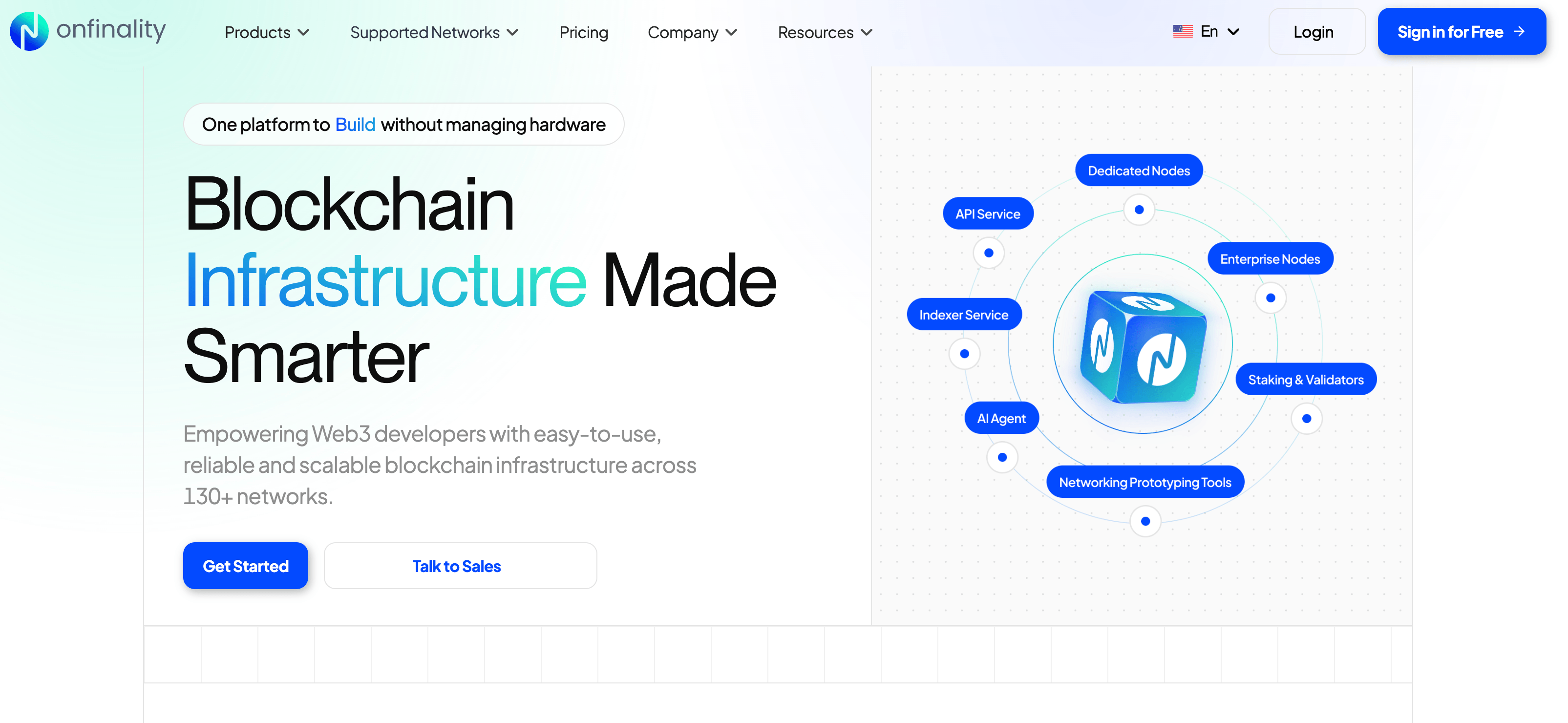
OnFinality is a multi-chain node service across 100+ networks that routes traffic across several underlying providers, Chainstack among them. For Solana it offers a managed JSON-RPC API over HTTPS and WebSocket, dedicated nodes, archive RPC for historical blocks and signatures, and up to 500 RPS on authenticated plans across Mainnet and Devnet. Its differentiator for DeFi is data infrastructure: managed SubQuery indexer hosting lets a protocol index historical liquidity events, backfill position history, or power an analytics dashboard under the same vendor as its RPC, while WebSocket RPC pushes live account, log, slot, and block updates.
Limitations: OnFinality documents no native Yellowstone gRPC Geyser stream for Solana, so the lowest-latency push path for liquidation and arbitrage still favors a Geyser-native provider. Its deepest edge (Substrate/parachain coverage, SubQuery) suits indexing and multi-chain teams more than pure latency-critical DeFi.
Fit by workload:
- DeFi AMM / aggregator: Strong — managed nodes scale to 500 RPS, and WebSocket updates cover most aggregator read paths.
- DeFi liquidation / arb: Moderate — WebSocket streaming is solid, but no documented native Geyser gRPC exists for sub-slot latency.
- Institutional DeFi (compliance): Good — dedicated nodes and archive RPC, and stronger still when the workload also needs managed indexing.
Helius
Helius is the most widely adopted Solana-native RPC provider, with infrastructure built for Solana’s architecture rather than adapted from EVM tooling. Its Sender product routes sendTransaction calls across multiple high-speed pathways, and staked connections improve landing rates for swaps and liquidations — Helius publishes a 99.99% uptime figure across its plans.
LaserStream is Helius’s gRPC streaming product, available on the Business plan ($499/month). It delivers real-time account and transaction events comparable to Yellowstone in architecture, with enhanced WebSockets that hold persistent connections through slot transitions — a real alternative to Yellowstone for liquidation bots and price-feed aggregators. Dedicated nodes start at $2,900/month with gRPC streaming and bundle simulation. Plans run from free (1M credits, 10 RPS) through Developer $49/month (10M credits, 50 RPS), Business $499/month (100M credits, 200 RPS, LaserStream), and Professional $999/month (200M credits, 500 RPS), with custom Enterprise for 1B+ credits.
Limitations: LaserStream and dedicated nodes require high-tier plans ($499–$2,900/month). The free tier is the most restrictive of any major provider at 10 RPS — less useful for integration testing. Helius does not publish ISO 27001 certification, a gap for institutional buyers that require it.
Fit by workload:
- DeFi AMM / aggregator: Excellent — native Solana infrastructure, staked connections, and LaserStream gRPC in one stack.
- DeFi liquidation / arb: Excellent — staked send pushes landing rates up, and LaserStream delivers events sub-slot.
- Institutional DeFi (compliance): Strong — SOC 2 certified with 24/7 support, though entry cost is high and ISO 27001 isn’t published.
Triton One
Triton One created the Yellowstone gRPC Geyser plugin — the real-time streaming layer now offered by every major Solana RPC provider. Founded by early Solana ecosystem builders, Triton One runs bare-metal deployment across 20+ global PoPs, giving it a latency edge over virtualized alternatives.
For DeFi analytics and backtesting, Triton One’s ClickHouse-based historical offering covering Solana from the genesis block is the deepest in this comparison — the company cites up to 20x faster getProgramAccounts queries, directly relevant for tracking historical liquidity events or backtesting across market regimes. Real-time gRPC streaming is a core offering, not an add-on, and dedicated nodes plus pay-as-you-go pricing give DeFi teams flexibility during scaling.
Limitations: Onboarding requires a conversation — pricing is not fully self-serve. Public shared endpoints carry no SLA. Triton One’s product presentation and documentation are less polished than Chainstack or Helius, and there is no published SOC 2 or ISO 27001 certification, which matters for institutional DeFi teams that need vendor attestation.
Fit by workload:
- DeFi AMM / aggregator: Strong — the team that built Yellowstone, running bare-metal with strong global coverage.
- DeFi liquidation / arb: Strong — genesis archive and real-time gRPC make strategy research faster.
- Institutional DeFi (compliance): Moderate — no documented SOC 2 or ISO 27001, and pricing isn’t self-serve.
Alchemy
Alchemy is a multi-chain RPC provider offering Solana support through its Supernode edge and routing infrastructure, with a permanent free tier (30M CU/month) and CU-based paid plans that scale with usage. Its Solana infrastructure claims 10x faster performance on heavy calls (getProgramAccounts) and 20x faster archival access, with gRPC streams averaging 5–15ms faster delivery than standard polling.
For DeFi data workloads, Alchemy’s enhanced account data — up to 50x more token-account data in a single call — cuts the sequential calls needed for full portfolio state, useful for aggregators and yield dashboards. A 48-hour block-replay window supports short-term historical queries without full archive infrastructure.
Limitations: Alchemy does not offer standard dedicated nodes for Solana — all access is shared infrastructure, so DeFi protocols needing guaranteed isolated throughput or contractual RPS commitments need a different provider. CU-based billing (method-weighted, ~27 CU per standard request) is difficult to budget for mixed DeFi method profiles, and there is no staked transaction relay equivalent to Chainstack Trader Nodes or Helius staked connections. At meaningful production volume, Alchemy’s per-CU pricing is one of the pricier options in this comparison — Chainstack’s current pricing page puts method-weighted competitors like Alchemy at up to a 26x multiplier on heavy calls such as getProgramAccounts versus Chainstack’s flat 1 RU, so it’s worth running your actual method mix through the interactive cost calculator before committing to volume.
Fit by workload:
- DeFi AMM / aggregator: Good — handles heavy calls fast, but there’s no dedicated isolation if traffic spikes.
- DeFi liquidation / arb: Moderate — gRPC latency competes well, though no dedicated throughput or transaction-landing product exists yet.
- Institutional DeFi (compliance): Good — SOC 2 Type II and 99.99% uptime, missing ISO 27001 and any dedicated infrastructure option.
Quicknode

Quicknode is the multi-chain RPC incumbent with mature Solana support across Mainnet, Testnet, and Devnet, and a 99.99% uptime SLA over a distributed node network. Credit-based pricing — where heavier methods like getProgramAccounts consume more credits than lightweight reads — is the primary pricing risk for teams doing frequent program-state scans, since the invoice tracks the method mix rather than a flat per-call rate.
Yellowstone gRPC is available via Quicknode’s Hybrid Dedicated gRPC Nodes product, which pairs dedicated compute with unmetered gRPC usage and built-in failover — a competitive offering for DeFi streaming architectures. SOC 2 Type II and ISO 27001 certifications make Quicknode one of two providers here with dual compliance credentials, relevant for institutional DeFi teams that require ISO 27001 specifically.
The Quicknode Marketplace adds Solana-specific tooling: real-time webhooks with reorg handling, backfill APIs, and program monitoring. For multi-chain DeFi protocols already running Ethereum or Base on Quicknode, consolidating Solana on the same platform simplifies vendor management.
Limitations: Credit-based pricing is harder to predict than RU-based billing for variable method mixes. Quicknode’s free offering is explicitly framed as a 1-month trial rather than a permanent tier, so staging needs a paid plan once it ends. Quicknode has no equivalent to Chainstack’s Trader Node product, and its gRPC offering requires a Hybrid Dedicated plan. Quicknode’s tiered credit plans look reasonable on the surface, but method-weighted billing — Chainstack’s own pricing page puts Quicknode’s multiplier on heavy calls at up to 20x versus Chainstack’s flat 1 RU — means the effective cost per call climbs fast for a getProgramAccounts-heavy DeFi workload.
Fit by workload:
- DeFi AMM / aggregator: Strong — gRPC streaming and a genuinely global footprint, though credit pricing adds variable cost at scale.
- DeFi liquidation / arb: Strong — Yellowstone support and a reliable SLA, but there’s no dedicated transaction-landing product.
- Institutional DeFi (compliance): Excellent — both SOC 2 Type II and ISO 27001, backed by a contractual SLA.
Real-world performance benchmark
Solana is tracked on the Chainstack performance dashboard, which monitors method-level latency across providers and regions in real time. For a quick top-level ranking, compare.chainstack.com is the lighter-weight view; the Grafana dashboard is the drill-down for per-method breakdown across EU, US West, and Asia-Pacific. The three metrics that matter most for DeFi are getLatestBlockhash p99 (the per-slot floor for every transaction you build), getProgramAccounts median and p99 (the cost of full state scans, where most DeFi calls concentrate), and sendTransaction confirmation latency (end-to-end slot landing under load).
⚡ Data sourced from the Chainstack performance dashboard. Figures change as infrastructure evolves — run benchmarks from your target deployment region before committing to a provider.
Getting started with DeFi on Chainstack
Deploy a production Solana endpoint in a few steps and build better with Solana on Chainstack:
- Log in to the Chainstack console (or create an account).
- Create a new project.
- Select Solana as your blockchain protocol.
- Choose network: Solana Mainnet or Devnet.
- Deploy the node.
- Open Access and credentials and copy your HTTPS and WebSocket endpoints.
For latency-critical DeFi, evaluate Dedicated Nodes or Solana Trader Nodes after the initial deploy, and add the Yellowstone gRPC Geyser plugin from the marketplace if your application needs real-time account event streaming — both are available inside the same project.
import { createSolanaRpc } from "@solana/kit";
const rpc = createSolanaRpc("YOUR_CHAINSTACK_ENDPOINT");
// Fetch a fresh blockhash before building any DeFi transaction
const { value: latestBlockhash } = await rpc.getLatestBlockhash().send();
console.log(latestBlockhash.blockhash);
📖 For the full integration guide, see the Chainstack Solana tooling documentation.
Need testnet SOL? Grab some from the Chainstack Solana faucet.
🤖 You can also access Chainstack Solana RPC directly from Claude, Cursor, Codex, Windsurf, Gemini CLI, GitHub Copilot, Antigravity, Claude.ai, or ChatGPT using Chainstack MCP. For a fuller agent stack — MCP, the Chainstack skill, llms.txt for context ingestion, and WebMCP for agentic browsers — see the Chainstack Agents page.
Conclusion
The single most important decision for Solana DeFi infrastructure in 2026 is whether your protocol can tolerate shared-endpoint rate limits and noisy-neighbor effects, or whether you need guaranteed isolated throughput. Shared RPC serves most DeFi up to ~100 RPS sustained; above that, or wherever a missed transaction has material cost, dedicated infrastructure and Geyser streaming stop being optional.
- AMM integrations and aggregators: Chainstack (Solana Trader Nodes + Yellowstone gRPC) or Helius (native Solana, LaserStream).
- Liquidation bots and arb systems: Chainstack (bloXroute Warp landing) or Helius (staked send connections).
- Institutional DeFi (compliance required): Chainstack (SOC 2 Type II and ISO 27001, contractual SLA) or Quicknode (SOC 2 Type II + ISO 27001).
- Deep historical analytics and backtesting: Triton One (genesis archive via ClickHouse) or Chainstack (archive data from $49/month).
- Development and staging: Chainstack Developer plan (3M RU, 25 RPS, free, no card) or Helius free tier (1M credits, 10 RPS).
- Multi-provider aggregation and managed indexing: Uniblock (unified RPC plus token/market-data APIs) or OnFinality (managed Solana nodes with SubQuery indexing).
Frequently asked questions
Q: What RPC latency and streaming do I need for a Solana DeFi liquidation bot?
Liquidation and arbitrage bots operate in sub-50ms territory, and p99 latency matters far more than average — a spike to 800ms during a cascade is when a missed liquidation costs the most. Poll-based reads top out around 100ms; for single-digit-millisecond reaction, use Yellowstone gRPC Geyser streaming plus a staked send path like Chainstack Trader Nodes or Helius staked connections.
Q: Which provider has the best free tier for prototyping a Solana DeFi app?
Chainstack’s Developer plan is a permanent free tier — 3M RU, 25 RPS, no credit card at signup or upgrade. Alchemy’s 30M CU/month is also permanent. Helius’s free tier is the most restrictive at 10 RPS, and Quicknode’s is explicitly a 1-month free trial rather than a standing tier, so it is not a permanent option for staging.
Q: How do I migrate a Solana DeFi backend from Quicknode or Alchemy to Chainstack?
Both are drop-in JSON-RPC and WebSocket replacements — swap the endpoint URL, then point Geyser/gRPC clients at the Yellowstone gRPC add-on. The main change is billing: Chainstack’s flat 1 RU per call replaces method-weighted credits/CU, so re-estimate cost from call volume rather than method mix. Run both endpoints in parallel behind failover during cutover.
Q: Do I need an archive node for Solana DeFi, and what does it cost?
Only for historical state — position P&L at a past slot, pool reserves at a specific block, or backtesting across old market regimes. Live pool reads and recent transaction history do not need archive. On Chainstack, archive reads bill at 2 RU each versus 1 RU for full-node calls and are available from the Growth plan ($49/month); Triton One offers the deepest coverage with a genesis archive via ClickHouse.
Q: Which Solana providers have the compliance certifications institutional DeFi requires?
Chainstack, Quicknode, and Alchemy all hold SOC 2 Type II; Chainstack and Quicknode add ISO 27001, which Alchemy does not publish. Helius is SOC 2 certified but does not publish ISO 27001, and Triton One has neither certification published — a gap for teams whose auditors require vendor attestation.
Q: Why does pricing model matter more than sticker price for Solana DeFi workloads?
DeFi call mixes lean on getProgramAccounts and other heavy methods, which method-weighted models (Quicknode credits, Alchemy CU) charge at a multiple of a standard call — so the advertised entry price understates the real bill. Chainstack bills every standard call as 1 RU regardless of method, so a month heavy in getProgramAccounts scans costs the same per call as a month of simple balance checks.
Additional resources