AI-ready infrastructure
 Refer and earn


 Ethereum
 Hyperliquid
 Solana
 Arbitrum
 BNB Smart Chain
 Base
 Polygon
 TRON
 Sui
 Robinhood


Best Tempo RPC providers for stablecoin infrastructure

Tempo RPC providers are the backbone of payment infrastructure on Tempo blockchain. As stablecoin settlement and real-time payments migrate to purpose-built chains, selecting reliable Tempo RPC providers directly impacts transaction reliability, cost predictability, and system uptime.
Quick verdict: best Tempo RPC providers in 2026
Chainstack is our top pick for production Tempo workloads, based on request-based pricing, published RPS tiers up to ~600 RPS on Business, and SOC 2 Type II and ISO 27001 certification. Chainstack publishes this page and is one of the listed providers, so see how we compared before relying on the ranking. The best fit by need:
- Best for stablecoin payments with predictable pricing and compliance: Chainstack (request-based billing, Unlimited Node add-on, SOC 2 Type II + ISO 27001).
- Best for per-response billing: Dwellir (1 credit per response, flat-rate Unlimited Nodes, trace/debug on its Tempo mainnet endpoint).
- Best for multi-provider failover: RouteMesh (an aggregation layer that routes across 15+ upstream providers, not a node operator).
- Best for high-throughput bursts: dRPC (pay-as-you-go at 100 RPS, up to 600 RPS on the Scale plan, routed across 60+ operators).
- Best for existing Alchemy users: Alchemy (HTTP, WebSocket and Debug API on Tempo mainnet; no Trace API or Webhooks).
- Best for latency-sensitive production with compliance needs: Quicknode (500+ RPS on top tiers, SOC 1/2 + ISO 27001).
The challenge: Payment systems can’t tolerate downtime. A single RPC failure during settlement can halt thousands of transactions, trigger compliance violations, or cause missed SLA targets. Traditional blockchain infrastructure wasn’t built for this—Tempo was.
This guide compares the top 6 Tempo RPC providers, evaluating performance, pricing transparency, uptime guarantees, and enterprise readiness. Whether you’re building stablecoin payment rails, high-frequency settlement systems, or regulated financial workflows, you’ll find the Tempo RPC provider that fits your requirements.
What is Tempo blockchain?
Tempo is a Layer-1 blockchain purpose-built for payment infrastructure. Unlike general-purpose chains that balance multiple use cases, Tempo optimizes specifically for financial transactions where predictable latency, fast finality, and deterministic execution are non-negotiable.
Why Tempo matters for payments:
- Sub-second finality – Transactions confirm in under 1 second, enabling real-time settlement
- Predictable gas costs – No surprise fee spikes during network congestion
- Deterministic execution – Smart contracts behave consistently under load
- Built for compliance – Architecture designed with regulated finance in mind
Tempo is being adopted for stablecoin payments, cross-border settlement infrastructure, and institutional transaction processing—environments where even minor latency or inconsistent state reads can disrupt operations. Tempo’s architecture prioritizes sustained performance under production load, making it the go-to chain for payment systems and high-frequency financial applications.
📖 Learn more about Tempo and its underlying architecture here: Tempo blockchain: Low-latency infrastructure for stablecoins
Why choosing the right Tempo RPC provider matters
Your Tempo RPC provider is not just a connection point—it’s mission-critical infrastructure for payment applications.
What reliable Tempo RPC providers deliver:
- 99.99%+ platform uptime – Multi-region failover reduces downtime risk during settlement windows
- Low-latency routing – Geographic distribution keeps response times consistent across regions
- Predictable costs – Request-based pricing with no surprise compute unit charges
- SOC 2 compliance – Security controls required for enterprise financial infrastructure
- Archive access – Historical data for auditing, compliance, and debugging
What happens with unreliable Tempo RPC:
- ❌ Payment transactions fail during critical settlement periods
- ❌ Unpredictable costs make budgeting impossible
- ❌ Regional outages halt cross-border payment flows
- ❌ Compliance violations from insufficient audit trails
- ❌ Lost revenue from downtime during high-volume periods
In this guide, we evaluate the best Tempo RPC providers across five critical dimensions: performance benchmarks, pricing models, uptime SLAs, developer experience, and security compliance. By the end, you’ll know exactly which Tempo RPC provider matches your payment infrastructure requirements.
Best Tempo RPC providers comparison
This section compares the best Tempo RPC providers by pricing, latency, uptime, and developer experience
| Rank | Provider | Best for | Free plan | Paid plans & pricing | Latency & uptime | Developer Experience |
|---|---|---|---|---|---|---|
| 1 | Chainstack | Stablecoin payments, predictable pricing, compliance | 3M requests/mo, 25 RPS | Starting from 250 RPS and scaling beyond 600 RPS on custom Enterprise plans, with an Unlimited Node add-on for unmetered requests at a flat monthly rate | Low latency global routing with 99.99%+ uptime | Docs, dashboard metrics, guides, Access rules |
| 2 | Dwellir | Per-response billing, flat-rate Unlimited Nodes | 20 responses/s, 100k responses/day | Developer $49/mo (25M responses, 100/s); Growth $299/mo (150M, 500/s); Scale $999/mo (500M, 5,000/s); Unlimited Nodes from $119/mo | 99.99% uptime SLA stated on Dwellir pages (contract terms not verified); public status page | 1 credit per response (no CU weighting), trace/debug on paid plans, HTTP + WebSocket, dedicated cluster $4,300/mo, crypto payments |
| 3 | RouteMesh | Multi-provider failover (aggregator) | No dedicated free tier | Per-request; Economy from $3/M, Performance from $6/M | No formal SLA; Replay/Lag data-quality checks instead | Aggregates 15+ providers incl. Chainstack, 1,000+ chains, auto-failover |
| 4 | dRPC | High-throughput bursts, bots and monitoring | ~210M CUs/mo (~≈10M calls), ~100 RPS | ~$6 per 1M requests (Pay-as-you-go, 100 RPS). Pro $49/mo (300 RPS), Scale $199/mo (600 RPS); Enterprise from $990/mo, unlimited RPS | Latency-aware multi-region routing; 99.96% uptime listed on paid plans, committed SLAs on Enterprise | Dashboard analytics and request metrics, unlimited keys on paid plans, stake weighted QoS messaging and MEV safe routing |
| 5 | Alchemy | Existing Alchemy tooling (Debug API) | 30M CUs/mo; 300 CU/s (about 15 RPS) | Pay-as-you-go or monthly; higher CU throughput on paid plans | Low latency routing, uptime available on higher tiers | HTTP + WebSocket + Debug API on Tempo mainnet (no Trace API, no Webhooks) |
| 6 | Quicknode | Latency-sensitive production with compliance | No free tier; 10M credits trial only | 50–500 RPS; credit-based (method-weighted) monthly plans | Globally distributed, 99.99% uptime on paid tiers | Streams, Webhooks, team dashboards, multi-region setup |
What separates one RPC provider from another usually comes down to the same few metrics: pricing, latency, uptime, and scalability options available. Here’s how the leading Tempo options measure up:
Key takeaways from the comparison:
- Chainstack offers the most balanced feature set with transparent request-based pricing, 99.99%+ platform uptime, and full SOC 2 Type II and ISO 27001 certification
- Dwellir bills one credit per response with no compute-unit weighting, and adds flat-rate Unlimited Nodes and a dedicated cluster for teams that outgrow shared plans
- dRPC is ideal for small projects and developers needing simple setup
- Alchemy has the broadest multi-chain tooling, but on Tempo it currently exposes only RPC, the Debug API and WebSockets
- Quicknode delivers strong throughput on higher tiers (500+ RPS) with globally distributed infrastructure—though dRPC (600 RPS on Scale) and Chainstack (600+ RPS on Business/Enterprise) reach higher RPS ceilings in this comparison
Before diving into detailed provider reviews, let’s examine how each performs across critical Tempo use cases:
How we compared Tempo RPC providers
Disclosure: this comparison is published by Chainstack. Chainstack is one of the 6 providers listed and is ranked first, so read the ranking as a vendor perspective and check the figures against the official pricing pages linked in each provider section.
Criteria. Each provider is compared on the same attributes: pricing model, free tier, published rate limits (RPS), uptime and SLA evidence, security certifications, and developer tooling. The order is editorial judgment based on those attributes for production workloads on Tempo. It is not the output of a benchmark.
Sources. Prices, limits and uptime figures come from each provider’s public pricing, documentation and status pages. Where a provider does not publish a Tempo-specific figure, such as latency, the provider section says so instead of estimating one. Plans change often, so confirm current prices on the linked official pricing pages before you buy. Chainstack platform uptime is cited to the Tempo Mainnet component on status.chainstack.com (99.99%+ over the 90 days to October 29, 2026). Status-page figures are for the Mainnet component, and testnet components are tracked separately. Platform uptime is not an SLA or a guarantee. The status page covers Chainstack only, so other providers’ uptime figures are as stated by each provider.
Not covered. Other RPC providers may also support Tempo. They are not part of this comparison. RouteMesh is an aggregation layer rather than a node operator, so its figures are not directly comparable with the other providers.
Latency data. Chainstack Compare did not monitor Tempo when this article was updated (October 29, 2026), so no latency benchmark is included here. Published latency claims vary by region and method, so test from the region where your application runs. This request returns the total round-trip time for one eth_blockNumber call. Run it repeatedly against each endpoint and compare the median and the 95th percentile. See how to measure RPC latency (P50, P95, P99) for the full method.
curl -s -o /dev/null -w "%{time_total} s" -X POST https://YOUR_ENDPOINT -H "Content-Type: application/json" -d '{"jsonrpc":"2.0","method":"eth_blockNumber","params":[],"id":1}'Choose Tempo RPC provider by your use case
Stablecoin & payments infrastructure
Tempo is purpose-built for payment infrastructure. Applications building on Tempo require RPC service with consistent throughput, near-zero downtime, and predictable costs. Even minor RPC outages or high latency can disrupt payment flows and settlement operations.
Top providers address this with robust multi-region infrastructure that automatically fails over if any node goes down. Chainstack’s network delivered 99.99%+ platform uptime in testing, with multi-cloud architecture that reroutes traffic instantly if a region fails. Such redundancy ensures payment transactions aren’t halted by regional outages.
Critical requirements for payment infrastructure:
- Multi-region failover – Automatic rerouting when nodes go down
- Predictable pricing – Fixed monthly costs, no surprise bills during high-volume periods
- SLA guarantees – a contractual uptime SLA with service credits
- Security compliance – SOC 2 Type II and ISO 27001 for enterprise financial workflows
High-frequency transaction workloads
Tempo’s deterministic execution model makes it ideal for applications requiring consistent performance under load. Trading bots, automated market makers, and real-time analytics need RPC infrastructure that can handle sustained throughput without degradation.
High-frequency essentials:
- Sustained RPS capacity: Chainstack offers high-throughput plans with custom RPS configurations on Tempo and achieves 99.99%+ platform uptime via global load balancing
- Dedicated Nodes for isolated performance: For ultra-low-latency applications, Chainstack’s Nodes provide exclusive infrastructure with no resource contention from other users
- Low-latency routing: Multi-region data centers and intelligent routing keep response times uniform worldwide
- Burst handling: Infrastructure that maintains performance during network congestion
SOC 2 compliant providers
Security and compliance are paramount for enterprises integrating with Tempo. SOC 2 certification has become a key benchmark of a provider’s security controls and operational integrity.
Security leaders:
- Chainstack achieved SOC 2 Type II in December 2025 and ISO 27001 in July 2026, underscoring enterprise-grade security and 99.99%+ platform uptime
- Quicknode maintains SOC 1 Type 2, SOC 2 Type 2, plus ISO 27001 certifications
Tempo RPC rate limits and free tiers compared
Rate limits and billing units differ between providers, so the same number of calls can cost different amounts. This table summarizes the figures from the provider sections below.
| Provider | Free tier | Free-tier rate limit | Highest published paid rate limit | Billing unit |
| Chainstack | 3M requests/month | ~25 RPS | ~600 RPS on Business; custom on Enterprise | Requests |
| Dwellir | 100,000 responses/day | 20 responses/sec | 5,000 responses/sec on Scale (10,000 burst) | Responses |
| RouteMesh | No dedicated free tier | Not stated | Not stated | Requests (from $3 per 1M on Economy keys; from $6 per 1M on Performance keys) |
| dRPC | ~210M CUs/month (~10M calls) | ~100 RPS | 600 RPS on Scale (pay-as-you-go is 100 RPS); unlimited on Enterprise | Compute units (free tier); requests (pay-as-you-go) |
| Alchemy | 30M CUs/month | 300 CU/sec (about 15 RPS) | From 300 RPS on pay-as-you-go; custom on Enterprise | Compute units |
| Quicknode | No free tier; 10M-credit trial | 15 RPS (trial) | 500 RPS on Business; custom on Enterprise | Credits (method-weighted) |
Chainstack alternatives for Tempo RPC
If Chainstack is not the right fit, these are the head-to-head differences between Chainstack and each alternative on Tempo:
- Chainstack vs Dwellir: both offer flat-rate unlimited options (Unlimited Node add-on from $149/month; Dwellir Unlimited Nodes from $119/month); Dwellir bills one credit per response, and its public pricing pages show no SOC 2 or ISO 27001 attestation.
- Chainstack vs RouteMesh: RouteMesh aggregates 15+ upstream providers (including Chainstack) with automatic failover and per-request pricing, but it runs no Tempo nodes of its own and publishes no formal SLA; Chainstack operates the infrastructure directly.
- Chainstack vs dRPC: dRPC routes across 60+ operators and reaches 600 RPS on its Scale plan (pay-as-you-go is capped at 100 RPS), but performance can vary between upstream operators; Chainstack runs a single stack with fixed RPS tiers.
- Chainstack vs Alchemy: Alchemy exposes RPC, the Debug API and WebSockets on Tempo and bills in compute units, so cost depends on the call mix; Chainstack bills per request.
- Chainstack vs Quicknode: Quicknode reaches 500 RPS on Business and adds Streams and Webhooks, but uses method-weighted credits; dRPC and Chainstack reach higher RPS ceilings in this comparison.
In-depth Tempo RPC providers analysis
1. Chainstack: best for stablecoin payments with predictable pricing
Verdict: Request-based billing with fixed RPS tiers and SOC 2 Type II + ISO 27001. Trade-off: RPS is fixed per tier, so ultra-low-latency apps may need Dedicated Nodes. Official pricing: Chainstack pricing.
Chainstack is a multi-chain infrastructure platform offering one of the most complete ways to connect to Tempo without the overhead. By choosing Chainstack Tempo RPC node, you get secure HTTP and WebSocket access to Tempo, backed by 99.99%+ platform uptime and globally distributed routing for consistently low latency. Chainstack is listed as an official integration on the Tempo docs, highlighting its active role in the Tempo ecosystem.
From a single console, teams can deploy and manage:
- Global Nodes for geo-balanced Tempo RPC access.
- Dedicated Nodes for isolated performance and full control over node configuration.
- Archive nodes for deep historical queries, tracing, and debugging.
- Access rules to manage allowed domains and IPs directly from the dashboard.
- Unlimited Node add-on for flat-rate, unmetered requests within a fixed RPS tier.
| How much does Chainstack cost? | Developer — free, 3M requests/month (~25 RPS), $20 per extra million. Growth — $49/month, 20M requests (~250 RPS), $15 per extra million. Pro — $199/month, 80M requests (~400 RPS), $12.5 per extra million. Business — $499/month, 200M requests (~600 RPS), $10 per extra million. Enterprise — from $990/month, 400M requests (custom RPS), extra from $5 per million. Unlimited Node Add-on — flat monthly fee for unmetered requests starting from $149, priced by RPS tier. Dedicated Nodes — billed per node (compute plus storage) from the Pro plan for exclusive, isolated Tempo node instances, with an effective per-request cost that falls as volume grows. While others price in shifting compute units, Chainstack keeps it simple with request-based billing and clear RPS tiers, so you always know what you’ll pay. What’s more, on Chainstack, you are able to pay in crypto. |
| Chainstack performance | Uptime: 99.99%+ platform uptime (status.chainstack.com, Tempo Mainnet, 99.99%+ over the 90 days to October 29, 2026) backed by a multi-cloud network that reroutes automatically if a region drops. Public status page is also available. Latency: Choose endpoints in the US, EU, or APAC to keep response times tight. Throughput: Plans come with enough RPS capacity to absorb traffic surges without forcing you to throttle the app. Stability: Remains steady under load, including during network-wide surges. Monitoring: Built-in console metrics plus public performance/compare dashboards and a status page. |
| Chainstack pros | – High throughput at price point (~250 RPS on Growth, ~600 RPS on Business) – Predictable, request-based pricing with Unlimited Node add-on for flat, unmetered traffic within your chosen RPS tier – 99.99%+ platform uptime, SOC 2 Type II + ISO 27001, globally distributed routing for low latency One provider for Tempo plus 70+ other chains |
| Chainstack cons | – Fixed RPS per tier; ultra-low-latency apps may need Dedicated Nodes – Free plan (3M calls, ~25 RPS) can be tight for bots or indexers – Dedicated Nodes require at least a Pro plan |
🤖 You can also access Chainstack Tempo RPC directly from Claude, Cursor, Codex, Windsurf, Gemini CLI, GitHub Copilot, Antigravity, Claude.ai, or ChatGPT using Chainstack MCP. Learn more about Chainstack MCP.
Chainstack offers a full-featured infrastructure stack for running Tempo, including high RPS capacity, global routing, and archive access. The deployment model stays consistent as workloads grow, helping teams scale without re-architecting their setup or losing cost visibility.
2. Dwellir: best for per-response billing
Verdict: One credit per response and flat-rate Unlimited Nodes. Trade-off: no SOC 2 or ISO 27001 attestation found on its public pricing pages. Official pricing: Dwellir pricing.
Dwellir is a Swedish RPC provider with a long Polkadot track record that now serves 150+ networks, Tempo among them. For Tempo it offers a managed API over HTTPS and WebSocket, with trace and debug methods on paid plans, plus a dedicated node cluster for teams that want isolated, unmetered access. Dwellir’s Tempo mainnet endpoint (chain ID 4217) lists trace and debug alongside standard JSON-RPC.
Shared plans bill one credit per response with no compute-unit weighting, so a heavy call costs the same as a light one. Plans scale by responses per month and responses per second, and you can pay in crypto.
| How much does Dwellir cost? | Free — 20 responses/second, 100,000 responses per day. Developer — $49/month, 25M responses, 100 responses/second. Growth — $299/month, 150M responses, 500 responses/second, eth_getLogs over up to 10,000 blocks.Scale — $999/month, 500M responses, 5,000 responses/second (10,000 burst). Unlimited Nodes — from $119/month flat, 25 to 1,000 RPS. Dedicated Node Cluster — $4,300/month list price for Tempo, unmetered. Pay-as-you-go is available above 1B responses per month. (Pricing checked October 9, 2026.) |
| Dwellir performance | Uptime: 99.99% uptime SLA stated on Dwellir pages (contract terms not verified); a public status page covers the shared service. Latency: No Tempo-specific latency figures published on its product pages. Throughput: Plan-based, up to 5,000 responses/second on Scale; no rate limits or request counting on a dedicated cluster. Monitoring: Usage dashboard; chat support on Developer, a dedicated account manager from Growth. |
| Dwellir pros | – 1 credit per response, no compute-unit weighting – Trace and debug APIs on paid plans, HTTP and WebSocket on every plan – Flat-rate Unlimited Nodes and a dedicated cluster in the same account – Crypto payments accepted |
| Dwellir cons | – No SOC 2 or ISO 27001 attestation found on its public pricing and dedicated-cluster pages – Free tier is capped at 100,000 responses per day – The Tempo dedicated cluster is listed at $4,300/month |
Dwellir is a good fit for teams that want predictable per-response billing and a path from shared plans to a dedicated cluster. Ask for its compliance documents up front if your vendor review requires SOC 2 or ISO 27001.
3. RouteMesh: best for multi-provider failover
Verdict: Routes across 15+ upstream providers with automatic failover and data-quality checks. Trade-off: not a Tempo-specific operator, and no formal SLA. Official pricing: RouteMesh pricing.
RouteMesh is an RPC aggregation and routing layer rather than a node operator itself. RouteMesh routes requests across 15+ upstream providers, including Chainstack, and 1,000+ chains, including Tempo, with automatic retries and failover built in. Instead of running its own Tempo infrastructure, RouteMesh’s value is picking the best available upstream route per request and catching bad data before it reaches your app.
| How much does RouteMesh cost? | Per-request, billed monthly. Economy keys from $3 per 1M requests; Performance keys (lowest-latency routing) from $6 per 1M requests. No minimum commitments or hidden fees. |
| RouteMesh performance | Uptime: No formal published SLA — reliability comes from routing across multiple upstream nodes with automatic failover. Data quality: Replay Checks (cross-node consistency) and Lag Checks (freshness) filter out lagging or incorrect nodes. Latency: Edge routing measures caller-to-router latency per region; Performance keys prioritize the lowest-latency route. |
| RouteMesh pros | – No vendor lock-in to a single node operator – Per-request pricing with no minimums – Automatic multi-provider failover – Built-in Replay/Lag data-quality checks most aggregators don’t publish |
| RouteMesh cons | – Not a Tempo-specific infrastructure provider — aggregates other operators rather than running dedicated Tempo nodes – No formal SLA – Security certifications and Tempo-specific WebSocket/testnet support not documented |
4. dRPC: best for high-throughput bursts
Verdict: Pay-as-you-go at 100 RPS and up to 600 RPS on the Scale plan, across 60+ operators. Trade-off: performance can vary between upstream operators, and regional pinning is limited. Official pricing: dRPC pricing.
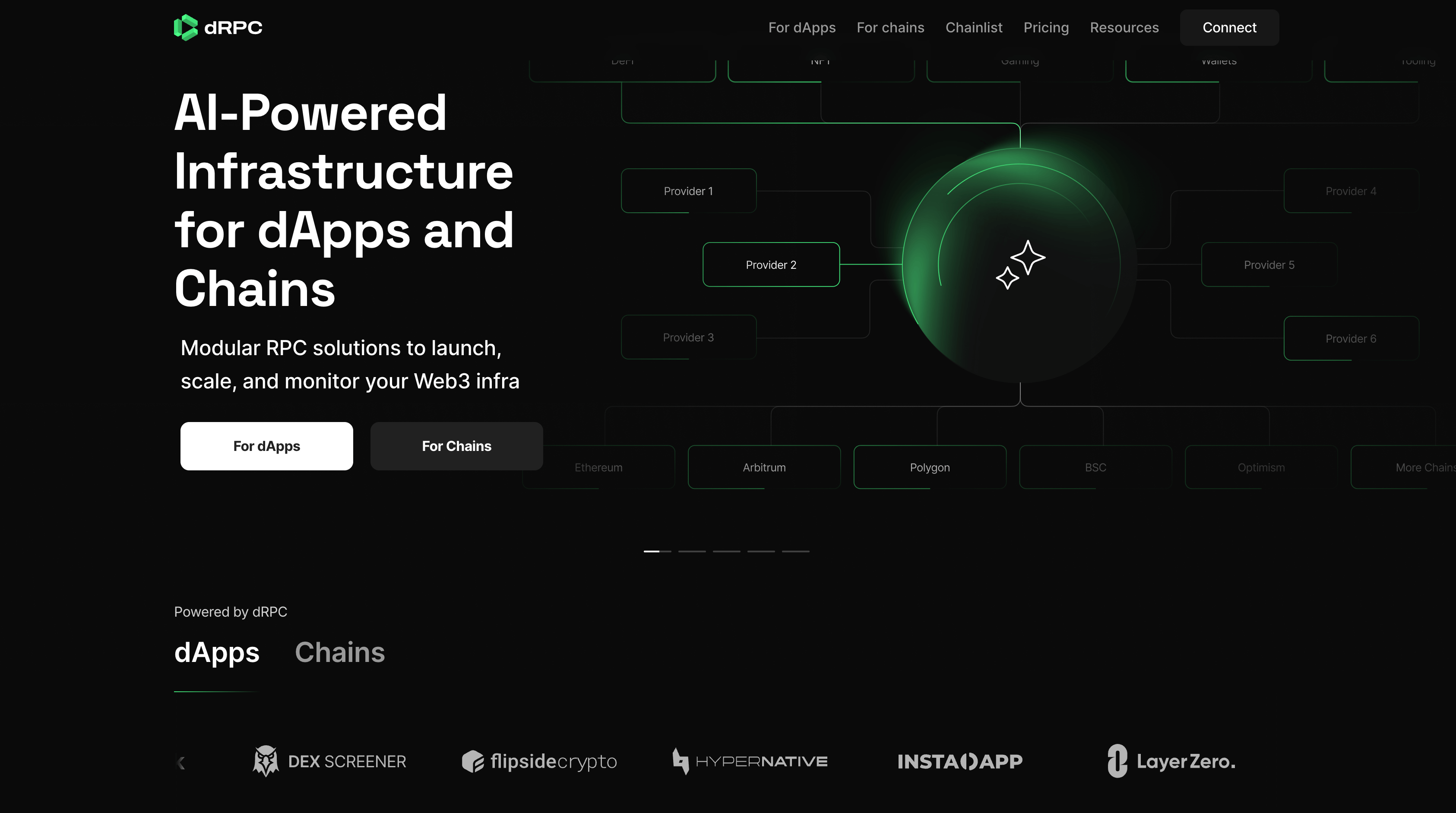
dRPC, instead of running its own single cluster, routes traffic across a network of 60+ independent node operators and uses an AI-driven load balancer to select the fastest, healthiest endpoint for each request. The goal is to eliminate single points of failure, reduce latency by steering calls to the nearest region, and deliver production-level throughput without tying you to a single provider’s hardware profile.
That design comes with a clear trade-off: you’re not getting one tightly controlled Tempo stack. Speed and redundancy are achieved by sitting on top of multiple operators, so performance depends on a rotating pool of providers. As a result, you don’t always get the same level of deterministic routing, regional pinning, or operational visibility that other providers provide.
| How much does dRPC cost? | dRPC prices Tempo access on a pay-as-you-go model. Costs are structured around compute units and per-million-request pricing: higher tiers get you more RPS capacity, priority routing, uptime SLAs, and dedicated support. Free — $0. Includes 210M compute units per month (roughly ~10M calls). Growth / Pay-as-you-go — $6 per 1M requests, 100 RPS limit. Includes high-performance nodes behind an AI-driven load balancer. Subscription plans raise the limit: Pro $49/month (300 RPS) and Scale $199/month (600 RPS). Enterprise — From $990/month, unlimited RPS, committed SLAs. |
| dRPC performance | Availability: 99.96% uptime listed on paid plans (committed SLAs on Enterprise), with automatic fallback across 60+ operators and 8 geo-clusters. Latency: Region-aware routing keeps calls close; speeds can fluctuate slightly. Scalability: Pay-as-you-go is limited to 100 RPS; Scale reaches 600 RPS and Enterprise is unlimited. Stability: Automatic retries and smart rotation maintain flow during mints or heavy network load. Controls: Unlimited API keys, request analytics, and MEV-safe routing included. |
| dRPC pros | – Decentralized aggregator with AI routing across 60+ operators for low latency and no single point of failure – High headroom on paid plans – Built-in MEV-safe routing and automatic fallback under congestion |
| dRPC cons | – Less predictable than a single-provider stack; routing and performance can vary between upstream operators – Finer controls like strict regional pinning or per-cluster visibility are limited compared to infra-first providers – Debugging edge cases can take longer because issues may originate from different upstream node operators |
dRPC is a good fit for teams that want high RPS fast and are fine with smart routing deciding where traffic goes. The pay-as-you-go model and up to 600 RPS on Scale work for bots, liquidators, and monitoring systems that just need throughput right now. If you need strict region pinning, predictable billing, or deep visibility into a single stack, something more infra-directed like Chainstack will feel safer long term.
5. Alchemy: best for existing Alchemy tooling
Verdict: HTTP, WebSocket and Debug API on Tempo mainnet. Trade-off: compute-unit pricing depends on the call mix, and there is no Trace API or Webhooks on Tempo. Official pricing: Alchemy pricing.
Alchemy offers Tempo RPC access with Day 1 mainnet support (chain ID 4217), providing HTTP and WebSocket endpoints and the Debug API. The Trace API, Webhooks, Token, NFT and Transfers APIs, Gas Manager and Bundler are not currently available on Tempo, and its testnet is Tempo Moderato.
The platform supports 100+ networks, so teams already on Alchemy can reuse the same SDK and dashboard on Tempo, though the extra APIs it offers on other chains are not yet available here.
| How much does Alchemy cost? | Alchemy measures usage in compute units (CUs) rather than raw requests, which can make costs less predictable for teams sending large volumes of latency-sensitive calls compared to flat, request-based models. Alchemy starts with a free tier offering 30M CUs per month, roughly 1.1M basic requests at 300 CU/s (about 15 RPS). Paid plans scale by total CU usage: Pay-as-you-go — $0.525 per million CUs (from 300 RPS). Enterprise — custom pricing with lower per-unit costs at high volumes. |
| Alchemy performance | Uptime: Reports 99.9% historical uptime, but an uptime SLA is only guaranteed on Enterprise plans. Latency: Region-based routing helps keep response times low; however, Alchemy does not publish official Tempo-specific latency numbers. Throughput: Begins at 300 CU/s (about 15 RPS) on the free tier; pay-as-you-go starts at 300 RPS, adds Debug API access, and more capacity is bought in 5,000 CU/s blocks. Reliability: The Supernode setup helps maintain data accuracy during heavy traffic. Monitoring: You can check usage, errors, and request patterns through the dashboard in real time. |
| Alchemy pros | – Day 1 Tempo support – Covers Tempo plus 100+ chains – Debug API and WebSocket on Tempo – Broad multi-chain SDK and dashboard |
| Alchemy cons | – CU pricing isn’t intuitive, – Alchemy publishes no Tempo-specific latency benchmarks of its own, – Throughput caps by plan, very high RPS needs an enterprise plan – SOC 2 Type II certified; no published ISO 27001 certification |
Alchemy’s Day 1 Tempo support and developer-first tooling make it attractive for teams already standardized on its SDK. Compute-based CU pricing offers flexibility but bills vary by API call complexity, making cost prediction challenging at scale. Best suited for teams that value ecosystem familiarity over strict cost predictability.
6. Quicknode: best for latency-sensitive production with compliance needs
Verdict: 500+ RPS on top tiers and SOC 1/2 + ISO 27001. Trade-off: method-weighted credits and no flat-rate unlimited option. Official pricing: Quicknode pricing.

Quicknode runs a multi-region infrastructure for Tempo RPC, letting you connect to Tempo over HTTP or WebSocket. Archive support is available for teams that need to query deep historical data.
Quicknode also supports dozens of other chains and offers add-ons such as Webhooks and Streams if you want event-based triggers or real-time blockchain feeds. Quicknode is popular with high-traffic teams because the network scales well under pressure, but to get to that performance you would need to move to the higher-priced tiers.
| How much does Quicknode cost? | Build — $49/month, 80M credits plus $0.62 per extra million, up to 50 RPS. Accelerate — $249/month, 450M credits plus $0.56 per extra million, up to 125 RPS. Scale — $499/month, 950M credits plus $0.53 per extra million, up to 250 RPS. Business — $999/month, 2B credits plus $0.50 per extra million, up to 500 RPS. Enterprise — custom terms for higher volumes and dedicated support. Unused credits do not roll over month to month, so variable Tempo loads need headroom, and the credit model adds a layer compared to straight request counts. |
| Quicknode performance | Uptime: States 99.99% uptime across supported services on its security page; premium SLA on Enterprise. Latency: Region-routed endpoints optimized for low latency; no official ms target published, so benchmark in your region. Throughput: 15 RPS on the trial, 50 RPS on Build, up to 500 RPS on Business, custom on Enterprise. Reliability: Requests are rerouted automatically. Monitoring: The dashboard gives real-time visibility into request performance and errors. |
| Quicknode pros | – Scales up to 500+ RPS on higher plans, – Archive data available (by chain/plan), – Low latency from multi-region routing |
| Quicknode cons | – Free trial caps at 15 RPS with community-level support, – Method-weighted, credit-based billing makes costs less predictable, – No flat-rate unlimited option for heavy workloads |
Quicknode gives you speed, global routing, and developer tooling, which makes it good option for Tempo apps. The main limitation is its credit-based (method-weighted) pricing. Because different methods burn credits at different rates, long-term cost planning takes more effort, especially if your workload isn’t static.
Getting started with Tempo on Chainstack
The provider you choose shapes your baseline for speed, reliability, and how easily you can scale over time. Chainstack bundles the full stack into a setup that takes minutes to deploy:
- Log in to your Chainstack account (or create one if you don’t have it yet).
- Create a new project or select an existing one.
- Choose Tempo Mainnet or Testnet.
- Deploy a node with RPC access and copy the HTTP or WebSocket endpoint into your app.
Once your endpoint is live, Tempo behaves like a standard EVM JSON-RPC network — for example, checking the latest block:
curl -X POST https://YOUR_CHAINSTACK_ENDPOINT/YOUR_API_KEY \
  -H "Content-Type: application/json" \
  -d '{
    "jsonrpc": "2.0",
    "method": "eth_blockNumber",
    "params": [],
    "id": 1
  }'
Conclusion
The 2026 Tempo RPC providers landscape is more competitive and mature than ever. In our assessment, Chainstack leads as the top all-around provider, combining enterprise-grade performance and 99.99%+ platform uptime via multi-cloud routing, transparent request-based pricing ($5–$20 per extra million requests, or flat-rate Dedicated Nodes from the Pro plan), and full SOC 2 Type II and ISO 27001 compliance. Chainstack serves stablecoin payments and enterprise dApps, with 70+ chains supported from one platform.
Dwellir and dRPC serve more cost-conscious use cases. Dwellir offers flat per-response billing, flat-rate Unlimited Nodes, and a dedicated-cluster path, but publishes no compliance attestation, while dRPC fits testing and lightweight applications with simple regional endpoints.
Alchemy remains a developer-first platform with rich tooling and a generous free tier, best suited for teams prioritizing productivity over raw infrastructure control. Quicknode is a strong choice for latency-sensitive workloads, offering solid throughput (500+ RPS on top tiers) and robust compliance certifications—though the comparison table above shows dRPC (600 RPS on Scale) and Chainstack (600 RPS on Business, custom on Enterprise) scaling to higher RPS ceilings.
- Stablecoin settlement and payment infrastructure: Chainstack (predictable pricing, SOC 2 Type II + ISO 27001).
- High-throughput bots and monitoring systems: dRPC’s pay-as-you-go, AI-routed capacity.
- Early-stage testing and prototyping: Chainstack’s or Dwellir’s free plan and quick setup.
- Latency-sensitive production workloads with compliance needs: Quicknode.
FAQ
Tempo RPC is the standard interface that lets applications communicate with the Tempo blockchain. Through an RPC provider, you can read blockchain data (balances, transactions), send transactions, deploy smart contracts, and interact with dApps using JSON-RPC API calls. Without reliable RPC, your app can’t connect to Tempo.
For production workloads, Chainstack is a strong option, combining predictable request-based pricing, scalable performance, 99.99%+ platform uptime, global low-latency routing, SOC 2 Type II and ISO 27001 compliance, and both free/enterprise tiers. It covers payment infrastructure, settlement systems, and high-frequency transaction needs better than competitors.
Yes. Chainstack offers 3M requests/month (~25 RPS) free with Tempo access (archive data starts on the Growth plan). Alchemy gives 30M CUs (~1.1M requests), and Dwellir includes a free plan of 100,000 responses per day.
When you start building on Tempo, the provider you choose shapes your baseline for speed, reliability, and how easily you can scale over time. While different platforms cater to different use cases, Chainstack bundles the full stack into a setup that takes minutes to deploy:
1. Log in to your Chainstack account (or create one if you don’t have it yet).
2. Create a new project or select an existing one.
3. Choose Tempo Mainnet or Testnet
4. Deploy a node with RPC access and copy the HTTP or WebSocket endpoint into your app.
Yes. Most top Tempo RPC providers, including Chainstack, Dwellir, and Quicknode, support both HTTP and WebSocket endpoints for Tempo, so you can subscribe to real-time events such as new blocks and pending transactions in addition to making standard JSON-RPC calls.
It depends on your workload. Light applications can start on free tiers around 25 RPS, while high-throughput systems need higher ceilings: Chainstack offers up to 600 RPS on Business (custom RPS on Enterprise), dRPC offers up to 600 RPS on its Scale plan (pay-as-you-go is limited to 100 RPS), and Quicknode scales past 500 RPS on its top tiers. Check the comparison table above for exact figures before choosing a plan.
Additional resources
- Chainstack Tempo product page — build better with Tempo.
- Stablecoin infrastructure — Chainstack’s stablecoin-focused infrastructure.
- Chainstack Enterprise plans — custom RPS, SLAs, and dedicated support.
Changelog
We review this comparison regularly so that the information stays accurate, clear, and easy to verify. This page was reviewed to improve how the comparison is structured and sourced.
- October 29, 2026: Added a quick verdict and a “Best for” column, numbered the provider sections with one-line verdicts, added a methodology and disclosure section, a rate limits and free tiers comparison, alternatives guidance, links to official pricing pages, corrected vendor pricing, limits and certification details, wording clarifications, and a status-page source for the platform uptime claim.
- February 4, 2026: Original publication.