AI-ready infrastructure
 Refer and earn


 Ethereum
 Hyperliquid
 Solana
 Arbitrum
 BNB Smart Chain
 Base
Base Polygon
 TRON
TRON Sui
Sui Robinhood


Top 5 Arc RPC providers for production apps in 2026

Arc is Circle’s EVM-compatible layer 1 built for stablecoin finance, where USDC — not a volatile gas token — pays for every transaction. Its public testnet has processed more than half a billion transactions across nearly 3 million wallets since going live in October 2025.
Its public mainnet launched on September 16, 2026, with BlackRock, DTCC, Mastercard, Standard Chartered, and Visa among the validators — which is why provider choice matters this year specifically. Arc reads like a standard EVM chain, so teams default to whatever Ethereum RPC endpoint they already use. That assumption breaks on contact with Arc’s actual mechanics: native USDC is an 18-decimal balance with a separate 6-decimal ERC-20 view of the same value, every native transfer emits a Transfer log under EIP-7708, the pending mempool isn’t observable, and historical queries older than roughly 127 blocks bill at Chainstack’s archive rate (2 RU). None of that is exotic once you know it — but a provider that can’t serve archive reads cleanly or silently truncates a log range will cost you more than a slow response time.
This guide covers what building on Arc generally demands from an RPC layer — not just payment settlement, but general dApp deployment, wallet and exchange integrations, and developer tooling — and how the best Arc RPC providers compare: Chainstack, Dwellir, Blockdaemon, Alchemy, and Quicknode.
💡 Already building on Arc? Jump straight to the Arc tooling docs or deploy an endpoint in minutes with build better with Arc.
Why RPC provider choice matters for Arc
Arc’s whole design point is that USDC is the gas token and every native transfer is a logged event — so a shared endpoint that silently rate-limits eth_getLogs or drops a WebSocket subscription doesn’t just slow a dApp down, it produces a wrong answer. That’s true whether the app is a payments backend, a DEX front end, a wallet, or an indexer — Arc doesn’t have a “simple” workload category, because the log stream and the dual-decimal balance model touch everything built on top of it.
Because Arc’s provider field is still forming, most of the criteria below are about which providers have real, current Arc support rather than years of chain-specific tuning. Here’s what actually separates a production-ready Arc endpoint from a testnet toy:
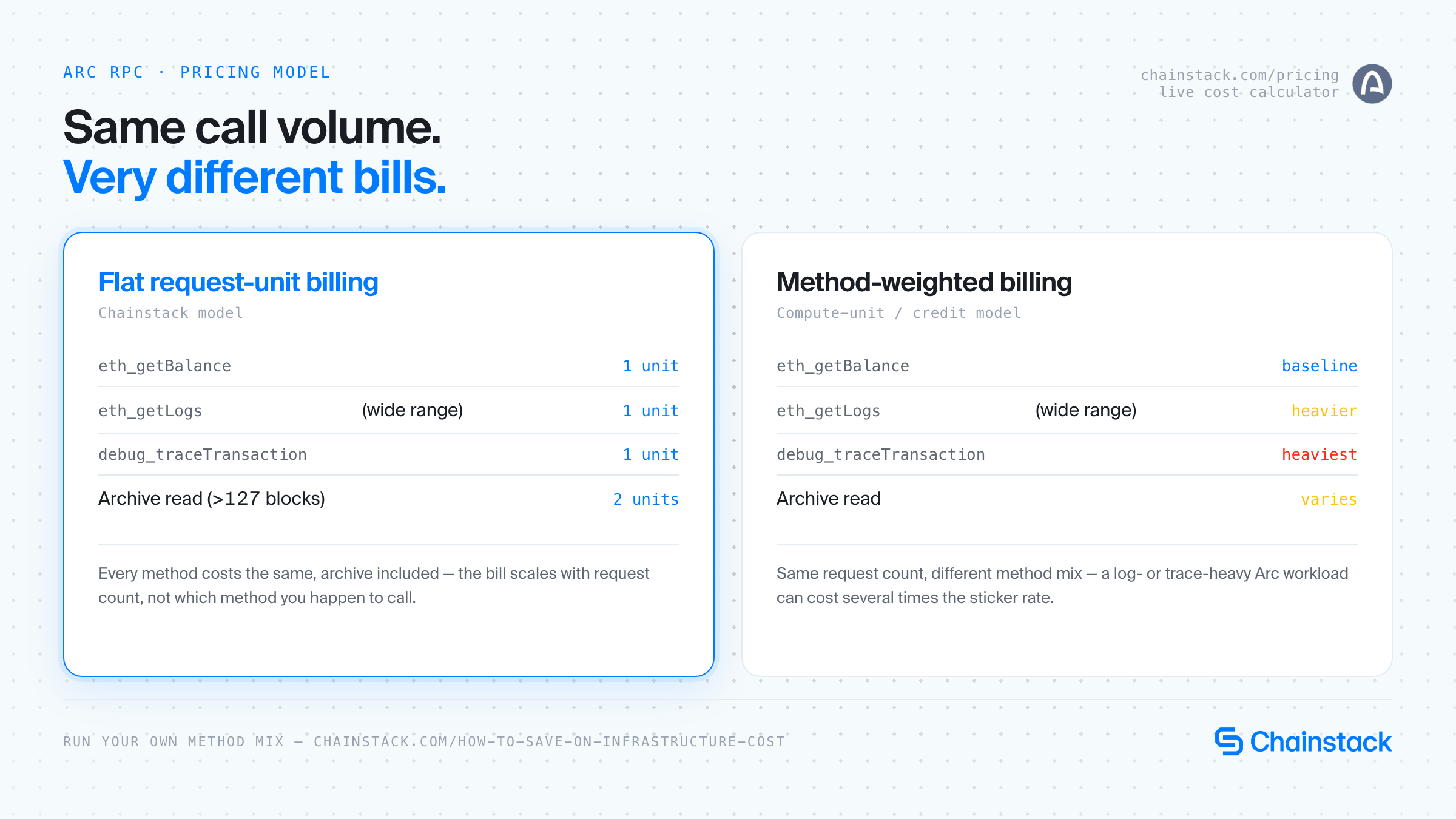
- Cost predictability and pricing model — flat request-unit pricing versus method-weighted CU/credit models. Chainstack bills every call as 1 RU (2 RU for archive); Alchemy’s compute units and Quicknode’s credits are method-weighted, so a log-heavy or archive-heavy Arc workload can cost several times more than the sticker price suggests.
- Archive and historical data access — depth of history, and per-request cost, for reads older than Arc’s roughly 127-block full-node window (about a minute at Arc’s ~0.48-second block time). Any reconciliation, indexing, or audit workload on Arc lives on archive access.
- Throughput stability under load — RPS ceilings and how gracefully a provider degrades under burst traffic, since Arc’s sub-second finality means client-side retry logic has less room to hide a slow endpoint.
- Free-tier reality — a permanent standalone free plan (Chainstack, Alchemy) versus a time-limited trial that later requires payment (Quicknode). This matters most right now, while teams are moving from Arc Testnet toward production mainnet.
- Support quality and responsiveness — whether free-tier support is community Discord/Telegram with engineers actually in-channel or documentation only, and what paid-tier response-time commitments look like. On a chain this new, getting a real answer to an Arc-specific question matters more than usual.
- SLA and compliance — uptime guarantees and audited certifications (SOC 2 Type II, ISO 27001). Arc’s founding validator list reads like a regulated-finance who’s-who, and teams building anything customer-facing on it should expect their own compliance reviewers to ask for the same attestations.
- Arc-specific mechanics — the EIP-7708 log-as-ledger model, the 18-decimal native / 6-decimal ERC-20 dual view of USDC, the unobservable pending mempool (
eth_newPendingTransactionFilterand pending-transaction subscriptions return-32001), and the customarc_getCertificatefinality-proof method. A provider’s Arc support is only as good as its handling of these four points — full EVM compatibility doesn’t automatically cover them.
Comparison of the top Arc RPC providers
Arc’s provider field is still young, so this comparison stays direct-provider only. Routing layers such as RouteMesh now list Arc too, but they route to underlying providers rather than operating nodes. Ankr also doesn’t support Arc at time of writing. Other tier-2 providers such as GetBlock list Arc Testnet endpoints too; this comparison focuses on the five providers with the clearest current product depth and mainnet trajectory. All five providers in this comparison now list Arc Mainnet endpoints.
The table below summarizes public positioning as of October 2026.
| Provider | Pricing model | Free tier | Dedicated nodes | Archive & trace |
|---|---|---|---|---|
| Chainstack | Request units (1 RU full, 2 RU archive) | 3M RU/mo, 25 RPS | Yes (Pro plan and up) | Yes (Growth plan and up) |
| Dwellir | Credits (1 per response, flat) | 20 responses/s, 100,000/day | Yes (cluster $4,300/mo; Unlimited Nodes from $119/mo) | Not on shared endpoint per Dwellir FAQ (-32601); old state pruned |
| Blockdaemon | Custom / institutional | Not documented | Yes | Yes |
| Alchemy | Compute units (method-weighted) | 30M CU/mo | No | Debug + Trace APIs listed |
| Quicknode | Credits (method-weighted) | Trial only | Yes (clusters) | Yes (full, no pruning) |
How to choose an Arc RPC provider
1. Pricing model — flat vs weighted, and what that means at scale
Chainstack bills a flat 1 request unit per call (2 RU for archive), regardless of method. Alchemy’s compute units and Quicknode’s credits are method-weighted, meaning heavier calls — eth_getLogs over a wide range, debug_traceTransaction, historical eth_call — consume several times what a simple read costs. The formula worth keeping in your head: true cost per call = (method’s CU/credit weight × price per million units) ÷ 1,000,000 — multiply by your monthly call volume for the real bill, not the headline rate.
Not every provider publishes a per-method Arc rate yet, so the table below only states numbers that are actually confirmed rather than estimating the rest:
| Provider | eth_getLogs unit weight | Effective cost / 1M calls (entry paid tier) |
|---|---|---|
| Chainstack | 1 RU full / 2 RU archive | ~$2.45 full / ~$4.90 archive (Growth: $49/mo for 20M RU) |
| Dwellir | 1 credit per response (flat) | ~$1.96 (Developer: $49/mo for 25M responses) |
| Blockdaemon | Custom / institutional | Contract pricing — not published |
| Alchemy | Method-weighted CU | Not published per-method; $0.525/1M CU on Pay-as-you-go (from 300 RPS) |
| Quicknode | Method-weighted credit | Not published for Arc specifically |
For a full worked breakdown across providers, run your own numbers through the interactive cost calculator — it converts your actual method mix and call volume into a live comparison rather than relying on published averages.
2. Archive, trace, and debug method access
Arc runs the Reth client, so it exposes the standard debug_* namespace (including debug_traceTransaction) alongside the Parity-style trace_* namespace — useful for reconstructing a reverted call or auditing contract execution. What varies by provider is depth and pruning: Quicknode publishes full, unpruned Arc archive; Chainstack and Blockdaemon both support archive and debug/trace; Alchemy lists Debug and Trace APIs on Arc mainnet; Dwellir says its shared Arc endpoint does not serve debug_* or trace_* and prunes old state. If your workload does anything with historical state — a past-block eth_call, a wide eth_getLogs backfill, or contract-level tracing — archive access isn’t optional. See Chainstack archive data for how this is priced.
3. Free tier reality
Chainstack’s Developer plan (3M RU/month, 25 RPS) is a permanent free tier with no credit card required, and Alchemy’s 30M CU/month free tier is similarly permanent. Dwellir’s free plan allows 100,000 responses a day. Quicknode has no permanent free tier for Arc — only a time-limited trial — and Blockdaemon is enterprise-contract only. Even with mainnet live, a meaningful share of Arc development still happens against Testnet on a free or low-cost tier before teams cut over, so which one survives past a prototype matters.
4. When dedicated infrastructure matters
Three concrete signals it’s time to move off a shared endpoint: sustained request volume that regularly bumps a shared RPS ceiling, a compliance requirement for isolated infrastructure (common for anything touching regulated stablecoin flows), or a need for custom node configuration that a shared endpoint can’t offer. Dedicated Nodes and Global Nodes cover the first two on Chainstack; Blockdaemon, Dwellir and Quicknode each offer their own dedicated or cluster options for Arc.
5. Arc-specific data access
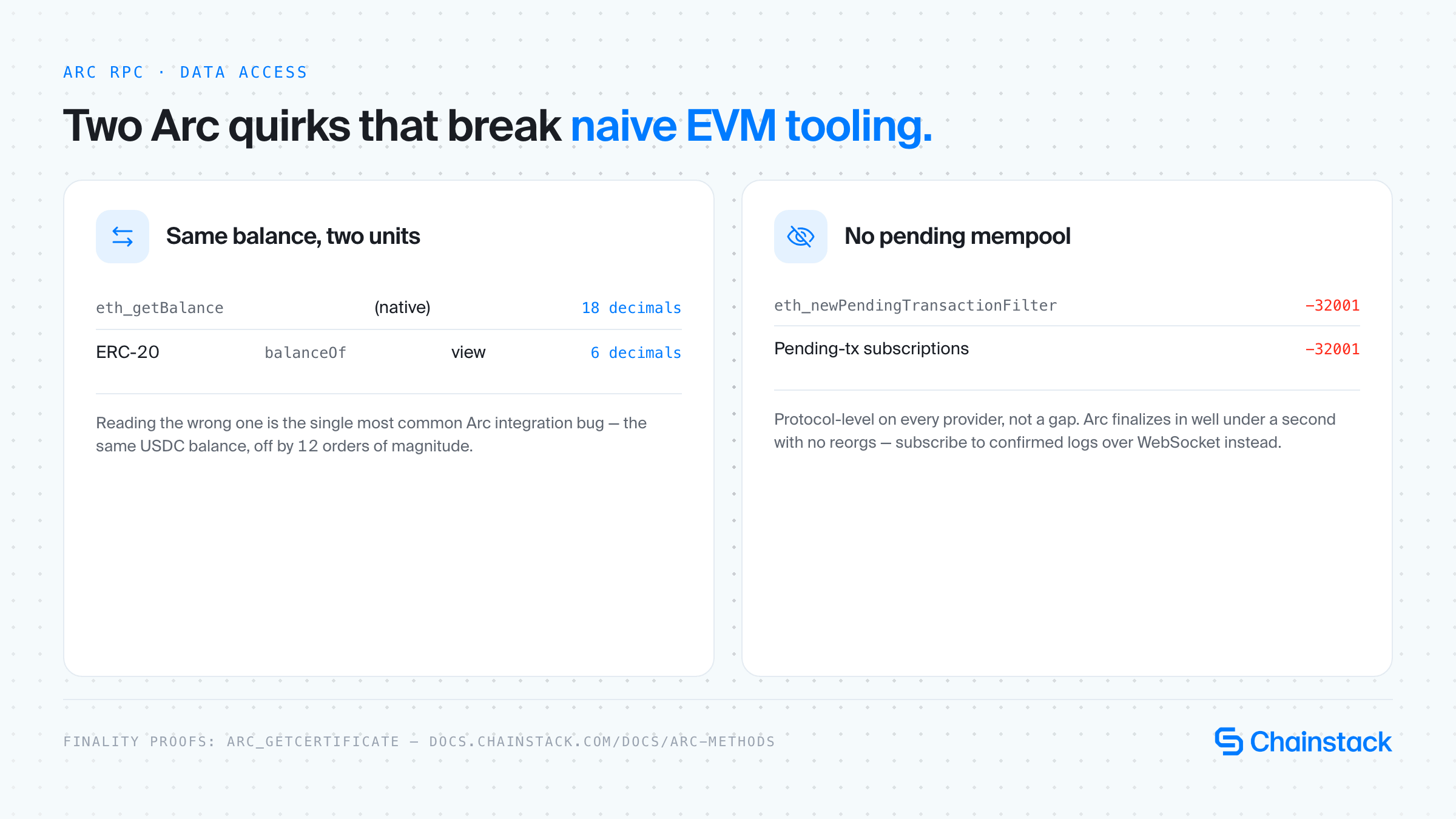
Two Arc mechanics change how you write RPC calls. First, native USDC balances from eth_getBalance are 18-decimal, while the ERC-20 view most tooling expects is 6-decimal — reading the wrong one is the single most common Arc integration bug. Second, the pending mempool isn’t observable at all: eth_newPendingTransactionFilter and pending-transaction subscriptions return -32001 on every provider, since this is a protocol-level restriction, not a provider gap. Because Arc finalizes deterministically in well under a second with no reorgs, subscribing to confirmed logs over WebSocket — rather than watching a mempool — is the correct pattern for anything that needs near-real-time visibility into activity. For finality proofs specifically, the custom arc_getCertificate method (documented in the Arc methods reference) returns the consensus commit certificate for a given height.
6. Support quality — tiered, not “SLA yes/no”
Chainstack offers community Telegram support with engineers active in-channel on the free Developer plan, standard email support from Growth ($49/mo), and 24/7 enterprise support with sub-hour response on the Premium add-on (see enterprise support SLA). Alchemy and Chainstack both offer meaningful free-tier support; Quicknode and Blockdaemon lean more toward paid/contract support models. On a chain this new, a provider with engineers who actually know Arc’s quirks — not just generic EVM support — is worth more than the SLA document alone suggests.
7. Latency consistency vs. average latency
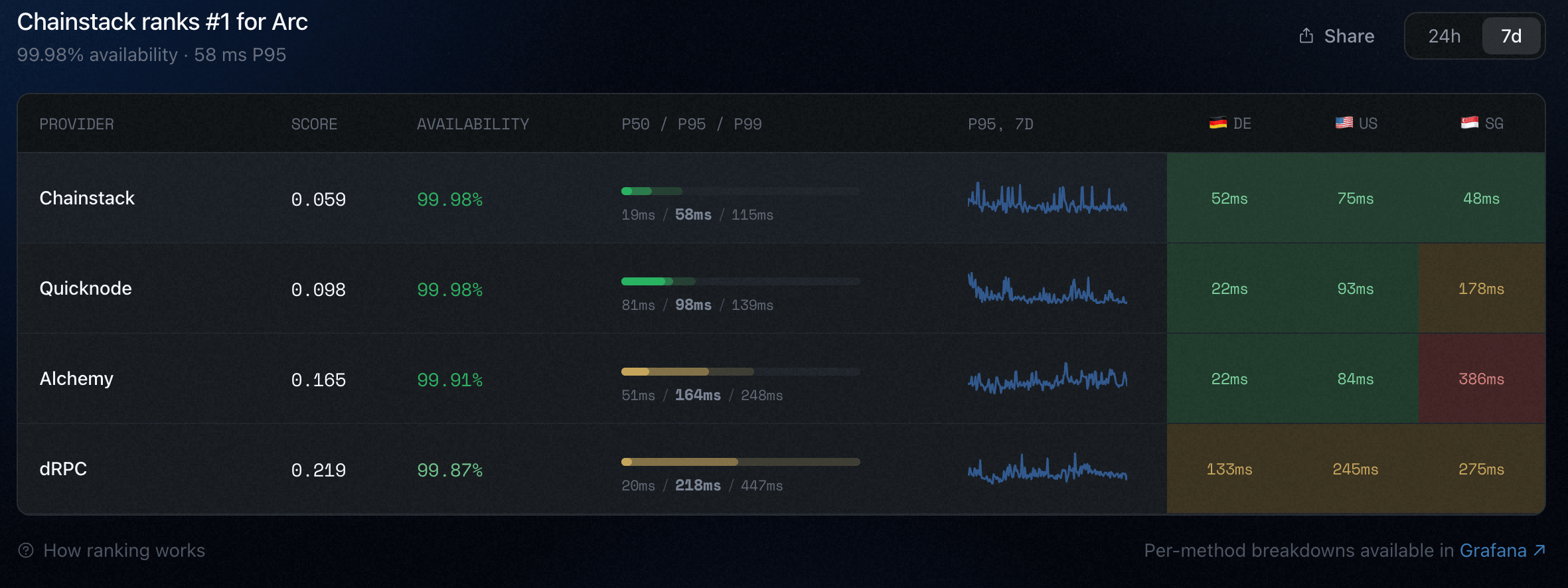
Average latency hides the tail — what matters for a production app is p95/p99 response time under real, bursty traffic, not a clean benchmark run. Arc is now covered by Chainstack’s public, real-time RPC performance dashboard.
⚡ Benchmark before you commit: compare.chainstack.com now tracks Arc live — numbers refresh every 3 minutes, so check the live dashboard for current availability and P95 before committing, or run your own
curl/k6 loop againsteth_getBlockByNumberandeth_getLogsfor method-specific p95/p99 from your own target region.
Choose by use case
Stablecoin payments and settlement
Arc’s entire design centers on stablecoin settlement — USDC as native gas, EIP-7708 emitting a Transfer log for every native movement, and sub-second deterministic finality built for payment windows rather than general contract execution. A payments or FX application built on Arc lives or dies on log completeness: an eth_getLogs call that silently truncates a wide block range, or a WebSocket subscription that drops mid-settlement, turns into a reconciliation gap that shows up as missing money rather than a missing feature.
Chainstack and Alchemy both give this group a permanent free tier to build against Arc without a credit card, and Chainstack’s flat request-unit pricing keeps a log-heavy settlement pipeline’s cost predictable in a way method-weighted CU billing doesn’t. Archive and debug/trace access on the same account matter here too — reconstructing a disputed settlement after the fact is exactly the workload archive access is for.
Exchanges, wallets, and on/off-ramp integrators
A wallet or exchange backend reading Arc balances has to get the 18-decimal-native / 6-decimal-ERC-20 split right on every single balance display, and an on/off-ramp product moving USDC across Arc needs reliable, high-volume read traffic without a bill that scales unpredictably with usage. This is also the group most likely to outgrow a shared, per-request-billed endpoint quickly — a wallet backend’s read volume doesn’t follow a predictable daily curve the way a typical dApp’s does.
Chainstack’s Unlimited Node add-on replaces per-request billing with a flat monthly rate at a chosen RPS tier — a direct fit for wallet-scale read traffic where the call count is high but predictable in shape. Quicknode’s dedicated clusters and Blockdaemon’s institutional infrastructure are also credible options here if the integration already sits inside either vendor’s broader stack.
Enterprise infrastructure and compliance for institutions building on Arc
Arc’s founding validator cohort — BlackRock, DTCC, Mastercard, Standard Chartered, Visa — signals who’s showing up at mainnet, and any product built for that audience inherits their vendor-risk expectations regardless of whether it’s a payments rail, a custody integration, or an institutional trading tool. That means audited compliance certifications, a contractual uptime SLA, and — increasingly — a self-hosted or single-tenant deployment option for teams that can’t put regulated infrastructure on shared multi-tenant hardware.
Chainstack holds both SOC 2 Type II and ISO 27001; Blockdaemon and Quicknode publish both as well. Chainstack additionally lists Arc Testnet in its Self-Hosted supported-deployments table, while Arc Mainnet runs on Global and Dedicated Nodes. Dwellir publishes no SOC 2 or ISO 27001 attestation on its public pages, so ask for compliance documents before using it for anything regulated, even though it’s a fine fit for prototyping.
Provider-by-provider breakdown
Chainstack
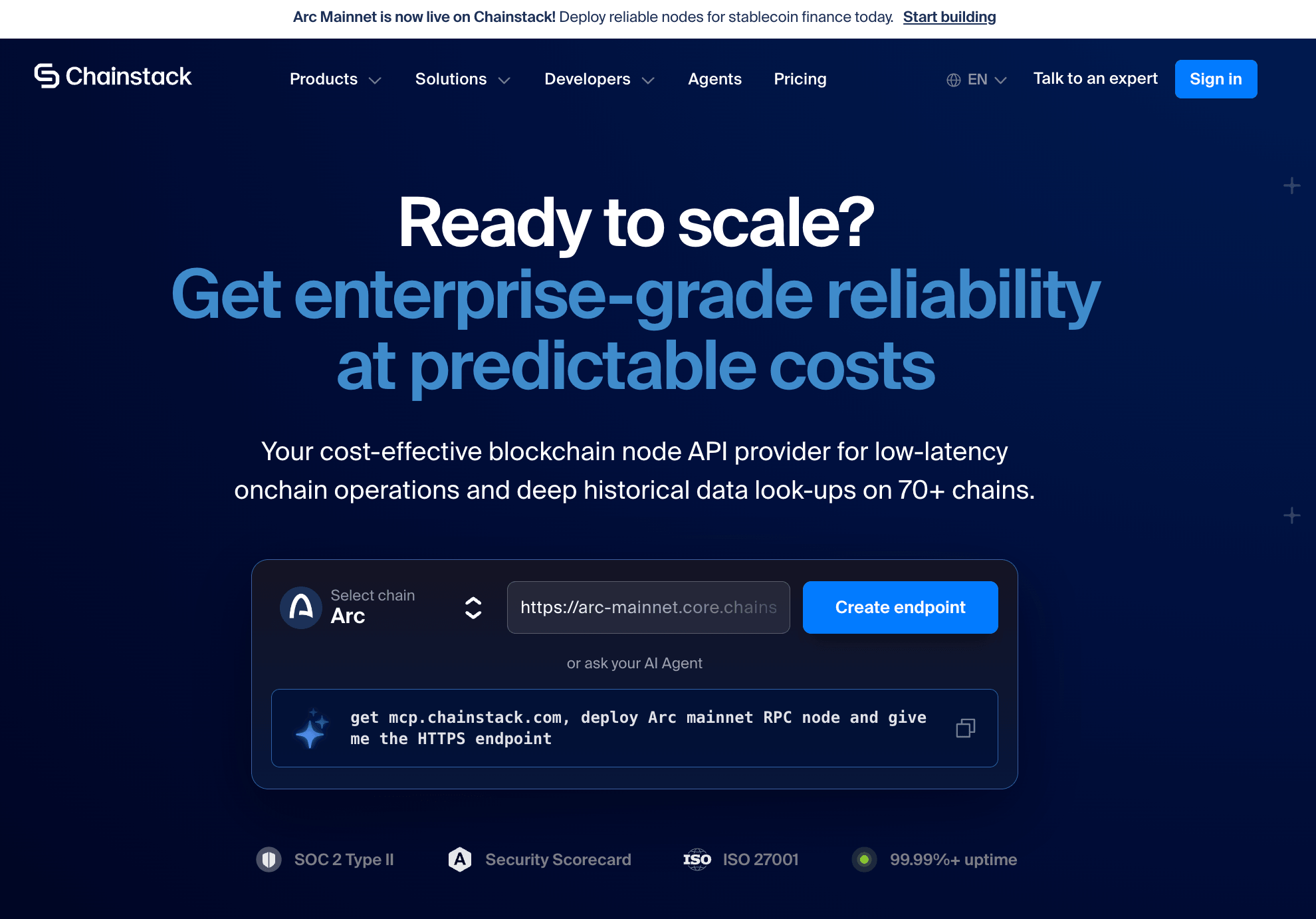
Chainstack runs Arc RPC infrastructure on the Reth execution client and exposes the full standard surface — the eth, debug, trace, net, web3, and rpc namespaces (txpool_status only) — plus the custom arc namespace with arc_getCertificate for consensus commit certificates. Nodes are available in both Full and Archive modes, with the complete debug/trace method set on each, which is precisely what an Arc reconciliation and audit pipeline needs. Billing is request units at a flat one request equals one RU, so payment volume maps to cost directly instead of through a method-weighted credit multiplier — archive requests count as 2 RU, which matters on Arc because the 127-block archive cutoff pushes even recent reconciliation reads into archive rates.
Pricing starts at a free Developer tier (3M RU/month, 25 RPS) and scales through Growth ($49), Pro ($199), Business ($499), and Enterprise (from $990). Dedicated Nodes bill per node (compute plus storage) from the Pro plan, and the Unlimited Node add-on offers flat-fee RPS tiers from $149/month for teams that want predictable high-volume billing. Arc Testnet is also on Chainstack’s Self-Hosted deployment list, running the Arc execution and consensus clients inside a customer’s own environment for teams that need the node inside their own perimeter. On the compliance side, Chainstack carries SOC 2 Type II and ISO 27001 certification with SSO, MFA, and custom SLAs — the attestations regulated stablecoin operators need. Global Nodes provide low-latency shared access across regions for teams not yet on dedicated infrastructure.
Limitations: request-unit billing is predictable but still requires capacity planning around the 2-RU archive multiplier for backfill-heavy workloads — teams that want that variable removed entirely should move heavy read traffic onto an Unlimited Node tier instead. Chainstack is also not named on Circle’s own node-providers documentation page (which lists Alchemy, Blockdaemon, dRPC, Goldsky, and QuickNode), so teams that only check that one list may miss it.
Fit by workload:
- General dApp building: Excellent — permanent free tier, standard EVM tooling, archive and trace on the same account.
- Wallet and exchange integration: Excellent — Unlimited Node fits high, predictable read volume without a method-weighted surprise.
- Enterprise and compliance: Excellent — SOC 2 Type II and ISO 27001 published, plus Self-Hosted deployment for Arc Testnet that most competitors don’t offer.
Dwellir
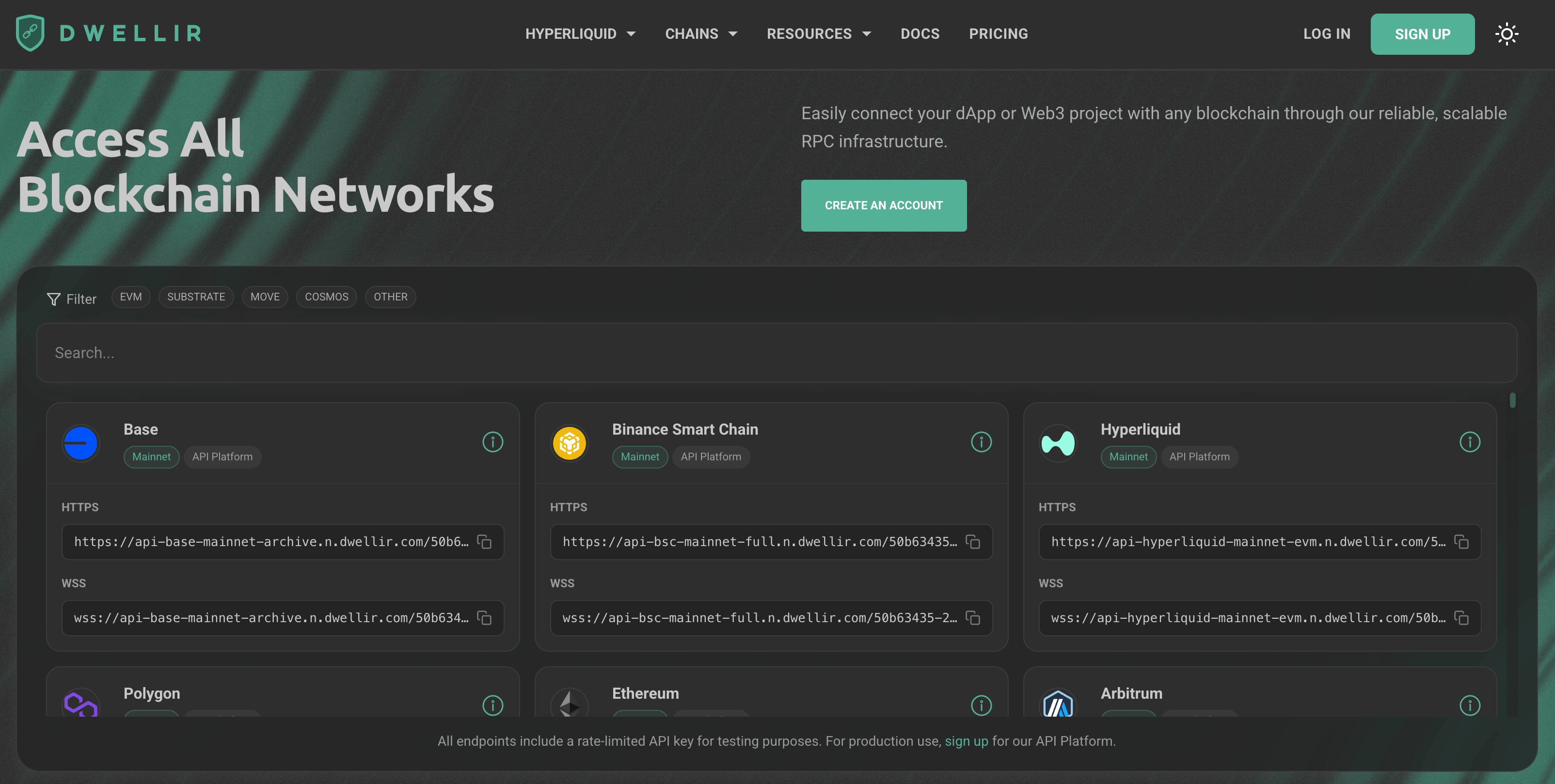
Dwellir is a Swedish RPC provider with a long Polkadot track record that now serves 150+ networks, including Arc Mainnet (chain ID 5042) over HTTPS and WebSocket. Shared plans bill one credit per response with no compute-unit weighting, so a log-heavy reconciliation read costs the same as a balance check, and its Arc page is inconsistent on tracing: the plan cards list trace and debug APIs, but its FAQ says the shared Arc mainnet endpoint returns -32601 for debug_*, trace_* and txpool_* and that state reads at old blocks are pruned (blocks, receipts and logs are served back to genesis).
Pricing runs from a free plan (20 responses per second, 100,000 responses per day) through Developer at $49/month (25M responses, 100 per second), Growth at $299/month (150M, 500 per second) and Scale at $999/month (500M, 5,000 per second). Unlimited Nodes start at $119/month flat for 25 to 1,000 RPS, and the Arc dedicated cluster is listed at $4,300/month, unmetered, with a 99.99% SLA on custom terms. You can pay in crypto. Pricing checked October 9, 2026.
Limitations: No SOC 2 or ISO 27001 attestation on its public pricing and dedicated-cluster pages; the free plan is capped at 100,000 responses per day; old-block state reads are pruned on the shared endpoint, which matters because Arc reconciliation reads older than roughly 127 blocks bill as archive on Chainstack.
Fit by workload:
- General dApp building: Good — a free plan and flat per-response billing keep prototyping cheap; check trace/debug availability first.
- Wallet and exchange integration: Good — Unlimited Nodes from $119/month fix the cost of high, predictable read volume at a chosen RPS tier.
- Enterprise and compliance: Limited — no published attestation, though the dedicated cluster carries a 99.99% SLA on custom terms.
Blockdaemon
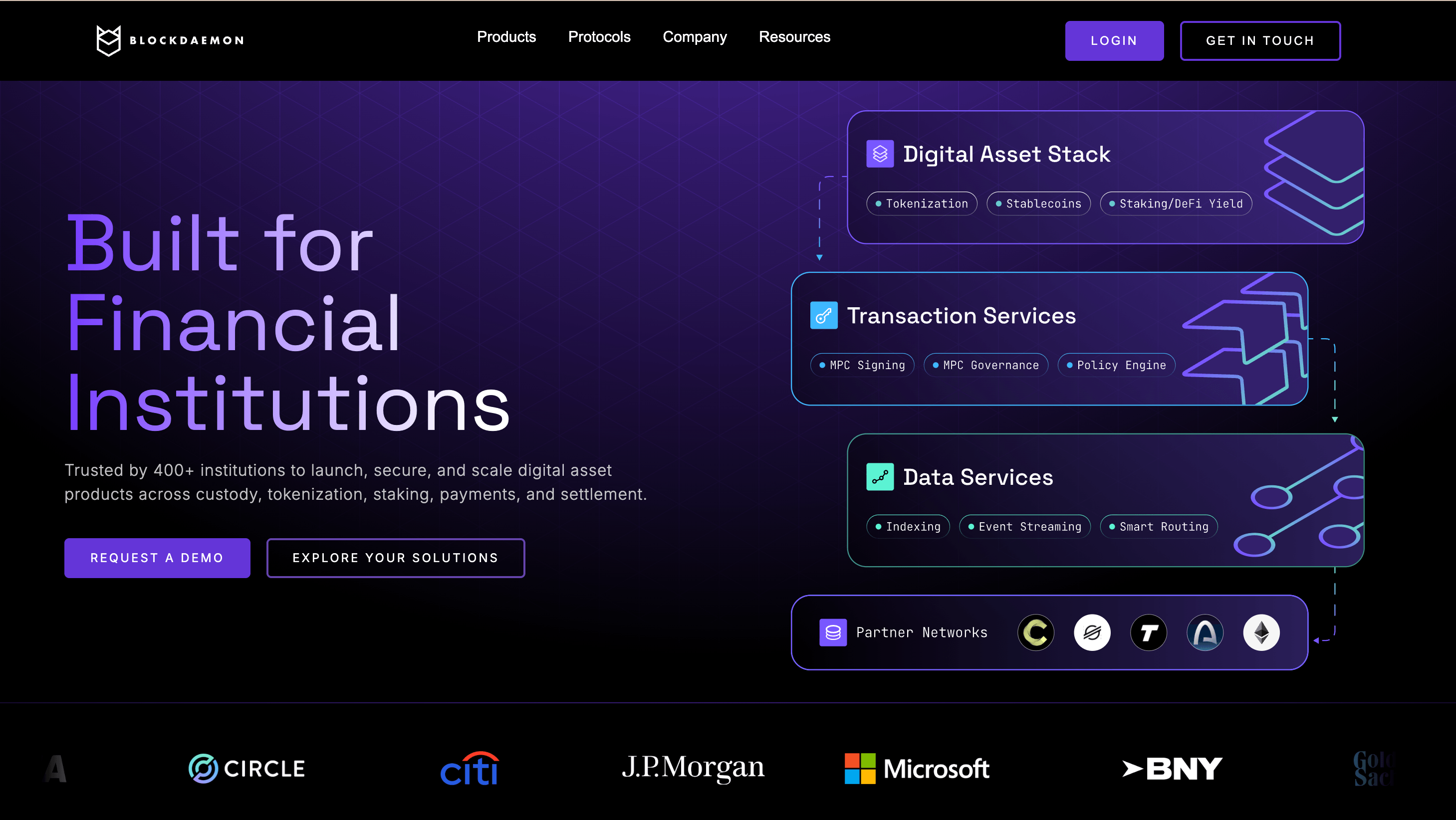
Blockdaemon provides institutional-grade RPC infrastructure for Arc, with dedicated node deployments and archive access across both mainnet and testnet. Its positioning is squarely institutional — the same audience Arc’s founding validator list is drawn from — which makes it a natural fit for teams that already run multi-chain infrastructure through Blockdaemon and want Arc under the same vendor relationship.
Pricing is custom rather than published, and both SOC 2 Type II and ISO 27001 are part of Blockdaemon’s standard institutional compliance posture.
Limitations: There’s no self-serve pricing — you engage sales rather than sign up directly, which is a real friction cost for a small team just prototyping.
Fit by workload:
- General dApp building: Moderate — no self-serve tier makes it a heavy option for early prototyping.
- Wallet and exchange integration: Strong — institutional archive infrastructure and dedicated nodes suit high-volume backends.
- Enterprise and compliance: Strong — institutional positioning and published certifications, contract-priced.
Alchemy
Alchemy supports Arc mainnet and testnet with HTTP and WebSocket endpoints listed in its standard chain directory, so teams already standardized on Alchemy can treat Arc like any other EVM network in their existing Foundry or viem config. The WebSocket support matters specifically on Arc: since the pending mempool isn’t observable, subscribing to confirmed logs is the correct pattern for near-real-time visibility, and Alchemy’s WebSockets handle that cleanly.
The free tier is a genuine 30M compute units per month, permanent rather than a trial — a real positive for early-stage teams. Alchemy is SOC 2 Type II certified; ISO 27001 is not currently published.
Limitations: Alchemy’s Arc support has no standard dedicated node option, and the compute-unit model — like any method-weighted scheme — makes archive-heavy read costs harder to forecast than flat per-call billing.
Fit by workload:
- General dApp building: Strong — permanent free tier, familiar tooling, solid WebSocket support.
- Wallet and exchange integration: Good — reliable endpoints, though CU costs need modeling at high read volume.
- Enterprise and compliance: Good — SOC 2 Type II published; no ISO 27001 or dedicated nodes.
Quicknode

Quicknode was an early official Arc infrastructure partner, offering managed Arc mainnet and testnet endpoints with full, unpruned archive data — a genuinely strong fit for anything doing historical reads, since there’s no pruning gap to work around. Its docs also surface Arc-native context (USDC gas, the FX engine, CCTP and Paymaster integration), which shortens the ramp-up for teams new to the chain.
Quicknode is SOC 2 Type II and ISO 27001 certified with dedicated clusters for isolated throughput. Pricing is credit-based and method-weighted, so a log-heavy or trace-heavy workload consumes credits faster than plain reads — worth modeling before committing to a tier, since Quicknode’s per-credit costs on heavy methods stack up quickly at production volume.
Limitations: there’s no permanent free tier for Arc, only a time-limited trial. Method-weighted credits make archive-heavy spend harder to forecast than flat per-call pricing, despite the strong unpruned archive depth.
Fit by workload:
- General dApp building: Good, once past the trial — full archive depth is a real advantage, but ongoing dev work runs on a paid plan.
- Wallet and exchange integration: Strong — dedicated clusters and unpruned archive suit high-volume backends well.
- Enterprise and compliance: Strong — SOC 2 Type II and ISO 27001 published, with dedicated infrastructure for isolated workloads.
Getting started with Arc on Chainstack
Deploy a production Arc endpoint in a few steps and build better with Arc on Chainstack:
- Log in to the Chainstack console (or create an account).
- Create a new project
- Select Arc as your blockchain protocol
- Choose network: Arc Mainnet or Arc Testnet
- Deploy the node
- Open Access and credentials and copy your HTTPS and WebSocket endpoints
For workloads that need isolated throughput or a fixed monthly cost regardless of call volume, evaluate Dedicated Nodes or the Unlimited Node add-on after the initial deploy — both are available inside the same project.
import { createPublicClient, http, defineChain, formatEther } from "viem";

const arcMainnet = defineChain({
  id: 5042,
  name: "Arc",
  nativeCurrency: { decimals: 18, name: "USDC", symbol: "USDC" },
  rpcUrls: { default: { http: ["YOUR_CHAINSTACK_ENDPOINT"] } },
});

const arcTestnet = defineChain({
  id: 5042002,
  name: "Arc Testnet",
  nativeCurrency: { decimals: 18, name: "USDC", symbol: "USDC" },
  rpcUrls: { default: { http: ["YOUR_CHAINSTACK_ENDPOINT"] } },
});

const client = createPublicClient({ chain: arcMainnet, transport: http() });

// Native USDC balance is 18-decimal; the ERC-20 view is 6-decimal
const balance = await client.getBalance({ address: "YOUR_WALLET_ADDRESS" });

console.log("Balance:", formatEther(balance), "USDC");
The Arc tooling documentation has the full defineChain setup plus ethers.js and web3.py equivalents. Need testnet USDC to exercise a transaction path? Circle’s own faucet at faucet.circle.com tops up Arc Testnet accounts — Chainstack does not run a separate Arc faucet.
🤖 You can also access Chainstack Arc RPC directly from Claude, Cursor, Codex, Windsurf, Gemini CLI, GitHub Copilot, Antigravity, Claude.ai, or ChatGPT using Chainstack MCP. For a fuller agent stack — MCP, the Chainstack skill, llms.txt for context ingestion, and WebMCP for agentic browsers — see the Chainstack Agents page.
Conclusion
For most teams building on Arc in 2026, the decision isn’t which provider has the flashiest feature set — it’s which one has genuinely shipped Arc support, handles the log-as-ledger and dual-decimal mechanics correctly, and won’t need replacing the moment mainnet traffic arrives.
- General-purpose dApp builders: Chainstack or Alchemy — both offer a permanent free tier and standard EVM tooling on Testnet today.
- Wallets, exchanges, and on/off-ramp integrators: Chainstack’s Unlimited Node for predictable high-volume reads, or Quicknode’s dedicated clusters if already inside that stack.
- Institutional and multi-chain enterprise stacks: Blockdaemon to keep Arc under one vendor relationship, or Chainstack for the same compliance posture with self-serve deployment.
- Cost-sensitive prototyping: Dwellir for a free plan and flat per-response pricing — it publishes no compliance attestation, so pair it with a compliant provider before anything production-facing.
Frequently asked questions
Q: What EVM quirks should developers know before deploying to Arc?
Arc is EVM-compatible, so most tooling works unmodified, but four mechanics are Arc-specific: native USDC balances are 18-decimal while the ERC-20 view is 6-decimal, every native transfer emits a Transfer log under EIP-7708, the pending mempool isn’t observable (eth_newPendingTransactionFilter returns -32001), and historical queries older than roughly 127 blocks bill at Chainstack’s archive rate (2 RU). Get any of these wrong and your dApp still runs — it just returns the wrong numbers.
Q: Which Arc RPC providers offer a free tier for testnet development?
Chainstack (3M request units/month, permanent, no card required), Alchemy (30M compute units/month, permanent), and Dwellir (20 responses per second, up to 100,000 per day) all offer free plans for Arc. Dwellir’s networks page lists Arc Mainnet endpoints, so confirm testnet access before relying on it. Quicknode is trial-only with no permanent free tier, and Blockdaemon is enterprise-contract only.
Q: What changed for Arc RPC providers now that mainnet is live?
All five providers in this comparison now list Arc Mainnet endpoints. Confirm each provider’s current mainnet-specific details — archive depth, pricing, and SLA — directly before moving production traffic over, since mainnet-specific terms can still move faster than general EVM documentation reflects this early in the network’s life.
Q: How should I benchmark Arc RPC providers before choosing one?
The Chainstack Compare dashboard tracks Arc live, but also run your own test: a curl timing loop or short k6 script hitting eth_getBlockByNumber and a heavier call like eth_getLogs from your target region. Measure p95/p99, not average latency — Arc’s sub-second deterministic finality means tail latency, not headline speed, is what a real workload will feel.
Q: What compliance credentials matter when picking an Arc RPC provider for a regulated product?
Insist on an audited report, not a logo. Chainstack holds both SOC 2 Type II and ISO 27001; Quicknode and Blockdaemon publish both as well; Alchemy publishes SOC 2 Type II only; Dwellir publishes no attestation on its public pages. Chainstack also lists Arc Testnet on its Self-Hosted deployment table; mainnet runs on Global and Dedicated Nodes.
Q: How do Arc RPC pricing models compare across providers?
Chainstack bills flat request units (1 RU per call, 2 RU for archive), which keeps cost proportional to call volume regardless of method. Alchemy and Quicknode use method-weighted compute units or credits, so log-heavy or trace-heavy workloads cost more than the sticker price implies. Dwellir charges one credit per response (about $1.96 per million at the $49 Developer plan), and Blockdaemon is enterprise-contract priced.
Additional resources