AI-ready infrastructure
 Refer and earn


 Ethereum
 Hyperliquid
 Solana
 Arbitrum
 BNB Smart Chain
 Base
 Polygon
 TRON
 Sui
 Robinhood


How Global Node GEN 2.0 upgrade made Hyperliquid RPC up to 48x faster

Summary: GEN 2.0 is a major update to Chainstack Global Nodes, as significant for Hyperliquid developers as a protocol upgrade is for the network. On Hyperliquid mainnet it brings the median time to first byte (TTFB) down from 175 ms to 81 ms: 53.7% lower, or 2.2x faster. The same probe measured both routes in all 16 cities, and 15 of them improved, from 1.9x in New York to 48.0x in Los Angeles. Dubai is the exception, going from 199 ms to 265 ms.
On Hyperliquid, trading bots and market-data tools poll the node constantly, and a slow first byte costs them reaction time. The GEN 2.0 routing change targets exactly that wait. This post measures it from 16 cities, including the one where it went the wrong way.
What changed for Hyperliquid requests
Hyperliquid Global Nodes no longer send calls through a Cloudflare Workers edge layer. DNS load balancing picks the nearest healthy region, and the request lands on that region’s gateway and then on the node, the same path every Global Nodes chain now uses.
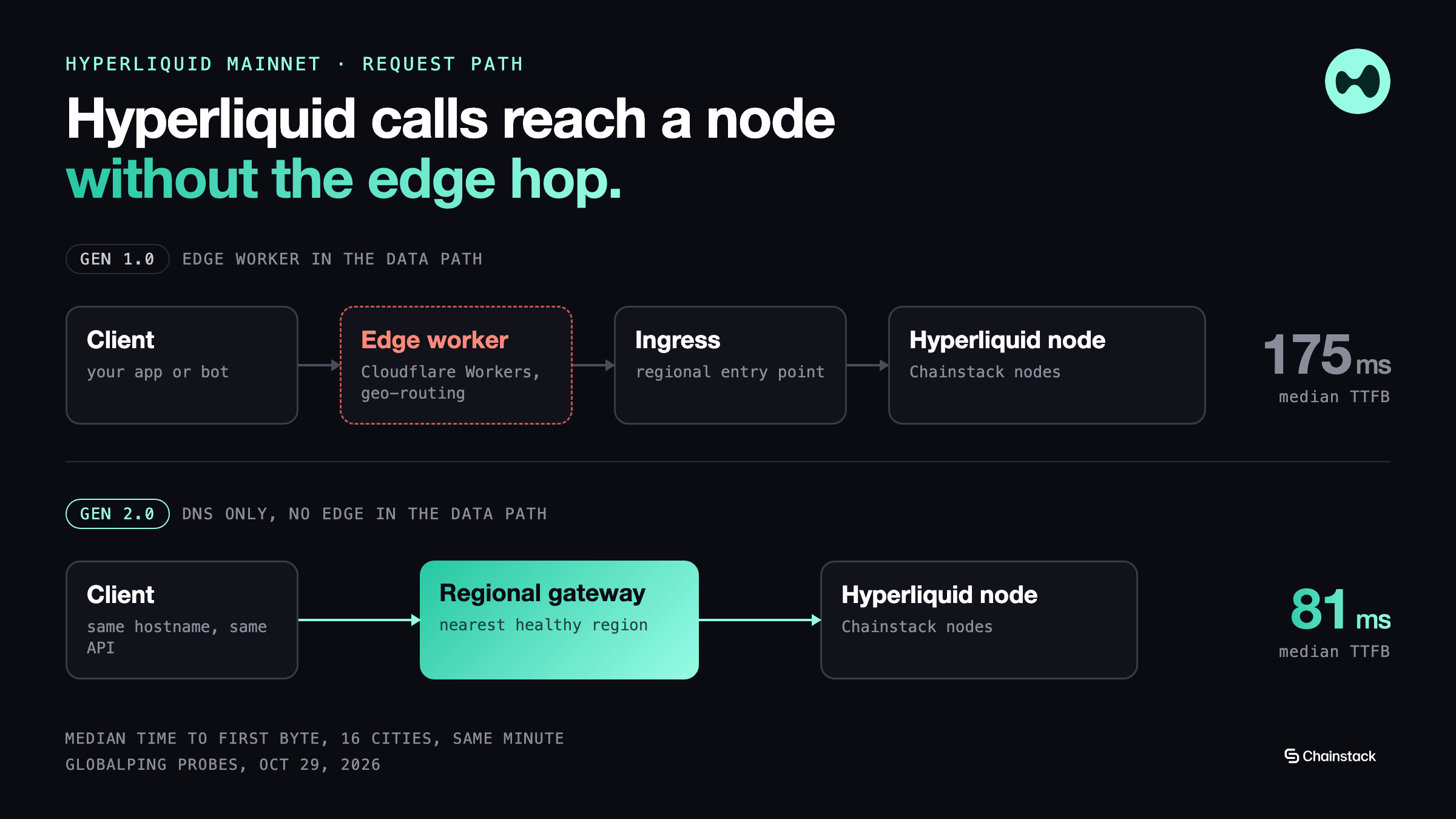
The wider rollout. Hyperliquid is one of the chains moved to GEN 2.0. For the architecture and the rest of the list, see Chainstack GEN 2.0 is live: faster Global Nodes.
How we measured Hyperliquid
We sent an RPC request to a Chainstack Hyperliquid endpoint from Globalping probes in 16 cities and recorded the TTFB on two routes in the same minute on Oct 29, 2026: the pre-GEN 2.0 route through Cloudflare and the GEN 2.0 direct route.
Unlike on some other chains, every one of the 16 cities used the same probe on both routes, so the headline covers all 16 and the full table has no asterisks.
Hyperliquid mainnet results: median TTFB fell from 175 ms to 81 ms
| Metric (16 cities) | Before GEN 2.0 | GEN 2.0 |
|---|---|---|
| Median TTFB | 175 ms | 81 ms |
| Mean TTFB | 286 ms | 93 ms |
| Reduction at the median | – | 53.7% |
| Faster at the median | – | 2.2x |
| Cities that improved | – | 15 of 16 |
| Range of improvement | – | 0.8x to 48.0x |
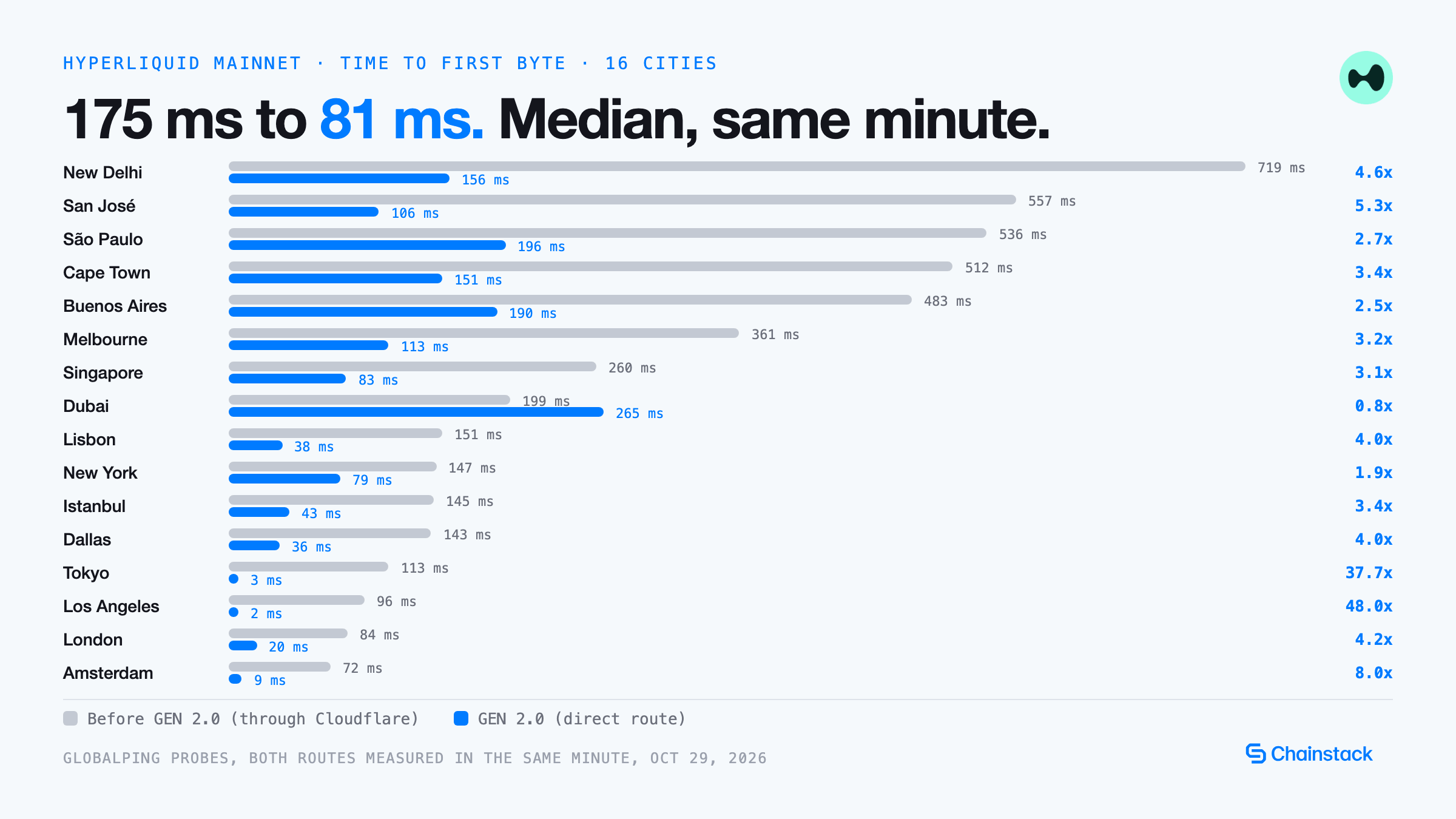
Full per-city results (Hyperliquid mainnet)
| City | Country | Before GEN 2.0 (ms) | GEN 2.0 (ms) | Saved (ms) | Faster (x) |
|---|---|---|---|---|---|
| New Delhi | India | 719 | 156 | 563 | 4.6 |
| San José | Costa Rica | 557 | 106 | 451 | 5.3 |
| São Paulo | Brazil | 536 | 196 | 340 | 2.7 |
| Cape Town | South Africa | 512 | 151 | 361 | 3.4 |
| Buenos Aires | Argentina | 483 | 190 | 293 | 2.5 |
| Melbourne | Australia | 361 | 113 | 248 | 3.2 |
| Singapore | Singapore | 260 | 83 | 177 | 3.1 |
| Dubai | United Arab Emirates | 199 | 265 | -66 | 0.8 |
| Lisbon | Portugal | 151 | 38 | 113 | 4.0 |
| New York | United States | 147 | 79 | 68 | 1.9 |
| Istanbul | Turkey | 145 | 43 | 102 | 3.4 |
| Dallas | United States | 143 | 36 | 107 | 4.0 |
| Tokyo | Japan | 113 | 3 | 110 | 37.7 |
| Los Angeles | United States | 96 | 2 | 94 | 48.0 |
| London | United Kingdom | 84 | 20 | 64 | 4.2 |
| Amsterdam | Netherlands | 72 | 9 | 63 | 8.0 |
All 16 rows used the same probe on both routes. A value of 0.8x means the GEN 2.0 route was slower in that city.
Where Hyperliquid gains the most
- In milliseconds: New Delhi saves 563 ms (719 ms to 156 ms), San José 451 ms (557 ms to 106 ms) and Cape Town 361 ms (512 ms to 151 ms).
- As a ratio: Los Angeles drops from 96 ms to 2 ms (48.0x), Tokyo from 113 ms to 3 ms (37.7x) and Amsterdam from 72 ms to 9 ms (8.0x).
- The smallest gain: New York improves 1.9x, from 147 ms to 79 ms.
- The exception: Dubai is the only city that got slower, from 199 ms to 265 ms (0.8x).
How does Hyperliquid compare today?
Compare ranks providers on p95 latency and success rate, measured for Hyperliquid from Germany, Japan and the US, over methods that include the Hyperliquid-specific clearinghouseState and openOrders. As of Nov 18, 2026 (last 7 days), Chainstack ranks #1:
- Score 0.030 (lower is better), availability 99.93%.
- p50 / p95 / p99: 17 ms / 29 ms / 863 ms.
- p95 by probe region: Germany 19 ms, US 46 ms, Japan 21 ms.
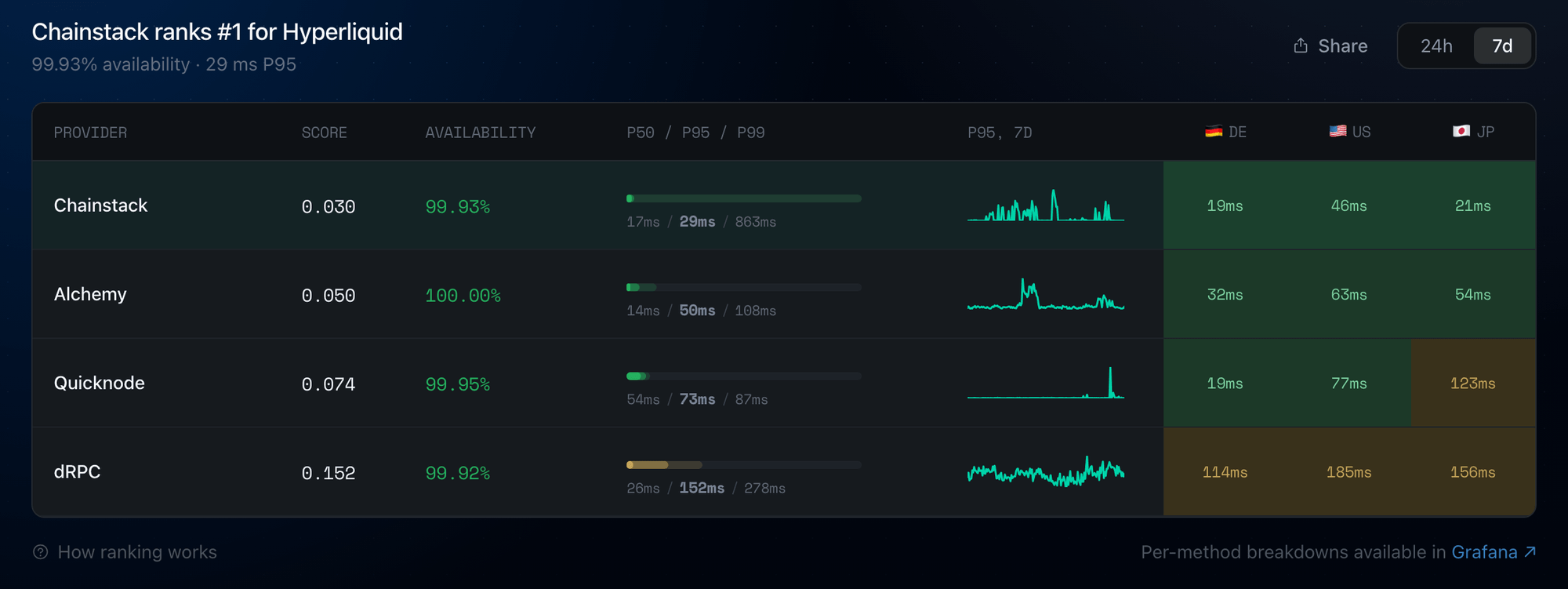
The next provider is at 0.050. The weak spot is the tail: p99 is 863 ms against 87 to 278 ms for the other three, and one provider shows 100.00% availability against 99.93% here. The live view is Hyperliquid on Compare. For a fixed window (Nov 5 to Nov 12, 2026, score 0.028), see the Hyperliquid RPC provider benchmark: latency and uptime (November 2026).
How to read these numbers (and what they don’t prove)
- One run, 16 cities. Every row is a single measurement from Oct 29, 2026. With 16 cities the median is steady, but single rows such as Dubai can be noise.
- TTFB, not total call time. The clock stops at the first byte, so it leaves out the download of large responses (a wide
eth_getLogsrange, for example) and the time the node spends computing them. - One request type. The A/B timed one RPC request per probe, so it does not show how Hyperliquid-specific calls such as
clearinghouseStatebehave. - Chainstack against Chainstack. The A/B compares two Chainstack routes. For other providers, see Compare and the Chainstack vs Alchemy RPC benchmark, where Chainstack won 52.4% of HyperEVM JSON-RPC regional p95 comparisons and Alchemy led Asia (61.8%).
What this means for Hyperliquid builders
Hyperliquid bots and dashboards poll all day: a bot reading market state before it acts, a portfolio tool refreshing positions, a wallet loading balances. From far regions the saving is hundreds of milliseconds per call (New Delhi 563 ms, San José 451 ms), and it repeats on every loop iteration.
In short: GEN 2.0 is a major update, as significant for Hyperliquid RPC users as a protocol upgrade is for the network. Same endpoint, same API, and a median first byte of 81 ms instead of 175 ms.
To try Hyperliquid on GEN 2.0, deploy a Global Node on the free Developer plan in a few seconds. More about Hyperliquid on Chainstack.
FAQ
Yes, nothing to reconfigure. The hostname and the API are unchanged, and GEN 2.0 applies to Hyperliquid mainnet.
On Hyperliquid mainnet the median time to first byte fell from 175 ms to 81 ms, about 2.2x, in a same-minute test from 16 cities on Oct 29, 2026. The gain ranged from 1.9x to 48.0x in the 15 cities that improved.
No. 15 of 16 did. Dubai went from 199 ms to 265 ms, and the other 15 gained between 1.9x and 48.0x.
On Compare, Chainstack ranks #1 on score for the last 7 days (0.030 as of Nov 18, 2026), with the lowest p95 in the US and Japan and a tie in Germany. The tail is the weak spot: p99 is 863 ms, higher than the other providers, and availability is 99.93%.
Seven: eth_call, eth_getBalance, eth_getLogs, eth_getTransactionReceipt, eth_blockNumber and the Hyperliquid-specific clearinghouseState and openOrders, measured from Germany, Japan and the US. The score combines p95 latency per method with the success rate, and lower is better.
No. It is the median of one A/B test in 16 cities on Oct 29, 2026, and your result depends on where your servers and users are.
Related reading
- Chainstack GEN 2.0 is live: faster Global Nodes
- Hyperliquid on Compare
- Hyperliquid RPC provider benchmark: latency and uptime (November 2026)
- Hyperliquid RPC provider scores for production DApps (November 2026)
- Hyperliquid RPC nodes and APIs
- Chainstack vs Alchemy RPC benchmark: 7 networks, November 2026