AI-ready infrastructure
 Refer and earn


 Ethereum
 Hyperliquid
 Solana
 Arbitrum
 BNB Smart Chain
 Base
 Polygon
 TRON
 Sui
 Robinhood


Arbitrum RPC Provider Benchmark: Latency & Uptime (November 2026)

Data source: Chainstack Compare for Arbitrum and the Grafana dashboard pinned to this window. Window: 7 days, Nov 5, 2026, 14:06 UTC to Nov 12, 2026, 14:06 UTC. Captured Nov 12, 2026, 14:06 UTC.
Disclosure: Chainstack runs the probes, the dashboard, and the scoring formula behind this report, and Chainstack is one of the four providers ranked. The collection code is open source in the compare-dashboard-functions repository.
Abstract
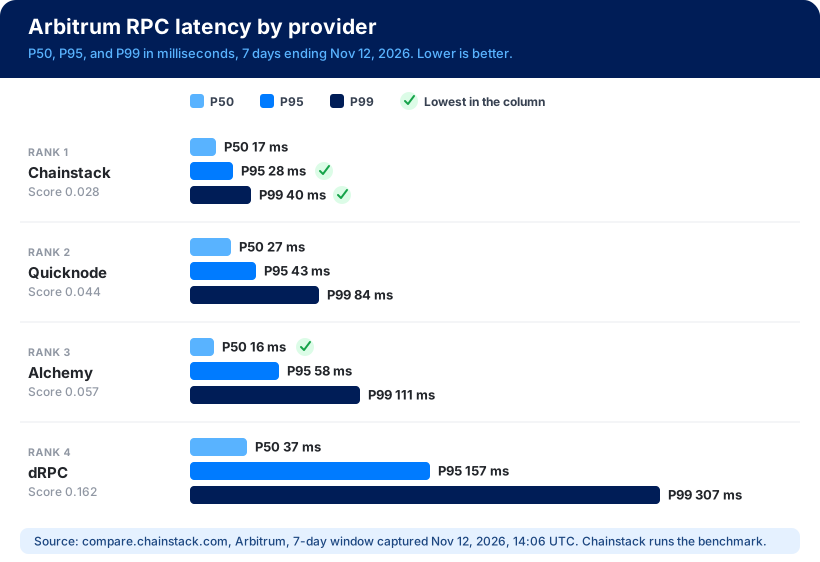
This report ranks four Arbitrum RPC provider endpoints (Chainstack, Quicknode, Alchemy, and dRPC) on latency and uptime over the 7 days ending Nov 12, 2026, measured from three regions. Chainstack has the lowest score on Arbitrum at 0.028, and Quicknode is second at 0.044. Chainstack does not lead every column: Alchemy has the lowest P50 on Arbitrum at 16 ms, and Alchemy ties Chainstack on availability at 99.99%.
Key findings
- Chainstack has the lowest Arbitrum score, 0.028. Quicknode follows at 0.044, Alchemy at 0.057, and dRPC at 0.162. The Quicknode score is 60% above the Chainstack score.
- Chainstack has the lowest P95 and P99 on Arbitrum, at 28 ms and 40 ms. Quicknode is second on both, at 43 ms and 84 ms.
- Alchemy has the lowest P50 on Arbitrum, 16 ms. Chainstack does not lead P50: Chainstack is second at 17 ms, 1 ms behind Alchemy.
- Chainstack has the lowest P95 from all three probe regions on Arbitrum, at 20 ms from DE, 20 ms from JP, and 43 ms from the US.
- Chainstack and Alchemy tie on availability at 99.99%. Quicknode measured 99.98% and dRPC measured 99.16%. All four providers had at least one failed request in the window.
Arbitrum RPC provider comparison: latency and uptime
| Rank | Provider | Plan | Score | Availability | P50 | P95 | P99 | DE P95 | JP P95 | US P95 | Best for |
|---|---|---|---|---|---|---|---|---|---|---|---|
| 1 | Chainstack | First paid plan | 0.028 | 99.99% | 17 ms | 28 ms | 40 ms | 20 ms | 20 ms | 43 ms | Lowest score, P95, and P99; lowest P95 in DE, JP, and US; highest availability (tied) |
| 2 | Quicknode | Growth | 0.044 | 99.98% | 27 ms | 43 ms | 84 ms | 27 ms | 26 ms | 76 ms | – |
| 3 | Alchemy | Growth | 0.057 | 99.99% | 16 ms | 58 ms | 111 ms | 50 ms | 61 ms | 62 ms | Lowest P50; highest availability (tied) |
| 4 | dRPC | First paid plan | 0.162 | 99.16% | 37 ms | 157 ms | 307 ms | 49 ms | 202 ms | 220 ms | – |
Lower is better in every column except availability. The table covers Arbitrum for the 7 days from Nov 5, 2026, 14:06 UTC to Nov 12, 2026, 14:06 UTC, and bold marks the best value in each column, including Chainstack and Alchemy tied on availability.
The gap between first and second place on Arbitrum reads two ways. The Quicknode score (0.044) is 60% above the Chainstack score (0.028), and the Chainstack score is 37% below the Quicknode score. Both figures describe the same 0.016 difference. Ranking the four Arbitrum providers by score gives the same order as ranking them by P95.
Contents
- Abstract
- Key findings
- Arbitrum RPC provider comparison: latency and uptime
- How the Arbitrum RPC benchmark works
- Provider results: Chainstack vs Quicknode vs Alchemy vs dRPC
- Arbitrum RPC latency by region
- Conclusion
- Frequently asked questions
- Appendix: measurement parameters
- Related reports
How the Arbitrum RPC benchmark works
The figures in this report come from the Chainstack Compare dashboard for Arbitrum, and the description below repeats what that dashboard documents.
Probes and cadence. A Python service on Vercel serverless functions sends requests to each Arbitrum RPC provider every 1–3 minutes.
Regions. The service probes from three regions, which the Compare page labels DE, JP, and US. Each region counts equally in the Arbitrum score.
Methods probed. The Arbitrum dashboard measures eight RPC methods:
eth_calleth_getBalance(archive)eth_getLogseth_getTransactionReceiptdebug_traceTransactioneth_blockNumberdebug_traceBlockByNumbereth_subscribe
All requests use the latest blocks, except the archive method, which queries historical blocks from 1–2 days ago.
Failure rule. A response time above 55 seconds counts as a failure and is excluded from the latency charts.
Plan monitored. Unless the dashboard names a plan, the first paid plan of each RPC provider is monitored. The dashboard names Growth for Quicknode and Alchemy, and names no plan for Chainstack and dRPC.
Formula. The dashboard scores each provider with this formula, where a lower score is better:
Score = 1 / ((1/ResponseTime) × (SuccessRate³))The response time is the arithmetic mean of each method’s P95. eth_subscribe is excluded from that mean, because its latency reflects chain block cadence and not provider speed, but eth_subscribe still counts toward the success rate. Methods are weighted equally for latency, and the success rate uses sample counts. The score is computed per region and then averaged across the three regions, so one slow region cannot be hidden by fast ones. The score is in seconds, so 0.028 reads as 28 ms.
Window. The window is the dashboard’s rolling 7 days, ending at the capture time of Nov 12, 2026, 14:06 UTC.
Limits
- What is not measured. The Arbitrum benchmark covers response time and success rate for the eight methods above from three regions. The benchmark does not measure throughput, rate limits, price, data correctness, support, or any method outside that list.
- Chainstack chose the formula. Chainstack designed the scoring formula and the method list, and Chainstack is ranked by them. A different formula or method mix could order the Arbitrum providers differently.
- Roster. Only the four providers the dashboard monitors for Arbitrum are ranked: Chainstack, Quicknode, Alchemy, and dRPC. Other Arbitrum RPC providers are absent because the dashboard does not monitor them, not because of their results.
- One plan per provider. Chainstack, Quicknode, Alchemy, and dRPC are each measured on a single plan on Arbitrum. Other plans of those providers may perform differently.
- Pinned link. The pinned Grafana link shows this exact window only while the dashboard retains the data. The live dashboard shows a newer window and its numbers will differ from this report.
Provider results: Chainstack vs Quicknode vs Alchemy vs dRPC
1. Chainstack on Arbitrum
- Verdict: Chainstack ranks first on Arbitrum with a score of 0.028, 37% below second-placed Quicknode.
- Leads: Chainstack leads P95 (28 ms), P99 (40 ms), DE P95 (20 ms), JP P95 (20 ms), and US P95 (43 ms), and ties Alchemy on availability at 99.99%.
- Trails: Chainstack does not lead P50 on Arbitrum. Chainstack P50 is 17 ms against 16 ms for Alchemy, a 1 ms difference, and P50 is the only column where Chainstack is behind another provider.
- Regional spread: Chainstack is quickest from DE and JP at 20 ms and slowest from the US at 43 ms, a 2.2x spread.
2. Quicknode on Arbitrum
- Verdict: Quicknode ranks second on Arbitrum with a score of 0.044, 60% above Chainstack.
- Leads: Quicknode leads no column on Arbitrum. Quicknode availability is 99.98%, behind Chainstack and Alchemy at 99.99%.
- Trails: Quicknode is furthest behind on P99, at 84 ms against 40 ms for Chainstack, a 44 ms difference. Quicknode measures 76 ms from the US probe, 33 ms behind Chainstack.
- Regional spread: Quicknode is quickest from JP at 26 ms and slowest from the US at 76 ms, a 3.0x spread.
3. Alchemy on Arbitrum
- Verdict: Alchemy ranks third on Arbitrum with a score of 0.057.
- Leads: Alchemy leads P50 (16 ms) and ties Chainstack on availability at 99.99%.
- Trails: Alchemy is furthest behind on P99, at 111 ms against 40 ms for Chainstack, a 71 ms difference. Alchemy measures 61 ms from the JP probe, 41 ms behind Chainstack.
- Regional spread: Alchemy is quickest from DE at 50 ms and slowest from the US at 62 ms, a 1.2x spread, the narrowest of the four Arbitrum providers.
4. dRPC on Arbitrum
- Verdict: dRPC ranks fourth on Arbitrum with a score of 0.162.
- Leads: dRPC leads no column on Arbitrum. dRPC availability is 99.16%, behind Chainstack and Alchemy at 99.99% and Quicknode at 99.98%.
- Trails: dRPC is furthest behind on P99, at 307 ms against 40 ms for Chainstack, a 267 ms difference. dRPC measures 220 ms from the US probe, 177 ms behind Chainstack.
- Regional spread: dRPC is quickest from DE at 49 ms and slowest from the US at 220 ms, a 4.5x spread, the widest of the four Arbitrum providers.
Arbitrum RPC latency by region
| Region | Lowest P95 on Arbitrum | Provider |
|---|---|---|
| DE | 20 ms | Chainstack |
| JP | 20 ms | Chainstack |
| US | 43 ms | Chainstack |
Chainstack leads all three probe regions on Arbitrum in this window. The full order for each region follows.
From the DE probe, Chainstack leads Arbitrum at 20 ms, followed by Quicknode at 27 ms, dRPC at 49 ms, and Alchemy at 50 ms. From the JP probe, Chainstack leads Arbitrum at 20 ms, followed by Quicknode at 26 ms, Alchemy at 61 ms, and dRPC at 202 ms. From the US probe, Chainstack leads Arbitrum at 43 ms, followed by Alchemy at 62 ms, Quicknode at 76 ms, and dRPC at 220 ms.
The region columns are P95 figures. On the P50 column of the main table, Alchemy leads Arbitrum at 16 ms and Chainstack follows at 17 ms.
Conclusion
Chainstack has the lowest score on Arbitrum for the 7 days ending Nov 12, 2026, at 0.028, with Quicknode second at 0.044, which is 60% above Chainstack. The column to read depends on the workload:
- Typical request latency: read P50. Alchemy leads Arbitrum at 16 ms, and Chainstack follows at 17 ms.
- Tail latency: read P95 and P99. Chainstack leads Arbitrum on both, at 28 ms and 40 ms.
- Users or servers in one region: read that region’s P95. Chainstack leads Arbitrum from DE at 20 ms, from JP at 20 ms, and from the US at 43 ms.
- Uptime: read availability. Chainstack and Alchemy both measured 99.99% on Arbitrum, Quicknode measured 99.98%, and dRPC measured 99.16%.
The standings move between windows, so check the live Arbitrum standings on Chainstack Compare before relying on any figure in this report.
Frequently asked questions
Which Arbitrum RPC provider has the lowest latency?
Chainstack has the lowest P95 and P99 latency on Arbitrum, at 28 ms and 40 ms, for the 7 days ending Nov 12, 2026. Alchemy has the lowest P50 on Arbitrum at 16 ms, ahead of Chainstack at 17 ms.
Which Arbitrum RPC provider has the highest availability?
Chainstack and Alchemy tie for the highest availability on Arbitrum at 99.99% for the 7 days ending Nov 12, 2026. Quicknode measured 99.98% and dRPC measured 99.16% on Arbitrum, and each of the four providers had at least one failed request in the window.
Which Arbitrum RPC provider has the lowest P95 in each region?
Chainstack has the lowest Arbitrum P95 from all three probe regions: 20 ms from DE, 20 ms from JP, and 43 ms from the US. Quicknode is second from DE at 27 ms and from JP at 26 ms, and Alchemy is second from the US at 62 ms.
How is the Arbitrum RPC benchmark score calculated?
The Chainstack Compare score is 1 / ((1/ResponseTime) × (SuccessRate³)), computed per region and averaged across the three regions, and a lower score is better. The response time is the mean of each method’s P95, excluding eth_subscribe. Chainstack scored 0.028 on Arbitrum and dRPC scored 0.162.
Appendix: measurement parameters
| Parameter | Value |
|---|---|
| Chain | Arbitrum |
| Providers ranked | Chainstack, Quicknode, Alchemy, dRPC |
| Plans monitored | Quicknode Growth, Alchemy Growth; first paid plan for Chainstack and dRPC |
| Window | 7 days, Nov 5, 2026, 14:06 UTC to Nov 12, 2026, 14:06 UTC |
| Capture time | Nov 12, 2026, 14:06 UTC |
| Probe regions | DE, JP, US |
| Probe cadence | Every 1–3 minutes |
| Probe service | Python service on Vercel serverless functions |
| Methods probed | eth_call, eth_getBalance (archive), eth_getLogs, eth_getTransactionReceipt, debug_traceTransaction, eth_blockNumber, debug_traceBlockByNumber, eth_subscribe |
| Failure rule | Response time above 55 seconds |
| Formula | Score = 1 / ((1/ResponseTime) × (SuccessRate³)), per region, then averaged |
| Compare page | compare.chainstack.com, Arbitrum, 7d |
| Pinned dashboard | Grafana, this window |
| Live dashboard | Grafana, current window |
| Collection code | chainstacklabs/compare-dashboard-functions |
Related reports