AI-ready infrastructure
 Refer and earn


 Ethereum
 Hyperliquid
 Solana
 Arbitrum
 BNB Smart Chain
 Base
Base Polygon
 TRON
TRON Sui
Sui Robinhood


Top 7 Arbitrum RPC providers for RWA in 2026

Real-world asset tokenization has moved past pilot programs and onto production infrastructure, and Arbitrum is one of the chains institutions actually settle on. BlackRock’s BUIDL fund holds roughly $2.46 billion across eight chains — Arbitrum among them — as of June 2026, and Ondo Finance’s USDY Treasury token spans Ethereum, Solana, Arbitrum, and Aptos, backing a business that carried $3.78 billion in TVL by mid-2026 (rwa.xyz). Tokenized real-world asset AUM overall crossed $22 billion by May 2026, led by tokenized Treasuries and private credit.
None of that runs on a retail-grade RPC connection. RWA issuance and settlement on Arbitrum means checking an ERC-3643 or ERC-1400 compliance registry before every transfer, reconstructing historical state for NAV calculations, and producing an auditable trace of exactly what a transaction did — not just whether it succeeded. That combination of read-heavy compliance checks, archive-depth lookups, and regulator-facing trace output is a different load profile than a DeFi front end or a wallet backend, and it rules out providers that quietly drop trace support or gate archive access behind enterprise sales calls.
Fund administrators, transfer agents, and custody platforms building on Arbitrum share a common constraint: every operational action — issuing a token, processing a redemption, onboarding an investor — has to be defensible after the fact. That’s why the provider evaluation here weighs archive depth and trace completeness as heavily as raw throughput. A provider that’s fast for standard reads but can’t produce a full execution trace on a two-year-old transaction is not a viable long-term infrastructure choice for a regulated issuer, however good its uptime numbers look on a status page.
This guide compares seven RPC providers for Arbitrum RWA workloads specifically: what each one supports for compliance-registry calls, historical state, and transaction tracing, what it costs at the volumes an issuance or custody platform actually runs, and where each one falls short.
RWA on Arbitrum: RPC requirements
Compliance-heavy Arbitrum applications lean on a narrower set of methods than a typical DeFi integration, and most of them are either archive-priced or trace-priced rather than standard reads. On Chainstack, a standard call costs 1 request unit; a call against a block more than roughly 127 blocks behind the chain tip — the archive threshold — costs 2 RUs, and debug/trace calls cost 2 RUs regardless of block age, per the request units documentation. That pricing model matters here because RWA workloads hit the 2-RU tier constantly: every historical NAV reconstruction is an archive read, and every audit trace is a trace call.
Arbitrum’s Nitro upgrade also splits the tracing story in two. debug_traceTransaction works for post-Nitro blocks (block 22,207,815 onward); for anything before that boundary, you need the chain-native arbtrace_transaction method instead. A provider that only implements one of the two has a blind spot for either recent transactions or pre-Nitro history — worth checking explicitly rather than assuming “trace support” covers both.
Throughput on the compliance side tends to look different from a typical DeFi integration too: instead of a steady stream of quote requests, an issuance or transfer-agent platform runs bursts of eth_call checks around subscription and redemption windows, with eth_getLogs indexing running continuously in the background to keep the identity and claims registry current. Sizing a plan around average daily volume alone tends to undercount the burst, since compliance checks cluster around settlement cycles rather than spreading evenly across the day.
Key RPC methods for Arbitrum RWA:
eth_callagainst anIdentityRegistry.isVerified()orCompliance.canTransfer()view function — the pre-transfer compliance gate every ERC-3643/ERC-1400 token enforces.eth_getLogsfiltered onTransfer,TransferRestricted,IdentityRegistered, andClaimAddedevents — how compliance and custody systems index who holds what and which claims are attached to an identity.eth_getStorageAtagainst historical blocks — used to reconstruct NAV oracle state, redemption queues, and identity-claim storage at a specific point in time; this is an archive-tier call the moment the target block is outside the recent window.eth_getBlockByNumber— Arbitrum’s sequencer confirms transactions in roughly a quarter of a second, but that confirmation is not the same as L1-anchored settlement finality, which trails behind by the batch-posting and challenge-period timeline. Fund administrators reconciling NAV against L1 settlement should track confirmation depth rather than treat sequencer confirmation as final — this endpoint only exposes"latest","earliest", and"pending"tags on Arbitrum, so building a finality check means tracking block confirmations yourself rather than requesting a"finalized"tag the way you would on Ethereum L1.debug_traceTransaction/arbtrace_transaction— full execution trace for regulatory audit trails, split across the Nitro boundary as described above.eth_getCode— confirms the bytecode at a compliance-registry or token address actually matches the expected ERC-3643/ERC-1400 implementation before a system trusts it.eth_getTransactionReceipt— the confirmation record custody and fund-admin systems reconcile against for settlement bookkeeping.
Provider comparison
| Provider | Pricing model | Free tier | Archive + trace on Arbitrum | MEV protection | Why it matters for RWA |
|---|---|---|---|---|---|
| Chainstack | Flat request units, 1 RU standard / 2 RU archive+trace | 3M RU/month | Yes, both debug_* and arbtrace_*, unrestricted at Growth tier and above |
Optimized Submission (opt-in) | Predictable per-call cost for a workload that’s almost entirely archive and trace calls |
| RouteMesh | Per-request, routes across underlying providers | Free community endpoint | Depends on routed provider | Inherited from routed provider | Failover across providers for settlement-critical transfer flows |
| OnFinality | Tiered API + dedicated nodes | 5 RPS free | Yes, on paid tiers | Not applicable (aggregator) | Managed indexing (SubQuery) for compliance-event and audit-trail pipelines |
| Infura | Credit-based, tiered plans | 3M daily credits | Debug/Trace included from the Developer plan ($50/mo) | Not published | Lowest-cost path to trace access, but no published compliance attestation |
| GetBlock | Pay-per-use or flat monthly | 40,000 daily requests | SOC 2 Type II attested; dedicated infrastructure for trace-heavy workloads is custom-quoted | Not published | Attested compliance posture at a lower entry price than the tier-1 providers |
| Alchemy | Compute-unit based, tiered plans | Limited free tier | No — debug_traceTransaction and arbtrace_* are not available for Arbitrum on Alchemy |
Not published | Fine for compliance-check reads, not viable if audit tracing is a requirement |
| Quicknode | Credit-based, method-weighted | 10M credits, 15 RPS | Yes, debug_* and arbtrace_* both supported |
Not published | Full trace support at tier-1 pricing, no Arbitrum-specific discount plan |
Provider-by-provider breakdown
Chainstack
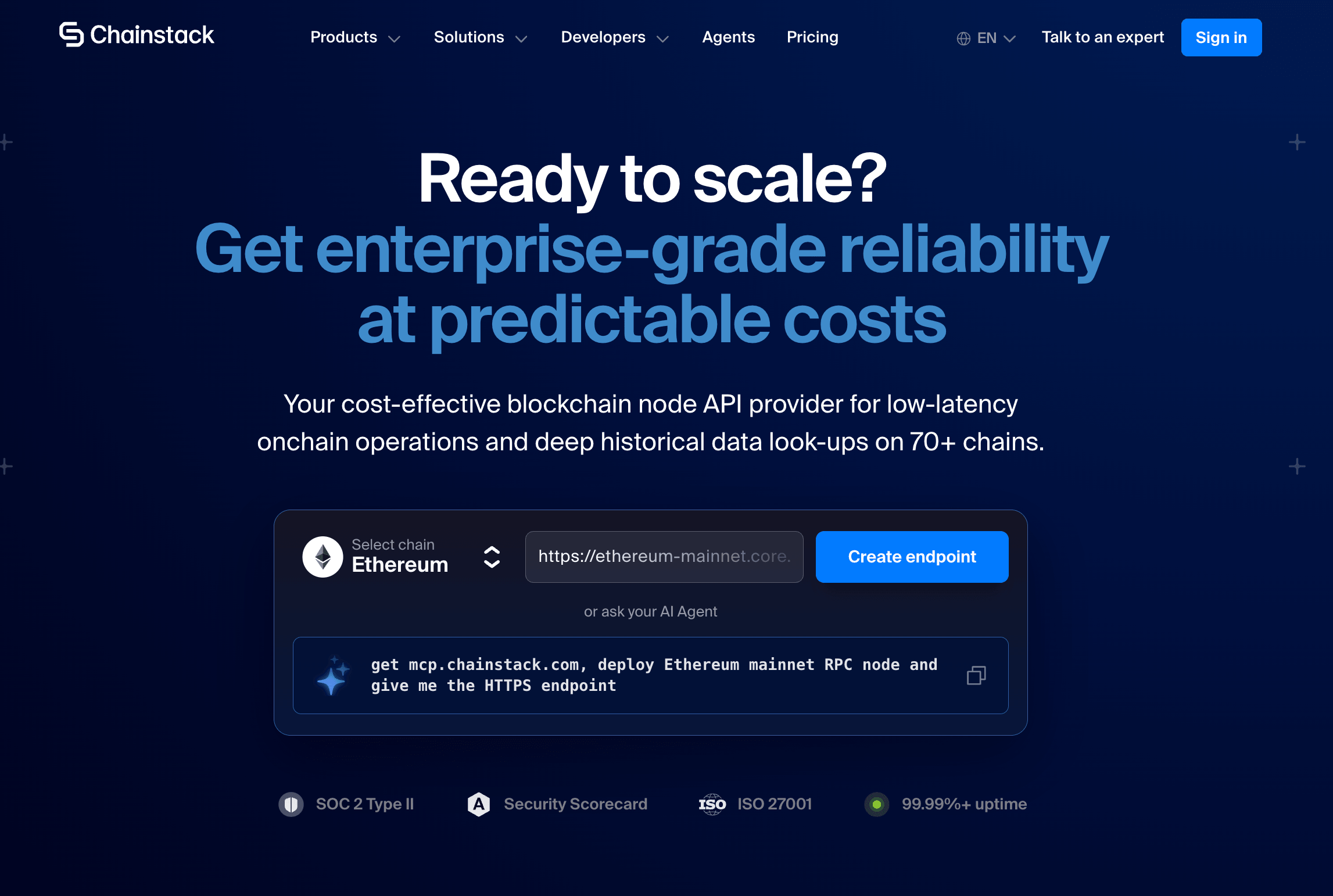
Chainstack runs Arbitrum RPC infrastructure with unrestricted debug_* and arbtrace_* access on Global Nodes and Dedicated Nodes, at a flat 2 RU per archive or trace call regardless of how deep the historical query goes. For an RWA platform running constant compliance-registry reads and periodic audit traces, that flat multiplier is the whole pitch: no separate trace-access tier, no per-method surcharge stacked on top of the archive rate.
Request-unit pricing means an RWA compliance pipeline that’s mostly 2-RU archive and trace calls doesn’t get penalized twice — Chainstack’s own API Units converter shows its 1x request-unit baseline against Alchemy’s 26x compute-unit multiplier and Quicknode’s 20x credit multiplier, and Chainstack’s pricing page cites typical migration savings of 50-66% for teams switching from Alchemy or QuickNode, with archive- and trace-heavy workloads sitting at the wider end of that gap given how much more those competitors’ multipliers weigh a trace call. Archive Nodes start at $49/month, and Dedicated Nodes are available from $0.50/hour for teams that want isolated infrastructure rather than a shared endpoint.
Chainstack holds SOC 2 Type II and ISO 27001 certification, both current as of the most recent audit cycle — relevant for RWA issuers and fund administrators whose own compliance requirements flow down to infrastructure vendors. Arbitrum Global Nodes also support Optimized Submission, a private, optimized submission path designed to reduce inclusion delays (off on a new node until you enable it from the Add-ons tab), which is useful for RWA-adjacent settlement flows that route through DEX liquidity rather than pure custody transfers. An MCP server is available for teams that want to manage nodes from an AI coding assistant rather than the console.
RouteMesh
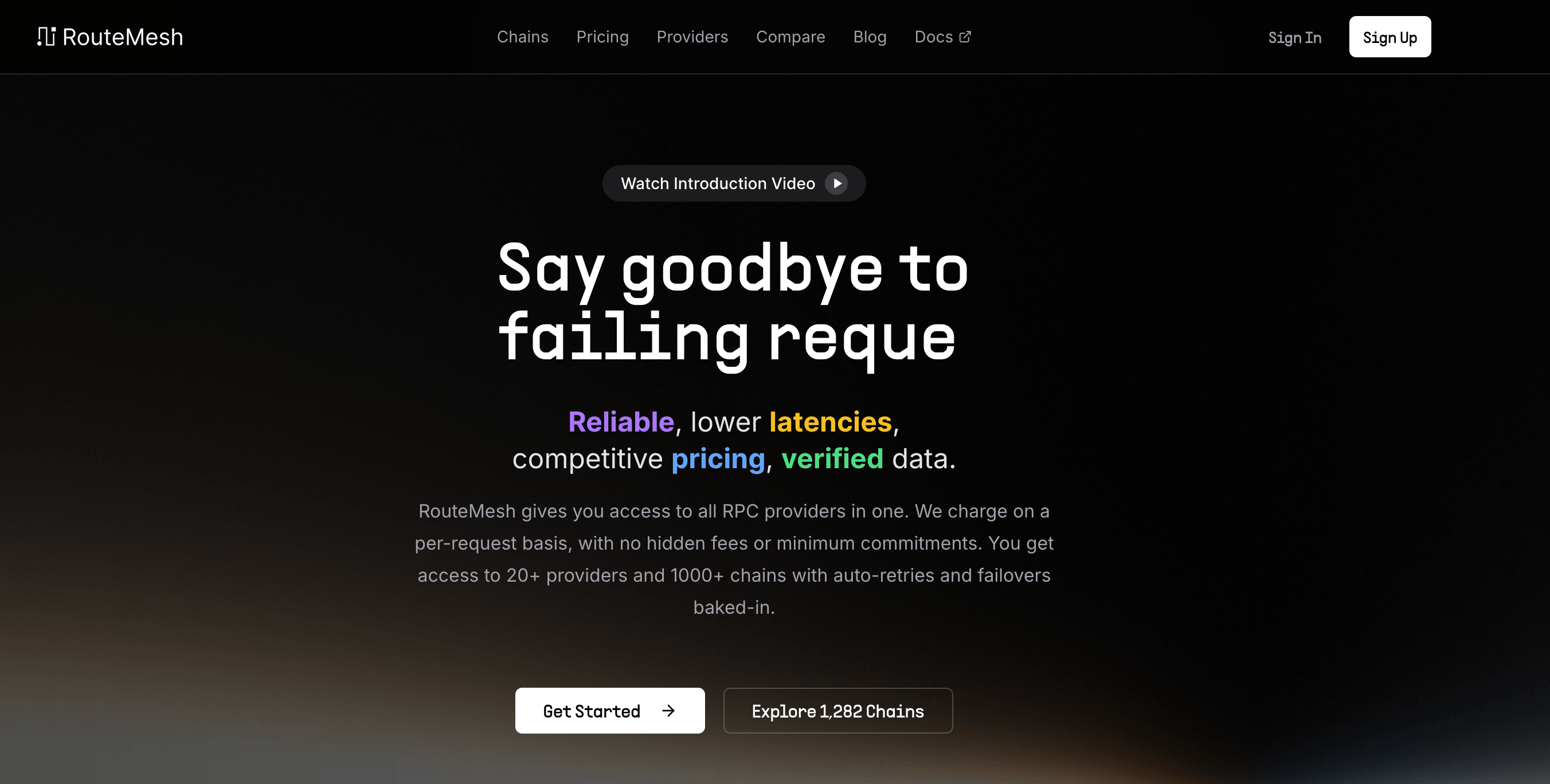
RouteMesh is an intelligent RPC routing layer that sits in front of multiple underlying providers across more than 1,000 EVM networks, making real-time health-scored routing decisions and failing over automatically when an upstream provider degrades. For Arbitrum specifically, RouteMesh confirms full support with a free community endpoint and 65 supported methods, with transaction-sensitive requests routed to premium infrastructure behind the scenes.
That failover model is a genuine fit for RWA settlement flows where a dropped or delayed transfer confirmation has compliance consequences, not just a bad user experience — a redemption that silently fails to confirm because a single upstream provider degraded is an operational incident for a fund administrator, not just a support ticket. RouteMesh’s customer base — including LI.FI routing 97% of its EVM RPC calls through the platform across 60+ chains, plus Vaults.fyi and DAMM Capital — reflects production reliability at scale rather than a thin proxy layer. Pricing is per-request and varies by key type, chain, and method; archive and trace depth on Arbitrum depends on which underlying provider a given request gets routed to, so teams with strict trace-availability requirements should confirm routing behavior for their specific method mix before relying on it as a primary path. RouteMesh also happens to route a portion of its Arbitrum traffic to Chainstack infrastructure, though that’s one routing detail among several rather than the reason to pick it.
OnFinality
OnFinality is a multi-chain node service covering more than 100 networks, with a managed API tier, dedicated and enterprise node options, and — the differentiator that matters most for this use case — managed SubQuery indexer hosting. RWA compliance and audit pipelines are fundamentally indexing problems (who holds what, which claims are attached, what transferred when), and having that indexing layer managed rather than self-hosted removes a real operational burden from a compliance team.
OnFinality’s public Arbitrum access is capped at 5 RPS on the free tier and 500 RPS on paid plans, with archive and debug/trace access gated to paid tiers rather than available on the shared endpoint. Node infrastructure spans regions including Hong Kong, France, and Northern Virginia, which is a relevant detail for institutions with data-residency requirements around where compliance-sensitive queries get processed. Dedicated and Enterprise Node tiers are available for teams that outgrow the shared API service, alongside AI Agent and staking products that are less relevant to this specific use case. OnFinality operates independently of Chainstack — it’s a separate multi-provider platform, not a reseller arrangement — so evaluate it on its own indexing and infrastructure merits.
Infura
Infura’s Developer plan, at $50/month for 15 million daily credits, is the cheapest way to get Debug/Trace API access on Arbitrum among the providers compared here — the free Core tier caps out at 3 million daily credits without trace access at all. For a smaller RWA pilot that needs occasional audit traces but isn’t running production settlement volume yet, that’s a meaningfully lower entry point than the tier-1 providers.
The tradeoff is compliance posture: Infura does not publish a SOC 2 or ISO 27001 attestation on its public pricing or trust materials, which is a real gap for a fund administrator or custodian whose own regulatory obligations require verifying vendor security certifications rather than taking availability on faith. Team and Enterprise plans scale to 75 million daily credits and custom volumes respectively, but the certification gap doesn’t close with plan tier — it’s a company-level posture, not a pricing-tier feature. For an internal tooling or reporting layer that never faces an external auditor, that gap may not matter; for anything a regulator or institutional counterparty will eventually ask about, it’s worth flagging early rather than discovering during a vendor security review.
GetBlock
GetBlock covers more than 100 chains including Arbitrum on a pay-per-use or flat monthly model, with a free tier at 40,000 daily requests, a pay-as-you-go tier starting at $29 for 5 million-plus requests, and an Unlimited plan at $499/month. What sets GetBlock apart from Infura on this specific comparison is that it carries a SOC 2 Type II attestation (audited by Atom Assurances, Q2 2026) at a price point well under Chainstack’s or Quicknode’s entry-level dedicated tiers.
Trace and debug access for high-volume Arbitrum workloads runs through GetBlock’s dedicated node offering, which is custom-quoted rather than published as a fixed price — worth getting a specific number for your volume before assuming it undercuts a Chainstack or Quicknode dedicated plan on trace-heavy usage. The pay-as-you-go tier’s 5-million-request floor also means smaller pilots pay a flat $29 regardless of whether they use a fraction of that allowance, which is a different cost shape than the RU- or credit-metered providers below it. For teams that need an attested compliance posture without committing to tier-1 pricing, GetBlock is a reasonable middle tier; for teams running constant trace calls at scale, the custom dedicated-node quote is the number that decides it either way.
Alchemy
Alchemy is priced on compute units rather than flat requests, and Chainstack’s own API Units converter puts Alchemy’s multiplier at roughly 26x Chainstack’s baseline — meaning a workload of archive-heavy eth_getStorageAt and eth_call compliance checks burns through a compute-unit allowance considerably faster than the same call volume would against a flat-RU provider. For read-only compliance verification at moderate volume, Alchemy’s tooling and reliability are solid; the CU cost just needs to be modeled against actual call volume rather than assumed comparable to a per-request quote.
The disqualifying gap for this specific use case is trace support: debug_traceTransaction and the arbtrace_* namespace are not available for Arbitrum on Alchemy at all — trace API coverage there is effectively Ethereum-mainnet-only. Any RWA workflow that needs a regulator-facing execution trace on an Arbitrum transaction — which is most of them, given how central audit trails are to this use case — needs a second provider for that specific call, full stop, regardless of how well Alchemy otherwise performs on the read side. A team already standardized on Alchemy for Ethereum work could still route compliance-check reads there and send only the trace calls elsewhere, but running the primary Arbitrum RWA endpoint on Alchemy alone leaves the audit-trail requirement unmet.
Quicknode

Quicknode supports both debug_* and arbtrace_* on Arbitrum, so unlike Alchemy it’s a viable single-provider option for teams that need both compliance reads and full audit tracing. Pricing runs on a method-weighted credit system across tiers from the free 10M-credit/15 RPS plan up through Business+ tiers around $2,999/month for 7 billion credits, with Quicknode’s own credit multiplier landing around 20x Chainstack’s flat RU baseline per Chainstack’s published conversion figures — trace calls specifically carry a heavier credit weighting than standard reads, so a trace-dense RWA workload should be modeled against the credit table rather than the headline monthly price.
There’s no Arbitrum-specific flat-rate plan on Quicknode’s current pricing page — if that’s a detail from an older comparison, it isn’t reflected in the plans on offer today. What Quicknode does offer is full trace coverage at every plan tier from Build upward, which puts it ahead of Alchemy on capability even though it sits at the same general price bracket. For a team that has already standardized tooling and monitoring around Quicknode across other chains, extending that same setup to Arbitrum RWA workloads is a reasonable path — the credit cost simply needs to be modeled against the specific method mix, since trace calls consume the allowance faster than standard reads do.
Getting started with Arbitrum RPC infrastructure on Chainstack
Deploying an Arbitrum endpoint on Chainstack takes a few minutes, and the same node handles both the compliance-check reads and the archive/trace calls an RWA pipeline needs — no separate provisioning step for trace access.
- Log in to the Chainstack console (or create an account).
- Create a new project
- Select Arbitrum as your blockchain protocol
- Choose network: Arbitrum One Mainnet or Arbitrum Sepolia testnet
- Deploy the node
- Open Access and credentials and copy your HTTPS and WebSocket endpoints
For trace-heavy compliance workloads, evaluate Dedicated Nodes after the initial deploy — isolated infrastructure removes the shared-endpoint rate limits that constant debug_traceTransaction and archive calls can otherwise run into.
from web3 import Web3

w3 = Web3(Web3.HTTPProvider("YOUR_CHAINSTACK_ENDPOINT"))

# ERC-3643/ERC-1400 compliance registry
REGISTRY_ADDRESS = "YOUR_REGISTRY_ADDRESS"
REGISTRY_ABI = [{"inputs": [{"name": "investor", "type": "address"}],
                  "name": "isVerified", "outputs": [{"type": "bool"}],
                  "stateMutability": "view", "type": "function"}]

registry = w3.eth.contract(address=REGISTRY_ADDRESS, abi=REGISTRY_ABI)

# Pre-transfer compliance check
is_verified = registry.functions.isVerified("YOUR_INVESTOR_ADDRESS").call()

print(f"Investor verified: {is_verified}")
📖 For the full integration guide, see the Chainstack Arbitrum tooling documentation.
🤖 You can also access Chainstack Arbitrum RPC directly from Claude, Cursor, Codex, Windsurf, Gemini CLI, GitHub Copilot, Antigravity, Claude.ai, or ChatGPT using Chainstack MCP. For a fuller agent stack — MCP, the Chainstack skill, llms.txt for context ingestion, and WebMCP for agentic browsers — see the Chainstack Agents page.
Conclusion
For Arbitrum RWA infrastructure specifically, the decision mostly comes down to how a provider handles the two things every compliance pipeline actually calls constantly: archive-depth state reads and post-transfer execution traces. Chainstack’s flat 2-RU archive-and-trace pricing and unrestricted debug_*/arbtrace_* access across the Nitro boundary make it the default recommendation, particularly once Optimized Submission and the SOC 2/ISO 27001 attestations are weighed alongside the raw cost per call. RouteMesh and OnFinality are worth layering in for failover and managed indexing respectively, rather than as replacements for a primary provider — both are independent platforms with their own strengths, not partners standing in for Chainstack. Infura and GetBlock are reasonable lower-cost options if trace access matters more than a published compliance attestation (Infura) or a moderate attestation at a moderate price is the target (GetBlock). Alchemy works fine for read-only compliance checks but cannot serve as a sole provider if audit tracing on Arbitrum is a requirement, and Quicknode is a solid full-trace alternative to Chainstack at a comparable price bracket, without the request-unit cost advantage.
Whichever combination a team lands on, the evaluation should be redone periodically rather than treated as a one-time decision — trace availability, compliance attestations, and pricing tiers on every provider in this comparison have shifted at least once in the last year, and an RWA platform’s own audit obligations tend to only get stricter over time.
Frequently asked questions
Q: Why can’t I request Arbitrum’s "finalized" block tag the way I would on Ethereum L1?
Arbitrum’s eth_getBlockByNumber only documents "latest", "earliest", and "pending" — there’s no "finalized" parameter. The sequencer confirms transactions in roughly a quarter of a second, but that’s not the same as L1-anchored settlement finality, so NAV reconciliation against true finality means tracking block confirmation depth yourself rather than requesting a tag.
Q: Should an RWA platform use an aggregator like RouteMesh or OnFinality instead of a direct provider such as Chainstack?
RouteMesh and OnFinality are independent multi-provider platforms with no formal partnership with Chainstack — they route or index across many underlying providers rather than replacing one outright. They’re worth layering in for failover (RouteMesh) or managed compliance-event indexing (OnFinality), but neither substitutes for a primary provider with a usable free tier for testing, such as Chainstack’s 3 million request units per month.
Q: What does migrating an existing Alchemy or Infura Arbitrum integration to Chainstack involve?
Arbitrum RPC is standard JSON-RPC across providers, so migration is mostly swapping the endpoint URL rather than rewriting integration code. The harder part is re-estimating cost: Chainstack’s published API Units converter puts its request-unit baseline at roughly 1x against Alchemy’s ~26x compute-unit multiplier and Quicknode’s ~20x credit multiplier, which is the tool to run your current call volume through before choosing a new plan tier.
Q: Does RPC latency matter for RWA compliance checks the way it does for DeFi trading?
Less on raw single-call latency, more on burst headroom. Compliance checks cluster around subscription and redemption windows rather than spreading evenly across the day, so a plan sized to average daily volume tends to undercount the burst — provision for peak RPS around settlement cycles, not the daily average.
Q: What compliance certifications should an RWA custody platform look for in an Arbitrum RPC provider?
SOC 2 Type II and ISO 27001 are the two most commonly requested in institutional vendor reviews. Among the seven providers compared here, Chainstack and GetBlock both hold SOC 2 Type II attestations (Chainstack adds ISO 27001), while Infura and Alchemy publish neither — worth confirming directly with a provider rather than assuming coverage from general reputation.
Q: How do request units, compute units, and credits actually compare for an RWA workload?
They aren’t directly comparable 1:1. Chainstack’s request-unit model charges a flat 2 RU for any archive or trace call regardless of complexity, while Alchemy’s compute units and Quicknode’s credits both weight individual methods differently, with trace calls costing disproportionately more relative to standard reads — Chainstack’s own conversion figures put its RU baseline at roughly 1x versus Alchemy’s ~26x and Quicknode’s ~20x for comparable call volume.
Additional resources
- Arbitrum on the Chainstack blog — ongoing coverage of Arbitrum infrastructure, benchmarks, and provider comparisons
- Arbitrum’s official node providers reference — Arbitrum Foundation’s own list of infrastructure providers
- rwa.xyz — independent tracker for tokenized real-world asset market size and issuer data
- Chainstack pricing