AI-ready infrastructure
 Refer and earn


 Ethereum
 Hyperliquid
 Solana
 Arbitrum
 BNB Smart Chain
 Base
Base Polygon
 TRON
TRON Sui
Sui Robinhood


Build your onchain data layer: 8 tools to compare

An onchain product rarely runs on raw RPC calls alone. A portfolio screen needs balances and token activity. A DeFi app needs decoded events and reliable historical state. A trading product needs data that is queryable at product speed. An analytics team needs a way to explore the same activity without rebuilding the application database.
Those needs sound similar, but they lead to different architectures. Some teams should build an application-specific indexer and own the database. Others should use a managed pipeline or a broad data API. Some only need SQL and dashboards. A smaller set of applications needs query results that a smart contract can verify.
This guide compares eight tools from the Chainstack Marketplace by the data job they solve. It is not a ranking. The right choice depends on whether you are building a product backend, a data service, an internal analytics workflow, or an onchain application that needs verifiable computation.
Start with the data job
| If you need to… | Start by comparing… | Why |
|---|---|---|
| Build a custom backend around a known set of contracts | Ponder, Envio, SubQuery | These tools let you define a schema and transform contract activity into application data. |
| Query or stream large volumes of chain data | SQD, Goldsky | They provide data access and indexing infrastructure without requiring every team to operate it from scratch. |
| Add broad, multi-chain data to a product or workflow | Dune, Covalent API | Pre-indexed data and APIs reduce time spent building coverage for common data needs. |
| Feed verifiable query results into an EVM-based application | Space and Time | It is designed around indexed data, SQL, and zero-knowledge proofs of query execution. |
1. Ponder
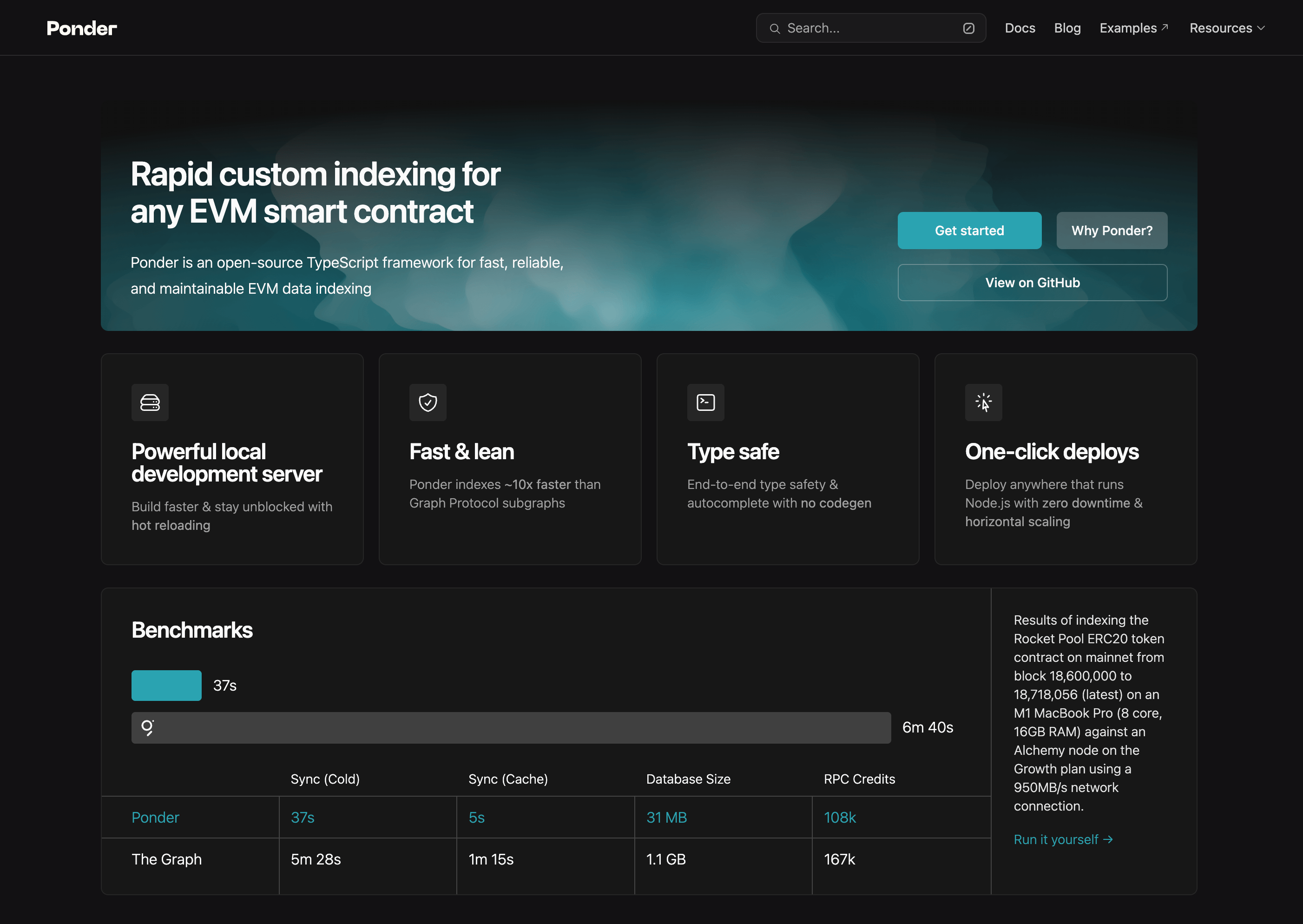
Ponder is an open-source TypeScript framework for EVM data indexing. You define how contract data should become your application’s schema, Ponder fetches the chain data, runs the indexing logic, and writes the output to Postgres. The resulting data can be queried through GraphQL, SQL over HTTP, or Postgres directly.
Ponder is a strong fit when the product logic is centered on a known contract set and the team wants control over its tables, transformations, and API. A marketplace, protocol dashboard, rewards system, or portfolio feature can often be modeled more cleanly this way than through a general-purpose blockchain API.
Choose Ponder if: your team works in TypeScript, needs EVM contract indexing, and wants a Postgres-backed application database it can own and extend.
Think twice if: you need broad multi-chain data immediately or do not want to operate and model an application-specific data layer.
2. Envio
Envio provides tooling around HyperIndex, HyperSync, HyperRPC, and Envio Cloud. Its documentation positions HyperIndex as part of a real-time blockchain indexing workflow.
Envio is worth evaluating when you want to create a product-specific indexer but care about fast access to onchain data and a managed deployment path. It belongs in the same early evaluation as Ponder and SubQuery, but the implementation model, deployment experience, chain coverage, and operational requirements will matter more than a generic feature checklist.
Choose Envio if: you need a custom indexer and want to compare a real-time indexing stack with hosted deployment options.
Think twice if: you only need a ready-to-query API or an analyst-facing dashboard. A broad data platform may take less engineering time.
3. SubQuery
SubQuery is an open-source data indexer that creates custom APIs for Web3 projects across supported chains. Its indexer workflow uses a GraphQL schema, mapping functions, local testing, and a query layer that applications can call.
SubQuery is useful when a team wants to transform blockchain activity into a custom query service without designing every part of the infrastructure from zero. It also makes sense for teams that want a local development path and the option to run a managed production project.
Choose SubQuery if: your product needs a custom GraphQL data layer and you want an indexing workflow with a clear build, run, query, and publish path.
Think twice if: you need a small, tightly controlled EVM-only database or want a pure SQL-first workflow. Compare the data model and developer experience against Ponder before committing.
4. SQD
SQD is listed in the Chainstack Marketplace as Subsquid. Its current documentation describes an HTTP API for raw blockchain data, TypeScript SDKs for decoding and persisting data, and managed indexer hosting on SQD Cloud.
SQD is a strong option when the application needs access to raw or transformed chain data at scale, but the team does not want to build a full data collection network. Its Portal API, SDKs, and Cloud offering cover different needs, so choose the entry point based on whether you want live queries, a custom indexer, or managed deployment.
Choose SQD if: you need data access across many networks, SDK-based transformations, or a managed place to run a production indexer.
Think twice if: your needs are limited to a handful of contracts on one EVM chain. A narrower indexer can be easier to operate and reason about.
5. Goldsky
Goldsky positions itself as a backend for crypto-enabled products. Its current products include subgraphs, Mirror for streaming real-time data into a database, Turbo pipelines, Edge RPC, and Compose for onchain and offchain workflows.
Goldsky becomes particularly useful when a product needs to turn contract data into a GraphQL surface, replicate data into its own database, or build a pipeline around real-time events. The decision is less about whether you need data and more about the interface your application needs after indexing.
Choose Goldsky if: you need managed subgraphs, database replication, streaming pipelines, or application backend components for crypto products.
Think twice if: you only need a one-off analytics query or an existing data API already supplies the fields you need.
6. Dune
Dune is an onchain data platform for analytics, data engineering, and application development. Its Data Hub supports querying, visualizing, and sharing blockchain data, while its APIs, dbt connector, Datashare, and external BI integrations give teams ways to use data outside a dashboard.
Dune is the obvious starting point when the first problem is understanding a market, protocol, or user behavior rather than operating a bespoke application database. It can also grow beyond analysis: teams can execute queries programmatically, export data to a warehouse, and build production data models with its dbt connector.
Choose Dune if: you want SQL, dashboards, data discovery, programmatic query access, or an existing warehouse workflow before investing in a custom indexer.
Think twice if: your product depends on a custom write model, a tightly controlled schema, or a latency-sensitive API built only around your contracts. Build an indexer for that core product path.
7. Covalent API
Covalent API is the Marketplace entry for Covalent’s data access layer. Covalent’s current documentation describes the network as indexing blockchain data and making it accessible through the GoldRush API, formerly called the Unified API.
Covalent is useful when your product needs broad blockchain data through an API instead of a custom indexing project. This can be a pragmatic path for wallets, portfolio features, token views, transaction history, and other features where the application needs normalized data across networks.
Choose Covalent API if: you need multi-chain data through an API and would rather spend engineering time on the product than build an indexing pipeline for common data needs.
Think twice if: you require a custom contract schema, unusual transformations, or data that must be available under your own database and operational controls.
8. Space and Time
Space and Time is different from the other entries in this list. Its documentation describes SXT Chain as a decentralized layer 1 blockchain for securing financial data onchain, with indexed blockchain data, SQL queries, and zero-knowledge proofs of query execution.
Space and Time is relevant when a smart contract or onchain workflow needs more than an offchain dashboard or API response. It is designed to make query results verifiable, then return those results to an EVM contract through a callback. That is a specialized design, but it matters for applications that need to act on historical or cross-chain data with a cryptographic proof of how it was computed.
Choose Space and Time if: the product needs verifiable SQL over onchain and offchain data, with results that can be consumed by an EVM smart contract.
Think twice if: you only need internal analytics or a standard application backend. The proof system adds capability, but it also defines the architecture.
Three useful architecture patterns
Contract-specific product backend
Use this when the application has a known set of contracts and product-specific tables.
- Connect an indexer such as Ponder, Envio, or SubQuery to the required blockchain endpoint.
- Decode events and write the fields your product actually needs into your database.
- Expose a GraphQL, REST, or SQL-backed API to the frontend and internal services.
- Treat reorg handling, retries, historical backfills, and schema changes as part of the product architecture.
Product analytics and market research
Use this when the first objective is to answer questions, measure behavior, or share a dashboard.
- Start in Dune to explore the available data and validate the question.
- Use Dune’s API, Datashare, or BI integrations when the analysis needs to become repeatable.
- Add a custom indexer only when a product path truly needs its own data model or service-level control.
Verifiable data for smart contracts
Use this when an EVM-based application needs to respond to data that is too large or too expensive to compute directly onchain.
- Define the data sources and query logic carefully.
- Use Space and Time to query the relevant indexed and offchain data.
- Verify the result onchain before the contract uses it.
- Treat data provenance and update behavior as protocol-level design decisions.
What to validate before you choose
Every data tool looks straightforward in a quickstart. Production questions are more specific:
- Which chains, contracts, traces, and historical block ranges does the product actually need?
- How are chain reorganizations, missing events, and replayed backfills handled?
- Can the team evolve the schema without rebuilding the whole service?
- What is the data freshness requirement for user-facing screens?
- Does the product need a database it controls, or is an API sufficient?
- Can engineers debug a wrong balance or missing event back to its source?
- What becomes the source of truth when a dashboard, API, and application database disagree?
How Chainstack fits into the stack
Indexers need reliable access to blockchain data. For a product-owned indexing pipeline, use a Chainstack endpoint as the source of the RPC and WebSocket calls that retrieve blocks, logs, receipts, and contract state. Confirm the required chain, historical range, and data access method before you choose the indexing tool.
Data platforms such as Dune, Covalent API, and Space and Time have their own data layers. Chainstack still matters around the parts of your application that need direct chain access: live reads, writes, event subscriptions, transaction monitoring, and independent verification of product data.