AI-ready infrastructure
 Refer and earn


 Ethereum
 Hyperliquid
 Solana
 Arbitrum
 BNB Smart Chain
 Base
 Polygon
 TRON
 Sui
 Robinhood


Top 6 Helius alternatives in 2026: getProgramAccounts costs, gRPC streaming and RPS limits


Teams comparing Helius alternatives usually check these points: credits weighted by method (1 credit for standard calls and getProgramAccountsV2, 10 for getProgramAccounts or a DAS call), LaserStream gRPC on mainnet from the $499 Business plan, requests-per-second ceilings by plan, a Solana-only catalog, and dedicated nodes from $2,900 a month. This guide compares Helius with Chainstack, OnFinality, dRPC, Alchemy, Triton One, and Quicknode, checked against provider pages and docs in October 2026. Dwellir is left out because its network list and docs show no Solana endpoint.
We publish this on the Chainstack blog, so Chainstack is first and you should weigh that. Every price comes from a live provider page, and because Chainstack’s benchmark reports do not cover Solana, the performance section uses the live Solana view of Chainstack Compare instead. Moving off Helius? Start with our Helius to Chainstack switch page or jump to the migration steps.
💡 Already using Chainstack? Jump straight to the Solana tooling docs or deploy your endpoint from the console.
Why teams look for Helius alternatives
Helius is Solana-only, and its real strength is the depth of that focus: Sender is credit-free on every plan, staked connections are on by default for paid plans, and DAS, webhooks and LaserStream sit in one account. These are the points teams compare.
- Credits weighted by method. Standard calls and the paginated getProgramAccountsV2 cost 1 credit, but getProgramAccounts and every DAS call cost 10, Parsed Events 10 and legacy Enhanced Transactions 100, and extra credits are $5 per 1M on paid plans. At 10 credits a call, 1M getProgramAccounts calls use all 10M credits of the $49 Developer plan, or $50 at the overage rate; the same 1M calls on getProgramAccountsV2 use 1M credits, about $4.90.
- gRPC by plan and metered by data. LaserStream gRPC on mainnet needs the Business ($499) or Professional ($999) plan, Developer includes devnet only, and usage costs 2 credits per 0.1 MB of uncompressed data. Spent only on streaming, Business’s 100M credits equal about 5 TB.
- Requests-per-second ceilings by plan. RPC limits are 10 (Free), 50 (Developer), 200 (Business) and 500 (Professional), with 100 extra RPS sold for $100 a month on Professional. sendTransaction is limited to 1, 5, 50 and 100 a second (Sender has a separate 50 a second on every plan) and getProgramAccounts to 5, 25, 50 and 75.
- One chain. Helius serves Solana mainnet and devnet, so a team that also runs EVM or other networks needs a second provider, where Chainstack lists 70+ chains.
- Dedicated nodes, support tiers and SLAs rise by plan. Dedicated nodes start at $2,900 a month with Yellowstone gRPC and no shared-plan rate limits, support targets are 24 hours on Developer, 12 on Business and 8 on Professional, and Enterprise adds uptime SLAs. Helius lists a SOC 2 Type II report on its Trust Center, and we found no published ISO 27001.
Helius alternatives compared: credits, free tier, and Solana RPS limits (2026)
The table below summarizes public positioning as of October 2026. Plans and prices change often, so check each provider’s page before you decide.
| Rank | Provider | Best for | Pricing model | Free tier | Dedicated nodes | Solana RPS and limits | Standout |
|---|---|---|---|---|---|---|---|
| — | Helius (for reference) | — | Credits: 1 per standard call, 10 for getProgramAccounts and DAS; Developer $49 (10M), Business $499 (100M), Professional $999 (200M); $5 per extra 1M | Yes, 1M credits, 10 RPS, community support | From $2,900 a month | 50, 200 and 500 RPS on paid plans; getProgramAccounts 25, 50 and 75 a second; sendTransaction 5, 50 and 100 a second | Solana-only, DAS API, webhooks, Sender on every plan, LaserStream |
| 1 | Chainstack | Account scans and streaming on flat meters, with Yellowstone gRPC and Warp transactions from $49 a month | Flat request units, 1 RU full, 2 RU archive, debug and trace; getProgramAccounts is 1 RU | Yes, Developer plan, 3M RU, no card, 5 RPS on Solana Mainnet; getProgramAccounts not included | Yes, from the Pro plan ($199 a month) plus compute and storage; the one Solana Mainnet full-node flavor in the catalog is about $3,577 a month before the plan fee | Solana Mainnet 5 RPS on Developer and 50 on Growth; getProgramAccounts by program size, up to 20 RPS | Yellowstone gRPC from $49, Warp transactions, SOC 2 Type II and ISO 27001 |
| 2 | OnFinality | Pay-as-you-go dedicated Solana nodes and indexer hosting | Response units, 2 per Solana method; Growth $49 plus node and API usage costs | Yes, 400,000 response units a day | Dedicated nodes, pay-as-you-go | 40, 200 and 500 units a second on Developer, Growth and Accelerate | 130+ networks, indexer hosting |
| 3 | dRPC | A flat 20 CU per Solana request with no monthly plan | Pay as you go, flat 20 CU per request at $0.30 per 1M CU, $6 per 1M requests | Yes, 210M CU a month (about 10.5M requests), public nodes only | No self-serve dedicated plan; NodeCore is open-source self-hosted | About 100 RPS per IP on free, 5,000 RPS on Growth | 130+ chains, flat price |
| 4 | Alchemy | DAS and Photon APIs next to RPC, plus Yellowstone gRPC and Jito bundle methods on paid plans | Compute units, 10 for getAccountInfo and 20 for getProgramAccounts; $0.525 per 1M CU on Pay As You Go | Yes, 30M CU a month, 15 RPS | Dedicated Clusters, quoted by sales | 15 RPS on Free, from 300 RPS on Pay As You Go | DAS and Photon APIs, gRPC at $75 per TB, 100+ chains |
| 5 | Triton One | Bandwidth-metered Dragon’s Mouth gRPC from the team behind the Yellowstone plugin | Prepaid: $10 per 1M calls plus $0.08 per GB of bandwidth, $125 minimum deposit | No free trial | From $2,900 a month, with unmetered gRPC | 1,200 requests per 10 seconds per IP by default, adjustable; heavy methods lower | Created the Yellowstone plugin; self-serve pricing for Solana, Sui and Monad only |
| 6 | Quicknode | RPC plus Streams, Webhooks, and a DAS add-on, at 30 credits per Solana call | Credits with a per-chain multiplier, 30 per call on Solana; Build $49 (80M credits) | 1-month trial, 10M credits, 15 RPS, no card | Dedicated Clusters on Enterprise | 15 RPS on the trial, 50 on Build; getProgramAccounts 3 a second | Streams, Webhooks, Metaplex DAS add-on, SOC 2 and ISO 27001 on its security page |
Official pricing pages: Helius, Chainstack, OnFinality, dRPC, Alchemy, Triton One, Quicknode.
True cost per call = (method’s unit weight × price per million units) ÷ 1,000,000. Multiply by monthly call volume for the real bill. Here it is for one heavy Solana method, getProgramAccounts, at each provider’s entry paid plan, assuming you use the included allowance in full, where a plan has one.
| Provider | Unit weight for getProgramAccounts | Entry paid plan | Cost per 1M calls |
|---|---|---|---|
| Helius (for reference) | 10 credits | Developer, $49 with 10M credits, $5 per extra 1M | $49.00 in allowance, $50.00 at overage (1 credit for getProgramAccountsV2: $4.90 and $5.00) |
| Chainstack | 1 RU | Growth, $49 with 20M RU, $15 per extra 1M RU | $2.45 in allowance ($2.00 on annual billing), $15.00 at overage |
| OnFinality | 2 response units | Growth, $49 plus node and API usage costs, 20M units, $6 per extra 1M | $4.90 in allowance, $12.00 at overage |
| dRPC | Flat, 20 CU (default for methods not in its table) | Growth, $6 per 1M requests, no allowance | $6.00 at any volume |
| Alchemy | 20 CU | Pay As You Go, $0.525 per 1M CU | $10.50 (the Free plan’s 30M CU cover 1.5M calls) |
| Triton One | Not weighted: $10 per 1M calls plus bandwidth | Prepaid balance, $125 minimum | Not comparable per call: $10.00 plus $0.08 per GB returned ($18.00 if responses average 100 KB) |
| Quicknode | 30 credits | Build, $49 a month ($34 billed annually) with 80M credits, $0.62 per extra 1M | $18.38 in allowance on monthly billing ($12.75 on annual), $18.60 at overage |
Among the alternatives, Chainstack has the lowest figure inside the plan allowance ($2.45) and dRPC the lowest once allowance runs out ($6.00 against Chainstack’s $15.00 at Growth overage). Helius’s paginated getProgramAccountsV2 at 1 credit ($4.90 and $5.00) is lower than every alternative at overage, though it returns pages of up to 10,000 accounts, so a full scan takes several calls. OnFinality’s $4.90 excludes its node and API usage costs, and Quicknode’s $18.38 and $18.60 are the highest of the five per-call prices. Triton One’s price depends on how much data each response returns, so we do not rank it. The table does not price rate limits: Chainstack’s $2.45 comes with 50 RPS overall on Solana Mainnet but only 5 to 20 getProgramAccounts a second by program size, against 25 a second (and 50 RPS overall) on Helius Developer.
Sources: Helius credits and plans docs, Chainstack request units, and the OnFinality, dRPC, Alchemy, Triton One and Quicknode pricing and method-cost pages. To model your own mix, use the interactive cost calculator.
Landing, streaming and data APIs on Solana
This is where Solana providers differ most. The table lists what each provider documents, and “none found” means we found nothing on the pages we checked, not that it is impossible.
| Provider | Transaction landing | Streaming | Data APIs |
|---|---|---|---|
| Helius (for reference) | Sender on every plan at 0 credits, paid with a SOL tip (0.001 SOL minimum for Sender Max, 0.000005 SOL for the SWQOS-only tier); staked connections default on paid plans at 1 credit | LaserStream gRPC on Business and up, billed by data, with up to 48 hours of replay; LaserStream WebSocket (Helius extensions) | DAS API (10 credits), Photon ZK Compression APIs, webhooks, priority fee API |
| Chainstack | Trader Nodes with Warp transactions through bloXroute, from Growth, $0.15 per transaction, HTTP only | Yellowstone gRPC add-on from Growth: $49 for 2 streams, $149 for 7, $449 for 25 | Standard Solana methods; no DAS API or webhooks product found in its Solana docs |
| OnFinality | None documented on its Solana pages | JSON-RPC WebSocket subscriptions; no gRPC stream found | Indexer hosting; no DAS found |
| dRPC | None documented | Yellowstone Geyser gRPC as a marketplace add-on: Premium $399 a month (25 streams, 5 TB included), Advanced $599 (50 streams, 10 TB) | None found |
| Alchemy | Jito bundles on paid plans | Yellowstone gRPC from $75 per TB, WebSockets billed by bandwidth | DAS and Photon APIs |
| Triton One | Staked connections (SWQoS) included, enabled on request | Dragon’s Mouth gRPC at $0.08 per GB | Metaplex DAS API at $0.08 per GB plus $50 per 1M calls |
| Quicknode | Lil’ JIT add-on for Jito bundles | Solana gRPC on Scale ($499) and up | Metaplex DAS add-on, priority fee API, Streams and Webhooks |
Performance proof: Solana latency on Chainstack Compare
Chainstack’s benchmark reports cover Ethereum, BNB Chain and Hyperliquid (September and October 2026) and Arc (September 2026), and none covers Solana. What does is Chainstack Compare, a live dashboard. Disclosure: Chainstack runs Compare and the scoring formula, and is one of the ranked providers. The Compare docs say it probes each provider from Germany, the US and Singapore every 1 to 3 minutes on paid plans (Growth, and Helius Developer, per its Solana dashboard). Score is per-method p95 response time divided by the success rate cubed, averaged across regions, so lower is better. OnFinality and Triton One are not tracked, so there are no figures for them here.
The image is the Solana view with the 7-day window, captured on October 15, 2026; the live numbers will have moved:
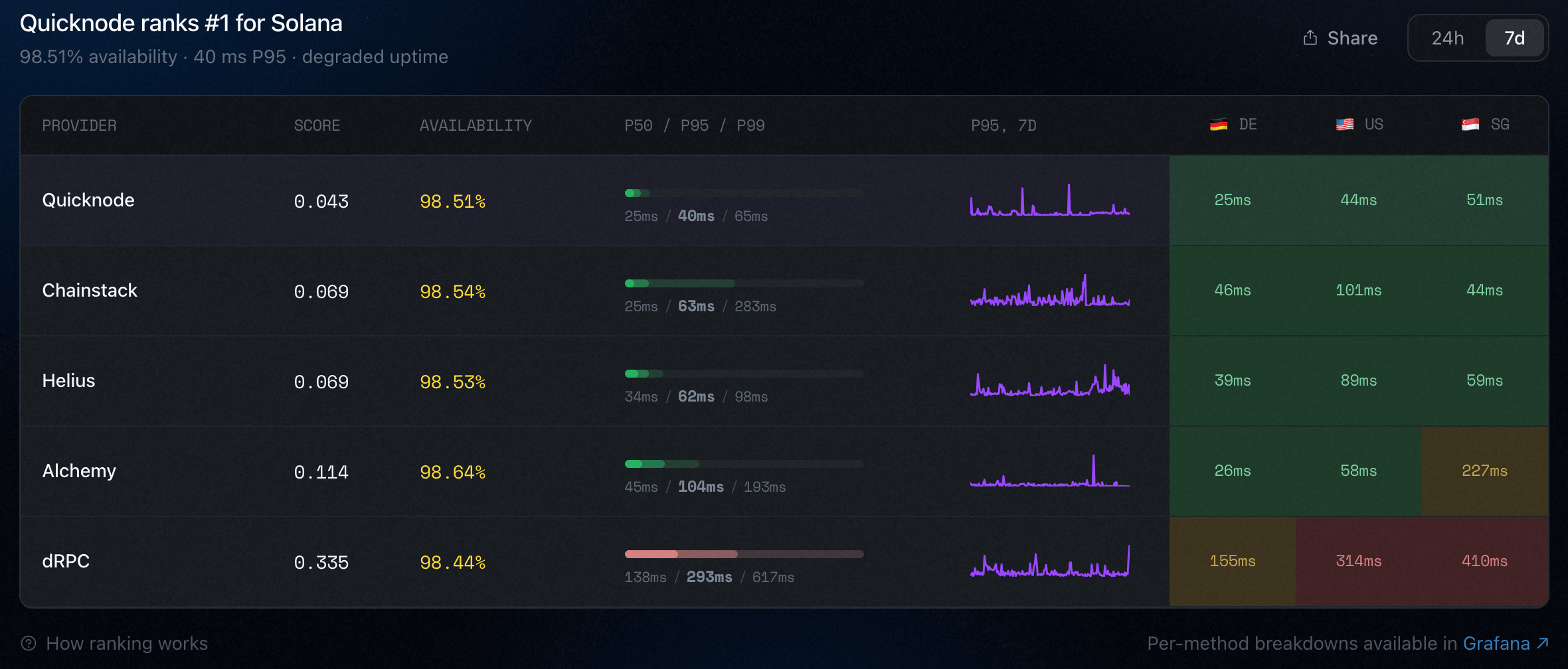
Scores in that capture: Quicknode 0.043 (P95 40 ms), Chainstack 0.069 (63 ms), Helius 0.069 (62 ms), Alchemy 0.114 (104 ms), dRPC 0.335 (293 ms). Chainstack ranks second jointly with Helius and behind Quicknode, and the capture shows where it does not lead:
- Tail latency. Chainstack’s P99 is 283 ms, against 65 ms (Quicknode), 98 ms (Helius) and 193 ms (Alchemy).
- US traffic. Chainstack’s US P95 is 101 ms, against 44 ms (Quicknode), 58 ms (Alchemy) and 89 ms (Helius).
- Where Chainstack is ahead. Its Singapore P95 is 44 ms, below Quicknode’s 51 ms and Helius’s 59 ms.
- Availability. All five sit between 98.44% and 98.64% (the view flags degraded uptime without a cause), so it does not separate them.
The EU-only transaction-landing panels on the Solana Grafana dashboard showed about 13% for every provider when we checked, so we do not quote them. Compare is one rolling window from three regions and does not measure throughput under load or cost. Chainstack chose the formula and operates the probes, so another formula could reorder close pairs; if your users sit elsewhere, run your own probes.
Top 6 Helius alternatives and what each is best for
1. Chainstack
Best for: Account scans and streaming on flat meters, with Yellowstone gRPC and Warp transactions from $49 a month.
Chainstack is a managed node provider across 70+ blockchains with Solana RPC on Mainnet and Devnet, billed in flat request units: 1 RU for a full request and 2 RU for archive, with no per-method multipliers. The free Developer plan includes 3M RU with no card required, and Growth is $49 a month ($40 billed annually) with 20M RU, per the pricing page.
Chainstack uses a flat meter with no per-method multipliers: 1 RU for a full request and 2 RU for archive on Global Nodes. On Solana, archive billing applies only to eight historical methods such as getTransaction and getSignaturesForAddress, so getProgramAccounts costs 1 RU, per the request units doc. Global Nodes route requests across Asia-Pacific, Europe and the United States. Trader Nodes with Warp transactions send sendTransaction through bloXroute’s staked connections for $0.15 a transaction from Growth (HTTP only, no front-running protection); its page claims up to a 99% landing rate, while its docs say landing depends on distance, priority fees and network conditions. The Yellowstone gRPC add-on is available from Growth at $49 for 2 concurrent streams, $149 for 7 and $449 for 25, with unlimited events. Dedicated Nodes start at the Pro plan ($199 a month) plus compute and storage, and the catalog lists one Solana Mainnet full-node flavor at about $3,577 a month before the plan fee. Chainstack holds SOC 2 Type II and ISO 27001, and its Enterprise SLA page states a 99.9% quarterly uptime commitment with service credits. Support is community-based on Discord and Telegram on the free plan; paid plans get email support under 24 hours (24×5), and Professional ($100 a month) and Premium ($1,000 a month) add under 6 hour and under 1 hour targets.
Limitations: The free plan includes 3M RU a month (extra usage is optional and billed at $20 per 1M RU, otherwise services stop at the quota), and the throughput guidelines list 5 RPS on Solana Mainnet for Developer and 50 on Growth, below the 25 and 250 RPS global plan limits shown on the pricing page and level with Helius Developer’s 50. getProgramAccounts needs a paid plan, is limited by program size (5 to 20 RPS with filters and 2 to 10 without on programs under 1M accounts, and only 3 and 2 requests per 20 seconds on larger ones), aborts scans after 60 seconds and rejects unfiltered calls to the Token programs, where Helius lists 25 a second on Developer. Its Solana docs list no DAS API or webhooks product. Growth overage ($15 per 1M RU) is above dRPC’s flat $6, so very high volume suits a custom Pay As You Go plan (from $2.5 per 1M RU, arranged with sales for high monthly spend) or an Unlimited Node add-on (from $149 a month at 25 RPS). In the Compare capture its P99 (283 ms) and US P95 (101 ms) trail Quicknode, Helius and Alchemy.
Fit by workload:
- Heavy account scans on a fixed budget: Strong, with getProgramAccounts at 1 RU, as long as the program-size RPS caps fit.
- Streaming plus landing under one account: Strong, since Yellowstone gRPC and Warp transactions both start at the $49 Growth plan.
- Compliance paperwork or isolated nodes: Strong, with SOC 2 Type II and ISO 27001 published and Dedicated Nodes from the Pro plan.
2. OnFinality
Best for: Pay-as-you-go dedicated Solana nodes and indexer hosting.
OnFinality is a multi-chain node service that its homepage says covers 130+ networks, with a Solana mainnet and devnet RPC over HTTPS and WebSocket, archive access and dedicated nodes. Its pricing page lists a free Developer plan with 400,000 response units a day, Growth at $49 a month with 20M units and $6 per extra million, Accelerate at $249 with 100M units and $3.75 per extra million, and a custom Ultimate plan.
Its Solana page lists a 2-unit weight for every method in the table, getProgramAccounts included, so the free plan covers about 200,000 calls a day. Rate limits are in response units a second: up to 40 on Developer, 200 on Growth and 500 on Accelerate, which is 20, 100 and 250 Solana calls a second. Archive access is listed on every plan and dedicated nodes are pay-as-you-go on every plan, with regions listed as N. Virginia and Hong Kong.
Limitations: Growth and Accelerate list node and API usage costs on top of the monthly fee, we found no Yellowstone gRPC stream, DAS API or transaction-landing service on its Solana pages, and no SOC 2 Type II or ISO 27001 on its pages. Chainstack Compare does not track OnFinality, so there are no latency figures for it.
Fit by workload:
- Pay-as-you-go dedicated Solana nodes: Strong, since dedicated nodes are offered on every plan.
- Moderate scan volume on a $49 budget: Good, at $4.90 per million getProgramAccounts calls inside the Growth allowance before node and API costs.
3. dRPC
Best for: A flat 20 CU per Solana request with no monthly plan.
dRPC is a pay-as-you-go RPC provider that lists 130+ chains across 232 networks, including Solana mainnet and devnet over HTTPS and WebSocket, and charges a flat 20 CU per request on every Solana method (a few such as getHealth cost 0) at $0.30 per 1M CU, which makes Growth $6 per 1M requests. Its free plan includes 210M CU a month (about 10.5M requests) on public nodes, and Growth lists 5,000 requests per second.
A method missing from its CU table defaults to 20 CU, which is how getProgramAccounts is priced. Its docs describe a Yellowstone Geyser gRPC stream sold as a marketplace add-on in two tiers: Premium at $399 a month (25 concurrent streams, 50 accounts per stream, 5 TB included, about $30 per extra TB) and Advanced at $599 (50 streams, 100 accounts, 10 TB, about $20 per extra TB). dRPC also publishes NodeCore, an open-source self-hosted RPC load balancer.
Limitations: The free plan runs on public nodes only, with, per its docs, about 100 requests per second per IP (down to about 40 under high regional demand), 3-item batches and filter methods disabled by default. There is no plan with included monthly volume, the pricing page lists no self-serve dedicated plan, and we found no published SOC 2 Type II or ISO 27001 on its pages. In the live Compare capture dRPC ranks last of five (0.335, P95 293 ms, 314 ms from the US and 410 ms from Singapore).
Fit by workload:
- High volume at one flat price: Strong, at $6.00 per million getProgramAccounts calls with no weights and no allowance to size.
- Prototypes on public nodes: Good, with about 10.5M free requests if the per-IP limits fit.
4. Alchemy
Best for: DAS and Photon APIs next to RPC, plus Yellowstone gRPC and Jito bundle methods on paid plans.
Alchemy is a multi-chain platform listing 100+ chains that includes Solana RPC with compute-unit pricing, DAS and Photon APIs, Jito bundle methods on paid plans and Yellowstone gRPC. Its pricing page lists a Free plan with 30M compute units (CU) a month and 15 requests per second, and Pay As You Go at $0.525 per 1M CU from 300 requests per second.
On Solana getAccountInfo is 10 CU and getProgramAccounts 20 CU, so the free allowance covers about 1.5M getProgramAccounts calls. Yellowstone gRPC is priced on bandwidth, from $75 per TB. Alchemy’s trust center lists a SOC 2 Type II report (access on request), and we found no ISO 27001 certification.
Limitations: Compute-unit weighting stays, so $10.50 per million getProgramAccounts calls is above Chainstack’s $2.45 and OnFinality’s $4.90 inside their plan allowances and dRPC’s flat $6.00, though below their $15.00 and $12.00 overage rates, and the free plan has no gRPC. We found no Solana-specific dedicated price, and in the live Compare capture its Singapore P95 (227 ms) is the slowest of the four leading providers, though its German (26 ms) and US (58 ms) figures are among the lowest.
Fit by workload:
- A standing free plan with a bigger allowance than a trial: Strong, with 30M CU a month on the Free plan.
- Apps that want DAS and compressed-account data next to RPC: Excellent, as those APIs ship in the same platform.
- European and US Solana reads: Alchemy posted 26 ms and 58 ms P95 in the capture, against 46 ms and 101 ms for Chainstack.
5. Triton One
Best for: Bandwidth-metered Dragon’s Mouth gRPC from the team behind the Yellowstone plugin.
Triton One is a Solana-focused infrastructure company, also serving Sui and Monad, that created the open-source Yellowstone plugin and sells its gRPC stream as Dragon’s Mouth. Pricing is prepaid pay as you go: $10 per 1M calls plus $0.08 per GB of bandwidth, with a $125 minimum deposit that is non-refundable and valid for 12 months.
Every service is included on every plan with no tiers, and staked-connection landing (SWQoS) is included at no extra cost and enabled on request. Streaming is billed on bandwidth at $0.08 per GB, and dedicated nodes start at $2,900 a month with unmetered gRPC included. A getProgramAccounts call costs the same whether it is served from a custom index or a full scan, and default limits are 1,200 requests per 10 seconds per IP.
Limitations: There is no free trial, the deposit is non-refundable, and billing on response bandwidth makes the cost of scan-heavy methods depend on payload size, so it cannot be set against per-call prices. We found no published SOC 2 Type II or ISO 27001 on its site, its self-serve pricing covers only Solana, Sui and Monad, and Chainstack Compare does not track it, so there are no comparable latency figures here.
Fit by workload:
- Streaming-heavy workloads: Strong, with the plugin’s authors running the stream at bandwidth pricing and a dedicated option with gRPC included.
- Prepaid balances without monthly tiers: Good, since services stay active while the balance is above zero.
6. Quicknode

Best for: RPC plus Streams, Webhooks, and a DAS add-on, at 30 credits per Solana call.
Quicknode is a multi-chain provider listing 75+ chains that bundles Streams and Webhooks with its node product and sets credit weight per chain, 30 credits per call on Solana. Its pricing page lists a one-month free trial (10M credits, 15 RPS, no card required) and Build at $49 a month ($34 billed annually) with 80M credits and 50 RPS.
Specialized Solana calls such as getLargestAccounts and getSupply carry a 4x multiplier, and Build’s 80M credits buy about 2.67M standard Solana calls. Solana gRPC (Yellowstone-compatible) is included from the Scale plan ($499 a month, $424 annually) and is a paid add-on on Build and Accelerate, and add-ons include Lil’ JIT for Jito bundles, a Metaplex DAS API and a priority fee API. Quicknode’s security page states SOC 1 Type 2, SOC 2 Type 2 and ISO/IEC 27001, with reports on request through an account representative (the pricing page lists them under Enterprise).
Limitations: The free entry is a trial, not a standing plan. Because Solana is 30 credits against 20 on Ethereum, a million getProgramAccounts calls cost $18.38 inside Build’s allowance on monthly billing, against $2.45 on Chainstack Growth, and $18.60 at overage, and the method has its own 3 requests a second limit. In the live Compare capture Quicknode has the best score, so this is a pricing trade-off and not a latency one.
Fit by workload:
- One vendor for RPC plus data streams and DAS: Strong, since Streams, Webhooks and a Metaplex DAS add-on sit next to the node product.
- Latency-sensitive reads in the capture: Quicknode posted the best Solana score (0.043) and the lowest P95 (40 ms) and P99 (65 ms).
How to migrate from Helius to Chainstack
Most migrations are an endpoint swap plus a testing pass. A coding agent can run the assessment from the Chainstack MCP migration runbook, and the Helius switching page compares the two platforms feature by feature. If you call Helius’s getTokenAccounts, Chainstack’s tutorial on replacing it with standard Solana methods covers the rewrite.
- Assess endpoints and usage. List every Helius endpoint and API key, your plan, and the Helius-specific features you call: DAS methods, webhooks, Sender, LaserStream or enhanced WebSocket subscriptions, the priority fee API and getProgramAccountsV2. Standard RPC methods move as they are; DAS calls and webhooks have no equivalent in Chainstack’s Solana docs.
- Deploy a node. Create a project and deploy a Solana Mainnet node on Global Nodes, then add Warp transactions on a Trader Node, the Yellowstone gRPC add-on, or Dedicated Nodes if you need isolation.
- Swap the endpoint URL. Replace the Helius HTTPS and WebSocket URLs with your Chainstack endpoints behind a config flag so you can roll back. Point gRPC clients at the Yellowstone endpoint on port 443 with the x-token and retest filters and reconnects, since LaserStream’s historical replay is Helius-specific and from_slot replays only about the last 100 slots.
- Test methods. Run your real mix: getProgramAccounts with filters against the program-size limits (errors -32602 and -32012 mean an unfiltered or oversized scan), sendTransaction through Warp instead of Sender tips, priority fees from getRecentPrioritizationFees, and subscriptions.
- Compare cost. Export a billing period of usage, count standard calls as 1 RU each and divide getProgramAccounts credits by 10, and check the result against the pricing page, noting the 5 RPS (Developer) and 50 RPS (Growth) caps on Solana Mainnet.
- Cut over gradually. Shift a share of traffic, watch errors and latency from your regions, then move the rest.
Getting started with Chainstack
Deploy a Solana endpoint in a few steps:
- Log in to the Chainstack console (or create an account).
- Create a new project
- Select Solana as your blockchain protocol
- Choose network: Solana Mainnet or Devnet
- Deploy the node
- Open Access and credentials and copy your HTTPS and WebSocket endpoints
After the first deploy, open the node’s Add-ons tab to install Yellowstone gRPC or Warp transactions, both from the Growth plan. Then connect with @solana/kit, using the setup from the Chainstack tooling docs:
import { address, createSolanaRpc } from "@solana/kit";

const rpc = createSolanaRpc("YOUR_CHAINSTACK_ENDPOINT");

const balance = await rpc
  .getBalance(address("YOUR_WALLET_ADDRESS"))
  .send();

console.log(balance.value); // lamports as bigint
📖 For the full integration guide, see the Chainstack Solana tooling documentation.
Need testnet SOL? The Chainstack Solana devnet faucet tops an address up to 1 SOL every 24 hours (it needs a Chainstack API key and an address holding at least 0.8 SOL on Solana mainnet, with a history of holding SOL).
🤖 You can also access Chainstack Solana RPC directly from Claude, Cursor, Codex, Windsurf, Gemini CLI, GitHub Copilot, Antigravity, Claude.ai, or ChatGPT using Chainstack MCP. For a fuller agent stack — MCP, the Chainstack skill, llms.txt for context ingestion, and WebMCP for agentic browsers — see the Chainstack Agents page.
Conclusion
The deciding question when you leave Helius is what you want to pay for: per-method credits with streaming by plan, or flat meters, bandwidth billing and add-on streams. Across the five alternatives with a per-call price, a million getProgramAccounts calls cost between $2.45 and $18.60 on the entry paid plan, against $49.00 on Helius Developer for getProgramAccounts at 10 credits ($4.90 for the paginated getProgramAccountsV2 at 1 credit).
- Account scans, streaming and landing on flat meters: Chainstack, with Yellowstone gRPC and Warp transactions from the $49 Growth plan, and Dedicated Nodes with SOC 2 Type II and ISO 27001.
- Pay-as-you-go dedicated Solana nodes and indexer hosting: OnFinality.
- A flat per-request price with no monthly plan: dRPC.
- DAS and Photon APIs next to RPC, with a larger free allowance: Alchemy.
- Bandwidth-metered gRPC from the authors of the Yellowstone plugin: Triton One.
- RPC plus Streams, Webhooks and a DAS add-on from one vendor: Quicknode.
Frequently asked questions
Q: Is there a free alternative to Helius’s free tier?
Yes. Helius Free has 1M credits at 10 RPS. Chainstack’s Developer plan offers 3M RU with no card and 5 RPS on Solana Mainnet, without getProgramAccounts. OnFinality offers 400,000 response units a day (about 200,000 Solana calls), dRPC 210M CU a month on public nodes (about 10.5M requests) and Alchemy 30M CU a month at 15 RPS. Triton One has no free trial, and Quicknode offers a one-month trial of 10M credits.
Q: Which Helius alternatives offer Yellowstone-style gRPC streaming?
Chainstack sells the Yellowstone gRPC add-on from the Growth plan at $49 for 2 streams, $149 for 7 and $449 for 25. We found no gRPC stream on OnFinality’s Solana pages, dRPC lists a Geyser gRPC add-on from $399 a month, Alchemy charges from $75 per TB, Triton One bills $0.08 per GB and Quicknode includes Solana gRPC from its $499 Scale plan. Helius includes LaserStream gRPC on mainnet from Business at $499.
Q: How do I land transactions without Helius Sender?
Chainstack’s Warp transactions route sendTransaction through bloXroute’s staked connections for $0.15 a transaction from Growth. We found no landing service on OnFinality or dRPC, Alchemy lists Jito bundle methods, Triton One includes staked-connection landing on request and Quicknode offers Lil’ JIT for Jito bundles. Chainstack’s page claims up to a 99% landing rate, but the landing panels on its public Solana dashboard showed about 13% for every provider when we checked, so we quote no independent figure.
Q: How do I migrate from Helius to Chainstack?
Inventory your Helius URLs, keys and Helius-specific calls (DAS, webhooks, Sender, LaserStream), deploy a Solana node, swap the endpoint, test getProgramAccounts and sendTransaction, and compare cost before cutting over. The migration runbook lets a coding agent handle the assessment.
Q: Which alternatives publish SOC 2 Type II and ISO 27001?
Chainstack publishes SOC 2 Type II and ISO 27001. We found neither certification for OnFinality, dRPC or Triton One. Helius’s Trust Center lists a SOC 2 Type II report and a SOC 3 report, Alchemy’s trust center lists a SOC 2 Type II report (access on request), and Quicknode’s security page states SOC 2 Type 2 and ISO/IEC 27001 (reports through an account representative). We found no ISO 27001 for Helius or Alchemy, so request reports from each vendor.
Q: What is the cheapest alternative for getProgramAccounts?
It depends on volume. Per million calls at the entry paid plan, Chainstack costs $2.45 inside the Growth allowance and $15.00 at overage, OnFinality $4.90 and $12.00, dRPC a flat $6.00, Alchemy $10.50, Triton One $10 plus $0.08 per GB returned and Quicknode $18.38 and $18.60, against $49.00 and $50.00 on Helius Developer for getProgramAccounts, or $4.90 and $5.00 for getProgramAccountsV2 at 1 credit. Model your own mix with the cost calculator.
Additional resources