AI-ready infrastructure
 Refer and earn


 Ethereum
 Hyperliquid
 Solana
 Arbitrum
 BNB Smart Chain
 Base
Base Polygon
 TRON
TRON Sui
Sui Robinhood


Best free tier RPCs for web3 builders in 2026

TL;DR: Every RPC provider says “free tier.” Almost none of them mean it. Some require a credit card upfront just to see the dashboard. Others throttle you into uselessness with tiny per-second quotas. Most cap real production features — WebSockets, MEV protection, dedicated endpoints — behind paid plans. A few pretend “free” means a 30-day trial that deactivates your account when it ends. If you’re a web3 builder trying to ship your first dApp without funding a subscription first, most of these free tiers waste your time. Chainstack’s Developer plan doesn’t play these games — no credit card, no trial, no time limit, and features (private endpoint, WebSockets, MEV protection, MCP for AI agents, free testnet faucet) that others charge for.
Why “free” isn’t the same everywhere
Every major RPC provider advertises a free tier. But “free” means very different things in practice.
Some providers give you a permanent free plan with real production features. Others give you a 30-day trial that deactivates your account when it ends. Some require a credit card just to see the dashboard. Some throttle you so aggressively that anything past a toy project needs a paid upgrade.
➡️ None of that on Chainstack. No trial. No countdown. No credit card at signup or at upgrade. No account deactivation after 30 days. No downgrade of features to force you onto a paid plan. The free Developer plan is a permanent, standalone plan — not a marketing funnel dressed up as one.
If you’re just starting your web3 builder journey — spinning up your first dApp, learning Solidity, prototyping a bot, testing an idea — the last thing you want is to hand over your card before you’ve written a line of code.
This article covers what you actually get on Chainstack’s Developer plan: the free tier that requires no credit card, has no time limit, and includes the features you’d normally have to pay for elsewhere.
What you actually get on Chainstack’s free Developer plan
Ten features — most of which competitors either lock behind paid tiers, gate behind a credit card, or don’t offer at all. Each section below covers one feature, what it means for a builder, and how it compares to Alchemy, Infura, and Quicknode where relevant.
1. A private, geo-balanced RPC endpoint
Yes — the free Developer plan gives you a private RPC endpoint, not a shared public URL. It lives in your Chainstack console, only your API key routes through it, and it runs on Chainstack’s geo-balanced Global Node infrastructure with “>99.99% uptime” and sub-second failover between regions. Chainstack’s own pricing page puts it plainly: “Global nodes are free on Chainstack.”
This is the difference between a public endpoint (shared with thousands of anonymous users, aggressive rate limits, 429 Too Many Requests errors, no SLA) and a private one (yours alone, higher throughput, predictable behavior). Public endpoints are fine for reading the chain occasionally. They break the moment your app has real users.
On the free plan you get:
- 3,000,000 request units per month — enough for a real prototype, not a toy
- 25 requests per second steady throughput
- Global Node architecture — requests route to the nearest region automatically
- Support for 70+ protocols including Ethereum, Solana, Bitcoin, BNB Smart Chain, Polygon, Arbitrum, Base, Optimism, TON, TRON, Starknet, Hyperliquid, and more
- Node analytics, node logs, and 2FA — all included
Why 3M requests on Chainstack is worth more than 3M elsewhere. Chainstack bills every API call as 1 request unit, regardless of the method. Quicknode’s credits and Alchemy’s compute units are weighted — the same call costs more depending on complexity, and archive/trace methods cost multiple times more. According to Chainstack’s own pricing page, 3M Chainstack request units is roughly equivalent to 75M Alchemy compute units or 60M Quicknode API credits for typical workloads. That’s the actual comparison, not the sticker number. See the full method-by-method breakdown here.
Compared to competitors: Alchemy’s free tier gives you ~30M compute units/month (roughly ~1.1M requests) but its documented rate limit is 25 req/s — comparable to Chainstack. Infura’s Core plan is 3M credits/day at 500 credits/sec (~37K standard requests/day at 80 credits each). Quicknode has no permanent free plan — its entry tier is a 30-day trial, after which the account is deactivated.
2. WebSocket endpoints — included, not upsold
Yes — WebSocket endpoints (wss://) are included on the free plan. You can subscribe to new blocks, pending transactions, log events, and account changes in real time, without polling.

Every free-plan endpoint ships with both an HTTPS URL and a WSS URL. No separate upgrade, no add-on, no “starts at $49/mo.” Just paste the WSS URL into your ethers.js or web3.py provider and start listening.
Why this matters for a beginner: most useful web3 patterns — mempool watching, event indexing, real-time UIs, bots reacting to trades — need WebSockets. Learning to build them on a free tier that supports WebSockets is the difference between building the actual thing and building a rate-limited HTTP polling workaround.
Alchemy and Infura also include WebSockets on their free tiers. Quicknode’s trial technically includes them for 30 days. The real value here isn’t uniqueness — it’s that on Chainstack you get WebSockets on a plan that never expires.
3. MEV protection — enabled by default
Yes — MEV protection is included and turned on by default on the free plan. You don’t opt in. It’s already routing your eth_sendRawTransaction calls through a private builder network instead of the public mempool. You’d have to actively click Disable to turn it off.
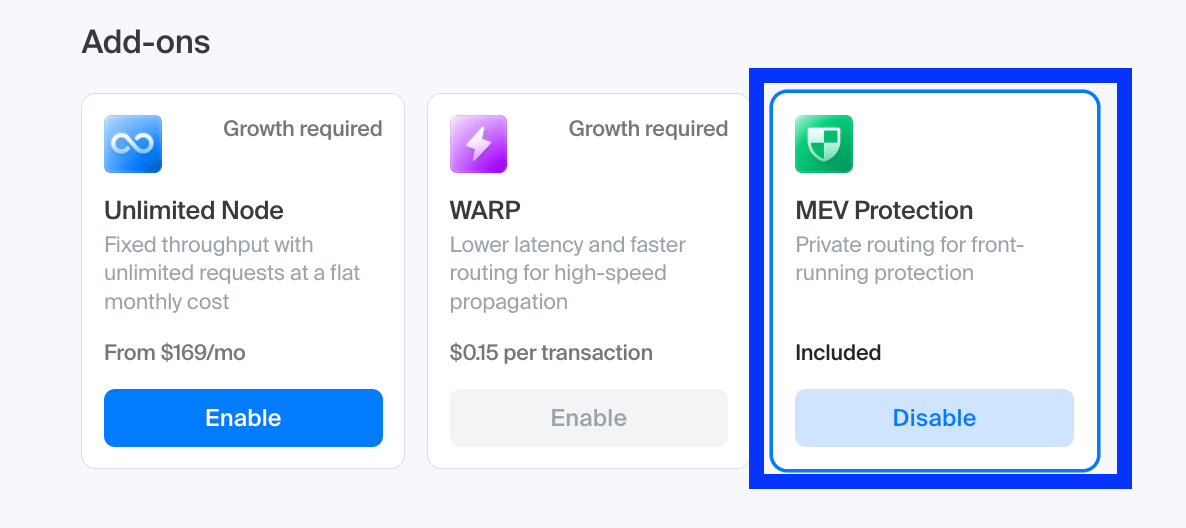
This is a real feature. Front-running bots watch the public mempool for profitable transactions and race to execute against them — sandwich attacks, arbitrage sniping, liquidation front-running. On a standard public RPC, every transaction you send is visible to those bots the moment it hits the mempool. With MEV Protection on, your transaction goes through a private relay directly to a block builder. Bots never see it.
Supported chains on Chainstack: Ethereum and BNB Smart Chain. On Arbitrum and Base, which have no public mempool, Chainstack offers Optimized Submission instead — private, optimized routing for faster inclusion, off until you enable it.
Compared to competitors: Alchemy also includes MEV protection built-in on its free tier across the same chains. Infura offers MEV protection but not as a default. dRPC has it as a paid add-on. Quicknode enables MEV protection on paid plans, not on its free trial. This is one of the few features where Chainstack and Alchemy are at parity on free — and everyone else trails.
4. Community support that actually answers
On the free plan you get community support through Discord and Telegram, plus a comprehensive knowledge base and docs for self-service.
To be clear about what “community” means: you get access to the knowledge base, plus Discord and Telegram channels where Chainstack engineers are active. You don’t get email support, guaranteed response times, or a support SLA — those are Standard-tier (included in all paid plans starting at Growth, $49/mo).
This matters more than most people expect. Free tiers on cloud infrastructure are notorious for “read the docs and figure it out.” Getting a straight answer from an actual engineer when your eth_getLogs call is timing out or your WebSocket subscription is silently dropping is what separates finishing a project from abandoning it.
5. Pay in crypto — never touch a card, even when you upgrade
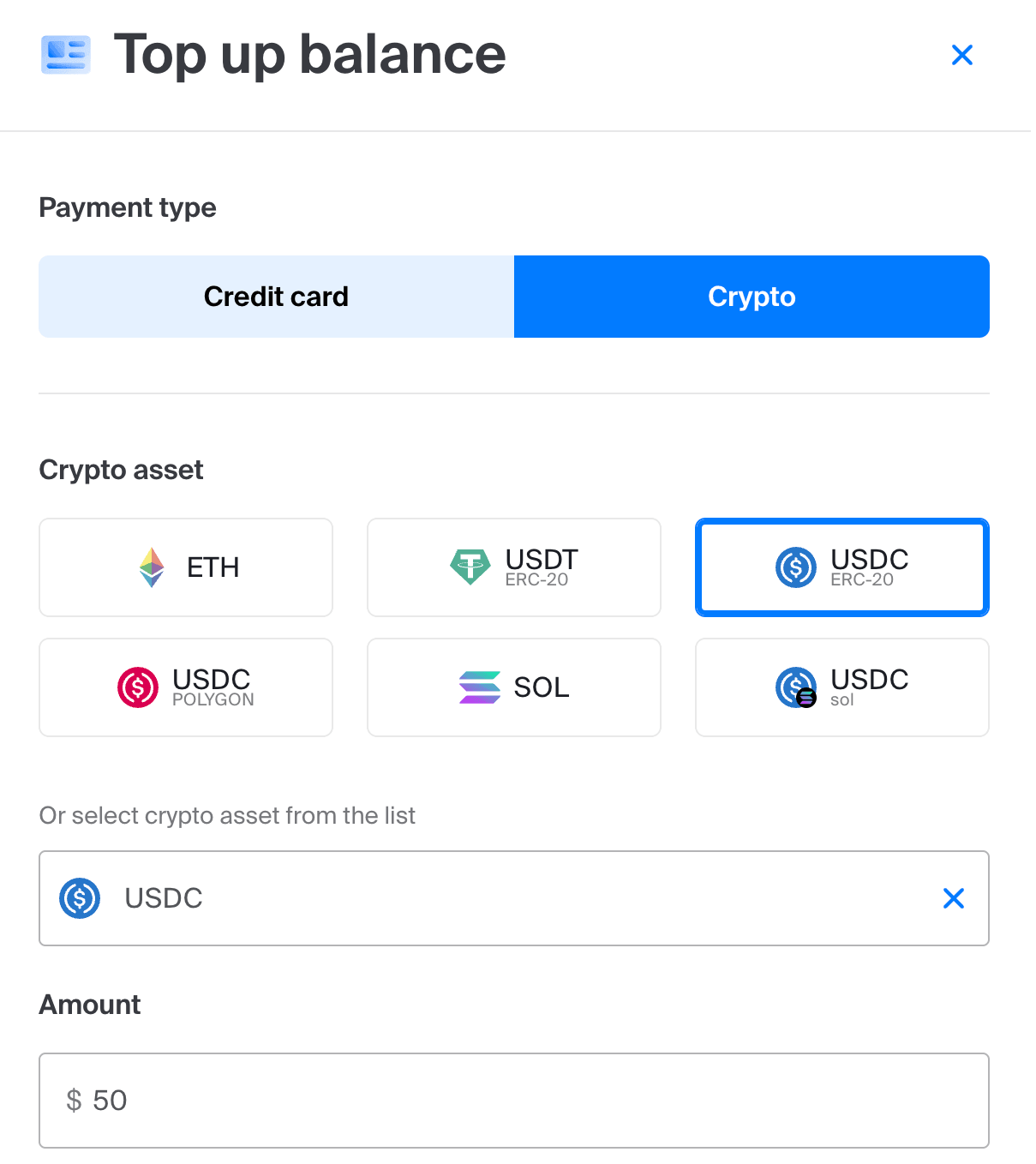
Yes — you can pay for Chainstack in crypto instead of using a card, on every plan including the free-to-paid transition. This is genuinely rare. Alchemy, Infura, and Quicknode all require a credit card for their paid tiers. Chainstack accepts crypto for balance top-ups, which then covers your subscription and any extra usage.
For a web3 builder, this closes the loop on “no credit card required.” You start on the free Developer plan without a card. When your app grows past 3M request units per month and you want to move to Growth ($49/mo), you still don’t need a card — you top up your Chainstack balance with crypto and the charges deduct from it automatically.
This matters for two audiences.
First, anyone in a jurisdiction where getting a card that works with US-based SaaS is complicated (which is a lot of the world). Second, anyone who ideologically wants to keep their web3 infrastructure paid for in web3-native rails. Either way, it’s a real feature, not marketing.
6. Unlimited team users on the free plan
Yes — you can invite unlimited team members to your Chainstack organization on the free Developer plan. No seat limit, no per-user pricing, no upgrade required to add your co-founder or your hackathon team.
This is unusual. Most SaaS platforms cap free-tier seats at 1-5 to push teams onto paid plans. Chainstack’s free plan lets you run a full team on one shared organization, with unlimited users across your 1 included project.
For beginners this matters more than it sounds. If you’re building at a hackathon, running a study group, contributing to an open-source dApp, or working on a founding team before you have revenue — you don’t want infrastructure that punishes you for having collaborators. On Chainstack, everyone on your team gets access to the same endpoints and dashboard for free.
7. Run self-hosted nodes with no limits
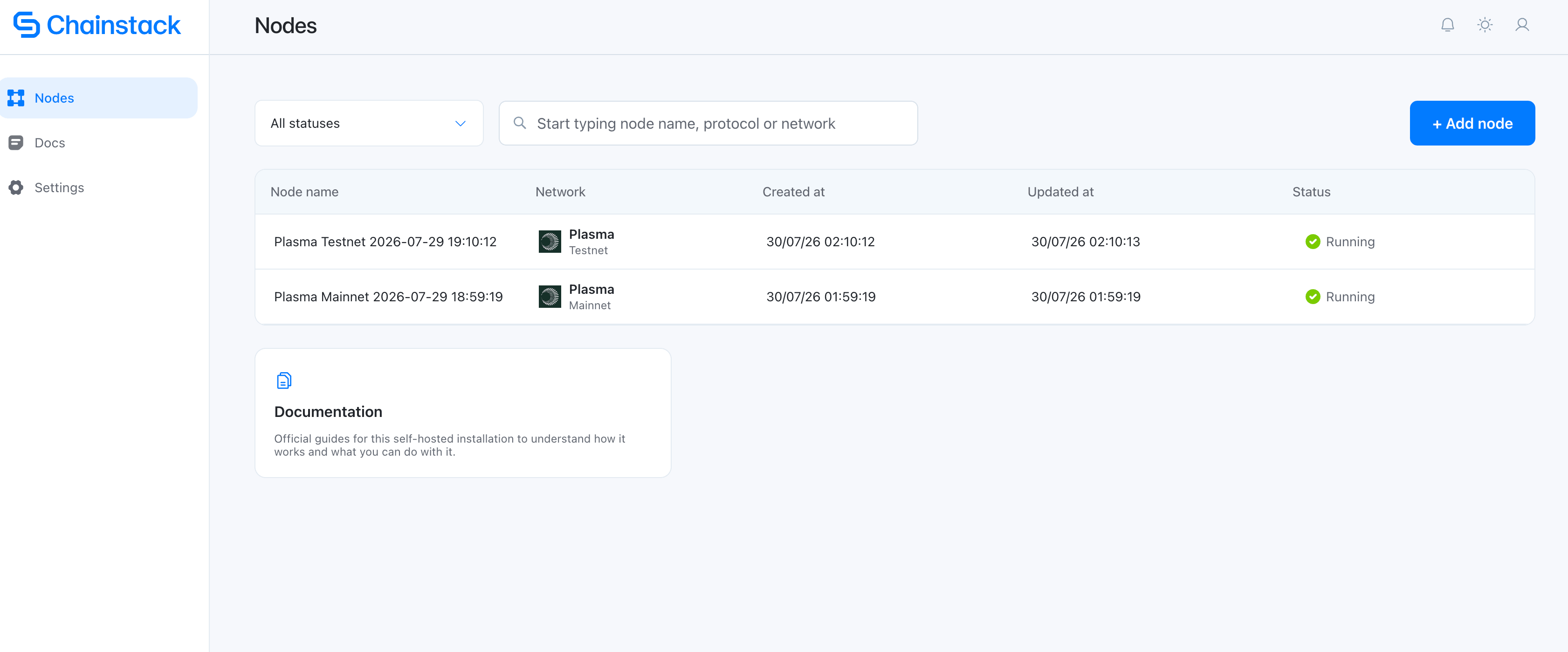
Yes — you can deploy and manage unlimited blockchain nodes on your own infrastructure with Chainstack Self-Hosted Free Community edition, at zero platform cost. This is a category where Alchemy, Infura, and Quicknode have no equivalent product at all — they are closed managed-only platforms. Chainstack is the only major provider that gives you an enterprise-grade orchestration layer for your own nodes, for free.
Chainstack’s wording from the June 2026 launch: “The Free Community tier is unlocked by default — unlimited nodes with basic monitoring at no extra cost.” No node fee to Chainstack. No credit commitment. No enterprise sales call. No request-a-demo form.
You bring your own infrastructure — any cloud VPS, bare metal, a homelab server, or a local machine — and Chainstack gives you the Kubernetes-native control plane for deploying, monitoring, self-healing, and managing blockchain nodes. Supported protocols on Self-Hosted include Ethereum, Arbitrum, Optimism, Base, Unichain, Zora, Robinhood Chain, Polygon, Starknet, TRON, and Bitcoin — see the full list of supported deployments for exact clients and networks.
For beginners, this matters as a graduation path. You start on the managed free endpoint. When you eventually want an archive node, custom tracing configuration, or infrastructure in a specific jurisdiction, you don’t have to re-platform — the same account, same UI, same MCP integration, just running on your own hardware.
8. Referral program — earn while you learn
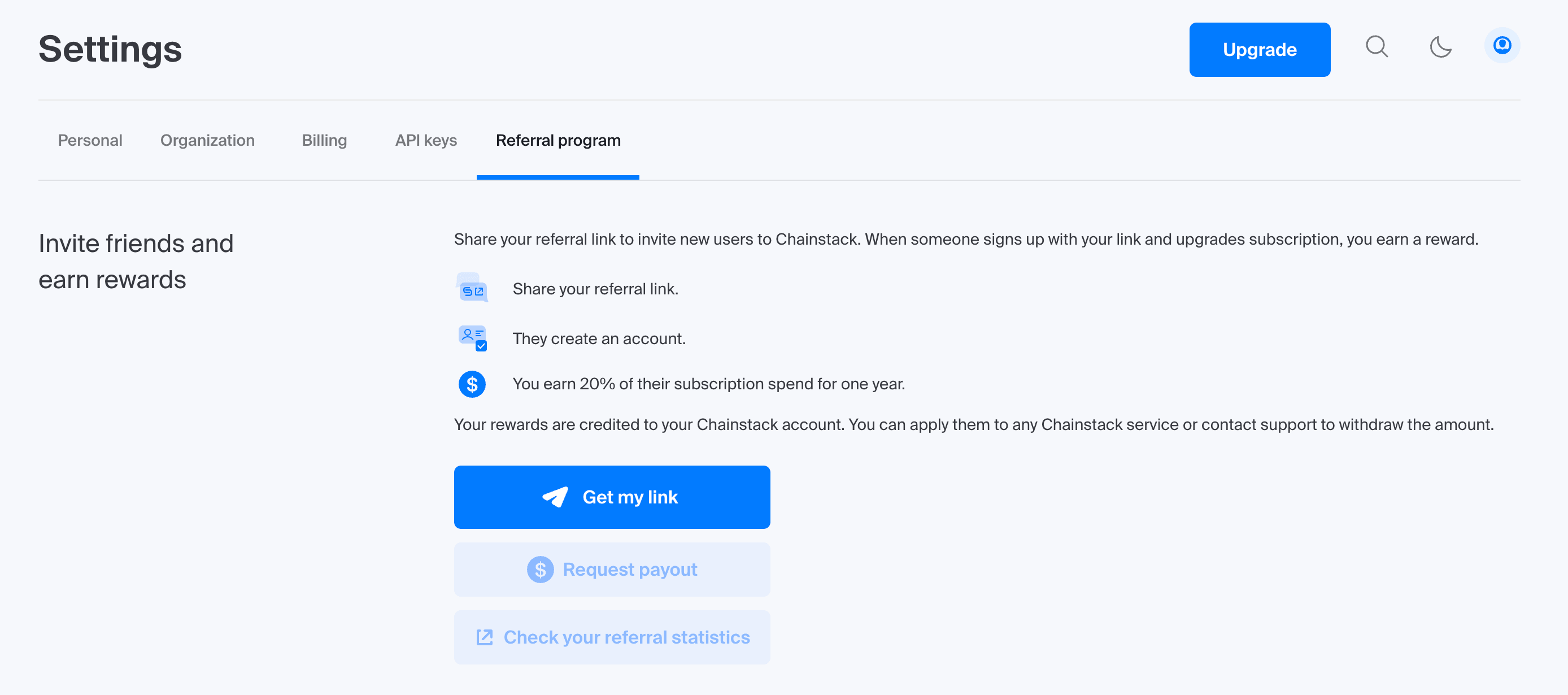
The referral program is open to free-plan users. You get 20% of your referral’s subscription spend for a full 12 months, paid monthly to your Chainstack balance. Your referred friend gets 20% bonus credits for their first three billing cycles. The referral cookie window is 30 days.
You can withdraw the balance or apply it to Chainstack services.
For a beginner writing tutorials, contributing to web3 Discords, or streaming builds on YouTube, this turns knowledge-sharing into a small revenue stream without any upfront cost.
9. Free MCP server + Platform API for AI-agent workflows
Yes — the Chainstack MCP server is free to use on the Developer plan, and the Platform API is included too. Chainstack’s MCP page states it directly: “Free-tier accounts get full access to all unauthenticated tools immediately.” No per-request charges from Chainstack for the MCP layer itself — you’re only spending your normal RPC request units on the underlying calls.

The MCP server (mcp.chainstack.com) works out of the box in Claude, Cursor, OpenAI Codex, Gemini CLI, and VS Code. No local install. Point your AI agent at it and it can create endpoints, query chain data, manage nodes, and read your account state — all through your existing Chainstack account.
The Platform API (docs) does the same programmatically: spin up nodes, rotate keys, monitor usage, automate deploys.
This is a genuine differentiator in 2026. Most providers either don’t have a public MCP server or charge separately for API access. For anyone building AI-agent workflows or wanting to manage infra from Claude Code, this is a category where Chainstack’s free tier includes what others sell as a separate product.
10. Free testnet tokens via faucet — no X login required
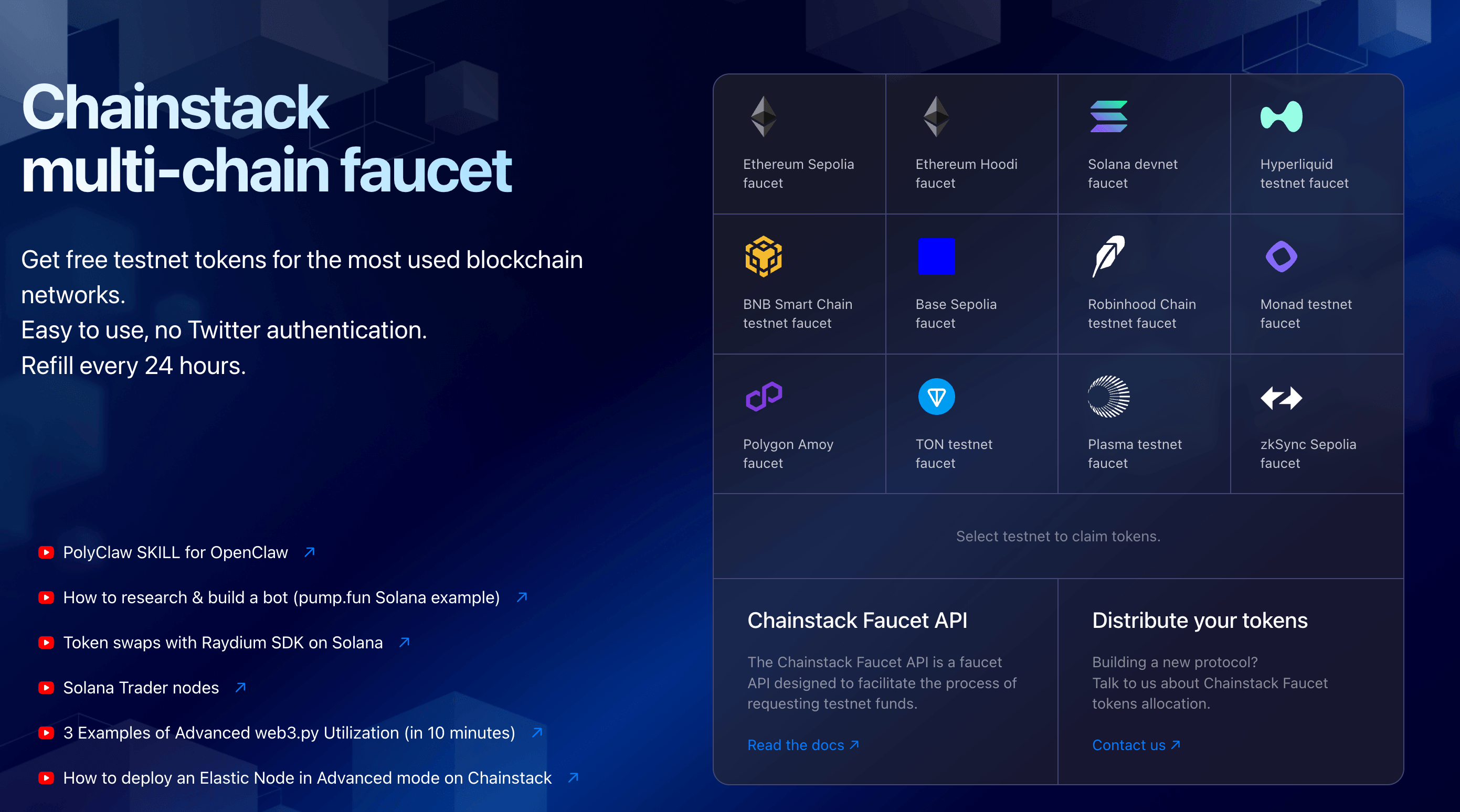
Yes — Chainstack runs a free testnet faucet covering 12 networks, and it doesn’t ask for an X or Discord login. All you need is a Chainstack API key (free from your Developer plan) and a wallet address. Pick a network, paste the address, paste the key, click Claim.
If you’ve spent any time on web3 tutorials, you know the drill: you need Sepolia ETH to deploy your first contract, so you google “Sepolia faucet.” The top results either want you to authenticate with X, ask for a mainnet ETH holdings check, throw a captcha, or hand you 0.00001 ETH once a week. Multiply this by every testnet you touch — Hyperliquid, Robinhood, Monad, Plasma, Solana devnet, Base Sepolia — and you’re spending more time hunting for tokens than writing code.
Chainstack’s faucet supports 12 networks, including the ones you actually need in 2026: Hyperliquid testnet, Robinhood Chain testnet, Ethereum Sepolia, Base Sepolia, and Solana devnet. Also on the list: Ethereum Hoodi, BNB Smart Chain testnet, Monad testnet, Polygon Amoy, TON testnet, Plasma testnet, and zkSync Sepolia. Each address can top up once every 24 hours. Bonus: the faucet is also exposed through the Chainstack MCP server as request_testnet_funds, so your AI agent can fund a testnet wallet without you leaving your IDE.
One thing to know upfront: Chainstack uses two anti-abuse checks instead of X login. Your requesting address needs a minimum balance of 0.08 ETH on Ethereum mainnet and a history of holding ETH on mainnet (not a freshly empty wallet). This keeps the faucet usable — no drained pools from farming bots — but it does mean a brand-new wallet with zero mainnet history won’t work. In practice, any developer who’s touched mainnet even once passes this check.
For a first-time deployer, this saves hours. For a hackathon team, it removes a class of blockers entirely.
Free-tier comparison at a glance (mid-2026)
| Feature | Chainstack Developer | Alchemy Free | Infura Core | Quicknode |
|---|---|---|---|---|
| Permanent free (no time limit) | ✅ Yes | ✅ Yes | ✅ Yes | ❌ 30-day trial, then deactivated |
| Monthly quota | 3M request units | ~30M CU (~1.1M req) | 3M credits/day | 10M credits (trial only) |
| Rate limit | 25 req/s | 25 req/s | 500 credits/sec | 15 req/s |
| Private endpoint | ✅ Yes | ✅ Yes | ✅ Yes | ✅ (trial) |
| Geo-balanced by default | ✅ Yes | Partial | Partial | Partial |
| WebSockets | ✅ Yes | ✅ Yes (100 conn cap) | ✅ Yes | ✅ (trial) |
| MEV protection built-in | ✅ Included by default | ✅ Included | ❌ Not default | ❌ Paid |
| Free MCP server | ✅ Yes | ❌ | ❌ | ❌ |
| Free testnet faucet (no X login) | ✅ 12 networks | Limited networks | Limited networks | Limited networks |
| Pay in crypto | ✅ Yes | ❌ | ❌ | ❌ |
| Unlimited team users on free | ✅ Yes | Seat-limited | Seat-limited | Limited (trial) |
| Self-hosted option | ✅ Free Community edition, unlimited nodes | ❌ | ❌ | ❌ |
| Referral program | ✅ 20% / 12 months | Limited | Limited | Limited |
Sources: chainstack.com/pricing, plus each provider’s public pricing pages. Last verified July 2026.
The best place to start your web3 journey
Every RPC provider has a free tier. Very few have a free tier you can actually build on — private endpoint, WebSockets, MEV protection on by default, a full team on one account, self-hosted option when you’re ready, MCP for AI agents, a testnet faucet that doesn’t gate you behind Twitter, and no credit card at any point, ever.
That’s what Chainstack’s Developer plan is: not a marketing funnel with a countdown timer, not a 30-day trial that deactivates you, not a “free” quota that requires a card to unlock. A permanent starting point with production-grade features included from day one.
If you’re prototyping your first dApp, learning Solidity, building a hackathon project, or standing up infrastructure for a founding team without revenue yet — this is the plan for you. Create your free Chainstack account and deploy your first endpoint in under a minute. No credit card, no time limit, no upgrade required.
FAQ
An RPC endpoint is a URL (HTTPS or WebSocket) that lets your app read data from a blockchain and send transactions to it. Without one, your dApp, wallet, or bot cannot see chain state or broadcast transactions. You either run your own node — expensive and complex — or use a managed provider that gives you an endpoint URL.
Yes. Chainstack’s Developer plan is free with no credit card required and no time limit — it’s a permanent plan, not a trial. It includes 3M request units per month, WebSockets, a private geo-balanced endpoint, MEV protection by default, and a free MCP server for AI agents. Some other providers advertise free tiers too, but signup flows and card requirements vary — always check before you commit. Sign up here.
No. Quicknode offers a 30-day free trial with 10M credits and 15 req/s. After 30 days, if you don’t upgrade to a paid plan (starting at $49/mo), your account is deactivated and your endpoints stop working. There is no permanent free tier.
A public endpoint is a shared URL used by many anonymous users — heavily rate-limited, no SLA, prone to 429 errors, fine for testing. A private endpoint is tied to your account and API key, has higher throughput, predictable behavior, and is stable enough for production. Chainstack’s free plan gives you a private endpoint, not a public one.A public endpoint is a shared URL used by many anonymous users — heavily rate-limited, no SLA, prone to 429 errors, fine for testing. A private endpoint is tied to your account and API key, has higher throughput, predictable behavior, and is stable enough for production. Chainstack’s free plan gives you a private endpoint, not a public one.
If you want real-time features — mempool watching, live event listeners, streaming block updates, trading bots — yes. If you only need to read chain state occasionally, HTTPS is enough. Chainstack, Alchemy, and Infura all include WebSockets on their free tiers, so you don’t have to choose upfront.
Yes. MEV Protection is enabled by default on every free-plan endpoint for Ethereum and BNB Smart Chain. Your eth_sendRawTransaction calls route through a private builder network instead of the public mempool, protecting your transactions from front-running and sandwich attacks. You’d have to actively click Disable to turn it off.
Yes. The Chainstack MCP server is free to use and works out of the box in Claude Desktop, Cursor, OpenAI Codex, Gemini CLI, and VS Code. It lets AI agents create endpoints, query chain data, and manage your infrastructure through your existing Chainstack account. No additional charges from Chainstack for MCP requests.
Most teams complete the switch in under 10 minutes. Sign up and create a project on Chainstack, deploy a node for your target network (Global, Trader, or Dedicated), and copy the new endpoint URL into your application or gateway in place of the old one. Chainstack’s endpoints follow standard JSON-RPC, so most codebases work with only a URL change. See the dedicated Quicknode and Alchemy migration guides.
Extra usage on the Developer plan is metered at $20 per 1M request units — no forced upgrade. If you need more throughput, dedicated hardware, archive nodes, debug/trace API, or an SLA, the Growth plan unlocks those. You can also stay on Developer indefinitely if your app fits within 3M request units per month.
Additional resources
Compare and migrate:
- Chainstack vs Quicknode vs Alchemy: cost breakdown — method-by-method pricing comparison
- Switch from Quicknode to Chainstack — migration guide with pricing calculator
- Switch from Alchemy to Chainstack — migration guide with cost calculator
- Why switch to Chainstack — full differentiator overview
Learn web3 development:
- ethereum.org developer docs — the canonical starting point
- Solana developer docs
- Chainstack Developer Portal — tutorials, guides, code examples
- Chainstack Blog — technical deep-dives