AI-ready infrastructure
 Refer and earn


 Ethereum
 Hyperliquid
 Solana
 Arbitrum
 BNB Smart Chain
 Base
 Polygon
 TRON
 Sui
 Robinhood


How Global Node GEN 2.0 upgrade made Avalanche RPC up to 17x faster


Summary: GEN 2.0 is a major update to Chainstack Global Nodes, as significant for Avalanche developers as a network upgrade is for the chain. On Avalanche mainnet the median time to first byte (TTFB) fell from 370 ms to 115 ms: 68.9% lower, or 3.2x faster. All 16 cities improved, from 2.0x in Cape Town to 17.0x in Los Angeles, and the Fuji testnet improved in all 16 cities with a median 6.1x lower.
Avalanche wallets, games and DeFi front ends reach the node from every continent, so distance to the nearest region decides a lot. From New Delhi an Avalanche call used to take 642 ms. The GEN 2.0 routing change targets exactly that, and this post shows the result from 16 cities for mainnet and Fuji.
What changed for Avalanche requests
Under GEN 2.0, an Avalanche request is resolved by DNS to the nearest healthy region and lands on the regional gateway, with no Cloudflare Workers layer in between. That applies to Avalanche mainnet and the Fuji testnet.
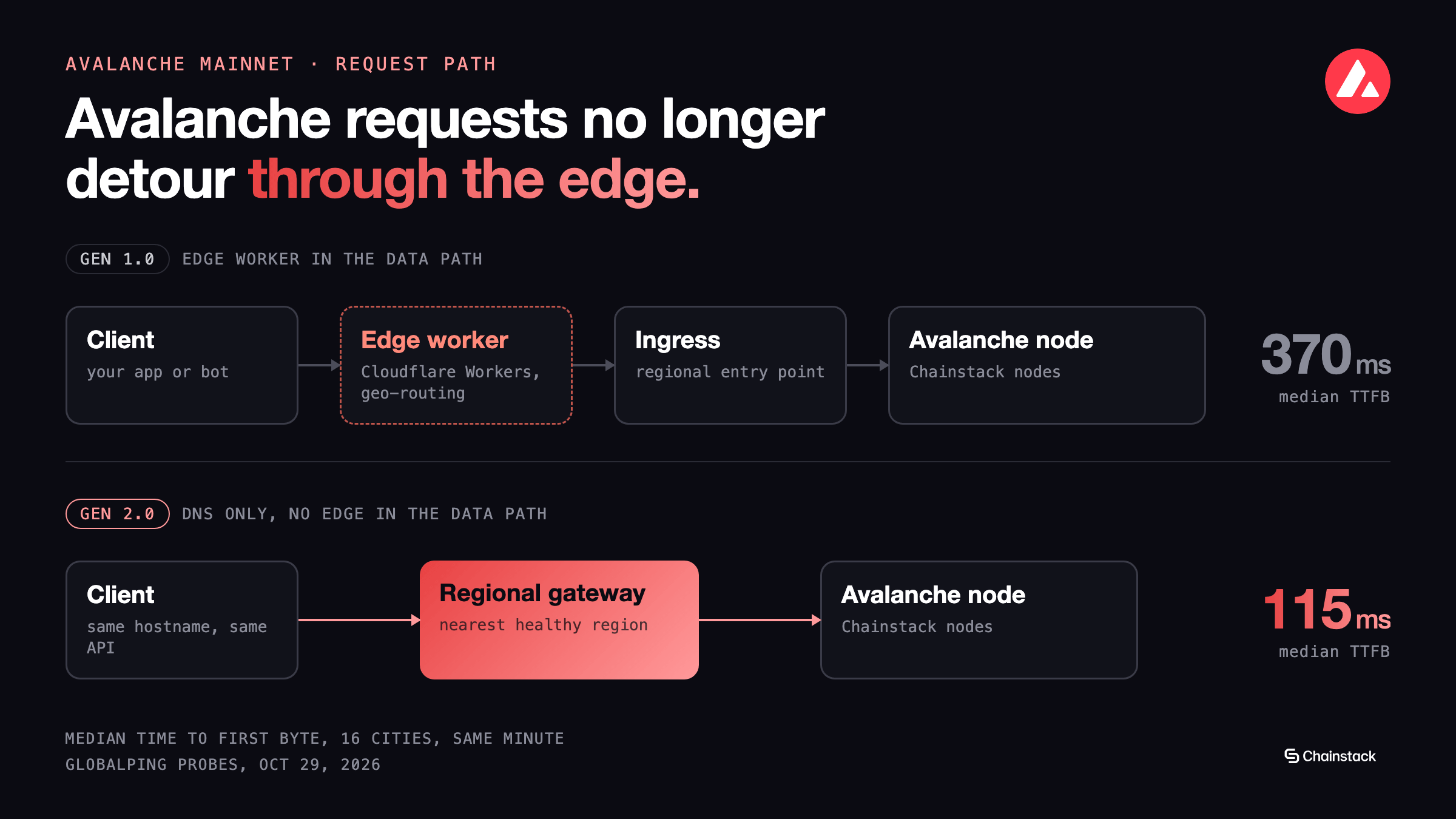
Beyond Avalanche. The same change is live across Global Nodes. For the design and the chains it covers, read Chainstack GEN 2.0 is live: faster Global Nodes.
How we measured Avalanche
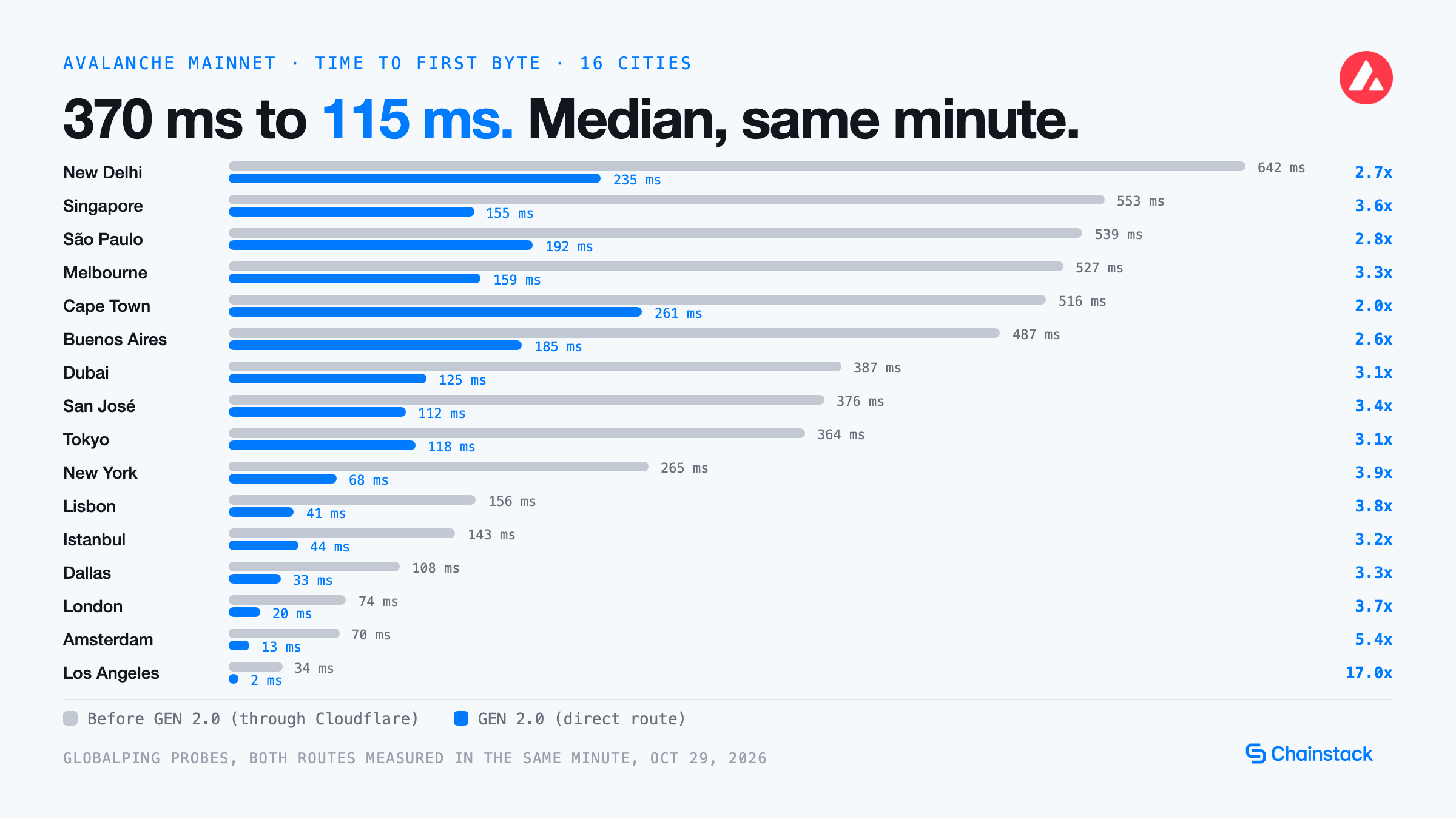
Probes from Globalping in 16 cities timed an RPC request to a Chainstack Avalanche endpoint twice in the same minute on Oct 29, 2026, once on the pre-GEN 2.0 route (through Cloudflare) and once on the GEN 2.0 direct route. The measure is time to first byte (TTFB).
Every city used the same probe on both routes, so the headline covers all 16 and the full table has no asterisks.
Avalanche mainnet results: median TTFB fell from 370 ms to 115 ms
| Metric (16 cities) | Before GEN 2.0 | GEN 2.0 |
|---|---|---|
| Median TTFB | 370 ms | 115 ms |
| Mean TTFB | 328 ms | 110 ms |
| Reduction at the median | – | 68.9% |
| Faster at the median | – | 3.2x |
| Cities that improved | – | 16 of 16 |
| Range of improvement | – | 2.0x to 17.0x |
Full per-city results (Avalanche mainnet)
| City | Country | Before GEN 2.0 (ms) | GEN 2.0 (ms) | Saved (ms) | Faster (x) |
|---|---|---|---|---|---|
| New Delhi | India | 642 | 235 | 407 | 2.7 |
| Singapore | Singapore | 553 | 155 | 398 | 3.6 |
| São Paulo | Brazil | 539 | 192 | 347 | 2.8 |
| Melbourne | Australia | 527 | 159 | 368 | 3.3 |
| Cape Town | South Africa | 516 | 261 | 255 | 2.0 |
| Buenos Aires | Argentina | 487 | 185 | 302 | 2.6 |
| Dubai | United Arab Emirates | 387 | 125 | 262 | 3.1 |
| San José | Costa Rica | 376 | 112 | 264 | 3.4 |
| Tokyo | Japan | 364 | 118 | 246 | 3.1 |
| New York | United States | 265 | 68 | 197 | 3.9 |
| Lisbon | Portugal | 156 | 41 | 115 | 3.8 |
| Istanbul | Turkey | 143 | 44 | 99 | 3.2 |
| Dallas | United States | 108 | 33 | 75 | 3.3 |
| London | United Kingdom | 74 | 20 | 54 | 3.7 |
| Amsterdam | Netherlands | 70 | 13 | 57 | 5.4 |
| Los Angeles | United States | 34 | 2 | 32 | 17.0 |
All 16 rows used the same probe on both routes. Cities are listed from the slowest pre-GEN 2.0 time to the fastest.
Where Avalanche gains the most
- In milliseconds: New Delhi saves 407 ms (642 ms to 235 ms), Singapore 398 ms (553 ms to 155 ms) and Melbourne 368 ms (527 ms to 159 ms).
- As a ratio: Los Angeles drops from 34 ms to 2 ms (17.0x), Amsterdam from 70 ms to 13 ms (5.4x) and New York from 265 ms to 68 ms (3.9x).
- The smallest gains: Cape Town improves 2.0x (516 ms to 261 ms) and Buenos Aires 2.6x (487 ms to 185 ms).
Avalanche Fuji testnet
Fuji got the same test from the same 16 cities, with the same probe on both routes.
| Network | Median before GEN 2.0 | Median with GEN 2.0 | Cities that improved |
|---|---|---|---|
| Fuji | 724.5 ms | 119.5 ms | 16 of 16 |
Fuji started from a much slower baseline than mainnet (724.5 ms median before) and ended 6.1x lower, at 119.5 ms. Every city improved, from 2.5x in Los Angeles to 50.8x in Dallas.
Test your own Avalanche endpoint
Sixteen probes cannot tell you what your servers see. To measure the effect for your app, time a request to your Avalanche endpoint from the machine that runs it (use your full C-Chain URL as the endpoint):
curl -s -o /dev/null -X POST "$ENDPOINT" \
  -H "Content-Type: application/json" \
  --data '{"jsonrpc":"2.0","id":1,"method":"eth_blockNumber","params":[]}' \
  -w "tls %{time_appconnect}s  first byte %{time_starttransfer}s\n"
The first byte figure counts from the start of the request and includes connection setup. Subtract tls to approximate the wait after the connection is open, and take the median of a handful of runs.
How to read these numbers (and what they don’t prove)
- One measurement per city. The numbers are from a single run on Oct 29, 2026. The median is more reliable than any single row.
- First byte, not the whole response. The clock stops at the first byte, so large responses and node compute time are not included.
- Testnet was tested separately. Fuji ran as its own test, so its 6.1x is not a like-for-like comparison with mainnet’s 3.2x.
- Chainstack against Chainstack. The A/B compares two routes of the same provider and does not rank providers.
What this means for Avalanche builders
Avalanche apps serve users everywhere, so the long-distance cases matter most: New Delhi, Singapore and Melbourne each save close to 400 ms per call. For a wallet, a game or a DeFi front end that makes several calls per screen, that is time the user stops waiting.
In short: GEN 2.0 is a major update, as significant for Avalanche RPC users as a network upgrade is for the chain. Same endpoint, same API, and a median first byte of 115 ms instead of 370 ms.
To try Avalanche on GEN 2.0, deploy a Global Node on the free Developer plan in a few seconds, and see Avalanche on Chainstack for the rest.
FAQ
Yes. The hostname and the API are unchanged, so there is nothing to reconfigure. GEN 2.0 applies to Avalanche mainnet and Fuji.
On Avalanche mainnet the median time to first byte fell from 370 ms to 115 ms, about 3.2x, in a same-minute test from 16 cities on Oct 29, 2026. The gain ranged from 2.0x to 17.0x.
Cape Town went from 516 ms to 261 ms, still a 255 ms saving. The new number is high compared with other cities, so the ratio is small.
Fuji’s median before GEN 2.0 was 724.5 ms, almost double mainnet’s 370 ms, so there was more to remove. It dropped to 119.5 ms, 6.1x lower. The two networks are separate endpoints tested in separate runs.
No. It is a before and after of Chainstack’s own routes. It does not compare Avalanche latency across providers.
No. It is the median of one A/B test in 16 cities on Oct 29, 2026, and your result depends on where your servers and users are.
Related reading