AI-ready infrastructure
 Refer and earn


 Ethereum
 Hyperliquid
 Solana
 Arbitrum
 BNB Smart Chain
 Base
 Polygon
 TRON
 Sui
 Robinhood


How Global Node GEN 2.0 upgrade made Polygon RPC up to 48x faster


Summary: GEN 2.0 is a major update to Chainstack Global Nodes, as significant for Polygon developers as a network upgrade is for the chain. On Polygon mainnet the median time to first byte (TTFB) went from 202.5 ms to 73.5 ms: 63.7% lower, or 2.8x faster. Every one of the 16 cities improved, from 1.6x in Dubai to 48.5x in Tokyo, and the Amoy testnet improved in all 16 cities too.
Polygon apps make cheap, frequent calls: wallets refreshing balances, payment flows waiting on receipts, indexers reading block after block. Each call pays the wait for the first byte, and the GEN 2.0 routing change shortens it. This post shows the measurements from 16 cities for Polygon mainnet and the Amoy testnet.
What changed for Polygon requests
Before GEN 2.0, a Cloudflare Workers layer chose the region for every Polygon call. Today Cloudflare DNS load balancing resolves your hostname to the nearest healthy region, and the request goes to the regional gateway and on to the node. Polygon mainnet and Amoy both run this way.
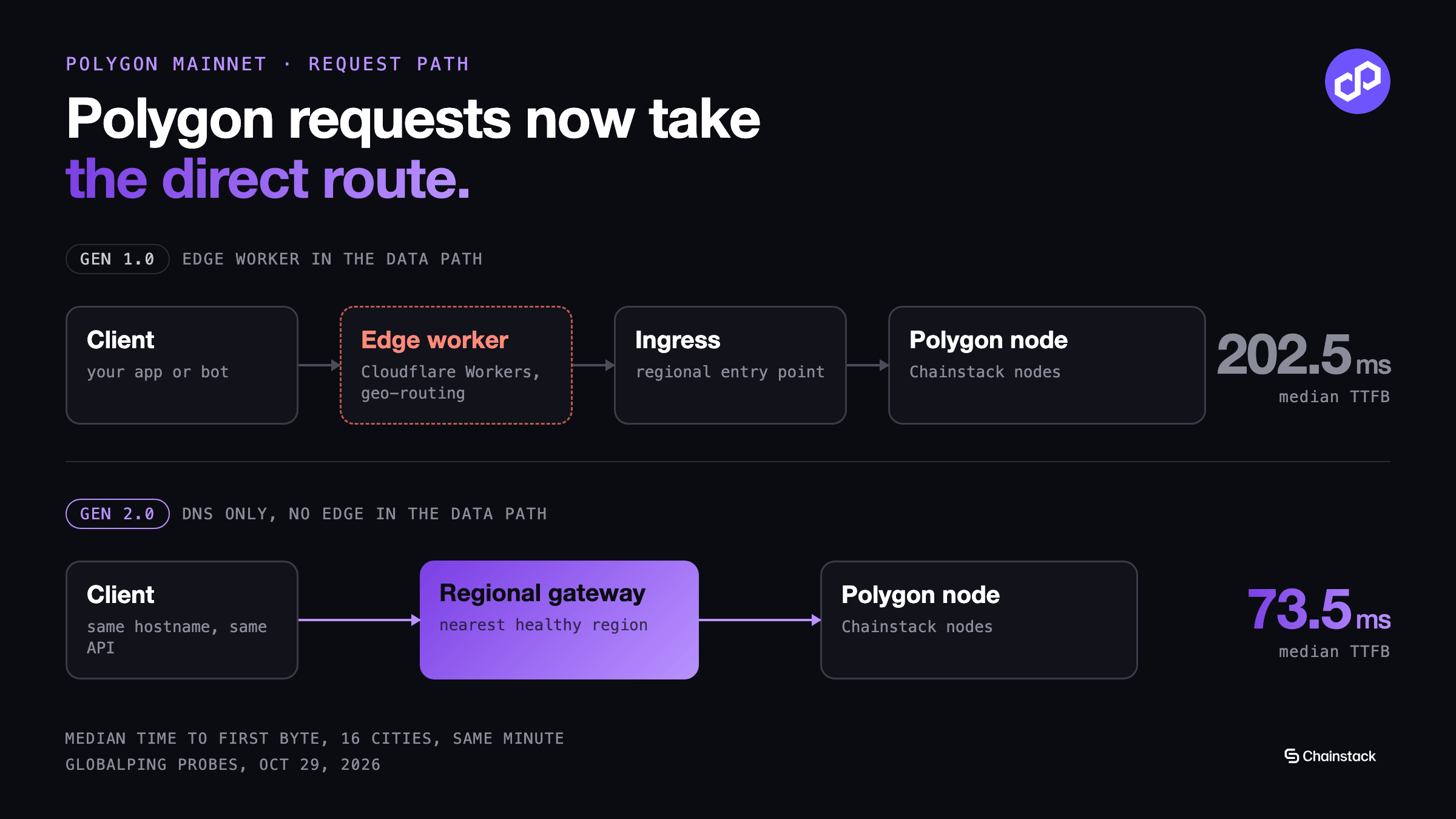
Not Polygon only. GEN 2.0 runs on every Global Nodes chain. The architecture and the full list of changes are in Chainstack GEN 2.0 is live: faster Global Nodes.
How we measured Polygon
Globalping probes in 16 cities sent an RPC request to a Chainstack Polygon endpoint and recorded the time to first byte (TTFB). Each city tested the pre-GEN 2.0 route (through Cloudflare) and the GEN 2.0 direct route in the same minute on Oct 29, 2026.
All 16 cities used the same probe on both routes, so the headline covers every city and the full table has no asterisks.
Polygon mainnet results: median TTFB fell from 202.5 ms to 73.5 ms
| Metric (16 cities) | Before GEN 2.0 | GEN 2.0 |
|---|---|---|
| Median TTFB | 202.5 ms | 73.5 ms |
| Mean TTFB | 242 ms | 78 ms |
| Reduction at the median | – | 63.7% |
| Faster at the median | – | 2.8x |
| Cities that improved | – | 16 of 16 |
| Range of improvement | – | 1.6x to 48.5x |
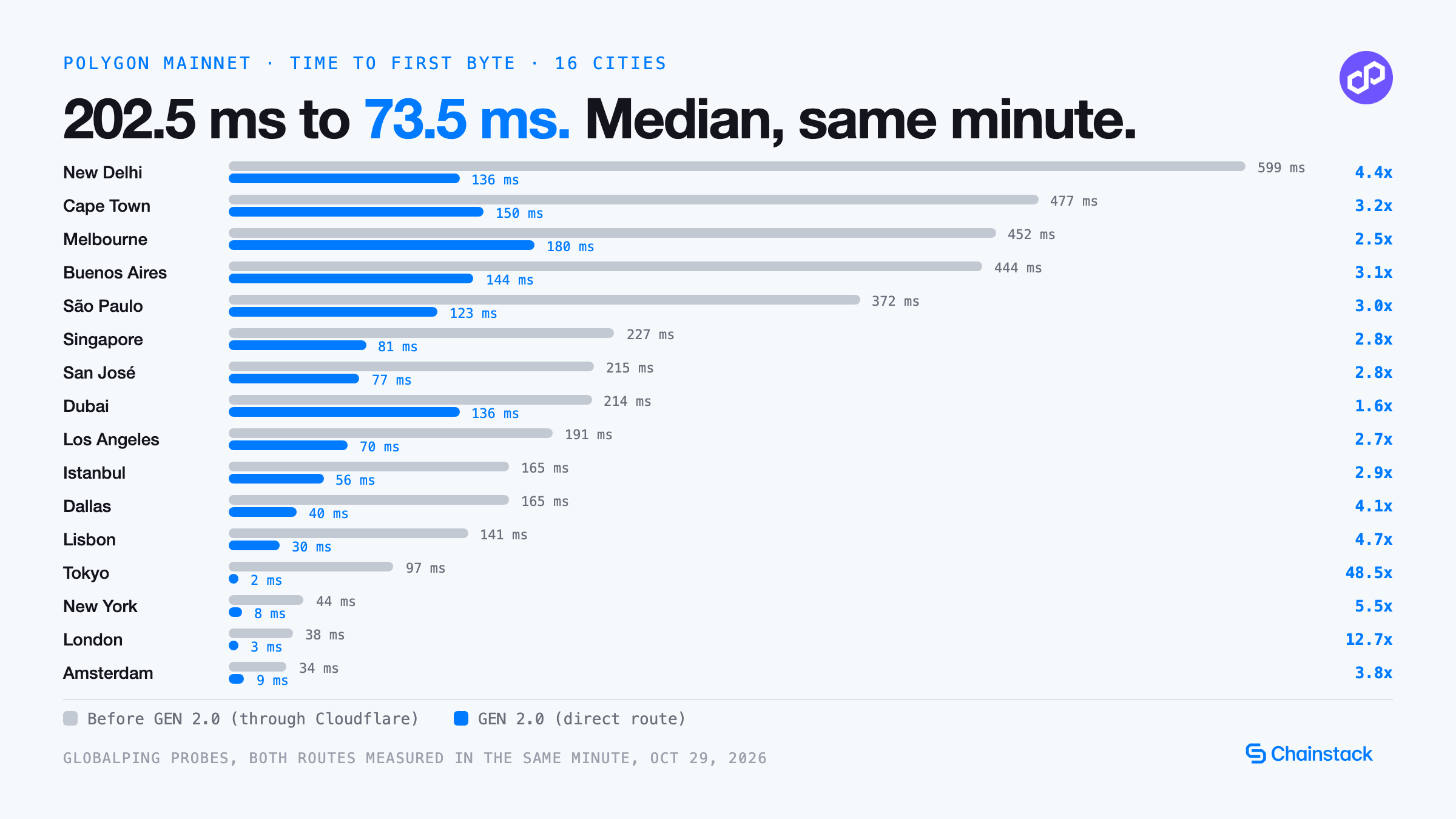
Full per-city results (Polygon mainnet)
| City | Country | Before GEN 2.0 (ms) | GEN 2.0 (ms) | Saved (ms) | Faster (x) |
|---|---|---|---|---|---|
| New Delhi | India | 599 | 136 | 463 | 4.4 |
| Cape Town | South Africa | 477 | 150 | 327 | 3.2 |
| Melbourne | Australia | 452 | 180 | 272 | 2.5 |
| Buenos Aires | Argentina | 444 | 144 | 300 | 3.1 |
| São Paulo | Brazil | 372 | 123 | 249 | 3.0 |
| Singapore | Singapore | 227 | 81 | 146 | 2.8 |
| San José | Costa Rica | 215 | 77 | 138 | 2.8 |
| Dubai | United Arab Emirates | 214 | 136 | 78 | 1.6 |
| Los Angeles | United States | 191 | 70 | 121 | 2.7 |
| Istanbul | Turkey | 165 | 56 | 109 | 2.9 |
| Dallas | United States | 165 | 40 | 125 | 4.1 |
| Lisbon | Portugal | 141 | 30 | 111 | 4.7 |
| Tokyo | Japan | 97 | 2 | 95 | 48.5 |
| New York | United States | 44 | 8 | 36 | 5.5 |
| London | United Kingdom | 38 | 3 | 35 | 12.7 |
| Amsterdam | Netherlands | 34 | 9 | 25 | 3.8 |
Every city used one probe for both routes, so no row is excluded. The median of 16 cities falls between two values, which is why the headline numbers end in .5.
Where Polygon gains the most
- In milliseconds: New Delhi saves 463 ms (599 ms to 136 ms), Cape Town 327 ms (477 ms to 150 ms) and Buenos Aires 300 ms (444 ms to 144 ms).
- As a ratio: Tokyo drops from 97 ms to 2 ms (48.5x), London from 38 ms to 3 ms (12.7x) and New York from 44 ms to 8 ms (5.5x).
- The weakest result: Dubai, at 1.6x (214 ms to 136 ms).
Polygon Amoy testnet
We ran the Amoy testnet through the same 16 probes, again measuring both routes together.
| Network | Median before GEN 2.0 | Median with GEN 2.0 | Cities that improved |
|---|---|---|---|
| Amoy | 305.5 ms | 96 ms | 16 of 16 |
The Amoy median is about 3.2x lower, a bigger relative gain than mainnet (2.8x), and every city improved, from 2.3x in Melbourne to 16.7x in London.
How to measure Polygon latency from your own servers
The numbers above come from 16 public probes, not from your infrastructure. To see your own gain, time a request to your Polygon endpoint from the machine that runs your app:
curl -s -o /dev/null -X POST "$ENDPOINT" \
  -H "Content-Type: application/json" \
  --data '{"jsonrpc":"2.0","id":1,"method":"eth_blockNumber","params":[]}' \
  -w "tls %{time_appconnect}s  first byte %{time_starttransfer}s\n"
time_starttransfer includes the connection setup, so subtract the tls value to approximate the wait for the first byte once the connection is open. Run it several times and read the median, because a single request is noisy.
How to read these numbers (and what they don’t prove)
- One run, 16 cities. Each row is a single measurement from Oct 29, 2026. The median is steadier than any single city.
- First byte only. The clock stops at the first byte, so it leaves out the download of large responses and the time the node spends computing them.
- Probes are not your servers. What you gain depends on where your own servers run.
- Not a ranking. This test compares two Chainstack routes with each other. It says nothing about other providers.
What this means for Polygon builders
On Polygon the calls are small and frequent: a wallet refreshing balances, a payment flow waiting on a receipt, an indexer reading blocks in sequence. Saving 300 to 460 ms per call from far regions (New Delhi 463 ms, Cape Town 327 ms) adds up across all of them.
In short: GEN 2.0 is a major update to how Polygon requests are routed, on the scale of a network upgrade for the chain. Same endpoint, same API, and the median request now sees its first byte in 73.5 ms instead of 202.5 ms.
Need a Polygon endpoint? A Global Node takes a few seconds to deploy on the free Developer plan; more in Polygon on Chainstack.
FAQ
No. Your hostname and your calls stay as they are, so existing code keeps working, on Polygon mainnet and on Amoy.
In our Oct 29, 2026 test, the median Polygon mainnet request got its first byte after 73.5 ms instead of 202.5 ms, about 2.8x faster. The gain ranged from 1.6x to 48.5x across 16 cities.
Dubai went from 214 ms to 136 ms, a 78 ms saving. The gain depends on the network path between the probe and the nearest region, so cities differ.
Tokyo went from 97 ms to 2 ms. The ratio is huge because the new number is tiny; the saving, 95 ms, is of the same order as in other cities.
No. It only compares Chainstack routes before and after GEN 2.0, and says nothing about other providers.
No. 2.8x is the median of a single test on Oct 29, 2026; your own result depends on where your servers and users are.
Related reading