AI-ready infrastructure
 Refer and earn


 Ethereum
 Hyperliquid
 Solana
 Arbitrum
 BNB Smart Chain
 Base
 Polygon
 TRON
 Sui
 Robinhood


How Global Node GEN 2.0 upgrade made Arbitrum RPC up to 60x faster


Summary: GEN 2.0 is a major update to Chainstack Global Nodes, the kind of step change a network upgrade is for Arbitrum itself. On Arbitrum mainnet the median time to first byte (TTFB) went from 267 ms to 57 ms, a 78.8% cut or about 4.7x faster. All 10 cities where the same probe measured both routes improved, from 2.8x in Buenos Aires to 59.0x in Los Angeles. Arbitrum Sepolia improved in 15 of 16 cities.
On a fast chain like Arbitrum, the RPC round trip is a large share of what a user waits for. Chainstack Global Nodes moved to GEN 2.0, and this post measures what that did to Arbitrum mainnet and Sepolia from 16 cities.
What GEN 2.0 changed for Arbitrum requests
Before GEN 2.0, every Arbitrum call crossed a Cloudflare Workers edge layer before it reached the regional ingress. Now DNS load balancing does the routing, and the call goes from the client to the nearest regional gateway and the node. Mainnet and Sepolia both run this way.
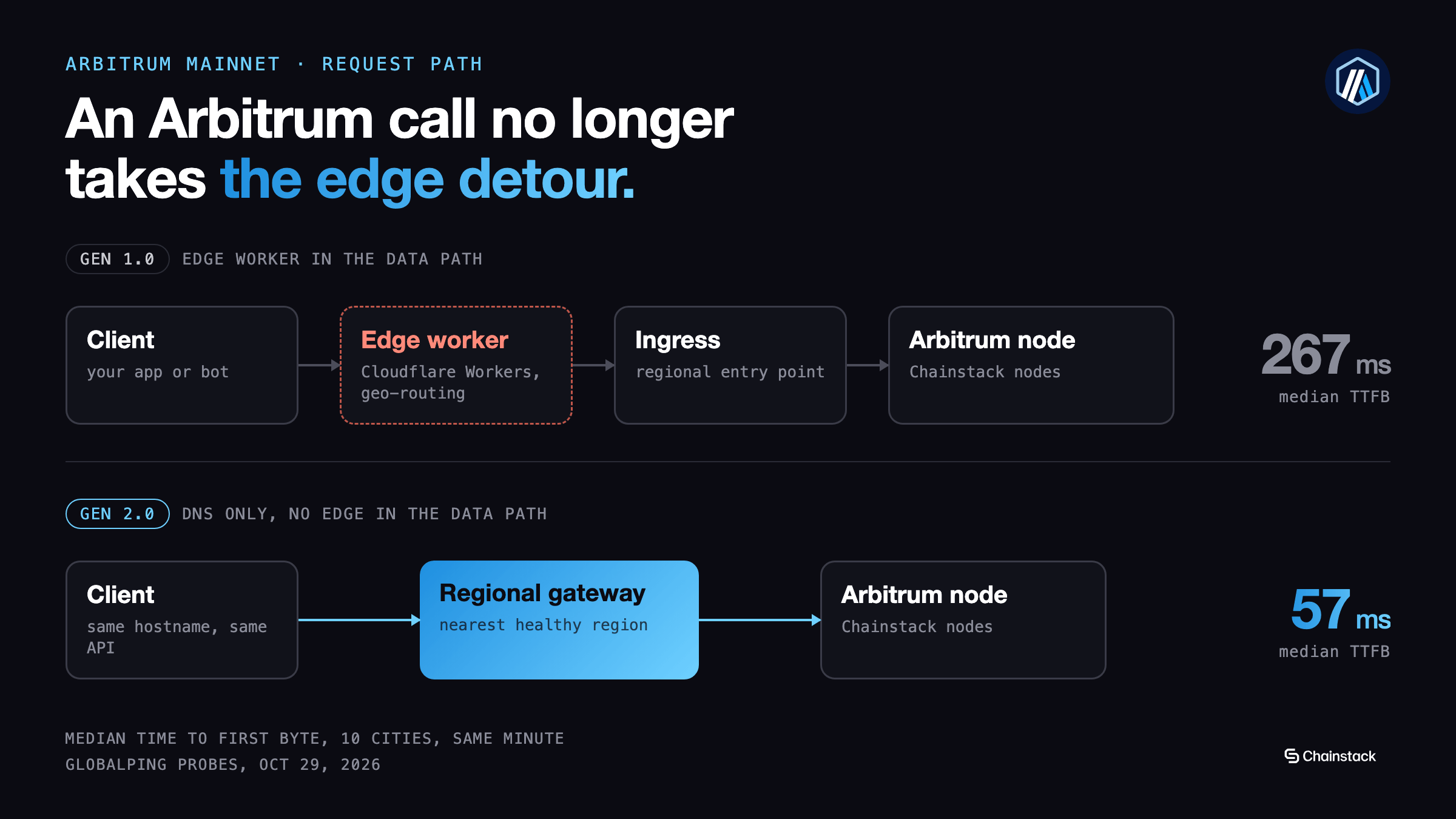
Details elsewhere. The GEN 2.0 announcement explains the architecture and lists every chain it covers: Chainstack GEN 2.0 is live: faster Global Nodes.
How we measured Arbitrum
TTFB here is the delay between sending an RPC request to a Chainstack Arbitrum endpoint and receiving the first byte of the reply. Globalping probes in 16 cities measured it on both routes, the pre-GEN 2.0 one through Cloudflare and the GEN 2.0 direct one, in the same minute on Oct 29, 2026.
The same probe measured both routes in 10 cities, and those 10 make up the headline. The other 6 (Cape Town, San José, Lisbon, Amsterdam, London and New York) are marked with an asterisk in the full table. The median of an even number of cities sits between two values, so the headline 267 ms and 57 ms are the rounded 266.5 ms and 56.5 ms.
Arbitrum mainnet results: median TTFB fell from 267 ms to 57 ms
| Metric (10 cities) | Before GEN 2.0 | GEN 2.0 |
|---|---|---|
| Median TTFB | 266.5 ms | 56.5 ms |
| Mean TTFB | 272 ms | 76 ms |
| Reduction at the median | – | 78.8% |
| Faster at the median | – | 4.7x |
| Cities that improved | – | 10 of 10 |
| Range of improvement | – | 2.8x to 59.0x |
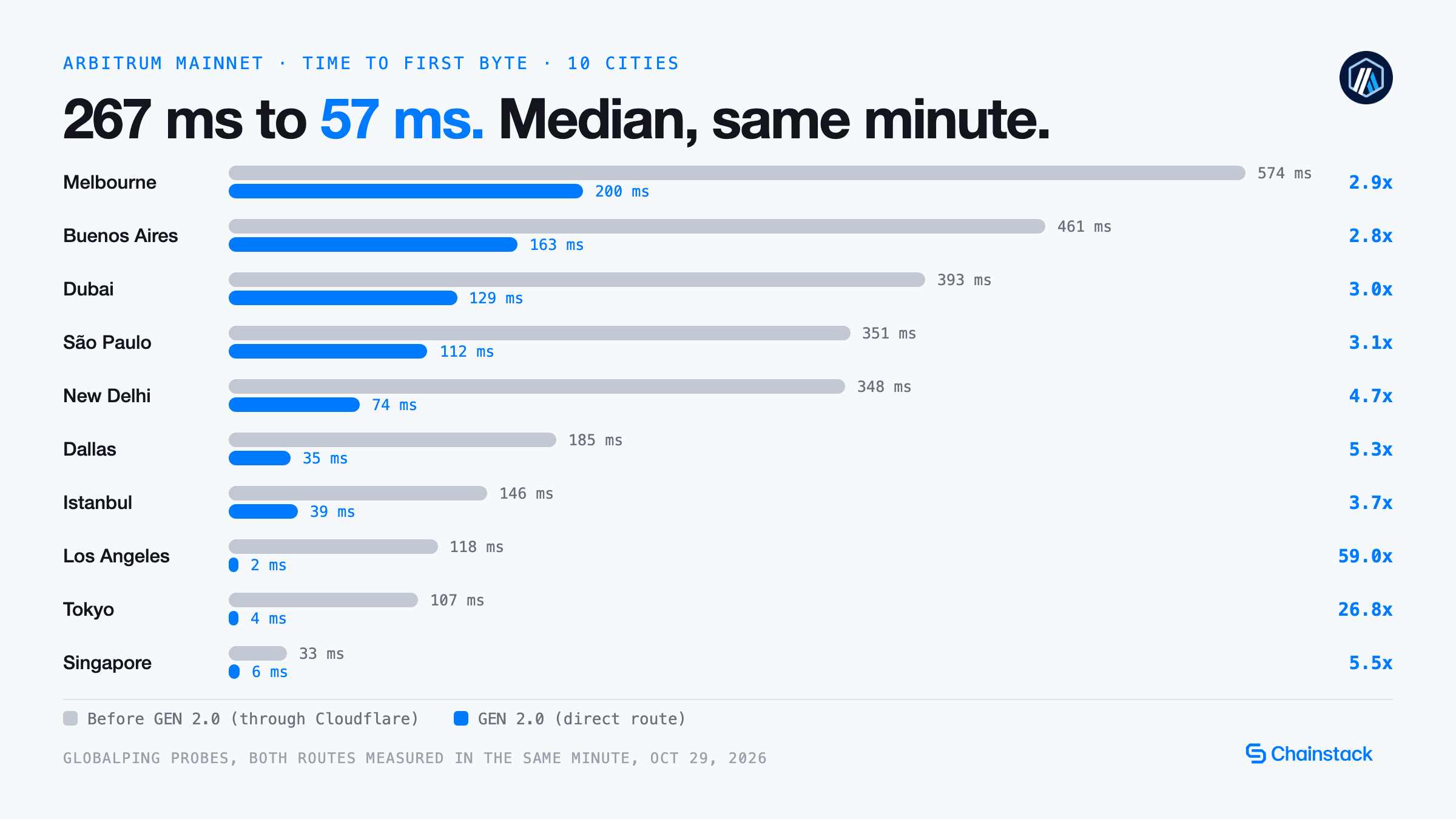
Full per-city results (Arbitrum mainnet)
| City | Country | Before GEN 2.0 (ms) | GEN 2.0 (ms) | Saved (ms) | Faster (x) |
|---|---|---|---|---|---|
| Melbourne | Australia | 574 | 200 | 374 | 2.9 |
| Cape Town* | South Africa | 516 | 190 | 326 | 2.7 |
| Buenos Aires | Argentina | 461 | 163 | 298 | 2.8 |
| Dubai | United Arab Emirates | 393 | 129 | 264 | 3.0 |
| São Paulo | Brazil | 351 | 112 | 239 | 3.1 |
| New Delhi | India | 348 | 74 | 274 | 4.7 |
| San José* | Costa Rica | 249 | 68 | 181 | 3.7 |
| Dallas | United States | 185 | 35 | 150 | 5.3 |
| Istanbul | Turkey | 146 | 39 | 107 | 3.7 |
| Lisbon* | Portugal | 140 | 40 | 100 | 3.5 |
| Los Angeles | United States | 118 | 2 | 116 | 59.0 |
| Tokyo | Japan | 107 | 4 | 103 | 26.8 |
| Amsterdam* | Netherlands | 102 | 13 | 89 | 7.8 |
| London* | United Kingdom | 80 | 20 | 60 | 4.0 |
| Singapore | Singapore | 33 | 6 | 27 | 5.5 |
| New York* | United States | 30 | 9 | 21 | 3.3 |
Rows marked with an asterisk (*) used different probes for the two routes and are not in the headline numbers. Across all 16 cities the median goes from 165.5 ms to 39.5 ms.
Where Arbitrum gains the most
- In milliseconds: Melbourne saves 374 ms (574 ms to 200 ms), Buenos Aires 298 ms and New Delhi 274 ms (348 ms to 74 ms).
- As a ratio: Los Angeles drops from 118 ms to 2 ms (59.0x) and Tokyo from 107 ms to 4 ms (26.8x). In both cities almost nothing is left once the edge worker is out of the path.
- The smallest gain: Buenos Aires improves 2.8x, from 461 ms to 163 ms.
Arbitrum Sepolia
Sepolia got the same test from the same 16 cities, with the same probe on both routes.
| Network | Median before GEN 2.0 | Median with GEN 2.0 | Cities that improved |
|---|---|---|---|
| Sepolia | 209.5 ms | 81 ms | 15 of 16 |
The Sepolia median is about 2.6x lower. One city went the other way: Amsterdam rose from 54 ms to 81 ms. Every other city improved, up to 48.0x in Tokyo.
How does Arbitrum compare today?
Compare ranks providers on p95 latency and success rate, measured for Arbitrum from Germany, Japan and the US. As of Nov 18, 2026 (last 7 days), Chainstack ranks #1:
- Score 0.033 (lower is better), availability 99.96%.
- p50 / p95 / p99: 17 ms / 32 ms / 44 ms.
- p95 by probe region: Germany 20 ms, US 50 ms, Japan 27 ms.
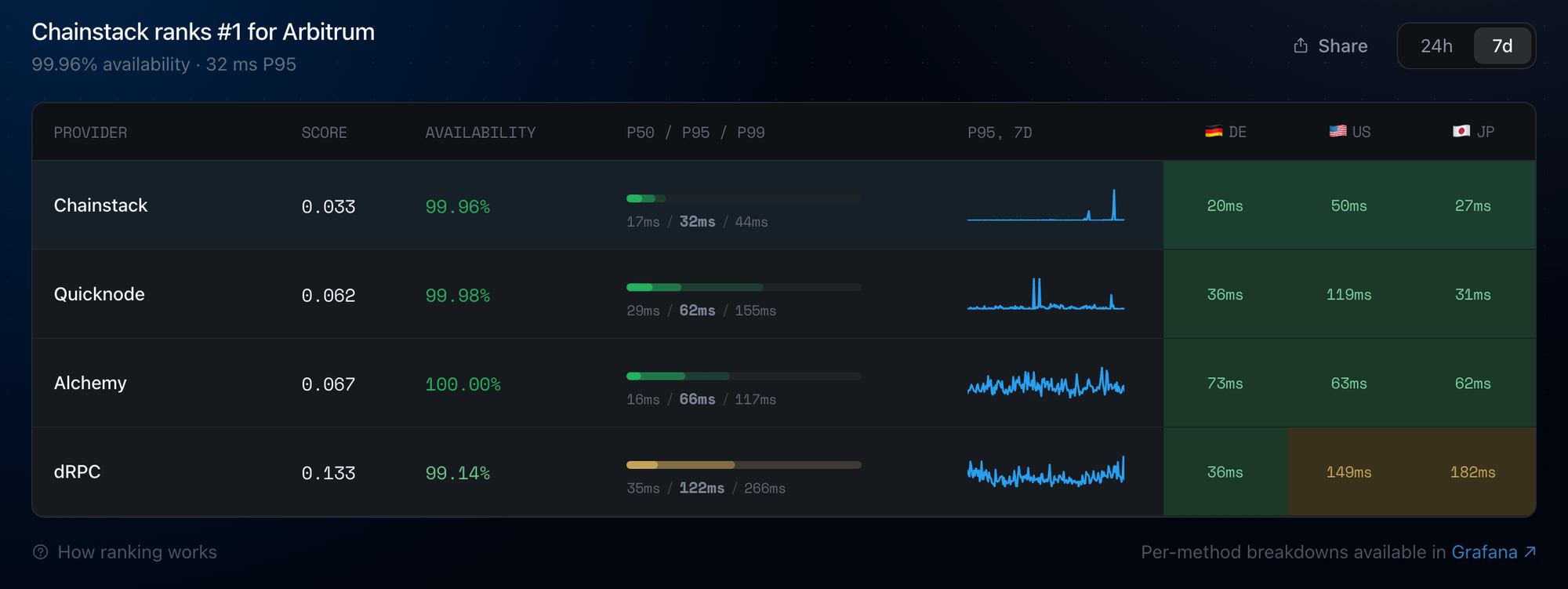
The live view is Arbitrum on Compare. In the fixed window of Nov 5 to Nov 12, 2026 (score 0.028), Chainstack also had the lowest p95 in all three regions; see the Arbitrum RPC provider benchmark: latency and uptime (November 2026).
How to read these numbers (and what they don’t prove)
- Ten cities, one run. The headline rests on a single run from Oct 29, 2026 in 10 cities. Read the median, not a single row, and treat 59.0x as the outlier it is.
- First byte only. The clock stops at the first byte, so it excludes the time to download a big response and the time the node needs to compute it. Heavy calls such as
debug_traceTransactionspend most of their time in that second part. - Sepolia is not uniform. One of 16 cities got slower, so the gain is not guaranteed in every city.
- Chainstack against Chainstack. The A/B above compares two Chainstack routes. For other providers, see Compare and the Chainstack vs Alchemy RPC benchmark, where Chainstack won 76.3% of Arbitrum JSON-RPC regional p95 comparisons and Alchemy led WebSocket newHeads.
What this means for Arbitrum builders
Arbitrum workloads lean on fast reads and logs: a trading bot reading pool state before it swaps, an indexer paging through eth_getLogs, a wallet or bridge checking balances. Cutting 300 ms or more per call from far regions (Melbourne 374 ms, Buenos Aires 298 ms) adds up in each of them.
In short: GEN 2.0 is a major update, a step change for Arbitrum RPC users comparable to a network upgrade for the chain. The endpoint and the API stay the same, and the median first byte is now 57 ms instead of 267 ms.
To try Arbitrum on GEN 2.0, deploy a Global Node in a few seconds on the free Developer plan. More about Arbitrum on Chainstack.
FAQ
Yes, nothing to reconfigure. The hostname is unchanged, and GEN 2.0 applies to Arbitrum mainnet and Sepolia.
On Arbitrum mainnet the median time to first byte fell from 267 ms to 57 ms, about 4.7x, in a same-minute test from 10 cities on Oct 29, 2026. The gain ranged from 2.8x to 59.0x.
Los Angeles went from 118 ms to 2 ms and Tokyo from 107 ms to 4 ms. The ratio is large because the new number is tiny; the saving in milliseconds, about 100 ms, is in line with other cities.
In 15 of 16 cities. Amsterdam went from 54 ms to 81 ms, the only city that got slower. The median across all 16 fell from 209.5 ms to 81 ms.
Germany, Japan and the US. Compare queries the first paid plan of each provider every 1 to 3 minutes, and the score combines p95 latency per method with the success rate. Lower is better.
No. It is the median of a single test across 10 cities on Oct 29, 2026. Measure from your own regions to see your gain.
Related reading