AI-ready infrastructure
 Refer and earn


 Ethereum
 Hyperliquid
 Solana
 Arbitrum
 BNB Smart Chain
 Base
Base Polygon
 TRON
TRON Sui
Sui Robinhood


Top 6 Stellar RPC providers for payments and stablecoin infrastructure in 2026

Stellar is a layer-1 network purpose-built for cross-border payments and asset tokenization, running its own Stellar Consensus Protocol rather than an EVM- or Solana-style execution model. The clearest sign that RPC access on Stellar just changed for good: Horizon, the REST API that has served the chain since its early years, is nearing end-of-life per Stellar’s own documentation — no new feature development, though it keeps receiving compatibility updates with no published shutdown date — with Stellar RPC, rebranded from Soroban-RPC in late 2024, now the recommended way to read ledger and Soroban contract data going forward.
That shift is landing right as Stellar’s Protocol 23 “Whisk” upgrade shipped parallel transaction execution aimed at pushing theoretical throughput toward 5,000 TPS, on-chain stablecoin supply grew 22% quarter-over-quarter to roughly $297 million in Q1 2026, led by USDC’s 14.9% jump to $256.3 million, and DeFi TVL sits around $213 million as of this writing — check the live DeFiLlama figure rather than trusting a snapshot, since it’s swung from under $200 million to a $235 million April peak and back within the past few months. It’s a small base compared to Ethereum or Solana, but it’s growing fast enough that RPC reliability suddenly matters more than it did a year ago — and providers still built around Horizon’s older REST model, or that haven’t adapted to Stellar RPC’s bounded retention window, are already behind.
This guide compares the providers actually running Stellar RPC in production today — including Chainstack, which only added Stellar node support this month — against the aggregators and specialists filling out the rest of the field.
Already using Chainstack? Jump straight to the Stellar tooling docs or deploy your endpoint in minutes.
Why RPC provider choice matters for Stellar
Stellar’s RPC model doesn’t map cleanly onto EVM or Solana conventions, and that mismatch is exactly where thin integrations show their limits. There’s no eth_getLogs, no account-level archive tier, and no protocol-native mempool subscription stream — Stellar RPC exposes ledger, transaction, and Soroban contract state through a comparatively small method surface (getLedgerEntries, getTransaction, getEvents, sendTransaction, simulateTransaction, and a handful of others), keeping only a rolling window of recent history rather than the full chain state Horizon used to expose.
That narrow, bounded-history design changes what matters when picking a provider: less raw archive depth, more how each provider fills the gap Stellar RPC’s retention window leaves open, how consistently they sustain throughput on a payments-heavy chain, and how honestly they price a network most of them only added support for in the past year or two.
- Cost predictability and pricing model. Chainstack bills every Stellar RPC call — reads and
sendTransactionsubmissions alike — as a flat 1 request unit, and Stellar has no archive tier to weight differently in the first place. Alchemy and Quicknode still price Stellar through the same method-weighted CU/credit systems they run everywhere else, so a workload heavy on indexed queries or push delivery can cost more than the flat sticker price implies. See the cost comparison between Chainstack, Quicknode, and Alchemy for worked examples on other chains. - Historical data access and the Horizon transition. Stellar RPC nodes retain only a bounded recent window —
getHealth‘soldestLedgerfield reports the actual floor, since the configured retention window is a ceiling, not a guarantee. Anything further back means Horizon, a third-party indexer, or a provider that bundles both. Horizon itself is nearing end-of-life per Stellar’s own docs — no new feature development, though compatibility updates continue with no announced shutdown date — so integrations still leaning on Horizon alone are on a runway that’s shrinking, just not on a fixed clock yet. - Throughput stability under load. Protocol 23 raised Stellar’s own theoretical throughput ceiling, but a shared RPC endpoint can still throttle well below that. Dedicated infrastructure starts to matter once polling volume gets sustained rather than bursty.
- Support quality and responsiveness. A
getTransactioncall returning an unexpected result at 2 a.m. is a different debugging problem on a network most support teams have covered for months rather than years. Check whether free-tier support is community-only or has engineers actually in the loop, and what paid tiers commit to in writing. - Free-tier reality. Chainstack, Alchemy, and Validation Cloud all offer standalone free tiers with no time limit. Quicknode’s Stellar access currently starts as a time-limited trial. That distinction matters most for hackathon and pilot-stage payments or RWA teams evaluating before they commit budget.
- WebSocket and subscription support. Stellar RPC itself has no native WebSocket layer, so this varies entirely by provider: OnFinality and Alchemy publish WebSocket endpoints for Stellar, Chainstack’s current integration is HTTPS-only, and the rest don’t document it either way.
- SLA and compliance certifications. Stellar’s growing stablecoin and RWA activity means SOC 2 Type II and ISO 27001 — or their absence — start mattering to a different kind of buyer than the typical hackathon team. See the certification breakdown in the enterprise use case below.
The table below summarizes public positioning as of August 2026.
| Provider | Pricing model | Free tier | Dedicated nodes | Historical data access | WebSocket support |
|---|---|---|---|---|---|
| Chainstack | Flat 1 RU per call, no archive split on Stellar | Permanent Developer plan — 3M RU/mo, 25 RPS, no card required | Yes — Global Nodes and Dedicated Nodes, Mainnet and Testnet | Bounded rolling window via Stellar RPC | Not supported (HTTPS only) |
| Uniblock | Per-request pricing pooled across 55+ underlying providers | Free tier available | Not documented for Stellar | Depends on the underlying provider routed to | Not documented |
| OnFinality | Tiered RPS — free public endpoint plus paid Growth plan | Free plan, up to 40 RPS | Yes — one-click Dedicated Node deployment | Not documented beyond the RPC retention window | Yes — public and authenticated WSS endpoints |
| Validation Cloud | Usage-based, scales from a free starter tier | Free starter tier | Not documented as a discrete product | Full history via bundled Horizon nodes alongside Stellar RPC | Not documented |
| Alchemy | Method-weighted CU billing | Permanent free tier | No standard dedicated nodes | Indexed Data APIs extend past the RPC retention window | Yes — RPC and WebSocket |
| Quicknode | Method-weighted credit billing | 1-month free trial — 10M credits, 15 RPS | Not documented for Stellar specifically | Core RPC (bounded window); Streams/Webhooks for push delivery | Not documented for Stellar |
How to choose a Stellar RPC provider
1. Pricing model — flat vs weighted, and what that means at scale
Stellar has no archive tier to bill at a premium, so the EVM-style multiplier problem (20–26× weighting on heavy methods, per Chainstack’s own cost breakdown) doesn’t really exist on the chain itself — Chainstack bills every Stellar call, reads and sendTransaction submissions alike, as a flat 1 request unit. What still varies is provider overhead: Alchemy and Quicknode price Stellar through the same method-weighted CU/credit systems they run across every chain they support, so a workload heavy on indexed queries or push delivery can cost more than a plain getLedgerEntries poll suggests.
True cost per call = (method’s CU/credit weight × price per million units) ÷ 1,000,000 — multiply by monthly call volume for the real bill.
Stellar doesn’t yet have a widely used equivalent to eth_getLogs or debug_traceTransaction to build a representative per-method cost table around, since every provider’s Stellar pricing sits closer to flat than their EVM pricing does. The more useful move is running your own expected call mix through that same interactive calculator once you know it.
2. Archive, historical data, and the Horizon transition
Stellar RPC’s bounded retention window is the single biggest chain-specific constraint on this list — always confirm the actual floor via getHealth‘s oldestLedger rather than trusting the configured ceiling. For anything beyond that window — reconciliation, audits, RWA issuance history — you’re looking at Horizon, a third-party indexer, or a provider that runs both interfaces. Validation Cloud is the one provider here that bundles Stellar RPC and Horizon nodes natively; Alchemy’s indexed Data APIs cover a related gap from a different angle (transfer history, token balances, NFT holdings) without running Horizon itself.
3. Free-tier reality
Chainstack’s Developer plan, Alchemy’s free tier, and Validation Cloud’s starter tier are all permanent, no-card-required plans. Quicknode’s entry point into Stellar is a one-month free trial — 10 million credits, 15 requests per second, community support only — that exits into a paid tier or lapses once the month is up. That’s a real distinction for a hackathon team or an early-stage RWA pilot evaluating providers before committing to a subscription.
4. When dedicated infrastructure matters
Three concrete triggers for moving off a shared endpoint on Stellar: sustained polling well above a shared plan’s RPS ceiling (a payments processor watching thousands of accounts continuously behaves very differently from a wallet doing occasional balance checks); isolated infrastructure requirements for regulated RWA issuers who need contractual or data-residency guarantees a shared pool can’t offer; and custom retention needs that go beyond what any provider’s default Stellar RPC window covers.
5. Stellar RPC vs Horizon — picking the right interface
“Stellar RPC” is the current, correct name — it replaced “Soroban-RPC” in a late-2024 rebrand, though the older name still shows up across provider docs and comparison sites. RPC is a JSON-RPC 2.0 interface built for Soroban contract data and ledger reads (getHealth, getNetwork, getLatestLedger, getLedgers, getLedgerEntries, getTransaction, getTransactions, getEvents, getFeeStats, getVersionInfo, sendTransaction, simulateTransaction). Horizon is the older REST/HAL API that historically handled account, effects, and history queries; new integrations should default to RPC.
6. Support quality — tiered, not “SLA yes/no”
Chainstack runs four support tiers on Stellar the same as everywhere else: Community (free, Discord/Telegram), Standard (all paid plans, sub-24-hour response), Professional ($100/month, sub-6-hour response with 24×7 coverage), and Premium ($1,000/month, sub-1-hour response across all severities). Quicknode’s free trial includes community support only, with paid-tier response commitments kicking in above that. Validation Cloud advertises 24/7 support as a standard feature of its Node API rather than a paid add-on. Match the support tier to how much Stellar-specific troubleshooting experience you actually expect to need — most teams on this list have been running Stellar in production for well under two years.
7. Latency consistency vs. average latency
Average latency is the number every provider will quote; tail latency (p95/p99) is the number that determines whether your payment confirmation flow feels reliable under real load. Stellar isn’t yet one of the chains tracked on Chainstack’s own performance benchmarks, so there’s no pre-computed ranking to lean on here.
⚡ Benchmark before you commit: Neither the Chainstack performance dashboard nor compare.chainstack.com covers Stellar yet. Run a quick latency test against each provider’s endpoint from your target region before committing — a curl loop or k6 script hitting
getHealthand one heavier call likegetTransactionsover a wide ledger range is enough to surface meaningful p95/p99 differences.
Choose by use case
Stellar for stablecoin and cross-border payments infrastructure
Payments are Stellar’s reason for existing, and that shows up in the RPC load pattern: a payments backend is mostly sendTransaction and getTransaction calls at high, steady frequency, plus continuous balance and trustline reads, rather than the bursty read-heavy pattern more common on general-purpose chains. Reliability and consistent tail latency matter more here than raw throughput ceilings, since a delayed confirmation on a cross-border transfer is a support ticket, not just a slow page load.
Chainstack’s flat per-call billing removes the risk of a payments integration quietly costing more as call volume grows, and OnFinality’s WebSocket gateway is a real option for watching payment channels without constant polling. Validation Cloud’s bundled Horizon access fits teams that also need full settlement history for reconciliation, not just the RPC window.
Stellar for RWA and tokenized asset infrastructure
Real-world asset issuance on Stellar — tokenized treasuries, funds, and similar instruments — leans hard on exactly the historical-data gap Stellar RPC’s bounded window creates. Issuers and transfer agents need full, queryable transaction history for audit trails, not just a rolling week or two of recent ledgers, and they need it from infrastructure that can hold up to a compliance review.
Validation Cloud’s combined Stellar RPC and Horizon offering is the closest fit here, since it covers real-time contract state and full history from one vendor rather than stitching two providers together. Alchemy’s indexed Data APIs for token balances and NFT holdings cover a related but narrower slice of the same problem. Chainstack’s Dedicated Nodes are worth evaluating once an issuance platform needs isolated infrastructure rather than a shared endpoint, even without a bundled archive product on Stellar today.
Stellar for enterprise and regulated fintech infrastructure
Payments and RWA activity on Stellar both eventually run into the same institutional buyer: a compliance or procurement team that wants published, audited certifications rather than a vendor’s word for it. That team is going to ask about SOC 2 Type II and ISO 27001 specifically, and the answers vary more across this provider set than the marketing pages suggest. Chainstack holds both SOC 2 Type II and ISO 27001, as does Quicknode; Alchemy holds SOC 2 but doesn’t publish ISO 27001; Validation Cloud is SOC 2 Type 2 certified; Uniblock and OnFinality don’t publicly confirm either as of this writing.
For contractual guarantees rather than self-reported uptime, Chainstack’s Enterprise plan adds SSO, role-based access, and a dedicated account team, backed by the response-time commitments and service credits detailed in the Enterprise Support SLA. None of that is Stellar-specific — it’s the same enterprise stack Chainstack runs across every supported chain — but for a network whose primary use case is regulated payments and asset issuance, it’s worth checking before assuming a smaller specialist’s compliance posture matches.
Provider-by-provider breakdown
Chainstack
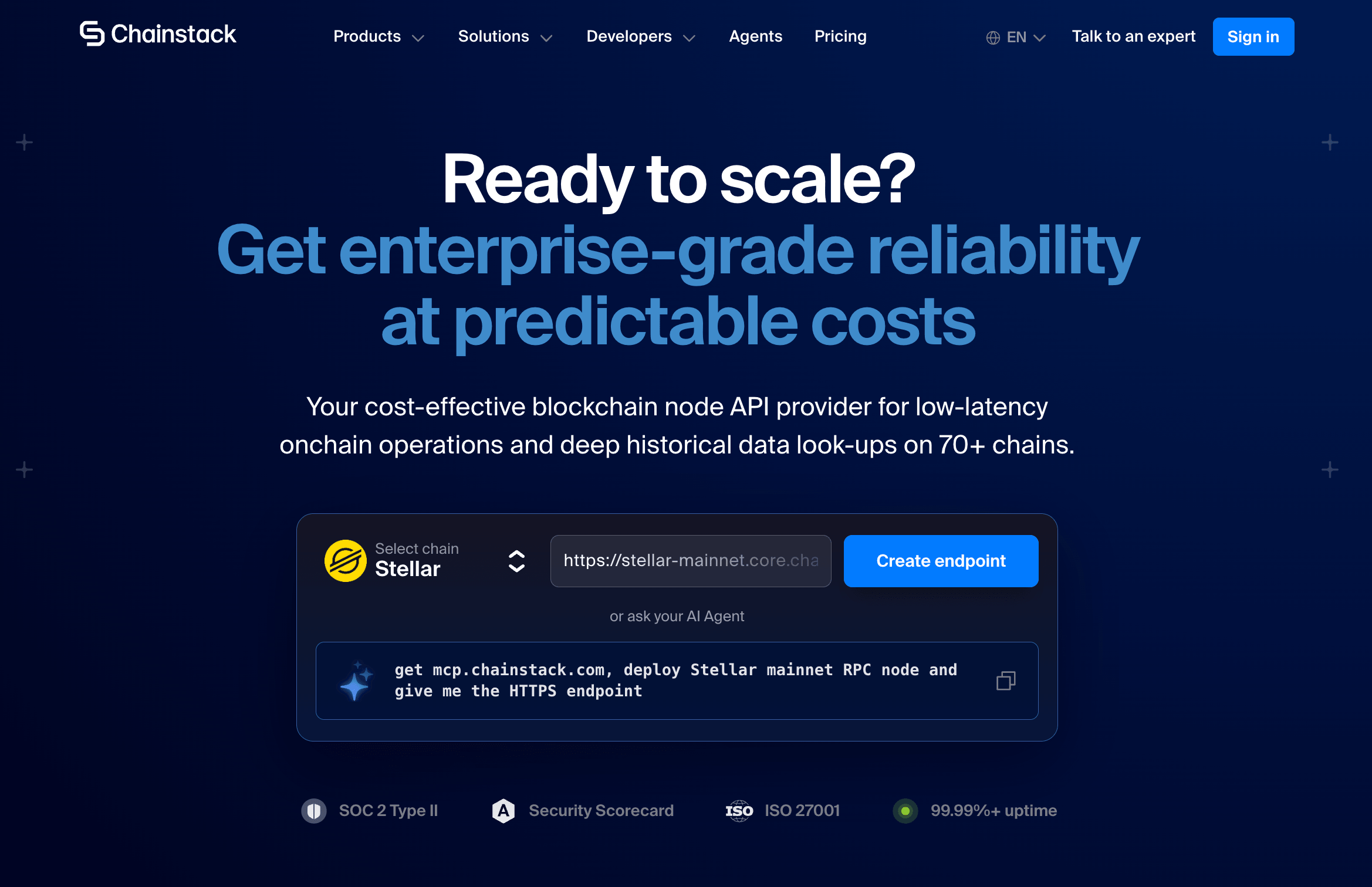
Chainstack added Stellar support on August 20, 2026, running Stellar RPC across Global Nodes and Dedicated Nodes on Stellar Mainnet and Testnet, with every request — reads and transaction submissions alike — billed as a flat 1 request unit, since Stellar has no separate archive tier to bill.
Integration uses Stellar’s own SDKs against a Chainstack endpoint — @stellar/stellar-sdk in JavaScript (rpc.Server) or stellar-sdk in Python (SorobanServer) — with no proprietary wrapper layer. Global Nodes handle geo-distributed shared access; Dedicated Nodes suit teams that need isolated Stellar infrastructure without operating validators themselves. Pricing follows Chainstack’s standard tiers: a permanent Developer plan (3M RU/month, 25 RPS, no card required), Growth at $49/month (20M RU, 250 RPS), and Pro, Business, and Enterprise scaling up from there — the same tiers that apply across every Chainstack-supported chain.
Chainstack’s SOC 2 Type II and ISO 27001 certifications and four-tier support structure (Community through $1,000/month Premium with sub-1-hour response) apply to Stellar the same as any other supported chain, and Stellar RPC access is also reachable through Chainstack MCP for teams working from an AI coding agent.
Limitations: WebSocket access isn’t available for Stellar on Chainstack yet — the current integration is HTTPS-only. There’s also no third-party track record to point to: Chainstack’s own Stellar support is weeks old at the time of writing, and Stellar isn’t yet listed among the providers on Stellar’s own developer docs.
Fit by workload:
- Stablecoin and payments infrastructure: Excellent — flat billing means high-volume payment polling doesn’t multiply against a credit weight as call volume grows.
- RWA and tokenized asset infrastructure: Strong, with a caveat — Dedicated Nodes give isolated throughput, but there’s no archive product on Stellar today, so long-window historical queries still need a companion service.
- Enterprise and regulated fintech: Strong on paper — SOC 2 Type II and ISO 27001 plus a published SLA — though the Stellar integration itself is measured in weeks, not years.
Uniblock
Uniblock is a managed multi-chain infrastructure layer offering unified JSON-RPC and HTTP API access to Stellar across 300+ blockchains and 55+ underlying providers, with the Stellar ecosystem itself listed among Uniblock’s production customers — a notable case of the chain’s own team routing some traffic through the same aggregator layer a reader here might use.
Uniblock’s product sits in three tiers: Unified JSON-RPC for raw RPC access, Unified APIs for higher-level token, NFT, market, and webhook data, and Direct Provider APIs for pass-through access to specific underlying providers. The pooled-provider model means automatic routing and failover across whichever backends Uniblock integrates for a given chain, smoothing over a single provider’s rate limits without the integrating team managing multiple accounts. The company raised $5.2 million in a March 2026 round and reports over 4,000 developers and 3,000 projects on the platform, including Plume Network and Apechain alongside Stellar.
Limitations: Public documentation of Stellar-specific throughput, pricing, and dedicated-node options is thinner than Uniblock’s EVM coverage, and no SOC 2 or ISO 27001 certification is publicly confirmed for Uniblock as of this writing.
Fit by workload:
- Stablecoin and payments infrastructure: Good — pooled provider capacity helps absorb bursty payment traffic without a single point of failure.
- RWA and tokenized asset infrastructure: Good — the Unified APIs layer is a genuine advantage for teams also pulling token or NFT metadata alongside raw ledger data.
- Enterprise and regulated fintech: Moderate, mainly because there’s nothing public yet to point a compliance reviewer toward.
OnFinality
OnFinality runs dedicated public and authenticated Stellar RPC endpoints — including a WebSocket gateway — with the public tier capped at 5 requests per second and authenticated plans scaling to 500+ RPS, alongside one-click Dedicated Node deployment for teams that want isolated Stellar infrastructure without running validators themselves.
The free plan raises that ceiling to 40 RPS for general API access, with the paid Growth plan adding RPC analytics, priority support, and no daily response limit. OnFinality’s broader platform spans 100+ networks and includes managed SubQuery indexer hosting elsewhere in its catalog — a real differentiator for indexing-heavy workloads, though SubQuery support specifically for Stellar isn’t independently confirmed at the time of writing.
Limitations: The free public endpoint’s 5 RPS ceiling is thin for anything beyond prototyping, and moving past it means an authenticated paid plan. No SOC 2 or ISO 27001 certification is publicly confirmed for OnFinality itself.
Fit by workload:
- Stablecoin and payments infrastructure: Strong — the WebSocket gateway is a genuine plus for anything watching payment channels in near-real time instead of polling.
- RWA and tokenized asset infrastructure: Good — OnFinality’s one-click dedicated node option provides isolated throughput, though full historical depth still depends on a companion indexer.
- Enterprise and regulated fintech: Moderate — nothing publicly confirmed on the compliance side to hand to a procurement checklist yet.
Validation Cloud
Validation Cloud is a Stellar-native infrastructure provider running both Stellar RPC (for Soroban smart contract data) and Horizon nodes side by side, giving teams full historical account and transaction history through Horizon while using RPC for real-time ledger and contract queries — a combination none of the other providers in this comparison bundle natively.
The platform is SOC 2 Type 2 certified and built around what it calls Smart Routing, which manages request traffic for consistent performance rather than leaving failover entirely to the client. Pricing scales from a free starter tier upward with usage, and the company — headquartered in Zug, Switzerland — positions itself as a Web3 data-streaming and infrastructure specialist rather than a general-purpose multi-chain reseller, with 24/7 support advertised as standard rather than a paid add-on.
Limitations: Validation Cloud doesn’t publish Stellar-specific throughput ceilings or dedicated-node pricing the way the larger generalist providers do, and it carries far less brand recognition among teams evaluating providers by reputation alone.
Fit by workload:
- Stablecoin and payments infrastructure: Strong — Horizon access alongside RPC covers both real-time and full-history payment queries from a single vendor.
- RWA and tokenized asset infrastructure: Excellent — full transaction history is exactly what asset-issuance audit trails need, and here it’s bundled rather than sourced from a second provider.
- Enterprise and regulated fintech: Strong — SOC 2 Type 2 certified and built specifically around Soroban and Stellar, though ISO 27001 isn’t confirmed either way.
Alchemy
Alchemy went live with full Stellar support in April 2026, shipping JSON-RPC and WebSocket access plus indexed Data APIs for transfer history, token balances, and NFT holdings across both classic Stellar operations and Soroban contracts — and has stood up its own three-validator Stellar node cluster while working toward tier-1 validator status — Alchemy’s own posts frame this as a “path to,” not an achieved status yet — an unusual case of an RPC provider directly participating in the network’s consensus infrastructure rather than just serving reads against it.
The indexed APIs are the headline feature for Stellar specifically: instead of building a custom indexer against Stellar RPC’s bounded retention window, teams can query transfer history and balances directly. Alchemy’s free tier for Stellar is permanent rather than time-limited, a genuine point in its favor next to Quicknode’s trial-based entry. Method-weighted CU billing applies here the same as on Alchemy’s other chains — pay-as-you-go pricing adds up fast past the free tier, so it’s worth running the numbers before committing to production volume.
Limitations: Alchemy’s Dedicated Clusters product isn’t currently extended to Stellar, a real gap for teams needing isolated throughput. SOC 2 is published; ISO 27001 is not — don’t assume dual certification just because some competitors here hold it.
Fit by workload:
- Stablecoin and payments infrastructure: Strong — indexed transfer-history APIs are a direct fit for payment reconciliation without building a custom indexer.
- RWA and tokenized asset infrastructure: Strong — token and NFT holdings APIs cover tokenized-asset bookkeeping out of the box.
- Enterprise and regulated fintech: Good, with a gap — SOC 2 is published, but no ISO 27001 and no dedicated nodes will matter for some regulated buyers’ checklists.
Quicknode

Quicknode offers Core RPC API access plus Streams and Webhooks for Stellar mainnet and testnet, giving teams a push-based option for transaction and payment events on top of standard JSON-RPC polling, backed by both SOC 2 Type II and ISO 27001 certification.
Streams and Webhooks are the practical differentiator for Stellar: instead of polling getTransactions on a schedule, a payments backend can subscribe to push delivery for relevant events. Quicknode’s broader plan structure runs from a Build tier at $49/month through Accelerate, Scale, and multiple Business+ tiers up to custom Enterprise pricing. Teams scaling past the free trial often find credit consumption outpaces what that trial made pricing feel like.
Limitations: There’s no permanent free tier — the entry point is a one-month trial (10 million credits, 15 RPS, community support only) that exits into a paid plan or lapses. No dedicated-node option is documented specifically for Stellar.
Fit by workload:
- Stablecoin and payments infrastructure: Good — Streams and Webhooks fit payment-event pipelines well, though credit costs need modeling before committing to volume.
- RWA and tokenized asset infrastructure: Moderate — no Stellar-specific archive or indexing product beyond Core RPC and Streams.
- Enterprise and regulated fintech: Strong — dual SOC 2 Type II and ISO 27001 certification checks a box many procurement teams look for first.
Getting started with Stellar on Chainstack
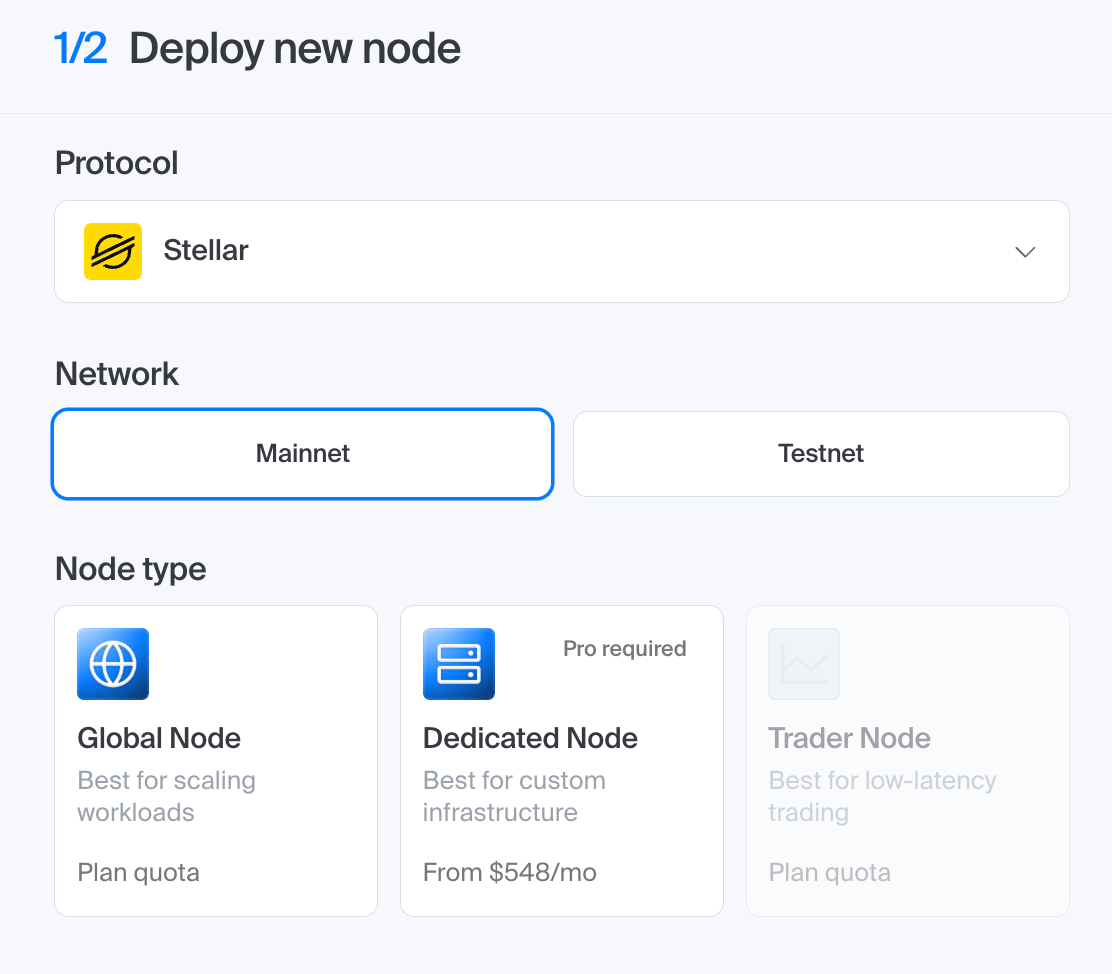
Deploy a production Stellar endpoint in a few steps:
- Log in to the Chainstack console (or create an account).
- Create a new project
- Select Stellar as your blockchain protocol
- Choose network: Stellar Mainnet or Testnet
- Deploy the node
- Open Access and credentials and copy your HTTPS endpoint
For issuance platforms or payment processors that need isolated throughput rather than a shared endpoint, Dedicated Nodes are available for Stellar Mainnet and Testnet alongside the same initial deploy.
import { rpc } from "@stellar/stellar-sdk";

const server = new rpc.Server("YOUR_CHAINSTACK_ENDPOINT");

// Confirm the node is healthy and see how far back its ledger history goes
const health = await server.getHealth();
console.log(`Status: ${health.status}, oldest ledger: ${health.oldestLedger}`);

const network = await server.getNetwork();
console.log(`Passphrase: ${network.passphrase}`);
📖 For the full integration guide, see the Chainstack Stellar tooling documentation.
🤖 You can also access Chainstack Stellar RPC directly from Claude Code, Cursor, Codex, Pi, or any MCP-compatible agent using Chainstack MCP. For a fuller agent stack — MCP, the Chainstack skill, llms.txt for context ingestion, and WebMCP for agentic browsers — see the Chainstack Agents page.
Conclusion
For a chain whose RPC interface only fully stabilized in the past two years, and whose biggest 2026 headline is a wave of major providers just now shipping real support, the question worth asking first is whether a provider treats Stellar as a first-class integration or a fast-follow afterthought.
- For stablecoin and payments infrastructure: Chainstack for predictable flat billing, or Validation Cloud where full settlement history via Horizon matters as much as real-time reads.
- For RWA and tokenized asset issuance: Validation Cloud for bundled full-history access, or Alchemy for indexed token and NFT APIs.
- For teams already standardized on Alchemy or Quicknode for other chains: both now support Stellar, but check the certification and dedicated-node gaps above before assuming full parity with their EVM offerings.
- For prototyping and hackathons: Chainstack’s and Alchemy’s permanent free tiers avoid Quicknode’s time-limited trial entirely.
Frequently asked questions
Q: What’s the difference between Stellar RPC and Horizon?
Stellar RPC is a JSON-RPC 2.0 interface for real-time ledger reads and Soroban smart contract data, retaining only a bounded recent window of history. Horizon is the older REST/HAL API that historically handled account, effects, and history queries; per Stellar’s own docs it’s now nearing end-of-life and no longer receives new feature development, though it continues to receive compatibility updates and has no published shutdown date.
Q: Which Stellar RPC providers have a permanent free tier?
Chainstack, Alchemy, and Validation Cloud all offer standalone free tiers with no time limit and no card required at signup. Quicknode’s Stellar access currently starts as a one-month free trial (10 million credits, 15 RPS) rather than a permanent plan.
Q: Do I need to migrate off Horizon?
Not immediately — Horizon still works and continues to get protocol-compatibility updates — but Stellar’s own documentation recommends RPC for new integrations, and Horizon isn’t receiving new features going forward. Teams building anything new should default to Stellar RPC and treat Horizon as a legacy or historical-data companion rather than the primary interface.
Q: How do I benchmark Stellar RPC latency across providers?
Stellar isn’t yet tracked on Chainstack’s public performance dashboards, so there’s no ready-made ranking to check. Run your own test — a curl loop or k6 script hitting getHealth and a heavier call like getTransactions over a wide ledger range from your target region — and compare p95/p99, not just average response time.
Q: Which Stellar RPC providers are SOC 2 or ISO 27001 certified?
Chainstack holds both SOC 2 Type II and ISO 27001, and Quicknode holds both too. Alchemy holds SOC 2 but has not published ISO 27001. Validation Cloud is SOC 2 Type 2 certified. Uniblock and OnFinality don’t publicly confirm either certification as of this writing.
Q: Why does Stellar RPC pricing look different from Ethereum or Solana RPC pricing?
Stellar has no archive or debug/trace tier to bill at a premium, so a flat-billing provider like Chainstack ends up genuinely flat on Stellar rather than just flat-on-simple-calls. Method-weighted providers like Alchemy and Quicknode still apply their standard CU/credit models, but the gap between “cheap” and “expensive” calls on Stellar is narrower than it is on an EVM chain with debug_traceTransaction or wide-range eth_getLogs queries in the mix.
Additional resources