AI-ready infrastructure
 Refer and earn


 Ethereum
 Hyperliquid
 Solana
 Arbitrum
 BNB Smart Chain
 Base
Base Polygon
 TRON
TRON Sui
Sui Robinhood


5 decentralized compute networks for Web3 applications

“Decentralized compute” is an umbrella term, not a workload definition. One product may need to run a containerized backend continuously. Another may need a discrete offchain computation. A creative team may need GPU rendering. An AI team may need a cluster, virtual machine, or bare metal GPU capacity. The right network depends on that job before it depends on a price comparison.
This guide compares five Marketplace tools through the workload they are best suited to evaluate. The list does not declare a universal winner. Availability, hardware, geography, runtime, price, support model, and data-handling requirements can all change the answer for a production deployment.
Profile the workload before comparing providers
| Workload | Tool | Best fit |
|---|---|---|
| Deploy a containerized application through a decentralized marketplace | Akash | Akash uses a deployment specification and provider-bidding model for application workloads. |
| Run a programmable decentralized computation as an application task | Golem | Golem provides developer tooling for building and running computations across network resources. |
| Scale a creative render or generative 3D workflow on decentralized GPUs | Render Network | Render Network is built around decentralized GPU rendering and generative creative workflows. |
| Provision and manage GPU clusters, VMs, or containers for AI work | io.net | IO Cloud provides GPU cluster, VM, bare metal, and container deployment options. |
| Access decentralized GPU infrastructure for AI, gaming, and virtualized compute | Aethir | Aethir offers distributed GPU infrastructure with products for bare metal AI compute and cloud gaming rendering. |
1. Akash

Akash is a decentralized cloud marketplace for application deployments. In its workflow, a developer describes containers, resource needs, ports, pricing, and optional placement requirements in a deployment. Providers bid to host the workload, and accepting a bid creates a lease for the running application.
That model makes Akash the first tool to evaluate for a containerized Web3 application or supporting service. Think web apps, APIs, databases, developer environments, AI endpoints, or other software that can run in a container and benefits from a marketplace model for compute. The product question is not simply whether the app can be containerized. It is whether you can specify the performance, storage, networking, uptime, and operational requirements clearly enough to select and monitor a provider responsibly.
Akash deserves a full deployment test before production. Run the actual image, simulate upgrades and rollbacks, observe logs and metrics, test secrets handling, and confirm what data persists when a lease changes. For a user-facing application, define an incident response plan that does not rely on manually discovering a problem after users report it.
Choose Akash if: you have a deployable container workload and want to evaluate a decentralized marketplace for continuous application hosting.
Think twice if: your need is a one-off computational task or a specialized creative rendering workflow. A deployed service and a queued job have different operating models.
2. Golem

Golem is a decentralized computing network with developer resources for creating and running applications on network-provided resources. Its documentation provides JavaScript and Python paths, plus examples for executing tasks, composing work, and transferring data.
Golem is worth evaluating when the application can express its work as jobs or tasks instead of a long-running, public web service. Examples might include batch processing, research workloads, simulations, model-related processing, media transforms, or a computation whose output can be brought back into another product system. Its value lies in treating distributed execution as part of the application architecture, not as an invisible replacement for a conventional server.
The boundary around data is the key design question. Define precisely what inputs leave the application, what the workers receive, how output is verified, and what happens when a task retries or fails. For Web3 use cases, a smart contract should not blindly trust a computation simply because the request originated from a decentralized network. Decide how results are checked, attested, challenged, or otherwise made safe for the business action they influence.
Choose Golem if: your product can use discrete, programmable computation and you are prepared to model task inputs, outputs, retries, and verification.
Think twice if: you need a conventional always-on application with tightly managed networking and operations. That may be a better fit for a deployment-oriented platform.
3. Render Network
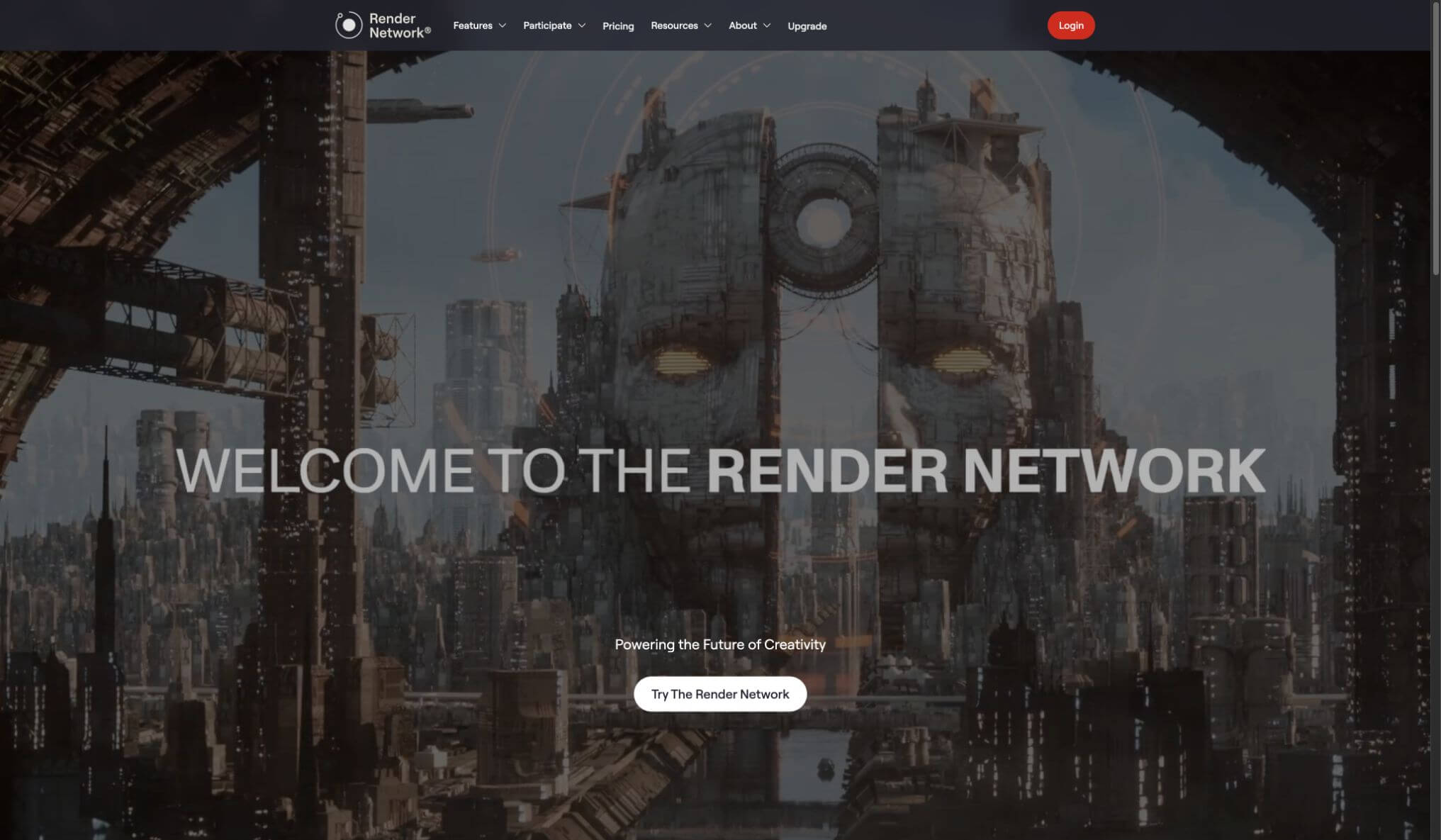
Render Network is a decentralized GPU platform designed around creative workflows. Its official materials describe 3D rendering, generative 3D work, and a GPU compute path for creative and AI-oriented processing. It is the clearest specialist in this comparison when the workload is a rendering job rather than a general backend.
That specialization matters. A team building generative art, 3D assets, spatial experiences, video-related workflows, or a creator-facing product can evaluate Render Network for the job it is optimized to perform: breaking a GPU-intensive creative workload into work that can be processed at scale. The API and upload workflow should be tested with representative scenes, assets, and output volumes, not with a tiny sample that hides the actual bottleneck.
Do not stretch the category. Render Network may be part of a Web3 creator stack, but it does not replace the application database, user-account system, contract integration, or the frontend. It handles a specific compute-heavy portion of the product. Keeping that role focused makes the architecture easier to operate and explain.
Choose Render Network if: your primary need is decentralized GPU rendering or a generative creative workflow that maps naturally to rendering jobs.
Think twice if: the workload is a normal API, an arbitrary application server, or a clustered AI service that needs a different runtime model.
4. io.net
io.net offers IO Cloud for on-demand decentralized GPU clusters. Its current documentation describes options for Ray clusters, GPU-accelerated virtual machines, bare metal, and container-as-a-service deployments. That gives AI and machine-learning teams several routes to match the infrastructure to the runtime they already use.
io.net is a practical comparison candidate when the workload needs more than a single GPU job. A team can look at GPU hardware, location, cluster size, deployment duration, image configuration, and monitoring through a cloud-style workflow. For a model-serving or training system, the evaluation should include start time, networking, dependency setup, inference or training performance, checkpoint handling, observability, and failure behavior across the chosen deployment model.
The Web3 relevance is in the network and economic model, not in a requirement to put the workload itself onchain. Keep private model inputs, customer data, and credentials within an explicit security design. Also separate the compute runtime from the blockchain components that may trigger, pay for, verify, or record the outcome of the work.
Choose io.net if: you need to compare GPU clusters, VMs, bare metal, or container deployments for a distributed AI or compute-heavy workload.
Think twice if: the job is mainly a creative render pipeline or a simple containerized website. A more specialized or simpler platform may produce a clearer operating model.
5. Aethir
Aethir provides distributed cloud compute infrastructure that aggregates GPUs into a global network. Its documentation distinguishes Aethir Earth for decentralized bare metal GPU compute and Aethir Atmosphere for cloud gaming rendering. It positions the network for AI training, fine-tuning, inference, real-time rendering, gaming, and other virtualized compute work.
Aethir is worth evaluating for demanding GPU workloads where raw infrastructure characteristics and service expectations matter. The first comparison should be based on the exact environment your team needs: GPU class, region, bare metal versus a containerized endpoint, network performance, storage, security controls, workload duration, and operational support. An AI workload and a cloud gaming workload should not be assessed with the same benchmark.
As with any distributed compute layer, make the data boundary concrete. Decide what data is permitted in the environment, how it is encrypted, how access is controlled, who can reach the workloads, and what retention or cleanup rules apply when use ends. These questions are part of the architecture, not a procurement checklist to postpone.
Choose Aethir if: your workload needs decentralized GPU infrastructure for AI, real-time rendering, gaming, or high-performance virtualized compute.
Think twice if: your deployment is lightweight or if the product has not yet defined the GPU, performance, and operational requirements it actually needs.
Two deployment patterns worth separating
A blockchain application with a conventional backend workload
- Run the backend, indexer, API, or worker service on a platform that fits its container and operational requirements, such as Akash.
- Use a dedicated database, observability, backup, and incident-response plan that fits the application’s risk profile.
- Use a blockchain node provider separately for contract reads, writes, and event subscriptions.
The compute network runs your service. The blockchain connectivity layer lets that service interact with the chain. They are adjacent roles, not substitutes.
A compute-heavy product where the result affects an onchain action
- Execute the GPU or distributed computation on a network that matches the runtime and hardware needs, such as Golem, Render Network, io.net, or Aethir.
- Define how the application validates the result before it affects a user balance, permission, settlement, or contract call.
- Record only the data or proof that the onchain workflow actually needs, rather than assuming every intermediate artifact belongs onchain.
The validation rule should be designed before the result is allowed to influence an irreversible action.
Production questions that matter more than a headline price
- Is this a long-running container, a batch task, a render job, a GPU cluster, or a bare metal environment?
- Which GPU model, memory, network throughput, region, and duration does the workload actually require?
- What data enters the environment, and what security, access, and cleanup rules apply to it?
- How will the application monitor health, capacity, cost, retries, and failed jobs?
- What happens during a provider change, a workload restart, a lost output, or a delayed result?
- When a compute result informs an onchain decision, how is the result checked before a transaction is submitted?
How Chainstack fits into the stack
Chainstack is the blockchain connectivity layer, not a decentralized compute host. Use it when the application deployed on one of these networks needs reliable RPC and WebSocket access to supported chains: to read contract state, submit transactions, track confirmations, and react to relevant events.
For example, a containerized service can subscribe to contract events through Chainstack, run an offchain compute or rendering workflow, validate its result, and then submit an application-controlled transaction when the business rule allows it. That separation keeps responsibilities clear: the compute network executes the workload, Chainstack connects the application to blockchain state, and the application owns the validation and user-facing logic.