AI-ready infrastructure
 Refer and earn


 Ethereum
 Hyperliquid
 Solana
 Arbitrum
 BNB Smart Chain
 Base
Base Polygon
 TRON
TRON Sui
Sui Robinhood


Top 7 Robinhood Chain RPC providers for tokenized assets in 2026

Robinhood Chain is an Ethereum Layer 2 built by Robinhood Markets on the Arbitrum Orbit stack, purpose-built for tokenized equities, ETFs, and other real-world assets. Within two weeks of its July 2026 mainnet launch it had crossed $312 million in total value locked and now processes more than 10 million transactions a day at roughly 100-millisecond block times. Memecoins and stablecoins drive most of that early volume, and tokenized real-world assets are still a small slice, but they are the workload the chain, and this guide, is built around.
Choosing the best Robinhood Chain RPC providers matters more here than on most chains, because of the workload the chain was designed for. Robinhood Chain settles tokenized versions of NVDA, AAPL, TSLA, and other equities, and the teams building on it are brokerages, asset managers, and fintechs rather than weekend hackers. The chain uses first-come-first-served sequencing with no fee-priority ordering, native ERC-4337 account abstraction, and posts data to Ethereum via blobs, reaching full Ethereum finality about 13 minutes after each batch is confirmed. For an application moving real financial assets, an RPC endpoint that rate-limits during a market open, lacks trace access for audit trails, or carries no SOC 2 attestation is not a minor inconvenience; it is a compliance and reliability gap.
This guide compares the seven most relevant Robinhood Chain RPC providers for production workloads, explains the infrastructure requirements the chain creates, and rates each provider against the workloads that actually run here.
💡 Already using Chainstack? Jump straight to the Robinhood Chain tooling docs or deploy your endpoint in minutes.
Why RPC provider choice matters for Robinhood Chain
Robinhood Chain inherits Arbitrum Nitro’s execution model but runs it at a far more aggressive cadence: new blocks every 100 milliseconds with sub-second soft confirmations. That speed changes how applications interact with the chain. A wallet or consumer front-end polling for state at human speed is fine, but any system that reconciles transfers, tracks tokenized-equity balances, or confirms settlement needs an endpoint that keeps up with block production without dropping WebSocket subscriptions or throttling under burst load. The chain’s design goal, moving regulated financial assets on-chain, means the reliability bar is set by finance, not by DeFi experimentation.
The second factor is auditability. Because Robinhood Chain hosts tokenized securities, the teams building brokerage integrations and RWA dashboards operate under real compliance obligations. That pushes archive access, debug/trace methods, and vendor security attestation from “nice to have” to “required.” Not every provider exposes trace methods on this chain, and not every provider can hand a compliance team a current SOC 2 Type II report. The criteria that separate a production-grade Robinhood Chain endpoint from a basic one:
- Cost predictability and pricing model — flat request-unit billing you can forecast at scale, versus method-weighted credits that spike unpredictably on a trace-heavy audit workload
- Archive, debug, and trace access — historical state and execution-level tracing for audit trails and reconciliation
- Throughput stability under load — sustained RPS and clean burst handling during market opens and volatility, not just a high headline limit
- Free-tier reality — a standing free plan you can build a prototype on, versus a time-limited trial that forces a provider decision before you’ve validated the integration
- WebSocket and subscription support — reliable
eth_subscribestreams to keep up with 100 ms blocks without polling - Dedicated node options — isolated infrastructure for workloads that cannot share compute with noisy neighbors
- Compliance attestation — SOC 2 Type II and ISO 27001 reports that satisfy institutional vendor due diligence
Robinhood Chain RPC provider comparison
The table below summarizes public positioning as of October 2026. Robinhood Chain is fully EVM-compatible and supports the standard Ethereum JSON-RPC interface, so the providers below expose the same core method set — the differences are in throughput, compliance, and infrastructure options.
| Provider | Pricing model | Free tier | Dedicated nodes | Archive & trace | SOC 2 / ISO |
|---|---|---|---|---|---|
| Chainstack | Request units (RU) | Yes — 3M RU / 25 RPS | Yes (Pro plan+) | Yes, debug/trace from Growth plan | SOC 2 Type II + ISO 27001 |
| RouteMesh | Per-request (economy/performance tiers) | Yes — free community endpoint (rate-limited) | No — routing layer, not raw nodes | Full method coverage via backend providers | Not documented |
| Dwellir | 1 credit per response, method-agnostic | Yes — 100,000 responses/day, 20 RPS | Yes (dedicated cluster $4,200/mo) | Archive endpoints with Nitro debug methods | Not documented |
| Blockdaemon | Custom / enterprise | No | Yes | Yes | SOC 2 Type II + ISO 27001 |
| dRPC | Pay-as-you-go per request | Yes — public nodes (no SLA) | No (NodeCore is a self-hosted load balancer) | Partial (debug/trace on paid tier) | Not documented |
| Alchemy | Compute units (CU) | Yes — 30M CU / month | No | No — Debug and Trace APIs not supported on Robinhood Chain | SOC 2 Type II |
| Quicknode | Credit-based (method-weighted) | Trial only (30 days) | Yes (clusters) | Yes | SOC 2 Type II + ISO 27001 |
How to choose a Robinhood Chain RPC provider
1. Shared RPC for moderate traffic
For a prototype, a testnet deployment, or a low-volume dashboard, a shared endpoint is enough. Robinhood Chain’s public RPC at rpc.mainnet.chain.robinhood.com works for exploration, and every direct-node provider here offers a shared tier that handles moderate read traffic against the standard JSON-RPC interface. If you are calling eth_call to read a tokenized-stock balance a few times a second and occasionally scanning logs, a free or entry-level shared plan will serve you well.
2. When dedicated infrastructure matters
Shared endpoints stop being enough at three thresholds. First, when sustained throughput crosses a few hundred RPS: a settlement reconciler polling eth_getTransactionReceipt across thousands of daily fills will saturate a shared plan. Second, when latency consistency becomes a requirement rather than a preference, because a shared node under load from other tenants during a market open will not give you predictable p95 response times. Third, when isolation is a compliance requirement, since banks and custodians handling RWAs frequently mandate that infrastructure not run in a shared environment. In all three cases, Dedicated Nodes with reserved compute are the right answer — on Chainstack this tier starts at the Pro plan.
3. Archive, debug, and trace access
Robinhood Chain exposes Nitro-native debug_* methods for transaction replay and call tracing, including every standard Geth tracer (callTracer, prestateTracer, and the struct/opcode logger). Parity-style trace_* and arbtrace_* namespaces are not exposed on the chain at all — debug_* is the only tracing path, regardless of provider. If your application reconstructs historical state — pricing a tokenized asset at a past block, rebuilding a portfolio snapshot, or producing an audit trail — you need archive access, and for execution-level detail you need debug_traceTransaction. Be precise about what actually requires an archive node: scanning event logs by block range with eth_getLogs works on a full node, but querying eth_call or eth_getBalance at a historical block, and any debug_ call, require archive. Confirm your provider enables trace on Robinhood Chain specifically — it is not universal.
4. Latency consistency vs. average latency
A provider advertising a low average latency can still deliver poor p95 and p99 numbers under load. For a chain producing blocks every 100 ms, the tail latency is what determines whether your subscription-driven monitor stays in sync during a volatility spike. Robinhood Chain is one of the few newer chains already covered by a public real-time RPC benchmark dashboard, so you do not have to guess.
⚡ Benchmark before you commit: live latency and availability numbers across Robinhood Chain RPC providers are tracked at compare.chainstack.com — updated every 3 minutes, with P50/P95/P99 broken down by region (DE/US/SG). Check the current ranking before you commit, then confirm with your own probe from your target region (a
curltiming loop or a short k6 script hittingeth_blockNumberandeth_getLogsis enough to surface meaningful p95/p99 differences for your workload).
5. Enterprise support for regulated products
Because Robinhood Chain hosts tokenized securities, the providers you shortlist for a production brokerage or RWA product should carry published, audited security attestations — not self-reported checklists. A SOC 2 Type II report demonstrates that controls operate effectively over time, and ISO 27001 adds a certified information-security management system. Pair that with a contractual uptime SLA and a defined support-response time, and you have infrastructure a compliance team can actually sign off on. Chainstack, Quicknode, and Blockdaemon all carry audited SOC 2 Type II and ISO 27001 certification. dRPC does not publish an equivalent attestation, and RouteMesh, as a routing layer rather than a node operator, does not publish one either.
Choose by use case
For real-world assets (RWA) and tokenized securities
Robinhood Chain exists to put real-world assets on-chain: tokenized equities such as NVDA, AAPL, and TSLA, plus ETFs and other instruments. The RPC demands of an RWA workload are less about raw speed and more about data integrity and history. Pricing and net-asset-value calculations need archive-backed eth_call at specific historical blocks; holder analytics and transfer tracking depend on eth_getLogs queries over the Transfer events each asset contract emits; and compliance reporting relies on complete, reproducible audit trails built with debug_traceTransaction. A provider that prunes historical state or lacks trace access simply cannot serve this workload.
The providers that fit are those combining archive depth, trace, and an audited security posture. Chainstack enables archive plus debug/trace on Robinhood Chain from the Growth plan across mainnet and testnet, Blockdaemon targets RWA custody and asset-manager workloads explicitly, and Quicknode offers archive access with dual compliance certifications. dRPC and Dwellir can back read-heavy RWA dashboards on shared tiers, but with no published attestation they are a weaker fit for regulated, auditable RWA infrastructure. RouteMesh routes to backend node providers rather than running its own audited infrastructure, so it is not a fit for the audit-trail-critical parts of this workload even though it can front read traffic.
For regulated fintech and institutional teams
Brokerages, custodians, and asset managers building on Robinhood Chain operate under real regulatory frameworks — SOC 2 for vendor due diligence, and emerging regimes such as MiCA in the EU and the GENIUS Act for stablecoin and tokenized-asset settlement in the US. For these teams, RPC selection is a procurement decision as much as a technical one. The requirements are archive access for complete audit trails, debug_traceTransaction for execution-level forensics, isolated infrastructure, a contractual uptime SLA, and — critically — a current, audited attestation the compliance team can file.
Among the seven, Chainstack, Quicknode, and Blockdaemon publish audited SOC 2 Type II reports, and Chainstack, Quicknode, and Blockdaemon add ISO 27001. Alchemy holds SOC 2 Type II but does not offer standard dedicated nodes. dRPC and Dwellir do not publish an equivalent attestation, and RouteMesh’s routing-layer model means the underlying compliance posture depends on whichever backend provider ultimately serves the request — neither is a strong fit for a regulated brokerage’s vendor list on its own.
For consumer dApps, wallets, and account abstraction
Robinhood Chain ships first-class ERC-4337 support — sponsored gas, batched transactions, programmable wallets, and session keys — which makes it a strong base for consumer-facing apps where users should never see a gas prompt. These workloads are read-heavy and latency-sensitive at the edge: fast eth_call for balances and allowances, eth_subscribe over WebSocket to reflect new blocks in the UI instantly, and reliable transaction broadcasting for bundled user operations. Geo-distributed endpoints matter here because your users are everywhere.
Global Nodes suit this profile — geo-balanced routing that scales with request volume and keeps read latency low across regions. Alchemy is also strong for account abstraction thanks to its bundler and Gas Manager APIs, RouteMesh’s low-latency routing and automatic failover across backend providers suit a latency-sensitive consumer front-end well, and a generous free tier from Chainstack or Alchemy covers most early-stage consumer apps before they need dedicated capacity.
Provider-by-provider breakdown
Chainstack
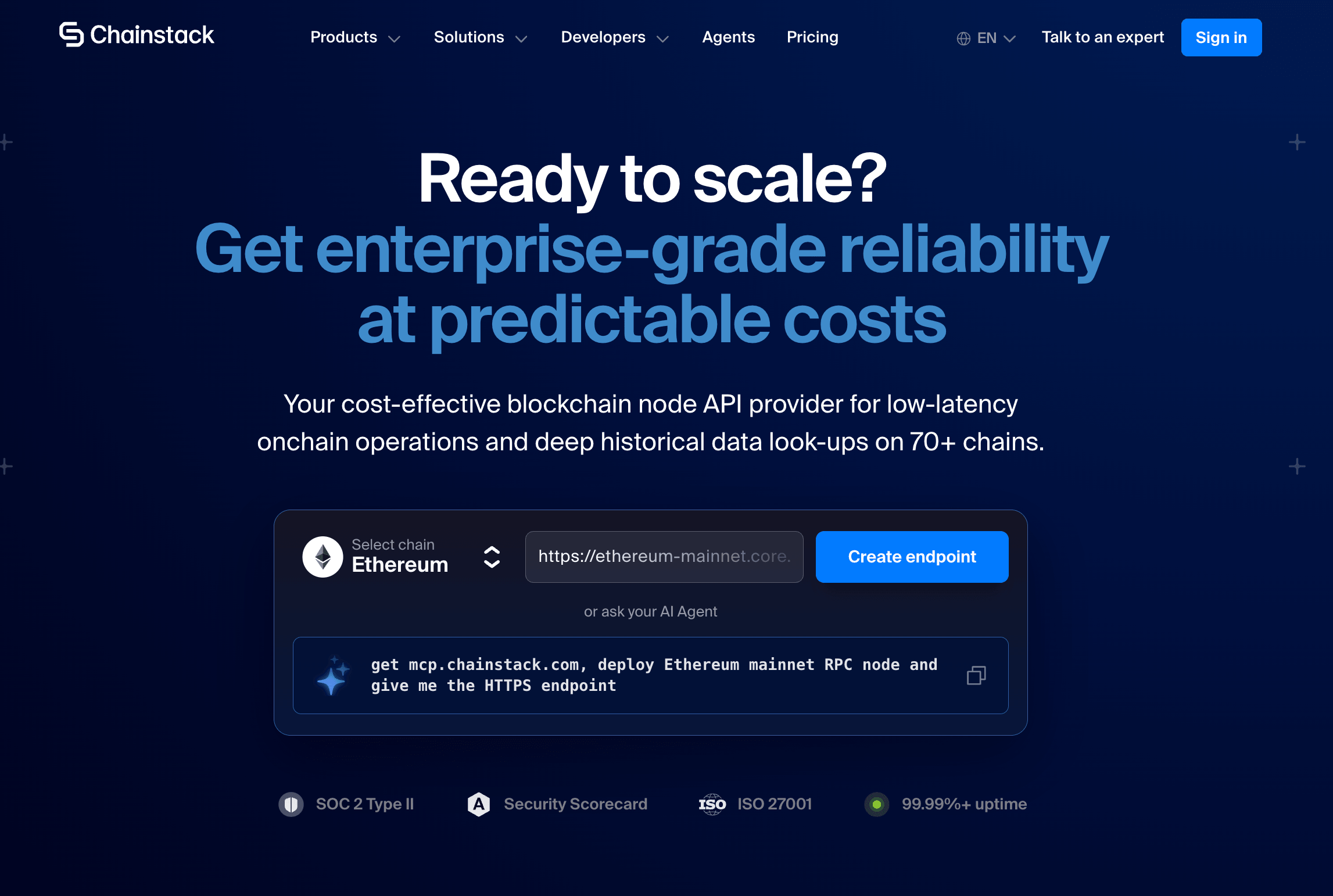
Chainstack added Robinhood Chain as a first-class protocol at launch, with Nitro-native debug_* methods for transaction replay, call tracing, and smart-contract debugging enabled on both mainnet (chain ID 4663) and testnet (46630). It offers three deployment paths on the chain: Global Nodes for geo-balanced, scalable access; Dedicated Nodes for isolated production infrastructure, available from the Pro plan; and Self-Hosted deployment on both mainnet and testnet (Arbitrum Nitro) for teams that need the node inside their own environment.
Pricing is request-unit (RU) based and transparent: a free Developer tier includes 3M RU/month at 25 RPS, Growth is $49/month for 20M RU at 250 RPS and is where archive data and debug/trace access turn on, and Dedicated Nodes become available starting on the $199/month Pro plan. Debug and trace methods additionally require the node to be deployed as a Global Node. For workloads with predictable high volume, the Unlimited Node add-on provides flat-fee, RPS-tiered access from $149/month (25 RPS) to $3,199/month (500 RPS) with no per-request billing or overage. On the compliance side, Chainstack holds SOC 2 Type II (certified December 2025) and ISO 27001 (certified July 2026), with a 99.9% quarterly uptime SLA and service credits on Enterprise.
Limitations: Chainstack is a general-purpose multi-chain provider rather than a Robinhood-Chain-native specialist, so it does not ship Robinhood-specific data-abstraction APIs (tokenized-asset indexing, prebuilt transfer feeds) the way a couple of competitors do. Teams wanting those higher-level APIs will build them on top of raw RPC or pair Chainstack with an indexer.
Fit by workload:
- Real-world assets (RWA): Excellent — archive, debug/trace, and dedicated throughput available from the Growth and Pro plans respectively.
- Regulated fintech and institutional: Excellent — SOC 2 Type II, ISO 27001, dedicated nodes, and a contractual SLA.
- Consumer dApps and account abstraction: Strong — Global Nodes and a real free tier cover consumer read patterns and early growth.
RouteMesh
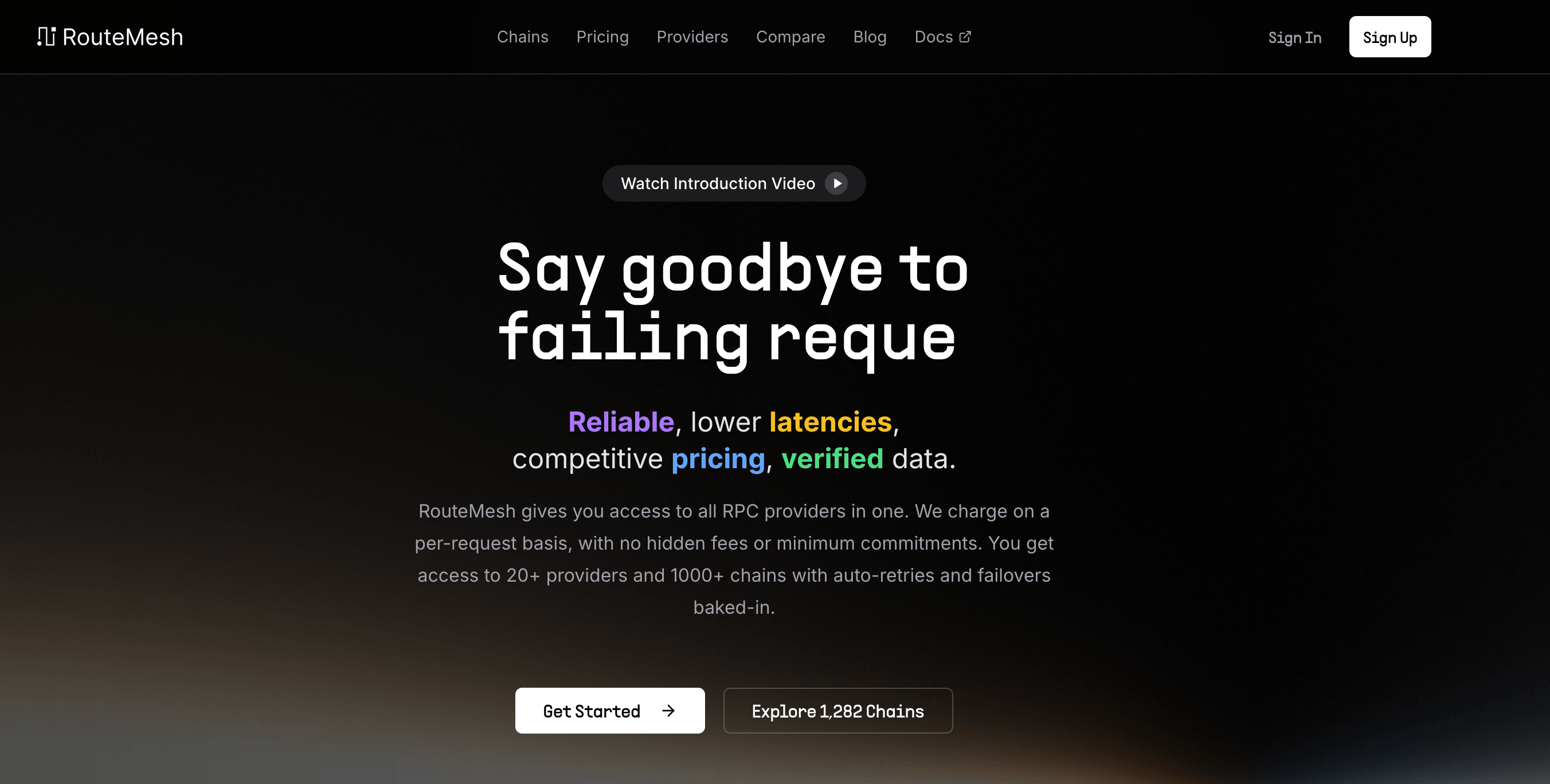
RouteMesh is an intelligent RPC routing layer covering 1000+ EVM networks, and it added full support for Robinhood Chain (chain ID 4663) shortly after the chain’s mainnet launch, exposing 70 supported JSON-RPC methods through a single unified endpoint. Rather than running its own node fleet, RouteMesh scores the health of multiple upstream providers in real time and routes each request to the fastest healthy backend, failing over automatically when one degrades — useful for teams that don’t want a single provider outage to take down their Robinhood Chain integration.
A free community endpoint (lb.routeme.sh/rpc/evm/4663) handles read requests with no API key required for testing, while transaction requests route through premium infrastructure priced per million requests across economy and performance tiers. RouteMesh customers building multi-chain products include LI.FI, Vaults.fyi, and DAMM Capital, and the platform ships an MCP server and Cursor integration for agent-driven workflows.
Limitations: RouteMesh does not operate its own single-tenant node infrastructure and does not publish a SOC 2 Type II or ISO 27001 attestation of its own — its effective compliance posture depends on whichever backend provider ultimately serves a given request, which is a real gap for a regulated Robinhood Chain workload. It is also a routing product rather than a dedicated-node option, so isolation-sensitive workloads still need a direct provider.
Fit by workload:
- Real-world assets (RWA): Limited — useful for read-heavy dashboards, but no audited attestation of its own for regulated RWA data.
- Regulated fintech and institutional: Limited — compliance posture is inherited from backend providers rather than independently certified.
- Consumer dApps and account abstraction: Strong — low-latency routing and automatic failover suit a latency-sensitive consumer front-end.
Dwellir
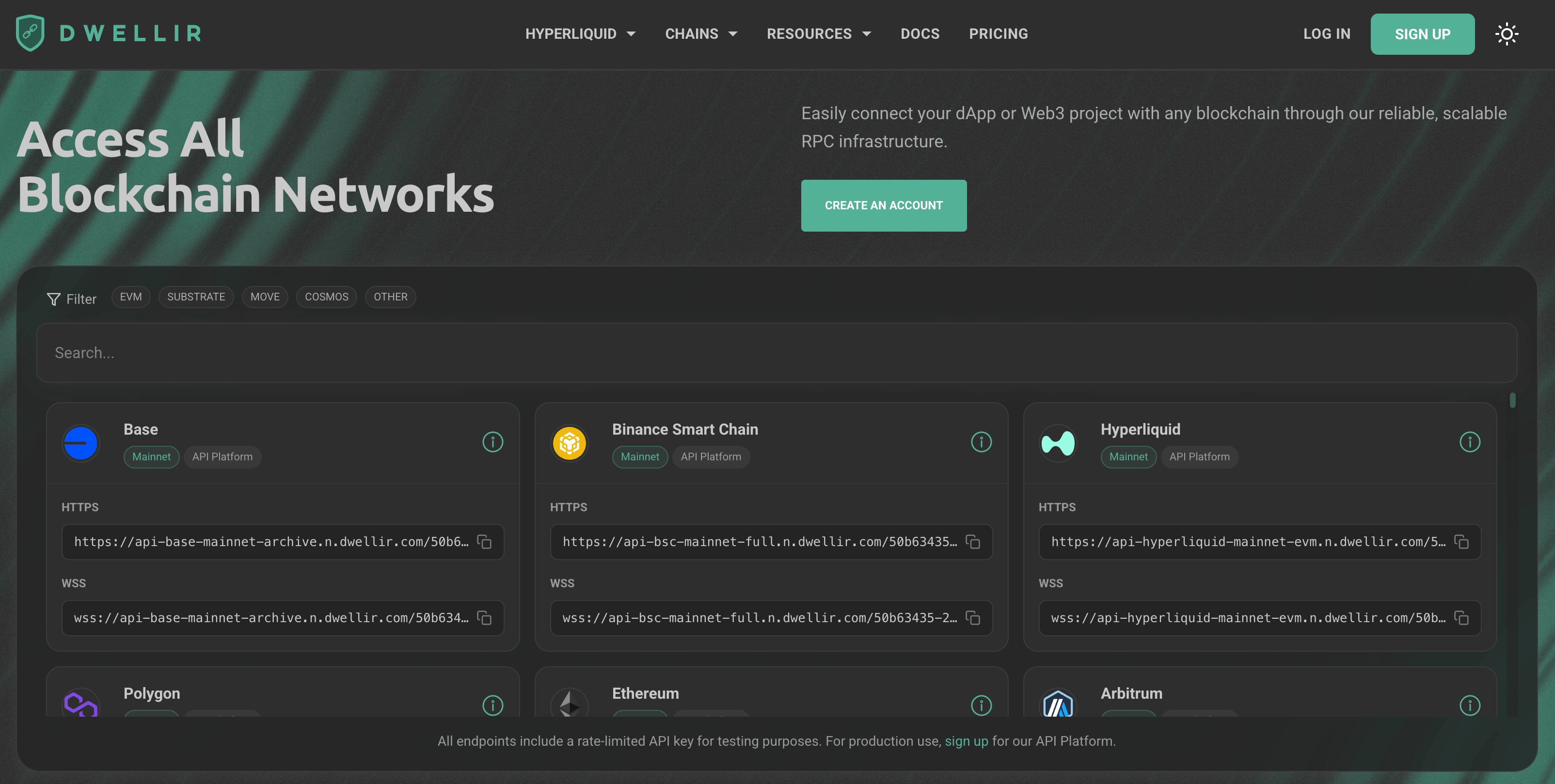
Dwellir is a Swedish RPC provider with a long Polkadot track record that now serves 150+ networks, Robinhood Chain mainnet among them, through both a managed API and dedicated node clusters. Shared plans bill one credit per response regardless of method, which keeps the cost of a trace-heavy audit run the same as a plain balance read. Its Robinhood Chain endpoints are archive nodes with Nitro debug methods; the chain itself does not expose trace_* or arbtrace_*, so debug_* tracers are the only tracing path with any provider.
Free covers 20 responses/second and 100,000 responses per day (HTTP and WebSocket, but no eth_getLogs on Free); Developer is $49/month (25M responses, 100/second), Growth $299/month (150M, 500/second, eth_getLogs over up to 10,000 blocks), and Scale $999/month (500M, 5,000/second). Unlimited Nodes start at $119/month flat. A Robinhood Chain dedicated cluster is listed at $4,200/month and adds unmetered throughput, no rate limits, and a 99.99% uptime SLA on custom terms. WebSocket is available on every plan, which matters at 100 ms block times. Pricing checked October 9, 2026.
Limitations: We found no SOC 2 or ISO 27001 attestation on Dwellir’s public pricing and dedicated-cluster pages, which is the deciding gap for the regulated and tokenized-securities workloads this guide focuses on. Request compliance documents and SLA terms in writing before shortlisting it for a brokerage or issuer.
Fit by workload:
- Real-world assets (RWA): Moderate — archive endpoints with debug methods and flat billing help, but there is no public attestation for compliance reporting.
- Regulated fintech and institutional: Limited — a contractual SLA is available on clusters, but no published SOC 2 or ISO 27001.
- Consumer dApps and account abstraction: Good — a permanent free plan, WebSocket on every plan, and predictable per-response billing suit read-heavy consumer apps.
Blockdaemon
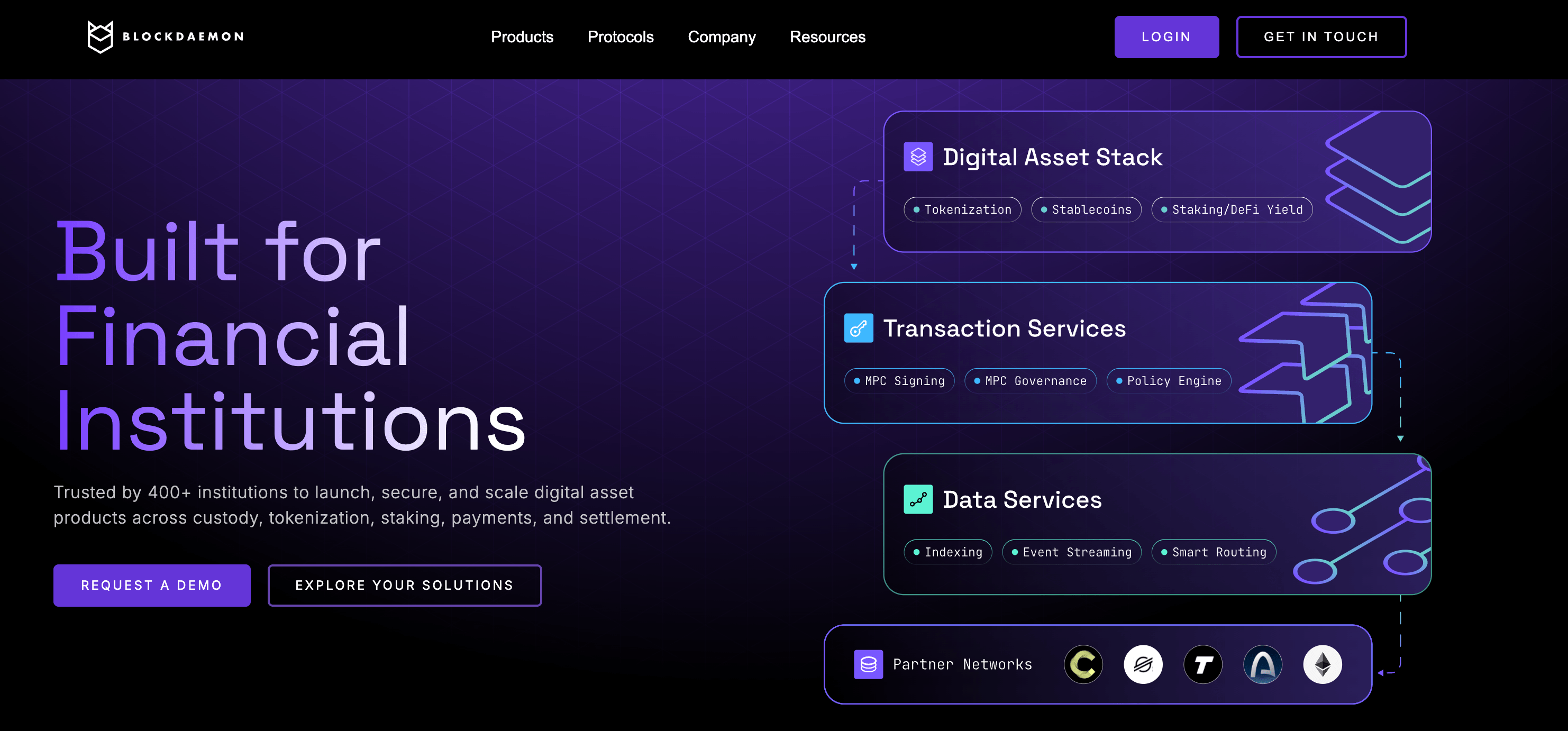
Blockdaemon supports Robinhood Chain from day one with JSON-RPC API access and dedicated nodes as part of its Data Services portfolio, positioned explicitly at institutional segments: developers building financial applications, banks and custodians managing RWAs with audit trails and isolated environments, and funds accessing tokenized equities and ETFs. Infrastructure spans six continents in Tier 3 data centers with 24/7 support and a 99.9% uptime target.
The compliance story is Blockdaemon’s strongest card — SOC 2 Type II and ISO 27001 certifications, with an emphasis on privacy, control, and no shared environments, which maps directly onto what a regulated brokerage’s vendor questionnaire asks for. Dedicated nodes provide predictable latency and isolation for clients that cannot run in a multi-tenant setup.
Limitations: Blockdaemon does not publish a self-service free tier or transparent per-request pricing — engagement is enterprise-oriented and quote-based, which raises the barrier for smaller teams and makes quick evaluation harder than with a provider you can sign up for in minutes. Its 99.9% published target is a notch below the 99.99% others advertise.
Fit by workload:
- Real-world assets (RWA): Strong — dedicated nodes and isolation aimed squarely at institutional RWA custody.
- Regulated fintech and institutional: Strong — SOC 2 Type II and ISO 27001 with an explicitly institutional posture.
- Consumer dApps and account abstraction: Moderate — enterprise engagement model and no free tier make it a poor fit for early-stage consumer apps.
dRPC
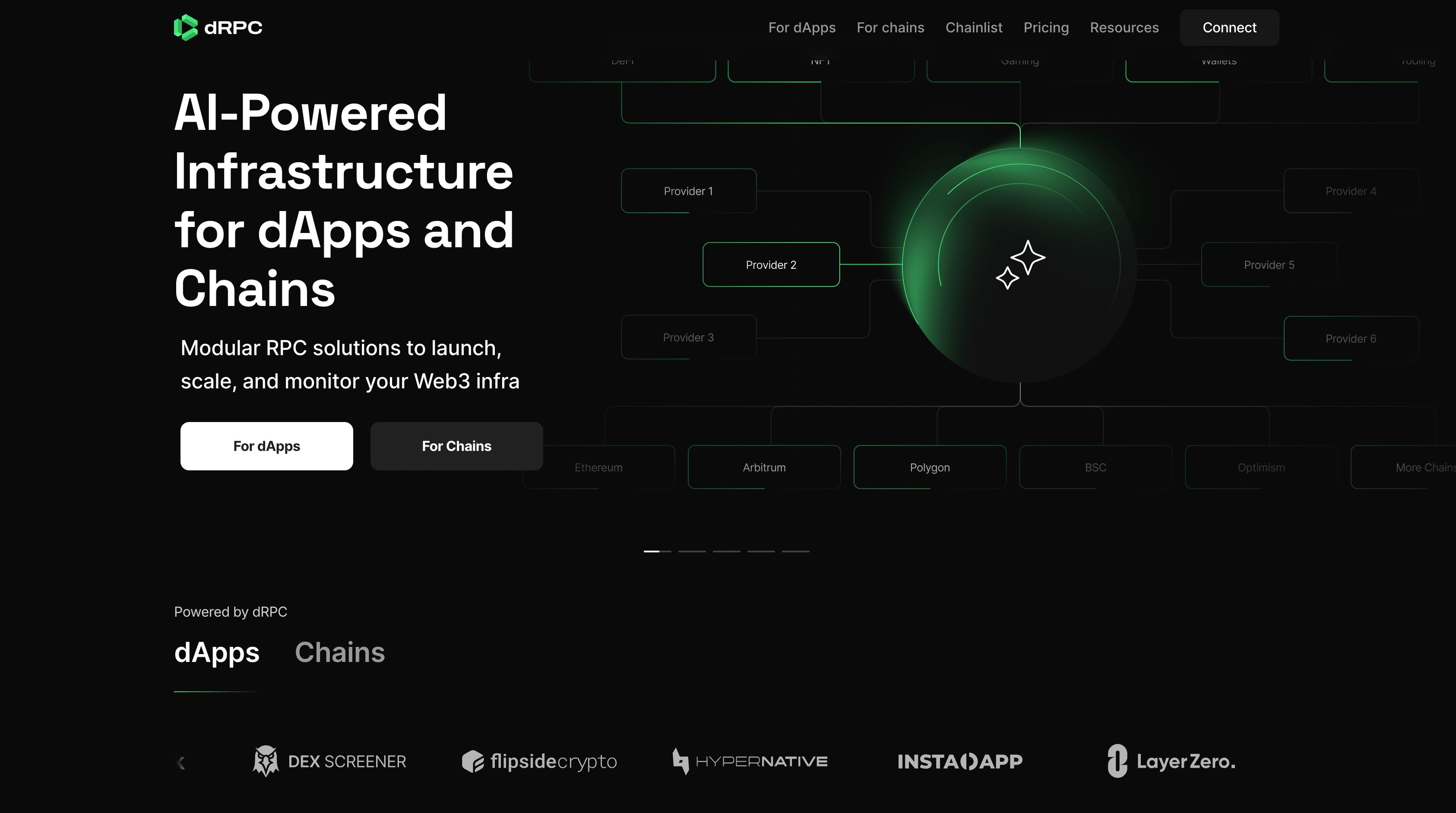
dRPC brought Robinhood Chain mainnet online with production-ready endpoints, offered two ways: NodeCloud, a hosted multichain platform that aggregates infrastructure from independent node operators across geo-distributed clusters with automatic routing based on latency and availability, and pay-as-you-go pricing with no monthly lock-in; and NodeCore, a free, open-source, provider-agnostic RPC load balancer you self-host for full control over routing, caching, and observability. The pay-as-you-go per-request model is one of the most transparent and forecastable in this comparison, and debug and trace methods are included.
For read-heavy analytics and dashboards on Robinhood Chain, dRPC’s free public nodes and flat per-request pricing are attractive, and NodeCore is a genuinely useful option for teams that want to run their own routing layer.
Limitations: dRPC does not publish a SOC 2 Type II or ISO 27001 attestation, which is often disqualifying for regulated brokerage and custody workloads on a chain hosting tokenized securities. Its aggregator model routes across third-party operators rather than a single-tenant infrastructure it controls end to end, and its public/free nodes carry no SLA.
Fit by workload:
- Real-world assets (RWA): Moderate — debug and trace are included, but no audited attestation limits regulated RWA use.
- Regulated fintech and institutional: Limited — no published SOC 2/ISO attestation is a hard blocker for most compliance teams.
- Consumer dApps and account abstraction: Good — transparent pricing and a free public tier suit cost-sensitive consumer builds.
Alchemy
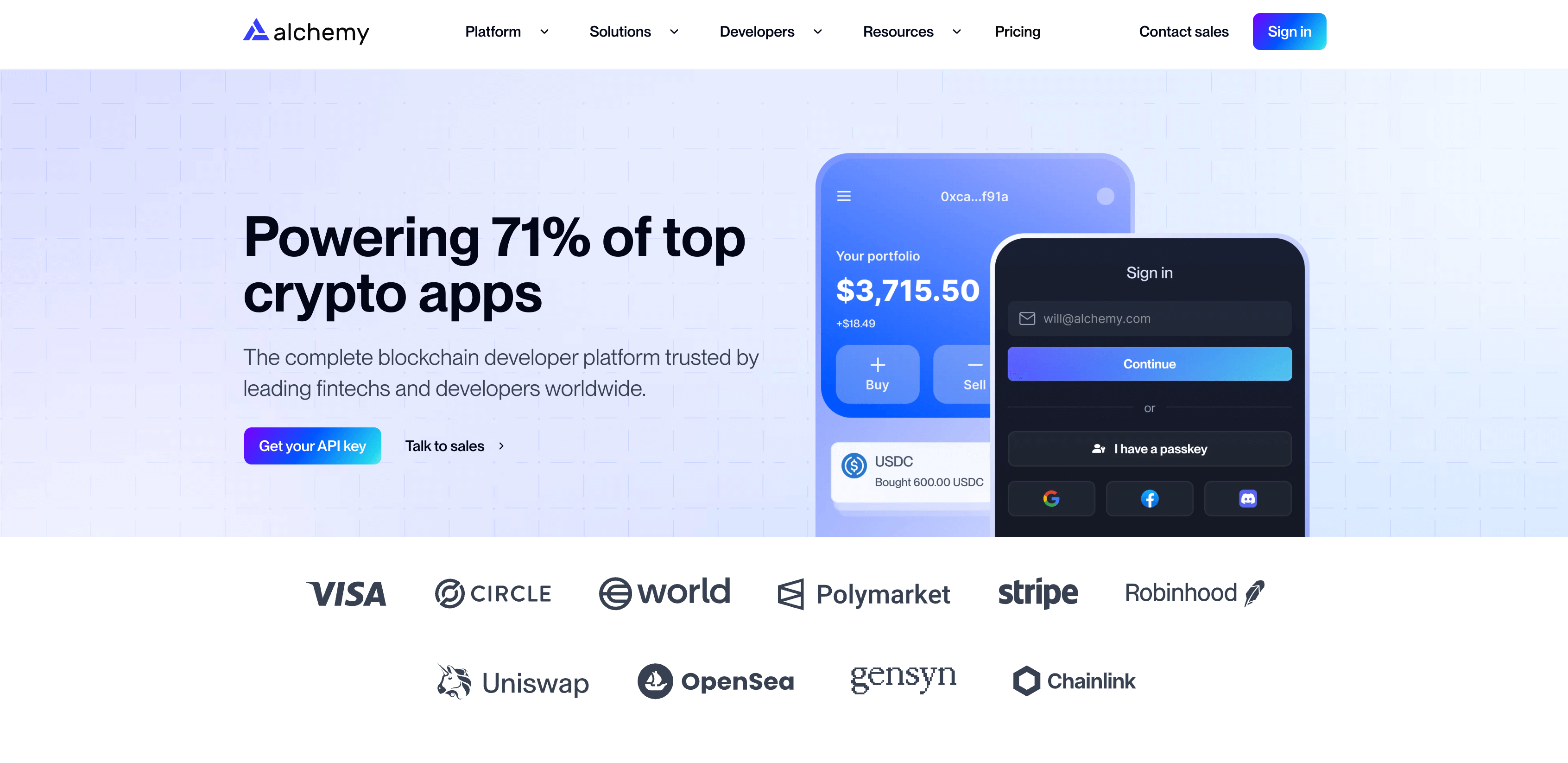
Robinhood Chain is live on Alchemy for both mainnet and testnet, with the full Alchemy stack layered on top of plain JSON-RPC: webhooks for on-chain events, a bundler and Gas Manager API for ERC-4337, and data APIs for tokens, transfers, and NFTs. For teams building consumer apps that lean on account abstraction, this is a genuinely useful toolkit — the sponsored-gas and bundler endpoints map directly onto Robinhood Chain’s native ERC-4337 support.
Pricing is compute-unit (CU) based and method-weighted, with a generous 30M CU/month free tier that comfortably covers development and small production apps. Alchemy holds SOC 2 Type II but does not publish an ISO 27001 certification. Alchemy’s own Robinhood Chain page lists the Debug and Trace APIs as not currently supported, so audit-trail tracing has to come from another provider.
Limitations: Alchemy does not offer standard dedicated nodes, so workloads that require isolated, contention-free infrastructure — a common requirement for regulated RWA settlement — cannot be served on Alchemy alone. At meaningful production volume, Alchemy’s per-CU pricing is one of the pricier options in this comparison, and it does not publish an ISO 27001 certification alongside its SOC 2 report.
Fit by workload:
- Real-world assets (RWA): Moderate — strong token and transfer data APIs, but no dedicated-node isolation and no Debug/Trace on Robinhood Chain for audit trails.
- Regulated fintech and institutional: Good — SOC 2 Type II is solid, though the lack of dedicated nodes and ISO 27001 is a gap for strict procurement.
- Consumer dApps and account abstraction: Excellent — bundler, Gas Manager, and a large free tier make it a natural fit for ERC-4337 consumer apps.
Quicknode

Quicknode supports Robinhood Chain mainnet and testnet with managed endpoints optimized for the chain’s 100 ms block times, exposing standard Ethereum JSON-RPC plus Debug API methods for tracing. It states 99.99% uptime and runs globally distributed nodes, and its platform includes marketplace add-ons and analytics that many teams already rely on across other chains.
Pricing is credit-based, where each method call consumes a method-weighted number of credits — flexible but harder to forecast than a flat request model, since a trace-heavy audit workload burns credits far faster than simple reads. There is no perpetual free tier; access is via a 30-day trial. Quicknode carries both SOC 2 Type II and ISO 27001 certifications, and dedicated clusters are available for teams needing isolated capacity.
Limitations: The absence of a standing free tier makes long-running low-volume workloads (a monitoring bot, a testnet integration) awkward to host. Quicknode’s credit-based pricing can also surprise teams once archive or trace calls enter the mix — worth modeling before committing to a tier, since the method-weighted model can produce surprising bills for trace- and log-heavy institutional workloads unless carefully monitored.
Fit by workload:
- Real-world assets (RWA): Strong — archive and Debug API access with dedicated clusters for asset-manager workloads.
- Regulated fintech and institutional: Strong — dual SOC 2 Type II and ISO 27001 attestation with a premium SLA on Enterprise.
- Consumer dApps and account abstraction: Good — solid global infrastructure, though no free tier for early-stage apps.
Getting started with Robinhood Chain on Chainstack
Deploying a Robinhood Chain endpoint on Chainstack takes a few minutes:
- Log in to Chainstack, or create a free account.
- Create a new project, or select an existing one.
- Select Robinhood Chain as your blockchain protocol.
- Choose network: Robinhood Chain Mainnet (chain ID 4663) or Testnet (chain ID 46630).
- Deploy the node — Global or Dedicated.
- Open Access and credentials and copy your HTTPS and WebSocket endpoints.
For latency-critical settlement reconciliation or isolated compliance environments, evaluate Dedicated Nodes (available from the Pro plan) after the initial deploy, or Self-Hosted deployment on mainnet or testnet if the workload needs to run entirely inside your own environment — both are available inside the same project.
Once you have an endpoint, a basic health check with eth_blockNumber confirms you are connected and reading the chain tip. To read a tokenized-stock balance, call the ERC-20 balanceOf function with eth_call against the stock-token contract:
const { ethers } = require("ethers");

const provider = new ethers.JsonRpcProvider("YOUR_CHAINSTACK_ENDPOINT");

// Minimal ERC-20 ABI for reading a tokenized-stock balance
const ABI = ["function balanceOf(address account) view returns (uint256)"];
const STOCK_TOKEN_CONTRACT = "YOUR_CONTRACT_ADDRESS";

const contract = new ethers.Contract(STOCK_TOKEN_CONTRACT, ABI, provider);
const balance = await contract.balanceOf("YOUR_WALLET_ADDRESS");

console.log(`Balance: ${ethers.formatUnits(balance, 18)}`);
Because Robinhood Chain is fully EVM-compatible, standard tooling works unchanged. The Robinhood Chain tooling documentation includes ready-to-use configuration for MetaMask, ethers.js, viem, Web3.py, Hardhat, Foundry, and Remix — just point the RPC URL at your Chainstack endpoint.
📖 For the full integration guide, see the Chainstack Robinhood Chain tooling documentation. Need testnet ETH? Grab some from the Chainstack Robinhood Chain faucet — it tops up eligible addresses up to 1 ETH every 24 hours.
🤖 You can also access Chainstack Robinhood Chain RPC directly from Claude Code, Cursor, Codex, or Antigravity using Chainstack MCP, or from Gemini in Chrome via WebMCP. See the Chainstack Agents page for the full current list of supported clients.
Conclusion
On a chain built to settle tokenized securities, the single most important selection criterion for 2026 is auditable, compliance-grade infrastructure: archive and trace access paired with a current, audited SOC 2 Type II attestation. That is what separates a provider you can put behind a regulated product from one you cannot.
- Real-world assets (RWA): Chainstack, Quicknode, or Blockdaemon — archive, trace, and dedicated infrastructure for auditable RWA data.
- Regulated fintech and institutional: Chainstack or Quicknode for dual SOC 2 Type II + ISO 27001; Blockdaemon for institution-first isolation.
- Consumer dApps and account abstraction: Alchemy for bundler/Gas Manager APIs, RouteMesh for multi-provider failover at the edge, or Chainstack Global Nodes with a free tier for early growth.
- Cost-sensitive analytics and prototyping: dRPC or Dwellir on shared, pay-as-you-go tiers.
Frequently asked questions
Q: Do I need an archive node for Robinhood Chain?
Only for historical state. Scanning event logs by block range with eth_getLogs works on a full node, but querying eth_call or eth_getBalance at a past block, and any debug_ call such as debug_traceTransaction, requires an archive node. Chainstack enables debug and trace on Robinhood Chain from the Growth plan, on a node deployed as a Global Node.
Q: Which RPC providers support Robinhood Chain, and is there a free option?
Robinhood’s own documentation names Alchemy, Quicknode, Blockdaemon, dRPC, and Validation Cloud as supported production RPC providers. Chainstack, RouteMesh, and Dwellir also support the chain independently of that list. For a standing free tier, Chainstack offers 3M request units per month and Alchemy offers 30M compute units, and Dwellir offers 100,000 responses per day; Quicknode is trial-only, while RouteMesh and dRPC offer free public/community endpoints without a full account.
Q: How do I migrate an existing Robinhood Chain integration to a new RPC provider?
Because Robinhood Chain exposes the standard Ethereum JSON-RPC interface, migrating is usually a matter of swapping the endpoint URL your SDK or node client points to — no contract or ABI changes required. Chainstack publishes an AI agent migration runbook that assesses your current Quicknode, Alchemy, or other provider usage, estimates the equivalent Chainstack cost, and walks through the switch step by step.
Q: How does Robinhood Chain’s 100 ms block time affect my RPC setup?
At 100-millisecond blocks, polling wastes requests and lags the chain tip. Use WebSocket subscriptions via eth_subscribe to receive new blocks and logs as they are produced, and choose a provider whose p95/p99 latency stays stable under burst load rather than one advertising only a low average.
Q: Which providers meet compliance requirements for tokenized-securities apps?
For regulated products, prioritize providers with published, audited attestations. Chainstack and Quicknode carry both SOC 2 Type II and ISO 27001; Blockdaemon carries SOC 2 Type II and ISO 27001; Alchemy holds SOC 2 Type II only. dRPC, RouteMesh, and Dwellir do not publish an equivalent attestation of their own.
Q: What pricing model is easiest to forecast for Robinhood Chain workloads?
Flat, RPS-tiered pricing is the most predictable. Chainstack’s Unlimited Node add-on gives flat-fee access with no per-request billing, and dRPC’s and RouteMesh’s pay-as-you-go per-request rates are transparent. Method-weighted credit and compute-unit models (Quicknode, Alchemy) are flexible but harder to forecast for trace- and log-heavy workloads.
Additional resources