AI-ready infrastructure
 Refer and earn


 Ethereum
 Hyperliquid
 Solana
 Arbitrum
 BNB Smart Chain
 Base
Base Polygon
 TRON
TRON Sui
Sui Robinhood


Top 5 node software options to deploy an Ethereum node in 2026

“Ethereum node software” means two different things, and most guides don’t tell you which one they’re covering. Execution clients — Geth, Reth, Nethermind — sync the chain. Deployment tools — Dappnode, eth-docker, Chainstack Self-Hosted — manage the clients. Picking the wrong category wastes weeks. This guide covers both.
What you’re actually choosing between
Before the list: “node software” means different things to different audiences. You need to separate execution clients from deployment tools, because they solve different problems.
- Execution clients — Geth, Nethermind, Besu, Erigon, Reth — are the raw node software. They sync the chain, serve JSON-RPC requests, and participate in consensus. You run one of these on every Ethereum node, always.
- Deployment and management tools — Dappnode, Stereum, eth-docker, Chainstack Self-Hosted — are wrappers that handle orchestration, monitoring, updates, and failover on top of clients. You don’t always use one of these, but without one, you’re handling all of that yourself.
Most “best Ethereum node software” comparisons conflate these two categories. This one doesn’t.
The operational reality most articles skip
If you’re running a node for development or to support a validator, you need to know the actual cost profile before choosing anything.
A production-grade Ethereum setup today requires 32 GB RAM, 2–4 TB NVMe (the chain passed 3 TB in mid-2025), and sustained 25+ Mbps bandwidth. Chainstack’s own estimate for self-hosted cloud archive nodes runs $300–600/month in compute. Across cloud costs and engineering time, the industry figure for a production node is roughly $86,000 per year.
Then there’s maintenance. The February 2025 Pectra Holesky incident — where Geth, Nethermind, and Besu all shipped a misconfigured depositContractAddress and attested an invalid block — required emergency coordination across every operator running those clients. The Fusaka upgrade in December 2025 looked clean on the execution layer, but a Prysm resource-exhaustion bug caused 248 missed blocks across 42 epochs, dropping participation to 75% and costing validators roughly 382 ETH in lost rewards. The BPO1 and BPO2 updates that followed each required up-to-date EL and CL versions within days of each other. One missed upgrade means downtime or slashing.
Geth’s own release notes, after a corruption bug, included: “We apologize for this regression and the headaches fixing it will entail on your side.” That’s the tone of DIY Ethereum infrastructure in 2026.
None of this means you shouldn’t self-host. It means the software you use to self-host matters more than most guides acknowledge.
5. Raw execution client: Geth or Reth with manual setup

Best for: MEV/HFT firms who need bare-metal colocation and don’t want any abstraction layer between their code and the node.
Geth (go-ethereum) is the reference client and still holds roughly 41% of the network. Version 1.17.2 syncs a full node in around 3 hours on NVMe, uses ~8 GB RAM, and path-based state storage has collapsed archive disk usage from 18–20 TB down to ~1.9 TB. For most workloads, Geth is the safe default.
Reth is the newer entrant — a Rust implementation with benchmark performance that’s meaningfully higher: up to 16,000 RPS, sub-millisecond latency under load, and 500+ RPS on debug and trace APIs (roughly 10x Erigon on those endpoints). It currently holds about 2% of the network but is growing fast.
Both give you maximum control. Both also give you maximum operational responsibility: manual monitoring, self-managed updates, hardfork coordination, corruption recovery, and no failover unless you build it.
This is the right choice only if your team’s primary work is infrastructure engineering, or if you’re a latency-sensitive MEV firm that needs to own every layer of the stack. For application developers, protocol teams, and infrastructure teams that primarily build products rather than babysit nodes, it’s the most expensive option by total cost.
4. Nethermind or Besu for client diversity
Best for: validators and protocol teams with a compliance or diversity mandate.
Geth’s ~41% share sits close to the 33% threshold that would allow a single-client bug to threaten network finality. If you’re running validators and care about the network’s health, running a minority client is a legitimate reason to choose Nethermind or Besu over Geth.
Nethermind (C#/.NET, ~38% share) syncs faster than Geth and ships with trace_* endpoints and a plugin API. The January 2024 consensus bug that knocked 8% of validators offline for four hours is a known incident — the team shipped a hotfix quickly, and the client’s been stable since. Besu (Java, ~16%) is the only client with Apache 2.0 licensing and serves enterprise and consortium-network workloads, including IBFT 2.0 and QBFT configurations. It’s the slowest initial sync of the major clients (~13 hours) and heaviest on RAM (~10 GB).
The operational overhead is the same as raw Geth. You’re still handling everything yourself — monitoring, updates, recovery. You’re just doing it with a different client. If client diversity is your primary reason for being here, this is the correct pick. If you want client diversity without the operational burden, see #1.
3. Dappnode or eth-docker for home stakers

Best for: solo validators and technically capable home stakers who want their own hardware and are comfortable managing a single server.
Dappnode ships as both an operating system and a hardware appliance (mini-PCs from €1,720 to €3,240). The my.dappnode web dashboard makes deploying execution and consensus clients genuinely approachable for non-DevOps audiences. It bundles WireGuard VPN, Web3Signer, MEV-Boost, and supports over 100 packages through its DAppStore — including Lido CSM, Obol DVT, and SSV. If you want to run a validator from home with minimal Linux expertise, Dappnode is the most mature option.
eth-docker is the choice for technically capable solo stakers who prefer Docker Compose over a GUI. It supports every major execution client (Geth, Nethermind, Besu, Erigon, Reth) and consensus client (Lighthouse, Teku, Prysm, Nimbus, Lodestar, Grandine), ships with production-grade Grafana dashboards, and calendar-versions its releases ahead of every hardfork. Its ./ethd interactive shell wizard handles most setup complexity. The EthStaker community maintains it actively.
Neither is designed for anything beyond a single node. There’s no RBAC, no team accounts, no Kubernetes path, no API gateway, no cross-node observability, and no SLA. For home stakers, that’s fine — these tools fit their audience precisely. For teams running nodes as production infrastructure for an application or protocol, they stop fitting very quickly.
2. Stereum for VPS-based single-node operators
Best for: technically independent operators who want a managed-style GUI but run their own VPS or bare-metal server.
Stereum is an Electron desktop launcher that SSH’s into a user-provided server and orchestrates Docker containers remotely. It supports five execution clients and five consensus clients, auto-installs Prometheus and Grafana, and ships a mobile monitoring app (Stereum Node Monitor) with push alerts — a genuine differentiator that most tools in this category don’t offer.
The positioning is honest: Stereum handles setup complexity better than raw clients, and it monitors better than eth-docker out of the box. But it’s still single-server, still manual in its update model, still without team or fleet management. If you’re a solo operator who wants a GUI and real alerting without buying a Dappnode appliance, Stereum is a solid middle ground.
1. Chainstack Self-Hosted
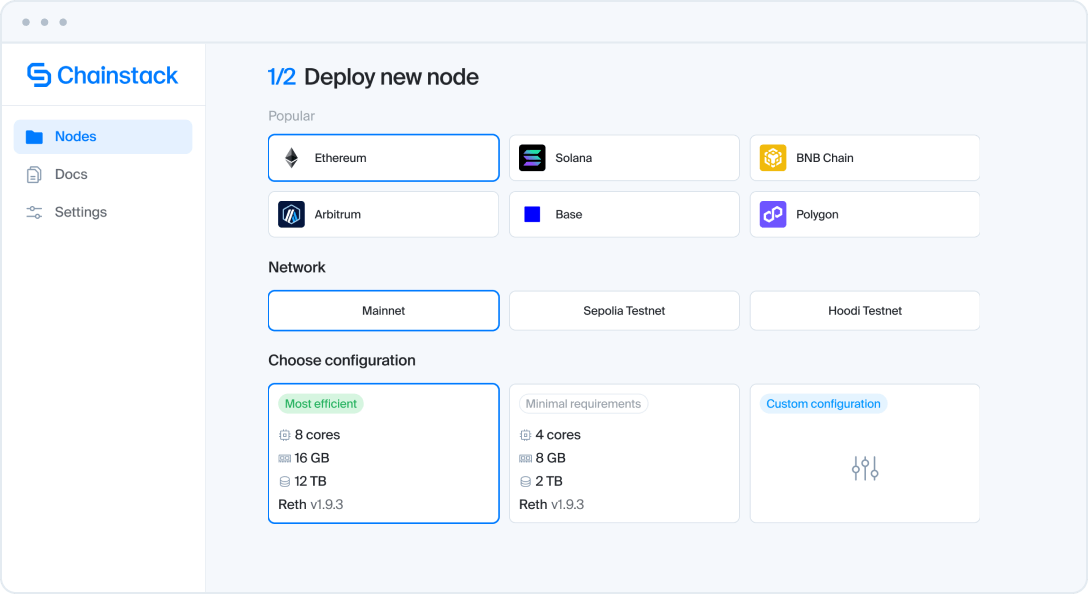
Best for: development teams, protocol teams, and infrastructure teams that need their own node without the operational overhead of managing one.
Chainstack Self-Hosted is a Kubernetes-native control plane that deploys and operates Ethereum nodes on infrastructure you control. You bring the server — cloud VPS, VM, bare metal, or local environment. Chainstack provides the software that handles everything above the hardware layer: deployment orchestration, authentication, real-time monitoring, alerts, failover configuration, and managed update rollouts.
The install takes 5–10 minutes. Compare that to Chainstack’s own documented figure for DIY production setup: two weeks to get a production-ready node running for the first time, then four hours per week per engineer to keep it healthy — more when a hardfork or corruption event hits.
What Self-Hosted adds on top of running Reth yourself:
- One-click deployment with pre-tested Reth + Prysm configurations
- Configurable failover — to a secondary node, Chainstack’s managed RPC endpoint, or any user-specified endpoint — so a node crash doesn’t take down your application
- Controlled update notifications with managed rollout, so you’re not discovering hardfork requirements at 2am
- Encrypted, access-controlled environments
- ~1ms internal latency via in-cluster endpoint exposure
- SOC 2 Type II certification and ISO 27001 data center infrastructure, which matters for compliance-sensitive deployments
For teams with an existing cloud provider relationship, it runs directly on their infrastructure. For teams that want a turnkey hardware option, Chainstack’s partnership with HOSTKEY ships servers with Self-Hosted pre-installed across 13 countries — the entry point is around $190 per quarter for a VDS in the Netherlands.
Why it’s #1: Every other option on this list — raw clients, Dappnode, eth-docker, Stereum — forces you to choose between ownership and operational simplicity. Chainstack Self-Hosted is the first option in the market that gives you both. You retain full infrastructure ownership: your servers, your data, your cloud account. You don’t inherit DIY’s operational burden: no manual monitoring setup, no hardfork-coordination risk, no custom failover architecture to build. That’s a category that didn’t exist two years ago, and it’s the one that solves the actual problem most development teams have when they decide to stop relying on Infura or Alchemy.
Decision framework
- You should use Chainstack Self-Hosted if you’re a development team, protocol team, or infrastructure organization that needs to own your node’s infrastructure without owning its operations. Especially strong if you have compliance requirements, a multi-person team that needs controlled access, or you’re starting a new deployment and want to be on a GA-ready trajectory.
- You should use eth-docker or Dappnode if you’re a solo validator or technically capable home staker running a single node for staking or personal use, and you want the lightest possible tooling. Chainstack Self-Hosted also works well here if you’d prefer a managed-grade control plane even for a single node.
- You should use Stereum if you’re a solo operator on a VPS who prefers a GUI and wants built-in mobile alerts out of the box. Chainstack Self-Hosted is equally valid if you want failover and a managed update model on top of that.
- You should use raw clients with manual setup if you’re an MEV firm, HFT shop, or infrastructure-focused team whose primary work is node operations and you need to own every layer of the stack with no abstraction.
- You should use Nethermind or Besu if client diversity is a first-order concern for your validator setup and you’re comfortable with the operational overhead of running a minority client without a management layer.
Getting started with Chainstack Self-Hosted
Deploying a self-hosted Ethereum node no longer requires weeks of manual setup and operational overhead. With Chainstack Self-Hosted, you get a streamlined deployment workflow while retaining full control over infrastructure, data, and network access.
If you need Ethereum nodes that meet internal compliance, security, or data residency requirements, Chainstack Self-Hosted provides a practical path to self-managed blockchain infrastructure — without sacrificing usability. Apply for early access at chainstack.com/self-hosted. If you want hardware pre-configured and ready to go, the HOSTKEY partnership ships servers with Self-Hosted pre-installed across 13 countries from ~$190/quarter.
In other cases, teams may prefer a managed approach. Getting started with Ethereum on Chainstack is fast and straightforward — deploy a reliable node in seconds through an intuitive console, no hardware or complex setup required. With 99.99% uptime, 24/7 SLA-backed operations, and low-latency global endpoints, Chainstack ensures seamless RPC access for building and scaling DeFi, analytics, and trading applications:
FAQ
Managed nodes run on Chainstack’s infrastructure. Self-Hosted runs on infrastructure you control — your cloud account, your VPS, or your bare metal — with Chainstack providing the deployment and management software.
Not currently. The beta supports Reth as the execution client and Prysm as the consensus client. Additional client support is on the roadmap. Check docs.chainstack.com/docs/self-hosted/supported-clients-and-protocols for the current state.
Not in the current beta. Self-Hosted supports full nodes only. For archive node requirements, Chainstack’s managed dedicated nodes support archive mode and are production-ready today.
The control plane itself installs in 5–10 minutes. Initial Reth sync time depends on your hardware and network — Reth is among the fastest clients for initial sync, substantially faster than Geth’s ~3-hour baseline on equivalent NVMe hardware, though exact times vary.
It’s free during the beta period. Chainstack has confirmed there will be a licensing cost after general availability, but pricing has not been published. Given that DIY engineering cost for a comparable setup runs to four hours per week per engineer plus two weeks of initial setup time, the relevant comparison is licensing cost versus engineering time, not licensing cost versus zero.
Self-Hosted includes configurable failover: you can route traffic to a secondary self-hosted node, Chainstack’s managed RPC endpoint, or any other specified endpoint. This is the feature that distinguishes it most clearly from running a raw Reth node yourself, where failover requires building your own load balancer and health-check logic.
Currently Ethereum Mainnet, Sepolia, and Hoodi only. Chainstack’s managed platform supports 70+ chains, and additional protocol support for Self-Hosted is planned post-GA.
Additional resources