AI-ready infrastructure
 Refer and earn


 Ethereum
 Hyperliquid
 Solana
 Arbitrum
 BNB Smart Chain
 Base
 Polygon
 TRON
 Sui
 Robinhood


How Global Node GEN 2.0 upgrade made Ethereum RPC up to 10x faster

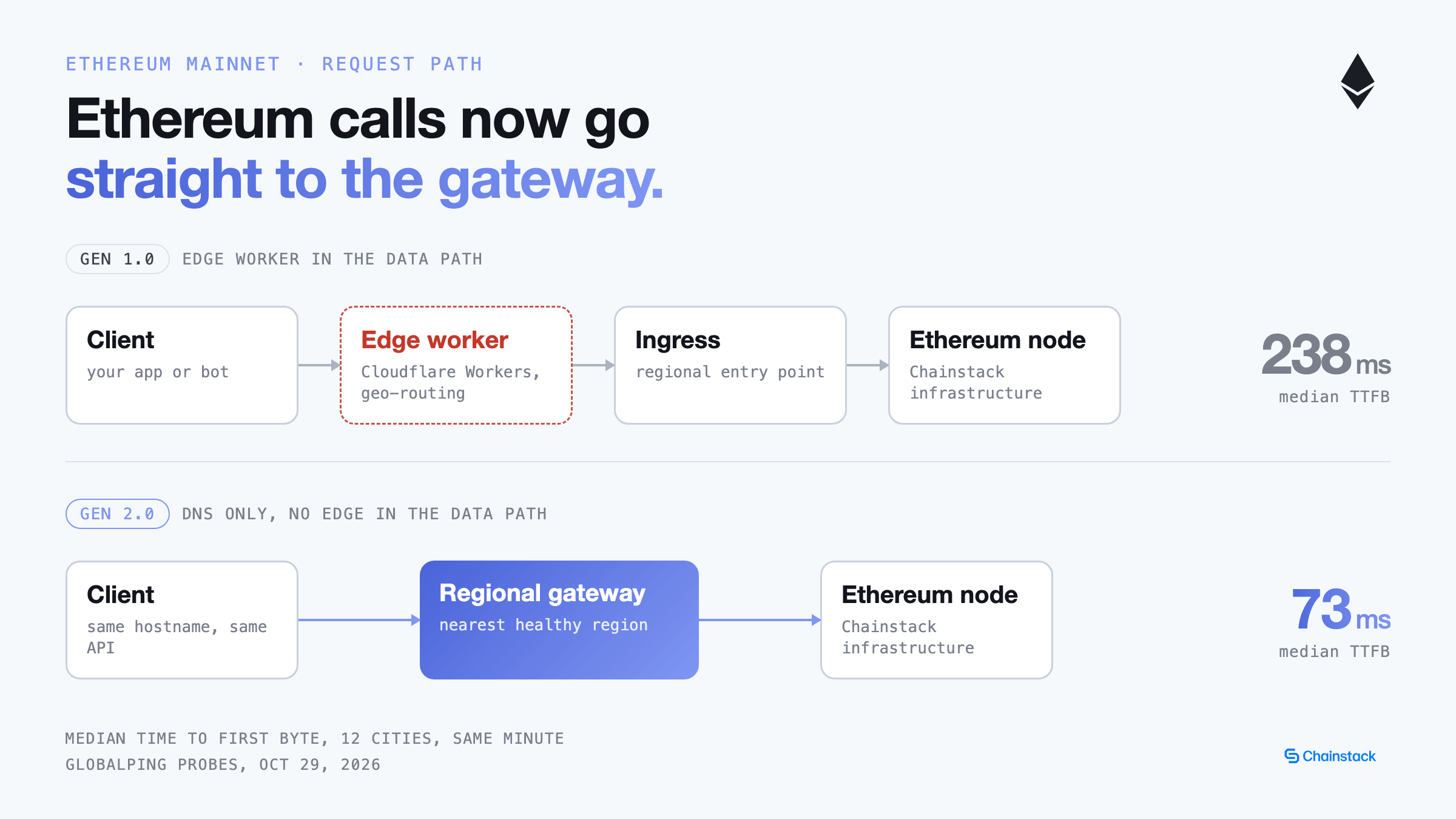
Summary: GEN 2.0 is a major update to Chainstack Global Nodes, as major for RPC users as an Ethereum network upgrade. On Ethereum mainnet it brings the median time to first byte (TTFB) down from 238 ms to 73 ms: 69.3% lower, or 3.3x faster. All 12 cities where the same probe measured both routes got faster, from 1.6x in Dubai to 9.7x in Singapore. Sepolia and Hoodi improved in all 16 cities.
Most Ethereum RPC calls are small reads: a wallet checks a balance, an indexer pulls logs, a bot reads state before it trades. Each one waits for the first byte of the response, and the GEN 2.0 routing change cuts that wait. Here is what it did to Ethereum mainnet, Sepolia and Hoodi.
What changed on the way to your Ethereum node
Before GEN 2.0, a Cloudflare Workers layer sat in front of every Ethereum node and chose the region for each request. Now Cloudflare DNS load balancing resolves your hostname to the nearest healthy region, and the request goes straight to the regional gateway and the node. Ethereum Mainnet, Sepolia and Hoodi all run this way.
Not Ethereum only. GEN 2.0 runs on every Global Nodes chain. For the architecture and the full list of changes, read Chainstack GEN 2.0 is live: faster Global Nodes.
How we measured Ethereum
Each probe sent an RPC request to a Chainstack Ethereum endpoint and recorded the TTFB. Globalping probes in 16 cities ran it twice in the same minute on Oct 29, 2026: once on the pre-GEN 2.0 route (through Cloudflare) and once on the GEN 2.0 direct route.
The headline uses the 12 cities where the same probe measured both routes. San José, London, Amsterdam and New York had different probes for the two routes, so they are marked in the full table and left out of the headline.
Ethereum mainnet results: median TTFB fell from 238 ms to 73 ms
| Metric (12 cities) | Before GEN 2.0 | GEN 2.0 |
|---|---|---|
| Median TTFB | 238 ms | 73 ms |
| Mean TTFB | 296 ms | 91 ms |
| Reduction at the median | – | 69.3% |
| Faster at the median | – | 3.3x |
| Cities that improved | – | 12 of 12 |
| Range of improvement | – | 1.6x to 9.7x |
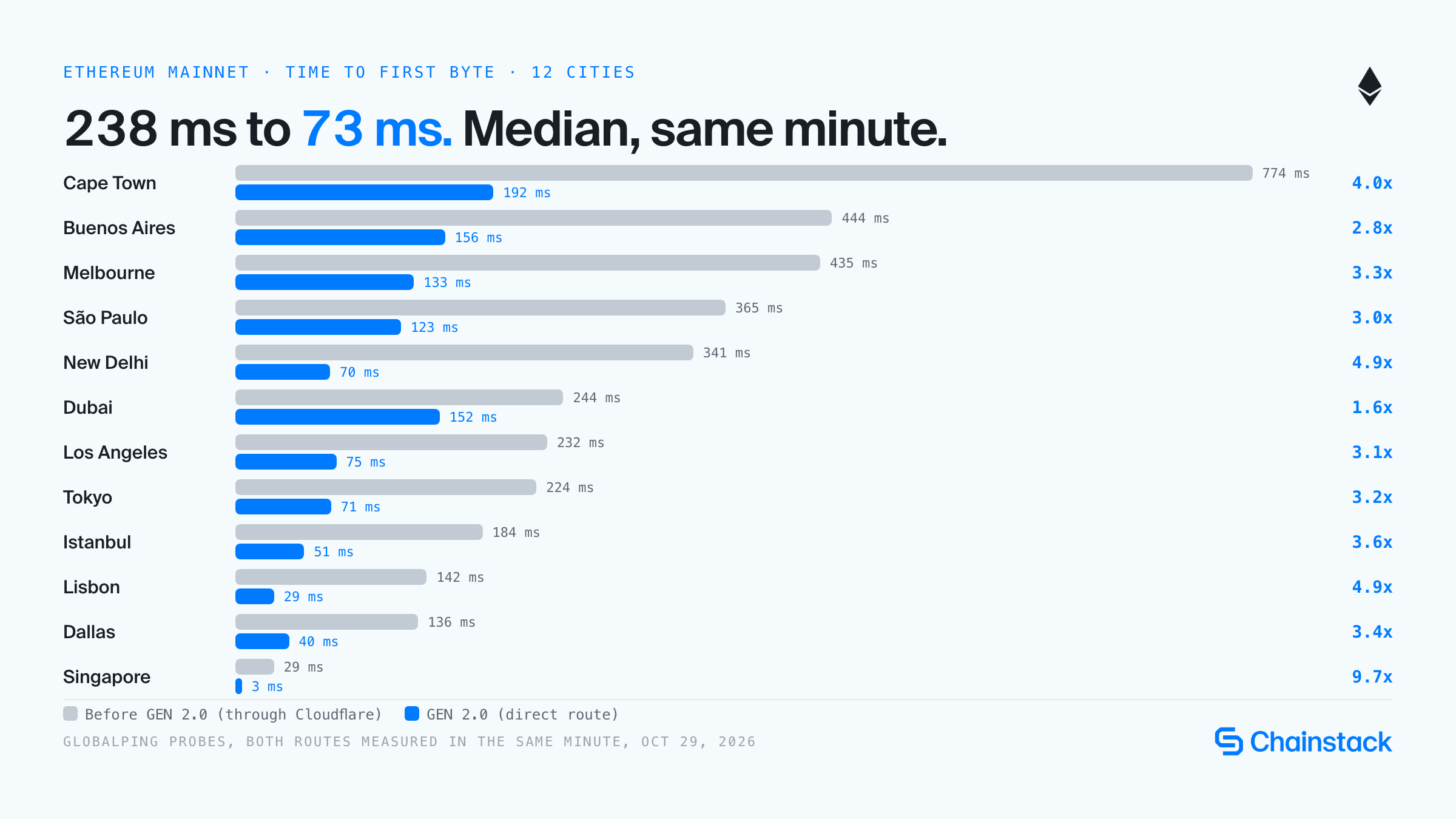
Full per-city results (Ethereum mainnet)
| City | Country | Before GEN 2.0 (ms) | GEN 2.0 (ms) | Saved (ms) | Faster (x) |
|---|---|---|---|---|---|
| Cape Town | South Africa | 774 | 192 | 582 | 4.0 |
| Buenos Aires | Argentina | 444 | 156 | 288 | 2.8 |
| Melbourne | Australia | 435 | 133 | 302 | 3.3 |
| São Paulo | Brazil | 365 | 123 | 242 | 3.0 |
| New Delhi | India | 341 | 70 | 271 | 4.9 |
| Dubai | United Arab Emirates | 244 | 152 | 92 | 1.6 |
| Los Angeles | United States | 232 | 75 | 157 | 3.1 |
| Tokyo | Japan | 224 | 71 | 153 | 3.2 |
| Istanbul | Turkey | 184 | 51 | 133 | 3.6 |
| San José* | Costa Rica | 156 | 72 | 84 | 2.2 |
| Lisbon | Portugal | 142 | 29 | 113 | 4.9 |
| Dallas | United States | 136 | 40 | 96 | 3.4 |
| London* | United Kingdom | 55 | 5 | 50 | 11.0 |
| Amsterdam* | Netherlands | 50 | 11 | 39 | 4.5 |
| New York* | United States | 43 | 8 | 35 | 5.4 |
| Singapore | Singapore | 29 | 3 | 26 | 9.7 |
Rows marked with an asterisk (*) used different probes for the two routes and are not in the headline numbers. Across all 16 cities the median goes from 204 ms to 71 ms.
Where the gains are biggest
- In milliseconds: Cape Town saves 582 ms (774 ms to 192 ms), followed by Melbourne with 302 ms, Buenos Aires with 288 ms and New Delhi with 271 ms. The farther the caller is from a Chainstack region, the more time the direct route saves.
- As a ratio: Singapore goes from 29 ms to 3 ms (9.7x), and New Delhi and Lisbon are both 4.9x faster.
- The smallest gain: Dubai improves 1.6x, from 244 ms to 152 ms.
Ethereum testnets: Sepolia and Hoodi
Sepolia and Hoodi got the same test from the same 16 cities.
| Network | Median before GEN 2.0 | Median with GEN 2.0 | Cities that improved |
|---|---|---|---|
| Sepolia | 206 ms | 120.5 ms | 16 of 16 |
| Hoodi | 377 ms | 97 ms | 16 of 16 |
Sepolia gains less at the median (1.7x) than mainnet (3.3x) or Hoodi (3.9x), but every city still improved.
How does Ethereum compare today?
Compare probes every provider from three regions (Germany, the US and Singapore) and ranks them on p95 latency and success rate. On Nov 17, 2026, over the last 7 days, Chainstack is #1 for Ethereum:
- Score 0.047 (lower is better), availability 99.99%.
- p50 / p95 / p99: 32 ms / 46 ms / 66 ms.
- p95 by probe region: Germany 30 ms, US 85 ms, Singapore 25 ms.
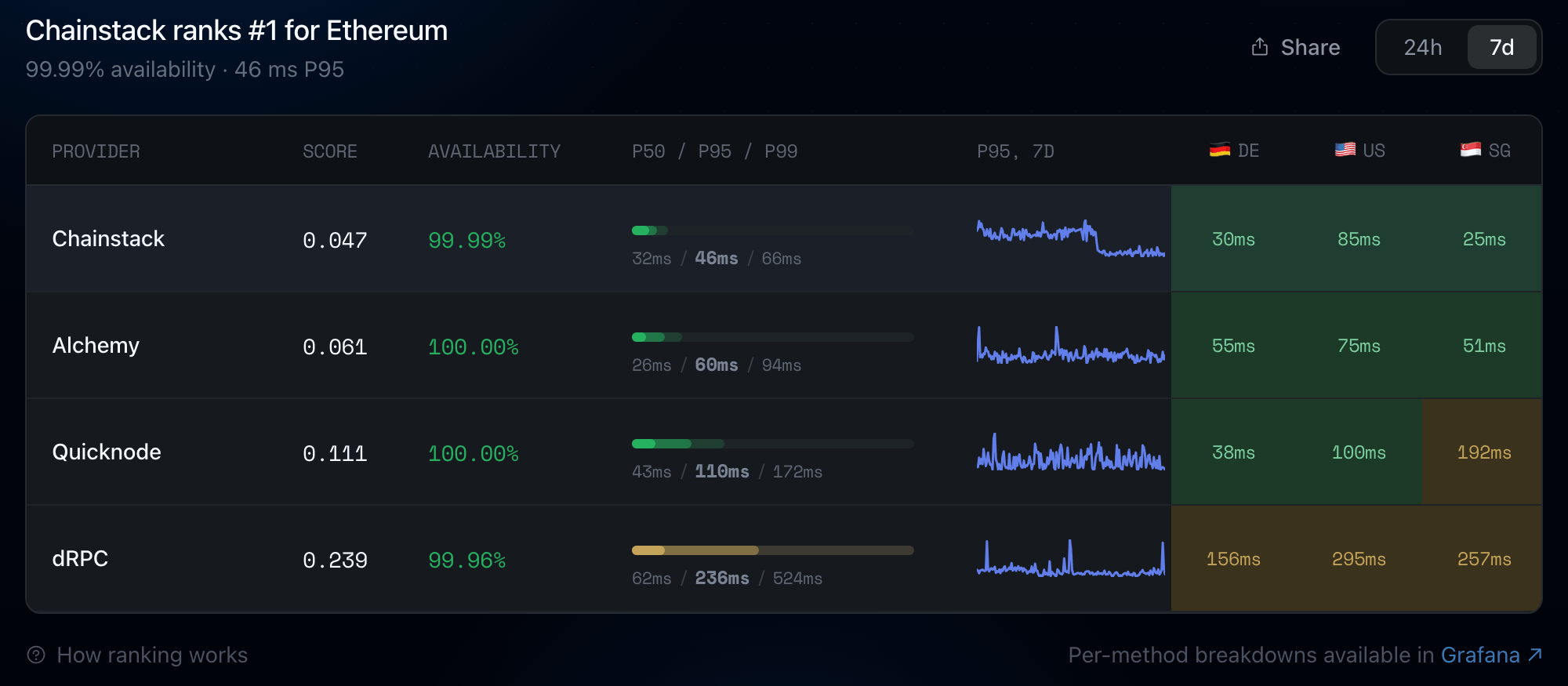
The live view is Ethereum on Compare. It is a different test from the one-minute A/B above: p95 over time, from three regions. For a fixed window (Nov 5 to Nov 12, 2026), see the Ethereum RPC provider benchmark: latency and uptime (November 2026).
How to read these numbers (and what they don’t prove)
- Single run, 12 cities. Each city is one measurement from Oct 29, 2026, so a single row can be noisy. Look at the median, not at one city.
- TTFB, not total call time. The clock stops at the first byte, so it leaves out the download time of large responses (an
eth_getLogsover a wide range, for example) and the time the node spends computing them. - Your users are not probes. Your gain depends on where your servers sit relative to the nearest region.
- Two Chainstack routes, not two providers. For other providers, see Compare and the Chainstack vs Alchemy RPC benchmark, which covers Ethereum.
What this means for Ethereum builders
Ethereum workloads are made of many small reads: a wallet loading balances, an indexer walking blocks and logs, a bot checking state before it trades. Saving 100 ms or more per call from far regions (Cape Town saves 582 ms, Melbourne 302 ms) adds up quickly in each of them.
In short: GEN 2.0 is a major update, as major for Ethereum RPC users as a network upgrade is for the chain. You keep the same endpoint and the same API, and the median request now gets its first byte in 73 ms instead of 238 ms.
No Ethereum endpoint yet? Deploy a Global Node in seconds on the free Developer plan and see Ethereum on Chainstack.
FAQ
No. The hostname and the API are unchanged, so existing code keeps working. GEN 2.0 covers Ethereum Mainnet, Sepolia and Hoodi.
On Ethereum mainnet the median time to first byte fell from 238 ms to 73 ms, about 3.3x, in a same-minute test from 12 cities on Oct 29, 2026. The gain ranged from 1.6x to 9.7x.
GEN 2.0 removes a hop before the request reaches the node, so it applies to every method, including archive reads and debug_ and trace_ calls. The time the node spends computing a response is unchanged, so a heavy trace call still takes as long as the node needs.
The saving grows with the distance from the caller to the nearest region and with the length of the network path. Cape Town went from 774 ms to 192 ms, 582 ms saved, the most of any city. Singapore, close to a region, saved only 26 ms but is 9.7x faster.
Compare sends requests to each provider every 1 to 3 minutes from three regions, uses the first paid plan of each provider, and combines the p95 of each method with the success rate. Lower is better.
No. It is the median of one A/B test in 12 cities on Oct 29, 2026. Your own number depends on where your servers and users are.
Related reading