AI-ready infrastructure
 Refer and earn


 Ethereum
 Hyperliquid
 Solana
 Arbitrum
 BNB Smart Chain
 Base
 Polygon
 TRON
 Sui
 Robinhood


Top 6 NOWNodes alternatives in 2026: request-based plans vs flat meters, archive and free tiers

Teams comparing NOWNodes alternatives usually check these points: euro plans with no overage rate listed for Start and Pro, Arbitrum archive access described differently on two NOWNodes pages, a Debug API without trace methods on Arbitrum, and dedicated nodes shown as custom on the plans table. This guide compares NOWNodes with Chainstack, Dwellir, OnFinality, dRPC, GetBlock, and Quicknode, checked against provider pages and docs in October 2026.
We publish this on the Chainstack blog, so Chainstack is first and you should weigh that. Every price comes from a live provider page, and the performance section uses the public Chainstack RPC benchmark reports, which do not cover NOWNodes. Moving off NOWNodes? Jump to the migration steps.
💡 Already using Chainstack? Jump straight to the Arbitrum tooling docs or deploy your endpoint from the console.
Why teams look for NOWNodes alternatives
NOWNodes lists 120+ networks behind one API key, Blockbook endpoints, archive access on 45+ networks at no extra charge, free public endpoints, a first response under 3 minutes on every plan, and migration guides from Alchemy, Quicknode and GetBlock in its docs.
- Request-count plans in euros. Plans run from EUR 20 for 1M requests a month to EUR 500 for 100M, with overage per 100,000 requests from EUR 5 on Pro Plus to EUR 0.5 on Enterprise. No rate is listed for Start or Pro, while its FAQ says over-limit usage is invoiced at the end of the billing cycle. We found no per-method weights.
- A one-month free plan. Start gives 100,000 requests, 15 RPS and any 5 networks for one month with no card. Its public endpoints page lists six endpoints, none for Arbitrum, at 5 RPS (its FAQ says about 1 RPS).
- Arbitrum archive and trace. Its archive page lists an Arbitrum archive node, but the archive table in its docs marks the Arbitrum endpoints without archive. Its docs list a Debug API for Arbitrum, the Trace API only for Ethereum and no arbtrace_ methods.
- Dedicated nodes. The plans table shows a custom tier, while the Dedicated tab prices an Arbitrum full node at EUR 1,000 a month with no setup fee and shows no archive option for Arbitrum (its docs say archive can be requested as a dedicated deployment through sales).
- Compliance and benchmarks. We found no SOC 2 Type II or ISO 27001 on its site, and Chainstack’s benchmark reports do not include NOWNodes (all eight editions checked, including Arc).
NOWNodes alternatives compared: request plans, free start, and archive (2026)
The table summarizes public positioning as of October 2026.
| Rank | Provider | Best for | Pricing model | Free tier | Dedicated nodes | Archive & trace | Standout |
|---|---|---|---|---|---|---|---|
| — | NOWNodes (for reference) | — | Plans sized by monthly requests, EUR 20 (1M) to EUR 500 (100M) | Yes, Start plan, one month, 100,000 requests, 15 RPS, no card | Custom; Arbitrum full node EUR 1,000 a month | Archive on 45+ networks (none for Arbitrum in docs table); Debug API on Arbitrum | 120+ networks, Blockbook, no RPS limits listed on paid plans |
| 1 | Chainstack | Archive, debug, and arbtrace methods at 2 RU from Growth, plus SOC 2 Type II and ISO 27001 | Flat request units, 1 RU full, 2 RU archive, debug and trace; overage on paid plans, optional extra usage on Developer | Yes, Developer plan, 3M RU, 25 RPS, no card | Yes, from Pro; Unlimited Node add-on from $149 on top of Growth ($49) or higher | Archive, debug_ and arbtrace_ on Arbitrum from Growth ($49) | Best score in its own benchmarks (disclosed below), SOC 2 Type II and ISO 27001 |
| 2 | Dwellir | A flat per-response credit and a public Arbitrum cluster price | 1 credit per response, no compute units; shared plans $49 (25M) to $999 (500M) | Yes, 100,000 daily responses, no eth_getLogs, trace or debug | Arbitrum cluster $4,200 a month; Unlimited Nodes from $119 | Archive endpoints on Arbitrum; trace and debug from $49 | 150+ networks by its own count |
| 3 | OnFinality | Indexer hosting and no daily response limit on paid plans | Response units, 1 for most methods, 3 for eth_getLogs on Arbitrum | Yes, 400,000 response units daily | Pay-as-you-go; Arbitrum full node $1,168 a month | Archive on every plan, Trace API from Growth | Substrate coverage, indexer hosting |
| 4 | dRPC | One flat price per request on full and archive, with a large free allowance | Flat 20 CU per priced method, $6 per 1M requests, pay as you go | Yes, 210M CU a month (about 10.5M requests), public nodes | None listed; Enterprise is personalised | Same price for full and archive; debug and trace API on Growth | 130+ chains across 232 networks |
| 5 | GetBlock | A fixed-RPS Limitless Node from $150 and public dedicated prices | CUs: 20 per call on Arbitrum, archive endpoint 2x; Starter $49 (90M CU) | Yes, 50,000 CU a day, 20 RPS, no top-ups | Arbitrum full from $1,300, archive from $2,100; Limitless Node from $150 (25 RPS) | Archive mode from Starter at 2x CU; arbtrace_ methods listed | 130+ networks, SOC 2 Type II attestation, support under 5 minutes on Pro and Premium |
| 6 | Quicknode | Streams, Webhooks, and archive on credit plans from $49 a month | Credits with a per-chain multiplier, 20 per call on Arbitrum | 1-month trial, 10M credits, 15 RPS | Dedicated Clusters on Enterprise | Archive on every plan; trace and debug from Build | 75+ chains, Streams, Webhooks, SOC 2 and ISO 27001 reports |
Official pricing pages: NOWNodes, Chainstack, Dwellir, OnFinality, dRPC, GetBlock, Quicknode.
True cost per call = (method’s unit weight x price per million units) / 1,000,000. Here it is for eth_getLogs on Arbitrum at each provider’s entry paid plan, using the included allowance in full. NOWNodes prices are in euros and are not converted.
| Provider | Unit weight for eth_getLogs | Entry paid plan | Cost per 1M calls |
|---|---|---|---|
| NOWNodes (for reference) | Not found on its pricing page | Pro, EUR 20 with 1M requests, no overage rate listed | EUR 20.00 on Pro (EUR 18.00 annual); EUR 9.00 in the Pro Plus allowance (EUR 90 for 10M, EUR 8.10 annual), EUR 50 at Pro Plus overage |
| Chainstack | 1 RU, 2 RU if fromBlock is 127 or more blocks behind the tip | Growth, $49 with 20M RU, $15 per extra 1M RU | $2.45 in allowance ($2.00 annual; archive $4.90 and $4.00), $15 at overage ($30 archive) |
| Dwellir | 1 credit, 500-block range per call | Developer, $49 with 25M responses, $5 per extra 1M | $1.96 in allowance, $5.00 at overage |
| OnFinality | 3 response units on Arbitrum | Growth, $49 plus node and API usage costs, 20M units, $6 per extra 1M | $7.35 in allowance, $18.00 at overage |
| dRPC | 20 CU, the flat rate for every priced method | Growth, pay as you go at $6 per 1M requests | $6.00, the same for full and archive |
| GetBlock | 20 CU on Arbitrum (the default row; 40 CU on an archive endpoint) | Starter, $49 with 90M CU ($39 annual); Pro ($499) top-up $0.40 per 1M CU | $10.89 in allowance ($8.67 annual; archive $21.78), $8.00 at the Pro top-up rate |
| Quicknode | 20 credits on Arbitrum | Build, $49 with 80M credits (monthly billing), $0.62 per extra 1M | $12.25 in allowance ($8.50 annual), $12.40 at overage |
Among the dollar-priced plans, Dwellir has the lowest figure inside the allowance ($1.96) and at overage ($5.00), and Chainstack is second inside the allowance ($2.45). dRPC’s flat $6.00 is below OnFinality ($7.35), GetBlock ($10.89) and Quicknode ($12.25). Arbitrum blocks arrive about every 250 ms (Arbitrum research forum), so Chainstack Developer’s 100 blocks is about 25 seconds of history, Dwellir Developer’s 500 blocks about 2 minutes and Dwellir Growth’s 10,000 blocks about 42 minutes. The 127-block archive boundary is about 32 seconds, so a log scan with an older fromBlock bills at 2 RU.
Dedicated Arbitrum mainnet nodes, list prices on October 15, 2026:
| Provider | Node | Monthly price | Notes |
|---|---|---|---|
| NOWNodes (for reference) | Full node, Germany | EUR 1,000, no setup fee | 99.99% uptime listed, no Arbitrum archive option |
| Chainstack | Full / archive (Nitro), single node | $1,708.20 / $11,278.50 | Compute plus storage over 730 hours, plus the Pro plan |
| Dwellir | Archive cluster | $4,200 | Redundant cluster, 99.99% SLA, final quote varies |
| OnFinality | Full node (self-service view) | $1,168 ($1.62 an hour) | Archive line reads $46 ($0.06 an hour), not reconciled with the full-node price |
| GetBlock | Full / archive, standard tier | $1,300 / $2,100 | Configurator list prices for a one-month term in one region |
| Quicknode | Dedicated Clusters | Found no price | Enterprise, sized to traffic |
Sources: each provider’s pricing and method-cost pages (Dwellir’s checked on October 15, 2026; GetBlock’s pricing page last updated September 17, 2026) and Chainstack request units. eth_getLogs block-range caps on Arbitrum: Chainstack 100 on Developer and 10,000 on Growth and above, Dwellir not available on Free, 500 on Developer and 10,000 on Growth and Scale, Quicknode 5 on the trial and 10,000 on paid plans, none found for OnFinality, dRPC, GetBlock or NOWNodes (GetBlock’s Arbitrum API reference has no eth_getLogs page, so the table uses its 20 CU default). Model your own mix with the interactive cost calculator.
Performance proof: Chainstack RPC benchmark reports
Chainstack publishes RPC benchmark reports for Ethereum, BNB Chain, Hyperliquid and Arc (September and October 2026) ranking Chainstack, Quicknode, Alchemy and dRPC. Disclosure: Chainstack runs the monitoring service, the dashboard and the scoring formula, and is one of the four ranked providers. Data comes from Chainstack Compare: a rolling 7-day window, probes from DE, US and SG (JP for Hyperliquid), each provider on its first paid plan in the October editions (the September editions use a standard shared endpoint). Score is p95 response time divided by the success rate cubed, so lower is better.
NOWNodes, Dwellir, OnFinality and GetBlock are not in any of the reports, while dRPC and Quicknode appear. No Chainstack report covers Arbitrum, the example chain here, so these figures measure other chains, although Chainstack Compare shows a live Arbitrum view for the same four ranked providers. The images are the October 2026 editions (published October 8), each linked to its report: Ethereum, BNB Chain and Hyperliquid. The Arc report of the same date, the fourth chain, scores Chainstack 0.059, Quicknode 0.096, Alchemy 0.173 and dRPC 0.181.
Ethereum, 7-day window ending October 8, 2026:
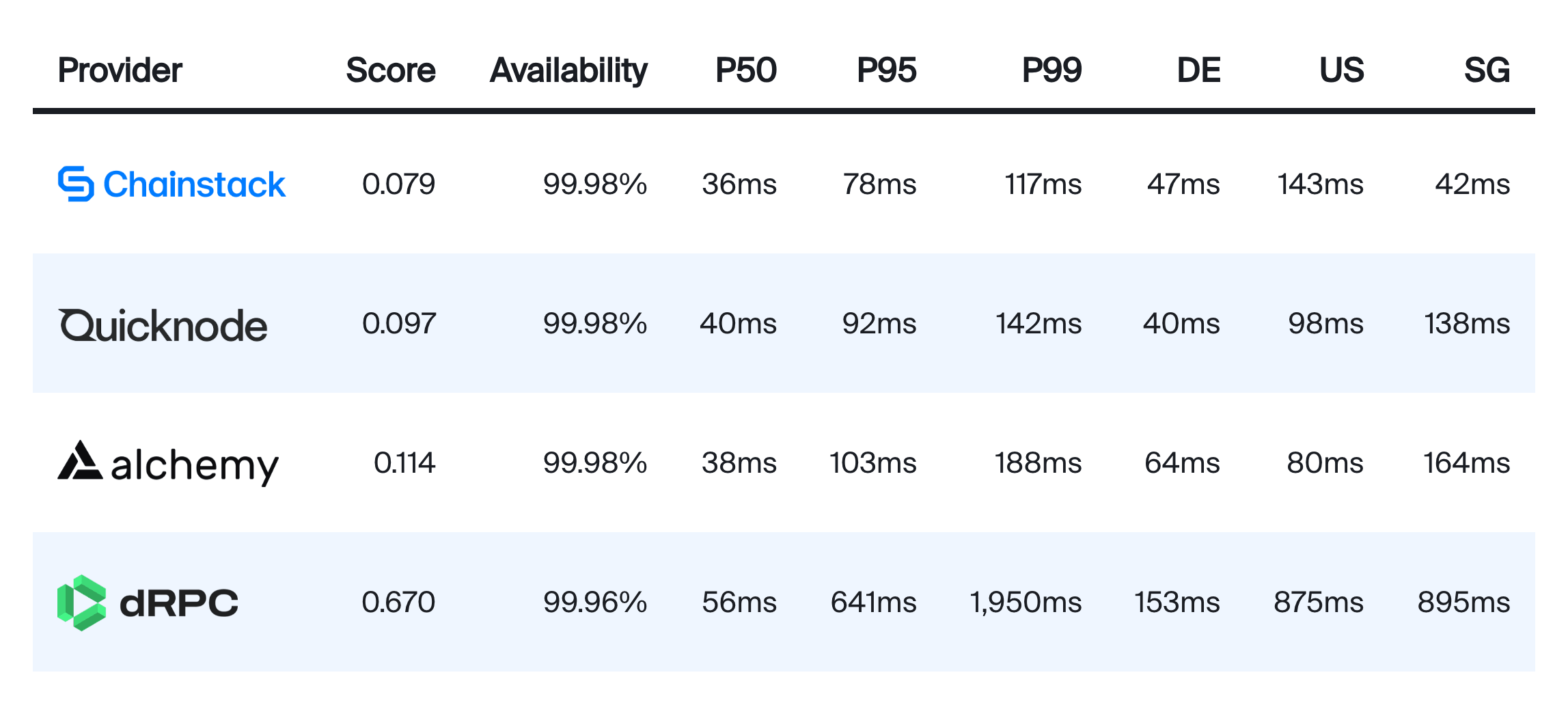
Ethereum scores: Chainstack 0.079, Quicknode 0.097, Alchemy 0.114, dRPC 0.670.
BNB Chain, 7-day window ending October 8, 2026:
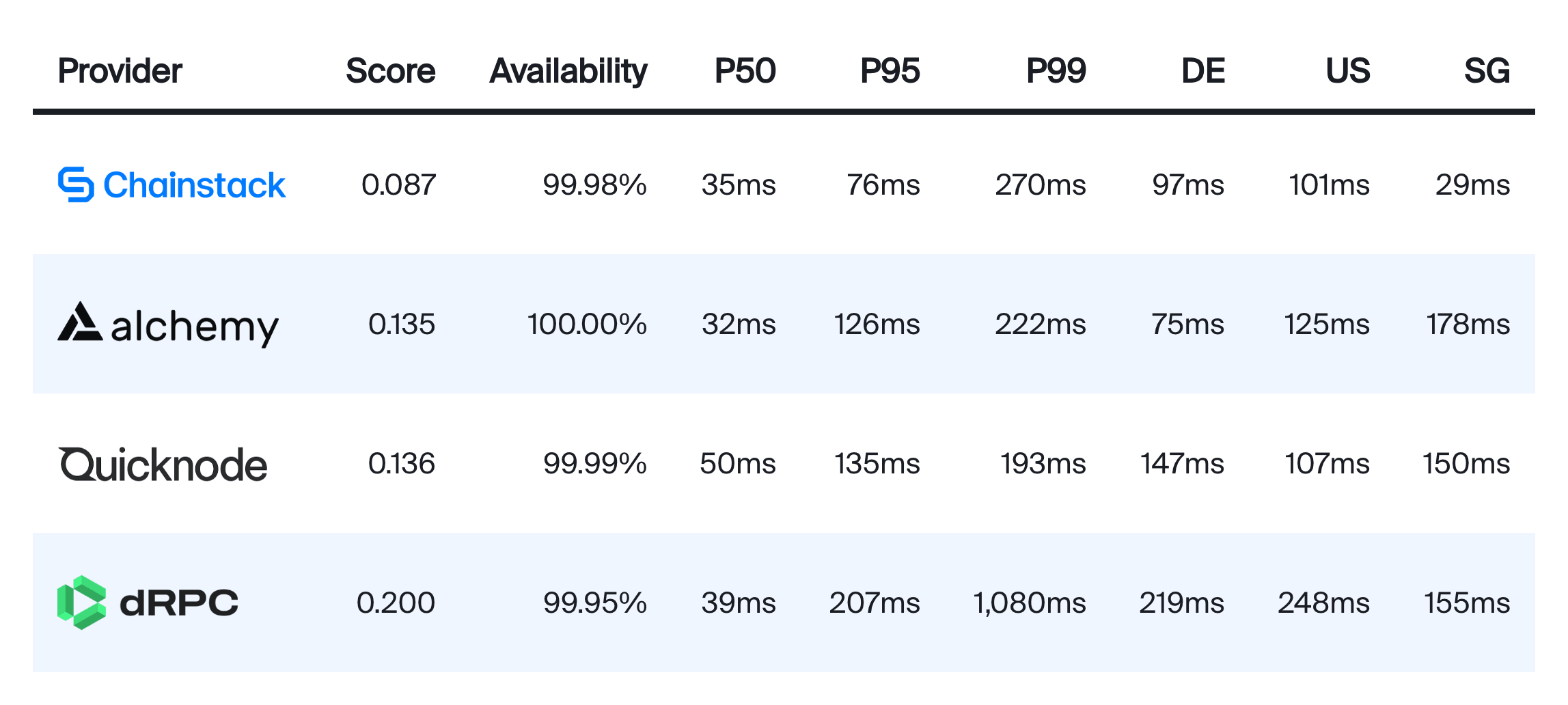
BNB Chain scores: Chainstack 0.087, Alchemy 0.135, Quicknode 0.136, dRPC 0.200.
Hyperliquid, 7-day window ending October 8, 2026:
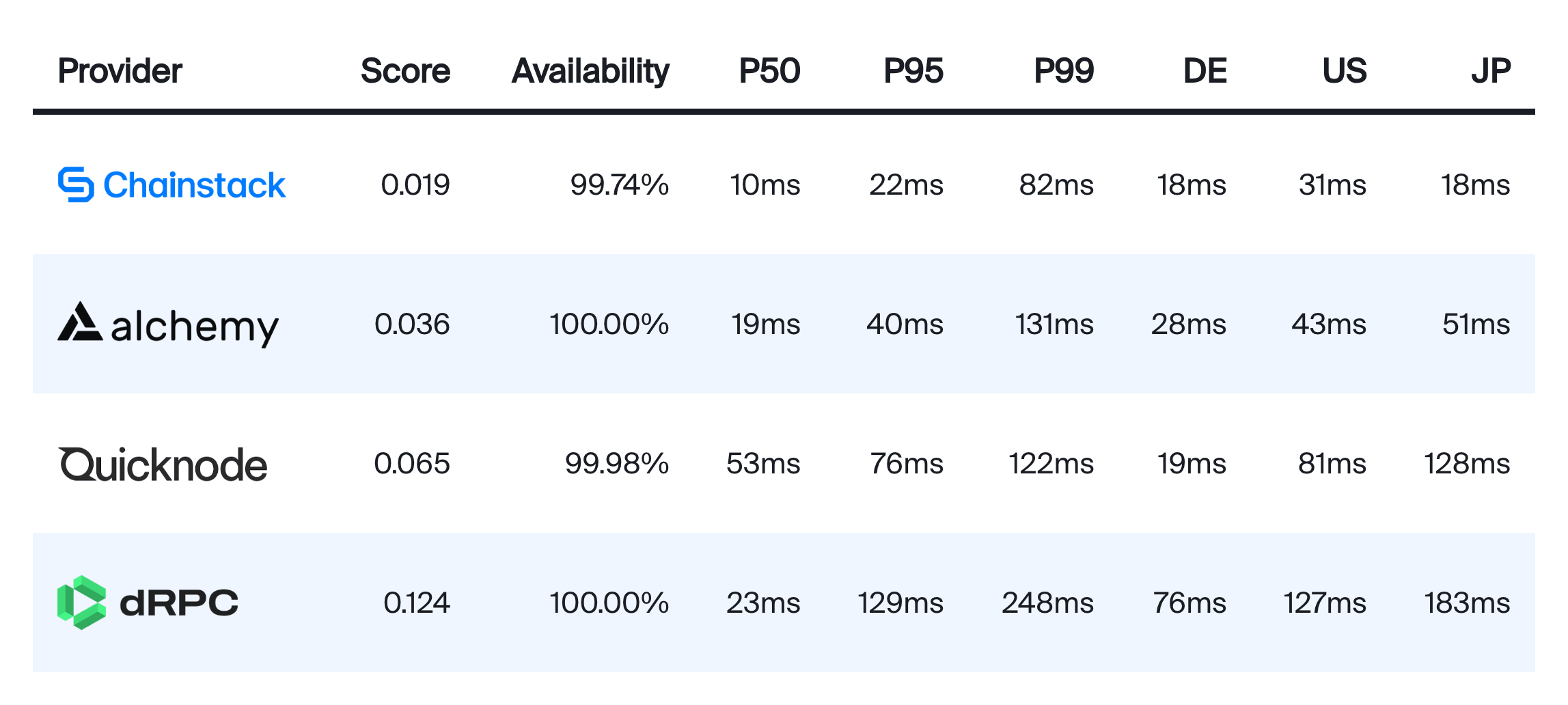
Hyperliquid scores: Chainstack 0.019, Alchemy 0.036, Quicknode 0.065, dRPC 0.124.
Chainstack has the best score on all four chains, and the reports show where it does not lead: Quicknode has the lowest DE P95 on Ethereum (40 ms against 47 ms), Alchemy the lowest P50 on BNB Chain (32 ms) while Quicknode and Alchemy have a lower P99 there (193 ms and 222 ms against 270 ms), and Chainstack’s 99.74% availability on Hyperliquid is the lowest in that set, which the report says costs about 0.8% of score.
The September 2026 editions (Ethereum, BNB Chain, Hyperliquid and Arc) ranked the same providers with Chainstack first. The October reports state their limits: one 7-day window, the entry paid plan only, synthetic probes from three cloud regions, and no measurement of throughput, correctness or cost. Chainstack chose the formula, so another could reorder close pairs.
Top 6 NOWNodes alternatives and what each is best for
1. Chainstack
Best for: Archive, debug, and arbtrace methods at 2 RU from Growth, plus SOC 2 Type II and ISO 27001.
Chainstack is a managed node provider across 70+ blockchains that bills flat request units: 1 RU for a full request and 2 RU for archive, debug and trace requests on Global Nodes, with no per-method multipliers. The free Developer plan includes 3M RU and 25 RPS with no card required, and Growth is $49 a month ($40 billed annually) with 20M RU, 250 RPS, archive data and debug and trace APIs.
The Arbitrum RPC Global Node offers full, archive and debug and trace on mainnet and Sepolia. Each request is classified on its own, so a call within 126 blocks of the tip is 1 RU and an older block 2 RU. Arbitrum’s Nitro client has no trace_ namespace, so debug and trace uses debug_ methods from block 22,207,815 and arbtrace_ methods before it, both at 2 RU. Optimized submission, on by default and free on every plan on Global Nodes, routes transactions through a private path (Arbitrum has no public mempool, so this is not MEV protection). Dedicated Nodes start at the Pro plan ($199 a month) plus compute and storage, and the Unlimited Node add-on is the fixed-RPS option, from $149 a month at 25 RPS on top of the Growth plan or higher. Chainstack holds SOC 2 Type II and ISO 27001, and its Enterprise SLA page states a 99.9% quarterly uptime commitment.
Limitations: The free plan includes 3M RU a month (extra usage is optional at $20 per 1M RU, otherwise services stop at the quota), has no archive or debug and trace, and limits eth_getLogs to 100 blocks. debug_traceBlockByNumber on Arbitrum mainnet is capped at 20 RPS on all plans. On Arbitrum, Chainstack’s catalog lists an archive node at $11,278.50 a month ($0.50 an hour for compute plus $14.95 an hour for storage over 730 hours, plus the Pro plan), above Dwellir’s $4,200 redundant archive cluster and GetBlock’s $2,100 archive node (dedicated table). Growth overage of $15 per 1M RU is above Dwellir’s $5 per 1M responses, so very high volume suits Pay As You Go (from $2.5 per 1M RU, via sales) or an Unlimited Node.
Fit by workload:
- Archive, debug and trace on one fixed meter: Excellent, since a debug_traceTransaction call costs a flat 2 RU on Arbitrum Global Nodes with 20M RU included for $49.
- Procurement that asks for audit reports or isolated nodes: Strong, with SOC 2 Type II and ISO 27001 published and Dedicated Nodes from Pro.
2. Dwellir

Best for: A flat per-response credit and a public Arbitrum cluster price.
Dwellir is a multi-chain RPC provider covering 150+ networks by its own count, billed at one credit per response, even for trace and debug. Its pricing page lists Developer at $49 a month with 25M responses and 100 RPS, Growth at $299 and Scale at $999 (5,000 RPS), plus a Free plan (100,000 daily responses, 20 RPS).
Extra responses cost $5, $3 and $2 per 1M on Developer, Growth and Scale. Its Arbitrum page says the endpoints run archive nodes and lists trace and debug APIs, and Unlimited Nodes start at $119 a month for 25 RPS. Dedicated Node Clusters are redundant archive clusters with no request counting and a 99.99% uptime SLA, with Arbitrum at $4,200 a month (list price, final quote varies).
Limitations: The free plan has no eth_getLogs, trace or debug access, the $49 Developer plan limits log queries to 500 blocks (10,000 on Growth), and we found no published SOC 2 Type II or ISO 27001.
Fit by workload:
- A flat per-response meter: Excellent, since a trace call costs the same credit as a balance read.
- Arbitrum history on a shared plan: Strong: its Arbitrum page says the endpoints are archive nodes.
3. OnFinality
Best for: Indexer hosting and no daily response limit on paid plans.
OnFinality is a multi-chain node service whose homepage lists 130+ networks (a heading on the same page says 90+),. Its pricing page lists a free Developer plan with 400,000 response units a day and Growth at $49 a month with 20M units ($6 per extra million).
Its Arbitrum page lists the Nitro stack with archive access and trace and debug on paid plans, including arbtrace_ methods. Most methods are 1 response unit, but eth_getLogs is 3 and debug_traceTransaction 30. Dedicated nodes are pay-as-you-go.
Limitations: Response-unit weights make heavy methods cost more than the headline suggests, paid plans list node and API usage costs on top of the monthly fee, and its pages differ on Growth throughput (200 response units a second on the pricing page, up to 500 requests a second on the Arbitrum page). We found no published SOC 2 Type II or ISO 27001, and the Chainstack benchmark does not cover OnFinality.
Fit by workload:
- Substrate and Polkadot-ecosystem teams: Strong, since its tooling targets Substrate networks and it hosts indexers.
- Monthly volume with no daily stop: Good, because paid plans list no daily response limit.
4. dRPC
Best for: One flat price per request on full and archive, with a large free allowance.
dRPC is a multi-chain RPC provider listing 130+ chains across 232 networks, priced pay as you go: every priced method costs a flat 20 compute units at $0.30 per 1M CU, which is $6 per 1M requests. The free tier gives 210M CU a month (about 10.5M requests) on public nodes, and Growth lists 5,000 requests per second and 99.99% uptime.
dRPC charges the same for full and archive requests. Its docs list debug_ and arbtrace_ methods for Arbitrum, and its pricing page includes a debug and trace API in Growth.
Limitations: The free tier runs on public nodes at about 100 eth_call requests per second per IP, and responses capped at 10,000 log entries. We found no dedicated node prices (Enterprise is personalised) and no published SOC 2 Type II or ISO 27001, and its docs say the Archive label does not always guarantee history from block 0. In the Chainstack benchmarks dRPC ranks fourth on all four chains.
Fit by workload:
- Flat pricing on archive and trace: Excellent, since a debug_traceTransaction call costs 20 CU like eth_call.
- Free prototyping at volume: Strong, as 210M CU a month covers about 10.5M requests.
5. GetBlock
Best for: A fixed-RPS Limitless Node from $150 and public dedicated prices.
GetBlock is a node provider that lists 130+ networks, with shared nodes metered in compute units, fixed-RPS Limitless Nodes and dedicated nodes with public prices. Its pricing page lists a Free plan (50,000 CU a day, 20 RPS) and Starter at $49 a month with 90M CU and 250 RPS ($39 billed annually).
On Arbitrum the chain multiplier is 20, so most calls cost 20 CU, and an endpoint in archive mode doubles that to 40 CU. A Limitless Node is a flat fee per RPS tier with no CU metering, from $150 a month for 25 RPS on a full node or 15 RPS on archive, one chain per subscription. Dedicated Arbitrum nodes list from $1,300 (full) and $2,100 (archive) a month with a 99.99% uptime SLA, and Pro and Premium list 24/7 support with a response under 5 minutes.
Limitations: The free plan has no top-ups, and extra CU on Pro cost $0.40 per 1M. eth_getLogs has no Arbitrum row, so it takes the 20 CU default, and we found no block-range cap because its Arbitrum API reference has no eth_getLogs page. Its pricing page states a SOC 2 Type II attestation (Q2 2026), while its homepage lists ISO 27001 and ISO 27017 and its FAQ says ISO 27001 certification is in progress, and the Chainstack benchmark does not cover GetBlock.
Fit by workload:
- A fixed monthly cost on one chain: Strong, since a Limitless Node is a flat fee per RPS tier, from $150 on Arbitrum.
- Dedicated Arbitrum capacity at a listed price: Good: full nodes from $1,300 and archive from $2,100, with 7 to 12 days of estimated deployment for archive.
6. Quicknode

Best for: Streams, Webhooks, and archive on credit plans from $49 a month.
Quicknode lists 75+ chains, bundles Streams and Webhooks with its node product and sells credits weighted per chain. Its pricing page lists a one-month free trial (10M credits, 15 RPS, no card) and Build at $49 a month with 80M credits and 50 RPS.
On Arbitrum and most EVM chains every method is 20 credits, and trace and debug (arbtrace included) carry a 2x multiplier. Archive data is on every plan, trace and debug are listed from Build, and Dedicated Clusters are listed only on Enterprise. Its pricing page lists SOC 1 Type 2, SOC 2 Type 2 and ISO 27001 reports on request under Enterprise.
Limitations: The free entry is a trial, not a standing plan, and during the trial eth_getLogs is limited to 5 blocks per call. At its $0.62 overage rate a 40-credit debug call is about $24.80 per million.
Fit by workload:
- RPC plus data streams from one vendor: Strong, with Streams and Webhooks beside the node product.
- Ethereum reads from Germany: Strong: Quicknode posted the lowest DE P95 (40 ms) in the October Ethereum benchmark.
How to migrate from NOWNodes to Chainstack
Most migrations are an endpoint swap plus a testing pass, and a coding agent can run the assessment from the Chainstack MCP migration runbook.
- Assess endpoints and usage. List every NOWNodes API key, its networks, the interfaces you call (RPC, Blockbook, WebSocket) and the methods you use, including debug calls.
- Deploy a node. Create a project and deploy a node per network, starting with Global Nodes and adding Dedicated Nodes for isolation.
- Swap the endpoint URL. Replace the NOWNodes hostnames and API key with your Chainstack endpoints behind a config flag.
- Test methods. Run your real mix:
eth_getLogsranges (100 blocks on Developer, 10,000 on Growth and above), historicaleth_call, debug and arbtrace calls and subscriptions. - Compare cost. NOWNodes counts requests with no per-method weights, so price the same calls on Chainstack’s published pricing at 1 RU, or 2 RU for state and log calls 127 or more blocks behind the tip and for debug and trace.
- Cut over gradually. Shift a share of traffic, then move the rest.
Getting started with Chainstack
Deploy an Arbitrum endpoint in a few steps:
- Log in to the Chainstack console (or create an account).
- Create a new project
- Select Arbitrum as your blockchain protocol
- Choose network: Arbitrum Mainnet or Arbitrum Sepolia testnet
- Deploy the node
- Open Access and credentials and copy your HTTPS and WebSocket endpoints
Then connect with web3.py and read the latest 100 blocks of logs for a contract, replacing YOUR_CONTRACT_ADDRESS with its checksummed address:
from web3 import Web3

web3 = Web3(Web3.HTTPProvider('YOUR_CHAINSTACK_ENDPOINT'))
print(web3.eth.chain_id)

latest = web3.eth.block_number
logs = web3.eth.get_logs({
    "fromBlock": latest - 99,
    "toBlock": latest,
    "address": "YOUR_CONTRACT_ADDRESS",
})
print(latest, len(logs))
📖 For the full integration guide, see the Chainstack Arbitrum tooling documentation.
🤖 You can also access Chainstack Arbitrum RPC from Claude, Cursor, Codex, Gemini CLI, GitHub Copilot or ChatGPT using Chainstack MCP, or see the Chainstack Agents page.
Conclusion
The deciding question when you leave NOWNodes is how you want usage metered and how much Arbitrum history you need. NOWNodes remains a fit for teams that want 120+ networks behind one key, Blockbook endpoints and archive access on 45+ networks at no extra charge.
- Archive and trace on a fixed monthly plan, with audit reports: Chainstack, with flat 2 RU archive and trace billing, Dedicated Nodes, SOC 2 Type II and ISO 27001.
- A flat per-response credit and a public Arbitrum cluster price: Dwellir.
- Substrate, Polkadot, indexer hosting and no daily response limit: OnFinality.
- One flat price per request on full and archive, and a large free allowance: dRPC.
- A fixed-RPS Limitless Node from $150 and public dedicated prices: GetBlock.
- RPC plus data streams from one vendor: Quicknode.
Frequently asked questions
Q: What is the cheapest NOWNodes alternative?
For eth_getLogs on Arbitrum, a million calls cost $2.45 on Chainstack Growth inside the plan allowance and $1.96 on Dwellir Developer (which caps ranges at 500 blocks). OnFinality costs $7.35, dRPC $6.00, GetBlock $10.89 and Quicknode $12.25, against EUR 20 on NOWNodes Pro (euros, not converted).
Q: Is there a free alternative to the NOWNodes Start plan?
Yes. Chainstack’s Developer plan offers 3M RU a month and 25 RPS with no card, Dwellir 100,000 responses a day, OnFinality 400,000 response units a day, dRPC 210M CU a month on public nodes and GetBlock 50,000 CU a day, while Quicknode offers a one-month trial.
Q: Which alternatives offer archive and debug access on Arbitrum?
Chainstack serves archive, debug_ and arbtrace_ methods from Growth at 2 RU, Dwellir lists archive endpoints with trace and debug from $49, OnFinality archive on every plan and trace and debug on paid plans, dRPC the same price for full and archive, GetBlock archive mode from Starter at 2x CU, and Quicknode archive on every plan with trace and debug at 2x credits. NOWNodes lists a Debug API for Arbitrum, while its archive page and docs table disagree on Arbitrum archive.
Q: How do I migrate from NOWNodes to Chainstack?
Inventory your NOWNodes keys and methods, deploy a node per network, swap the endpoint, test heavy methods and compare cost. The migration runbook lets a coding agent handle the assessment.
Q: Which provider is fastest according to benchmarks?
In the Chainstack October 2026 reports, Chainstack has the best score on Ethereum, BNB Chain, Hyperliquid and Arc, while Quicknode has the lowest DE P95 on Ethereum (40 ms). Chainstack runs the benchmark and is ranked in it; NOWNodes, Dwellir, OnFinality and GetBlock are not covered, and dRPC ranks fourth on all four chains.
Q: What happens when I use up my plan?
On paid Chainstack plans requests continue at the overage rate ($15 per 1M RU on Growth) with extra usage enabled, Dwellir bills extra responses at $5, $3 or $2 per 1M, OnFinality $6 per million on Growth, dRPC bills pay as you go, GetBlock sells extra CU packages ($0.40 per 1M CU on Pro, none on Free), and Quicknode sells extra credits at $0.62 per 1M on Build. NOWNodes lists overage from EUR 5 per 100,000 requests on Pro Plus to EUR 0.5 on Enterprise, none for Start or Pro. A fixed-RPS plan avoids quotas: Chainstack’s Unlimited Node starts at $149 for 25 RPS on top of Growth ($49) or higher, Dwellir’s at $119 and GetBlock’s Limitless Node at $150.
Additional resources