AI-ready infrastructure
 Refer and earn


 Ethereum
 Hyperliquid
 Solana
 Arbitrum
 BNB Smart Chain
 Base
Base Polygon
 TRON
TRON Sui
Sui Robinhood


Dedicated node RPC pricing: what providers won’t share (2026)

TL;DR
Ask most of the biggest managed RPC platforms what a dedicated node costs and the answer is the same: talk to sales. Dedicated and enterprise infrastructure tiers across the market are typically sales-gated — no public number, no way to budget before a call. Chainstack publishes the formula instead: $199/month Pro plan, from $0.50/hour compute, $0.01 per 20GB/hour storage. A full Ethereum node — Reth + Prysm, ~2TB steady-state storage — comes out to roughly $1,279/month: a number you can calculate yourself, from three public figures, before you ever get on a call. Ethereum is the expensive end of the range — for a long list of other protocols, Chainstack’s actual dedicated node price comes in under $1,000/month and below the tracked market average for that same protocol. The real numbers are below, not projected.
Why dedicated node pricing matters
Shared RPC works until it doesn’t. Rate limits, noisy-neighbor latency spikes, and per-request billing that scales unpredictably with traffic are the three reasons teams move from a shared endpoint like Global Nodes to a dedicated node. At that point the infrastructure decision stops being about request quotas and starts being about isolated hardware, guaranteed throughput, and a monthly number that doesn’t move with usage.
That’s exactly the point where most of the biggest managed RPC platforms stop publishing prices.
What “dedicated” means across the market
- Most large managed RPC platforms offer some version of single-tenant node infrastructure — isolated hardware, guaranteed throughput, automatic failover. Pricing for this tier is almost never listed on the public site; the standard path is “talk to our team.”
- A few providers publish a range instead of a firm number — enough to signal scale, not enough to budget against. Independent pricing trackers that follow the space estimate these dedicated add-ons anywhere from the low hundreds to several thousand dollars a month depending on scope, which says more about how wide the negotiation range is than what any specific team would actually pay.
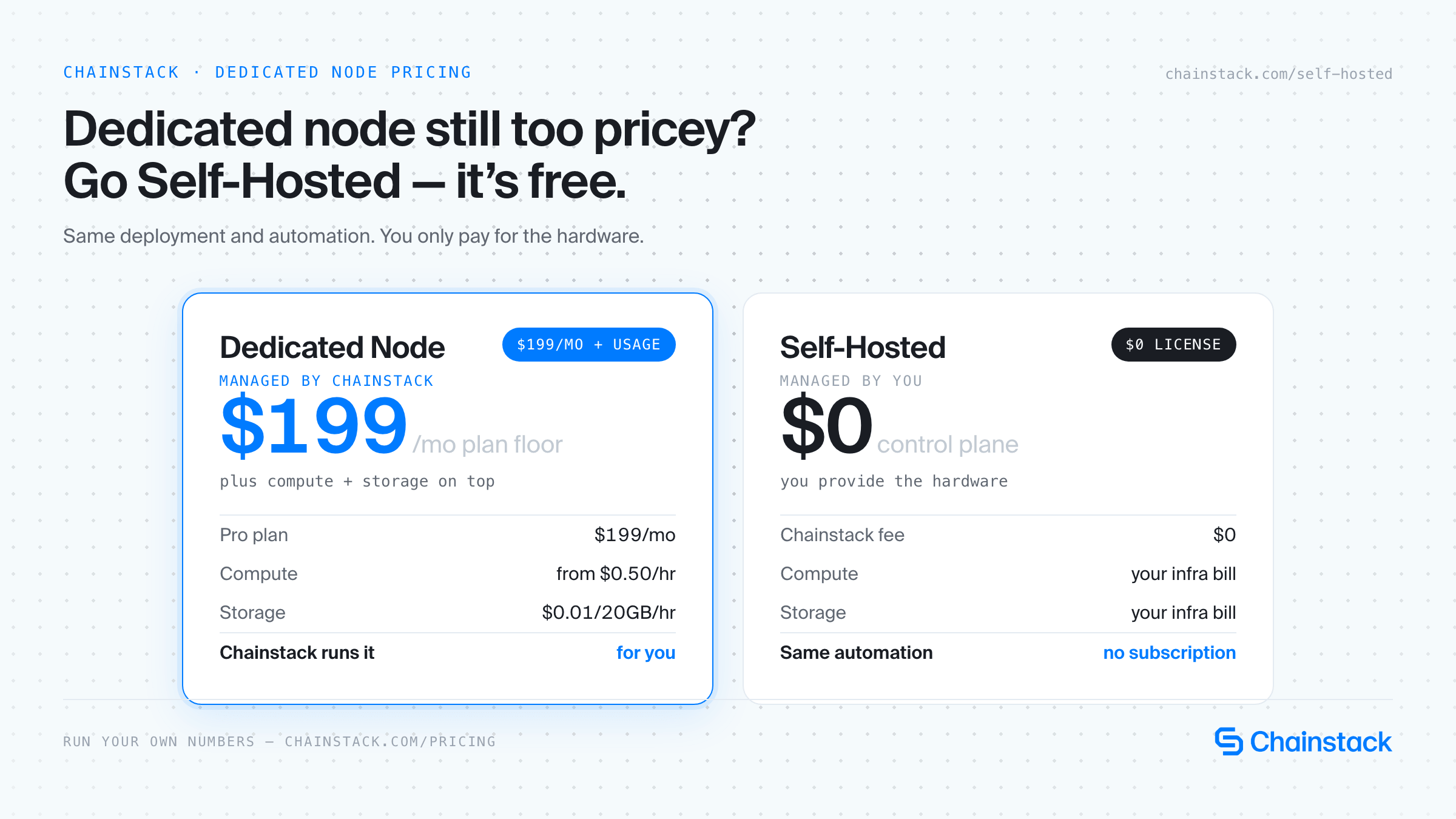
- Chainstack is the exception: Dedicated Node pricing is a published formula — a $199/month Pro plan (required to unlock the feature), plus from $0.50/hour compute, plus $0.01 per 20GB/hour storage. You can build the exact monthly number yourself before signing up — no sales call required to find out what you’d owe.
Comparison table
| Provider type | Dedicated pricing published? | Full Ethereum node, estimated monthly | Requires sales call to get a number |
|---|---|---|---|
| Chainstack | Yes — formula published | ~$1,279/mo (Pro plan + compute + ~2TB storage) | No |
| Large managed RPC platform (typical) | No | Custom quote only | Yes |
| Provider with public range only | Partial — range, not a number | Third-party estimates: low hundreds–$5,000+/mo | Usually |
Chainstack’s figure is a calculated example (Pro plan + from $0.50/hr compute × 720 hours + $0.01/20GB/hr × ~2,000GB × 720 hours, matching the ~2TB steady-state storage Chainstack’s own docs specify for an Ethereum Mainnet full node), not a discounted or promotional rate. Actual compute cost can run above the $0.50/hour floor depending on configuration. Competitor figures reflect general market patterns and third-party pricing trackers as of mid-2026, not any single named provider; since most of the market doesn’t publish dedicated pricing, verify directly with a given vendor’s sales team before budgeting.
Real numbers: dedicated nodes under $1,000/month that beat the market average
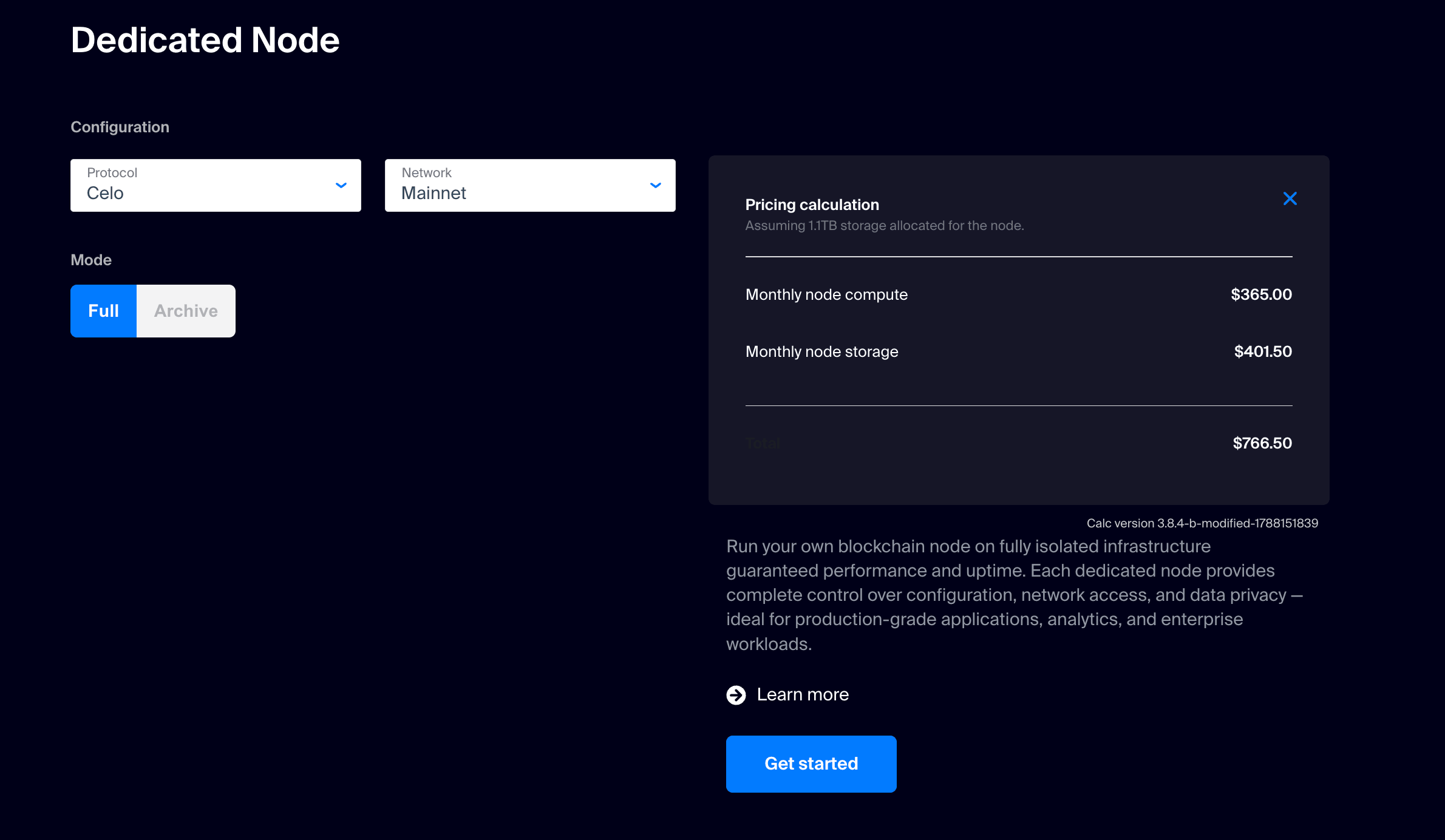
The Ethereum figure above is the headline case because Ethereum is the most storage-heavy chain Chainstack supports — it’s not the typical bill. Across the protocols Chainstack prices, a wide set land under $1,000/month on the same $199 Pro plan + compute + storage formula, and come in below the tracked market average for that exact protocol, network, and mode. These aren’t projected estimates: they’re Chainstack’s current price for that configuration, set against the average of tracked competitor prices for the same protocol/network/mode combination.
| Protocol | Network / mode | Chainstack price/mo | Tracked market avg/mo | Chainstack vs. market |
|---|---|---|---|---|
| Stable | mainnet, full | $730 | $2,430 | 233% cheaper |
| Ronin | mainnet, archive | $547.5 | $1,800 | 229% cheaper |
| Zora | mainnet, full | $445.3 | $1,235.33 | 177% cheaper |
| Unichain | mainnet, full | $562.1 | $1,220 | 117% cheaper |
| Celo | mainnet, full | $766.5 | $1,541.67 | 101% cheaper |
| Polkadot | mainnet, full | $562.1 | $1,062.67 | 89% cheaper |
Tracked market avg is Chainstack’s own tracked competitor pricing for that exact protocol/network/mode combination — the number of competitors behind each average varies by chain, so treat this as directional for your specific protocol, not a universal claim across the whole market. Figures current as of September 2026 and subject to change; confirm your exact configuration with the pricing formula above or the Chainstack pricing page before budgeting.
Two more worth flagging even without a market figure to compare against: Robinhood Chain and Tempo are both available on Dedicated Node and come in cheap on their own. On Chainstack’s pricing calculator, Robinhood Chain (mainnet, full, ~550GB) comes out to $569.40/month; Tempo (mainnet, archive, ~500GB) to $547.50/month. Not a “cheaper than market” claim — just a real, checkable number on its own.
Or skip the subscription entirely: Chainstack Self-Hosted
Every number above still sits on top of a paid plan — the $199/month Pro tier is the floor before compute and storage get added. If Dedicated Node is still more than you want to pay, the direct answer is Chainstack Self-Hosted: $0 in licensing, the same deployment, monitoring, and self-healing automation, running on infrastructure you provide and control. There’s no $199 Pro plan requirement and no per-hour compute or per-GB storage line item billed by Chainstack — you pay your own infrastructure bill, not a Chainstack subscription. It’s the closest thing on this list to a self-managed dedicated node for free.
Why most of the market doesn’t publish a number
Enterprise sales-led pricing isn’t unique to Web3 infrastructure — it’s a common model when a product bundles custom SLAs, negotiated volume discounts, and dedicated account management. The trade-off is that you can’t budget against it until you’ve already had the conversation, and the same workload can plausibly land anywhere in a multi-thousand-dollar range depending on who you talk to and when.
That’s a reasonable model for some products. It’s a harder sell for a line item you might want to comparison-shop before committing engineering time to a migration.
How to choose
- Do you need a number today, not after a sales call? Chainstack is one of the only providers in the category with a published formula for dedicated infrastructure — you can compute your own estimate before signing up anywhere.
- What does your actual config cost? The formula is chain- and mode-specific: storage requirements vary a lot by protocol (an Ethereum full node runs ~2TB; a lighter chain or a pruned/light preset can come in well under that). Check the supported deployments storage figures for your chain before estimating, and see how Request Units billing works if you’re comparing against a shared plan.
- Do you already have an enterprise relationship elsewhere? If you’re already deep into a competitor’s ecosystem with negotiated enterprise pricing, the switching cost may outweigh the transparency gain — model both before moving, or see what Chainstack Enterprise offers on negotiated terms of its own.
- Would you rather skip a subscription entirely? Chainstack Self-Hosted runs the same deployment, monitoring, and self-healing automation on infrastructure you control, at $0 for the control plane itself.
Getting started with Chainstack Dedicated Node
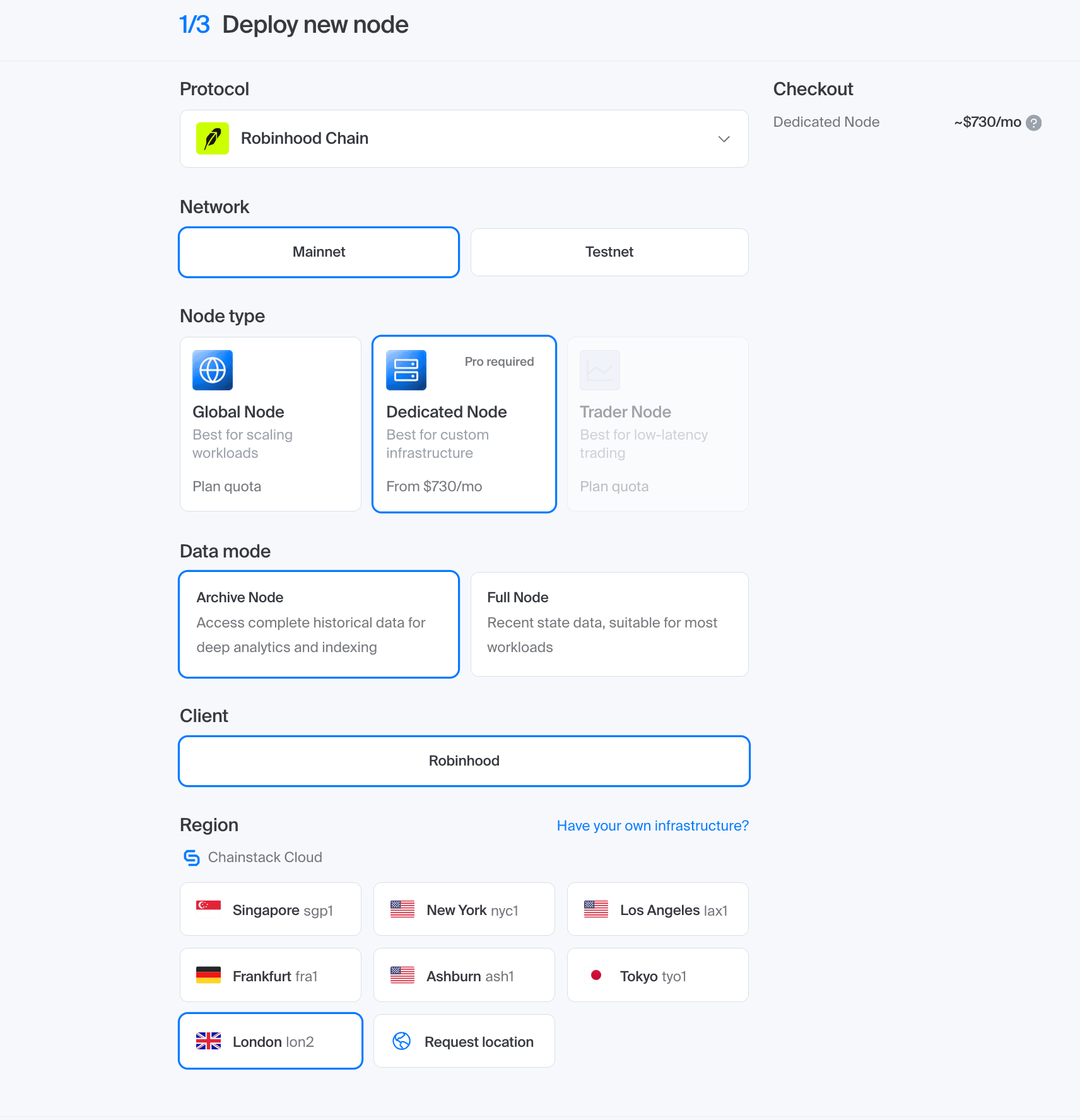
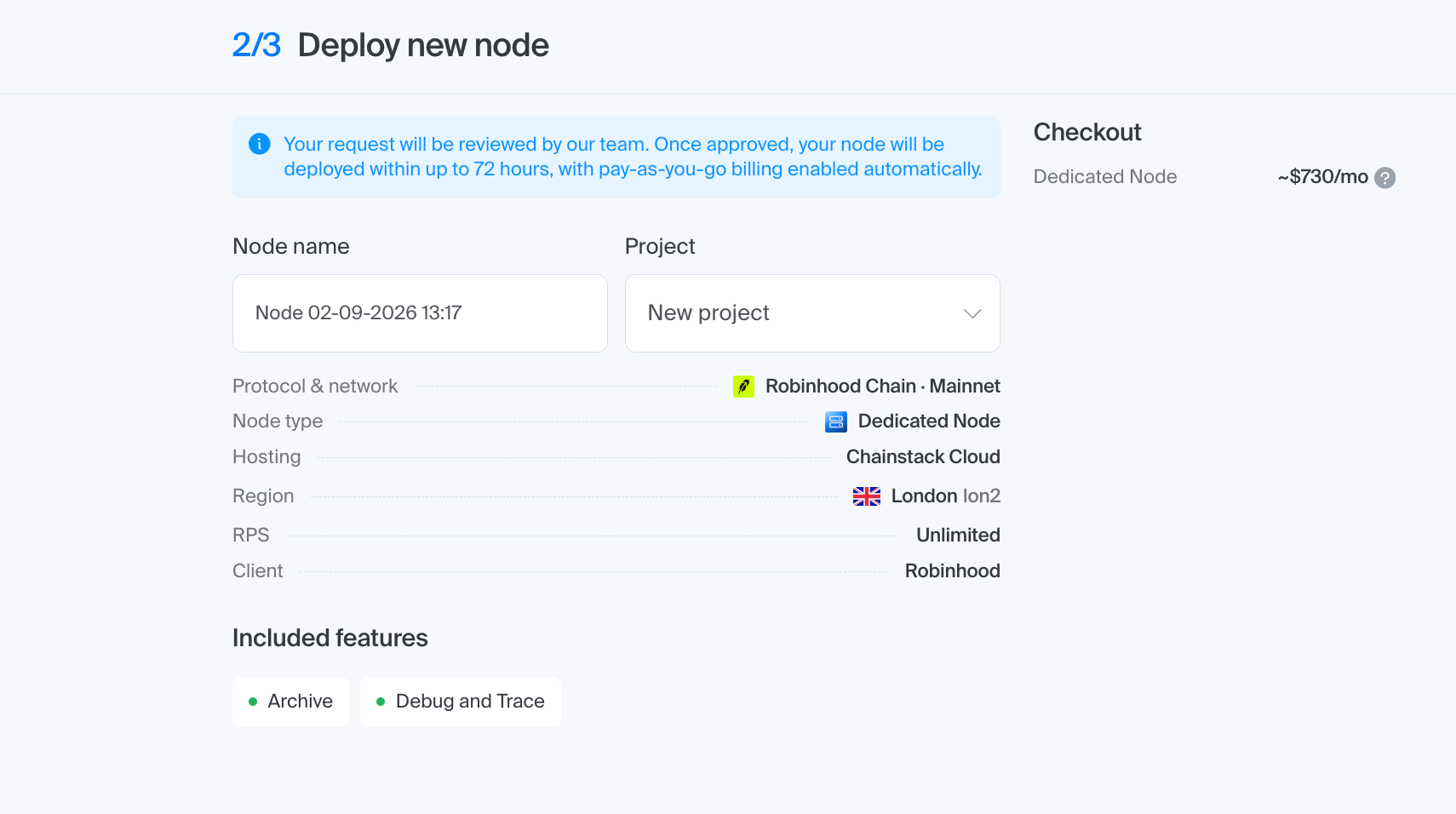
- Log in to the Chainstack console (or create an account) and click Deploy new node.
- Pick your protocol and network (mainnet or testnet).
- Select Dedicated Node as the node type — a Pro, Business, or Enterprise plan is required, with an estimated monthly price shown inline as soon as you select it.
- Choose full or archive data mode, the protocol client, and a region on Chainstack Cloud (or connect your own infrastructure instead).
- Name the node, assign it to a project, and review the summary — Dedicated Node ships with unlimited RPS.
- Submit — deployments go through review, live within up to 72 hours once approved, with pay-as-you-go billing enabled automatically.
Automating this instead? The Platform API covers the same deployment.
Need mempool access? Dedicated Node supports the txpool_* namespace on full or archive nodes, but it isn’t on by default — request it at deployment.
Not ready for dedicated yet? Global Nodes covers the same 70+ chains on shared infrastructure — deployable from the console or straight from an AI assistant via Chainstack MCP — and Archive Data gets you full historical state without committing to a dedicated instance first.
Conclusion
Most providers in this category sell some version of “dedicated node.” Very few tell you what it costs before you talk to anyone. Chainstack’s published formula puts a full Ethereum node at roughly $1,279/month — a real, checkable number built from three public figures, where most competitors offer none at all. If the goal is a dedicated node with a price you can verify yourself before signing up, that’s the whole comparison in one sentence.
- Need a number you can check right now → Chainstack
- Already have negotiated enterprise pricing elsewhere → compare the actual contract, not the list price
- Want the same automation without any subscription → Chainstack Self-Hosted
Frequently asked questions
Most treat dedicated/enterprise infrastructure as a sales-led product bundled with negotiated SLAs and support, which is common for enterprise tiers industry-wide but means you can’t get a number without a conversation.
Yes. A meaningful set of protocols — Zora, Unichain, Celo, Stable, Ronin, and Polkadot among them — come in under $1,000/month on the same published formula, and below the tracked market average for that protocol. Ethereum’s ~$1,279/month sits higher because Ethereum’s storage footprint is large, not because the formula itself is expensive by default.
That figure is for an Ethereum full node on the Pro plan with ~2TB of storage, matching Chainstack’s documented steady-state requirement for Ethereum Mainnet (Reth + Prysm). Storage and compute needs vary a lot by chain — archive nodes and heavier chains will cost more; lighter chains meaningfully less.
No — Dedicated Node requires a Pro, Business, or Enterprise plan ($199/month and up). The free Developer plan gives you shared Global Nodes access instead.
Take them as a range, not a quote. Different trackers report different numbers because the actual price is negotiated per customer, so any published range reflects that spread, not a fixed rate.
No. That number is a baseline full-node config. Multi-region deployments and archive storage both add cost on top of it — model those separately.
It’s a different trade-off, not a strict substitute. Self-Hosted gives you the same automation for $0 in licensing, but you provide and manage the underlying hardware yourself; Dedicated Node runs on Chainstack-provisioned or hybrid infrastructure.
Additional resources