


 Infrastructure compatible avec l'IA
 Parrainez et gagnez


 Ethereum
 Solana
 Arbitrum
 BNB Smart Chain
 Base
 Polygon
 TRON
 Sui
 Robinhood


 SOC 2 Type II
 ISO 27001
 Disponibilité supérieure à 99,99 %

HyperCore info API
Query account positions, balances, open orders, market metadata, and vault summaries through 46 supported /info queries. Use Hyperliquid’s public API for exchange actions and order-book data.
Available on every plan
 En savoir plus
Included
Power HyperEVM applications and HyperCore account queries with reliable, high-performance RPC infrastructure.











Connect through one geo-balanced Hyperliquid endpoint. Requests automatically reach the nearest available region, with no manual routing. Query HyperEVM contracts and supported HyperCore account data from your application.

Connect HyperCore account data, HyperEVM subscriptions, historical state, and execution traces in one development stack.
Query account positions, balances, open orders, market metadata, and vault summaries through 46 supported /info queries. Use Hyperliquid’s public API for exchange actions and order-book data.

Subscribe to new blocks, contract logs, and syncing updates with eth_subscribe. Keep wallets, dashboards, and DeFi applications up to date through your authenticated HyperEVM endpoint.

Run high-volume HyperEVM reads and supported HyperCore queries with unlimited requests within your selected RPS tier and predictable monthly add-on costs.

Query historical balances, contract storage, and past execution state for analytics, backfills, and accounting. Use /nanoreth when you need system transactions in block responses.

Inspect HyperEVM smart-contract execution, trace transactions, and diagnose reverted calls on archive Global Nodes. Build and troubleshoot with standard EVM development tools.

Read HyperCore positions, balances, and open orders through /info. Build your account and risk layer on managed infrastructure, while using Hyperliquid’s public API for signed orders and order-book feeds.
Explore HyperCore API methods (opens in a new tab)
Backfill historical balances, contract state, logs, and receipts. Choose /nanoreth to include HyperEVM system transactions in block responses and build a more complete indexing pipeline.
Explore HyperEVM archive access (opens in a new tab)
Deploy Solidity contracts, simulate calls, estimate gas, and submit signed EVM transactions. Connect ethers.js, viem, Foundry, or Hardhat to mainnet chain ID 999 or testnet 998.
Explore HyperEVM tooling (opens in a new tab)
Read HYPE balances and contract data on HyperEVM. Combine supported HyperCore account queries with EVM activity to power portfolio views, position monitoring, and wallet backends.
Get a Hyperliquid RPC endpoint
Deploy a Hyperliquid node and get its endpoint through Chainstack MCP. Connect your AI-assisted application to HyperEVM reads, transaction simulation, and supported HyperCore queries.
Explore Chainstack AI toolsRun HyperEVM indexers, portfolio backends, and data-intensive applications on isolated compute and storage. Choose full or archive infrastructure, with Chainstack managing node deployment and maintenance.
Select Hyperliquid mainnet or testnet and choose full or archive mode to see current monthly infrastructure pricing.
Save over 50% on our elite pay as you go plan
 Discuter sur Telegram (opens in a new tab)
What teams say about Chainstack performance, support, and multichain infrastructure.
 With Chainstack as an infrastructure partner, the difference in performance was remarkable.Chainstack’s custom gateway and Global Nodes have made a stellar impact on our operational efficiencyOur services are able to run with the highest performance and stability so that we can provide the best services for our customers.Chainstack’s resolution to the network load issues we experienced was both swift and smooth.Thanks to Chainstack we have a pleasant and stable user experience
Compare HyperEVM RPC response times and request success rates across Europe, the US, and Asia. Explore P50, P95, and P99 latency for the Hyperliquid endpoints monitored by Chainstack Compare.
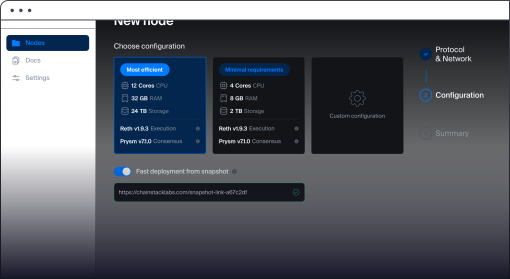
Compare Hyperliquid RPC providers (opens in a new tab)Run a Hyperliquid mainnet or testnet full node on infrastructure you control. Deploy the Hyperliquid node client and its HTTP EVM JSON-RPC service through Chainstack Self-Hosted, with monitoring, automated updates, and self-healing operations.




Get free testnet HYPE from the Chainstack Hyperliquid faucet to pay gas, deploy smart contracts, and test transactions on HyperEVM. Connect your Hyperliquid testnet RPC endpoint to ethers.js, viem, or your preferred EVM tools and test your application before mainnet.
The faucet tops up eligible wallets to 1 testnet HYPE, with a claim available every 24 hours.
Get testnet HYPE (opens in a new tab)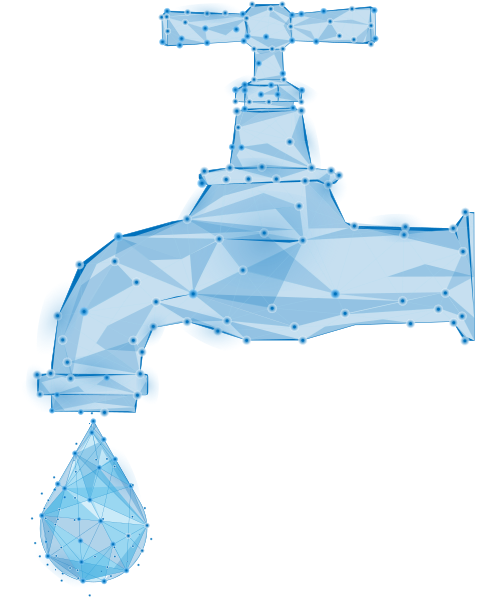
Start with free Hyperliquid RPC for HyperEVM development and supported HyperCore queries. Choose paid plans for historical state, higher throughput, and dedicated infrastructure.
Includes:
All Developer features, plus:
Add-ons and Dedicated Node infrastructure are billed separately.
 Exceptional support on every paid plan
Explore Hyperliquid trading infrastructure, AI development, provider comparisons, and hands-on bot tutorials.
Compare Hyperliquid bot strategies, infrastructure choices, and risk controls.
Read article
Explore Hyperliquid development workflows with MCP and AI tools.
Read article
Compare Hyperliquid RPC providers for perpetuals trading workloads.
Read article
Build a trading bot with Hyperliquid APIs, data feeds, and order handling.
Read article
A Hyperliquid RPC endpoint connects your application to Hyperliquid network data. Chainstack provides HyperEVM JSON-RPC for contract reads, transaction simulation, and signed EVM transaction submission, plus supported HyperCore queries at /info. HyperEVM and HyperCore share Hyperliquid consensus but expose different APIs.
Create a free Chainstack account, deploy a Hyperliquid mainnet or testnet node, and open Access and credentials. Copy the endpoint and its authentication token. Use the /evm path for standard HyperEVM JSON-RPC, /nanoreth for the system-transaction-aware EVM view, and /info for supported HyperCore queries.
Yes. The free Developer plan includes one node, 3 million request units per month, and 25 requests per second. No credit card is required. Use it for HyperEVM RPC, HyperEVM WebSockets, and supported HyperCore /info queries. Archive data, Debug & Trace APIs, and Unlimited Node are available on paid plans.
HyperEVM RPC serves the EVM-compatible smart-contract layer, including eth_call, eth_getLogs, and eth_sendRawTransaction. HyperCore is the native trading layer. Chainstack supports 46 HyperCore /info query types, including account positions, balances, open orders, and market metadata. Proprietary order-book queries and exchange actions use Hyperliquid’s public API.
For HyperCore trading actions, submit signed orders to Hyperliquid’s public /exchange API. Chainstack’s /info endpoint serves supported queries. For HyperEVM transactions, Chainstack supports eth_sendRawTransaction on its EVM endpoint.
Yes, for HyperEVM. Connect to the WebSocket endpoint shown in Access and credentials and use /evm with eth_subscribe for newHeads, logs, and syncing updates. HyperCore order-book and fill subscriptions use Hyperliquid’s public WebSocket API; they are not the same service as HyperEVM RPC subscriptions.
Chainstack supports Hyperliquid mainnet and testnet. HyperEVM uses chain ID 999 on mainnet and 998 on testnet, with HYPE as its gas token. Connect an EVM-compatible wallet or SDK using the appropriate Chainstack /evm endpoint.
Both paths are available on Chainstack Hyperliquid nodes. The /evm path provides the hl-node-compatible view and strips HyperEVM system transactions from block-shaped responses. The /nanoreth path retains those system transactions in block responses. Use /nanoreth when an indexer needs the system-transaction-aware view, and check the per-method behavior in the node configuration guide.
Yes. HyperEVM archive access supports historical execution state, such as past balances and contract storage. Debug & Trace APIs are available on paid Global Nodes, with archive infrastructure for historical traces. These features start from the Growth plan. EVM archive data does not replace HyperCore’s proprietary historical market-data APIs.
Yes. HyperEVM supports standard EVM development tools. Configure your Chainstack /evm endpoint and the mainnet or testnet chain ID to read contracts, estimate gas, simulate calls, deploy Solidity contracts, and submit signed transactions. HyperCore queries use the separate /info API rather than Ethereum eth_* methods.
Global Nodes provide a geo-balanced managed endpoint. Dedicated Nodes run on isolated infrastructure and are available from the Pro plan, with infrastructure billed separately. Unlimited Node is a paid add-on available from Growth: it provides unlimited request volume within the RPS tier you choose. It does not mean unlimited requests per second.
Yes. Chainstack Self-Hosted supports Hyperliquid mainnet and testnet full nodes on infrastructure you control. Its current deployment exposes HTTP EVM JSON-RPC on port 3001 and does not add a separate WebSocket listener. Follow the installation guide to configure the node. The self-hosted software is free; you provide and pay for the infrastructure.
Open the Chainstack Hyperliquid testnet faucet, enter your wallet address and Chainstack API key, and submit a claim. The faucet tops eligible wallets up to 1 testnet HYPE every 24 hours. Use testnet HYPE to pay gas for HyperEVM contract deployments and transactions through your Hyperliquid testnet RPC endpoint. Wallet eligibility requirements are listed on the faucet page. Testnet HYPE has no monetary value.
Hyperliquid has two execution environments: HyperEVM for EVM-compatible smart contracts and HyperCore for the native trading layer. Chainstack supports HyperEVM JSON-RPC at /evm and /nanoreth, and 46 supported HyperCore query types at /info. Use the endpoint and authentication token from Access and credentials.
HyperEVM mainnet uses chain ID 999, testnet uses 998, and HYPE is the gas token. Connect ethers.js, viem, web3.py, Foundry, or Hardhat to the appropriate EVM endpoint. Chainstack supports eth_call, eth_getLogs, gas estimation, and eth_sendRawTransaction. HyperEVM WebSockets support eth_subscribe for newHeads, logs, and syncing.
The /evm path strips system transactions from block-shaped responses, while /nanoreth includes them. Indexers that need the system-transaction-aware block view should use /nanoreth. Both paths are available by default; check the node configuration guide for per-method differences.
Chainstack /info supports queries such as meta, clearinghouseState, spotClearinghouseState, and openOrders. HyperCore signed exchange actions and proprietary queries such as l2Book, allMids, userFills, and candleSnapshot use Hyperliquid’s public API. HyperCore order-book streaming is separate from HyperEVM WebSocket subscriptions.
The Developer plan includes 3 million request units per month, 25 requests per second, and one node. Full requests consume 1 request unit and archive requests 2, according to the request-unit method rules. Archive access, Debug & Trace APIs, and Unlimited Node start from Growth. Dedicated infrastructure starts from Pro and is billed separately.
Chainstack MCP can deploy a Hyperliquid node and return its endpoint. Connect your application to the appropriate HyperEVM or HyperCore API. Keep private signing keys in your application’s secure signing environment, outside public page code.





 Consulter le guide d'installation