


 KI-fähige Infrastruktur
 Empfehlen und verdienen


 Ethereum
 Hyperliquid
 Solana
 Arbitrum
 BNB Smart Chain
 Base
 Polygon
 TRON
 Sui
 Robinhood


 SOC 2 Typ II
 ISO 27001
 Über 99,99 % Verfügbarkeit

MEV protection
Keep Ethereum mainnet transactions out of the public mempool with private routing to block builders. Reduce exposure to front-running and sandwich attacks through your existing endpoint.
Available on every plan
 Mehr erfahren
Kostenlos
Read contract state, submit transactions, and monitor Ethereum events with reliable, high-performance RPC infrastructure.





Access Ethereum through a single, geo-balanced endpoint. Your requests automatically reach the nearest available region, with no manual region selection or extra setup.

Protect transactions, accelerate propagation, access historical state, and trace smart contract execution with a complete Ethereum RPC stack.
Keep Ethereum mainnet transactions out of the public mempool with private routing to block builders. Reduce exposure to front-running and sandwich attacks through your existing endpoint.

Route Ethereum eth_sendRawTransaction calls through bloXroute’s distribution network for faster propagation. Keep your existing endpoint for contract reads, event monitoring, and transaction submission.

Scale high-volume RPC workloads with consistent performance, unlimited requests within your RPS tier, and predictable monthly costs.

Query Ethereum balances, contract storage, and smart contract state at historical blocks. Backfill event logs for indexers, analytics, and financial reconciliation.

Replay Ethereum transactions with debug_traceTransaction and inspect internal calls with trace_transaction. Diagnose reverts, investigate transfers, and analyze contract execution.

Read liquidity pools, simulate contract calls with eth_call, and submit signed transactions with MEV protection for swaps, trading bots, and DeFi applications.
Explore Ethereum MEV protection (opens in a new tab)
Query balances and contract state at past blocks. Combine archive RPC, event logs, and execution traces for indexing, backtesting, and onchain security research.
Explore Ethereum archive data
Read ETH and ERC-20 balances, estimate gas, and follow transaction receipts. Connect ethers, viem, or web3.py to Ethereum mainnet and Sepolia.
Get an Ethereum RPC endpoint
Monitor ERC-20 Transfer events, verify transaction receipts, and reconcile historical balances. Build deposit detection and stablecoin payment flows on Ethereum.
Build Ethereum payment infrastructure
Deploy Ethereum RPC endpoints with Chainstack MCP. Give agents access to contract reads, transaction simulations, and signed transaction submission.
Explore Chainstack AI toolsRun Ethereum workloads on isolated compute and storage. Choose full or archive infrastructure for custom RPC deployments, intensive analytics, and enterprise applications, with Chainstack managing node operations.
Select Ethereum mainnet, Sepolia, or Hoodi and choose full or archive mode to see current monthly infrastructure pricing.

Save over 50% on our elite pay as you go plan
 Auf Telegram chatten (opens in a new tab)
Customer feedback on Ethereum archive access, trading infrastructure, and the wider Chainstack experience.
 Working with Chainstack helped us cut our infrastructure costs by over 70%, all while tackling intricate challenges in Web3 security.The Unlimited Node flat-fee model gives us cost predictability, and the performance is rock-solidChainstack’s robust infrastructure has significantly enhanced our ability to secure Web3 environments effectively.Chainstack has been crucial in enhancing Brave Wallet’s multi-chain functionality and UX.Archive nodes are available across Ethereum and Polygon in one dashboard, so workflow is smooth.
Compare Chainstack’s Ethereum RPC response times and request success rates against other providers across Europe, the US, and Asia. Explore P50, P95, and P99 latency in Chainstack Compare.
Compare Ethereum RPC providers (opens in a new tab)Run Ethereum mainnet, Sepolia, or Hoodi nodes on infrastructure you control with Chainstack Self-Hosted. Deploy execution and consensus clients through one interface, with monitoring, automated updates, and self-healing operations.
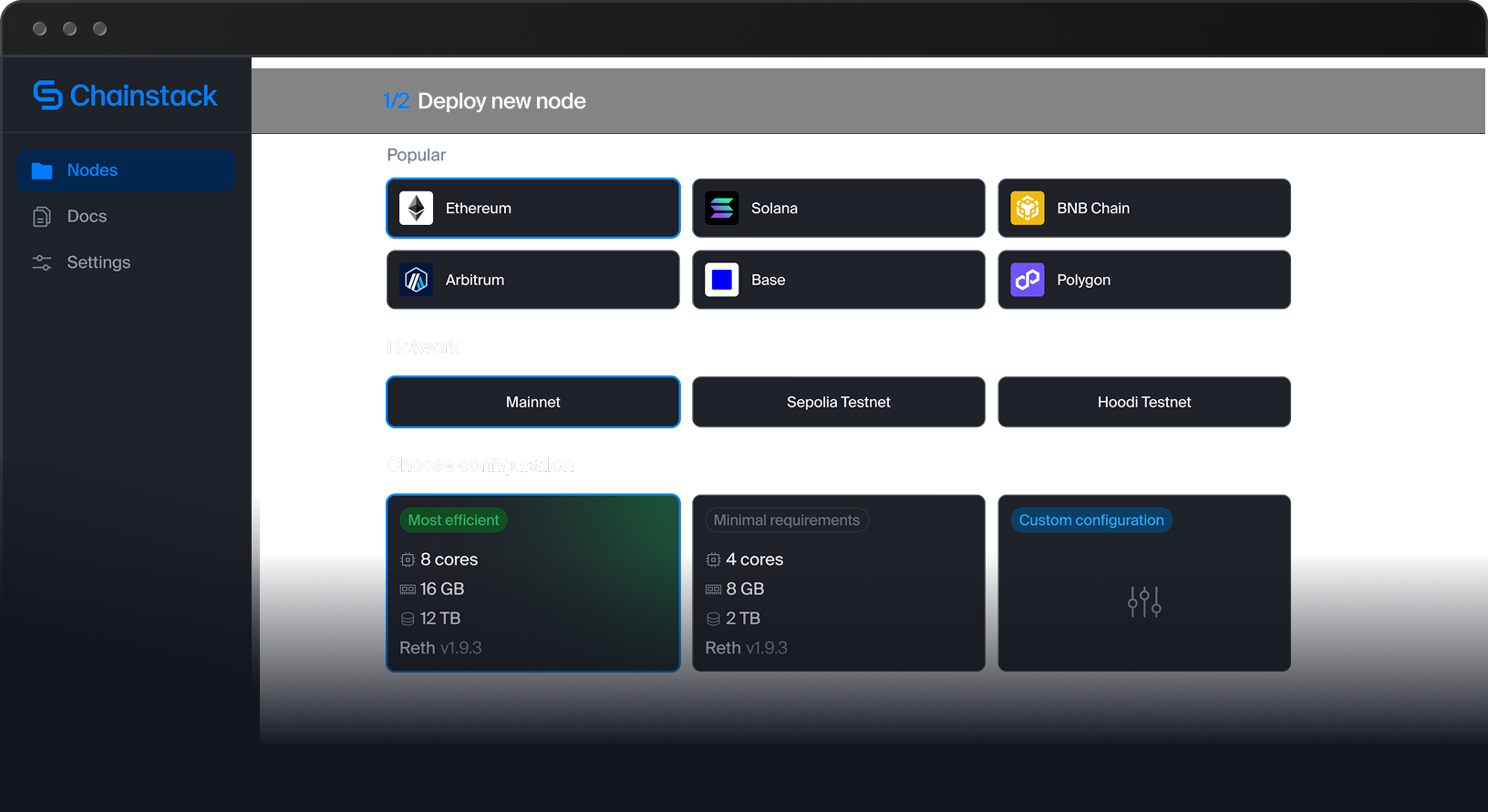


Get free testnet ETH from the Chainstack Ethereum faucets. Use Sepolia to deploy smart contracts and test applications with ethers.js, viem, Hardhat, or Foundry. Use Hoodi to test staking, validators, and Ethereum network upgrades. Connect your Ethereum RPC endpoint to the matching testnet.
Each faucet tops up eligible wallets to 0.5 testnet ETH, with a claim available every 24 hours.
Free Ethereum RPC for development, with paid plans for DeFi applications, historical data, payments, and enterprise workloads.
Includes:
All Developer features, plus:
Add-ons and Dedicated Node infrastructure are billed separately.
 Exceptional support on every paid plan
Explore Ethereum RPC providers, archive data, private transaction routing, and production integration guides.

Compare Ethereum RPC providers for real production workloads.
Read article
Understand historical state, full nodes, and archive RPC access.
Read article
See how private transaction routing reduces public-mempool exposure.
Read article
Build reliable event monitoring and stablecoin payment flows.
Read article
An Ethereum RPC endpoint is a URL your application uses to communicate with an Ethereum node. Through JSON-RPC, it can read balances, call smart contracts, retrieve event logs, estimate gas, and submit signed transactions.
Create a Chainstack account, create a project, and deploy an Ethereum node on your chosen network. Open Access and credentials and copy the Execution client HTTPS endpoint. Add the URL to your wallet, SDK, or development framework.
Yes. The Chainstack Developer plan includes 3 million request units per month, an overall limit of 25 requests per second, one node, and WebSocket access. No credit card is required. Individual methods may have additional limits.
Chainstack supports Ethereum mainnet, Sepolia, and Hoodi. Their chain IDs are 1, 11155111, and 560048, respectively. Use the endpoint and chain ID for the same network when configuring your application or wallet.
A full node handles current-state reads and transaction submission. An archive node also provides historical account and smart contract state, which you need to query past balances or storage. Chainstack archive access is available starting from the Growth plan.
Global Nodes provide managed, geo-balanced RPC access with automatic routing. Dedicated Nodes reserve compute and storage for your workload and support deployment-specific configurations. Choose based on isolation, configuration, and workload requirements.
Yes. Use your Ethereum WebSocket endpoint and eth_subscribe to receive new blocks, contract event logs, or pending transaction notifications. WebSocket access is included in the Developer plan.
Yes. Debug & Trace APIs are available on paid plans for supported Ethereum deployments. Methods such as debug_traceTransaction and trace_transaction help inspect execution and investigate contract behavior. Available namespaces depend on the node client and configuration.
Yes. MEV protection is available on Ethereum mainnet Global Nodes, including on the free Developer plan. It routes transaction submissions privately instead of broadcasting them to the public mempool, helping reduce exposure to front-running and sandwich attacks.
Warp transactions route eth_sendRawTransaction submissions through bloXroute’s relay network for faster propagation. Other RPC calls continue through Chainstack infrastructure. Warp is a paid add-on with transaction usage billed separately; faster propagation does not guarantee block inclusion.
Yes. The Unlimited Node add-on provides a fixed monthly price and unlimited RPC requests within the selected RPS tier. It is available starting from the Growth plan, with the add-on billed separately from your subscription.
Yes. Chainstack Self-Hosted lets you deploy and manage Ethereum execution and consensus clients on infrastructure you control. The Community edition is free; you pay for your servers or cloud infrastructure.
Use the Chainstack Sepolia faucet for smart-contract and application testing, or the Hoodi faucet for staking, validator, and network-upgrade testing. Open the faucet for your chosen network, enter your wallet address and Chainstack API key, and submit a claim. Each faucet tops eligible wallets up to 0.5 testnet ETH every 24 hours. Connect your Ethereum RPC endpoint to the same testnet. Wallet eligibility requirements are listed on each faucet page.
Connect your application to an Ethereum HTTPS endpoint to read account balances, query smart contracts and event logs, estimate gas, and submit signed transactions. Common JSON-RPC methods include eth_getBalance, eth_call, eth_getLogs, eth_estimateGas, and eth_sendRawTransaction. Use WebSocket subscriptions with eth_subscribe to receive new blocks and contract events.
Integrate your Chainstack endpoint with ethers.js or viem for JavaScript and TypeScript, or web3.py for Python. Use the same endpoint with Hardhat or Foundry for smart contract development. See the Ethereum API reference for supported methods and the Ethereum tooling guide for integration examples.





 Installationsanleitung ansehen