Connect to Avalanche C-Chain mainnet or Fuji through one geo-balanced endpoint. Read AVAX balances, call Solidity contracts, and track transactions through the nearest available region.
Scale Avalanche applications with predictable capacity, archive data, and transaction debugging.
无限Node
Scale high-volume RPC workloads with consistent performance, unlimited requests within your RPS tier, and predictable monthly costs.
25requests / second
$149/mo
25100250500
Avalanche archive data
Read historical AVAX balances, contract state, and event logs on C-Chain. Backfill DeFi data, wallet activity, and financial records with archive access.
Included
调试与跟踪API
Inspect C-Chain execution with debug_traceTransaction and debug_traceCall. Diagnose reverted swaps and internal calls using supported debug methods on archive nodes.
Included
Build and scale with reliable Avalanche RPC
Build DeFi and trading apps
Read liquidity-pool and lending-market state, simulate contract calls, and submit signed C-Chain transactions. Use ethers.js, viem, Hardhat, or Foundry with your Avalanche endpoint.
Backfill contract events and retrieve historical balances and state with archive access. Power portfolio reporting, analytics, and application recovery without operating an archive node.
Inspect execution traces to investigate reverted swaps, contract calls, and internal transfers. Use supported debug methods with a paid-plan archive node.
Query staking and validator information through P-Chain APIs. Use separate C-Chain, X-Chain, and P-Chain paths for the data each part of your application needs.
Run DeFi backends, indexers, and financial applications on isolated compute and storage. Choose an available Avalanche mainnet or Fuji configuration, with Chainstack managing deployment, upgrades, and node operations.
专属Node
Choose Avalanche mainnet or Fuji and an available node mode to see monthly infrastructure pricing.
Feedback from Benqi’s Avalanche infrastructure work and teams building wallets, security tools, and trading applications across supported networks.
Our collaboration with Chainstack marks a pivotal step in enhancing the Avalanche ecosystem, offering a seamless experience for deploying Subnets.Dan Mgbor, Co-Founder, Benqi客户故事 (opens in a new tab)Chainstack’s robust infrastructure has significantly enhanced our ability to secure Web3 environments effectively.Lior Betzalel, VP R&D, Hypernative客户故事 (opens in a new tab)Chainstack has been crucial in enhancing Brave Wallet’s multi-chain functionality and UX.James Mudgett, VP Web3, Brave客户故事 (opens in a new tab)The Unlimited Node flat-fee model gives us cost predictability, and the performance is rock-solidOleksandr Holofaiev, COO, Peanut.trade客户故事 (opens in a new tab)We’ve gone from weekly incidents to zero incidents.Frank S., Founder, Whale Alert客户故事 (opens in a new tab)
Fast Avalanche RPC with predictable costs
Build on geo-balanced Avalanche endpoints for C-Chain mainnet and Fuji. Scale sustained RPC workloads with flat-fee Unlimited Node capacity, or choose Dedicated Nodes for isolated infrastructure.
Self-hosted Avalanche RPC on your own infrastructure
Run Avalanche mainnet or Fuji nodes on infrastructure you control. Deploy AvalancheGo through Chainstack Self-Hosted, with monitoring, automated updates, and self-healing operations.
Copy your C-Chain URL from Access and credentials. Replace YOUR_ENDPOINT_ID with your endpoint ID. Keep /ext/bc/C/rpc before the ID; P-Chain and X-Chain use different paths.
Start with free Avalanche RPC for C-Chain mainnet or Fuji. Scale DeFi applications with archive data, debug APIs, higher throughput, and dedicated infrastructure.
Avalanche RPC is the interface applications use to read Avalanche blockchain data and submit transactions. C-Chain provides Ethereum-compatible JSON-RPC for Solidity applications, while the X-Chain and P-Chain expose different APIs. Chainstack provides managed access to Avalanche mainnet and Fuji. See the Avalanche API reference.
How do I get a free Avalanche RPC endpoint?
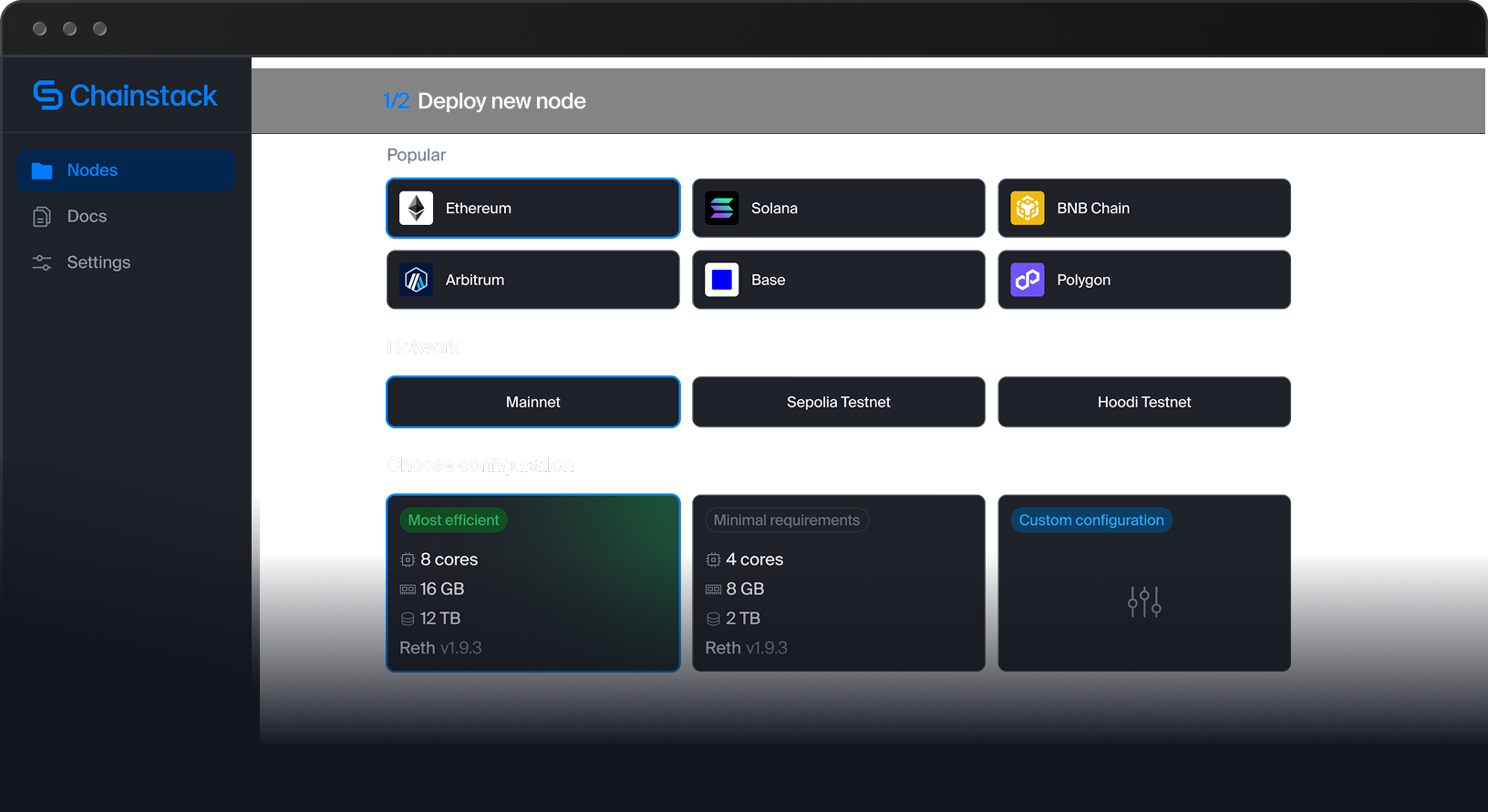
Create a free Chainstack account, create a project, and deploy an Avalanche Global Node on mainnet or Fuji. Open Access and credentials and copy the URL for the chain you need. The Developer plan includes 3 million request units per month, up to 25 requests per second, and one node. No credit card is required.
What are the Avalanche C-Chain mainnet and Fuji RPC URLs?
Your Chainstack C-Chain HTTPS URL follows https://avalanche-mainnet.core.chainstack.com/ext/bc/C/rpc/YOUR_ENDPOINT_ID for mainnet and https://avalanche-fuji.core.chainstack.com/ext/bc/C/rpc/YOUR_ENDPOINT_ID for Fuji. Copy your complete URL from Access and credentials. The chain path comes before the endpoint ID. See the Avalanche endpoint structure.
What are the Avalanche and Fuji chain IDs?
Avalanche C-Chain mainnet uses chain ID 43114 (0xa86a), and Fuji C-Chain uses 43113 (0xa869). Both use AVAX for gas. These are EVM chain IDs for C-Chain, not identifiers to reuse for every Avalanche blockchain. See the official C-Chain RPC reference.
What is the difference between C-Chain, X-Chain, and P-Chain RPC?
C-Chain serves EVM smart contracts through /ext/bc/C/rpc. X-Chain serves native asset APIs through /ext/bc/X. P-Chain serves staking and validator APIs through /ext/P. On Chainstack, append the endpoint ID after the chain path. A custom Avalanche L1 can require its own RPC service; a Primary Network C-Chain endpoint does not automatically expose that L1’s state. See Avalanche endpoint paths 以及 supported methods.
Can I use MetaMask, Ethereum libraries, and WebSockets with Avalanche?
Yes. Use your C-Chain endpoint with MetaMask, ethers.js, viem, web3.py, Hardhat, or Foundry. For C-Chain subscriptions, use wss://avalanche-mainnet.core.chainstack.com/ext/bc/C/ws/YOUR_ENDPOINT_ID, or the corresponding Fuji URL from your node. HTTPS and WSS use different C-Chain paths. Follow the Avalanche tooling guide.
How do I check an AVAX balance through Avalanche RPC?
Call eth_getBalance on C-Chain with an EVM address and a block tag such as latest. The result is a hexadecimal balance in wei, with 10^18 wei per AVAX. It reads the address’s C-Chain AVAX balance, not ERC-20 token balances or funds on the X-Chain or P-Chain. See the Avalanche eth_getBalance reference.
Does Chainstack provide Avalanche archive data?
Yes. Chainstack lists Avalanche archive access on Global Nodes for mainnet and Fuji, available from the Growth plan. Use archive access for historical C-Chain balances and contract state. Full requests consume 1 request unit, while archive requests consume 2. Dedicated archive configurations depend on the selected network and current availability. See supported networks and modes and request-unit rules.
Can I trace and debug Avalanche transactions?
Yes. Avalanche debug APIs require a paid plan and an archive node. Supported methods include debug_traceTransaction 以及 debug_traceCall for investigating execution and contract failures. Availability follows the current AvalancheGo API surface, so do not assume every Geth debug method is supported. See Avalanche debug API requirements.
What is the difference between latest and finalized on Avalanche C-Chain?
After the Helicon upgrade, latest refers to the last executed block, while safe 以及 finalized refer to the last settled block. Choose the block tag required by your application, especially when reconciling payments or reading contract state for settlement. See the official C-Chain RPC behavior.
How much does Avalanche RPC cost on Chainstack?
Start with the free Developer plan. Paid plans start at $40 per month with annual billing. Unlimited Node adds flat-fee RPC capacity from the Growth plan. Dedicated Nodes start from Pro, with infrastructure billed separately; available modes depend on the selected network. Compare plan features and current Avalanche configurations.
Can I run a self-hosted Avalanche node?
Yes. Chainstack Self-Hosted supports Avalanche mainnet and Fuji using AvalancheGo. It runs a non-validator full node on infrastructure you control, with monitoring, automated updates, and self-healing operations. A Primary Network node serves the built-in chains; custom Avalanche L1 tracking can require additional configuration. Check supported clients and networks and the installation guide.
Where can I get free Avalanche Fuji testnet AVAX?
Use the official Avalanche faucet for Fuji testnet tokens, subject to its eligibility requirements. Connect your application to Fuji C-Chain with chain ID 43113. Testnet AVAX has no monetary value and cannot pay mainnet fees. Chainstack’s faucet portal does not currently list Avalanche Fuji.
Avalanche RPC API: C-Chain URLs, Fuji, and chain IDs
Connect to Avalanche C-Chain mainnet at https://avalanche-mainnet.core.chainstack.com/ext/bc/C/rpc/YOUR_ENDPOINT_ID or Fuji at https://avalanche-fuji.core.chainstack.com/ext/bc/C/rpc/YOUR_ENDPOINT_ID. Copy your complete authenticated URL from Access and credentials and replace the example endpoint ID. Keep the chain path before the ID. Mainnet uses EVM chain ID 43114; Fuji uses 43113. Both use AVAX for gas. See the Avalanche endpoint and tooling guide.
Use eth_getBalance for AVAX balances, eth_call for contract reads, eth_getLogs for events, and eth_sendRawTransaction for signed transaction submission. Native AVAX balances use 18 decimals. C-Chain WebSocket connections use /ext/bc/C/ws before the endpoint ID. X-Chain and P-Chain use their own API paths. See the Avalanche API reference 以及 method availability.
Use archive access for historical C-Chain state and a paid-plan archive node for supported debug methods. After Helicon, latest refers to the last executed block, while safe 以及 finalized refer to the last settled block. Select the appropriate block tag for your application. See Avalanche debug requirements 以及 official C-Chain behavior.


 支持人工智能的基础设施
 推荐并赚取


 Ethereum
 Hyperliquid
 Solana
 Arbitrum
 BNB Smart Chain
 Base
 Polygon
 TRON
 Sui
 Robinhood


 SOC 2 II 类
 ISO 27001
 99.99%+ 的正常运行时间













 了解更多


 在Telegram上聊天

 查看安装指南




 Exceptional support on every paid plan