RPC con equilibrio geográficoDiseñado para aplicaciones EVM
Connect to Avalanche C-Chain mainnet or Fuji through one geo-balanced endpoint. Read AVAX balances, call Solidity contracts, and track transactions through the nearest available region.
Scale Avalanche applications with predictable capacity, archive data, and transaction debugging.
Ilimitado Node
Escala cargas de trabajo de RPC de gran volumen con un rendimiento constante, solicitudes ilimitadas dentro de tu nivel « RPS » y costes mensuales predecibles.
25solicitudes por segundo
$149$al mes
25100250500
Avalanche archive data
Read historical AVAX balances, contract state, and event logs on C-Chain. Backfill DeFi data, wallet activity, and financial records with archive access.
Incluido
API de depuración y seguimiento
Inspect C-Chain execution with debug_traceTransaction and debug_traceCall. Diagnose reverted swaps and internal calls using supported debug methods on archive nodes.
Incluido
Build and scale with reliable Avalanche RPC
Desarrolla aplicaciones de DeFi y de trading
Read liquidity-pool and lending-market state, simulate contract calls, and submit signed C-Chain transactions. Use ethers.js, viem, Hardhat, or Foundry with your Avalanche endpoint.
Backfill contract events and retrieve historical balances and state with archive access. Power portfolio reporting, analytics, and application recovery without operating an archive node.
Inspect execution traces to investigate reverted swaps, contract calls, and internal transfers. Use supported debug methods with a paid-plan archive node.
Query staking and validator information through P-Chain APIs. Use separate C-Chain, X-Chain, and P-Chain paths for the data each part of your application needs.
Más de 10 000millones de llamadas diariasa la API en Chainstack
Más de 10 centros de datos deChainstack en todo el mundo
Acceso al servicio de asistencia 24 horas al día, 7 días a la semana
99,99 % o más de tiempo de actividad
Dedicated Avalanche RPC for enterprise teams
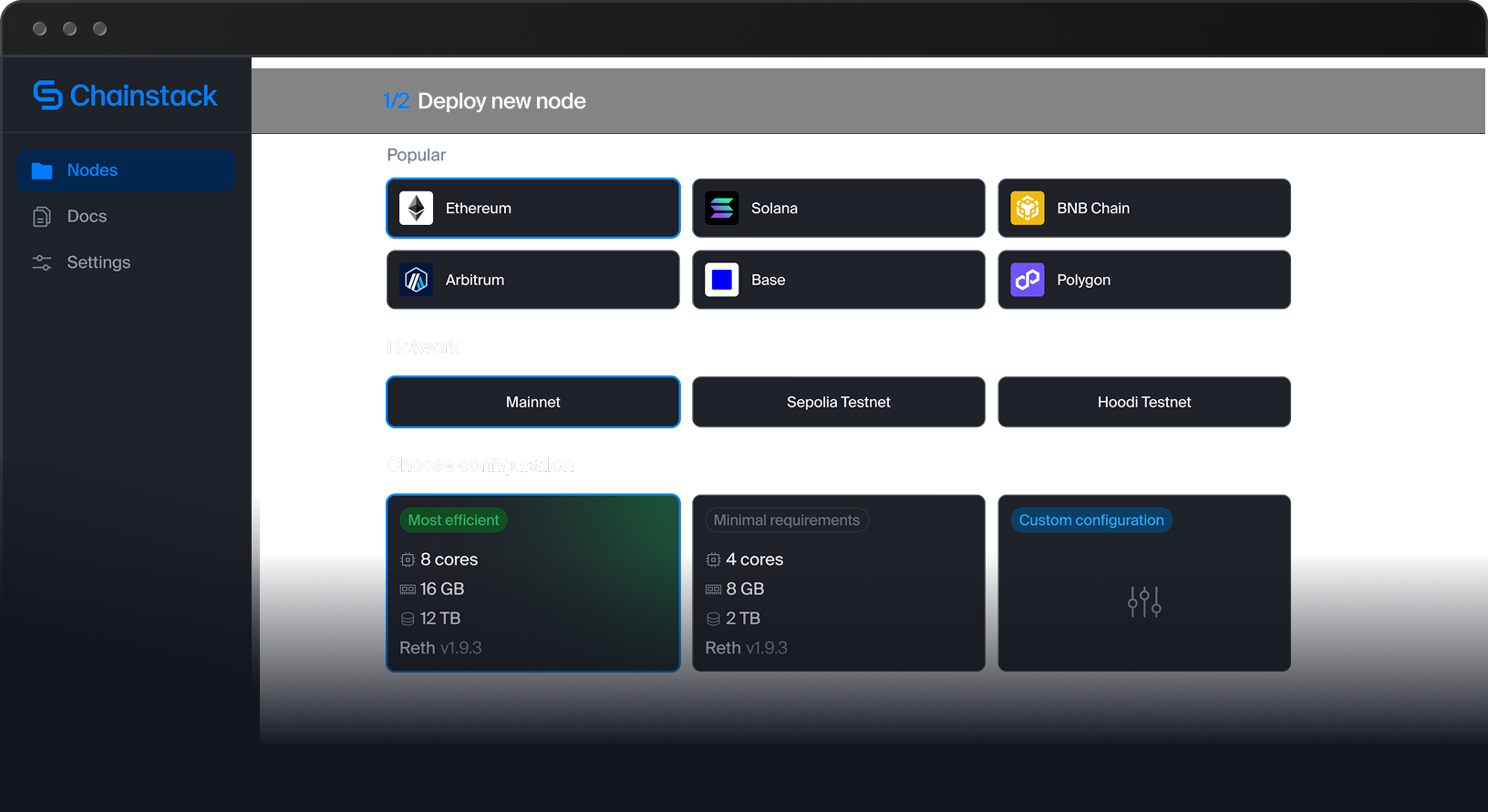
Run DeFi backends, indexers, and financial applications on isolated compute and storage. Choose an available Avalanche mainnet or Fuji configuration, with Chainstack managing deployment, upgrades, and node operations.
Dedicado Node
Choose Avalanche mainnet or Fuji and an available node mode to see monthly infrastructure pricing.
Feedback from Benqi’s Avalanche infrastructure work and teams building wallets, security tools, and trading applications across supported networks.
Our collaboration with Chainstack marks a pivotal step in enhancing the Avalanche ecosystem, offering a seamless experience for deploying Subnets.Dan Mgbor, Co-Founder, BenqiHistorias de clientes (se abre en una nueva pestaña)ChainstackSu sólida infraestructura ha mejorado considerablemente nuestra capacidad para proteger de forma eficaz los entornos Web3.Lior Betzalel, vicepresidente de I+D de HypernativeHistorias de clientes (se abre en una nueva pestaña)Chainstack ha sido fundamental para mejorar la funcionalidad multicadena y la experiencia de usuario de Brave Wallet.James Mudgett, vicepresidente de Web3 de BraveHistorias de clientes (se abre en una nueva pestaña)El modelo de tarifa plana «Unlimited» de Node nos ofrece previsibilidad en los costes, y el rendimiento es muy sólido.Oleksandr Holofaiev, director de operaciones de Peanut.tradeHistorias de clientes (se abre en una nueva pestaña)Hemos pasado de tener incidentes semanales a no tener ninguno.Frank S., fundador de Whale AlertHistorias de clientes (se abre en una nueva pestaña)
Build on geo-balanced Avalanche endpoints for C-Chain mainnet and Fuji. Scale sustained RPC workloads with flat-fee Unlimited Node capacity, or choose Dedicated Nodes for isolated infrastructure.
Self-hosted Avalanche RPC on your own infrastructure
Run Avalanche mainnet or Fuji nodes on infrastructure you control. Deploy AvalancheGo through Chainstack Self-Hosted, with monitoring, automated updates, and self-healing operations.
Copy your C-Chain URL from Acceso y credenciales. Sustituye YOUR_ENDPOINT_ID with your endpoint ID. Keep /ext/bc/C/rpc before the ID; P-Chain and X-Chain use different paths.
Start with free Avalanche RPC for C-Chain mainnet or Fuji. Scale DeFi applications with archive data, debug APIs, higher throughput, and dedicated infrastructure.
Explora los proyectos de código abierto de nuestro equipo de experiencia en « developer ». Sigue las guías prácticas, mira los tutoriales y adapta el código a tu aplicación.
Python · Recursos del mundo real
Consultar activos tokenizados con Python
Read BUIDL token data on Avalanche with a read-only Python SDK. Query metadata and the adapter’s supported price, supply, and compliance information through your RPC endpoint.
Run repeatable RPC load tests with Chainbench’s built-in profile for this network. Configure the method mix, concurrency, and test duration for your application.
Avalanche RPC is the interface applications use to read Avalanche blockchain data and submit transactions. C-Chain provides Ethereum-compatible JSON-RPC for Solidity applications, while the X-Chain and P-Chain expose different APIs. Chainstack provides managed access to Avalanche mainnet and Fuji. See the Avalanche API reference.
How do I get a free Avalanche RPC endpoint?
Create a free Chainstack account, create a project, and deploy an Avalanche Global Node on mainnet or Fuji. Open Access and credentials and copy the URL for the chain you need. The Developer plan includes 3 million request units per month, up to 25 requests per second, and one node. No credit card is required.
What are the Avalanche C-Chain mainnet and Fuji RPC URLs?
Your Chainstack C-Chain HTTPS URL follows https://avalanche-mainnet.core.chainstack.com/ext/bc/C/rpc/YOUR_ENDPOINT_ID para mainnet y https://avalanche-fuji.core.chainstack.com/ext/bc/C/rpc/YOUR_ENDPOINT_ID for Fuji. Copy your complete URL from Acceso y credenciales. The chain path comes before the endpoint ID. See the Avalanche endpoint structure.
What are the Avalanche and Fuji chain IDs?
Avalanche C-Chain mainnet uses chain ID 43114 (0xa86a), and Fuji C-Chain uses 43113 (0xa869). Both use AVAX for gas. These are EVM chain IDs for C-Chain, not identifiers to reuse for every Avalanche blockchain. See the official C-Chain RPC reference.
What is the difference between C-Chain, X-Chain, and P-Chain RPC?
C-Chain serves EVM smart contracts through /ext/bc/C/rpc. X-Chain serves native asset APIs through /ext/bc/X. P-Chain serves staking and validator APIs through /ext/P. On Chainstack, append the endpoint ID after the chain path. A custom Avalanche L1 can require its own RPC service; a Primary Network C-Chain endpoint does not automatically expose that L1’s state. See Avalanche endpoint paths y supported methods.
Can I use MetaMask, Ethereum libraries, and WebSockets with Avalanche?
Yes. Use your C-Chain endpoint with MetaMask, ethers.js, viem, web3.py, Hardhat, or Foundry. For C-Chain subscriptions, use wss://avalanche-mainnet.core.chainstack.com/ext/bc/C/ws/YOUR_ENDPOINT_ID, or the corresponding Fuji URL from your node. HTTPS and WSS use different C-Chain paths. Follow the Avalanche tooling guide.
How do I check an AVAX balance through Avalanche RPC?
Llamar eth_getBalance on C-Chain with an EVM address and a block tag such as latest. The result is a hexadecimal balance in wei, with 10^18 wei per AVAX. It reads the address’s C-Chain AVAX balance, not ERC-20 token balances or funds on the X-Chain or P-Chain. See the Avalanche eth_getBalance reference.
Does Chainstack provide Avalanche archive data?
Yes. Chainstack lists Avalanche archive access on Global Nodes for mainnet and Fuji, available from the Growth plan. Use archive access for historical C-Chain balances and contract state. Full requests consume 1 request unit, while archive requests consume 2. Dedicated archive configurations depend on the selected network and current availability. See supported networks and modes and request-unit rules.
Can I trace and debug Avalanche transactions?
Yes. Avalanche debug APIs require a paid plan and an archive node. Supported methods include debug_traceTransaction y debug_traceCall for investigating execution and contract failures. Availability follows the current AvalancheGo API surface, so do not assume every Geth debug method is supported. See Avalanche debug API requirements.
What is the difference between latest and finalized on Avalanche C-Chain?
After the Helicon upgrade, latest refers to the last executed block, while safe y finalized refer to the last settled block. Choose the block tag required by your application, especially when reconciling payments or reading contract state for settlement. See the official C-Chain RPC behavior.
How much does Avalanche RPC cost on Chainstack?
Start with the free Developer plan. Paid plans start at $40 per month with annual billing. Unlimited Node adds flat-fee RPC capacity from the Growth plan. Dedicated Nodes start from Pro, with infrastructure billed separately; available modes depend on the selected network. Compare plan features and current Avalanche configurations.
Can I run a self-hosted Avalanche node?
Yes. Chainstack Self-Hosted supports Avalanche mainnet and Fuji using AvalancheGo. It runs a non-validator full node on infrastructure you control, with monitoring, automated updates, and self-healing operations. A Primary Network node serves the built-in chains; custom Avalanche L1 tracking can require additional configuration. Check supported clients and networks and the installation guide.
Where can I get free Avalanche Fuji testnet AVAX?
Utiliza el official Avalanche faucet for Fuji testnet tokens, subject to its eligibility requirements. Connect your application to Fuji C-Chain with chain ID 43113. Testnet AVAX has no monetary value and cannot pay mainnet fees. Chainstack’s faucet portal does not currently list Avalanche Fuji.
Avalanche RPC API: C-Chain URLs, Fuji, and chain IDs
Connect to Avalanche C-Chain mainnet at https://avalanche-mainnet.core.chainstack.com/ext/bc/C/rpc/YOUR_ENDPOINT_ID or Fuji at https://avalanche-fuji.core.chainstack.com/ext/bc/C/rpc/YOUR_ENDPOINT_ID. Copy your complete authenticated URL from Acceso y credenciales and replace the example endpoint ID. Keep the chain path before the ID. Mainnet uses EVM chain ID 43114; Fuji uses 43113. Both use AVAX for gas. See the Avalanche endpoint and tooling guide.
Uso eth_getBalance for AVAX balances, eth_call para la lectura de contratos, eth_getLogs for events, and eth_sendRawTransaction for signed transaction submission. Native AVAX balances use 18 decimals. C-Chain WebSocket connections use /ext/bc/C/ws before the endpoint ID. X-Chain and P-Chain use their own API paths. See the Avalanche API reference y method availability.
Use archive access for historical C-Chain state and a paid-plan archive node for supported debug methods. After Helicon, latest refers to the last executed block, while safe y finalized refer to the last settled block. Select the appropriate block tag for your application. See Avalanche debug requirements y official C-Chain behavior.


 Infraestructura preparada para la IA
 Recomiende y gane


 Ethereum
 Hyperliquid
 Solana
 Arbitrum
 BNB Smart Chain
 Base
 Polygon
 TRON
 Sui
 Robinhood


 SOC 2 Tipo II
 ISO 27001
 99,99 %+ de tiempo de actividad






 Más información


 Ver la guía de instalación


 Asistencia excepcional en todos los planes de pago
 Chatea en Telegram


 Python · Recursos del mundo real