AI-ready infrastructure
 Refer and earn


 Ethereum
 Hyperliquid
 Solana
 Arbitrum
 BNB Smart Chain
 Base
Base Polygon
 TRON
TRON Sui
Sui Robinhood


Best Base RPC providers for onchain applications in 2026

Introduction
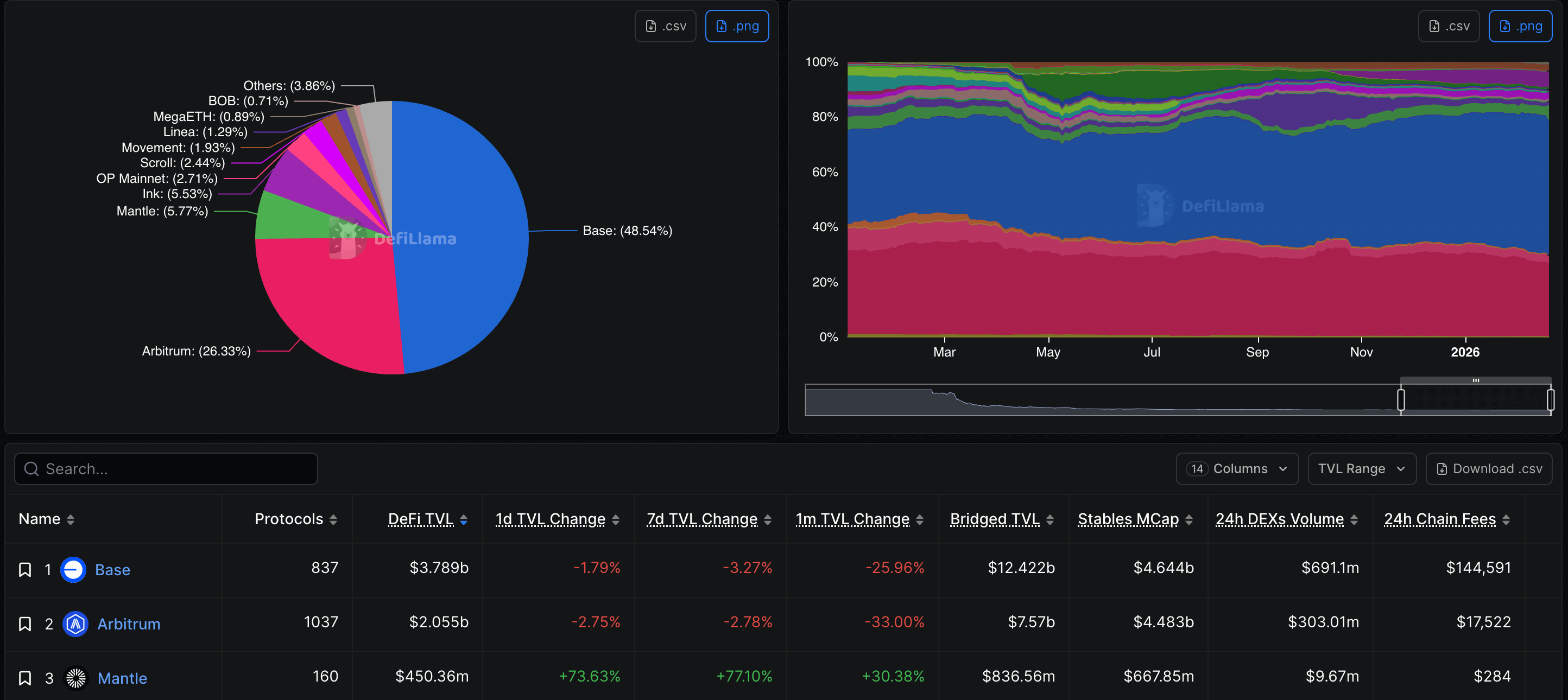
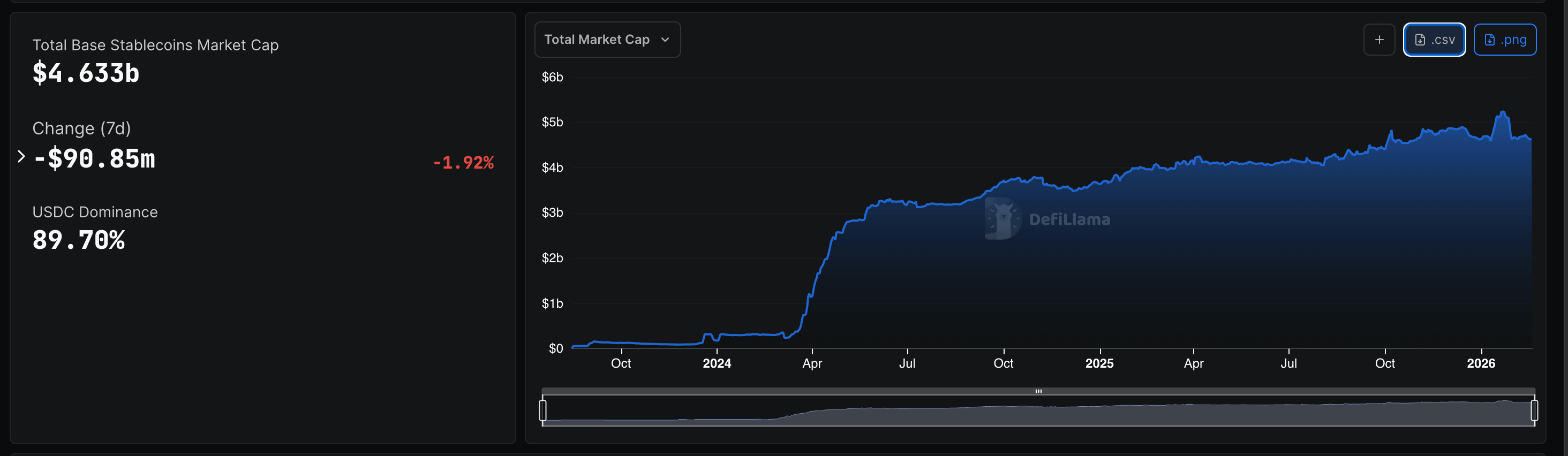
Base has become the dominant L2 production environment in 2026 — commanding 48.54% of all rollup TVL (nearly double Arbitrum’s 26.33%) and ranking as the #1 EVM chain by DeFi TVL after Ethereum, with $3.789B locked across 837 protocols and $4.644B in stablecoin market cap (DefiLlama, Feb 2026). As Base’s adoption across stablecoin platforms, DeFi protocols, and AI agent deployments grows, selecting among Base RPC providers is no longer a minor infrastructure choice — it’s a core architectural decision.
A note on Base’s evolving stack: Base has announced it is migrating from the OP Stack to its own unified stack — base/base — targeting a faster six-hard-fork-per-year cadence and a simpler, Base-specific codebase. The transition is rolling out over the coming months; all existing RPCs (including the
optimism_namespace) remain fully supported throughout. This guide focuses on present-day provider selection, which is still shaped by the current OP Stack architecture.
The starting point every production team should know: Base’s public RPC endpoints are explicitly rate-limited and marked “not for production” in the official documentation, making the choice of a third-party provider non-negotiable for any serious workload. Beyond that, Base’s current architecture introduces two infrastructure considerations that go beyond typical L1 or L2 thinking. First, OP Stack defines two distinct failure classes often misread as “RPC is down” — sequencer downtime (block height freezes, no new transactions) and transaction submission outages (sequencer runs but struggles to publish to L1, affecting safe/finalized status). A good RPC provider can’t fix these, but it can make incidents survivable. Second, Flashblocks — Base’s 200ms preconfirmation layer — has redefined what fast confirmation means on Base, and providers must support it correctly through both HTTP and WebSocket to be viable for time-critical applications.
In this benchmark, we compare the best Base RPC providers for 2026 across latency, uptime, throughput, pricing structure, and security posture — mapped to the three core use cases: stablecoin infrastructure, DeFi protocols, and AI agents. The comparison includes real benchmark data from Chainstack’s Compare Dashboard with method-level performance across EU, JP, and US West regions.
Base RPC providers comparison 2026
When evaluating Base RPC providers, teams should look beyond headline uptime claims and instead benchmark method-level performance, billing transparency, and Flashblocks implementation quality:
| # | Provider | Free Plan | Pricing Model | Uptime / SLA | Dev Experience | SOC 2 |
|---|---|---|---|---|---|---|
| 1 | Chainstack | 3M req/mo, ~25 RPS | Request Units (1 RU standard, 2 RU archive); | 99.99% formal SLA doc; 99.99%+ on Global/Dedicated lines | Dashboard metrics, IP/origin access rules, archive, testnet faucets, Chainbench, Compare Dashboard | Type II |
| 2 | Alchemy | 30M CUs/mo, ~25 RPS | Compute Units by method weight; PAYG + monthly | 99.99% uptime claimed during peak; SLA formally on Enterprise | Notify & Transact APIs, Mempool streaming, MEV protection, real-time analytics dashboard, SDK support | Type II |
| 3 | QuickNode | Trial only (10M credits) | API credits (method-weighted; e.g. eth_call = 20 credits on Base) | 99.99% guaranteed, formal SLA | Streams, Webhooks, OP-Node API, Trace API, marketplace add-ons (incl. DeFi integrations), team dashboards | Type II + ISO 27001 |
| 4 | dRPC | 210M CU/30 days (public nodes) | Flat-rate: 20 CU/request, $6 per 1M requests | High availability via multi-provider routing; no formal public SLA | Simple setup, OpenAI-compatible API, public status page, key control, front-end protection | No public SOC 2 |
| 5 | Ankr | 200M credits/mo, ~30 RPS | PAYG: $0.10 = 1M credits; EVM methods 200 credits flat | 99.99% uptime claimed; avg 56ms response time | Basic dashboard, multi-chain support (40+ chains, EVM + non-EVM), HTTPS & WebSocket, archive | Type I (Type II in progress) |
Choose the right Base RPC providers by use case
Different Base RPC providers perform differently depending on workload profile — stablecoin settlement, DeFi indexing, and AI-driven automation each stress infrastructure in distinct ways.
Stablecoin Settlement & Payment Infrastructure
Stablecoin platforms on Base run continuous, unforgiving pipelines — every payment, redemption, and treasury rebalance depends on infrastructure that simply doesn’t go down. Even brief outages cascade into failed settlements, reconciliation gaps, and user-facing errors that erode trust fast.
The Base-specific risk to plan for is sequencer downtime, which is distinct from an RPC provider failure. When it happens, transactions can’t be submitted through the normal path regardless of how good your provider is — so payment architectures need built-in grace periods and pause logic to handle it gracefully. On the upside, Flashblocks’ 200ms preconfirmations give stablecoin UIs faster transaction feedback than any other major L2, meaningfully improving the payment experience.
For this use case: prioritize providers with flat or request-unit billing (volume spikes shouldn’t surprise your finance team), stable WebSocket connections for real-time confirmation flows, and 99.99%+ uptime with multi-region failover.
DeFi Protocols
Base’s DeFi landscape is anchored by lending markets (Morpho, Aave), major DEXs (Aerodrome, Uniswap), and a growing derivatives layer — all of which place heavy, continuous read demands on RPC infrastructure. During volatility, every protocol queries simultaneously: positions checked, prices updated, liquidity rebalanced. Shared RPC endpoints degrade exactly when your protocol needs them most. Dedicated Nodes eliminate this risk — your infrastructure doesn’t share resources with anyone else, so response times stay consistent whether the market is quiet or in freefall. For lending protocols where stale data or a delayed liquidation has direct financial consequences, that consistency is a business requirement, not a performance optimization.
Beyond real-time performance, DeFi protocols need deep historical access for incident investigation, risk modeling, and compliance reporting. Archive data and transaction tracing should be part of your provider selection from day one, not an upgrade you retrofit after an incident.
For this use case: Dedicated Nodes for performance isolation during peak market conditions, archive access, and a provider with proven tail latency rather than just marketing averages.
AI Agents on Base
Base has become a primary home for onchain AI agents in 2026 — from Coinbase’s AgentKit-powered bots to autonomous DeFi strategies and LLM-orchestrated onchain workflows. Agent workloads expose two infrastructure problems that don’t show up in standard benchmarks: billing unpredictability and WebSocket reliability. Agents generate autonomous, bursty request patterns that are hard to forecast — credit-weighted pricing models can produce invoices that make agent economics unworkable, while a dropped event subscription means a missed liquidation or a failed keeper action.
Chainstack is purpose-built for this. Nodes are spec-compliant and expose standardized endpoints that any LLM can connect to out of the box — from OpenAI GPT and Anthropic Claude to Google Gemini, DeepSeek, and compact local models. MCP support ships in two forms: an RPC MCP server for all supported chains, and a Developer Portal MCP server so agents can autonomously ingest best practices and apply them to on-chain operations. For simulation-heavy agent architectures, full forking and call simulation is available out of the box. And the RU pricing model — 1 RU per standard call, 2 RU per archive or debug call — makes cost scaling predictable as agent volume grows, with no method-weight surprises.
For this use case: flat-rate or request-unit billing, high RPS headroom for burst windows, stable WebSocket infrastructure, and Flashblocks support.
In-depth Base RPC providers analysis
Below, we take a closer look at how individual Base RPC providers perform in real-world production environments, including latency consistency, scalability, and operational reliability.
Chainstack
What makes Chainstack stand out for Base is how much is available from the same console:
- Global Nodes for geo-balanced Base RPC access across US, EU, and APAC.
- Dedicated Nodes for isolated performance and full control over node configuration — worth it when tail latency consistency matters.
- Archive nodes for full historical data from genesis, including debug and trace queries.
- Unlimited Node add-on for flat monthly pricing with no request limits — useful for workloads with unpredictable burst windows.
- Base developer tooling with Base APIs, testnet faucet, and step-by-step development guides covering setup, deployment, and production best practices.
- MCP support for AI agent integrations — compatible with any LLM out of the box.
All of this adds up to a Base setup that covers nearly every use case. Whether you’re building stablecoin infrastructure, DeFi protocols, or AI agent backends, Chainstack gives you reliable performance, clear pricing, and infrastructure to scale with.
🤖 You can also access Chainstack Base RPC directly from Claude, Cursor, Codex, Gemini, or Windsurf using Chainstack MCP. Learn more about Chainstack MCP.
| Details | |
|---|---|
| Pricing | Developer — free, 3M req/mo (~25 RPS). Growth — $49/mo, 20M req (~250 RPS). Pro — $199/mo, 80M req (~400 RPS). Business — $499/mo, 200M req (~600 RPS). Enterprise — from $990/mo, 400M+ req, custom RPS. Unlimited Node add-on from $149/mo flat. Dedicated Nodes — $0.50/hr compute. Crypto payments accepted. |
| Billing model | Request Units: 1 RU per full node call, 2 RU per archive call. No method-weight multipliers. |
| Uptime / SLA | Formal SLA document: 99.99% minimum with service credits. Product positioning on Global/Dedicated lines: 99.99%+. Public status page available. |
| Security | SOC 2 Type II and ISO 27001 certified (achieved late 2025). Security materials accessible via security page. |
| Flashblocks | Supported on Base Mainnet and Sepolia. |
| Archive / debug | Full archive from genesis; debug and trace methods included on Dedicated. |
For enterprise: SOC 2 Type II and ISO 27001 artifacts are available, access controls are production-grade, and managed upgrades eliminate the OP Stack timestamp divergence risk. The distinction between the formal SLA document (99.99% minimum) and the product-level positioning (99.99%+) is worth noting for vendor risk documentation — both figures exist and serve different purposes.
Pros: Transparent RU billing, Flashblocks support, Unlimited Node add-on, full archive + debug/trace, SOC 2 Type II and ISO 27001, access controls, 70+ chains, crypto payments. Cons: Fixed RPS per tier (ultra-high-frequency apps may need Dedicated); free tier tight for indexers/bots; Dedicated Nodes require at least Pro plan; Ultra-high-frequency trading systems requiring custom node-level tuning may prefer fully self-hosted or bespoke infrastructure configurations.
Alchemy
Alchemy functions as a developer platform that extends well beyond raw RPC. For Base specifically, it is listed as an official node provider in Base documentation and publishes a Flashblocks quickstart covering pending block logic for key methods — reducing integration friction for teams adding preconfirmation to existing applications without changing API surface.
The platform’s strongest differentiation for DeFi workloads is tooling depth: Notify for event webhooks, Transact for private transaction submission, Mempool access for MEV-aware strategies, and real-time analytics dashboards. Teams building liquidation bots, MEV searchers, or event-driven settlement systems will find Alchemy’s extended APIs genuinely useful.
| Details | |
|---|---|
| Pricing | Free — 30M CUs/mo (~25 RPS). Pay-as-you-go — $5 per 11M CUs. Enterprise — custom with volume discounts. Different methods have different CU weights (heavier calls cost more). |
| Billing model | Compute Units: method-weighted. Bill depends on call composition, not just volume. Requires tracking method mix for accurate budget modeling. |
| Uptime / SLA | 99.99% uptime claimed during peak market conditions; global infrastructure with automatic failover. Formal SLA on Enterprise plans. |
| Security | SOC 2 Type II and ISO 27001 certified; public trust center available. |
| Flashblocks | Flashblocks API quickstart published; accessible through existing Alchemy Base RPC. |
| Archive / debug | Available; specifics depend on plan tier. |
On OP Stack and sequencer risk: Alchemy’s Flashblocks integration and rich dev tooling are strong, but sequencer risks don’t disappear at the RPC layer. Protocols using Alchemy should still design fallback logic and pause mechanisms for sequencer downtime — the infrastructure doesn’t abstract away OP Stack’s operational characteristics.
Pros: SOC 2 Type II and ISO 27001, Notify/Transact/Mempool APIs, MEV protection, Flashblocks quickstart, 40+ chains, rich analytics. Cons: CU pricing requires careful method-mix tracking; billing less predictable at scale than flat request models; very high RPS requires Enterprise plan; no Dedicated Node product in standard offerings.
QuickNode

QuickNode‘s Base infrastructure is among the most complete from an OP Stack-awareness perspective. Its documentation explicitly covers Flashblocks (“partial block updates every 200ms, up to 10× faster than the standard 2-second block”), Trace API, OP-Node API (for rollup-specific objects and diagnostics), and event streaming via Streams and Webhooks. For DeFi teams that need real-time data feeds as an architectural pattern rather than just request-response endpoints, QuickNode’s ecosystem is hard to match.
The platform handles enormous volume — 200B+ API calls/month across its network — and maintains a formally guaranteed 99.99% uptime SLA on paid plans, with dedicated clusters available for isolated enterprise workloads.
| Details | |
|---|---|
| Pricing | Build — $49/mo, 80M credits, 50 RPS. Accelerate — $249/mo, 450M credits, 125 RPS. Scale — $499/mo, 950M credits, 250 RPS. Business — $999/mo, 2B credits, 500 RPS. Enterprise — custom. Credits roll over. Note: eth_call on Base = 20 credits — method-weighting matters significantly for DeFi workloads. |
| Billing model | API credits, method-weighted. Call composition directly affects cost. |
| Uptime / SLA | 99.99% formally guaranteed on paid plans; enterprise SLA available. |
| Security | SOC 2 Type II + SOC 1 Type 2 + ISO 27001. |
| Flashblocks | Full documentation with examples; supported natively. |
| OP Stack-specific | OP-Node API, Trace API, Flashblocks docs all available. |
For DeFi teams specifically: the method-weighted credit model means eth_call and eth_getLogs — the two methods that typically dominate DeFi workloads — consume credits faster. Benchmarking your actual call composition against the credit pricing table before committing to a plan is strongly recommended.
Pros: 99.99% formal SLA, SOC 2 Type II + ISO 27001, Flashblocks, OP-Node API, Trace API, Streams/Webhooks, 500+ RPS at scale, archive access. Cons: No free tier (trial only); method-weighted credits make long-term cost modeling complex; no flat-rate unlimited option for burst-heavy workloads.
dRPC
dRPC takes a different architectural approach: rather than running its own node infrastructure, it aggregates across 40+ providers in 9 geoclusters, routing traffic intelligently to optimize availability and performance. Base mainnet and Sepolia are available, and Base’s official documentation highlights dRPC’s smart routing, analytics, key control, and front-end protection as specific differentiators.
The most significant development for cost planning: in 2025, dRPC moved to flat-rate method pricing — 20 CU per request regardless of method, at $6 per 1M requests. This eliminates the “pricing trap” that makes debug_traceTransaction and eth_getLogs expensive surprises in credit-weighted models. For DeFi teams doing heavy log queries or trace-based analytics, this is a meaningful advantage.
| Details | |
|---|---|
| Pricing | Free — 210M CU/30 days (public nodes only). Paid — PAYG with deposit, flat-rate: 20 CU per request, $6 per 1M requests. Private endpoints and additional features (fallback, verification) on paid tier. “Go unlimited” option available. |
| Billing model | Flat-rate per request — no method-weight multipliers. Predictable cost regardless of call composition. |
| Uptime / SLA | High availability through multi-provider routing. Public status page available (Base mainnet and Sepolia listed as components). No formal published SLA. |
| Security | No publicly documented SOC 2 certification at time of writing. |
| Flashblocks | Available through aggregated Base endpoints. |
| Multi-provider routing | Reduces risk from individual upstream provider degradation — but does not eliminate OP Stack L2 failure classes (sequencer downtime, L1 publication issues). |
Important nuance on reliability: dRPC’s aggregation reduces the risk of a single upstream provider degrading your service, but this is distinct from L2-level reliability. Sequencer downtime and safe/finalized discrepancies are OP Stack characteristics that exist at a layer above any RPC provider’s routing logic. The correct framing: dRPC reduces upstream-provider risk, not L2 protocol risk.
Pros: Flat-rate pricing (no method surprises), most generous free tier, multi-provider redundancy, public status page, no vendor lock-in. Cons: No formal SLA; no SOC 2 certification; enterprise compliance features depend on specific contract terms; performance consistency varies across distributed provider network.
Ankr
Ankr provides Base access through a globally distributed network spanning 800+ nodes across 12 countries on 5 continents, with Base mainnet and Sepolia available over HTTPS and WebSocket. The platform publishes specific performance metrics: average response time 56ms, 99.99% uptime, 2.5B+ daily API requests across the network — a level of public performance transparency that’s rare in this space.
For multi-chain teams adding Base to an existing stack that already includes other EVM and non-EVM networks, Ankr’s breadth (40+ chains) and consistent API surface lower the integration overhead compared to managing separate providers per chain.
| Details | |
|---|---|
| Pricing | Free — 200M credits/mo (~30 RPS). Premium — PAYG at $0.10 per 1M credits; EVM methods flat at 200 API credits each. Enterprise — custom SLA, region orchestration, dedicated infrastructure. |
| Billing model | API credits; EVM methods uniformly 200 credits (simpler than variable CU weights, but still credit-based). |
| Uptime / SLA | 99.99% uptime and 56ms avg response time publicly stated. Enterprise plan includes custom SLA. |
| Security | SOC 2 Type I certified (Asphere entity). SOC 2 Type II and ISO 27001 reported as near completion — verify current trust center status before using in vendor risk documentation. |
| Flashblocks | Available through Base endpoint. |
| Archive | Full and archive access available. |
On SOC 2 status: Ankr’s enterprise entity (Asphere) holds SOC 2 Type I. Type II has been described as nearly complete. For enterprise vendor risk documentation, confirm current certification status directly with Ankr’s trust center rather than relying on this article — the status may have updated since publication.
Pros: 200M free credits/mo, publicly stated performance metrics (56ms / 99.99%), HTTP + WSS + archive, 40+ chains including non-EVM, flexible PAYG. Cons: SOC 2 Type II and ISO 27001 not yet confirmed (verify current status); advanced analytics/support gated to paid; performance can vary across distributed nodes; no flat-rate unlimited option.
Real-world performance benchmark on Base
Provider scores (lower is better)
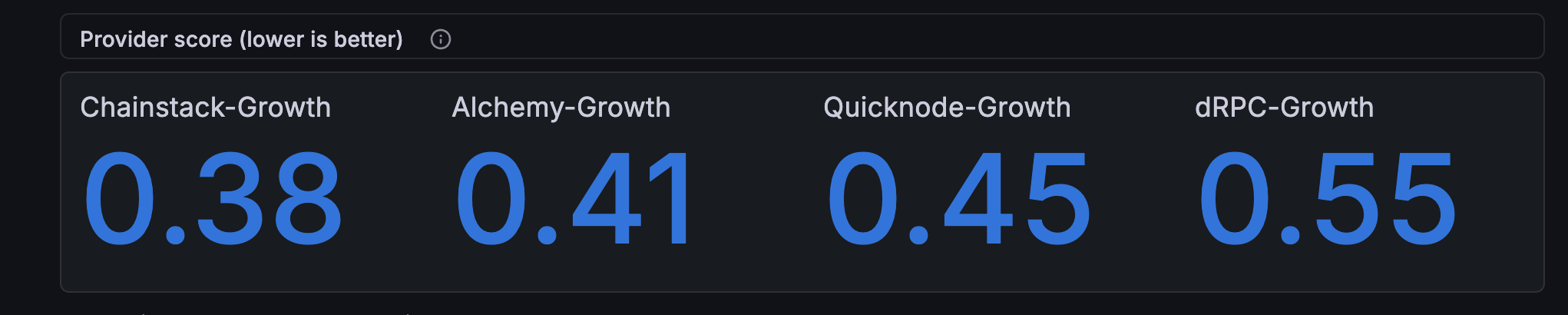
Metrics collected included average response latency and request success rate per method. All providers were tested within the same 30-minute timeframe to ensure comparable network conditions.
Performance metrics may vary depending on network congestion, market volatility, regional traffic spikes, and provider-side scaling events. The results reflect relative performance during the measured window rather than absolute guarantees under all conditions.
Dedicated and Enterprise-tier infrastructure were not included in this benchmark.
Response time by API method — key findings
The method-level breakdown reveals differences that matter significantly for Base production workloads:
eth_getLogs— QuickNode showed substantially higher response times (~1.5–2s range) compared to Chainstack, Alchemy, and dRPC on this method. For DeFi protocols where log scanning is a core operation (event indexing, liquidation triggers, settlement confirmation), this gap is operationally significant.eth_subscribe— dRPC showed the highest latency on WebSocket subscriptions (~2s), which matters for any application relying on real-time event streams rather than polling.eth_call,eth_getBalance,eth_blockNumber— All providers performed comparably on these lighter methods, with differences in the sub-100ms range.debug_traceTransaction,debug_traceBlockByNumber— Chainstack and Alchemy led on trace methods, relevant for DeFi incident analysis and compliance workflows.
What this means by use case
- For stablecoin and payment flows — dominated by
eth_call(balance checks) andeth_getTransactionReceipt(confirmation) — all four providers perform comparably. The overall score difference between Chainstack (0.38) and Alchemy (0.40) is minimal at this method profile. - For DeFi protocols — where
eth_getLogsandeth_subscribedrive a significant portion of traffic — Chainstack and Alchemy pull ahead meaningfully. QuickNode’seth_getLogslatency and dRPC’seth_subscribelatency are worth testing against your specific workload before committing. - For archive and trace-heavy workloads (analytics, incident response, compliance reporting) — Chainstack’s advantage on debug/trace methods is consistent across regions.
These results illustrate how Base RPC providers diverge under real production method mixes rather than synthetic single-method testing.
Methodology note: Scores reflect growth-tier plan benchmarks across EU, JP, and US West. Enterprise or Dedicated tier performance will differ — dedicated infrastructure typically shows lower tail latency and more consistent p95/p99 than shared endpoints. Run provider-specific benchmarks using the Chainstack Compare Dashboard against your actual method mix before finalizing infrastructure decisions.
Top 5 Base RPC providers 2026
No single provider is universally optimal for every Base workload. The right choice depends on your method mix, latency sensitivity, compliance requirements, and cost predictability needs. The ranking below reflects production-readiness for stablecoin, DeFi, and AI agents environments specifically — not general developer experimentation or trial usage.
🥇 1. Chainstack — For teams prioritizing predictable request-based billing, Dedicated infrastructure, Flashblocks support, full archive + debug/trace access, MCP support for AI agents, and managed upgrades. The most complete infrastructure for stablecoin platforms, DeFi protocols, and AI agent backends that can’t afford surprise billing or unplanned downtime.
🥈 2. Alchemy — Best for DeFi developer tooling. Notify, Transact, and Mempool APIs are purpose-built for event-driven DeFi architecture. Flashblocks quickstart lowers integration friction. SOC 2 Type II and ISO 27001 covers enterprise compliance needs.
🥉 3. QuickNode — Best for high-throughput OP Stack-aware applications. The most comprehensive Flashblocks and OP-Node API documentation, 99.99% formal SLA, SOC 2 Type II + ISO 27001. Strong choice for trading bots, keeper networks, and Streams-based architectures.
🏅 4. dRPC — Best for cost-optimized high-volume workloads. Flat-rate pricing ($6/1M requests, 20 CU regardless of method) removes cost uncertainty from heavy eth_getLogs and trace workloads. Most generous free tier. Multi-provider routing improves upstream resilience.
🏅 5. Ankr — Best multi-chain entry point for Base. Publicly stated 56ms average response time and 99.99% uptime, 200M free credits, and consistent API surface across 40+ chains. Right for teams adding Base to an existing multi-chain stack.
Conclusion: choosing the right Base RPC providers
For Base in 2026, choosing between Base RPC providers means selecting the infrastructure layer that will quietly determine your system’s reliability, cost predictability, and upgrade resilience.
Base’s dominance as the leading L2 (48.54% of rollup TVL, #1 EVM chain after Ethereum) means the stakes for infrastructure decisions are higher than ever. Stablecoin platforms need WSS stability and sequencer monitoring. DeFi protocols need tail latency control and honest cost modeling under peak load. AI agents need flat-rate billing, high RPS headroom for burst windows, and stable WebSocket connections for event-driven execution.
Chainstack covers all three — predictable request-unit pricing, SOC 2 Type II and ISO 27001, full archive and debug access, Flashblocks support, and managed infrastructure that handles Base upgrades on your behalf. For teams where Base infrastructure is foundational rather than incidental, it’s the most complete option in 2026.
FAQ
Base explicitly marks its public endpoints as rate-limited and not suitable for production workloads. The official Base documentation recommends using partner node providers or self-hosting for any application requiring consistent performance. This is the starting point, not a footnote.
Flashblocks is Base’s preconfirmation mechanism, delivering partial block updates every 200ms versus the standard ~2-second block time. For stablecoin confirmation flows, DEX interfaces, and any time-critical UX, Flashblocks support at the RPC/WSS level is now a baseline requirement, not an optional feature. Verify that your chosen provider explicitly supports Flashblocks on Base mainnet.
The sequencer going down looks like a frozen block height — users cannot submit transactions through the standard path. This is not an RPC provider failure. Well-architected applications detect this condition and enter a grace period or pause state. An RPC provider can help by maintaining stable reads and correct WSS behavior during the incident, but cannot route around the sequencer.
OP Stack upgrades activate at hard timestamps. Self-hosted nodes and unmanaged infrastructure that miss the window diverge from the canonical chain and require resync. Managed RPC providers coordinate upgrades and eliminate this risk. For enterprise teams and any production system where unplanned downtime is unacceptable, this is a concrete operational argument for managed infrastructure.
For DeFi workloads dominated by eth_getLogs, eth_call, and trace methods, method-weighted credit models (Alchemy, QuickNode, Ankr) make cost modeling complex because heavier methods consume credits faster. Chainstack’s request-unit model (1 RU per call) and dRPC’s flat-rate model ($6/1M, 20 CU regardless of method) are the most predictable for mixed or trace-heavy workloads.
1. Log in to your Chainstack account (or create one if you don’t have it yet).
2. Create a new project or select an existing one.
3. Choose Base Mainnet or Base Sepolia Testnet.
4. Deploy a node with RPC access and copy the HTTP or WebSocket endpoint into your app.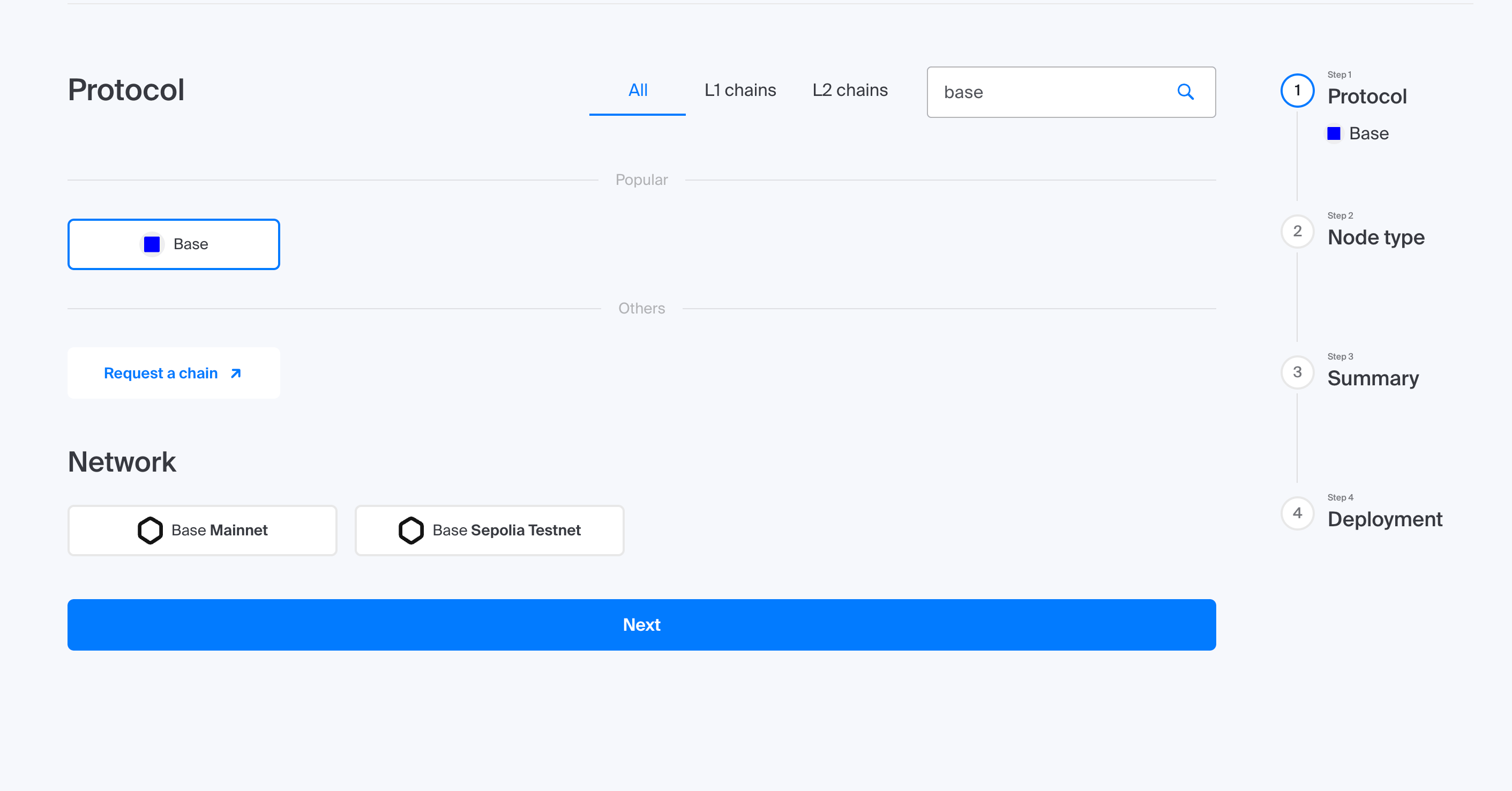
Need testnet ETH to get started? Chainstack’s built-in Base Sepolia faucet lets you fund a test wallet directly from our website — no third-party tools required.
Related Reading