


Setting up a reliable RPC node endpoint determines whether your Web3 applications perform well or fail under pressure.
Whether you’re developing trading bots, Web3 wallets, or blockchain analytics tools, RPC nodes can make or break application performance and user experience.
Chainstack offers managed solutions for top RPC providers, but the difference between a stable RPC setup and one that crashes comes down to five implementation factors. These factors cover everything from node access rules to performance settings. Getting them right helps you configure node endpoints that work when you need them to.

Rate limits and access rules
Probably the most essential thing to consider when setting up an RPC node infrastructure is how to prevent abuse by shaping traffic flow and ensuring fair resource allocation among all users.
Without proper control over request volume, your node endpoint will be inundated with too many requests, and performance may decline severely or even stop altogether.
Key implementation strategies
- Rate limits per IP: Cuts down on the resource usage of some IP addresses so that no single user can dominate all your resources.
- Limits unique to methods: RPC methods are not all equally complex and require varying amounts of computing power. Set thresholds on operations of maximum cost, for example
eth_getLogsoreth_trace_ *. - Tolerated increases, short packet lengths: Configure burst limits to handle legitimate traffic that causes momentary increases in traffic volumes, while maintaining overall traffic stability. Switch the setting in Billing -> Settings section (Pay-As-You-Go budgeting). Whether you can do so depends on whether this feature is enabled or disabled by default in your pay-as-you-go account from the Chainstack Console.
- Handling gracefully: Align the queue systems with processes such as backoff and other means to gently shift people, rather than pushing them away forcefully.
It’s worth considering whether tools such as Nginx with rate-limiting modules in place or an API gateway that can handle various rate-limiting scenarios will fit your circumstances.
Security measures
Production environments need rate limiters at multiple levels: network, application, and database. Most major RPC providers already have advanced rate-limiting built in, which gives you a good baseline to work from.
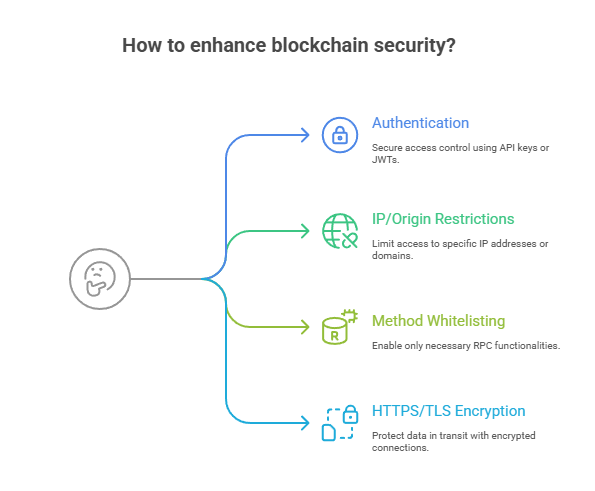
Security problems with RPC endpoints happen more than people think. A compromised RPC node can cause service outages, data breaches, and financial losses.
Essential security measures to keep an eye out for:
- Authentication and authorization: Use API keys, JWTs, or similar methods to control access to your endpoints.
- IP and origin restrictions: In the Chainstack Console, go to the Security tab in your node details to set up IP address or domain restrictions. This limits which sources can hit your endpoints.
- Method whitelisting: Make sure to only enable the RPC methods your application needs. Turn off administrative or potentially dangerous functions.
- HTTPS/TLS encryption: Use encrypted connections to protect data in transit.
Having regular security audits and hacked Pentesting should be part of your routine maintenance. On top, consider setting up Web Application Firewall (WAF) rules specifically for blockchain RPC endpoints to filter out malicious requests.

Performance optimization and caching
RPC performance directly links to application responsiveness and user satisfaction. Implementing effective caching mechanisms and operational optimizations typically reduces latency significantly while increasing transaction throughput.
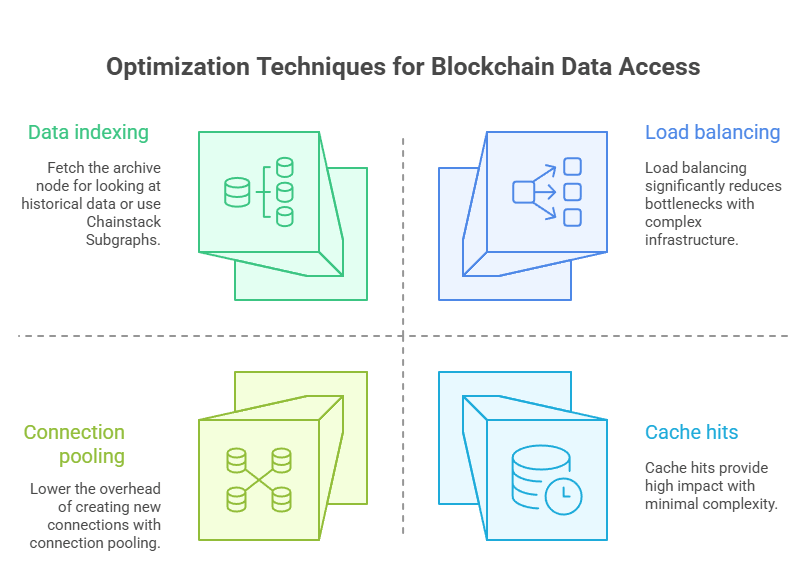
Optimization techniques to consider:
- Cache hits for CRUD operations: Build your cache around data unique identifiers to store the most frequently requested information. This works for both large and small requests across multiple instances.
- Connection pooling: Lower the overhead of creating new connections with connection pooling.
- Load balancing: Distribute requests across node instances so that the chances of a bottleneck are greatly reduced. For example, Chainstack Global Node features a globally balanced infrastructure, which automatically selects the closest instance to handle your request.
- Database indexing: Proper indexing of data from the blockchain can be a big help for query performance. Fetch the archive node for looking at historical data, and use Chainstack Subgraph for quick access where the info you want is indexed.
- Compression: Enable response compression to cut bandwidth usage and speed up responses. Multi-tier caching with Redis or Memcached for hot data and separate archival storage works well here. Monitor cache hit ratios and adjust TTL values based on your specific access patterns.

Monitoring and observability
RPC services break in production. Monitoring helps you catch issues before they become outages and people start complaining.
What you need to monitor:
- Performance tracking: Response times, throughput, error rates, and server resources like CPU and memory usage.
- Blockchain specifics: Sync status, peer connections, chain reorgs. If your node falls behind or loses peers, requests start failing.
- Security monitoring: Set up alarms for strange user behavior patterns, failed authentication attempts, or abnormal levels of demand.
- System health: Monitor server memory usage, network connectivity, and database performance. You can also check the Chainstack Status page for service updates and maintenance schedules.
- SLA compliance: Track service availability, uptime, and performance against your defined service levels.
Prometheus works well for metric collection, with Grafana handling visualization. For immediate alerts when things go wrong, integrate with Slack or PagerDuty. Distributed tracing gives you end-to-end visibility across your entire operation, so you can see exactly where requests are getting stuck or failing.
High availability and disaster recovery
The blockchain RPC infrastructure must be super-reliable. The value of many Blockchain applications will make downtime costly and will seriously affect user trust.
Available strategies:
- Deploy nodes in multiple geographical locations. Chainstack Trader and Dedicated Nodes are examples of how to build redundancy into an application. Global Node handles geographic routing automatically if you prefer a simpler setup.
- Set up health checks that detect node failures and automatically route traffic to healthy instances.
- Configure automatic failover with minimal service interruption.
Disaster recovery planning:
- Document your recovery procedures for different failure scenarios and test them regularly.
- Keep runbooks updated for common problems like node crashes or network issues.
- Verify your backups automatically to make sure they actually work when you need them.
- Consider managed blockchain services as backup infrastructure.
- Plan for different disaster types: hardware failures, network outages, or blockchain software bugs that mess up your data.
Conclusion
Getting your RPC node production ready means attending to these five crucial areas. Every step builds on the next until it forms an environment that is robust, secure, and high-performance, and can support large-scale Web3 applications.
Whether you are creating your own RPC infrastructure or considering offerings from major RPC vendors such as Chainstack, remember that it’s essential to be attentive about maintaining it long after installation.
Begin with these basic principles, but do not end here. As your applications grow and as requirements change, continue to refine and improve your RPC infrastructure. Investing in proper setup and maintenance will repay the time and effort costs with reliability for your users, as well as efficient operation.
Further Reading
- Tips to handle RPC request errors: Ready-to-use code patterns for handling errors, retries, and provider switching.
- Unmasking DApp endpoint security: The Chainstack research results: Our analysis of 8,000 DApps shows which practices are putting projects at risk.
Power-boost your project on Chainstack
- Discover how you can save thousands in infra costs every month with our unbeatable pricing on the most complete Web3 development platform.
- Input your workload and see how affordable Chainstack is compared to other RPC providers.
- Connect to Ethereum, Solana, BNB Smart Chain, Polygon, Arbitrum, Base, Hyperliquid, Robinhood Chain, Arc, Tempo, MegaETH, Monad, Plasma, Avalanche, Optimism, Aptos, Cronos, Gnosis Chain, Moonbeam, Celo, Aurora, TON, Ronin, and Bitcoin mainnet or testnets through an interface designed to help you get the job done.
- Fast access to blockchain archive data and gRPC streaming on Solana.
- To learn more about Chainstack, visit our Developer Portal or join our Telegram group.
- Connect your AI agent to Chainstack in seconds using Chainstack MCP — give Claude, Cursor, Codex, Gemini, and Windsurf live access to blockchain data, node management, and docs.
- Are you in need of testnet tokens? Request some from our faucets. Sepolia faucet, Base Sepolia faucet, Solana devnet faucet, Hoodi faucet, BNB faucet, zkSync faucet, Robinhood Chain faucet, Hyperliquid faucet, Monad faucet, Amoy faucet, Plasma faucet, TON faucet.
Have you already explored what you can achieve with Chainstack? Get started for free today.