


Introduction
TRON processes over $20 billion in daily stablecoin transfer volume across more than 7 million transactions per day. With $86 billion in circulating USDT, 373 million total accounts, and roughly 31% of global stablecoin supply sitting on the network, TRON is the second-largest blockchain by stablecoin market cap (behind Ethereum) and ranks among the top three chains by DeFi TVL (DefiLlama, TRONSCAN).

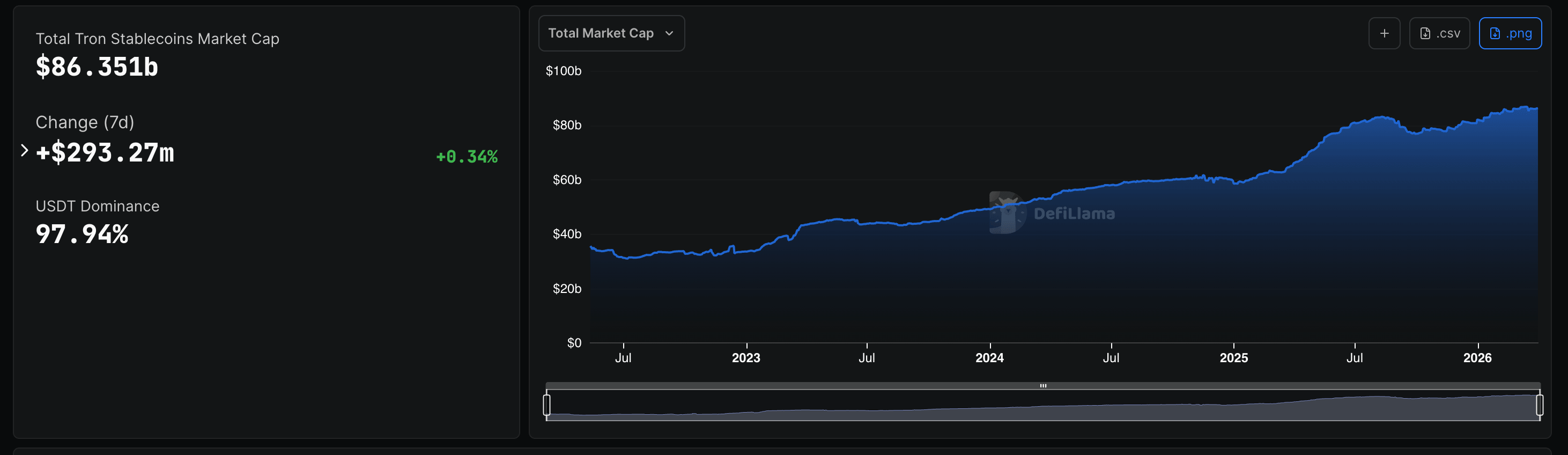
This isn’t speculative activity — the average TRON stablecoin transaction is around $6,400, consistent with commerce, remittances, and exchange settlement rather than trading (Arkham TRON Stablecoin Ecosystem Report, Jan 2026).
For developers and infrastructure teams, this usage profile means one thing: the RPC node provider you choose for TRON is stablecoin infrastructure. It determines whether your payment processor, such as NOWPayments, handles volume spikes, whether your exchange backend confirms transfers in time, and whether your analytics pipeline keeps up with 7 million daily transactions without falling behind.
TRON’s public endpoints aren’t built for this. TronGrid’s free tier caps at 15 QPS with an API key and throttles harder without one. For any production workload — payment systems, wallets serving millions of users, data indexing at scale — third-party RPC infrastructure is a core dependency, not an optional upgrade.
This guide compares the best TRON RPC providers in 2026 across performance, pricing, protocol support, and enterprise readiness, mapped to the use cases that actually drive TRON adoption.
TRON infrastructure specifics
TRON’s infrastructure differs from a typical EVM chain in ways that directly affect provider selection. Understanding these differences helps you evaluate which provider features matter for your specific workload.
API access: four interfaces, different trade-offs
TRON exposes four distinct API interfaces. Most third-party providers support only a subset — knowing which ones your workload requires narrows the field immediately.
/wallet— the native TRON HTTP API for full node operations including transaction creation and broadcast. Methods likebroadcastTransaction,getAccount, andtriggerSmartContractlive here. This is what TronWeb.js connects to by default./walletsolidity— confirmed-only data from the solidity node namespace. Useful when your application needs to read only finalized state (payment confirmation flows, balance verification)./jsonrpc— limited Ethereum-compatible JSON-RPC for read operations. Helpful if you have existing EVM tooling, but write methods (eth_sendRawTransaction,eth_getTransactionCount) are not available. Hardhat and Foundry can compile and test against this interface, but contract deployment and transaction submission require TronWeb through/wallet.
gRPC — TRON’s high-performance binary protocol using HTTP/2 and Protocol Buffers. For exchange backends, data indexing pipelines, and any integration making thousands of calls per second, gRPC can meaningfully reduce serialization overhead versus JSON-RPC — check current benchmarks for your workload — and eliminates connection overhead through HTTP/2 multiplexing. Not all RPC providers expose TRON gRPC — this is one of the most meaningful differentiators in provider selection.
For a detailed walkthrough of each interface with code examples across Python, Go, and JavaScript, Chainstack’s TRON tooling guide covers setup, proto file generation for gRPC, and integration patterns for TronWeb.js, web3.py, and Hardhat hybrid workflows.
Throughput, fees, and the resource model
TRON’s DPoS consensus produces blocks every 3 seconds via 27 Super Representatives, supporting 2,000+ TPS with 100% mainnet uptime since 2018 (TRONSCAN). Transaction costs use a bandwidth-and-energy model instead of conventional gas — TRC-20 transfers can cost fractions of a cent when a sender has staked TRX for resources. This is the primary reason payment processors and exchanges prefer TRON for stablecoin settlement.
The resource model also creates an operational layer that most EVM developers don’t encounter. High-volume USDT transfer operations require managing energy delegation, bandwidth staking, and resource allocation across wallets. Chainstack’s guide on mastering energy and bandwidth with Python walks through programmatic resource management — a practical concern for any team running production payment infrastructure on TRON.
Stablecoin concentration and what it means for RPC

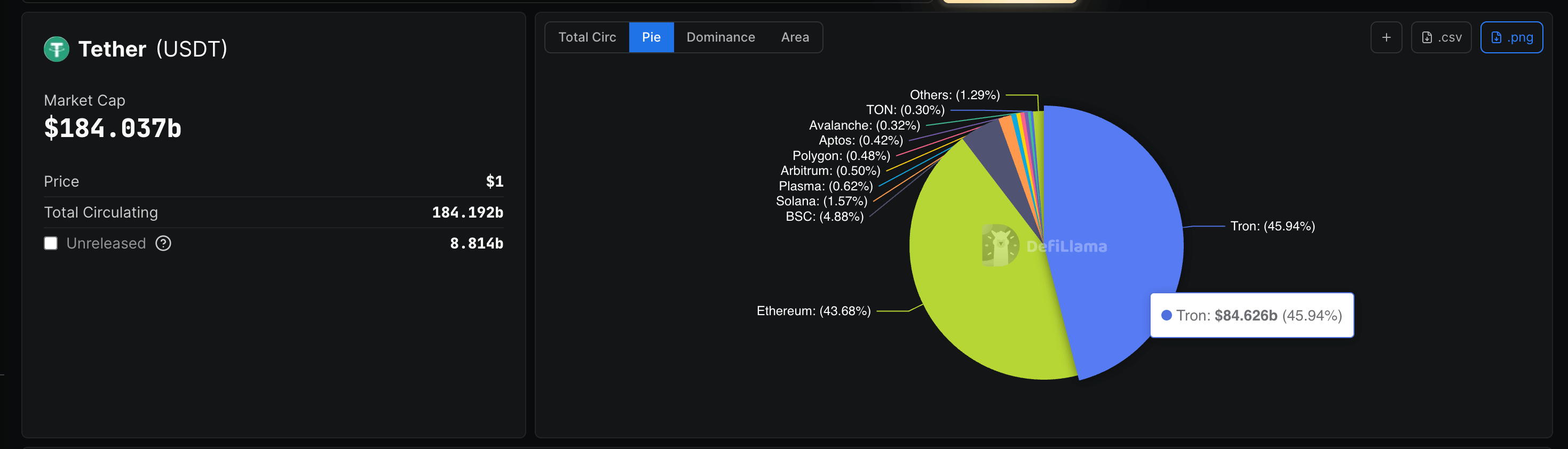
USDT (TRC-20) accounts for approximately 98% of stablecoins on TRON (DefiLlama). The network handles more USDT transfer volume than any other chain. In practice, this means your TRON RPC infrastructure is a USDT settlement pipeline. Provider evaluation should focus on how well the endpoint handles continuous triggerSmartContract calls against the USDT contract, how quickly /walletsolidity reflects confirmed state, and whether throughput holds during the volume surges that follow market volatility.
WebSocket and event access
Unlike EVM chains where eth_subscribe over WebSocket is standard, TRON nodes do not currently support WebSocket connections for event subscriptions. Event data is accessed through polling the /event API or provider-specific indexing services. If your application requires real-time notification of new USDT transfers or contract events, plan for polling logic or evaluate providers with event indexing layers.
TRON RPC providers comparison 2026
Table 1: Overview — pricing, positioning, and free tiers
| # | Provider | Best for | Free plan | Effective cost per 1M requests | Billing predictability |
|---|---|---|---|---|---|
| 1 | Chainstack | Enterprise, stablecoin infra, gRPC-dependent workloads | 3M req/mo, ~25 RPS | ~$10–20 (varies by plan tier) | High — 1 RU per call, no method weighting |
| 2 | TronGrid | Development, TRON-native event indexing | 100K req/day, 15 QPS | Free (within daily cap) / opaque custom | Low — daily caps, throttling penalties |
| 3 | Ankr | Multi-chain development, archive access on free tier | 200M credits/mo, ~30 RPS | ~$20 (at 200 credits/call) | Medium — per-method weighting inflates costs |
| 4 | dRPC | Cost-optimized high-volume workloads, failover endpoint | Free tier (public nodes) | $6 flat | High — 20 CU per call regardless of method |
| 5 | Quicknode | Multi-chain teams needing formal SLA + compliance | Trial only | Varies by method mix | Medium — requires method-mix modeling |
The table above covers pricing and positioning. The next table compares protocol support, data access, and compliance — the factors that typically determine the final provider decision for production workloads.
Table 2: Technical capabilities — protocol support, data access, and compliance
| # | Provider | gRPC support | Archive data | Uptime / SLA | SOC 2 | WebSocket events |
|---|---|---|---|---|---|---|
| 1 | Chainstack | Yes (Mainnet + Nile Testnet) | Full nodes (non-archive) | 99.99% formal SLA with service credits | Type II | Not supported (TRON limitation) |
| 2 | TronGrid | Yes (native TRON gRPC) | Limited | No formal public SLA | No public SOC 2 | Not supported (TRON limitation) |
| 3 | Ankr | Listed in docs | Full and archive on Premium | 99.99% claimed | Type I (Type II in progress) | Not supported (TRON limitation) |
| 4 | dRPC | No public TRON gRPC | Depends on upstream providers | Multi-provider routing; no formal SLA | No public SOC 2 | Not supported (TRON limitation) |
| 5 | Quicknode | No public TRON gRPC | Available on paid plans | 99.99% formal SLA | Type II + ISO 27001 | Not supported (TRON limitation) |
Reading the tables
- gRPC is a real differentiator. Chainstack launched TRON gRPC support for Mainnet and Nile Testnet in January 2026. TronGrid offers gRPC natively. Most other third-party providers don’t expose it for TRON — for exchange backends and data pipelines, this narrows the field.
- Archive availability varies. Chainstack currently offers TRON full nodes (non-archive), meaning some deep-history methods are unsupported. If your workload requires historical state queries at arbitrary block heights, confirm archive support explicitly before committing.
- Pricing models diverge. Chainstack’s 1 RU per call (regardless of method) and dRPC’s flat 20 CU per request are the most predictable. Ankr’s credit model applies per-method weighting that inflates effective costs. TronGrid’s free tier is daily-capped and rate-limited — functional for development but not for production.
Best TRON RPC providers: in-depth analysis
Chainstack

Chainstack is the only third-party provider that supports all four TRON API interfaces — /jsonrpc, /wallet, /walletsolidity, and gRPC — from a single endpoint. That coverage matters because TRON workloads typically span multiple namespaces: /wallet for transaction broadcast, /walletsolidity for confirmed state reads, and gRPC for high-throughput data access. Having all of them behind one provider with unified billing eliminates the complexity of routing different call types through different services.
The gRPC addition (January 2026, Mainnet and Nile Testnet) is the standout feature for enterprise and exchange teams. Chainstack’s TRON tooling documentation includes proto file setup, client code generation for Python and Go, and authenticated gRPC call examples — reducing integration time from days to hours.
Beyond protocol support, Chainstack’s infrastructure options cover the spectrum: Global Nodes for geo-balanced routing across US, EU, and APAC; Dedicated Nodes for isolated compute when tail latency consistency matters (payment settlement windows, exchange hot wallet operations); and the Unlimited Node add-on for flat monthly pricing with no request limits during unpredictable burst windows. The full TRON API reference covers every supported method across all four interfaces.
For teams evaluating whether to use public or private TRON RPC — and what the practical differences look like in production — Chainstack’s article on how to get a TRON RPC node breaks down the trade-offs between free public endpoints, managed private nodes, and self-hosted infrastructure.
🤖 You can also access Chainstack TRON RPC directly from Claude, Cursor, Codex, Windsurf, Gemini CLI, GitHub Copilot, Antigravity, Claude.ai, or ChatGPT using Chainstack MCP. Learn more about Chainstack MCP.
| Details | |
|---|---|
| Pricing | Developer — free, 3M req/mo (~25 RPS). Growth — $49/mo, 20M req (~250 RPS). Business — $499/mo, 200M req (~600 RPS). Enterprise — from $990/mo, 400M+ req, custom RPS. Dedicated Nodes — $0.50/hr compute. Crypto payments accepted. |
| Billing model | Request Units: 1 RU per full node call. No method-weight multipliers. |
| gRPC | Supported on TRON Mainnet and Nile Testnet. Requires proto files from the official TRON protocol repository. |
| Archive data | Full nodes (non-archive). Some deep-history methods unavailable. |
| Uptime / SLA | Formal SLA: 99.99% minimum with service credits. Global/Dedicated positioning: 99.99%+. |
| Security | SOC 2 Type II and ISO 27001. IP and origin access rules for endpoint protection. |
For enterprise teams: SOC 2 Type II and ISO 27001 artifacts are available for vendor risk assessments. The distinction between the formal SLA (99.99%) and product-level positioning (99.99%+) is worth noting for procurement documentation — both figures exist and serve different purposes.
Pros: Full TRON API coverage (all four interfaces), gRPC support, transparent RU billing, Dedicated Node isolation, SOC 2 Type II and ISO 27001, 70+ chain support, access controls, MCP server support for AI agent integrations. Cons: TRON nodes are full only (non-archive); WebSocket event subscriptions not supported (TRON protocol limitation); free tier is tight for production indexing; Dedicated Nodes require at least Business plan.
TronGrid

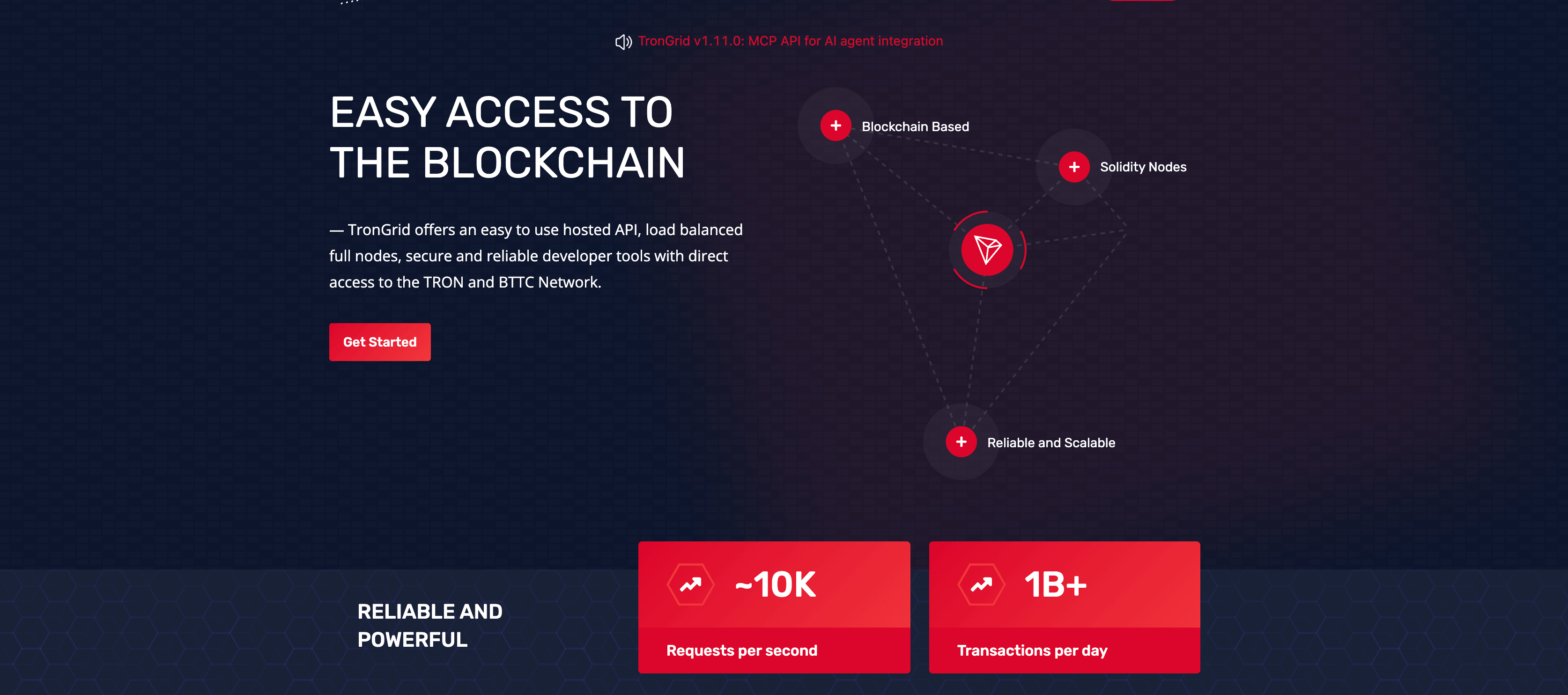
TronGrid is the official TRON Foundation infrastructure and the default endpoint bundled with TronWeb.js. It’s where most developers start, and for good reason — TronGrid exposes the complete native API surface including gRPC (port 50051 for Full Node, 50061 for Solidity) and a PostgreSQL-backed event indexing layer that no generic RPC provider fully replicates.
The event API is TronGrid’s unique strength. Contract event queries, transaction monitoring by address, and time-range event filtering are purpose-built for TRON and provide capabilities that teams otherwise need to build themselves or source from a separate indexer.
The trade-offs are rate limits and enterprise readiness. The free tier caps at 100K requests/day with 15 QPS — enough for development, not for production. Penalty mechanics are aggressive: exceeding limits triggers a 30-second access block returning 403 errors. Custom plans exist but require direct engagement with the TRON Foundation, and there is no published SLA or SOC 2 certification.
| Details | |
|---|---|
| Pricing | Free: 100K req/day, 3 API keys, 15 QPS. Custom: contact TRON Foundation. |
| Billing model | Daily request quotas. Overage triggers throttling, not billing. |
| gRPC | Native support (port 50051 / 50061). |
| Archive data | Limited. Event indexing covers historical events; full archive state not publicly documented. |
| Uptime / SLA | No formal public SLA. |
| Security | No public SOC 2. API key authentication only. |
Pros: Official TRON infrastructure, native gRPC, purpose-built event indexing, deep TronWeb.js integration, comprehensive API docs. Cons: 15 QPS ceiling, aggressive throttling penalties, no formal SLA, no SOC 2, TRON-only, opaque custom pricing.
For teams evaluating TronGrid alternatives with higher throughput, formal SLAs, and enterprise compliance, the remaining providers in this comparison address those gaps
Ankr

Ankr’s value proposition for TRON is breadth — 80+ networks on Premium, archive data on all tiers, and a 200-million-credit free tier that’s genuinely useful for development and testing. The platform spans 30+ global regions with bare-metal infrastructure and offers Advanced API for pre-indexed, cross-chain queries alongside standard RPC.
The pricing trap is well-documented but worth repeating. Ankr charges $0.10 per million API credits, but standard TRON methods consume 200 credits each. That translates to roughly $20 per million actual requests — among the highest effective per-request costs in this comparison. For production TRON workloads processing millions of calls daily, this math matters more than the headline rate.
Premium is required to unlock features most teams consider baseline for production: WebSocket access, debug/trace methods, IP whitelisting, and multi-project statistics. The free and Freemium tiers are development-only in practice.
| Details | |
|---|---|
| Pricing | Free: 200M credits/mo, ~30 RPS. Premium: PAYG at $0.10/1M credits. Deal packs available. |
| Billing model | API credits with per-method weighting. 200 credits per standard TRON call. |
| gRPC | Listed in Ankr’s pricing docs. |
| Archive data | Available on all tiers. |
| Uptime / SLA | 99.99% claimed, 56ms average response time. |
| Security | SOC 2 Type I (Type II in progress). |
Pros: Generous free tier, 80+ chains, archive on all tiers, 30+ global regions, Advanced API for indexed queries. Cons: $20/1M effective per-request cost; Premium required for production features; SOC 2 Type II and ISO 27001 not yet completed; TRON-specific features less developed than dedicated providers.
dRPC

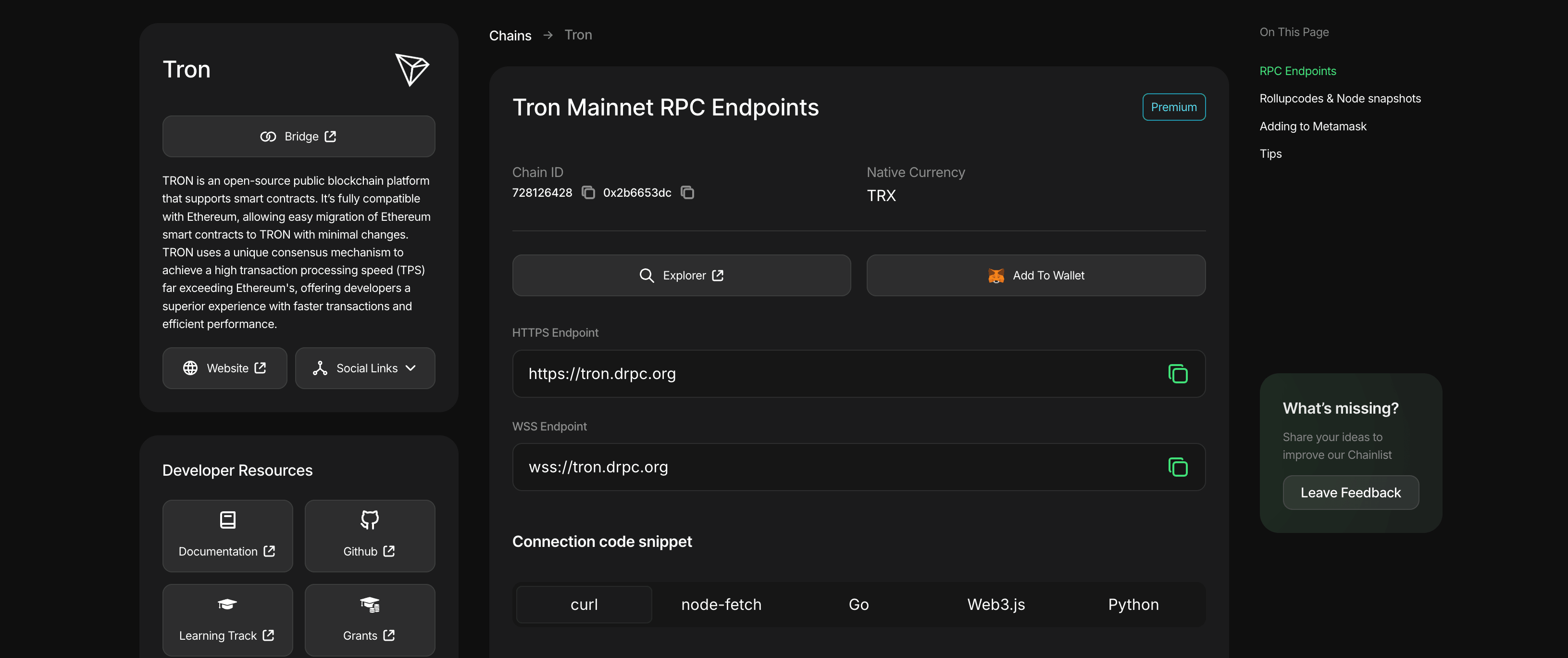
dRPC takes a fundamentally different approach — it’s a decentralized routing layer that distributes requests across multiple independent node operators. For TRON, this means built-in redundancy against any single provider going down. The pricing is the simplest in this comparison: every method costs a flat 20 CU, working out to $6 per million requests regardless of call complexity.
That cost predictability is dRPC’s strongest selling point for TRON. Workloads heavy on triggerConstantContract and getTransactionInfoById cost the same as simple getAccount calls — no credit-weight surprises. For high-volume, cost-sensitive operations (analytics pipelines, bulk transaction monitoring), the math is straightforward.
The trade-off is consistency and enterprise readiness. Latency varies across the distributed provider network — one request might hit a fast node, the next a slower one. There’s no formal SLA, no SOC 2, and TRON may require a paid plan. For a secondary/failover provider or for workloads where cost matters more than tail latency, dRPC makes sense. For primary production infrastructure serving payment flows, the absence of formal guarantees is a gap.
| Details | |
|---|---|
| Pricing | Free tier (public nodes). Paid from $10/mo. $6 per 1M requests. |
| Billing model | Flat-rate: 20 CU per request regardless of method. |
| gRPC | Not publicly documented for TRON. |
| Archive data | Depends on upstream providers. |
| Uptime / SLA | Multi-provider routing; no formal SLA. |
| Security | No SOC 2. API key management available. |
Pros: Flat-rate pricing, multi-provider redundancy, 95+ chains, 5,000 RPS ceiling, no vendor lock-in. Cons: No formal SLA; no SOC 2; TRON may require paid plan; inconsistent latency; no gRPC; archive access not guaranteed.
Quicknode

Quicknode brings operational maturity and the strongest compliance posture in this comparison — SOC 2 Type II, ISO 27001, and a formally guaranteed 99.99% uptime SLA. For teams already running Ethereum or Solana workloads on Quicknode, adding TRON to the same dashboard simplifies multi-chain infrastructure management.
TRON-specific protocol depth is where Quicknode is thinner. The platform provides HTTP API access compatible with TronWeb.js, but gRPC for TRON is not publicly documented. For workloads where gRPC performance matters (exchange backends, high-frequency data pipelines), this is a gap. The platform’s Streams and Webhooks tooling — strong on EVM chains — has more limited applicability on TRON given the network’s different event model.
The credit-weighted pricing also requires attention. TRON workloads dominated by triggerSmartContract calls (every TRC-20 balance query or transfer simulation) will consume credits faster than simple balance lookups. Model your actual method mix against the credit schedule before committing — the effective per-request cost for TRON-heavy workloads may differ significantly from headline pricing.
| Details | |
|---|---|
| Pricing | Trial only (no permanent free tier). Paid plans with credit bundles. Enterprise: custom with SLA. 15% annual discount. |
| Billing model | API credits: method-weighted. Heavier TRON methods consume more credits. |
| gRPC | Not publicly documented for TRON. |
| Archive data | Available on paid plans. |
| Uptime / SLA | 99.99% formally guaranteed. Dedicated clusters for enterprise. |
| Security | SOC 2 Type II + ISO 27001. |
Pros: 99.99% formal SLA, SOC 2 Type II + ISO 27001, 70+ chains, Streams and Webhooks, dedicated clusters, strong operational track record. Cons: No permanent free tier; method-weighted credits complicate TRON cost modeling; no public TRON gRPC; TRON-specific tooling is less developed than EVM chains.
How to choose a TRON RPC provider
If you’re building stablecoin payments or settlement
Your endpoint needs to sustain continuous broadcastTransaction and triggerSmartContract calls against the USDT contract without degrading during volume spikes. Flat billing matters — payment volume is hard to predict and credit-weighted models produce invoice surprises.
First choice: Chainstack Dedicated Nodes with gRPC for high-throughput settlement, plus the energy and bandwidth management guide to optimize per-transaction costs. Chainstack’s stablecoin infrastructure page details how the platform is architected for this exact workload profile. Alternative: Quicknode for teams that prioritize the 99.99% formal SLA above all else.
If you’re running exchange or fintech integrations
gRPC narrows the field to Chainstack and TronGrid. SOC 2 narrows it further to Chainstack. Exchange backends processing thousands of balance lookups and transaction broadcasts per second get measurable performance gains from protobuf serialization — see the gRPC setup examples in the TRON tooling docs.
First choice: Chainstack (gRPC + SOC 2 Type II and ISO 27001 + Dedicated Nodes for isolated compute that doesn’t share resources during peak settlement windows). Supplement with: TronGrid’s event indexing for contract monitoring where its purpose-built query layer adds value.
If you’re indexing data or running analytics
Volume and cost predictability are the primary concerns. Archive access matters if you need historical state — confirm support explicitly.
First choice: dRPC at $6/1M requests for bulk workloads where latency consistency is less critical. Alternative: Chainstack’s RU model for workloads that also need gRPC access to the full TRON API surface.
If TRON is one chain among many in your stack
Consolidation reduces operational overhead. Evaluate whether your multi-chain provider’s TRON support includes the specific interfaces you need — many multi-chain platforms support TRON’s HTTP API but not gRPC or the event namespace.
Broad coverage: Ankr (80+ chains, archive on all tiers) or dRPC (95+ chains). Deeper TRON integration within multi-chain: Chainstack (70+ chains with full TRON API coverage including gRPC).
Pricing reality check
| Provider | Effective cost per 1M TRON requests | Billing predictability |
|---|---|---|
| Chainstack | ~$10–20 (varies by plan tier) | High — 1 RU per call, no method weighting |
| TronGrid | Free (within daily cap) / opaque custom | Low — daily caps, throttling penalties |
| Ankr | ~$20 (at 200 credits/call) | Medium — per-method weighting inflates costs |
| dRPC | $6 flat | High — 20 CU per call regardless of method |
| Quicknode | Varies by method mix | Medium — requires method-mix modeling |
Enterprise TRON infrastructure
Compliance posture
SOC 2 Type II and ISO 27001 is the baseline for enterprise blockchain infrastructure procurement. The current landscape:
- Chainstack — SOC 2 Type II and ISO 27001 (achieved late 2025). Access controls include IP whitelisting and origin restrictions.
- Ankr — SOC 2 Type I (Type II in progress).
- TronGrid, dRPC — no public SOC 2 certification.
- Quicknode — SOC 2 Type II + ISO 27001. Dedicated clusters with SLA-backed support.
For exchange integrations and licensed payment processors, this narrows the primary provider choice to Chainstack or Quicknode. TronGrid and dRPC can serve as secondary or failover endpoints where formal compliance isn’t required for every provider in the stack. Chainstack’s enterprise infrastructure page covers SOC 2 certification details, SSO and 2FA support, custom SLAs, and dedicated account management for regulated teams.
gRPC as enterprise protocol
For enterprise-grade TRON integrations, gRPC isn’t a performance optimization — it’s the correct protocol choice. Binary serialization reduces payload sizes, HTTP/2 multiplexing handles high-frequency call patterns without connection overhead, and strongly typed protobuf definitions catch integration bugs at compile time rather than runtime. Chainstack is currently the only third-party provider offering TRON gRPC alongside enterprise compliance (SOC 2 Type II and ISO 27001).
Recommended production architecture
For mission-critical TRON workloads, run a multi-provider setup: primary traffic through a provider with formal SLA and gRPC (Chainstack Dedicated Nodes), with automated failover to a secondary provider (Ankr or dRPC) triggered by latency degradation or error rate thresholds.
For teams new to TRON infrastructure — including the decision between public endpoints, managed private nodes, and self-hosted options — Chainstack’s guide on how to get a TRON RPC node covers the practical trade-offs and setup steps for each approach.
Conclusion
TRON’s role as the dominant stablecoin settlement rail means your RPC provider choice is, in practice, a payments infrastructure decision. Here’s how the field breaks down:
- Chainstack is the most complete option — the only third-party provider with all four TRON API interfaces (
/jsonrpc,/wallet,/walletsolidity, gRPC), SOC 2 Type II and ISO 27001, transparent per-request billing, and Dedicated Node isolation. If you need gRPC for enterprise throughput and compliance artifacts for procurement, Chainstack is the default. - TronGrid is the right development starting point and the only provider with purpose-built TRON event indexing. Production use requires a custom plan to escape the 15 QPS ceiling.
- Quicknode offers the strongest formal SLA (99.99%) and dual compliance certifications (SOC 2 Type II + ISO 27001). Best for teams adding TRON to an existing Quicknode multi-chain stack where TRON gRPC isn’t required.
- dRPC delivers the lowest cost at scale ($6/1M requests) with the simplest billing model. Best as a primary provider for cost-sensitive, high-volume workloads or as a failover endpoint in a multi-provider architecture.
- Ankr provides the broadest free tier and archive access on all plans. Watch effective per-request costs — at $20/1M actual requests, production economics require careful modeling.
For TRON in 2026, choose based on what the network actually does: settle stablecoins, process payments, and power fintech infrastructure at scale. The provider that matches your protocol requirements (gRPC or HTTP), compliance obligations (SOC 2 or not), and billing model (flat or method-weighted) is the right one.
Other providers serving TRON include Dwellir, GetBlock, NOWNodes, Tatum, and TronQL — each with different coverage, pricing structures, and infrastructure approaches. The TRON developer hub maintains a list of recommended providers alongside public seed nodes for reference.
FAQ
An HTTP endpoint that connects your application to the TRON blockchain without running your own node. Most TRON RPC URLs point to a Full Node’s /wallet endpoint for general operations or /walletsolidity for confirmed-only data. Unlike Ethereum, TRON’s native API uses REST-style HTTP calls rather than JSON-RPC for most operations.
No. TRON uses a different address format (Base58), fee model (bandwidth/energy), and RPC design than Ethereum. You cannot add a TRON RPC URL to MetaMask. Use TronLink or Trust Wallet for native TRX and TRC-20 tokens.
TronGrid’s free tier allows 100,000 requests per day at 15 QPS. Exceeding limits triggers a 30-second access block. For production workloads, the free tier is insufficient — custom plans exist but require contacting the TRON Foundation directly.
HTTP API (/wallet) uses JSON over HTTP/1.1 — simpler, what TronWeb.js connects to by default. gRPC uses HTTP/2 with Protocol Buffers, and can meaningfully reduce payload sizes versus JSON-RPC — check current benchmarks for your workload — using persistent connections. Use HTTP for typical dApp development; gRPC for exchange backends and high-throughput data pipelines.
Several providers offer free TRON RPC access: Chainstack (3M req/mo), TronGrid (100K req/day), Ankr (200M credits/mo), and dRPC (public nodes). For production, start with your workload profile — stablecoin payments need gRPC and flat billing (Chainstack), compliance-heavy integrations need SOC 2 (Chainstack or Quicknode), cost-sensitive analytics need flat-rate pricing (dRPC). The comparison tables and “How to choose” section above map providers to specific use cases.
Build with Chainstack
- Discover how you can save thousands in infra costs every month with our unbeatable pricing on the most complete Web3 development platform.
- Input your workload and see how affordable Chainstack is compared to other RPC providers.
- Connect to Ethereum, Solana, BNB Smart Chain, Polygon, Arbitrum, Base, Hyperliquid, Robinhood Chain, Arc, Tempo, MegaETH, Monad, Plasma, Avalanche, Optimism, Aptos, Cronos, Gnosis Chain, Moonbeam, Celo, Aurora, TON, Ronin, and Bitcoin mainnet or testnets through an interface designed to help you get the job done.
- Fast access to blockchain archive data and gRPC streaming on Solana.
- To learn more about Chainstack, visit our Developer Portal or join our Telegram group.
- Connect your AI agent to Chainstack in seconds using Chainstack MCP — give Claude, Cursor, Codex, Gemini, and Windsurf live access to blockchain data, node management, and docs.
- Are you in need of testnet tokens? Request some from our faucets. Sepolia faucet, Base Sepolia faucet, Solana devnet faucet, Hoodi faucet, BNB faucet, zkSync faucet, Robinhood Chain faucet, Hyperliquid faucet, Monad faucet, Amoy faucet, Plasma faucet, TON faucet.
Have you already explored what you can achieve with Chainstack? Get started for free today.