


👉 Looking for the 2026 update? Read the latest → How to get a Solana RPC endpoint in 2026
This guide helps you pick the right Solana RPC setup for your stack, covering node types, protocol tradeoffs (HTTPS vs. WebSocket), and how to build for throughput and reliability from day one.
Introduction
Building on Solana begins with one small detail: the URL that connects your app to the chain. In this guide, you will learn what an RPC endpoint is, when you might need one, the importance of choosing the proper protocol (HTTPS vs. WebSocket), and how to secure a production-ready endpoint on Chainstack within minutes.
Why do you need a reliable RPC endpoint
Solana exposes every piece of on-chain data: account balances, token mints, and program logs through a JSON-RPC interface. Your client sends a structured request, and any Solana node that runs the RPC service answers. Without that URL, your wallet cannot fetch balances, your indexer cannot stream blocks, and your app cannot push transactions.
Because the network is fast, the number of requests can explode quickly. A bot that monitors new slots may fire 10+ requests per second; a browser wallet may create bursts during token swaps; an analytics job may replay the last 50 million slots overnight (archive data). Each scenario starts with the same question: which endpoint are we going to call, and can it handle the load?
Common use cases
- Wallet connectivity – End-users need a reliable, always-up endpoint. Almost every wallet allows advanced users to paste a custom URL for increased reliability and privacy.
- Development & testing – Devs need flexibility: quick spin-up, reasonable rate limits with free tier, and testnet support are the way to go. Chainstack’s Developer plan offers 3 million free requests per month which can be enough for most side projects.
- Production apps and trading bots – At scale, priorities shift to throughput, dedicated capacity, and observability. Your backend must handle Solana Mainnet traffic spikes and stay within strict SLOs.
The endpoint you choose and the transport protocol you enable should reflect the most demanding of these workloads, not the easiest one.
Full node or archive Solana node?
| Node mode | What it stores | When it shines |
| Full node | Current state plus ~2–3 days of recent slots | real-time wallets, games, trading bots |
| Archive node | Every slot since genesis and historical state queries | block explorers, analytics, compliance, ML models |
Archive nodes consume more storage and bandwidth, so providers usually charge extra. If you never need to query slot 100, you can safely start with a full Solana RPC node and upgrade later.
Public endpoint or private endpoint?
A public (shared) endpoint is pooled across many tenants. You pay (or don’t pay) a fraction of the cost but inherit rate limits. A private RPC endpoint eliminating “noisy neighbor” issues and enabling higher sustained throughput and reliability via geo-balanced Solana nodes at Chainstack.
Prototype with public; migrate to private once you hit either:
- consistent throttling (HTTP 429) during peaks, or
- security requirements that forbid multi-tenant infrastructure.
HTTPS vs. Websockets
Solana’s RPC service speaks both HTTPS (request/response) and WebSocket (bi-directional stream). Choosing the right protocol affects latency, bandwidth, and even feature availability.
| Feature | HTTPS | WebSocket |
| Transport style | stateless request/response | stateful, bi-directional |
Real-time subscriptions (accountSubscribe, logsSubscribe) | polling every N ms | native push, < 50 ms latency |
| Firewall-friendly | ✅ (port 443) | sometimes blocked on corp networks |
| Easy to cache & retry | ✅ | harder, connection-oriented |
| Mobile data usage | higher (headers per call) | lower (single handshake) |
| Supported by Trader node Warp tx | ✅ | ❌ (HTTP only) |
CLI default (solana config set) | HTTPS plus inferred WSS URL* | WSS must be set manually via --ws |
Tip: The Solana CLI auto-derives a WebSocket URL from the HTTPS endpoint, but the computed value may be wrong on custom hosts. Always override with --ws if you need live streams.
When to favor HTTPS
- Simple scripts that query state once per minute;
- RESTful backends behind HTTP load balancers;
- environments that block long-lived sockets.
When to favor WebSocket
- wallets showing live token balances;
- trading engines reacting to slot leaders;
- dashboards that stream
logsSubscribewithout polling.
Most serious builds expose both URLs and let the client pick based on context.
How to choose the best Solana RPC provider in 2025
The Solana ecosystem now handles billions of JSON-RPC calls each day, and the difference between a good endpoint and a great one is measured in lost trades, stalled user experiences, and unexpected invoices.
In other words, your RPC provider has become part of your application’s core logic. Before you copy-paste the first URL you find in a tutorial, step back and weigh the qualities that will keep your wallet, bot, or dApp competitive:
- multi-region footprint – latency matters when you race solana-validators.
- burst handling – can the pool absorb 10× traffic for a minute?
- add-ons – debug & trace APIs, Unlimited Node flat-fee tiers, or Warp transactions for MEV-sensitive bots.
- observability – per-method stats, logs, and alerts.
- a real SLA – credits for downtime.

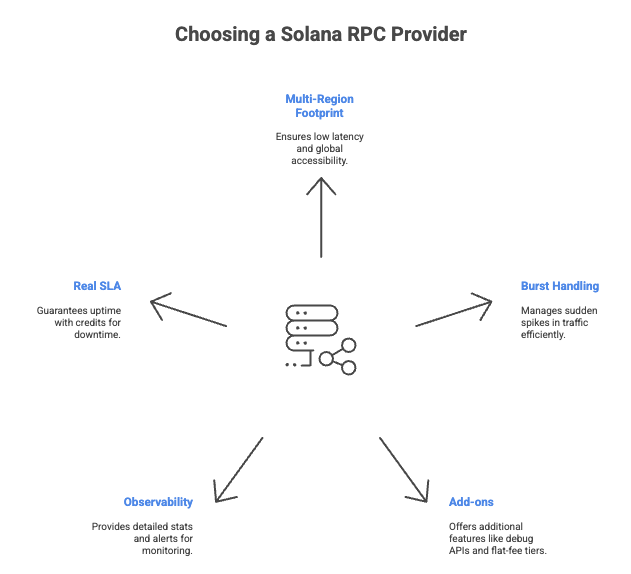
Chainstack checks all boxes and adds global elastic nodes, archive mode on demand, and an Unlimited Node add-on that swaps pay-per-request for a fixed monthly bill.
Best practices for happy endpoints
- cache non-critical calls (
getBalance, getEpochInfo) to cut billable requests; - batch reads with
getMultipleAccountswhere possible; - rotate through multiple regions (Chainstack Global Nodes) for resilience;
- protect private endpoints with access rules (IP allow-list or Origin filter) to stop abuse;
- monitor RPS and errors: Chainstack exposes per-method stats in the console;
- pin transaction volume: Trader nodes accelerate sendTransaction but still respect overall rate limits.
Create a Solana RPC endpoint on Chainstack
You can launch your own Solana RPC endpoint on Chainstack in a few clicks:
- Log in to your Chainstack account
- Create a project
- Click “Join network”
→ Choose Solana
→ Select Mainnet or Devnet - Select a node type
- Deploy the node
Wrap-up
Solana moves fast, but the recipe for a solid build remains stable:
- pick the right node type (full vs. archive),
- match public or private capacity to your growth curve,
- enable the transport (HTTPS or WebSocket) that best fits each workload, and
- host it on an infrastructure partner that scales with you.
Chainstack makes each step trivial while keeping costs predictable, so you can focus on shipping the next great Solana experience.
Further Reading
- 6 free tools to pick the top RPC node provider: Before you choose an endpoint, run these tools and test throughput, tail latency, and reliability across RPC providers yourself.
- 5 essential factors for setting up RPC node endpoints: Learn how to protect your RPC from abuse with IP filtering, Origin policies, and smart rate limits.
Power-boost your project on Chainstack
- Discover how you can save thousands in infra costs every month with our unbeatable pricing on the most complete Web3 development platform.
- Input your workload and see how affordable Chainstack is compared to other RPC providers.
- Connect to Ethereum, Solana, BNB Smart Chain, Polygon, Arbitrum, Base, Optimism, Avalanche, TON, Ronin, zkSync Era, Starknet, Scroll, Aptos, Fantom, Cronos, Gnosis Chain, Klaytn, Moonbeam, Celo, Aurora, Oasis Sapphire, Polygon zkEVM, Bitcoin and Harmony mainnet or testnets through an interface designed to help you get the job done.
- To learn more about Chainstack, visit our Developer Portal or join our Discord server and Telegram group.
- Are you in need of testnet tokens? Request some from our faucets. Multi-chain faucet, Sepolia faucet, Holesky faucet, BNB faucet, zkSync faucet, Scroll faucet.
Have you already explored what you can achieve with Chainstack? Get started for free today.