


Sui has emerged as a serious non-EVM Layer-1 in 2026. The launch of USDsui and CME cash-settled futures confirm it has crossed from developer experiment to institutional-grade network, with stablecoin transfer volume on Sui passing $1 trillion since August 2025 (per the Sui Foundation, reported in March 2026).
The defining constraint for Sui builders in 2026 is the retirement of JSON-RPC: Sui Foundation switched JSON-RPC off on its public Mainnet full nodes the week of July 27, 2026, and plans to remove it from the full node code in mid-October 2026, replaced by gRPC and GraphQL.
This guide covers the leading Sui RPC providers for production workloads in 2026, with specific focus on gRPC depth, object version retention, archive access, pricing predictability, and operational reliability under real traffic.
💡 Already using Chainstack? Jump straight to the Sui tooling docs for SDK examples across TypeScript, Go, Python, and cURL — or deploy your endpoint in minutes.
Why Sui RPC provider choice matters for production
In development, Sui’s public endpoints are sufficient. They’re free, easily accessible, and have no setup overhead. In production — where a gaming backend processes thousands of object mutations per second, where a DeFi protocol tracks checkpoint sequences for liquidation monitoring, or where an indexer backfills historical object states across months of chain history — the gap between providers becomes operationally decisive.
The API migration is the single most important constraint shaping provider selection in 2026. JSON-RPC, the legacy default that most Sui developers started with, has now been deprecated. Providers that hadn’t implemented gRPC in time forced migrations onto their customers at the worst possible moment — mid-growth, when infrastructure changes carry maximum risk. But beyond the protocol question, Sui’s object model means that standard EVM tooling assumptions simply don’t apply. There are no eth_getLogs-style calls, no account-based state lookups, no block-based event scans. Your provider needs to understand and support Sui’s actual data model — objects, checkpoints, Move events, dynamic fields — not just expose a URL that proxies requests to a Sui node.
The key factors separating production-grade Sui RPC providers from basic public options:
- gRPC support — required for Sui’s API roadmap; Sui Foundation’s public JSON-RPC endpoints have been off since the week of July 27, 2026, and JSON-RPC is due to leave the full node code in mid-October 2026
- GraphQL RPC access — flexible object and event queries with field-level precision and efficient pagination
- Archive and historical checkpoint access — essential for indexers, analytics pipelines, and backfill workloads
- Checkpoint-based query consistency — Sui’s object model requires checkpoint tracking, not block-log scanning
- Streaming — gRPC server streaming for checkpoints; JSON-RPC WebSocket subscriptions are deprecated and Sui does not carry them forward
- SLA and security certifications — non-negotiable for gaming studios, DeFi protocols, and institutional deployments
- Pricing predictability — cost must be modelable as Sui’s throughput scales. On Sui most providers charge a flat amount per call, so compare cost per call and how streaming is billed
Sui RPC providers comparison table (2026)
The table below summarizes public pricing and docs pages as of October 2026. Object-version and gRPC-depth figures come from the March 2026 benchmark and were not re-measured. Enterprise-only details are noted where applicable.
| Provider | Pricing model | Free tier | Dedicated nodes | gRPC support | GraphQL | Object versions stored (March 2026 benchmark) |
|---|---|---|---|---|---|---|
| Chainstack | Request-based (RU) | 3M RU/month, 25 RPS | Yes (Pro plan and above) | Yes (x-token auth required) | Yes (Mainnet) | 51.3M (6.76%) |
| OnFinality | Response-unit based, unified tiers | Public 5 RPS; Free plan 400K response units/day (up to 40/s) | Yes (Dedicated/Enterprise Nodes) | Yes (gRPC primary; JSON-RPC legacy) | Not listed | Not benchmarked |
| Dwellir | Flat 1:1 (1 response = 1 credit) | 100K responses/day, 20 RPS | Yes (dedicated clusters) | Yes (auth required) | No (not documented) | 14.0M (1.85%) |
| Uniblock | Compute-unit based, unified across chains | Yes, free tier | Not documented for Sui | Not documented for Sui | Not documented for Sui | Not documented for Sui |
| Ankr | API credit (gRPC: 10 credits per call plus data transfer) | 200M credits/month | Enterprise only (sales-led) | Yes | Yes (Premium only) | Not benchmarked |
| Alchemy | CU-based (10-20 CU per Sui call; streams by bandwidth) | 30M CUs/month | Dedicated Clusters (Sui not documented) | Yes (auth required) | No (not documented) | 7.4M (0.97%) |
| Quicknode | Credit-based (40 credits per Sui call) | Trial only (30-day) | Enterprise (platform level; Sui not named) | Yes (auth required) | Yes (Mainnet, beta) | 13.5M (1.78%) |
📖 What “object versions stored” means: Sui’s data model is object-centric — every time an object changes (a token transfer, an NFT update, a contract state mutation), a new version is created. Providers retain a limited window of these historical versions before pruning. More versions stored means your app can query deeper historical object state via gRPC
LedgerService/GetObjectat a past version (the old JSON-RPC callsui_tryGetPastObjectgoes away with JSON-RPC) — critical for DeFi protocols replaying collateral history, indexers backfilling NFT provenance, and analytics pipelines auditing past on-chain state. How far back checkpoint and transaction history reaches also varies by provider: Chainstack, for example, holds a rolling window of checkpoints (about 89.7M as of September 27, 2026) and points to Sui’s archival service for anything older. Object version retention is a separate, finer-grained capability.
How to choose a Sui RPC provider
1. API protocol support is the first filter
Unlike EVM chains where JSON-RPC remains stable indefinitely, Sui is mid-migration. Sui Foundation’s public Mainnet JSON-RPC endpoints went dark the week of July 27, 2026; Sui stopped publishing JSON-RPC snapshots at the end of August, scheduled the implicit archival fallback to disconnect at the end of September, and plans to remove JSON-RPC from the full node code in mid-October. Any provider without confirmed gRPC support creates a forced migration during your application’s growth phase. Before evaluating pricing, latency, or feature depth — confirm that the provider supports gRPC today and check whether it serves GraphQL (Chainstack does on Mainnet Global Nodes). This single criterion eliminates providers from consideration for new production Sui deployments.
2. When dedicated infrastructure starts to matter
In a development or low-traffic context, shared RPC infrastructure is usually sufficient. The threshold for dedicated infrastructure arrives quickly on Sui, typically in three scenarios: gaming applications with concurrent object mutations during peak player sessions, where shared endpoint noise introduces jitter into user-visible transaction flows; DeFi bots and keeper networks that depend on consistent checkpoint polling latency to hit liquidation windows; and indexers running long checkpoint backfills where shared endpoint throttling corrupts the consistency of historical data pipelines. Once any of these apply, shared RPC becomes a liability even if average metrics still look acceptable.
3. Archive and historical checkpoint access
A standard Sui full node keeps a limited window of history (Quicknode documents 14 epochs for its full nodes). Queries for older checkpoint data must route to archive infrastructure. For indexers, analytics pipelines, compliance tooling, and any workload that replays historical object states, your provider must explicitly support archive access — not just current chain state. Some providers handle this transparently through automatic routing from the same endpoint; others require separate archive endpoints, paid plan upgrades, or manual configuration. Know which category your provider falls into before you need it in production.
4. Latency consistency versus average benchmarks
Sui’s sub-second finality creates user experience expectations that average latency figures won’t reveal. What breaks real-time workloads — wallets displaying stale object state, games lagging on transaction confirmations, DeFi bots missing checkpoint windows — is p95 and p99 latency under sustained load, not median response times from a quiet endpoint. Sui isn’t currently one of the chains tracked on Chainstack’s public performance dashboard, so before committing to a provider, benchmark endpoint latency yourself against your actual Sui method mix under representative load — a simple curl loop or k6 script is enough. A provider that averages 40ms but spikes to 800ms under concurrent subscriptions is not production-ready, regardless of what its marketing page says.
5. Enterprise support for regulated and institutional workloads
Institutional DeFi protocols, gaming studios with large player bases, and infrastructure integrators all face the same reality: at some point, a performant endpoint isn’t enough. They need a contractual SLA, verifiable security certifications (SOC 2, ISO 27001), dedicated or isolated infrastructure options, multi-region resilience, and support quality that doesn’t require a public Discord thread to escalate a P1 incident. At this level, your Sui RPC provider becomes part of your operational risk model and needs to pass internal procurement reviews.
Choose the right Sui RPC provider by use case
For gaming and NFT applications
Sui has emerged as a serious gaming platform, driven by the object-centric Move model where in-game assets are native on-chain objects with direct ownership semantics — not entries in a contract mapping. This architectural choice makes Sui genuinely compelling for gaming: NFT transfers happen without global consensus, parallel execution handles concurrent player actions, and the object model maps naturally to game state. Projects like EVE Frontier migrating to Sui reflect real developer conviction, not ecosystem marketing. But this architecture also creates specific RPC demands: high-frequency object state reads, checkpoint streaming for in-game actions, and transaction submission pipelines that must stay responsive during concurrent player sessions without introducing visible lag.
For gaming workloads, the critical provider attributes are gRPC support for streaming, stream stability under sustained concurrent subscriptions, and consistent low latency during peak periods. Jitter or connection drops in a game loop are immediately user-visible failures that erode retention. Chainstack offers predictable request-unit pricing and a direct upgrade path to dedicated Sui infrastructure — practical for studios that need to model infrastructure costs as player counts and session concurrency scale. Chainstack’s gRPC exposes SubscribeCheckpoints; for per-event streams, subscribe to checkpoints and filter client-side, or keep suix_subscribeEvent on the JSON-RPC WebSocket while it lasts. Quicknode’s gRPC depth and Sui endpoints in EU and US regions make it a strong alternative for gaming apps where archive access and the broadest API surface matter. Dwellir’s flat one-credit-per-response pricing keeps billing simple for gaming workloads with unpredictable method mixes.
For DeFi protocols and stablecoin infrastructure
DeFi on Sui has matured significantly in 2026. DeepBook provides institutional-grade order book infrastructure, Suilend has become a cornerstone lending platform, and the launch of USDsui creates new stablecoin liquidity and payment rails on the network. Each of these protocols creates demanding RPC patterns: real-time object state reads for price feeds and collateral tracking, checkpoint sequence monitoring for liquidation triggers, Move event indexing for on-chain activity feeds, historical backfill for analytics and audit trails, and transaction submission pipelines that must stay fast during market volatility spikes.
For DeFi workloads, gRPC is not optional. With JSON-RPC being retired, gRPC and GraphQL are the interfaces Sui supports going forward, and providers without them will force migrations during exactly the windows when your protocol is most stressed and your team has the least capacity for infrastructure changes. Chainstack has the clearest upgrade path from shared RPC to dedicated Sui infrastructure, with request-unit pricing where every call is 1 RU, including reads at the bottom of the history window. Quicknode’s archive auto-routing via a single gRPC endpoint removes the friction of managing separate endpoints — a material advantage for analytics-heavy DeFi stacks. Alchemy brings strong developer tooling and a generous free tier, well-suited to teams with predictable, well-characterized method mixes.
For indexers, analytics, and enterprise deployments
Indexers and analytics pipelines stress a Sui RPC provider differently from transactional workloads. The concern here is not single-request latency — it’s whether the provider can sustain historical checkpoint reads across months of data, run long-duration object backfills without throttling, and deliver continuous Move event streams without gaps that corrupt downstream data pipelines. Enterprise deployments add compliance and SLA requirements: SOC 2 certifications for vendor procurement, contractual uptime guarantees for regulated products, and dedicated infrastructure so that a noisy neighbor on shared infrastructure can’t introduce data inconsistency into your indexing jobs.
For this workload category, the realistic production options narrow to Chainstack and Quicknode — both support gRPC with historical access (Chainstack through an extended window, Quicknode through archive routing) and hold enterprise-grade security certifications. For enterprise deployments specifically, Chainstack’s SOC 2 Type II (achieved December 2025) and ISO 27001 (certified July 2026), dedicated Sui node options, and transparent request-unit pricing provide a compliance-ready path that doesn’t require complex procurement negotiation just to get meaningful throughput. Quicknode’s dual SOC 2 + ISO 27001 certifications and archive auto-routing make it the strongest option for organizations where both compliance breadth and indexing infrastructure depth are required simultaneously.
Sui RPC providers: breakdown by provider
Chainstack

Chainstack supports Sui with Global Nodes offering JSON-RPC over HTTPS, WebSocket, and gRPC on the same node, plus GraphQL on Mainnet at the same endpoint — covering the full protocol stack required for production applications in 2026. Per the Chainstack Sui gRPC endpoint docs, the node holds a rolling window of about 89.7 million checkpoints (237,661,232 through 327,352,270 as of September 27, 2026); read lowestAvailableCheckpoint from GetServiceInfo at runtime rather than hard-coding it. Sui Global Nodes carry Chainstack’s Extended label: full nodes that keep more history than a standard Sui full node, but not a complete archive from genesis. Extended does not change billing, and every Sui request is 1 RU. Chainstack gRPC access requires authentication via an x-token header, passed with every call. The Sui tooling documentation covers TypeScript (gRPC-Web and native gRPC), Python, Node.js and Go for gRPC, plus JSON-RPC examples in TypeScript, Rust, Python, Go and cURL.
Pricing & throughput: Developer plan is free (3M RU/month, 25 RPS). Growth: $49/month (20M RU, 250 RPS). Pro: $199/month (80M RU, 400 RPS). Business: $499/month (200M RU, 600 RPS). Enterprise: from $990/month (400M RU, unlimited RPS). Overage rates scale down from $20/1M RU on Developer to $5/1M RU on Enterprise. The Unlimited Node add-on converts a node on Growth or above to flat-fee unlimited requests within a fixed RPS tier (25 to 1000 RPS), removing per-request billing entirely. Sui is also available as a Chainstack Self-Hosted deployment (Sui Mainnet and Testnet), for teams that want to run the node on infrastructure they control, with Chainstack’s control plane automating deployment, monitoring and updates. Dedicated Nodes need a Pro plan or higher and are billed for the node, not per request. A Sui Mainnet full node lists at about $3,577 a month in Chainstack’s pricing catalog (October 2026).
Limitations: GraphQL is available on Mainnet Global Nodes only — Testnet nodes do not serve /graphql — and there are no GraphQL subscriptions, so stream checkpoints over gRPC instead. Filtered transaction and event queries cover up to the most recent 90 days.
Fit by workload:
- Gaming and NFT apps: Excellent — gRPC, predictable request-unit pricing, dedicated node upgrade path from the Pro plan
- DeFi protocols and stablecoins: Excellent — clearest path to dedicated Sui infrastructure, deep checkpoint retention on the same endpoint, flat request-unit billing for mixed-method workloads
- Indexers and enterprise: Strong — SOC 2 Type II and ISO 27001, a 99.9% quarterly uptime commitment in the published SLA, dedicated nodes on Pro and above, custom SLAs on Enterprise, and a Self-Hosted option
OnFinality

OnFinality runs production Sui Mainnet infrastructure with gRPC as the primary API (querying checkpoints, transactions, objects, and balances, with streaming support) and legacy JSON-RPC maintained for existing applications during migration. Plans run from a public endpoint (5 RPS) and a Free plan (400,000 response units a day, up to 40 per second, with usage insights) up to a Growth plan ($49/month, 20M response units, 200 RPS), with Dedicated and Enterprise Nodes available for high-performance, scalable deployments.
Limitations: No SLA published on the free/public tiers; Sui-specific archive retention depth wasn’t independently confirmed and should be checked directly before a production commitment.
Fit by workload:
- Gaming and NFT apps: Strong — gRPC-primary access with streaming support fits real-time object state reads.
- Indexers, analytics, and enterprise: Strong — Dedicated/Enterprise Node tiers exist specifically for this profile.
- DeFi protocols and stablecoin infrastructure: Moderate — no independently confirmed SLA terms for regulated workloads.
Dwellir

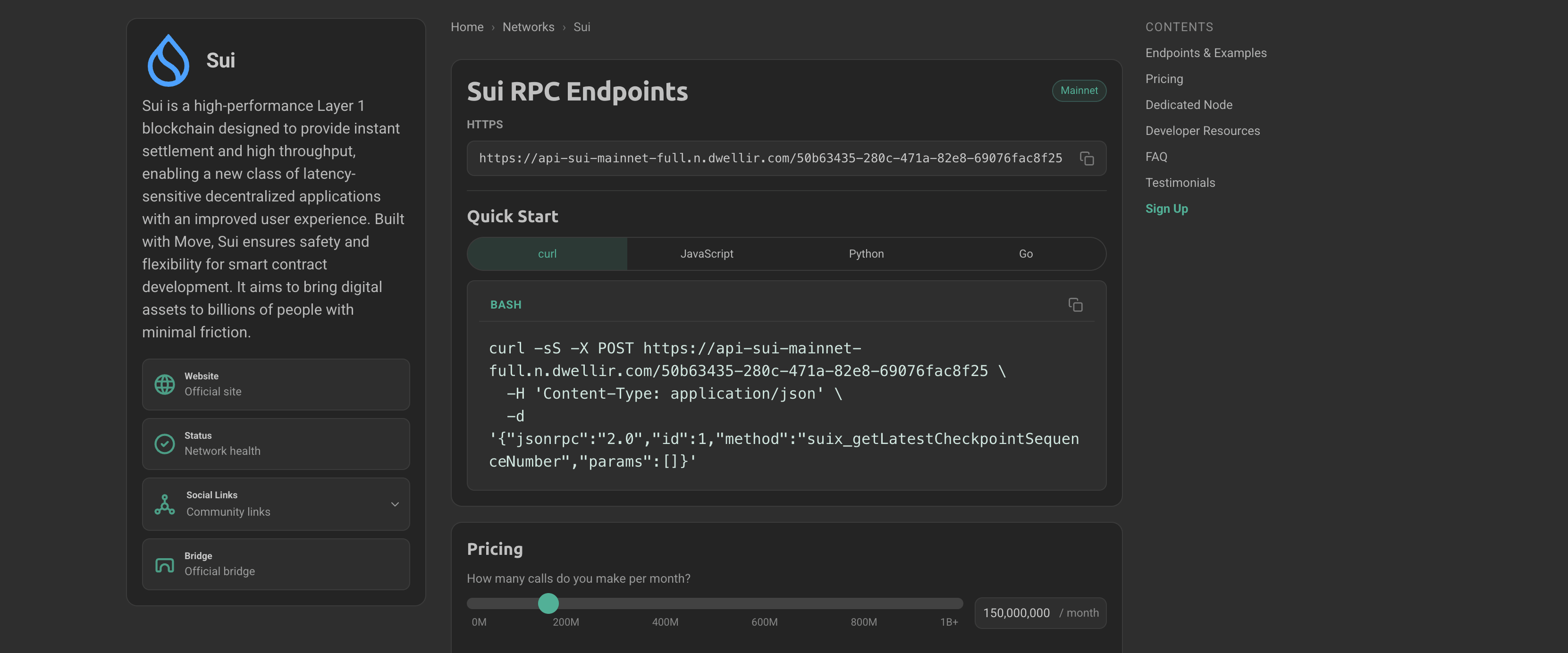
Dwellir operates Sui infrastructure with a 1:1 pricing model — every method costs the same credit regardless of complexity. Benchmark testing shows 14.0 million object versions retained (1.85% coverage, ~1 epoch) and gRPC checkpoint depth of 4.9 million — comparable to Quicknode, though a March 2026 benchmark measured a shorter full-node window than Chainstack’s current ~89.7M checkpoints. Dwellir’s gRPC runs on port 443 and requires authentication. All standard Sui RPC methods are supported. The platform covers 150+ networks under a single API key, making it practical for multi-chain teams adding Sui without managing separate billing.
Pricing & throughput: Flat pricing (1 response = 1 credit). Paid tiers from $49/month. Free plan: 100,000 responses a day at 20 RPS. Dedicated clusters available with direct technical support.
Limitations: Security certifications (SOC 2, ISO 27001) are not prominently published, requiring direct engagement for enterprise procurement. No contractual SLA on standard plans (custom SLA is Enterprise only), although its Sui docs page cites a 99.99% uptime SLA (its pricing page attaches that SLA to dedicated clusters on custom terms). GraphQL RPC for Sui is not documented. Object version history at 14.0M is 3.7x shallower than Chainstack.
Fit by workload:
- Gaming and NFT apps: Strong — 1:1 pricing eliminates billing surprises for unpredictable mixed-method gaming workloads, gRPC supported
- DeFi protocols and stablecoins: Good — gRPC, predictable pricing at any method mix, but GraphQL depth requires direct validation
- Indexers and enterprise: Moderate — one-credit-per-response pricing keeps heavy read workloads predictable, but the standard endpoint is a full node (deep history needs a dedicated cluster arranged with Dwellir), and compliance documentation requires direct engagement
Uniblock

Uniblock is a unified RPC aggregation platform rather than a node operator — it routes requests to upstream providers behind a single API and a single invoice across 300+ chains, including Sui. For teams juggling multiple chains, Uniblock’s value is consolidation: one API shape and one bill instead of separate integrations per provider, plus its higher-level Unified APIs (token, NFT, market data) layered on top of raw RPC.
Limitations: Uniblock is not a Sui-specific infrastructure provider — it aggregates upstream providers rather than running dedicated Sui nodes, and Sui-specific details (gRPC support, archive depth, dedicated node options) are not clearly documented on its own site. Confirm current Sui coverage directly before committing to a production workload.
Fit by workload:
- Multi-chain dashboards and wallets: Good — one API and one bill across 300+ chains reduces integration overhead.
- Gaming and NFT apps: Moderate — Sui-specific archive/gRPC depth isn’t independently confirmed.
- Indexers, analytics, and enterprise: Limited — no published Sui-specific SLA or compliance attestation found.
Ankr

Ankr runs its own Sui nodes. The platform handles over 8 billion daily requests across its multi-chain network, supports gRPC for Sui as part of the new data stack endorsed by the Sui Foundation, lists a GraphQL endpoint and a gRPC archive endpoint, both Premium only. Ankr’s infrastructure operator holds a SOC 2 Type II attestation audited by A-LIGN (report under NDA), and ISO 27001 is in progress, making Ankr a viable option for organizations with baseline compliance requirements. The 200M free API credits/month after sign-in give teams real runway for pre-production development and testing (about 20M gRPC calls at 10 credits each, before data transfer is billed).
Pricing & throughput: Freemium model with 200M API credits/month after account creation. Premium and Enterprise tiers available for higher throughput and dedicated options. The advertised $20 per 1M requests applies to HTTP calls at 200 credits; gRPC calls are 10 credits (about $1 per 1M) plus data transfer at $0.50 per GB.
Limitations: Dedicated Sui node offerings are less clearly positioned in Ankr’s public materials than Chainstack or Quicknode. For teams needing a formal dedicated Sui node with a defined SLA, the upgrade path requires direct engagement with Ankr’s sales team rather than self-service. At production scale, model data-transfer charges against the headline credit figures.
Fit by workload:
- Gaming and NFT apps: Good — gRPC, large free tier for pre-production development and load testing
- DeFi protocols and stablecoins: Good — archive on Premium, gRPC support, but dedicated node path and cost modeling require direct engagement
- Indexers and enterprise: Moderate — SOC 2 Type II held by its infrastructure operator, but dedicated Sui node offerings less clearly structured than top-tier alternatives
Alchemy

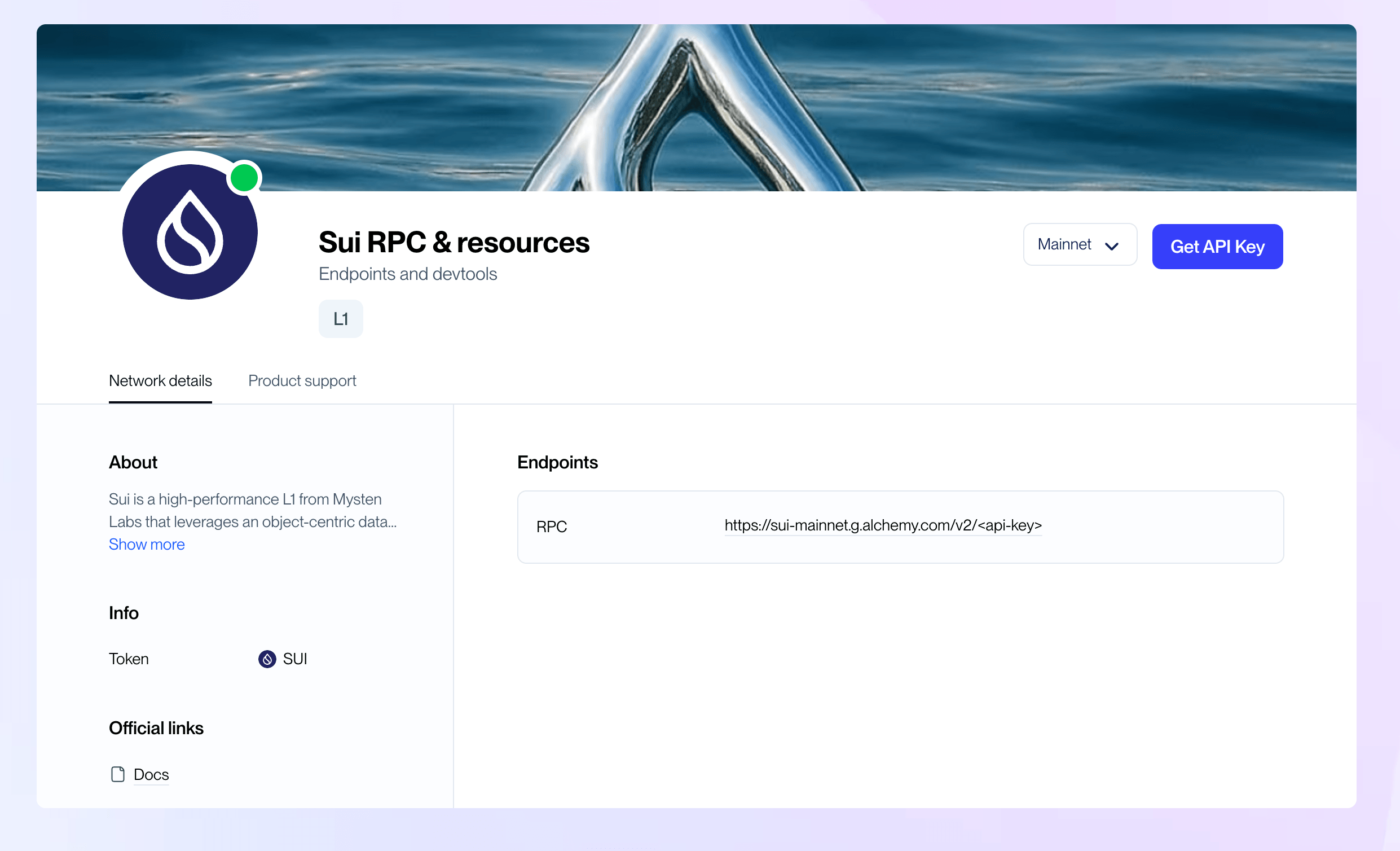
Alchemy supports Sui through gRPC on Mainnet. All 7 services (LedgerService, StateService, MovePackageService, NameService, SubscriptionService, TransactionExecutionService, SignatureVerificationService) are documented. Alchemy’s Sui page lists gRPC as the supported product and does not list WebSockets or a JSON-RPC API for Sui. The free tier — 30M CUs/month (about 1.5M Sui calls at 20 CU per call) — is a large allowance in compute units, but Sui calls cost 10 to 20 CU each. The platform brings its established developer tooling to Sui: analytics dashboards and the familiar SDK experience for teams already using Alchemy on EVM chains. The key gap from the March 2026 benchmark: Alchemy retains only 7.4 million object versions (0.97% coverage) — the lowest in the comparison, 6.9x less than Chainstack — and gRPC checkpoint depth was not measured.
Pricing & throughput: CU-based pricing: 10 to 20 CU per unary Sui call, and streaming methods are billed by bandwidth ($75 per TB). Free tier: 30M CUs/month. PAYG and higher tiers available. Alchemy sells Dedicated Clusters, but its Sui documentation does not say they cover Sui; enterprise infrastructure requires direct engagement.
Limitations: At 7.4M object versions retained, Alchemy has the shallowest historical object state coverage tested — a real constraint for DeFi protocols and indexers that depend on historical object queries. GraphQL for Sui isn’t documented in Alchemy’s Sui docs, so confirm availability before relying on it. No documented dedicated Sui tier means limited isolation options for latency-sensitive workloads.
Fit by workload:
- Gaming and NFT apps: Good — gRPC streaming through SubscriptionService, familiar tooling
- DeFi protocols and stablecoins: Good — reliable infrastructure, generous free tier, but no documented dedicated Sui tier limits production commitment for high-throughput DeFi
- Indexers and enterprise: Moderate — SOC 2 Type II, strong uptime, but no documented dedicated Sui infrastructure and no ISO 27001
Quicknode

Quicknode offers a comprehensive Sui API stack with gRPC and GraphQL on Mainnet (labeled beta in its docs); its Sui docs mark JSON-RPC as deprecated and list no WebSocket endpoint. Benchmark testing shows 13.5 million object versions retained (1.78% coverage, ~1 epoch) and gRPC checkpoint depth of 4.9 million — solid, though a March 2026 benchmark measured a shorter full-node window than Chainstack’s current ~89.7M checkpoints; Quicknode routes older data to its archive from the same endpoint. Both Quicknode and Chainstack require a token for gRPC: Quicknode serves it on port 9000 of your endpoint URL, Chainstack on sui-mainnet.core.chainstack.com:443 with an x-token header. All standard RPC methods are supported, and the platform explicitly documents gRPC in Go, Python, TypeScript, and grpcurl. For indexers, Quicknode’s archive auto-routing is convenient — queries for data older than 14 epochs route automatically to archive nodes without client-side configuration changes.
Pricing & throughput: Credit-based pricing. Sui calls cost a flat 40 credits each. Build tier starts at $49/month (80M credits, up to 50 RPS). No permanent free plan — only a 30-day limited trial. At 40 credits per call, the Build plan’s 80M credits cover about 2M Sui calls, against 20M request units on Chainstack’s Growth plan at the same $49.
Limitations: No permanent free tier makes early-stage development more costly. At 40 credits per call, cost per request is higher than on the other flat-priced providers. Object version history at 13.5M (1.78%) is 3.8x shallower than Chainstack — relevant for DeFi protocols and indexers needing deep historical object state.
Fit by workload:
- Gaming and NFT apps: Excellent — gRPC + GraphQL stack, ISO 27001 for studios with formal security procurement requirements
- DeFi protocols and stablecoins: Excellent — archive auto-routing via single gRPC endpoint removes separate endpoint management entirely
- Indexers and enterprise: Excellent — SOC 2 Type II + ISO 27001, dedicated clusters (platform level; Sui not named in its Sui docs), 99.99% uptime target on its security page
Getting started with Sui on Chainstack

- Log in to your Chainstack account or create a free account
- Create a new project or select an existing one
- Choose Sui Mainnet or Sui Testnet
- Deploy a Sui RPC node on Chainstack — Global Node for geo-balanced access or Dedicated Node (Pro plan and above) for isolated infrastructure
- Open Access/Credentials and copy your HTTP, WebSocket, or gRPC endpoint
Quick connectivity check — get the latest Sui checkpoint (JSON-RPC, still served on your Chainstack endpoint):
curl --request POST \
  --url YOUR_CHAINSTACK_ENDPOINT \
  --header 'Content-Type: application/json' \
  --data '{
    "jsonrpc": "2.0",
    "id": 1,
    "method": "sui_getLatestCheckpointSequenceNumber",
    "params": []
  }'
TypeScript over gRPC (using @mysten/sui 2.16 or later):
import { SuiGrpcClient } from '@mysten/sui/grpc';

const client = new SuiGrpcClient({
  network: 'mainnet',
  baseUrl: 'YOUR_CHAINSTACK_ENDPOINT',
});

const gasPrice = await client.core.getReferenceGasPrice();
console.log('Reference gas price:', gasPrice.referenceGasPrice);
The SDK’s default gRPC-Web transport works over HTTPS, in Node.js and in the browser, with only your node URL as baseUrl (gRPC-Web works on both Mainnet and Testnet). Use the native gRPC transport with the x-token header for server-side apps that prefer HTTP/2. For gRPC access, Chainstack Sui mainnet nodes are reachable at sui-mainnet.core.chainstack.com:443. Your gRPC endpoint and x-token credentials appear in the console under your node’s Access and credentials panel. The Sui tooling documentation includes gRPC examples in Go, Python and Node.js alongside the TypeScript examples above, and grpcurl for exploring services. On Mainnet, the same endpoint also serves GraphQL at YOUR_CHAINSTACK_ENDPOINT/graphql for filtered queries such as transactions by address and events by type.
🤖 You can also access Chainstack Sui RPC directly from Claude, Cursor, Codex, Windsurf, Gemini CLI, GitHub Copilot, Antigravity, Claude.ai, or ChatGPT using Chainstack MCP. See the Chainstack Agents page for the fuller agent stack.
⚠️ Migration note: Sui Foundation’s public endpoints no longer serve JSON-RPC, and Sui plans to remove it from the full node code in mid-October 2026. As of October 2026 your Chainstack endpoint still serves JSON-RPC, gRPC, and (on Mainnet) GraphQL on the same node, so you can port call by call — see the Chainstack migration guide, and finish the move rather than stay on JSON-RPC. The official
@mysten/suiSDK supports gRPC and GraphQL clients. For Rust, Python and Go, generate stubs from Sui’s proto definitions or check each SDK’s gRPC status before you migrate.
Conclusion
All seven providers in this comparison support Sui in some form, though gRPC-specific depth varies — the JSON-RPC retirement (public endpoints off since July 2026, planned code removal in mid-October) is no longer the filter. The differentiation is now benchmark depth: object version retention, gRPC checkpoint history, GraphQL availability, and pricing predictability under mixed workloads.
Provider recommendation by use case:
- Gaming and NFT apps: Chainstack (predictable pricing, gRPC and GraphQL, dedicated node upgrade path) or Quicknode (gRPC + GraphQL stack, ISO 27001)
- DeFi protocols and stablecoin infrastructure: Quicknode (archive auto-routing via single gRPC endpoint) or Chainstack (dedicated nodes, transparent request-unit pricing)
- Indexers, analytics, and enterprise: Chainstack (SOC 2 Type II, dedicated nodes, transparent pricing) or Quicknode (SOC 2 Type II + ISO 27001, dedicated clusters (platform level), 99.99% uptime target on its security page)
- Developer-first with tooling ecosystem: Alchemy (30M CUs free, gRPC on Mainnet, familiar SDK surface)
- Cost-optimized high volume: Dwellir (1:1 flat pricing, no method multipliers) or Ankr (200M free credits, gRPC)
- Multi-provider failover: Ankr or Dwellir as secondary endpoints alongside a primary SLA-backed provider
FAQ
gRPC is Sui’s future API — binary protocol, lower latency, native streaming. Sui is retiring JSON-RPC in stages: Sui Foundation’s public Mainnet endpoints stopped serving it the week of July 27, 2026, JSON-RPC snapshots ended in August, the archival fallback was scheduled to disconnect at the end of September, and Sui plans to remove JSON-RPC from the full node code in mid-October 2026. Providers that still serve JSON-RPC, Chainstack included, let you migrate call by call, but plan to finish the move to gRPC and GraphQL.
It depends on how you count, because credits and compute units are not comparable across providers. Converted to Sui calls: Ankr’s 200M credits a month cover about 20M gRPC calls at 10 credits each, before data transfer is billed. Chainstack’s Developer plan (3M RU/month, 25 RPS) covers 3M calls and includes gRPC and JSON-RPC on the same endpoint. Alchemy’s 30M CUs cover about 1.5M calls at 20 CU. Quicknode has no permanent free plan, only a 30-day trial of 10M credits (about 250,000 calls at 40 credits).
Confirm your provider supports gRPC, then update your SDK (@mysten/sui 2.16 or later for TypeScript; for other languages, generate stubs from Sui’s protos). Point it at your provider’s gRPC endpoint and port, validate with a checkpoint query, and migrate call sites; on Chainstack, queries with no gRPC equivalent, such as filtered transactions and events, move to GraphQL. Chainstack, Quicknode, Dwellir, and Ankr all document per-language gRPC setup.
No — p95 and p99 latency under load matters. A provider averaging 40ms that spikes to 800ms under concurrent subscriptions breaks wallets, games, and DeFi bots. Always benchmark against your actual method mix, not a quiet single-request test.
Chainstack (SOC 2 Type II and ISO 27001, dedicated nodes on Pro and above, custom SLAs on Enterprise) and Quicknode (SOC 2 Type II + ISO 27001, dedicated clusters (platform level; Sui not named in its Sui docs), 99.99% uptime target on its security page) are the strongest. Alchemy holds SOC 2 Type II. Ankr’s infrastructure operator holds a SOC 2 Type II attestation (ISO 27001 in progress). Dwellir requires direct validation.
On Sui, it is about as predictable as the others, with a lower price per call. Chainstack charges 1 RU per request regardless of method, with no archive split. Quicknode charges a flat 40 credits per Sui call, Alchemy 10 to 20 CU per unary call, and Ankr 10 credits per gRPC call plus data transfer. Alchemy bills streams by bandwidth, so streaming-heavy workloads are the hardest to forecast there.
Additional resources
- How to get a Sui RPC endpoint in 2026
- Sui tooling documentation — Chainstack Docs
- Migrate Sui from JSON-RPC to gRPC and GraphQL — Chainstack Docs
- Sui GraphQL: what it is, and when to use it over gRPC
- Sui gRPC developer guide: what to migrate, and how it works
- Sui gRPC endpoint — Chainstack Docs
- Sui GraphQL endpoint — Chainstack Docs
- Sui official RPC providers documentation
- Chainstack performance dashboard (other supported chains — Sui not yet tracked)