


The XRP Ledger went live in June 2012, which makes it one of the few blockchains old enough to have shipped, survived a decade of market cycles, and still be adding native features today. It was built by three people — David Schwartz, Jed McCaleb, and Arthur Britto — who wanted a settlement network that didn’t burn electricity to reach consensus. Fourteen years later it settles cross-border payments for banks, runs a native decentralized exchange, issues Ripple’s own RLUSD stablecoin, and just picked up an EVM-compatible sidechain — while the company most people associate with it, Ripple, doesn’t actually own or control the network it helped start.
That distinction — ledger versus company versus foundation — trips up a lot of coverage of XRP Ledger (XRPL), so it’s worth getting straight before anything else. This piece covers how XRPL’s consensus mechanism actually works, what ships natively on the protocol versus what lives on a separate sidechain, where the ledger’s 2025-2026 upgrade wave landed, and how to get a production RPC endpoint against it.
🚀 Want to skip ahead? Chainstack runs XRP Ledger Mainnet and Testnet as Global Nodes, Dedicated Nodes, and Self-Hosted deployments — get an endpoint or jump to Getting RPC access to XRP Ledger below.
Three names, three different things
“XRP,” “Ripple,” and “XRP Ledger” get used interchangeably in casual conversation, and that’s precisely the confusion worth clearing up first:
- XRP Ledger (XRPL) is the open-source, decentralized protocol and network — the actual blockchain, run by independent validators around the world, that this article is about.
- XRP is the ledger’s native digital asset, used to pay transaction costs and, since it needs no issuer, to bridge between other currencies on the built-in exchange.
- Ripple is a private fintech company — one of several organizations that build on and contribute code to XRPL, and a major holder of XRP, but not its owner. Schwartz, McCaleb, and Britto gifted 80 billion XRP to a new company shortly after launch; it was named NewCoin, immediately renamed OpenCoin, and became Ripple Labs — now just Ripple — in 2013.
McCaleb left the company in 2013 and went on to found Stellar; he’s had no operational role at Ripple or XRPL since. A fourth organization matters here too: the XRP Ledger Foundation (XRPLF), an independently incorporated nonprofit — re-established in France in November 2024 — whose stated mission is funding and coordinating XRPL development. It’s a separate legal entity from Ripple, though not fully arm’s-length: Ripple holds one of four permanent board seats, alongside XRPL Commons, XRPL Labs, and XAO DAO. Worth naming precisely rather than calling the Foundation fully independent.
One more correction worth making up front, because it’s a live source of confusion in older write-ups: Ripple’s own leadership page no longer lists David Schwartz as CTO. He stepped back from day-to-day technical leadership at the end of 2025 after thirteen years in the role and now sits on Ripple’s board; Brad Garlinghouse remains CEO.
Consensus without mining or staking
XRPL doesn’t use proof-of-work or proof-of-stake. Its consensus protocol is a trust-based Byzantine-agreement scheme: every server on the network — validator or not — picks a Unique Node List (UNL), the set of validators it trusts not to collude, and only listens to proposals from that set. Validators exchange proposed transaction sets over several rounds, narrowing disagreements each round, until enough of the trusted set converges on the same result. Once roughly 80% of a validator’s UNL agrees, the ledger closes — validated, immutable, final. No block reward, no slashing, no idle hardware racing to find a hash.
The math behind that threshold matters: the network tolerates up to roughly 20% of trusted validators being faulty or malicious without producing a wrong result, and needs over 80% actively colluding before it would confirm something invalid — anywhere between those two figures, the affected servers halt rather than fork. As of this writing, livenet.xrpl.org’s validator registry counts 162 validators total, 35 of them on the default UNL that Ripple and the XRP Ledger Foundation jointly publish — a number worth checking live rather than trusting any static figure, since validator counts shift continuously.

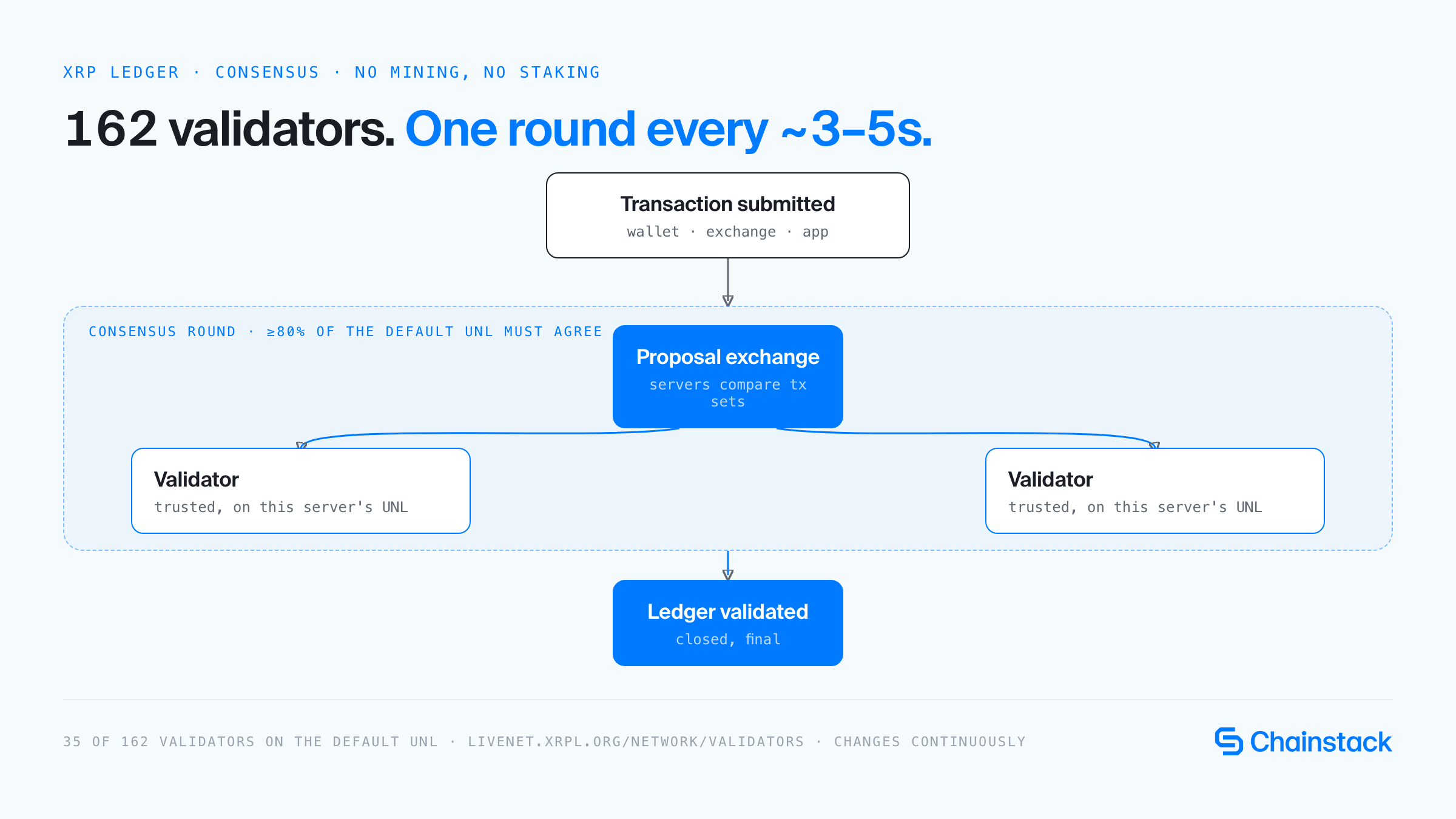
In practice, ledgers close roughly every 3 to 5 seconds. Pulling a live example while writing this: the validated ledger sitting at the top of the chain was index 106396877, closed at 2026-08-19T08:37:11Z, queried straight off a public full-history endpoint — that’s the kind of finality window a payments network is actually designed around, not a marketing ceiling. Fees stay proportionally tiny: the base transaction cost is 10 drops (0.00001 XRP), scaled up dynamically under load to deter spam, with the baseline itself changeable only through a separate validator vote called Fee Voting. Account reserves work the same way — currently 1 XRP to open an account plus 0.2 XRP per owned ledger object (a trust line, an open offer, an escrow) — down roughly 90% from the older 10 XRP / 2 XRP figures after a December 2024 validator vote cut them.
That same vote mechanism governs new features. A proposed amendment needs more than 80% of trusted validators voting in favor, sustained for two weeks, before it activates — which means a change can go live even if Ripple itself objects, since Ripple runs a minority of validators and controls neither the UNL nor the vote.
💡 The XRP Ledger Foundation migrated the default validator-list infrastructure to a new URL and signing key in 2025 (
vl.xrplf.org→unl.xrplf.org) — if you’re running your ownrippled/xrpldnode rather than using a managed RPC provider, check yourvalidators.txtis pointed at the current one.
What ships natively on the ledger
XRPL’s design philosophy has always leaned toward building financial primitives directly into the protocol rather than leaving them to smart contracts — which is also why “does XRPL support smart contracts” is a more complicated question than it looks (more on that below). What’s native today:
- A built-in order-book DEX. Any two assets on the ledger can be traded without a smart contract; the protocol itself matches offers and can auto-bridge through XRP as an intermediary currency.
- Trust lines and issued currencies (IOUs). Any account can issue a token by having other accounts extend it a trust line — this is how non-XRP value, including RLUSD, moves on the ledger.
- Escrow, payment channels, and checks. Time- or condition-locked XRP transfers, off-ledger-settled payment streams, and deferred pull-style payments a recipient claims later — all native transaction types, not contracts.
- Multi-signing, so an account can require M-of-N signatures instead of a single key.
- NFTs via XLS-20, a protocol-level standard rather than a token contract — mint, burn, and offer transactions exist as first-class ledger operations.
The recent upgrade wave: AMM, MPT, Clawback, oracles
The last two years added more to XRPL than most of its previous history combined:
- Automated Market Maker (XLS-30) — a non-custodial AMM integrated directly with the existing order book, live on Mainnet. Each asset pair gets at most one AMM instance, with its own account holding pooled funds and issuing LP tokens. A follow-on proposal, informally called AMM Swappable Curves, is in discussion to add more curve types.
- Multi-Purpose Tokens (XLS-33) — a fungible-token primitive built for cases like stablecoins, storing balances as individual holdings rather than per-pair trust lines, with compliance controls (allow-listing, transfer limits, locking, clawback) built into the token object itself rather than bolted on. It’s a meaningfully cleaner model than trust-line IOUs for an issuer managing thousands of holders.
- Clawback — live since February 2024, lets a token issuer reclaim its own issued tokens (never native XRP), but only if the issuer opted in before ever creating a trust line, offer, or escrow. Off by default, and an
AMMClawbackextension covers LP positions too. - Price Oracles (XLS-47) — a native
PriceOracleledger object so on-chain logic, including the AMM, can reference external asset-pricing data without an off-chain integration.
Every one of these arrived through the same amendment-vote process described above — including AMM and Clawback shipping over some validators’ reservations, which is the governance model working as designed rather than a controversy. New amendments keep entering that pipeline too — rippled 3.0.0 landed a fresh batch of disabled (not-yet-active) amendments, including a lending-protocol proposal and further MPT extensions, working through the same two-week vote clock right now.
Hooks, Xahau, and the EVM sidechain: three things that are not “smart contracts on XRPL”
This is where a lot of secondary coverage gets sloppy, so it’s worth being exact. Hooks — small, sandboxed WebAssembly programs attached to an account — were proposed for mainnet years ago and never activated there. Instead, a group forked the rippled codebase in 2023 specifically to ship Hooks, launching it as Xahau: a separate sidechain with its own token, validator set, and genesis-account governance model. If you see a project advertising “XRPL smart contracts” and it’s actually deployed on Xahau, that’s a different network with a different trust model — not a mainnet feature.
Mainnet is pursuing programmability on its own track instead: XLS-100d (“Smart Escrows”), a WebAssembly-based approach currently at devnet stage, with a broader draft spec (XLS-101d) that explicitly cites both Hooks and the EVM as design influences. There’s a genuine irony in XRPL now building WASM-based programmability roughly three years after Xahau forked specifically because the ledger wouldn’t ship Hooks — worth knowing if you’re evaluating XRPL for anything that eventually needs custom on-chain logic, since none of this is live on mainnet yet.
The third piece is real and live today: the XRPL EVM Sidechain, launched on mainnet in June 2025 and bridged to XRPL via Axelar. It runs full Ethereum-compatible smart contracts — Solidity, standard EVM tooling — with bridged XRP as its gas token. Same caveat as Xahau: this is a separate chain connected by a bridge, not mainnet XRPL gaining EVM support.
| Question | Answer |
|---|---|
| Consensus | UNL-based Byzantine agreement (XRPLCP) — no mining, no staking |
| Ledger close / finality | ~3-5 seconds, effectively final on validation |
| Base transaction cost | 10 drops (0.00001 XRP), dynamic under load |
| Native asset issuance | Trust lines / IOUs at the protocol level, no contract deployment needed |
| Native DEX | Yes — built-in order book, plus a native AMM (XLS-30) |
| Smart contracts on mainnet | Not yet — WASM-based Smart Escrows (XLS-100d) is devnet-stage |
| EVM compatibility | Via a separate bridged sidechain (XRPL EVM Sidechain), not mainnet itself |
| Governance | Validator amendment votes, ≥80% sustained for two weeks |
RLUSD and Ripple’s stablecoin push
Ripple launched its own stablecoin, RLUSD, in December 2024 — issued not by Ripple directly but by Standard Custody & Trust Company, a Ripple subsidiary operating under a limited-purpose trust charter from the New York Department of Financial Services, with additional oversight from Dubai’s Financial Services Authority. It’s backed 1:1 by cash and short-duration U.S. Treasuries held at BNY Mellon, with monthly third-party attestations, and — notably — issued natively on both XRP Ledger (as a standard trust-line IOU, the same mechanism any issuer uses) and Ethereum (as an ERC-20), rather than being XRPL-exclusive.
Market cap moves fast enough that any number printed here would be stale within weeks — check it live at RWA.xyz’s RLUSD tracker rather than trusting a figure in an article. What’s worth citing as fixed history: in a November 2025 funding announcement, Ripple disclosed that RLUSD had passed $1 billion in market cap and that Ripple Payments volume had surpassed $95 billion.
That same November raise is worth a closer look on its own: $500 million at a $40 billion valuation, led by affiliates of Fortress Investment Group and Citadel Securities, joined by Pantera Capital, Galaxy Digital, Brevan Howard, and Marshall Wace — all named directly in Ripple’s own release as investors in the round, distinct from the various exchange and partner logos that show up on Ripple’s marketing pages. The same announcement disclosed six acquisitions in a little over two years, including Hidden Road (rebranded Ripple Prime) and treasury-management platform GTreasury.
RLUSD’s growth didn’t stop at that November snapshot: by mid-2026 Ripple was expanding distribution into Japan through SBI and JFSA approval, with the token’s market cap well past the $1 billion figure cited above by then — another reason to check the live tracker rather than anchor on any single number in this piece.
Who’s building on it
XRPL’s application layer splits cleanly along the same lines as its architecture. On mainnet itself: XPMarket combines DEX/AMM trading, an NFT marketplace, and token launches in one app; Sologenic runs real-world-asset tokenization and cross-chain bridging — its own site now leads with “Sologenic is now TX,” so expect the TX branding going forward even though the URL and much of the surrounding coverage still says Sologenic. On the EVM sidechain, a growing set of standard EVM DeFi apps — lending markets, DEXs — reach XRPL liquidity through Axelar’s bridge and Squid Router. On Xahau, a separate set of Hooks-based applications runs entirely outside mainnet’s trust model. For a live, community-maintained index rather than a snapshot that will age, XRPL Commons’ ecosystem map tracks what’s currently shipping.
The SEC lawsuit, finally closed
For readers who last checked in on SEC v. Ripple years ago: it’s over. Judge Analisa Torres’s 2023 ruling — that Ripple’s direct institutional sales of XRP were unregistered securities offerings, while programmatic exchange sales to retail were not — was never overturned and stands as the final law of the case. Both sides tried to settle for a reduced $50 million penalty after the 2024 election brought a more crypto-friendly SEC; Torres refused, and the original $125 million penalty held. Ripple and the SEC dropped their respective appeals in August 2025, and the Second Circuit formally dismissed both on August 22, 2025 — ending, without further appeal, a case that had run since December 2020.
Getting RPC access to XRP Ledger
XRPL speaks its own JSON-RPC and WebSocket API — account_info, account_tx, tx, submit, book_offers, server_info, and the rest of the public API method set — not the Ethereum eth_* interface, so ethers.js, web3.py, and Hardhat don’t apply here. The official SDKs are xrpl.js and xrpl-py.
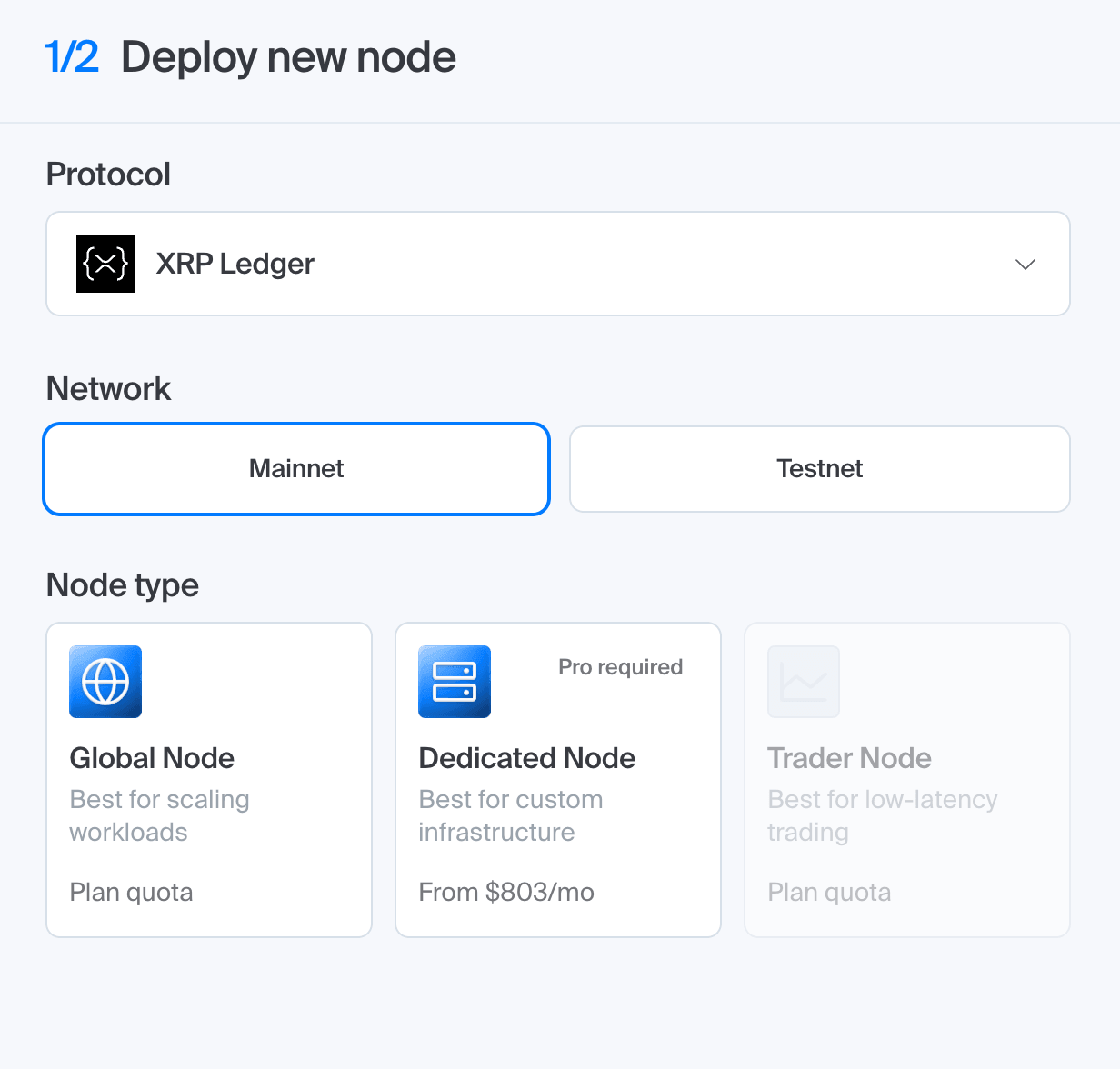
Chainstack added XRP Ledger support in August 2026, covering Mainnet and Testnet across three deployment models:
- Global Nodes — shared, geo-balanced full-mode endpoints over JSON-RPC HTTPS, the fastest way to get a working endpoint.
- Dedicated Nodes — single-tenant
rippled/xrpldinfrastructure, currently listed from $803/month for a Full node (16 vCPU / 64 GB RAM / 200 GB storage) across seven regions. - Self-Hosted — run
xrpldon your own infrastructure with Chainstack’s orchestration layer.
Global and Dedicated nodes run in full mode with a rolling retention window rather than complete history — request something older than the window and you’ll get lgrNotFound. For queries reaching further back, pair your endpoint with a full-history source, or budget for that when planning historical reconciliation. HTTPS JSON-RPC is the integration path to build against today; XRPL’s subscription methods run over WebSocket, which is available on Self-Hosted deployments running xrpld directly.
A minimal read against a live endpoint:
# pip install xrpl-py
from xrpl.clients import JsonRpcClient
from xrpl.models.requests import AccountInfo, ServerInfo
client = JsonRpcClient("YOUR_CHAINSTACK_ENDPOINT")
info = client.request(ServerInfo()).result["info"]
print("rippled", info["build_version"], "| ledgers held:", info["complete_ledgers"])
account = client.request(AccountInfo(
    account="rHb9CJAWyB4rj91VRWn96DkukG4bwdtyTh",  # genesis account
    ledger_index="validated",
)).result["account_data"]
print("balance (drops):", account["Balance"], "| sequence:", account["Sequence"])
Against a public full-history endpoint, that genesis account currently reports a balance of 56,774,125,592 drops at sequence 44,196 — real numbers as of this writing, not placeholders. The full walkthrough, including JavaScript and offline transaction-signing examples, is in Chainstack’s XRP Ledger tooling docs.
How to get an XRP Ledger RPC endpoint on Chainstack

To get an endpoint:
- Create a free account at console.chainstack.com/sign-up — no credit card required.
- Create a new project from the console.
- Select XRP Ledger as the protocol.
- Choose Mainnet or Testnet, and Global or Dedicated.
- Deploy the node — Global Nodes are ready immediately.
- Copy the HTTPS endpoint and credentials from the node’s dashboard page.
🚀 Free tier, no card needed: spin up an XRP Ledger Mainnet or Testnet endpoint on Chainstack’s Developer plan at console.chainstack.com/sign-up and you’ll have a working endpoint in a couple of minutes.
Conclusion
XRP Ledger’s pitch has stayed consistent since 2012 — cheap, fast settlement without mining — while everything built around that core keeps expanding: a native AMM, a fungible-token standard designed for compliance-heavy issuers, an EVM sidechain for teams that want Solidity, and now a regulated stablecoin issued by the same company that once fought the SEC over whether XRP itself was a security. The open questions worth watching are the ones this piece flagged rather than resolved: whether mainnet’s WASM-based Smart Escrows reach production before Xahau’s Hooks ecosystem pulls further ahead on programmability, and how far MPT adoption goes now that issuers have a token model built for compliance from the ground up. Either way, the ledger itself — the part no single company controls — is the piece that’s been running, unglamorously, for fourteen years.
FAQs
Is XRP Ledger the same as Ripple?
No. XRP Ledger is the open, independently validated blockchain; Ripple is a private company that helped start it, holds a large amount of XRP, and contributes code, but doesn’t own or control the network. A separate nonprofit, the XRP Ledger Foundation, also funds development and holds one of the same board seats Ripple does.
Does XRP Ledger support smart contracts?
Not natively on mainnet yet. A WASM-based approach (XLS-100d, “Smart Escrows”) is still at devnet stage. Full EVM-compatible smart contracts exist today, but only on the separate, bridged XRPL EVM Sidechain — not on XRPL mainnet itself.
How fast is XRP Ledger?
Ledgers close roughly every 3 to 5 seconds, and a transaction is effectively final once its ledger validates — there’s no probabilistic confirmation depth to wait out. The base transaction cost is 10 drops (0.00001 XRP).
What is RLUSD?
RLUSD is Ripple’s own stablecoin, launched in December 2024 and issued by a regulated Ripple subsidiary. It’s backed 1:1 by cash and short-duration U.S. Treasuries, and issued natively on both XRP Ledger and Ethereum.
Is the SEC lawsuit against Ripple still ongoing?
No. The case ended in August 2025, when Ripple and the SEC dropped their respective appeals and the Second Circuit formally dismissed them. The original $125 million penalty and the 2023 ruling on institutional versus programmatic XRP sales both stand as the final law of the case.
Additional resources
- XRP Ledger consensus protocol — the primary technical reference for XRPLCP
- XRP Ledger history — the ledger’s own account of its founding
- XRPL Explorer — live Mainnet data, including the current validator registry
- Chainstack’s XRP Ledger tooling docs — curl, Python, and JavaScript examples against a Chainstack endpoint
- Chainstack introduces XRP Ledger support — the original announcement covering deployment options in detail
- XRP Ledger Foundation — the independent nonprofit funding ledger development