


Hyperliquid is a high-performance perps and spot trading L1 with two layers developers actually query: HyperEVM, its EVM-compatible smart contract execution layer, and HyperCore, the native order-book and matching engine. The chain is not slowing down — it currently holds roughly about $7 billion in TVL (DefiLlama, October 2026) and regularly settles billions of dollars of perps volume a day.
2026 is the year the Hyperliquid RPC market actually became a market: Quicknode shipped a HyperCore public beta in January 2026 exposing all seven HyperCore data streams over gRPC, Streams, JSON-RPC, and WebSocket, and multiple aggregators now route Hyperliquid traffic behind a single API. The catch: pricing models diverge sharply enough that the sticker price rarely matches the real bill — method-weighted credit and compute-unit billing can push the effective cost of archive reads or high-frequency polling several multiples above a flat-rate alternative.
This guide compares the six providers worth evaluating for Hyperliquid RPC in 2026, with the actual cost math laid out per method rather than left to marketing pages.
💡 Already using Chainstack? Jump straight to the Hyperliquid tooling docs or deploy your endpoint in minutes.
Why RPC provider choice matters for Hyperliquid
Hyperliquid’s dual-layer design means a provider that’s strong on HyperEVM isn’t automatically strong on HyperCore, and vice versa. Reading order-book depth, fills, and funding rates from HyperCore is a different API surface than calling a smart contract on HyperEVM — some providers cover both, several cover HyperEVM only, and that split matters more here than on a single-layer chain.
Add in how differently providers price the same call, and the true cost of running a Hyperliquid integration can look nothing like the advertised rate. The criteria below separate a production-grade Hyperliquid endpoint from one that will surprise you on the invoice or under load.
- Cost predictability and pricing model — flat request-unit pricing (Chainstack, Dwellir) versus method-weighted compute units or credits (Alchemy, Quicknode, HypeRPC). A workload heavy in HyperCore market-data polling or historical reads pays very differently depending on which model it lands on.
- HyperEVM vs HyperCore coverage — confirm whether a provider actually exposes HyperCore data (order book, fills, funding) or only HyperEVM’s EVM-compatible execution layer. This is the single most consequential Hyperliquid-specific gap between providers.
- Throughput stability under load — RPS ceilings and how they hold up during volatility spikes, when trading bots and market makers poll hardest.
- Archive and historical data access — depth and per-request cost of historical HyperEVM state reads, needed for analytics, backfills, and reconciliation.
- Free-tier reality — a permanent standalone plan (Chainstack, Alchemy, Dwellir) versus a time-limited trial that deactivates afterward (Quicknode’s is 30 days). This matters for prototyping before committing to a subscription.
- Support quality and responsiveness — a community channel with engineers actually answering on the free tier versus docs-only, and what response-time commitment paid tiers add.
- SLA and compliance — published uptime guarantee, SOC 2 Type II and ISO 27001 for teams that need audited attestation, not self-reported claims.
The table below summarizes public positioning as of October 2026.
| Provider | Pricing model | Free tier | Dedicated nodes | HyperEVM / HyperCore | SOC 2 / ISO 27001 |
|---|---|---|---|---|---|
| Chainstack | Flat 1 RU/call (2 RU archive and debug/trace) | Permanent — 3M RU/mo, 25 RPS, no card required | Yes, from $810/mo (testnet); mainnet from $1,489/mo | HyperEVM + 46 HyperCore /info query methods (market-data methods such as l2Book via the public API) | Yes / Yes |
| RouteMesh | Per-request, by key/chain/method | Free community endpoint (reads) | No (routing layer) | HyperEVM | Not published |
| Dwellir | 1 credit per response; shared plans $49–$999/mo; Unlimited Nodes from $119/mo | Permanent — 20 responses/s, 100k responses/day | Yes — Dedicated Node Cluster from $4,000/mo (gRPC + Order Book included) | Both (HyperCore gRPC streaming and Order Book API as add-ons) | Not published |
| HypeRPC | Compute units — $0.50/M CU (EU), $0.75/M CU (JP) (pre-acquisition rate card) | Starter — 10K requests/mo, 5 RPS (pre-acquisition) | Yes | Both | Not published |
| Alchemy | Compute units (method-weighted) | Permanent | No standard dedicated tier | HyperEVM only | Yes / Not published |
| Quicknode | Credits (20 credits/info-endpoint call) | 30-day trial only | Yes — Hybrid Dedicated | Both, all 7 HyperCore streams | Yes / Yes |
Key takeaways from the comparison:
- Chainstack offers a permanent free plan with flat, predictable pricing across HyperEVM and its supported HyperCore /info queries, and full SOC 2 Type II and ISO 27001 certification
- RouteMesh routes across multiple upstream providers rather than running its own nodes — useful for teams that want automatic failover without managing several provider relationships
- HypeRPC is the only Hyperliquid-exclusive specialist here, covering both HyperEVM and HyperCore with dedicated infrastructure
- Alchemy covers HyperEVM only — no HyperCore data — but has the most mature general-purpose EVM tooling
- Quicknode covers all seven HyperCore streams from one unified endpoint but has no permanent free tier and credit-weighted billing
How to choose a Hyperliquid RPC provider
1. Pricing model — flat vs weighted, and what that means at scale
Chainstack bills every Hyperliquid call at a flat 1 RU (2 RU for archive and debug/trace calls). Alchemy, Quicknode, and HypeRPC weight by method — a HyperCore info-endpoint call costs Quicknode 20 credits, while a heavier HyperEVM read like eth_getLogs costs roughly 60 compute units on Alchemy versus roughly 10 for a simple eth_blockNumber call. The formula for comparing them: true cost per call = (method’s CU/credit weight × price per unit) ÷ total units in your plan — multiply by monthly call volume for the real bill. Run your own numbers through the Chainstack cost calculator rather than trusting a headline rate.
| Provider | Unit weight (info/read call) | Effective shape at volume |
|---|---|---|
| Chainstack | 1 RU flat | Predictable — every call costs the same regardless of method |
| HypeRPC | Variable CU by call complexity | $0.50–$0.75 per million CU overage, region-dependent |
| Quicknode | 20 credits (info endpoint) | Heavier for market-data polling than a flat-rate model |
| Alchemy | ~10–60 CU depending on method | Archive/log-heavy calls cost multiples of a simple read |
2. Latency consistency vs. average latency
For trading bots and market makers, tail latency matters more than the advertised average. A provider that’s fast most of the time but spikes during volatility — exactly when Hyperliquid sees its heaviest order flow — will cost more in missed fills than a slightly slower but consistent one. Check compare.chainstack.com for a live, continuously-updated ranking across tracked chains including Hyperliquid, and benchmark p95/p99 response times against your own target region before committing.
3. Archive and historical data access
Analytics, reconciliation, and backfill workloads live on archive access. Confirm depth (how far back), method coverage, and per-request cost before assuming a provider’s archive tier covers your use case — Chainstack prices archive reads at 2 RU versus 1 RU for standard calls, a fixed and known multiplier rather than a variable one.
4. Free-tier reality
Chainstack and Alchemy run permanent free plans with no card required, and Dwellir also has a free plan (100,000 responses per day). HypeRPC’s Starter tier (10K requests/month, 5 RPS) is also standalone. Quicknode’s entry point is explicitly a 30-day trial, not a permanent tier — fine for a quick prototype, less so for an evaluation that runs longer than a month.
5. When dedicated infrastructure matters
Shared endpoints stop being enough once you hit sustained load above the free-tier RPS ceiling, need isolated infrastructure for compliance reasons, or require guaranteed throughput during volatility spikes when every other bot on a shared endpoint is polling just as hard. Dedicated Nodes for Hyperliquid start from $810/month (testnet), scaling to $1,489/month for mainnet archive and $2,037/month for mainnet full nodes; HypeRPC and Quicknode’s Hybrid Dedicated also offer isolated tiers.
6. HyperEVM vs HyperCore coverage
This is the criterion unique to Hyperliquid. If your workload only touches smart contracts, HyperEVM-only coverage (Alchemy) is fine. If you need order-book depth, fills, or funding data, you need a provider that exposes HyperCore specifically. HypeRPC, Quicknode, and Dwellir (through paid add-ons) serve HyperCore market data and streams. Chainstack serves HyperEVM plus 46 HyperCore /info query methods (account and state queries such as clearinghouseState and openOrders), while proprietary market-data methods such as l2Book and recentTrades are only available from Hyperliquid’s public API. RouteMesh currently routes HyperEVM traffic only.
7. Support quality — tiered, not “SLA yes/no”
Chainstack runs community support (Discord and Telegram with engineers active in-channel) on the free Developer plan, standard email response from Growth ($49/mo), and 24/7 Enterprise support with fast SLA-backed response on Enterprise. Verify each competitor’s current tier names and response commitments directly — support-tier structures change more often than headline pricing.
Choose the right Hyperliquid RPC provider by use case
For cost-conscious teams and early-stage builders
Early-stage teams need a free tier that doesn’t expire and a pricing model that stays predictable as usage grows from zero to production. A time-limited trial forces a pricing decision before you have real usage data to base it on.
Chainstack’s permanent Developer plan (3M RU/month, no card) and flat per-call billing make it the easiest to model early and the cheapest to scale without a pricing-model migration later. HypeRPC’s free Starter tier is a reasonable second option if you specifically need HyperCore data from day one.
For trading bots and market makers
Trading infrastructure on Hyperliquid needs both layers — HyperCore for order-book state and fills, HyperEVM for any on-chain settlement logic — with throughput that holds up specifically during the volatility spikes when order flow is heaviest and every competing bot is polling the same endpoint just as hard.
HypeRPC, Quicknode, and Dwellir (gRPC streaming and Order Book API add-ons) expose HyperCore market data alongside HyperEVM, while Chainstack covers HyperEVM and the HyperCore account and state queries. Quicknode’s all-seven-stream gRPC coverage is the broadest from a single unified endpoint; HypeRPC is purpose-built for exactly this workload; Chainstack’s flat pricing keeps the bill predictable even as polling volume climbs during high-volatility periods.
For regulated and enterprise deployments
High-frequency trading and market-making desks that touch Hyperliquid at institutional volume carry compliance obligations most of the providers in this comparison don’t publicly address. Audited certifications, not self-reported security claims, are what a vendor-risk review actually asks for.
Chainstack and Quicknode are the only two providers here with both SOC 2 Type II and ISO 27001 published. HypeRPC, RouteMesh, and Dwellir do not publish either — a real gap worth naming honestly rather than assuming coverage that isn’t documented.
Provider-by-provider breakdown
Chainstack

Chainstack runs Hyperliquid RPC infrastructure covering HyperEVM and 46 HyperCore /info query methods (proprietary market-data methods such as l2Book stay on Hyperliquid’s public API), billed at a flat 1 RU per call (2 RU for archive and debug/trace calls) regardless of method — the same predictable model across all 70+ chains Chainstack supports, not a Hyperliquid-specific exception.
The free Developer plan includes 3M RU/month at 25 RPS with no card required, scaling through Growth ($49/mo, 20M RU, 250 RPS), Pro ($199/mo, 80M RU, 400 RPS), Business ($499/mo, 200M RU, 600 RPS), up to Enterprise (from $990/mo). Dedicated Nodes for Hyperliquid start from $810/month for isolated, unmetered access on testnet, scaling to $1,489–$2,037/month for mainnet. Chainstack also holds SOC 2 Type II and ISO 27001 certification, and a Hyperliquid testnet faucet is available for development.
Limitations: Dedicated Nodes for Hyperliquid sit at a higher entry price ($810/mo testnet, $1,489+/mo mainnet) than the generic Dedicated Nodes baseline on other chains, reflecting the chain’s own infrastructure requirements — worth budgeting for if you know you’ll need isolation early.
Fit by workload:
- Cost-conscious teams: Excellent — a permanent free tier with flat billing across HyperEVM and the supported HyperCore info queries.
- Trading bots: Strong — predictable costs even as polling volume spikes during volatility, though Dedicated Nodes are worth evaluating for latency-critical desks.
- Regulated deployments: Excellent — dual certification and a real SLA give compliance teams something to actually cite.
RouteMesh

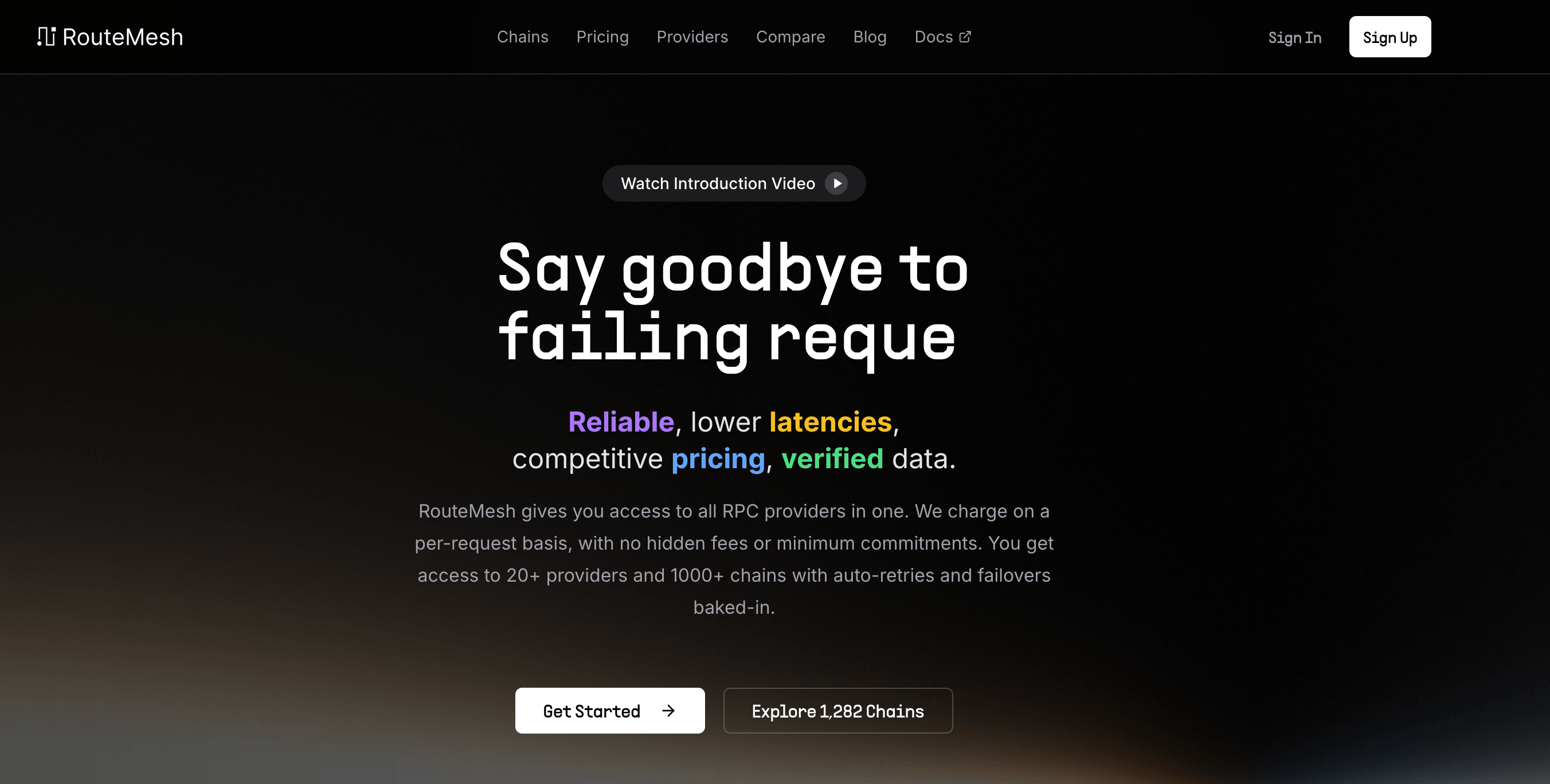
RouteMesh is an RPC aggregation and routing layer rather than a node operator — it routes requests across 10-14 upstream providers per method, including Chainstack, with real-time health scoring and automatic failover. RouteMesh confirms full support for Hyperliquid’s HyperEVM (chain ID 999) among its 1000+ supported chains, with a free community endpoint at lb.routeme.sh/rpc/evm/999.
Pricing is split between the free community endpoint (read requests) and a premium tier priced per request by key type, chain, and method. For teams that want automatic failover across many upstream operators without managing separate provider relationships, that’s the pitch.
Limitations: HyperEVM only — no HyperCore market-data routing currently. No formal SLA; archive depth depends on whichever upstream serves a given request rather than being something you configure directly.
Fit by workload:
- Cost-conscious teams: Good — a free community endpoint covers basic HyperEVM reads.
- Trading bots: Moderate — no HyperCore coverage limits it to the EVM side of a trading stack.
- Regulated deployments: Limited — no published compliance certifications.
Dwellir

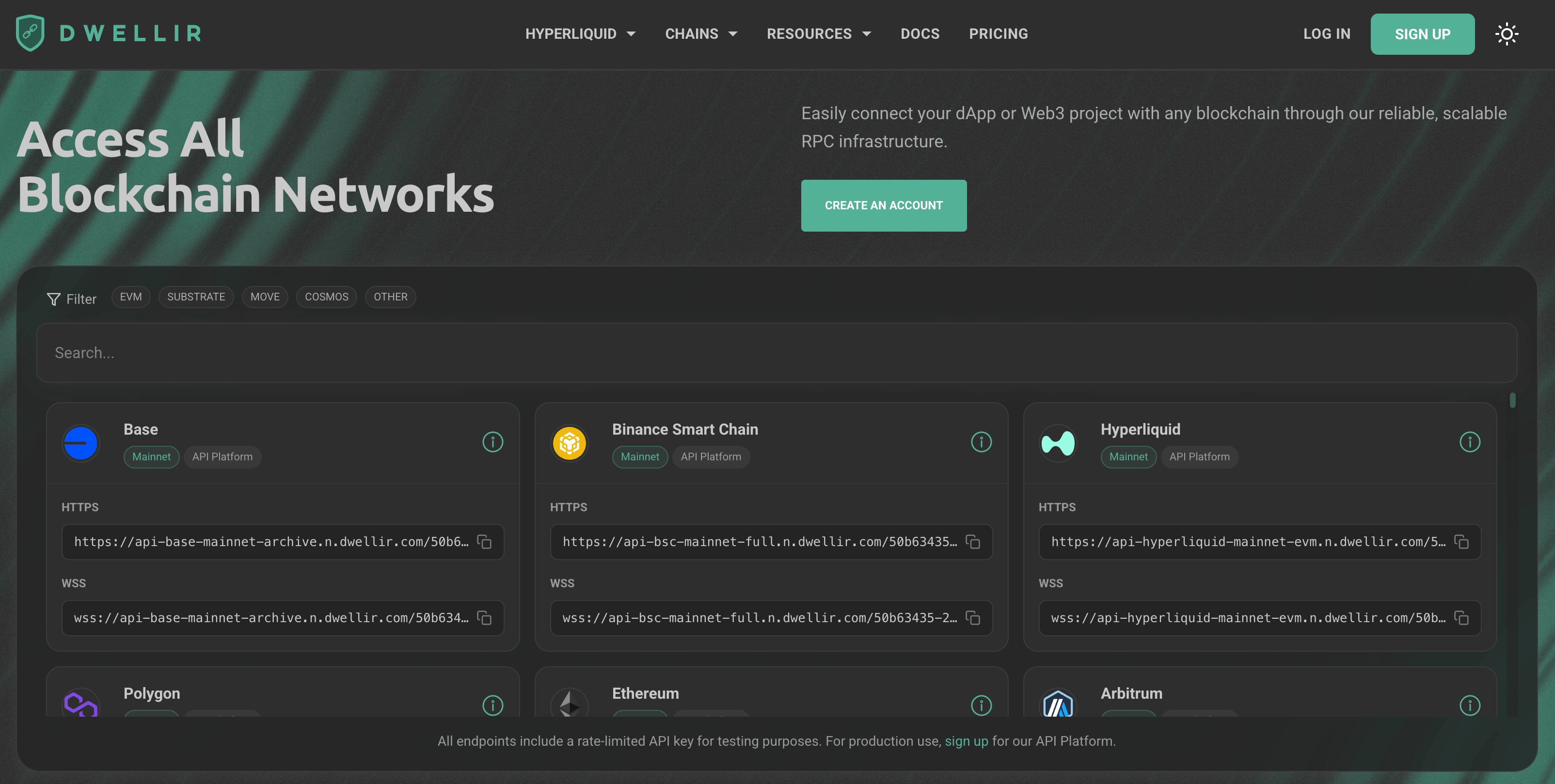
Dwellir is a Swedish RPC provider with a long Polkadot track record that now serves 150+ networks, Hyperliquid among them. On HyperEVM (chain ID 999) it serves HTTPS and WebSocket with the debug and trace namespaces enabled on every API plan. For HyperCore it sells separate products: a gRPC streaming API with raw node feeds and replay (from $299/mo plus usage), an Order Book API for L2, L4, and BBO data (from $199/mo plus usage), and archive node files.
Shared plans bill one credit per response regardless of method: Free covers 20 responses/second and 100,000 responses per day, Developer is $49/mo (25M responses, 100/second), Growth $299/mo (150M, 500/second), and Scale $999/mo (500M, 5,000/second). Unlimited Nodes start at $119/mo flat. A Dedicated Node Cluster for Hyperliquid starts at $4,000/mo, unmetered, with gRPC and the Order Book API included and no usage fees.
Limitations: HyperCore data is an add-on billed on top of the RPC plan, so the real monthly cost depends on how many streams you run. The $4,000/mo cluster entry point is above Chainstack’s mainnet Dedicated Nodes ($1,489–$2,037/mo), although it bundles gRPC and Order Book access. We found no SOC 2 or ISO 27001 attestation on its public pricing and dedicated-cluster pages.
Fit by workload:
- Cost-conscious teams: Good — a permanent free plan and one-credit-per-response billing, but HyperCore add-ons raise the bill once you need streaming or order book data.
- Trading bots: Strong — gRPC streaming with replay and an Order Book API from Singapore and Tokyo cover the HyperCore side directly.
- Regulated deployments: Limited — a 99.99% SLA is offered on dedicated clusters on custom terms, but no audited certification is published.
HypeRPC
HypeRPC, built by Imperator, describes itself as the first dedicated RPC provider for Hyperliquid — shared and dedicated nodes covering both HyperEVM and HyperCore, direct sentry peering with sub-500-microsecond validator connections, and orderbook WebSocket access up to 100 levels of depth. HypeRPC was acquired by Hyperdash in 2026 — pricing below reflects the pre-acquisition public rate card and should be verified directly before committing, since the acquisition may change plans or branding.
Pricing ran on compute units: a free Starter tier (10K requests/month, 5 RPS) for testing, a Professional tier at $99/month (1M requests, 50 RPS), and CU overage at $0.50 per million in the EU region or $0.75 per million in JP.
Limitations: No SOC 2 or ISO 27001 published — a real gap for institutional buyers. Being Hyperliquid-only means no multi-chain fallback if you also need coverage elsewhere.
Fit by workload:
- Cost-conscious teams: Good — a real free tier, though it’s the smallest here (10K requests/month).
- Trading bots: Excellent — direct sentry peering and deep orderbook access are built for exactly this workload.
- Regulated deployments: Limited — no audited certifications to point a compliance review at.
Alchemy

Alchemy’s Hyperliquid support is HyperEVM-only — no HyperCore query routing or dedicated HyperCore infrastructure. For teams building EVM-native contracts and DeFi protocols on HyperEVM specifically, Alchemy’s mature general-purpose tooling (per-method analytics, request tracing) is a familiar option if you already run other chains through it.
Pricing runs on compute units, method-weighted — a simple read like eth_blockNumber costs around 10 CU, while eth_getLogs runs closer to 60 CU. The free tier is permanent, a genuine positive next to Quicknode’s trial-only entry point.
Limitations: No HyperCore access at all rules it out for any workload touching order-book data. No standard dedicated node tier. Alchemy’s per-CU pricing is one of the pricier options in this comparison at meaningful production volume — worth running your own numbers through a cost calculator before committing.
Fit by workload:
- Cost-conscious teams: Moderate — permanent free tier, but CU costs climb fast on heavier methods.
- Trading bots: Limited — no HyperCore means no order-book or fills data at all.
- Regulated deployments: Moderate — SOC 2 Type II published, ISO 27001 is not.
Quicknode


Quicknode is the most feature-complete provider in this comparison for Hyperliquid specifically — its January 2026 HyperCore public beta exposes all seven HyperCore data streams through gRPC, Streams, JSON-RPC, and WebSocket from a single endpoint that also serves HyperEVM. For teams that want every available data surface from one provider, that’s a real advantage.
Billing is credit-based: all supported /info endpoint methods cost 20 credits per request, and gRPC streaming bills at 10 credits per 0.1 MB of filtered data. Paid plans run from $49/month up to $999/month for the highest non-custom tier.
Limitations: No permanent free tier — the entry point is a 30-day trial, not a standalone plan. Method-weighted credit billing can surprise teams once HyperCore streaming or heavy market-data polling enters the mix — worth modeling before committing to a tier.
Fit by workload:
- Cost-conscious teams: Limited — no permanent free plan to prototype against.
- Trading bots: Excellent — all seven HyperCore streams over gRPC from the same endpoint that serves HyperEVM.
- Regulated deployments: Strong — both SOC 2 Type II and ISO 27001 published.
Getting started with Hyperliquid on Chainstack
Deploy a production Hyperliquid endpoint in a few steps and build better with Hyperliquid on Chainstack:

- Log in to the Chainstack console (or create an account).
- Create a new project
- Select Hyperliquid as your blockchain protocol
- Choose network: Hyperliquid Mainnet or Testnet
- Deploy the node
- Open Access and credentials and copy your HTTPS and WebSocket endpoints
For latency-critical trading workloads, evaluate Dedicated Nodes after the initial deploy — available inside the same project.
import { InfoClient, HttpTransport } from "@nktkas/hyperliquid";

const transport = new HttpTransport({ url: "YOUR_CHAINSTACK_ENDPOINT" });
const info = new InfoClient({ transport });

// Fetch perp market metadata from HyperCore (an /info method Chainstack serves)
const meta = await info.meta();

console.log(meta);
📖 For the full integration guide, see the Chainstack Hyperliquid tooling documentation.
Need testnet funds? Grab some from the Chainstack Hyperliquid faucet.
🤖 You can also access Chainstack Hyperliquid RPC directly from Claude, Cursor, Codex, Windsurf, Gemini CLI, GitHub Copilot, Antigravity, Claude.ai, or ChatGPT using Chainstack MCP. For a fuller agent stack, see the Chainstack Agents page.
Conclusion
The Hyperliquid RPC market split cleanly in 2026 along two axes: whether a provider covers HyperCore alongside HyperEVM, and whether its pricing stays flat as usage grows or weights by method. Those two questions, more than brand recognition, decide which provider actually fits a given workload.
- Cost-conscious teams and prototypes → Chainstack’s permanent free tier and flat billing
- Trading bots and market makers needing full HyperCore depth → Quicknode, Dwellir, or HypeRPC
- Regulated or institutional deployments → Chainstack or Quicknode, the only two with both SOC 2 Type II and ISO 27001 published
- HyperEVM-only DeFi and contract workloads → Alchemy, if already standardized on it for other chains
FAQ
Q: What’s the difference between HyperEVM and HyperCore RPC access?
HyperEVM is Hyperliquid’s EVM-compatible smart contract layer — standard eth_* JSON-RPC methods apply. HyperCore is the native order-book and matching engine, queried through a separate /info API for market data, fills, and funding rates. Some providers (Alchemy) cover HyperEVM only; others (HypeRPC, Quicknode, Dwellir) cover both, and Chainstack covers HyperEVM plus a subset of HyperCore /info queries.
Q: Which Hyperliquid RPC provider has the best free tier?
Chainstack’s Developer plan (3M RU/month, 25 RPS, no card required) and Dwellir’s Free plan (100,000 responses per day, about 3M a month) are the largest permanent free tiers here; Chainstack’s covers HyperEVM and the supported HyperCore info queries, while Dwellir sells HyperCore streaming as paid add-ons. HypeRPC’s free Starter tier was smaller (10K requests/month, pre-acquisition) but Hyperliquid-specific. Quicknode’s entry point is a 30-day trial, not a permanent free plan.
Q: How do I migrate from a public Hyperliquid RPC endpoint to a managed provider?
Deploy a node with your chosen provider, copy the new HTTPS/WebSocket endpoint, and swap it into your existing SDK configuration — the API surface is the same. Test against testnet first using the Chainstack Hyperliquid faucet before cutting over production traffic.
Q: What latency should I expect from a Hyperliquid RPC provider?
This varies by region and provider, and averages hide the tail latency that matters most for trading. Check compare.chainstack.com for live rankings, and benchmark p95/p99 response times from your own target region rather than relying on a single average figure.
Q: Do Hyperliquid RPC providers publish security certifications?
Chainstack and Quicknode both publish SOC 2 Type II and ISO 27001. Alchemy publishes SOC 2 Type II but not ISO 27001. HypeRPC, RouteMesh, and Dwellir do not publish either certification.
Q: Is flat-rate or credit-based pricing cheaper for Hyperliquid RPC?
It depends on your method mix. Flat-rate billing (Chainstack, Dwellir) is more predictable and often cheaper for archive-heavy or high-volume polling workloads, since method-weighted models (Alchemy, Quicknode, HypeRPC) charge multiples of a base rate for heavier calls. Run your actual call mix through the Chainstack cost calculator to see the real number for your workload.