


Introduction
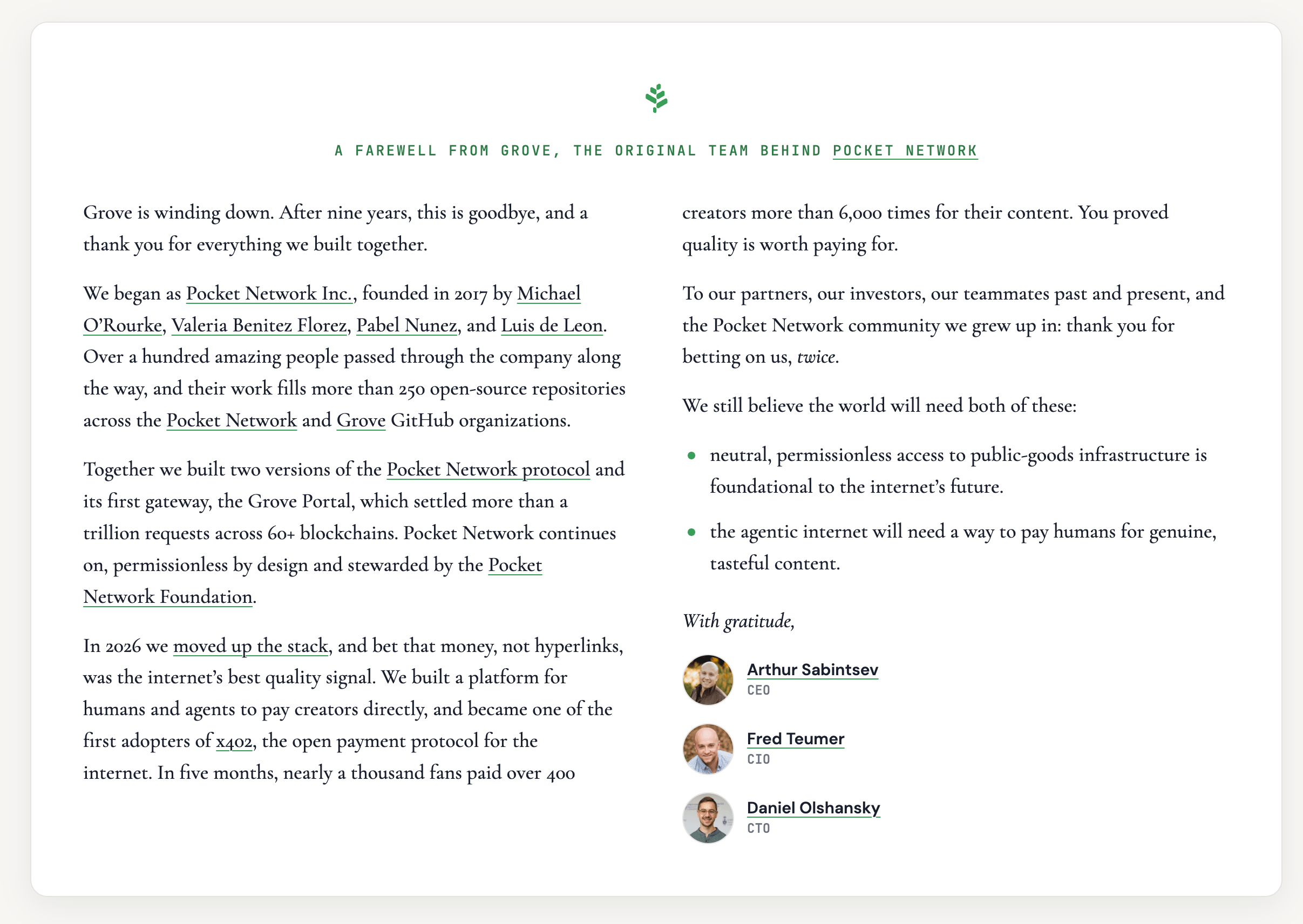
Grove — originally Pocket Network Inc., founded in 2017 by Michael O’Rourke, Valeria Benitez Florez, Pabel Nunez, and Luis Correa de Leon — has wound down after nine years. The Grove Portal settled more than a trillion requests across 60+ blockchains during its run. Now the rpc.grove.city and docs.grove.city domains no longer resolve, paid customers were migrated to the free Pocket Network Foundation endpoints at api.pocket.network starting November 2025, and in July 2026 Grove the company published its farewell note.
Two groups of teams are affected — and the fix looks slightly different depending on which one you’re in:
- Apps still calling
https://<chain>.rpc.grove.city/v1/<app-id>— these endpoints are offline. Your calls are throwing DNS errors right now, and you need a new provider before anything else works. - Apps that followed Grove’s redirect to
api.pocket.network— these calls still respond, but you’re on the free Pocket Foundation’s shared, rate-limited public endpoints with no SLA. Fine for prototyping; not what you want as the read path for a production dApp.
This guide is for teams in either bucket making the move to a dedicated RPC provider. It walks through the endpoint swap, the one code change you actually need (authentication), the chain mapping, and the validation you should do before decommissioning anything. The official Chainstack migration doc is the canonical reference; this article covers the same ground with the context and the trade-off calls Chainstack has run into with teams moving off Grove.
What actually happened

The Grove wind-down happened in two stages, and understanding which stage affected you changes what you need to do.
November 2025 — the gateway wind-down. Grove announced it was stepping away from operating the Grove Portal and moving up the stack. This came right after two protocol milestones: the Shannon upgrade shipped June 3, 2025, and PATH 1.0 — the reference gateway implementation — reached its milestone on November 4, 2025, enabling anyone to launch a permissionless Pocket gateway. Paid and public traffic migrated to new public endpoints hosted at api.pocket.network, managed by the Pocket Network Foundation with round-robin load balancing across PNF and community gateways (DevDAO Cloud, Pokt.ai, Stakenodes). The handoff was orderly — same JSON-RPC methods, same chain coverage, host swap only.
2026 — the pivot and the closure. Grove used the freed-up team to build a creator-payments platform on the x402 protocol, which ran for five months and settled ~6,000 payments from about 1,000 fans to 400 creators. In July 2026, the company published a farewell note and closed. The rpc.grove.city and docs.grove.city subdomains stopped resolving.
If your code still has rpc.grove.city URLs, you already know because your app is throwing DNS errors. If you followed the November redirect to api.pocket.network, your calls still work — Pocket Network itself continues under the PNF as a non-profit, and the Foundation runs the public endpoints as part of its F-Chains “public good” program with routing across 5,000+ independent supplier nodes. But you are now on shared, unmetered infrastructure with no dedicated capacity, no isolation, and no support contract. That is the exact reason most teams move to a paid provider even when the free path still resolves.
What migration actually looks like
For most Grove users, the migration is a one-line URL swap. Both Grove and Chainstack speak standard JSON-RPC over HTTPS. The methods and responses are identical. The one meaningful code change is authentication.
Grove endpoints were open. No key, or an optional app-id in the URL path (https://eth.rpc.grove.city/v1/YOUR_APP_ID). Anyone with the URL could call them. The current Pocket Foundation successor endpoints follow a similar open pattern with a chain subdomain (https://eth.api.pocket.network) — also key-free.
Chainstack endpoints authenticate every request. The default method is an auth token embedded directly in the endpoint URL. You copy the full HTTPS endpoint from the Chainstack console and use it as-is — no separate Authorization header, no query parameter to add, no code changes beyond the URL itself.
In practice:
// ethers.js — before (Grove, retired)
const provider = new ethers.JsonRpcProvider(
  "https://eth.rpc.grove.city/v1/YOUR_APP_ID"
);

// ethers.js — after (Chainstack)
const provider = new ethers.JsonRpcProvider(
  "YOUR_CHAINSTACK_ENDPOINT"
);

const block = await provider.getBlockNumber();
console.log(`Current block: ${block}`);
Same pattern in Python:
from web3 import Web3

# Before — Grove (retired)
# web3 = Web3(Web3.HTTPProvider("https://eth.rpc.grove.city/v1/YOUR_APP_ID"))

# After — Chainstack
web3 = Web3(Web3.HTTPProvider("YOUR_CHAINSTACK_ENDPOINT"))

print(f"Current block: {web3.eth.block_number}")
Non-EVM chains work the same way. On Solana, you point your client at the Chainstack Solana endpoint and keep calling the standard Solana JSON-RPC methods. On Sui or TRON — the pattern is identical, only the RPC surface changes.
If you need something other than URL-embedded auth — basic auth for infrastructure that can’t carry secrets in URLs, the Chainstack Platform API key for programmatic node management, or the gRPC x-token for streaming workloads — see Authentication methods. Most teams start with the default and never revisit it.
The fastest migration path: AI agent
Before the manual steps: if you use Claude Code, Codex CLI, Cursor, Windsurf, Gemini CLI, Antigravity, or any other agentic coding tool, the fastest migration is to let the agent do it. Chainstack publishes a runbook for exactly this. Paste the following into your agent and approve the plan it generates:
get docs.chainstack.com/docs/migrate-to-chainstack-with-ai.md
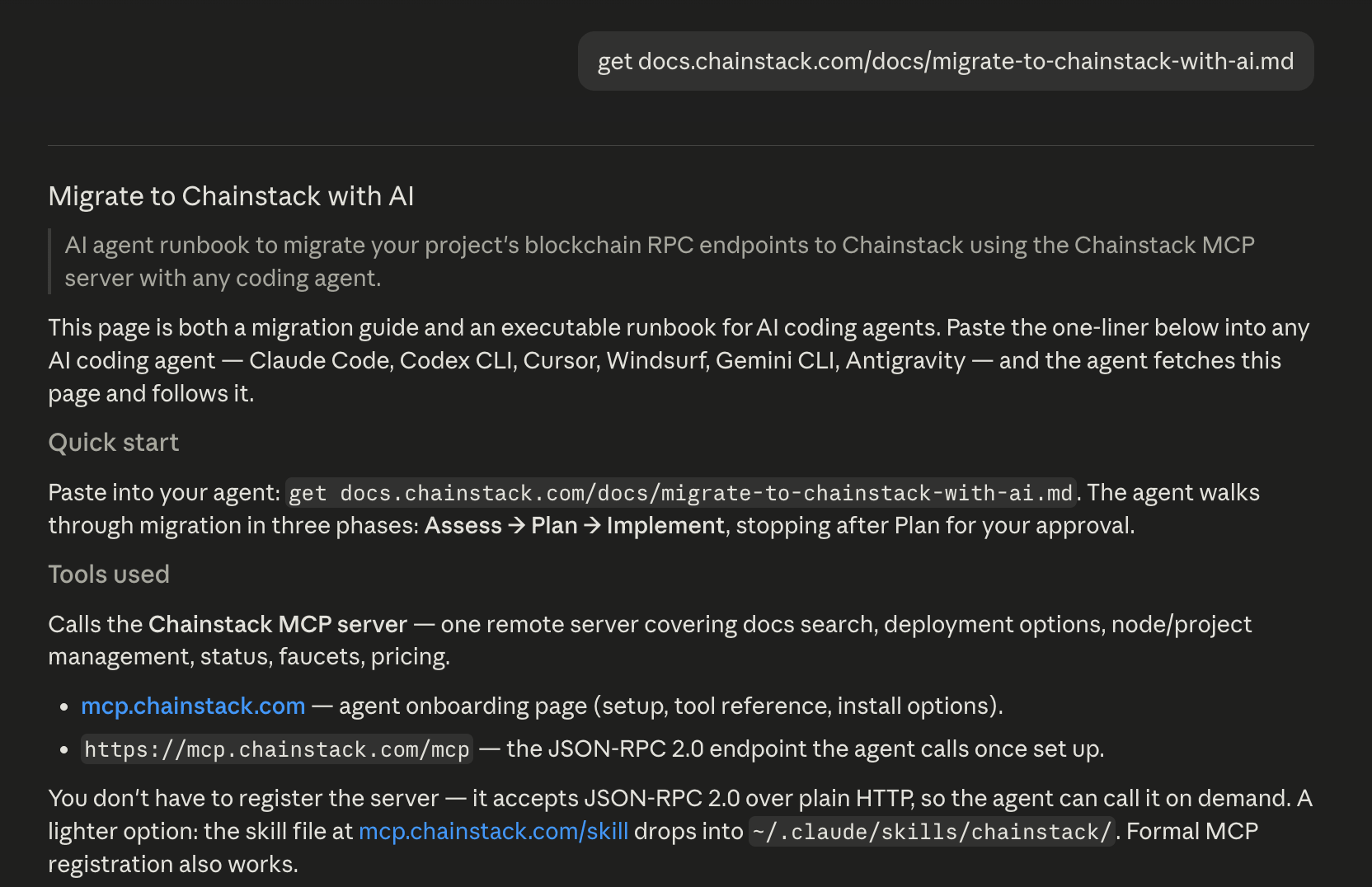
The agent scans your codebase for Grove endpoints (and any other RPC URLs), checks coverage against Chainstack, plans the swap, and executes after you approve. It uses the Chainstack MCP server for live deployment options and pricing. Full details in the migrate to Chainstack with AI guide. The manual steps below are for teams that prefer to migrate by hand or want to understand what the agent is doing.
Chain mapping
Every chain Grove supported that Chainstack also supports maps directly. The subdomain in your Grove URL tells you what to look for:
| Grove subdomain | Chainstack protocol |
|---|---|
eth | Ethereum |
base | Base |
arb-one | Arbitrum |
op | Optimism |
poly | Polygon |
bsc | BNB Smart Chain |
avax | Avalanche |
gnosis | Gnosis Chain |
linea | Linea |
scroll | Scroll |
sonic | Sonic |
opbnb | opBNB |
harmony | Harmony |
kaia | Kaia (ex. Klaytn) |
solana | Solana |
sui | Sui |
tron | TRON |
Chainstack supports 70+ chains total, so if you were on Grove for a subset of these, this is also a chance to consolidate other RPC infrastructure onto a single provider. The protocols and networks page is the authoritative current list.
Two edge cases worth flagging. If you were using Grove for a chain not on this table — some of the more experimental Cosmos SDK chains, or something added to Pocket recently — check the Chainstack list first; if it is not there, it may still be available as a dedicated deployment via Chainstack sales. And if your app was using an app-id-per-chain pattern on Grove (one Portal application, many chain endpoints), that maps to one Chainstack project with multiple nodes — same organizational shape, different terminology.
Picking your Chainstack node type
Grove Portal was effectively one product. Chainstack has four, and picking the right one is where teams either overthink or underthink the migration.
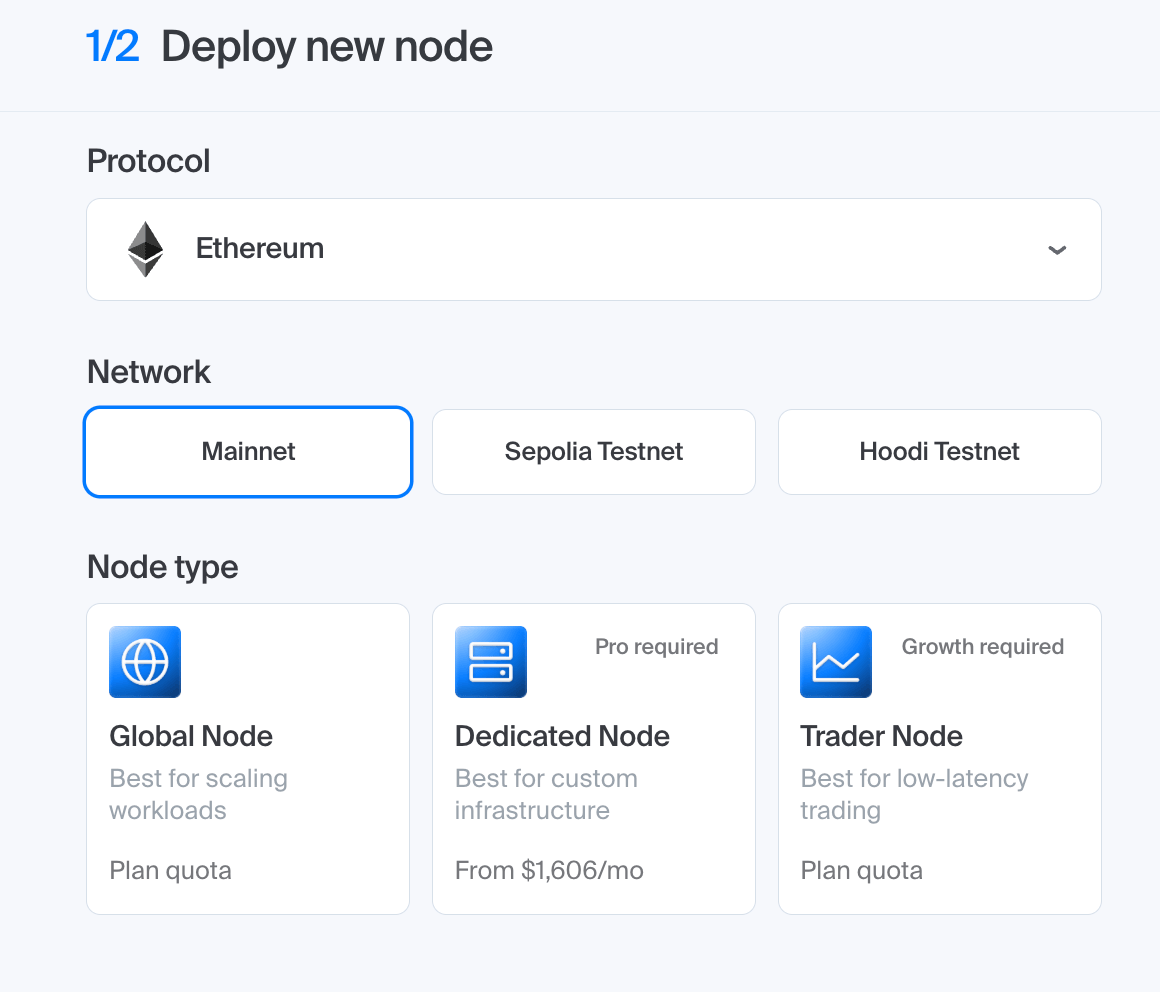
The right default for most Grove users is a Global Node (docs) — load-balanced, routes requests to the nearest healthy region, covers standard queries for standard workloads. This is the closest analog to what Grove Portal gave you: a URL, geographic redundancy behind it, no capacity planning required. Most Grove migrations land here.
You need a different node type when your workload has specific characteristics:
- Predictable high steady traffic → Global Node with the Unlimited Node add-on. Flat monthly fee at a fixed RPS tier. This is what you want if you know your traffic profile and want to lock in cost.
- Isolation, compliance, or dedicated capacity → Dedicated Node (docs). Exclusive infrastructure, archive mode, full debug/trace. If Grove’s shared model was already borderline for your compliance posture, Dedicated is the direct upgrade.
- Trading and latency-critical workloads → Trader Node with the Warp transactions add-on. Regional low-latency endpoints, direct-to-leader landing on Solana, Ethereum, and BNB Smart Chain.
- Nodes on your own infrastructure → Chainstack Self-Hosted. Your hardware, your data, with a Kubernetes-native control plane on top. Right choice if compliance requires nodes on your own hardware.
Start with a Global Node unless you have a clear reason not to. The other options are not upgrades — they are different, for specific workload shapes.
Migrating
The mechanics, in order:
1. Create a Chainstack account and deploy a node. Sign up with your GitHub, X, Google, or Microsoft account — no credit card required for the free tier. Create a project, then deploy a Global Node for the chain you are migrating first.

2. Copy the endpoint. Open the node’s Access and credentials tab and copy the HTTPS endpoint. The auth token is already in the URL — no separate configuration needed.


3. Swap the URL in your code. The cleanest way is via environment variables, if you are not already using them. Replace the Grove URL with the Chainstack endpoint:
# Before
ETH_RPC_URL=https://eth.rpc.grove.city/v1/YOUR_APP_ID
# After
ETH_RPC_URL=YOUR_CHAINSTACK_ENDPOINT
If you have hardcoded URLs in config files (hardhat.config.js, foundry.toml, Docker files), this is a good moment to move them to env vars while you are here. The next migration you do — provider or otherwise — will be minutes instead of hours.
4. Test the actual methods your code uses. Not just eth_blockNumber — the specific calls your application depends on. For a straightforward dApp that is standard reads and writes. For an indexer, archive queries and log range calls. For a trading bot, transaction submission latency under real conditions. The debug and trace APIs reference covers what’s available where.
curl -X POST \
  -H "Content-Type: application/json" \
  --data '{"jsonrpc":"2.0","method":"eth_blockNumber","params":[],"id":1}' \
  YOUR_CHAINSTACK_ENDPOINT
5. Run parallel for at least 24 hours before decommissioning anything. If you were on the free api.pocket.network endpoints, keep them as a fallback until you are confident. If you were on paid Grove that is now offline, this step is moot — you are already on the new endpoint by necessity. Chainstack’s dashboard shows request counts, error rates, and latency per node — monitor for the first day before turning off the old path.
What Chainstack adds that you did not have on Grove
Grove was a solid decentralized gateway with a clean developer experience. The switch to Chainstack adds a few things that only start to matter once you have real production traffic:
- Dedicated capacity. Grove Portal was multi-tenant across a decentralized supplier network. Chainstack Global Nodes are load-balanced but the capacity is yours to allocate — you are not competing with other users’ traffic bursts for QoS.
- Higher rate limits and burst tolerance. Free tiers on shared infrastructure have hard ceilings that get hit at exactly the wrong moment. Paid Chainstack plans scale linearly, and the Unlimited Node add-on removes per-request accounting entirely at an RPS-tiered flat fee.
- Archive and debug/trace on paid plans. Not just
eth_getBalanceat any block, but the fulldebug_*andtrace_*namespaces on Ethereum, Polygon Erigon, and the other chains where they are meaningful. - Direct support. If a chain has an incident or a new fork introduces breaking behavior, you have someone to open a ticket with rather than watching community channels.
- 1 Request Unit per full call, 2 per archive. Flat billing across all methods — no per-method credit multipliers. Compared to providers charging 20 credits per EVM request and 40 on Solana, this is the difference that changes the shape of your monthly bill. Run your own numbers on the interactive pricing calculator.
None of these matter for a hobby project. All of them start mattering the moment you have paying users or a business that depends on the read path staying up.
Common issues during migration
A few things that come up more often than they should:
| Issue | Cause | Fix |
|---|---|---|
401 Unauthorized | You added an Authorization header thinking Chainstack works like Grove-with-an-app-id. Chainstack embeds the auth token in the URL, not a header. | Remove the Authorization header and copy the full endpoint URL from the node access details page. |
| Archive queries returning errors | You are hitting a Global Node without archive access. | Upgrade to a plan with archive support, or deploy a Dedicated Node in archive mode for the chain you need. See features availability for per-plan coverage. |
debug_traceTransaction not supported | Debug and trace on Global Nodes require a paid plan. Free Developer tier does not expose these methods. | Upgrade to at least Growth if your prototype depends on debug_* or trace_* namespaces. |
| WebSocket disconnects | Long-lived connections drop occasionally on every provider — not Chainstack-specific. | Add reconnect logic with exponential backoff to your WSS client. Standard practice regardless of provider. |
| Method not found on Solana | Some Solana methods require specific node configurations (Trader Node, Yellowstone gRPC, or specific plan). | Search the Chainstack docs for the exact method name to confirm required node type. |
When Chainstack is not the right answer
A few honest cases where the migration is not a straightforward win:
- Your workload is dominated by light reads under any free tier. At very low volumes, every provider has a free plan and the pricing-model differences do not matter. Pick the developer experience you prefer.
- You need decentralization as a hard architectural requirement. If your product’s positioning depends on being served by a decentralized supplier network — some governance tools, some pro-decentralization dApps — the Pocket Network Foundation’s free
api.pocket.networkendpoints or a self-hosted Pocket gateway via PATH may be a better fit than any centralized provider, Chainstack included. For higher throughput on the decentralized path, Pocket also offers application staking — stake POKT on-chain for dedicated access proportional to your stake. - You want to run your own infrastructure. Chainstack Self-Hosted is the middle ground — your infrastructure, your data, with a Kubernetes-native control plane on top. Worth looking at if your compliance team wants nodes on your own hardware. For a full DIY vs managed comparison, see DIY vs Chainstack Self-Hosted.
Conclusion
Nine years, more than a trillion requests, an orderly two-stage wind-down. The Grove closure was as clean as these things get in Web3 — a documented handoff to Pocket Network Foundation endpoints, months of transition, and a clear final note. Most teams affected have already made a move. The remaining decision is whether the api.pocket.network free endpoints are enough for your workload, or whether you want dedicated capacity, higher throughput, archive access, and support.
The Chainstack migration itself is one line. Copy the endpoint from the console, swap the URL in your code, run a validation pass, and decommission the old configuration. If you use an AI coding agent — Claude Code, Codex, Cursor, Windsurf — the migrate to Chainstack with AI runbook does the endpoint discovery and swap for you.
FAQ
rpc.grove.city endpoints stopped resolving in July 2026 when Grove closed. If your code still points at them, calls are failing with DNS errors. api.pocket.network public endpoints continue to work under the Pocket Network Foundation, but they are free, shared, and load-balanced across community gateways with no SLA.
For a straightforward URL swap, most teams complete the code change in under an hour and validate over the next day or two. If you use an AI coding agent to discover and swap endpoints, the code change is minutes; the validation window is the same.
No. Grove and Chainstack both expose standard JSON-RPC. Every method your Grove code called works on Chainstack with the same signature and response format. The only code difference is authentication, and that is handled entirely by the URL.
Chainstack’s auth token is already embedded in the endpoint URL you copy from the console — same URL-in-path pattern, different token format. Remove the Grove app-id from your URLs and replace the entire endpoint with the Chainstack one.
Global Node for most workloads — load-balanced, geo-routed, closest analog to Grove Portal. Dedicated Node if you need isolation, guaranteed capacity, or the full debug/trace namespace. Trader Node if you are running latency-sensitive trading workloads. Unlimited Node add-on if you want a flat monthly fee at a fixed RPS tier instead of per-request accounting.
No. Pocket Network is the underlying decentralized RPC protocol, run by the Pocket Network Foundation. Grove was the first gateway built on top of it, operated by a separate company (originally Pocket Network Inc., renamed Grove). The protocol continues; the gateway is retired. Free api.pocket.network endpoints are run directly by the Foundation.
Yes. Some teams keep api.pocket.network as a fallback path for non-critical reads while running production traffic through Chainstack. On EVM chains, eRPC or a similar client-side router can split traffic by method or fail over between the two. For non-EVM chains, you would need to handle the fallback in application code.
Related reading
Canonical references
- Official Chainstack Grove migration docs
- Migrate to Chainstack with AI agent
- Authentication methods
- Protocols and networks
Other migration guides
- How to migrate your blockchain RPC endpoints to Chainstack — general migration guide
- How to migrate from GCP Blockchain Engine to Chainstack — Google Cloud sunset migration
- Chainstack vs Quicknode
- Chainstack vs Alchemy
Pocket Network / Grove background
- Grove’s Next Chapter (Nov 2025) — the original wind-down announcement
- Pocket Network Foundation — successor operator of
api.pocket.network - Pocket Network roadmap — where the protocol goes from here
- Grove farewell note — the closing statement